anaheim-gazette 1926-01-28
Scanned page
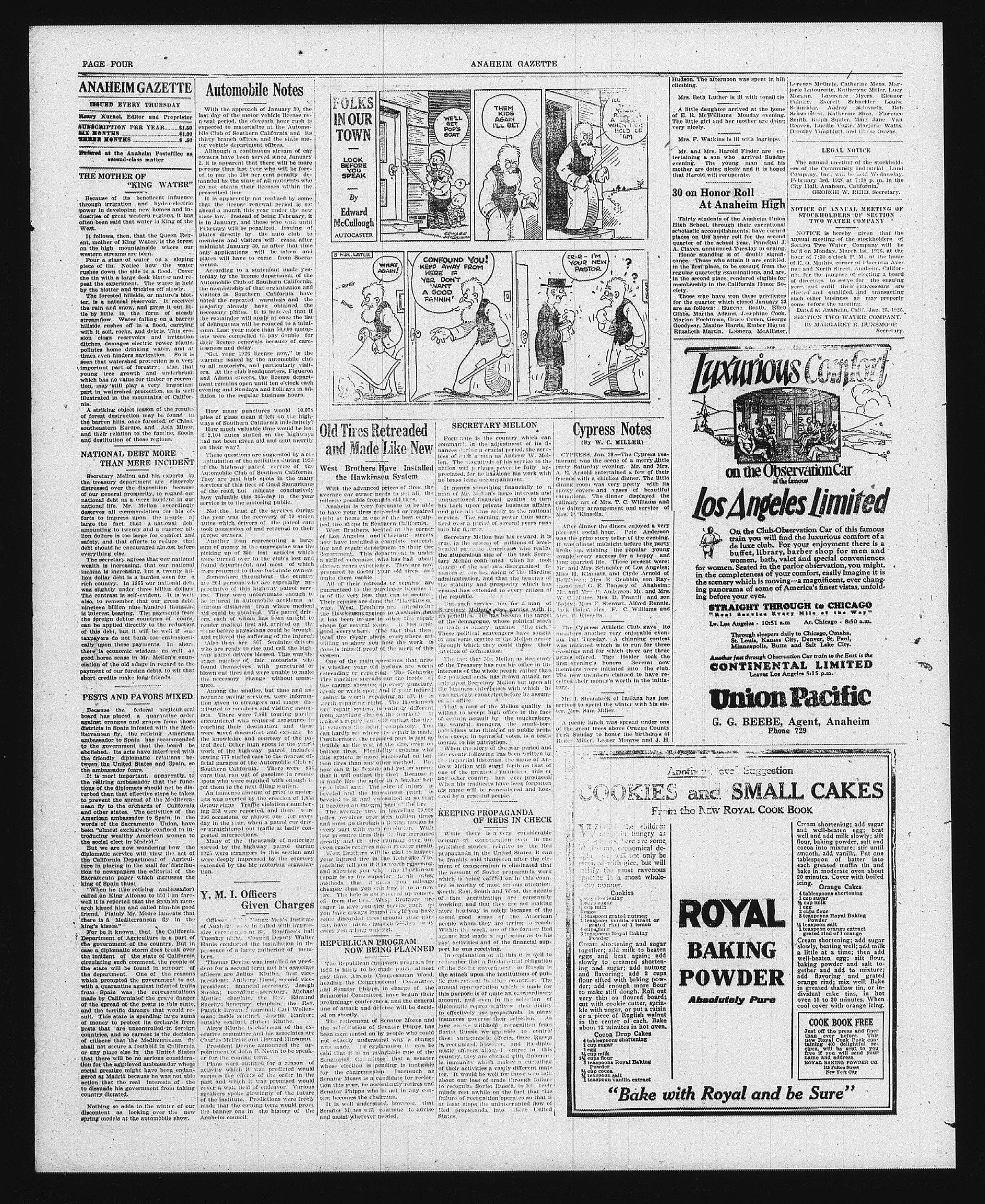
Searchable text
ANAHEIM GAZETTE
ISSUED EVERY THURSDAY
Henry Kuchel, Editor and Proprietor
SUBSCRIPTION PER YEAR.....$1.50
SIX MONTHS.....$1.00
THREE MONTHS.....$ .50
Furred at the Anaheim Postoffice as second-class matter
THE MOTHER OF "KING WATER"
Because of its beneficent influence through irrigation and hydro-electric power in developing new homes and industries of great western regions, it has often been said that water is King of the West.
It follows, then, that the Queen Regent, mother of King Water, is the forest on the high mountainside where our western streams are born.
Pour a glass of water on a sloping piece of tin. Notice how the water rushes down the side in a flood. Cover the tin with a large desk blotter and repeat the experiment. The water is held by the blotter and trickles off slowly.
The forested hillside, or nature's blotter, is a natural reservoir. It receives the rain and snow, and gives it out little by little in the form of steady streamflow. Water falling on a barren hillside rushes off in a flood, carrying with it soil, rocks, and debris. This erosion clogs reservoirs and irrigation ditches, damages electric power plants, pollutes home drinking water, and at times even hinders navigation. So it is seen that watershed protection is a very important part of forestry; also, that young tree growth and underbrush which has no value for timber or recreation, may still play a very important part in watershed protection, as is well illustrated in the mountains of California.
A striking object lesson of the results of forest destruction may be found in the barren hills, once forested, of China, southeastern Europe, and Asia Minor, and their relation to the famine, floods, and destitution of those regions.
Automobile Notes
With the approach of January 30, the last day of the motor vehicle license renewal period, the eleventh hour rush is expected to materialize at the Automobile Club of Southern California and its thirty branch offices, and the state motor vehicle department offices.
Although a continuous stream of car owners have been served since January 2, it is apparent that there will be more persons than last year who will be forced to pay the 100 per cent penalty demanded by the state of all motorists who do not obtain their licenses within the prescribed time.
It is apparently not realized by some that the license renewal period is set ahead a month this year under the new state law. Instead of being February, it is in January, and those who wait until February will be penalized. Issuing of plates directly by the auto club to members and visitors will cease after midnight January 30, as after that time only applications will be taken and plates will have to come from Sacramento.
According to a statement made yesterday by the license department of the Automobile Club of Southern California, the membership of that organization and visitors in Southern California have noted the repeated warnings and the majority already have obtained the necessary plates. It is believed that if the remainder will apply at once the list of delinquents will be reduced to a minimum. Last year more than 50,000 motorists were compelled to pay double for their license renewals because of carelessness and delay.
"Get your 1926 license now," is the warning issued by the automobile club to all motorists, and particularly visitors. At the club headquarters, Figueron and Adams streets, the license department remains open until ten o'clock each evening and Sundays and holidays in addition to the regular business hours.
How many punctures would 10,078 piles of glass mean if left on the highways of Southern California indelibly?
How much valuable time would be lost if 2,104 autos stalled on the highways and not been given aid and sent merrily on their way?
NATIONAL DEBT MORE THAN MERE INCIDENT
Secretary Mellon and his experts in the treasury department are sincerely distressed over the disposition because of our general prosperity, to regard our national debt as a mere incident in our national life. Mr. Mellon accordingly deserves all commendation for his efforts to impress upon the people large the fact that a national debt amounting to twenty and a quarter billion dollars is too large for comfort and safety, and that efforts to reduce that debt should be encouraged almost before everything else.
The secretary agrees that our national wealth is increasing, that our national income is increasing, but a twenty billion dollar debt is a burden even for a rich country. In 1865 our national debt was slightly under three billion dollars. The contrast is self-evident. It is well also, to remember that our gross debt nineteen billion nine hundred thousand is interest bearing. The payments from the foreign debtor countries of course can be applied directly to the reduction of this debt, but it will be well if our taxpayers do not bank too enthusiastically upon those payments. In short, there is economic wisdom as well as good horse sense in Mr. Mellon's enunciation of the old adage in regard to the payment of our foreign debts, to wit that short credits make long friends.
PESTS AND FAVORS MIXED
Because the federal horizicultural board has placed a quarantine order against oranges and grapes from those districts in Spain infested with the Mediterranean fly, the retiring American ambassador to Spain has recommended to the government that the board be abolished. Its acts have interfered with the friendly diplomatic relations between the United States and Spain, so the ambassador fears.
It is most important, apparently, to the retiring ambassador that the functions of the diplomats should not be disturbed than that effective steps be taken to prevent the spread of the Mediterranean fly to the orchards of California and other states. The activities of the American ambassador to Spain, in the words of the Sacramento Union, have been "almost exclusively confined to introducing wealthy American women to the social elect in Madrid."
But we are now wondering how the times even hinders navigation. So it is seen that watershed protection is a very important part of forestry; also, that young tree growth and underbrush which has no value for timber or recreation, nay still play a very important part in watershed protection, as is well illustrated in the mountains of California.
A striking object lesson of the results of forest destruction may be found in the barren hills, once forested, of China southeastern Europe, and Asia Minor, and their relation to the famine, floods, and destitution of those regions.
How many punctures would 10,078 piles of glass mean if left on the highways of Southern California indelibly?
How much valuable time would be lost if 2,104 autos stalled on the highways and not been given aid and sent merrily on their way?
These questions are suggested by a recapitulation of the activities during 1923 of the highway patrol service of the Automobile Club of Southern California. They are just high spots in the many services of this fleet of Good Samaritans of the road, but indicate conclusively how valuable this 365-day in the year service is to the motoring public.
Not the least of the services during the year was the recovery of 79 stolen autos which drivers of the patrol cars took possession of and returned to their proper owners.
Another item representing a large sum of money in the aggregate was the picking up of 350 lost articles which were turned over to the club's lost and found department, and most of which were returned to their fortunate owners.
Somewhere throughout the country are 204 persons who are especially appreciative of this highway patrol service. They were unfortunate enough to be injured in automobile accidents at various distances from where medical aid could be obtained. The patrol drivers, each of whom has been taught to render medical first aid, arrived on the scene before physicians could be brought and relieved the suffering of the injured. Also there are 867 feminine drivers who are ready to rise and call the highway patrol drivers blessed. This was the exact number of fair motorists who found themselves with punctured or blown out tires and were unable to make the necessary change without assistance.
Among the smaller, but time and annoyance saving services, were information given to strangers and maps distributed to members and visiting motorists. There were 7,861 touring parties encountered who required assistance in reaching their destination and these were saved discomfort and expense by the knowledge and courtesy of the patrol fleet. Other high spots in the year's work of the highway patrol included 777 stalled cars to the nearest official garage of the Automobile Club of Southern California. There were 834 cars that ran out of gasoline in remote spots who were supplied with enough to get them to the next filling station.
An immense amount of grief to motorists was averted by the erection of 1,861 detour signs. Traffic violations numbering 353 were reported, and there were 296 occasions, or almost one for every day in the year, when a patrol car driver straightened out traffic at badly congested intersections.
Many of the thousands of motorists served by the highway patrol during Get your 1926 license now is the warning issued by the automobile club to all motorists, and particularly visitors. At the club headquarters, Figueroa and Adams streets, the license department remains open until ten o'clock each evening and Sundays and holidays in addition to the regular business hours.
How many punctures would 10,078 piles of glass mean if left on the highways of Southern California indelibly?
How much valuable time would be lost if 2,104 autos stalled on the highways and not been given aid and sent merrily on their way?
These questions are suggested by a recapitulation of the activities during 1923 of the highway patrol service of the Automobile Club of Southern California. They are just high spots in the many services of this fleet of Good Samaritans of the road, but indicate conclusively how valuable this 365-day in the year service is to the motoring public.
Not the least of the services during the year was the recovery of 79 stolen autos which drivers of the patrol cars took possession of and returned to their proper owners.
Another item representing a large sum of money in the aggregataine was the picking up of 350 lost articles which were turned over to the club's lost and found department, and most of which were returned to their fortunate owners.
Somewhere throughout the country are 204 persons who are especially appreciative of this highway patrol service. They were unfortunate enough to be injured in automobile accidents at various distances from where medical aid could be obtained. The patrol drivers, each of whom has been taught to render medical first aid, arrived on the scene before physicians could be brought and relieved the suffering of the injured. Also there are 867 feminine drivers who are ready to rise and call the highway patrol drivers blessed. This was the exact number of fair motorists who found themselves with punctured or blown out tires and were unable to make the necessary change without assistance.
Among the smaller, but time and annoyance saving services, were information given to strangers and maps distributed to members and visiting motorists. There were 7,861 touring parties encountered who required assistance in reaching their destination and these were saved discomfort and expense by the knowledge and courtesy of the patrol fleet. Other high spots in the year's work of the highway patrol included 777 stalled cars to the nearest official garage of the Automobile Club of Southern California. There were 834 cars that ran out of gasoline in remote spots who were supplied with enough to get them to the next filling station.
An immense amount of grief to motorists was averted by the erection of 1,861 detour signs. Traffic violations numbering 353 were reported, and there were 296 occasions, or almost one for every day in the year, when a patrol car driver straightened out traffic at badly congested intersections.
Many of the thousands of motorists served by the highway patrol during Get your 1926 license now is the warning issued by the automobile club to all motorists, and particularly visitors. At the club headquarters, Figueroa and Adams streets, the license department remains open until ten o'clock each evening and Sundays and holidays in addition to the regular business hours.
How many punctures would 10,078 piles of glass mean if left on the highways of Southern California indelicious?
How much valuable time would be lost if 2,104 autos stalled on the highways and not been given aid and sent merrily on their way?
These questions are suggested by a recapitulation of the activities during 1923 of the highway patrol service ofthe Automobile Club of Southern California. They are just high spots in many services of this fleet of Good Samaritans of the road, but indicate conclusively how valuable this 365-day in the year service is to the motoring public.
Not the least of the services during the year was the recovery of 79 stolen autos which drivers of the patrol cars took possession of and returned to their proper owners.
Another item representing a large sum of money in the aggregataine was the picking up of 350 lost articles which were turned over to the club's lost and found department, and most of which were returned to their fortunate owners.
Somewhere throughout the country are 204 persons who are especially appreciative of this highway patrol service. They were unfortunate enough to be injured in automobile accidents at various distances from where medical aid could be obtained. The patrol drivers, each of whom has been taught to render medical first aid, arrived on the scene before physicians could be brought and relieved the suffering of the injured. Also there are 867 feminine drivers who are ready to rise and call the highway patrol drivers blessed. This was the exact number of fair motorists who found themselves with punctured or blown out tires and were unable to make the necessary change without assistance.
Among the smaller, but time and annoyance saving services, were information given to strangers and maps distributed to members and visiting motorists. There were 7,861 touring parties encountered who required assistance in reaching their destination and these were saved discomfort and expense by the knowledge and courtesy of the patrol fleet. Other high spots in the year's work ofthe highway patrol included 777 stalled cars tothe nearest official garageofthe Automobile Clubof Southern California. There were 834 cars that ran out of gasoline in remote spots who were supplied with enough to get them tothe next filling station.
An immense amount of grief to motorists was averted bythe erectionof1,861detoursigns.Trafficviolationsnumbering353werereported,andtherewere296occasionsofarimagesthroughoutouttrafficattablycongestedintersections.
ManyofthethousandsofmotoristservedbythehighwaypatrolduringGetyour1926licensenowisthewarningissuedbytheautomobileclubtoallmotorists,andmayhaveyourtrightatathomepedispshopinWestBrothersoftheHawkeynowsnowhavetheinstituteaprepairsystemfromanythingcleditmitremovesitcanhardlyseewithextraballoontires.Fitisystemismindotennormetheatomotortiresamblebeveledandthebeveledtofitanditbecomesanintroductionaveragemilesrevolvesandmustgothroweverypartwithlowpressuretiregreatlyandtheerownoadsreservedoneofthemovensreadilyoneofthemovensreadilyoneofthemovensreadilyoneofthemovensreadilyoneofthemovensreadilyoneofthemovensreadilyoneofthemovensreadilyoneofthemovensreadilyoneofthemovensreadilyoneofthemovensreadilyoneofthemovensreadilyoneofthemovensreadilyoneofthemovensreadilyoneofthemovensreadilyoneofthemovensreadilyoneofthemovensreadilyoneofthemovensreadilyoneofthemovensreadilyoneofthemovensreadilyoneofthemovensreadilyoneofthemovensreadilyoneofthemovensreadilyoneofthemovensreadilyoneofthemovensreadilyoneofthemovensreadilyoneofthemovensreadilyoneofthemovensreadilyoneofthemovensreadilyoneofthemovensreadilyoneofthemovensreadilyoneofthemovensreadilyoneofthemovensreadilyoneofthemovensreadilyoneofthemovensreadilyoneofthemovensreadilyoneofthemovensreadilyoneofthemovensreadilyoneofthemovensreadilyoneofthemovensreadilyoneofthemovensreadilyoneofthemovensreadilyoneofthemovensreadilyoneofthemovensreadilyoneofthemovensreadilyoneofthemovensreadilyoneofthemovensreadilyoneofthemovensreadilyoneofthemovensreadilyoneofthemovensreadilyoneofthemovensreadilyoneofthemovensreadilyoneofthemovensreadilyoneofthemovensreadilyoneofthemovensreadilyone oft hemovensreadily one oft hemovens readilly one oft hemovenses readilly one oft hemovenses readilly one oft hemovenses readilly one oft hemovenses readilly one oft hemovenses readilly one oft hemovenses readilly one oft hemovenses readilly one oft hemovenses readilly one oft hemOVENSE readilly one oft hemOVENSE readilly one oft hemOVENSE readilly one oft hemOVENSE readilly one oft hemOVENSE readilly one oft hemOVENSE readilly one oft hemOVENSE readilly one oft hemOVENSE readilly one oft hemOVENSE readilly one oft hemOVENSE readilly one oft hemOVENSE readilly one oft hemOVENSE readilly one oft hemOVENSE readilly one oft hemOVENSE readilly one oft hemOVENSE readilly one oft hemOVENSE readilly one oft hemOVENSE readilly one oft hemOVENSE readilly one oft hemOVENSE readilly one oft hemOVENSE readilly one oft hemOVENSE readilly one oft hemOVENSE readilly one oft hemOVENSE readilly one oft hemOVENSE readilly one oft hemOVENSE readilly one oft hemOVENSE readilly one oft hemOVENSE readilly one oft hemOVENSE readilly one oft hemOVENSE readilly one oft hemOVENSE readilly one oft hemOVENSE readilly one oft hemOVENSE readilly one oft hemOVENSE readilly one oft hemOVENSE readilly one oft hemOVENSE readilly one oft hemOVENSE readilly one oft hemOVENSE readilly one oft hemOVSEREADILY READILY READILY READILY READILY READILY READILY READILY READILY READILY READILY READILY READILY READILY READILY READILY READILY READILY READILY READILY READILY READILY READILY READILY READILY READILY READILY READILY READILY READILY READILY READILY READILY READILY READILY READILY READILY READILY READILY READILY READILY READILY READILY READILY READILY READILY READILY READILY READILY READILY READILY READILY READILY READILY READILY READILY READILY Readily Readily Readily Readily Readily Readily Readily Readily Readily Readily Readily Readily Readily Readily Readily Readily Readily Readily Readily Readily Readily Readily Readily Readily Readily Readily Readily Readily Readily Readily Readily Readily Readily Readily Readily Readily Readily Readily Readily Readily Readily Readily Readily Readily Readily Readily Readily Readily Readily Readily Readily Readily Readily Readily Readily Readily Readily Readily Readily ReadilyRead illyRead illyRead illyRead illyRead illyRead illyRead illyRead illyRead illyRead illyRead illyRead illyRead illyRead illyRead illyRead illyRead illyRead illyRead illyRead illyRead illlyRead illlyRead illlyRead illlyRead illlyRead illlyRead illlyRead illlyRead illlyRead illlyRead illlyRead illlyRead illlyRead illlyRead illlyRead illlyRead illlyRead illlyRead illlyRead illlyRead illlyRead illlyRead illlyRead illlyRead illlyRead illlyRead illlyRead illlyRead illlyRead illlyRead illlyRead illlyRead illlyRead illlyRead illlyRead illlyRead illlyRead illlyRead illlyReadingilllyReadingilllyReadingilllyReadingilllyReadingilllyReadingilllyReadingilllyReadingilllyReadingilllyReadingilllyReadingilllyReadingilllyReadingilllyReadingilltyReadingilltyReadingilltyReadingilltyReadingilltyReadingilltyReadingilltyReadingilltyReadingilltyReadingilltyReadingilltyReadingilltyReadingilltyReadingilltyReadingilltyReadingilltyReadingilltyReadingilltyReadingilltyReadingilltyReadingilltyReadingilltyReadingilltyReadingilltyReadingilltyReadingilltyReadingilltyReadingilltyReadingilltyReadingilltyReadingilltyReadingilltyReadingillty ReadingilltyReadingilltyReadingilltyReadingilltyReadingilltyReadingILLTYREADINGILLTYREADINGILLTYREADINGILLTYREADINGILLTYREADINGILLTYREADINGILLTYREADINGILLTYREADINGILLTYREADINGILLTYREADINGILLTYREADINGILLTYREADINGILLTYREADINGILLTYREADINGILLTYREADINGILLTYREADINGILLTYREADINGILLTYREADINGILLTYREADINGILLTYREADINGILLTYREADINGILLTYREADINGILLTYREADINGILLTYREADINGILLTYREADINGILLTYREADINGILLTYREADINGILLTYREADINGILLTYREADINGILLTYREADINGILLTYREADINGILLTYREADINGILLTYREADINGILLTYREADINGILLTYREADINGILLTYREADINGILLTYREADINGILLTYREADINGILLTYREADINGILLTYREADINGILLTYREADINGILLTYREADINGILLTYREADINGILLTYREADINGILLTYREADINGILLTYREADINGIllTyREADINGILLTYREADINGILLTYREADINGILLTYREADINGILLTYREADINGILLTYREADINGILLTYREADINGILLTYREADINGILLTYREADINGILLTYREADINGILLTYREADINGILLTYREADINGILLTYREADINGILLTYREADINGILLTYREADINGILLTYREADINGILLTYREADINGILLTYREADINGILLTYREADINGILLTYREADINGILLTYREADINGILLTYREADINGILLTYREADINGILLTYREADINGILLTYREADINGIllTyREADINGIllTYREADINGIllTYREADINGIllTYREADINGIllTYREADINGIllTYREADINGIllTYREADINGIllTYREADMEIllTyREADMEIllTyREADMEIllTyREADMEIllTyREADMEIllTyREADMEIllTyREADMEIllTyREADMEIllTyREADMEIllTyREADMEIllTyREADMEIllTyREADMEIllTyREADMEIllTyREADMEIllTyREADMEIllTyREADMEIllTyREADMEIllTyREADMEIllTyREADMEIllTyREADMEIllTyREADMEIllTyREADMEIllTyREADMEIllTyREADMEIlTMyRESOURCEImTMyRESOURCEImTMyRESOURCEImTMyRESOURCEImTMyRESOURCEImTMyRESOURCEImTMyRESOURCEImTMyRESOURCEImTMyRESOURCEImTMyRESOURCEImTMyRESOURCEImTMyRESOURCEImTMyRESOURCEImTMyRESOURCEImTMyRESOURCEImTMyRESOURCEImTMyRESOURCEImTMyRESOURCEImTMyRESOURCEImTMyRESOURCEImTMyRESOURCEImTMyRESOURCEImTMyRESOURCEImTMyRESOURCEImTMyRESOURCEImTMyRESOURCEImTMyRESOURCEImTMyRESOURCEImTMyRESOURCEImTMyRESOURCEImTMyRESOURCEImTMyRESOURCEImTMyRESOURCEImTMyRESOURCEImTMyRESOURCEImTMyRESOURCEImTMyRESOURCEImTMyRESOURCEImTMyRESOURCEImTMyRESOURCEImTTMYRESOURCEImTTMYRESOURCEImTTMYRESOURCEImTTMYRESOURCEImTTMYRESOURCEImTTMYRESOURCEImTTMYRESOURCEImTTMYRESOURCEImTTMYRESOURCEImTTMYRESOURCEImTTMYRESOURCEImTTMYRESOURCEImTTMYRESOURCEImTTMYRESOURCEImTTMYRESOURCEImTTMYRESOURCEImTTMYRESOURCEImTTMYRESOURCEImTTMYRESOURCEImTTMYRESOURCEImTTMYRESOURCEImTTMYRESOURCEImTTMYRESOURCEImTTMYRESOURCEImTTMYRESOURCEImTTMYRESOURCEimTTMYRESOURCEimTTMYRESOURCEimTTMYRESOURCEimTTMYRESOURCEimTTMYRESOURCEimTTMYRE_SOURCEimTTMYRE_SOURCEimTTMYRE_SOURCEimTTMYRE_SOURCEimTTMYRE_SOURCEimTTMYRE_SOURCEimTTMYRE_SOURCEimTTMYRE_SOURCEimTTMYRE_SOURCEimTTMYRE_SOURCEimTTMYRE_SOURCEimTTMYRE_SOURCEimTTMYRE_SOURCEimTTMYRE_SOURCEimTTMYRE_SOURCEimTTMYRE_SOURCEimTTMYRE_SOURCEimTTMYRE_SOURCEimTTMYRE_SOURCEimTTMYRESourceimTTMYReSourceim TTMyReSourceim TTMyReSourceim TTMyReSourceim TTMyReSourceim TTMyReSourceim TTMyReSourceim TTMyReSourceim TTMyReSourceim TTMyReSourceim TTMyReSourceim TTMyReSourceim TTMyReSourceim TTMyReSourceim TTMyReSourceim TTMyReSourceim TTMyReSourceim TTMyReSourceim TTMyReSourceim TTMyReSourceim TTMyReSourceim TTMyReSourceim TT MyReSourceim TT MyReSourceim TT MyReSourceim TT MyReSourceim TT MyReSourceim TT MyReSourceim TT MyReSourceim TT MyReSourceim TT MyReSourceim TT MyReSourceim TT MyReSourceim TT MyRe_sourceim TT MyRe_sourceim TT MyRe_sourceim TT MyRe_sourceim TT MyRe_sourceim TT MyRe_sourceim TT MyRe_sourceim TT MyRe_sourceim TT MyRe_sourceim TT MyRe_sourceim TT MyRe_sourceim TT MyRe_sourceim TT MyRe_sourceim TT MyRe_sourceim TT MyRe_sourceim TT MyRe_sourceim TT MyRe_sourceim TT MyRe_sourceim TT MyRe_source im TT Myre_source im TT myre_source im TT myre_source im TT myre_source im TT myre_source im TT myre_source im TT myre_source im TT myre_source im TT myre_source im TT myre_source im TT myre_source im TT myre_source im TT myre_source im TT myre_source im TT myre_source im TT myre_source im TT myre_source im TT myre_source im TT myre_source im TT myre_source im T Tmyre_source im T Tmyre_source im T Tmyre_source im T Tmyre_source im T Tmyre_source im T Tmyre_source im T Tmyre_source im T Tmyre_source im T Tmyre_source im T Tmyre_source im T Tmyre_source im T Tmyre_source im T Tmyre_source im T Tmyre_source im T Tmyre_source im T Tmyre_source im T Tmyre_source im T Tmyre_source im T Tmyre_source im T Tmyre_source im T Tmyre_score im T Tmyre_score im T Tmyre_score im T Tmyre_score im T Tmyre_score im T Tmyre_score im T Tmyre_score im T Tmyre_score im T Tmyre_score im T Tmyre_score im T Tmyre_score im T Tmyre_score im T Tmyre_score im T Tmyre_score im T Tmyre_score im T Tmyre_score im T Tmyre_score im I I I I I I I I I I I I I I I I I I I I I I I I I I I I I I I I I I I I I I I I I I I I I I I I I I I I I I I I I I I I I I I I I I I I I I I I I I I I I I I I I I I I I I I I I I I I I I II II II II II II II II II II II II II II II II II II II II II II II II II II II II II II II II II II II II II II II II II II II II II II II II II IIIIIIIIIIIIIIIIIIIIIIIIIIIIIIIIIIIIIIIIIIIIIIIIIIIIIIIIIIIIIIIIIIIIIIIIIIIIIIIIIIIIIIIIIIIIIIIIIIIIIIIIIIIIIIIIIIIIIIIIIIIIIIIIIIIIIIIIIIIIIIIIIIⅡⅡⅡⅡⅡⅡⅡⅡⅡⅡⅡⅡⅡⅡⅡⅡⅡⅡⅡⅡⅡⅡⅡⅡⅡⅡⅡⅡⅡⅡⅡⅡⅡⅡⅡⅡⅡⅡⅡⅡⅡⅡⅡⅡⅡⅡⅡⅡⅣⅣⅣⅣⅣⅣⅣⅣⅣⅣⅣⅣⅣⅣⅣⅣⅣⅣⅣⅣⅣⅣⅣⅣⅣⅣⅣⅣⅣⅣⅣⅣⅣⅣⅣⅣⅣⅣⅣⅣⅣⅣⅣⅣⅣⅣⅣⅣⅣⅴⅴⅴⅴⅴⅴⅴⅴⅴⅴⅴⅴⅴⅴⅴⅴⅴⅴⅴⅴⅴⅴⅴⅴⅴⅴⅴⅴⅴⅴⅴⅴⅴⅴⅠⅠⅠⅠⅠⅠⅠⅠⅠⅠⅠⅠⅠⅠⅠⅠⅠⅠⅠⅠⅠⅠⅠⅠⅠⅠⅠⅠⅠⅠⅠⅠⅠⅠⅠⅠⅠⅠⅠⅠⅠⅠⅠⅠⅠⅠⅠⅠⅠⅠⅠⅠⅠⅠⅠⅠⅠⅠⅠⅠⅠⅠⅠⅠⅠⅠⅠⅠⅠⅠⅠⅠⅠⅠⅠІІІІІІІІІІІІІІІІІІІІІІІІІІІІІІІІїїїїїїїїїїїїїїїїїїїїїїїїїїїїїїїїїїїїїїїїїїїїїїїїїїїїї玖玖玖玖玖玖玖玖玖玖玖玖玖玖玖玖玖玖玖玖玖玖玖玖玖玖玖玖玖玖玖玖玖玖玖玖玖玖玖玖玖玖玖玖玖玕玫痪瘁痪瘁痫痪瘁痫痪瘁痫痪瘁痫痪瘁痫痪瘁痫痪瘁
the friendly diplomatic relations between the United States and Spain, so the ambassador fears.
It is more important, apparently, to the retiring ambassador that the functions of the diplomats should not be disturbed than that effective steps be taken to prevent the spread of the Mediterranean fly to the orchards of California and other states. The activities of the American ambassador to Spain, in the words of the Sacramento Union, have been "almost exclusively confined to introducing wealthy American women to the social elect in Madrid."
But we are now wondering how the diplomatic service will view the act of the California Department of Agriculture in placing in the mail for distribution to newspapers the editorial of the Sacramento paper which discusses the king of Spain thus:
"When he (the retiring ambassador) called on King Alfonso to bid him farewell it is reported that the Spanish monarch kissed him and called him his good friend. Plainly Mr. Moore laments that there is a Mediterranean fly in the king's kisses."
For be it known that the California Department of Agriculture is a part of the government of the country. But in case a diplomatic storm does break over the incident of the state of California circulating such comment, the people of the state will be found in support of the department. One of the reasons which prompted the government to act with a quarantine against infected fruits from Spain was the representations made by California of the grave danger of the spread of the pests to this state, and the terrific damage that would result. This state is spending large sums of money to protect its orchards from pests that are uncontrolled in foreign countries, and so carnest is the decision of citizens that the Mediterranean fly shall not secure a foothold in California or any place else in the United States that there will be no serious consideration for the aggrieved ambassador whose social prestige might have been endangered at Madrid because he was not able action that the real interests of the to dissuade his government from taking country dictated.
Nothing so adds to the winter of our discontent as looking over the new spring models at the automobile show.
Y. M. I. Officers Given Charges
Officers at Young Men's Institute in Anaheim were installed with impressive ceremonies at St. Boniface's hall Tuesday night. Council Deputy Walter Ennis conducted the installation in the presence of a large gathering of members.
Thomas Devine was installed as president for a second term and his associate officers are Julius Kluthe, first vice-president; Anthony Hund, second vice-president; financial secretary, Joseph Stroka; recording secretary, Michael Mattis; chaplain, the Rev. Edmund Sheedy; honorary chaplain, the Rev. Patrick Brown; marshal, Carl Wollman; inside sentinel, Joseph Ranker; outside sentinel, Hubert Kluthe.
Alcoys Kluthe is chairman of the executive committee and his associates are Charles McBride and Howard Hineman.
President Devine announced the appointment of John F. Nevin to be speaker for the coming term.
Plans were outlined for a season of activity which it was predicted would surpass the efforts of the order in the past and which it was promised would cover a wide field of endeavor. Various speakers spoke glowingly of the future of the institute. Predictions were freely made that the coming term would prove the banner one in the history of the Anaheim council.
ANAHEIM GAZETTE
FOLKS IN OUR TOWN
LOOK BEFORE YOU SPEAK
By Edward McCullough
AUTOCASTER
WE'LL GET POP'S GOAT
THEM KIDS AGAIN I'LL BET
ILL THE YOUNG ROBOT WHEN LIT HOLD OR EM
5 MIN. LATER
WHAT AGAIN!
CONFOUND YOU! KEEP AWAY FROM HERE IF YER DON'T WANT A GOOD FANNIN'
ER-R - I'M YOUR NEW PASTOR?
Old Tires Retreaded and Made Like New
SECRETARY MELLON
Cypress Notes
(By W. C. MILLER)
Old Tires Retreaded and Made Like New
West Brothers Have Installed the Hawkinson System
With the advanced prices of tires, the average car owner needs to get all the mileage possible from old tires.
Anaheim is very fortunate to be able to have your tires retreaded or repaired right at home in one of the best equipped tire shops in Southern California.
West Brothers, located at the corner of Los Angeles and Chestnut streets now have installed a complete retreading and repair department to their tire department. This department is under a skilled vulcanizer who has had about sixteen years experience. They are now prepared to doctor your old tires and make them usable.
All of their retreads or repairs are guaranteed to the purchaser because it is of the very best that can be secured. Their repairs are done the Hawkinson way.
West Brothers are introducing the Hawkinson system to Anholim, but it has been in use in other tire repair shops for several years. It has made good everywhere. The fact that these local tire repair shops everywhere are willing to show you how the work is done is itself proof of the merit of this system.
One of the main questions that arise is whether your old tires are worth retreading or repairing. The Kehawk tire machine spreads out the inside of the casing, showing up every puncture break or weak spot. And if your injured casing is worth repairing at all, it is worth repairing right. The Hawkinson tire repair system is entirely different from anything else on the market: it makes a repair that will outlast the tire. It removes the injury completely. You can hardly see where the repair is made. Furthermore, the repaired part is just as flexible as the rest of the tire, even on balloon tires. Flexibility explains why this system is more successful on balloon tires than any other method. But how can it be flexible and yet so strong that it will outlast the tire? Because it is made like the splice in a leather belt or a bind saw. The edge of injury is beveled and the Hawkinson patch is beveled to fit and vulcanized in so that it becomes an integral part of the tire.
The average tire in traveling 10,000 miles, revolves over sixty million times and must go through a flexing motion in every part with each revolution. With low pressure tires this flexing increases greatly and this tire running over uneven roads receives much greater strain.
SECRETARY MELLON
Fortunately is the country which can command in the adjustment of its finances during a crucial period, the services of such a man as Andrew W. Mellon. The magnitude of his service to the nation will perhaps never be fully appreciated, for he has done his work with no brass band accompaniment.
It means something financially to a man of Mr. Mellon's large interests and unquestioned financial genius to turn his back upon private business affairs, and give him time solely to the national service. The earning power thus sacrificed over a period of several years runs into big figures.
Secretary Mellon has his reward, it is true, in the extent of millions of level-headed patriots Americans who realize the stupendous size of the task Secretary Mellon confronted when he took charge of the nation's disorganized finance at the beginning of the Harding administration, and that the benefits of the stability and prosperity which has ensued has extended to every citizen of the republic.
But such service too, for a man of Secretary Mellon's career with it, its penalties. He has become the target of the demagogue, whose political stock in trade is outrage against "the rich." These political scavengers have sought to and some crevice in the Mellon armor through which they could throw their vaults of defamation.
The fact that Mr. Mellon as Secretary of the Treasury has run his office in the interests of the whole people rather than for political ends, has drawn attack not only upon Secretary Mellon but upon all the business enterprises with which he was actively connected before he assumed his office.
That a man of the Mellon quality is willing to accept high office in the face of certain assault by the muckrakers, the scandal mongers, the small-bore politicians who think of no public problem except in terms of votes, is a testimonial to his patriotism.
When the story of the war period and the events following has been written by an impartial historian, the name of Andrew Mellon will stand forth as that of one of the greatest financiers this or any other country has ever produced. When his traduces have been forgotten his name will be remembered and honored by a grateful people.
Cypress Notes
(By W. C. MILLER)
CYPRESS, Jan. 28.—The Cypress restaurant was the scene of a merry little party Saturday evening. Mr. and Mrs. A. E. Arnold entertained a few of their friends with a chicken dinner. The little dining room was very pretty with its snowy covers and vases of beautiful carnations. The dinner displayed the culinary art of Mrs. T. C. Williams and the daltry arrangement and service of Mrs. P. Kinsella.
After dinner the diners enjoyed a very pleasant social hour. Pete Anderson was the prize story teller of the evening. It was almost midnight before the party broke up, wishing the popular young couple every success for a happy and long married life. Those present were: Mr. and Mrs. Schneider of Los Angeles; Miss H. Klamman and Clyde Arnold of Beltwater; Mrs. E. Grubblin, son Raymond and G. E. Raneys of Anheml; Mr. and Mrs. P. Anderson, Mr. and Mrs. W. C. Miller, Mrs. D. Francell and son Teddy Miss M. F. Stewart, Alfred Rennie, Jack tilley, Mrs. F. C. Williams and Mrs. P. Kinsella.
The Cypress Athletic Club gave its members another very enjoyable last Tuesday. A chinning contest was initiated which is to run for three evenings and for which there are three prizes offered. Tige Holder took the first evening's honors. Several new members were initiated into the club. The new members claimed to have received their money's worth in the initiation.
Mr. J. Strombeck of Indiana has just arrived to spend the winter with his sister, Mrs. Sam Miller.
A picnic lunch was spread under one of the great trees above Orange County Park Sunday to honor the birthdays of Roger Miller, Lester Monroe and J. H.
KEEPING PROPAGANDA OF REDS IN CHECK
While there is a very considerable amount of congestion even in the published stories relative to the Red
KEEPING PROPAGANDA OF REDS IN CHECK
While there is a very considerable amount of exaggeration even in the published stories relative to the Red propaganda in the United States, it can be frankly said that even after the element of exaggeration is eliminated that the amount of Soviet propaganda work which is being carried on in this country is worthy of most serious attention. North, East, South and West, the agents of this organization are constantly working, and that they are not making more headway is solely because of the sound good sense of the American people whom they are trying to reach. Within the week, one of the former Red agents had made a concession as to his past activities and of the financial support he was receiving.
In explanation of all this it is well to remember that a fundamental obligation of the Soviet government in Russia is the attack upon the institutions of public government in other countries. The annual appropriation which is made for this purpose is of quite an extraordinary amount, and even in the selection of diplomatic representatives their ability to effectively use propaganda in many instances governs their selection. As long as we withhold recognition from Soviet Russia we are able to control these antagonistic efforts. Once Russia is recognized, however, and its diplomatic officers allowed entry to this country, they are clothed with diplomatic immunity which makes a curtailing of their activities a vastly different matter. It would be well for those who talk about our loss of trade through failure to recognize Soviet Russia, to let their minds rest awhile on the fact that this failure of recognition operates so that it at least stops the uninterrupted flow of Red propaganda into these United States.
REPUBLICAN PROGRAM NOW BEING PLANNED
The Republican campaign program for 1926 is likely to be made public almost any time. Already Congressman Wood, heading the Congressional Committee, and Senator Philips, in charge of the Senatorial Committee, have begun their preliminary conferences, and the general line of attack and defense will be decided on shortly.
The retirement of Senator Moses and the substitution of Senator Phipps has been commented on by people who could not exactly understand why a change was made. In explanation it can be said that it is an invariable rule of the Senatorial Committee that a senator whose election is pending is negligible for the chairmanship. Inasmuch as Senator Moses is a candidate for reelection this year, he accordingly retires and Senator Phipps who is not in any contest becomes the chairman.
It is well understood, however, that Senator Moses will continue to advise and assist wherever needed.
Hudson. The afternoon was spent in hill climbing.
Mrs. Beth Luther is ill with tonsilitis
A little daughter arrived at the home of E. R. McWilliams Monday evening. The little girl and her mother are doing very nicely.
Mrs. F. Watkins is ill with lagrippe.
Mr. and Mrs. Harold Flader are entertaining a son who arrived Sunday evening. The young man and his mother are doing nicely and it is hoped that Harold will recuperate.
30 on Honor Roll At Anaheim High
Thirty students of the Anaheim Union High School, through their exceptional scholastic accomplishments, have earned places on the honor roll for the second quarter of the school year. Principal J. A. Clayes, announced Tuesday morning.
Honor standing is of double significance. Those who attain it are entitled in the first place, to be exempt from the regular quarterly examinations, and are in the second place, rendered eligible for membership in the California Honor Society.
Those who have won these privileges for the quarter which closed January 23 are as follows: Eugene Booth, Ellen Gibbs, Martha Adams, Josephine Cook, Morgan Fochtman, Grace Green, George Goodyear, Maxine Harris, Ember Hayne, Elizabeth Martin, Leonora McAllister,
Lorenzo McOmie, Catherine Mens, Marjorie Latourette, Katheryne Miller, Lucy Morsan, Lawrence Myers, Eleanor Palmer, Everett Schneider, Louise Schneider, Audrey Schwartz, Bob Schwilfest, Katherine Shea, Florence Smith, Ralph Squier, Mary Jane Van Booven, Lucille Vogle, Marjorie Watts, Derothy Yungbluth and Elise Owens.
LEGAL NOTICE
The annual meeting of the stockholders of the Community Industrial Land Company, Inc., will be held Wednesday, February 3rd, 1926 at 7:30 p.m. In the City Hall, Anaheim, California.
GEORGE W. REID, Secretary.
NOTICE OF ANNUAL MEETING OF STOCKHOLDERS OF SECTION TWO WATER COMPANY
NOTICE is hereby given that the annual meeting of the stockholders of Section Two Water Company will be held on Monday, March 1st, 1926, at the home of E.O. Mathis, corner of Placentia Avenue and North Street, Anaheim, California, for the purpose of electing a board of directors to serve for the ensuing years, and until their successors are elected and qualified, and transacting such other business as may properly come before the meeting.
Dated at Anaheim, Calif., Jan. 25, 1926.
SECTION TWO WATER COMPANY.
By MARGARET R. DUNSMOOP
Secretary.
Luxurious Comfort
on the Observation Car
of the famous
Los Angeles Limited
On the Club-Observation Car of this famous train you will find the luxurious comfort of a de luxe club. For your enjoyment there is a buffet, library, barber shop for men and women, bath, valet and special conveniences for women. Seated in the parlor observation, you might, in the completeness of your comfort, easily imagine it is the scenery which is moving—a magnificent, ever changing panorama of some of America’s finest vistas, unfolding before your eyes.
STRAIGHT THROUGH to CHICAGO
"Real Service Every Mile of the Way"
Lv. Los Angeles - 10:51 a.m. Ar. Chicago - 8:50 a.m.
Through sleepers daily to Chicago, Omaha,
St. Louis, Kansas City, Denver, St. Paul,
Minneapolis, Butte and Salt Lake City.
Another fast through Observation Car train to the East is the CONTINENTAL LIMITED
Leaves Los Angeles 5:15 p.m.
Union Pacific
G. G. BEEBE, Agent, Anaheim
Phone 729
Another novel Suggestion
OKIES and SMALL CAKES
From the NEW ROYAL COOK BOOK
Another Suggestion
BOKIES and SMALL CAKES
From the NEW ROYAL COOK BOOK
ROYAL BAKING POWDER
Absolutely Pure
Cream shortening; add sugar and well-beaten egg; beat well and add milk slowly; sift flour, baking powder, salt and cocoa into mixture; stir until smooth, add vanilla. Put one tablespoon of batter into each greased muffin tin and bake in moderate oven about 20 minutes. Cover with boiled icing.
Orange Cakes
4 tablespoons shortening
1 cup sugar
½ cup milk
1 egg
2 cups flour
3 teaspoons Royal Baking Powder
¼ teaspoon salt
1 teaspoon orange extract grated rind of 1 orange
Cream shortening; add sugar slowly, beating well; add milk a little at a time; then add well-beaten egg; sift flour, baking powder and salt together and add to mixture; add flavoring and grated orange rind; mix well. Bake in greased shallow tin, or individual cake tins, in hot oven 15 to 20 minutes. When cool cover with orange icing.
COOK BOOK FREE
Just off the press and finer than ever before. This new Royal Cook Book containing 400 delightful recipes, will be sent to you free if you will send your name and address.
ROYAL BAKING POWDER CO.
115 Fulton Street
New York City
Bake with Royal and be Sure”