anaheim-gazette 1926-01-28
Scanned page
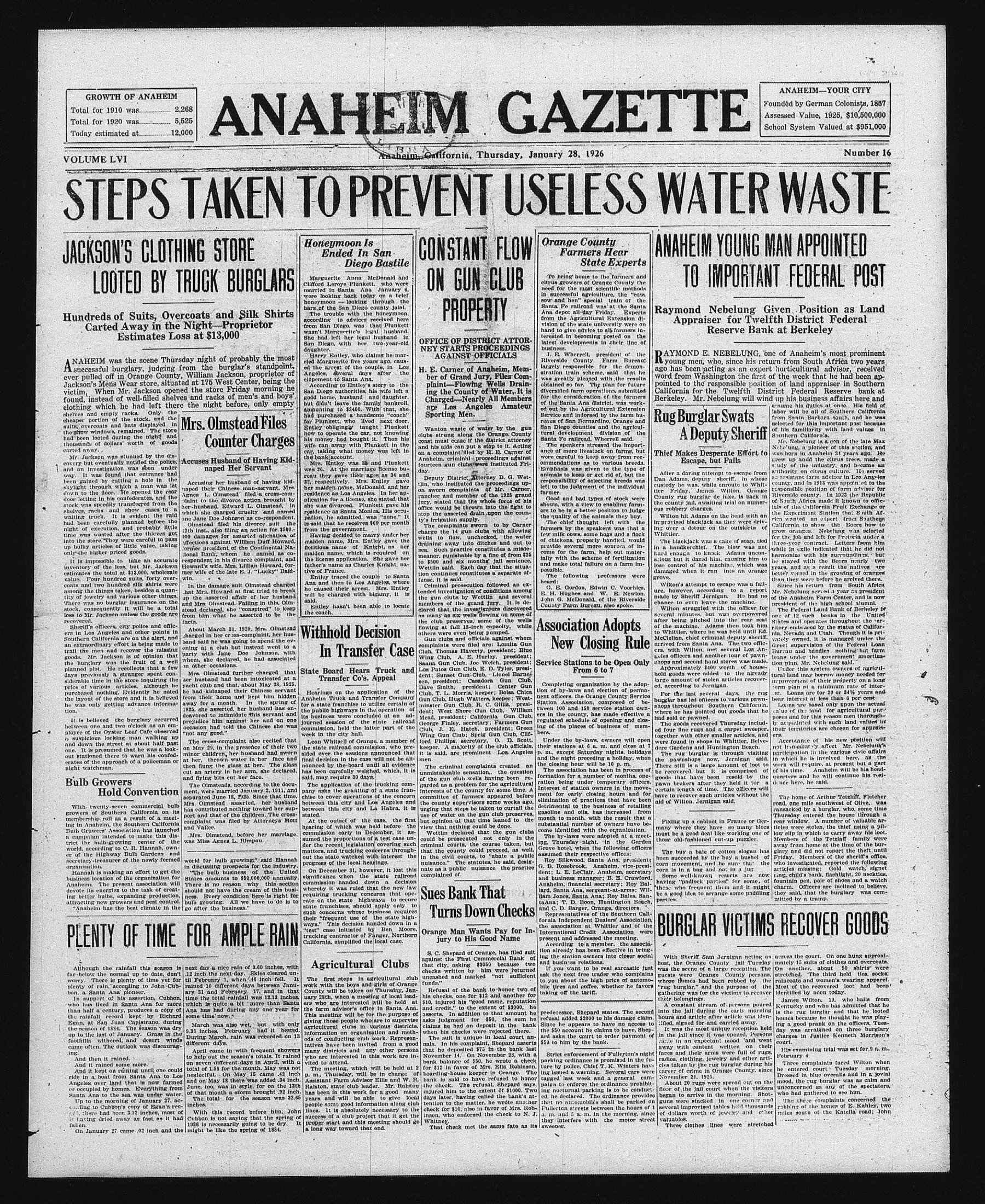
Searchable text
GROWTH OF ANAHEIM
Total for 1910 was... 2,268
Total for 1920 was... 5,525
Today estimated at...12,000
VOLUME LVI
STEPS TAKEN TO P
JACKSON'S CLOTHING STORE
LOOTED BY TRUCK BURGLARS
Hundreds of Suits, Overcoats and Silk Shirts
Carted Away in the Night—Proprietor
Estimates Loss at $13,000
ANAHEIM was the scene Thursday night of probably the most successful burglary, judging from the burglar's standpoint, ever pulled off in Orange County, William Jackson, proprietor of Jackson's Mens Wear store, situated at 175 West Center, being the victim. When Mr. Jackson opened the store Friday morning he found, instead of well-filled shelves and racks of men's and boys' clothing which he had left there the night before, only empty shelves and empty racks. Only the cheaper portion of the stock, and the suits, overcoats and hats displayed in the show windows, remained. The store had been looted during the night and thousands of dollars' worth of goods.
Mrs. Olmstead Files
Counter Charges
Honeymoon Ended In Diego
Marguerite Anna Clifford Leroye Plunkett married in Santa Ana were looking back to honeymoon — looking bars of the San Diego The trouble with the according to advices from San Diego, was wasn't Marguerite's life She had left her legacy San Diego, with her daughter.
Harry Entley, who carried Marguerite five years ed the arrest of the c Angeles, several days elopement to Santa An According to Entley's San Diego authorities, good home, husband but didn't leave the amounting to $3400. V had purchased a hand for Plunkett, who liv Entley obligingly tau how to operate the car his money had bought wife ran away with
ANAHEIM was the scene Thursday night of probably the most successful burglary, judging from the burglar's standpoint, ever pulled off in Orange County, William Jackson, proprietor of Jackson's Mens Wear store, situated at 175 West Center, being the victim. When Mr. Jackson opened the store Friday morning he found, instead of well-filled shelves and racks of men's and boys' clothing which he had left there the night before, only empty shelves and empty racks. Only the cheaper portion of the stock, and the suits, overcoats and hats displayed in the show windows, remained. The store had been looted during the night and thousands of dollars' worth of goods carted away.
Mr. Jackson was stunned by the discovery but eventually notified the police, and an investigation was soon under way. It was found that entrance had been gained by cutting a hole in the skylight through which a man was let down to the floor. He opened the rear door letting in his confederates, and the stock was speedily transferred from the shelves, racks and show cases to a waiting truck. It is evident the raid had been carefully planned before the night of execution, and probably little time was wasted after the thieves got into the store. They were careful to pass up bulky articles of little value, taking only the higher priced goods.
It is impossible to take an accurate inventory of the loss, but Mr. Jackson estimates the total at $13,000, wholesale value. Four hundred suits, forty overcoats and two hundred silk shirts were among the things taken, besides a quantity of jewelry and various other things. There was no burglar insurance on the stock, consequently it will be a total loss to Mr. Jackson unless the goods are recovered.
Sheriff's officers, city police and officers in Los Angeles and other points in Southern California are on the alert, and an extraordinary effort is being made to trail the men and recover the missing goods. Mr. Jackson is of opinion that the burglary was the fruit of a well planned plot. He recollects that a few days previously a stranger spent considerable time in the store inquiring the price of various articles, although he purchased nothing. Evidently he noted the layout of the store and it is believed he was only getting advance information.
It is believed the burglary occurred between one and two o'clock as an employee of the Oyster Loaf Cafe observed a suspicious looking man walking up and down the street at about half past one. It is presumed that he was a look-out stationed there to warn his confederates of the approach of a policeman or night watchman.
Bulb Growers Hold Convention
With twenty-seven commercial bulb growers of Southern California on its membership roll as a result of a meeting in Anaheim, the Southern California Bulb Growers' Association has launched a campaign intended to make this district the bulb-growing center of the world, according to C.R.Hannah, ownMrs. Olmstead Files Counter Charges
Accuses Husband of Having Kid-naped Her Servant
Accusing her husband of having kid-napped their Chinese man-servant, Mrs. Agnes L. Olmstead filed a cross-complaint to the divorce action brought by her husband, Edward L. Olmstead, in which she charged cruelty and named one Jane Doe Johnson as co-respondent.
Olmstead filed his divorce suit the 12th inst., also filing an action for $500-100 damages for asserted alienation of affection against William Duff Howard, former president of the Continental National Bank, whom he named as co-respondent in his divorce complaint, and Howard's wife, Mrs. Lillian Howard, former wife of the late E.J. "Lucky" Baldwin.
In the damage suit Olmstead charged that Mrs. Howard at first tried to break up the asserted affair of her husband and Mrs. Olmstead. Failing in this, Olmstead declared, she "conspired" to keep from him what he asserted to be the facts.
About March 31, 1925, Mrs. Olmstead charged in her cross-complaint, her husband said he was going to spend the evening at a club but instead went to a party with Jane Doe Johnson, with whom she declared, he had associated on other occasions.
Mrs. Olmstead further charged that her husband had been intoxicated at a yacht club and that, about May 28, 1925, he had kidnapped their Chinese servant from their home and kept him hidden away for a month. In the spring of 1925, she asserted, her husband has endeavored to intimidate this servant and prejudice him against her and on one occasion had told the Chinese she was "not any good."
The cross-complaint also recited that on May 29, in the presence of their two minor children, her husband had sworn at her, thrown water in her face and then flung the glass at her. The glass cut an artery in her arm, she declared, and flying bits cut her face.
The Olmsteads, according to the document, were married January 2, 1911, and separated June 18, 1925. Since that time, Mrs. Olmstead asserted, her husband has contributed nothing toward her support and that of the children. The cross-complaint was filed by Attorneys Mott and Vallce.
Mrs. Olmstead, before her marriage, was Miss Agnes L. Rimpau.
Harry Entley, who co-ruled Marguerite five years old at the arrest of the case Angeles, several days elapse to Santa Ana.
According to Entley's San Diego authorities, good home, husband but didn't leave the family amounting to $3400. Had purchased a hand for Plunkett, who lived Entley obligingly taut how to operate the car his money had bought wife ran away with P.Car taking what monsoon the bank account.
Mrs. Entley was 38 was 26. At the marriage they gave their rerelies respectively. Mrs. her maiden name McD residence as Los Angelesplication for a license she was divorced. Plu residence as Santa Monica he admitted, it said that he receives from the government.
Having decided to mmaiden name, Mrs.Effectious name of K maiden name which isthe license application father's name as Charlteive of France.
Entley traced the co Ana and then to Los he caused their arrest will be charged with said.
Entley hasn't been the coach.
Withhold De In Trans
State Board Hears Transfer Co.'s
Hearings on the appl Anaheim Truck and Tr for a state franchise to o its business highways in its business were concoured journed session of the commission, held la week in the city hall.
Leon Whitsell of Oran state railroad commided over.the sessions final decision in the case nounced by the board u has been carefully weel said may require 30 day
The application of thany asks the granting chise to cover operation between this city and between this city and stated.
At the outset of th hearing of which was commission early in D sumed the proportions s der recent legislation matters and trucking
Bulb Growers Hold Convention
With twenty-seven commercial bulb growers of Southern California on its membership roll as a result of a meeting in Anaheim, the Southern California Bulb Growers' Association has launched a campaign intended to make this district the bulb-growing center of the world, according to C. R. Hannah, owner of the Highway Bulb Gardens and secretary-treasurer of the newly formed organization.
Hannah is making an effort to get the business location of the organization for Anaheim. The present association will devote its energies to the task of creating better bulbs, expanding production, attracting new growers and pest control.
"Anaheim has the best climate in the world for bulb growing," said Hannah in discussing prospects for the industry.
"The bulb business of the United States amounts to $50,000,000 annually. There is no reason why this section should not have the cream of this business. Every condition here is right for bulb growing. All we have to do is go after the business."
PLENTY OF TIME FOR AMPLE RAIN
Although the rainfall this season is far below the normal up to date, don't worry. There is plenty of time yet for plenty of rain, according to John Cubbon, a Santa Ana pioneer.
In support of his assertion, Cubbon, who has lived in Santa Ana for more than half a century, produces a copy of the rainfall record kept by Richard Egan, at San Juan Capistrano, during the season of 1884. The season was dry up to the last of January. Grass in the foothills withered, and desert winds came often. The outlook was discouraging.
And then it rained.
And it rained some more.
And it kept on raining until one could ride in a boat from Santa Ana to Los Angeles over land that is now farmed or occupied by homes. Everything from Santa Ana to the sea was under water.
Up to the morning of January 27, according to Cubbon's copy of Egan's records, there had been 3.12 inches, most of it having dried away as fast as it had fallen.
On January 27 came .02 inch and the next day a nice rain of 3.60 inches, with .12 inch the next day. Skies cleared until February 1, when .46 inch fell. It rained 10 different days between January 31 and February 17, and in that time the total rainfall was 12.13 inches, which is quite a bit more than Santa Ana has had during any one year for some time now.
March was also wet, but with only 9.33 inches. February had it bested. During March, rain was recorded on 13 different days.
April came in with frequent showers to help out the season's totals. It rained on seven different days in April, with a total of 1.56 for the month. May was not neglectful. On May 15 came .42 inch and on May 18 there was added .34 inch. June, too, was in style, for on the 18th of that month a storm brought .92 inch.
The total for the season was 32.65 inches.
With this record before him, John Cubbon is not saying that the spring of 1926 is necessarily going to be dry. It might be like the spring of 1884.
Agricultural
The first steps in a work with the boys and County will be taken on January 28th, when a messers who are interested in the farm advisor's office This meeting will be held giving those people who agricultural clubs in information on organic ods of conducting club tatives have been involved many districts and who are interested in vited to attend.
The meeting, which p. m., Thursday, will Assistant Farm Advisor Ralston, state club leader has been in this work years, and will be all people some good inform lines. It is absolutely success of a club project start and this a long way toward the
AHEIM GAZETTE
Anaheim, California, Thursday, January 28, 1926
TO PREVENT USELESS WAIT
Honeymoon Is Ended In San Diego Bastile
Marguerite Anna McDonald and Clifford Leroy Plunkett, who were married in Santa Ana January 6, were looking back today on a brief honeymoon—looking through the bars of the San Diego county jail.
The trouble with the honeymoon, according to advises received here from San Diego, was that Plunkett wasn't Marguerite's legal husband. She had left her legal husband in San Diego, with her two-year-old daughter.
Harry Entley, who claims he married Marguerite five years ago, caused the arrest of the couple, in Los Angeles, several days after the elopement to Santa Ana.
According to Entley's story to the San Diego authorities, his wife left a good home, husband and daughter, but didn't leave the family bankroll, amounting to $3400. With that, she had purchased a handsome "coach" for Plunkett, who lived next door.
Entley obligingly taught Plunkett how to operate the car, not knowing his money had bought it. Then his wife ran away with Plunkett in the
CONSTANT FLOW ON GUN CLUB PROPERTY
OFFICE OF DISTRICT ATTORNEY STARTS PROCEEDINGS AGAINST OFFICIALS
H. E. Carner of Anaheim, Member of Grand Jury, Files Complaint—Flowing Wells Draining the County of Water. It is Charged—Nearly All Members are Los Angeles Amateur Sporting Men.
Wanton waste of water by the gun clubs strung along the Orange County coast must cease if the district attorney and his aids can put a stop to it. Acting Orange County Farmers Hear State Experts
To bring home to the farmers and citrus growers of Orange County the need for the most scientific methods in successful agriculture, the "cow sow and hen" special train of the Santa Fe railroad was at the Santa Ana depot all day Friday. Experts from the Agricultural Extension division of the state university were on hand to give advice to all farmers interested in becoming posted on the latest developments in their line of business.
J. E. Wherrell, president of the Riverside County Farm Bureau; largely responsible for the demonstration train scheme, said that he was greatly pleased with the results obtained so far. The plan for future diversified farm operations, submitted for the consideration of the farmers of the Santa Ana district, was worked out by the Agricultural Extension Service and indorsed by the farm bureau of San Bernardino, Orange and San Diego counties and the agricultural development division of the Santa Fe railroad, Wherrell said.
The speakers stressed the import-
Harry Entley, who claims he married Marguerite five years ago, caused the arrest of the couple in Los Angeles, several days after the elopement to Santa Ana.
According to Entley's story to the San Diego authorities, his wife left a good home, husband and daughter, but didn't leave the family bankroll, amounting to $3400. With that, she had purchased a handsome "coach" for Plunkett, who lived next door. Entley obliquely taught Plunkett how to operate the car, not knowing his money had bought it. Then his wife ran away with Plunkett in the car, taking what money was left in the bank account.
Mrs. Entley was 38 and Plunkett was 26. At the marriage license bureau they gave their ages as 34 and 32, respectively. Mrs. Entley gave her maiden name, McDonald, and her residence as Los Angeles. In her application for a license, she stated that she was divorced. Plunkett gave his residence as Santa Monica. His occupation, he admitted, was "none." It is said that he receives $60 per month from the government.
Having decided to marry under her maiden name, Mrs. Entley gave the fictitious name of Knight, as her maiden name, which is required on the license application. She gave her father's name as Charles Knight, native of France.
Entley traced the couple to Santa Ana and then to Los Angeles, where he caused their arrest. Mrs. Entley will be charged with bigamy, it is said.
Entley hasn't been able to locate the coach.
Withhold Decision In Transfer Case
State Board Hears Truck and Transfer Co.'s Appeal
Hearings on the application of the Anaheim Truck and Transfer Company for a state franchise to utilize certain of the public highways in the operation of its business were concluded at an adjourned session of the state railroad commission, held the latter part of the week in the city hall.
Leon Whittsle of Orange, a member of the state railroad commission, who presided over the sessions announced that final decision in the case will not be announced by the board until all evidence has been carefully weighed, which, it is said, may require 30 days.
The application of the trucking company asks the granting of a state franchise to cover operations of the concern between this city and Los Angeles and between this city and La Habra, it is stated.
At the outset of the case, the first hearing of which was held before the commission early in December, it assumed the proportions of a test case under the recent legislation covering such matters and trucking concerns through AGAINST OFFICIALS
H. E. Carner of Anaheim, Member of Grand Jury, Files Complaint—Flowing Wells Draining the County of Water. It is Charged—Nearly All Members are Los Angeles Amateur Sporting Men.
Wanton waste of water by the gun clubs strung along the Orange County coast must cease if the district attorney and his alds can put a stop to it. Acting on a complaint filed by H. E. Carner of Anaheim, criminal proceedings against fourteen gun clubs were instituted Friday.
Deputy District Attorney D. G. Wettlin, who instituted the proceedings upon sworn complaints of Mr. Carner, rancher and member of the 1925 grand jury, stated that the whole force of his office would be thrown into the fight to stop the asserted drain upon the county's irrigation supply.
The complaints sworn to by Carner charge the 14 gun clubs with allowing wells to flow, unchecked, the water draining away into ditches and out to sea. Such practice constitutes a misdemeanor, punishable by a fine of from $25 to $500 and six months' jail sentence. Wettlin said. Each day that the situation continues constitutes a separate offense, it is said.
Criminal prosecution followed an extended investigation of conditions among the gun clubs by Wettlin and several members of the grand jury. It is declared that the investigators discovered as many as six wells flowing on some of the club preserves, some of the wells flowing at full 18-inch capacity, while others were even being pumped.
Gun clubs and officials against whom complaints were filed are: Lomita Gun Club, Thomas Haverty, president; Blue Wing Club, A. E. Hurley, president; Saana Gun Club, Joe Welch, president; Los Patos Gun Club, E. D. Tyler, president; Sunset Gun Club, Lionel Barnesen, president; Casadora Gun Club, Dave Smith, president; Center Gun Club, T. L. Morris, keeper; Bolsa Chica Gun Club, Hugh Watters, keeper; Westminster Gun Club, R. C. Gillis, president; West Shore Gun Club, William Mead; California Gun Club, George Finley, secretary; Farmers Gun Club, J. E. Hatch, president; Green Wing Gun Club; Sprig Gun Club, Clifford Phillips, secretary; O. D. Scott, keeper. A majority of the club officials, it is said, are prominent Los Angeles men.
The criminal complaints created an unmistakeable sensation., the question of the gun club wells having been regarded as a problem for the agricultural interests of the county for some time. A committee of farmers appeared before the county supervisors some weeks ago urging that steps be taken to curtail use of water on the gun club preserves, but opinion at that time leaned to the view that nothing could be done.
Wettlin declared that the gun clubs could be prosecuted not only in the criminal courts, the course taken, but that the county could proceed as well.
J. E. Wherrrell, president of the Riverside County Farm Bureau; largely responsible for the demonstration train scheme, said that he was greatly pleased with the results obtained so far. The plan for future diversified farm operations, submitted for the consideration of the farmers of the Santa Ana district, was worked out by the Agricultural Extension Service and indorsed by the farm bureau of San Bernardino, Orange and San Diego counties and the agricultural development division of the Santa Fe railroad. Wherrrell said.
The speakers stressed the importance of more livestock on farms, but were careful to keep away from recommendations as to various breeds. Emphasis was given to the type of animals to keep or get rid of, but the responsibility of selecting breeds was left to the judgment of the individual farmer.
Good and bad types of stock were shown, with a view to enabling farmers to be in a better position to judge the quality of the animals they buy.
The chief thought left with the farmers by the speakers was that a few milk cows, some hogs and a flock of chickens properly handled would provide several more sources of income for the farm, help out materially with the scheme of fertilization and make total failure on a farm impossible.
The following professors were heard:
G. E. Gordon, Edwin C. Voorhies,
E. H. Hughes and W. E. Newlon,
John G. McDonald, of the Riverside County Farm Bureau, also spoke.
Association Adopts New Closing Rule
Service Stations to be Open Only From 6 to 7
Completing organization by the adoption of by-laws and election of permanent officers. The Orange County Service Station Association composed of between 100 and 150 service station owners in the county, has made effective a regulated schedule of opening and closing of the places of business of members.
Under the by-laws, owners will open their stations at 6 a.m. and close at 7 p.m., except Saturday nights, holidays and the night preceding a holiday when the closing hour will be 10 p.m.
The association has been in process of formation for a number of months, operation being under temporary officers. Interest of station owners in the movement for early closing hours and for elimination of practices that have been detrimental to the business of retail gasoline and oils, has increased from month to month, with the result that a substantial number of owners have become identified with the organization.
The by-laws were adopted at a meeting Thursday night. In the Garden Grove hotel, when the following officers...
final decision in the case will not be announced by the board until all evidence has been carefully weighed, which it is said, may require 30 days.
The application of the trucking company asks the granting of a state franchise to cover operations of the concern between this city and Los Angeles and between this city and La Habra, it is stated.
At the outset of the case, the first hearing of which was held before the commission early in December, it assumed the proportions of a test case under the recent legislation covering such matters, and trucking concerns throughout the state watched with interest the progress of the local hearings.
On December 31, however, it lost this significance when the state railroad commission handed down a decision whereby it was ruled that the new law requiring trucking concerns that operate on the state highways to secure state franchises, should apply only to such concerns whose business requires their "frequent use of the state highways." This decision handed down in a "test" case initiated by Ben Moore, trucking contractor of Fanger, Northern California, simplified the local case.
Agricultural Clubs
The first steps in agricultural club work with the boys and girls of Orange County will be taken on Thursday, January 28th, when a meeting of local leaders who are interested will be held at the farm advisor's office in Santa Ana. This meeting will be for the purpose of giving those people who are to supervise agricultural clubs in various districts, information on organization and methods of conducting club work. Representatives have been invited from a good many districts and any other persons who are interested in this work are invited to attend.
The meeting, which will be held at 2 p.m., Thursday, will be in charge of Assistant Farm Advisor Ellis and W. R. Ralston, state club leader. Mr. Ralston has been in this work for a good many years, and will be able to give local people some good information along club lines. It is absolutely necessary to the success of a club project that it get the proper start and this meeting should go a long way toward that end.
The criminal complaints created an unmistakeable sensation,, the question of the gun club wells having been regarded as a problem for the agricultural interests of the county for some time. A committee of farmers appeared before the county supervisors some weeks ago, urging that steps be taken to curtail the use of water on the gun club preserves, but opinion at that time leaned to the view that nothing could be done.
Wettlin declared that the gun clubs could be prosecuted not only in the criminal courts, the course taken, but that the county could proceed, as well, in the civil courts, to "abate a public nuisance." The statutes, he said, designate as a public nuisance the practice complained of.
Sues Bank That Turns Down Checks
Orange Man Wants Pay for Injury to His Good Name
S. C. Shepard of Orange, has filed suit against the First Commercial Bank of that city, asking $3050 because two checks written by him were returned uncashed and marked "not sufficient funds."
Refusal of the bank to honor two of his checks, one for $12 and another for $10, injured his "good name, reputation and credit," to the extent of $3000, he asserts. In addition to that amount he asks judgment for $50, the sum he claims he had on deposit in the bank when his checks were rejected there.
The suit is unique in local court annals. In his complaint, Shepard asserts that he deposited $75 in the bank last November 14. On November 28, with a bank balance of $50, he wrote a check for $12 in favor of Mrs. Ella Robinson, boarding-house keeper in Orange. The bank is said to have refused to honor the check. The refusal, Shepard says, injured him to the extent of $1000. Two days later, having called the bank's attention to the matter, he wrote another check for $10, also in favor of Mrs. Robinson, who endorsed the check to N. J. Whitney.
That check met the same fate as its predecessor added $2000 to his damage claim. Since he appears to have no access to the $50 account he claims to have, Shepard asks the court to order payment of $50 to him by the bank.
Strict enforcement of Fullerton's night parking ordinance is promised in the future by police, Chief T. K. Winters having issued a warning. Several cars were tagged last week and a general campaign to enforce the ordinance prohibiting nocturnal parking is to be conducted, he declared. The ordinance provides that no automobiles shall be parked on Fullerton streets between the hours of 1 a.m. and 5 a.m. In the morning, since they interfere with the motor street sweeper and the night preceding a holiday, when the closing hour will be 10 p.m.
The association has been in process of formation for a number of months, operation being under temporary officers. Interest of station owners in the movement for early closing hours and for elimination of practices that have been detrimental to the business of retailing gasoline and oils, has increased from month to month, with the result that a substantial number of owners have become identified with the organization.
By-laws were adopted at a meeting, Thursday night, in the Garden Grove hotel, when the following officers assumed their respective offices:
Roy Silkwood, Santa Ana, president; G. B. Rosebrook, Anaheim, vice-president; L. E. LeClair, Anaheim, secretary and business manager; B. E. Crawford, Anaheim, financial secretary; Roy Ballard, Santa Ana, sergeant-at-arms; William Jones, Santa Ana; Roy Bales, Santa Ana; T. D. Boon, Huntington Beach, and C. D. Barger, Orange directors.
Representatives of the Southern California Independent Dealers' Association, the association at Whittier and of the International Credit Association were present and addressed the meeting.
According to a member, the association already has been effective in bringing the station owners into closer social and business relations.
If you want to be real sarcastic just ask the next free trader who complains to you about the high price of automobile tires and coffee, whether he favors taking off the tariff.
With Sheriff host, the Orang was the scene guests were whose homes "rug burglar," gathering was their belonging.
A constant into the jail hours and art filled signed it.
It was in the jail siren case in an en face with faces and radios, clothies taken by career of crim November 21.
About 20 rulers began to arrive guns were stored several improvised dollars worth valuables.
Three cloth
ANAHEIM—YOUR CITY
Founded by German Colonists, 1857
Assessed Value, 1925, $10,500,000
School System Valued at $951,000
Number 16
PRESS WATER WASTE
ANAHEIM YOUNG MAN APPOINTED
TO IMPORTANT FEDERAL POST
Raymond Nebelung Given Position as Land Appraiser for Twelfth District Federal Reserve Bank at Berkeley
RAYMOND E. NEBELUNG, one of Anaheim's most prominent young men, who, since his return from South Africa two years ago has been acting as an expert horticultural advisor, received word from Washington the first of the week that he had been appointed to the responsible position of land appraiser in Southern California for the Twelfth District Federal Reserve bank at Berkeley. Mr. Nebelung will wind up his business affairs here and assume his duties at once. His field of labor will be all of Southern California from Santa Barbara south, and he was selected for this important post because of his familiarity with land values in Southern California.
Mr. Nebelung is a son of the late Max Nebelung, a pioneer of this section, and
Rug Burglar Swats
A Deputy Sheriff
Thief Makes Desperate Effort to Escape, but Fails
After a daring attempt to escape from Dan Adams, deputy sheriff, in whose custody he was, while enroute to Whittier Friday, James Wilton, Orange County rug burglar de luxe, is back in the county jail, awaiting trial on numerous robbery charges.
Wilton hit Adams on the head with an improvised blackjack as they were driving over a detour on the outskirts of Whittier.
The blackjack was a cake of soap, tied in a handkerchief. The blow was not hard enough to knock. Adams unconscious but it dazed him, causing him to lose control of his machine, which was damaged when it ran into an orange grove.
Wilton's attempt to escape was a failure, however, according to a report made by Sheriff Jernigan. He had no chance to even leave the machine.
Wilton struggled with the officer for several minutes, but was overpowered after being pitched into the rear seat of the machine. Adams then took him to Whittler, where he was held until Ed. McClellan, chief criminal deputy sheriff, arrived from Santa Ana. The two officers, with Wilton, met several Los Angeles officers and another tour of pawnshops and second hand stores was made.
Approximately $400 worth of household goods were added to the already large amount of stolen articles recovered, according to Jernigan.
For the last several days, the rug burglar has led officers to various pawnshops throughout Southern California, where he has pointed out goods that he had sold or pawned.
The goods recovered Thursday included four fine rugs and a carpet sweeper, together with other smaller articles, and were found in shops in Whittler, Belvedere Gardens and Huntington Beach.
The rug burglar is through visiting the pawnshops now, Jernigan said. There still is a large amount of loot to be recovered, but it is comprised of goods that have been resold by the pawn brokers after they held it for a certain length of time. The officers will have to recover such articles without the aid of Wilton, Jernigan said.
Fixing up a cabinet in France or Germany where they have so many blocs must be a good deal like working one of those old-fashioned cut-up puzzles.
Assume his duties at once. His field of labor will be all of Southern California from Santa Barbara south, and he was selected for this important post because of his familiarity with land values in Southern California.
Mr. Nebelung is a son of the late Max Nebelung, a pioneer of this section, and was born in Anaheim 31 years ago. He grew up amid the citrus trees, made a study of the industry, and became an authority on citrus culture. He served as assistant farm advisor in Los Angeles county, and in 1918 was appointed to the responsible position of farm advisor for Riverside county. In 1923 the Republic of South Africa made it known to officials of the California Fruit Exchange or the Experiment Station that South Africa wanted an expert from Southern California to show the Boers how to grow oranges. Nebelung was selected for the job and left for Victoria under a three-year contract. Letters from him while in exile indicated that he did not harmonize with his surroundings, but he stayed with the Boers nearly two years, and as a result the natives are better versed in the growing of oranges than they were before he arrived there.
Since his return from South Africa Mr. Nebelung served a year as president of the Anaheim Farm Center, and is now president of the high school alumni.
The Federal Land Bank of Berkeley is one of 12 such banks in the United States and operates throughout the territory embraced by the states of California, Nevada and Utah. Though it is privately owned, it is managed under the direct supervision of the Federal Loan Bureau and handles nothing but farm loans under the government amortization plan. Mr. Nebelung said.
Under this system owners of agricultural land may borrow money needed for improvement of their property on a long-term plan at a minimum rate of interest. Loans are for 20 or 34½ years and bear interest at less than 6 per cent.
Loans are based only upon the actual value of the land for agricultural purposes and for this reason men thoroughly acquainted with such land values in their territories are chosen for appraisers.
Accentuation of his new position will not immediately affect Mr. Nebelung's participation in the various civic affairs in which he is involved here, as the work will require at present but a part of his time. Anaheim will be his headquarters and he will continue his residence here, he said.
The home of Arthur Tetzlaff. Fletcher road, one mile southwest of Olive, was ransacked by a burglar who, some time Thursday entered the house through a rear window. A number of valuable articles were stolen, the thief using a pillow slip in which to carry away his loot. Members of the Tetzlaff family were away from home at the time of the burglary and did not report the theft until
BURGLAR VICTIMS RECOVER GOODS
With Sheriff Sam Jernigan acting as host, the Orange County jail Tuesday was the scene of a large reception. The guests were Orange County persons, whose homes had been robbed by the "rug burglar," and the purpose of the gathering was for the victims to recover their belongings.
A constant stream of persons poured into the jail during the early morning hours and article after article was identified, signed for and carried away.
It was the most unique reception held in the jail since it was opened. Persons came in an expectant mood and went away with content written on their faces and their arms were full of rugs, radios, clothing, jewelry and other articles taken by the rug burglar during his career of crime in Orange County, since November 21, 1925.
About 20 rugs were spread out on the floor of the jail court when the visitors began to arrive in the morning. Shotguns were stacked in one corner and several improvised tables held thousands of dollars worth of jewelry and other valuables.
Three clothes lines were stretched across the court. On one hung approximately 15 suits of clothes and overcoats. On another, about 50 shirts were stretched. The third held ties, socks, raincoats and women's wearing apparel. Most of the recovered loot had been identified by noon today.
James Wilton, 19, who halls from Kentucky and who has admitted that he is the rug burglar and that he looted homes because he thought he was playing a good prank on the officers. Tuesday was arraigned on three burglary charges in Justice Kenneth Morrison's court.
His examining trial was set for 9 a.m., February 4.
Three complaints faced Wilton when he entered court Tuesday morning. Dressed in blue overalls and in a jovial mood, the rug burglar was as calm and unconcerned as any of the spectators, who had gathered to see him.
The three complaints concerned the robbing of the homes of E. Kahley, two miles south of the Katella road; John