anaheim-gazette 1926-01-14
Scanned page
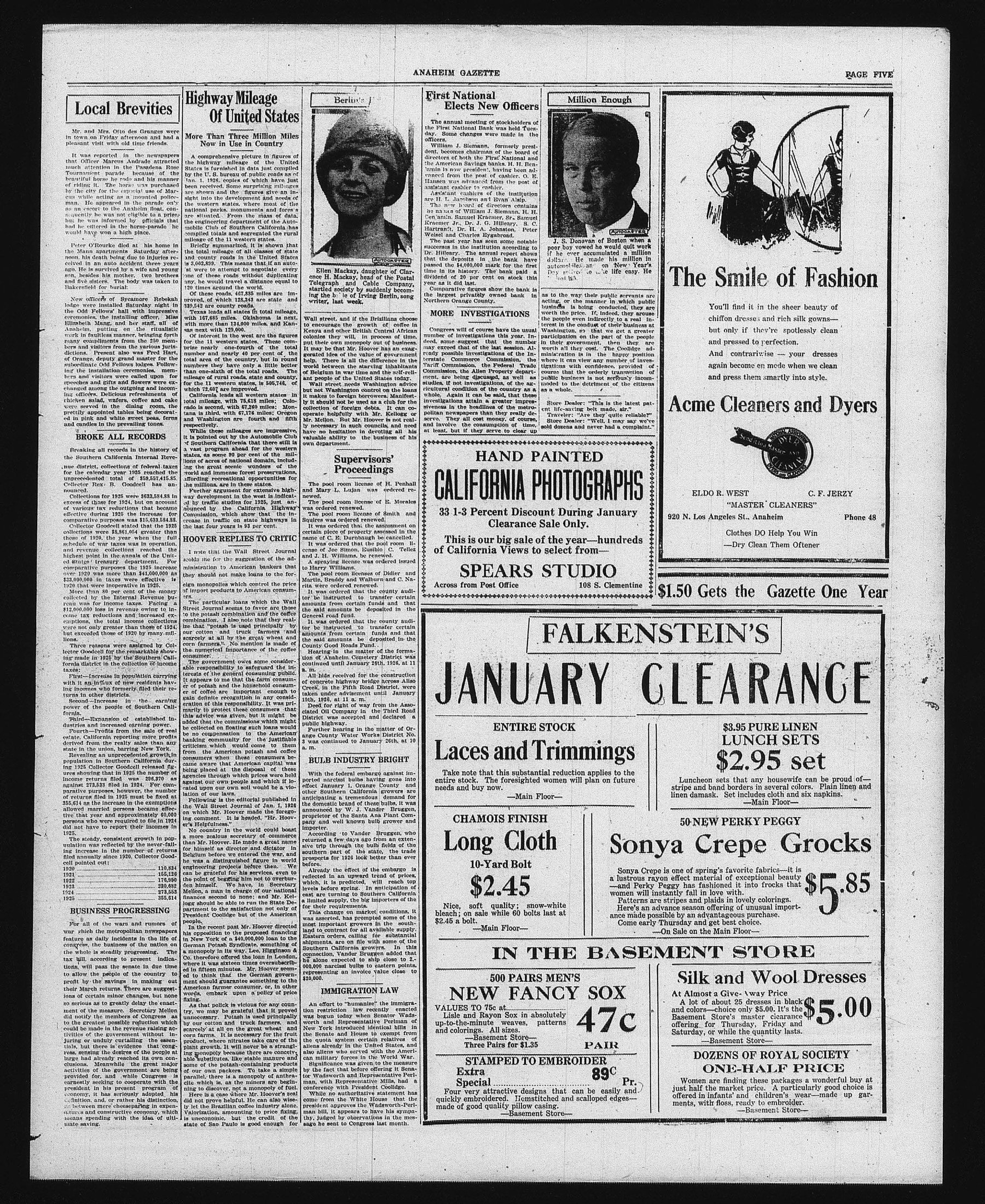
Searchable text
Local Brevities
Mr. and Mrs. Otto des Granges were in town on Friday afternoon and had a pleasant visit with old time friends.
It was reported in the newspapers that Officer Marcus Andrade attracted much attention in the Pasadena Rose Tournament parade because of the beautiful horse he rode and his manner of riding it. The horse was purchased by the city for the special use of Marcus while acting as a mounted policeman. He appeared in the parade only as an escort to the Anaheim float, consequently he was not eligible to a prize, but he was informed by officials that he entered in the horse-parade he would have won a high place.
Peter O'Rourke died at his home in the Mann apartments Saturday afternoon, his death being due to injuries received in an auto accident three years ago. He is survived by a wife and young son, besides his mother, two brothers and five sisters. The body was taken to Hakersfield for burial.
New officers of Sycamore Rebekah lodge were installed Saturday night in the Odd Fellows' hall with impressive ceremonies, the installing officer, Miss Elizabeth Mang, and her staff, all of Anaheim, putting on the ritualistic work in faultless manner, bringing forth many compliments from the 250 members and visitors from the various jurisdictions. Present also was Fred Hart, of Orange, deputy grand master for the subordinate Odd Fellows lodges. Following the installation ceremonies, members and visitors were called upon for speeches and gifts and flowers were exchanged among the outgoing and incoming officers. Delicious refreshments of chicken salad, wafers, coffee and cake were served in the dining room, the prettily appointed tables being decorated in pink and white sweet peas, ferns and candles in the prevailing tones.
BROKE ALL RECORDS
Highway Mileage Of United States
More Than Three Million Miles Now in Use in Country
A comprehensive picture in figures of the highway mileage of the United States is furnished in data just compiled by the U.S. bureau of public roads as of Jan. 1, 1926, copies of which have just been received. Some surprising milages are shown and the figures give an insight into the development and needs of the western states, where most of the national parks, monuments and forests are situated. From the mass of data, the engineering department of the Automobile Club of Southern California has compiled totals and segregated the rural mileage of the 11 western states.
Briefly summarized, it is shown that the total mileage of all classes of state and county roads in the United States is 3,002,899. This means that if an autostart were to attempt to negotiate every one of these roads without duplicating any, he would travel a distance equal to 120 times around the world.
Of these roads, 467,835 miles are improved, of which 128,343 are state and 339,542 are county roads.
Texas leads all states in total mileage, with 167,685 miles. Oklahoma is next, with more than 134,000 miles, and Kansas next with 129,000.
Of interest in the west are the figures for the 11 western states. These comprise nearly one-fourth of the total number and nearly 40 per cent of the total area of the country, but in round numbers they have only a little better than one-sixth of the total roads. The mileage of rural roads, state and county, for the 11 western states, is 505,746, of which 72,607 are improved.
California leads all western states in total mileage, with 75,618 miles; Colorado is second, with 67,260 miles; Montana is third, with 67,176 miles; Oregon and Washington are fourth and fifth respectively.
While these milages are impressive, it is pointed out by the Automobile Club of Southern California that there still is a vast program ahead for the western Wall street, and if they encourage the growth Kenya and other British colonies they will put their own monopoly It may be that Mr. Hooper generated idea of the value help. There is all the world between the state of Belgium in war time ant people of the United Wall street needs W but not Washington co it makes to foreign bor ly it should not be used collection of foreign d operate helpfully with Mr. Mellon. But Mr. Hly necessary in such c have no hesitation in valuable ability to th own department.
BROKE ALL RECORDS
Breaking all records in the history of the Southern California Internal Revenue district, collections of federal taxes for the calendar year 1925 reached the unprecedented total of $59,557,415.85. Collector Rex B. Goodcell has announced.
Collections for 1925 were $633,584.88 in excess of those for 1924, but on account of various tax reductions that became effective during 1925 the increase for comparative purposes was $15,633,584.88.
Collector Goodcell stated that the 1925 collections were $8,861,054 greater than those of 1920; the year when the full schedule of war taxes was in operation, and revenue collections reached the highest point in the annals of the United States treasury department. For comparative purposes the 1925 increase over 1920 was more than $41,000,000 as $33,000,000 in taxes were effective in 1920 that were inoperative in 1925.
More than 80 per cent of the money collected by the Internal Revenue bureau was for income taxes. Facing a $12,000,000 loss in revenue owing to income tax reductions and increased exemptions, the total income collections were not only greater than those of 1924, but exceeded those of 1920 by many millions.
Three reasons were assigned by Collector Goodcell for the remarkable showing made in 1925 by the Southern California district in the collection of income taxes:
First—Increase in population carrying with it an infux of new residents having incomes who formerly filed their returns in other districts.
Second—Increase in the earning power of the people of Southern California.
Third—Expansion of established industries and increased earning power.
Fourth—Profit from the sale of real estate. California reporting more profits derived from the realty sales than any state in the union, barring New York.
Revealing an unprecedented growth in population in Southern California during 1925 Collector Goodcell released figures showing that in 1925 the number of income returns filed was 296,370 as against 273,533 filed in 1924. For comparative purposes, however, the number of returns filed in 1925 must be fixed at 355,614 as the increase in the exemptions allowed married persons became effective that year and approximately 60,000 persons who were required to file in 1924 did not have to report their incomes in 1925.
The steady, consistent growth in population was reflected by the never-failing increase in the number of returns.
HOOVER REPLIES TO CRITIC
I note that the Wall Street Journal acords me for the suggestion of the administration to American bankers that they should not make loans to the foreign monopolies which control the price of import products to American consumers.
The particular loans which the Wall Street Journal seems to favor are those to the potash combination and the coffee combination. I also note that they realize that "potash is used principally by our cotton and truck farmers and scarcely at all by the great wheat and corn farmers." No mention is made of the numerical importance of the coffee consumer.
The government owes some considerable responsibility to safeguard the interests of the general consuming public. It appears to me that the farm consumer of potash and the household consumer of coffee are important enough to gain definite recognition in any consideration of this responsibility. It was primarily to protect these consumers that this advice was given, but it might be added that the commissions which might be collected on floating such loans would be no compensation to the American banking community for the justifiable criticism which would come to them from the American potash and coffee consumers when these consumers became aware that American capital was being placed at the disposal of these agencies through which prices were held against our own people and which if located upon our own soil would be a violation of our laws.
Following is the editorial published in the Wall Street Journal of Jan. 1, 1926 on which Mr. Hoover made the foregoing comment. It is headed: "Mr. Hoover's Helpfulness."
No country in the world could boast a more zealous secretary of commerce than Mr. Hoover. He made a great name for himself as director and dictator in number and nearly 40 per cent of the total area of the country, but in round numbers they have only a little better than one-sixth of the total roads. The mileage of rural roads, state and county, for the 11 western states, is 505,746, of which 72,607 are improved.
California leads all western states in total mileage, with 75,618 miles; Colorado is second, with 67,260 miles; Montana is third, with 67,176 miles; Oregon and Washington are fourth and fifth respectively.
While these mileages are impressive, it is pointed out by the Automobile Club of Southern California that there still is a vast program ahead for the western states, as some 90 per cent of the millions of acres of national domain, including the great scenic wonders of the world and immense forest preservations, affording recreational opportunities for the millions, are in these states.
Further argument for extensive highway development in the west is indicated by traffic studies for 1925, just announced by the California Highway Commission, which show that the increase in traffic on state highways in the last four years is 93 per cent.
HOOVER REPLIES TO CRITIC
I note that the Wall Street Journal acords me for the suggestion of the administration to American bankers that they should not make loans to the foreign monopolies which control the price of import products to American consumers.
The particular loans which the Wall Street Journal seems to favor are those to the potash combination and the coffee combination. I also note that they realize that "potash is used principally by our cotton and truck farmers and scarcely at all by the great wheat and corn farmers." No mention is made of the numerical importance of the coffee consumer.
The government owes some considerable responsibility to safeguard the interests of the general consuming public. It appears to me that the farm consumer of potash and the household consumer of coffee are important enough to gain definite recognition in any consideration of this responsibility. It was primarily to protect these consumers that this advice was given, but it might be added that the commissions which might be collected on floating such loans would be no compensation to the American banking community for the justifiable criticism which would come to them from the American potash and coffee consumers when these consumers became aware that American capital was being placed at the disposal of these agencies through which prices were held against our own people and which if located upon our own soil would be a violation of our laws.
Following is the editorial published in the Wall Street Journal of Jan. 1, 1926 on which Mr. Hoover made the foregoing comment. It is headed: "Mr. Hoover's Helpfulness."
No country in the world could boast a more zealous secretary of commerce than Mr. Hoover. He made a great name for himself as director and dictator in number and nearly 40 per cent of the total area of the country, but in round numbers they have only a little better than one-sixth of the total roads. The mileage of rural roads, state and county, for the 11 western states, is 505,746, of which 72,607 are improved.
California leads all western states in total mileage, with 75,618 miles; Colorado is second, with 67,260 miles; Montana is third, with 67,176 miles; Oregon and Washington are fourth and fifth respectively.
While these mileages are impressive, it is pointed out by the Automobile Club of Southern California that there still is a vast program ahead for the western states, as some 90 per cent of the millions of acres of national domain, including the great scenic wonders of the world and immense forest preservations, affording recreational opportunities for the millions, are in these states.
Further argument for extensive highway development in the west is indicated by traffic studies for 1925, just announced by the California Highway Commission, which show that the increase in traffic on state highways in the last four years is 93 per cent.
HOOVER REPLIES TO CRITIC
I note that the Wall Street Journal acords me for the suggestion of the administration to American bankers that they should not make loans to the foreign monopolies which control the price of import products to American consumers.
The particular loans which the Wall Street Journal seems to favor are those to the potash combination and the coffee combination. I also note that they realize that "potash is used principially by our cotton and truck farmers and scarcely at all by the great wheat and corn farmers." No mention is made of the numerical importance of the coffee consumer.
The government owes some considerable responsibility to safeguard the interests of the general consuming public. It appears to me that the farm consumer of potash and coffee consumers when these consumers became aware that American capital was being placed at the disposal of these agencies through which prices were held against our own people and which if located upon our own soil would be a violation of our laws.
Following is the editorial published in the Wall Street Journal of Jan. 1, 1926 on which Mr. Hoover made the foregoing comment. It is headed: "Mr. Hoover's Helpfulness."
No country in the world could boast a more zealous secretary of commerce than Mr. Hoover. He made a great name for himself as director and dictator in number and nearly 40 per cent of the total area of the country, but in round numbers they have only a little better than one-sixth of the total roads. The mileage of rural roads, state and county, for the 11 western states, is 505,746, of which 72,607 are improved.
California leads all western states in total mileage, with 75,618 miles; Colorado is second, with 67,260 miles; Montana is third, with 67,176 miles; Oregon and Washington are fourth and fifth respectively.
While these mileages are impressive, it is pointed out by the Automobile Club of Southern California that there still is a vast program ahead for the western states, as some 90 per cent of the millions of acres of national domain, including the great scenic wonders of the world and immense forest preservations, affording recreational opportunities for the millions, are in these states.
Further argument for extensive highway development in the west is indicated by traffic studies for 1925, just announced by the California Highway Commission, which show that the increase in traffic on state highways in the last four years is 93 per cent.
HOOVER REPLIES TO CRITIC
I note that the Wall Street Journal acords me for the suggestion of the administration to American bankers that they should not make loans tothe foreign monopolies which controlthe priceofimportproductstoAmericanconsumers.
The particular loans whichtheWallStreetJournalseemstocovirtorarethosetothepotashcombinationandthecoffeecombination.Ialsonotethattheyrealizethat"potashisusedprincipiatelybyourcotsshopfarmersandscarcelyatallbythegreatwheatandcornfarmers."Nomentionismadeofthenumericalimportanceofthecoffeesmounter.
The government owes some considerable responsibility to safeguardtheinterestsofthegeneralconsumingpublic.itappearstocovirtorarethosetothepotashcombinationandthecoffeecombination.Ialsonotethattheyrealizethat"potashisusedprincipientlybyourcotsshopfarmersandscarcelyatallbythegreatwheatandcornfarmers."Nomentionismadeofthenumericalimportanceofthecoffeesmounter.
ThepoolroomlicensedandMaryL.Lujannewed.
ThepoolroomlicensedandMaryL.Lujannewed.
ThepoolroomlicensedandMaryL.Lujannewed.
Itwasorderedthattreatmentofamountsfrom certainsaidamountsbewereadinGeneralroadfund.
Itwasorderedthattreatmentofamountsfrom certainsaidamountsbewereadinGeneralroadfund.
Itwasorderedthattreatmentofamountsfrom certainsaidamountsbewereadinGeneralroadfund.
SuperviveProceede
The pool room licencedand Mary L.Lujannewed.
The pool room licencedand Mary L.Lujannewed.
Itwasorderedthattreatmentofamountsfrom certainsaidamountsbewereadinGeneralroadfund.
Itwasorderedthattreatmentofamountsfrom certainsaidamountsbewereadinGeneralroadfund.
SuperviveProceede
WiththefederalembortednarcissialbulbsbffectJanuary1OrangeotherSouthernCaliforniaanticipatingaremendationtheannouncedbyW.J.Williamsbehypy necessaryinsuchcablehavevaluedabilitytotheowndepartment.
SuperviveProceede
WiththefederalembortednarcissialbulbsbffectJanuary1OrangeotherSouthernCaliforniaanticipatingaremendationtheannouncedbyW.J.Williamsbehypy necessaryinsuchcablehavevaluedabilitytotheowndepartment.
SuperviveProceede
VaultingrecourseintherangeCountyWaterWay3wascontinuedtoJanuarya.m.
BULBINDUSTRECORD
WiththefederalembortednarcissialbulbsbffectJanuary1OrangeotherSouthernCaliforniaanticipatingaremendationtheannouncedbyW.J.Williamsbehypy necessaryinsuchcablehavevaluedabilitytotheowndepartment.
SuperviveProceede
VaultingrecourseintherangeCountyWaterWay3wascontinuedtoJanuarya.m.
Revealing an unprecedented growth in population in Southern California during 1925 Collector Goodcell released figures showing that in 1925 the number of income returns filed was 296,370 as against 273,533 filed in 1924. For comparative purposes, however, the number of returns filed in 1925 must be fixed at 355,614 as the increase in the exemptions allowed married persons became effective that year and approximately 60,000 persons who were required to file in 1924 did not have to report their incomes in 1925.
The steady, consistent growth in population was reflected by the never-falling increase in the number of returns filed annually since 1920. Collector Goodcell pointed out:
1920 ..... 110,834
1921 ..... 155,126
1922 ..... 176,950
1923 ..... 230,682
1924 ..... 273,553
1925 ..... 355,614
BUSINESS PROGRESSING
For all of the wars and rumors of war which the metropolitan newspapers feature as daily incidents in the life of congress, the business of the nation on the whole is steadily progressing. The tax bill, according to present indications, will pass the senate in due time to allow the people of the country to profit by the savings in making out their March returns. There are suggestions of certain minor changes, but none so serious as to greatly delay the enactment of the measure. Secretary Mellon did notify the members of Congress as to the greatest possible reduction which could be made in the revenue raising activities of the government without injuring or unduly curtailing the essentials, but there is evidence that congress, sensing the desires of the people at large had already reached its own conclusions. Meanwhile the great major activities of the government are being provided for, and while Congress is earnestly seeking to cooperate with the president in his present program of economy, it has seriously adopted his definition, and, or rather his distinction, between mere cheesepearing in expenditures and constructive economy, which means spending with the idea of ultimate saving.
In the recent past Mr. Hoover directed his opposition to the proposed financing in New York of a $40,000,000 loan to the German Potash Syndicate, something of a monopoly in its way. Lee Higginson & Co. therefore offered the loan in London, where it was sixteen times oversubscribed in fifteen minutes. Mr Hoover seemed to think that the German government should guarantee something to the American farmer consumer, or, in other words, embark upon a policy of price fixing.
As that polick is vicious for any country, we may be grateful that it proved unnecessary. Potash is used principally by our cotton and truck farmers, and scarcely at all on the great wheat and corn farms. It is necessary for the fruit product, where nitrates take care of the plant growth. It will never be a strangling monopoly because there are conceivable substitutes, like stable manure and some of the potash-containing products of our own packers. To take a simple parallel; there is a monopoly of anthracite which is, as the miners are beginning to discover, not a monopoly of fuel.
Here is a case where Mr. Hoover's zeal did not prove helpful. He can also wisely let the Brazilian coffee industry alone, Valorization, amounting to price fixing, is uneconomic, but the credit of the state of Sao Paulo is good enough for consumers when these consumers become aware that American capital was being placed at the disposal of these agencies through which prices were held against our own people and which if located upon our own soil would be a violation of our laws.
Following is the editorial published in the Wall Street Journal of Jan. I, 1926 on which Mr. Hoover made the foregoing comment. It is headed: "Mr. Hoover's Helpfulness."
No country in the world could boast a more zealous secretary of commerce than Mr. Hoover. He made a great name for himself as director and dictator in Belgium before we entered the war, and he was a distinguished figure in world engineering projects before then. We can be grateful for his services, even to the point of begging him not to overburden himself. We have, in Secretary Mellon, a man in charge of our national finances second to none; and Mr. Kellogg should be able to run State Department to the satisfaction not only of President Coolidge but of the American people.
In the recent past Mr. Hoover directed his opposition to the proposed financing in New York of a $40,000,000 loan to the German Potash Syndicate, something of a monopoly in its way. Lee Higginson & Co. therefore offered the loan in London, where it was sixteen times oversubscribed in fifteen minutes. Mr Hoover seemed to think that the German government should guarantee something to the American farmer consumer, or, in other words, embark upon a policy of price fixing.
As that polick is vicious for any country, we may be grateful that it proved unnecessary. Potash is used principally by our cotton and truck farmers, and scarcely at all on the great wheat and corn farms. It is necessary for the fruit product, where nitrates take care of the plant growth. It will never be a strangling monopoly because there are conceivable substitutes, like stable manure and some of the potash-containing products of our own packers. To take a simple parallel; there is a monopoly of anthracite which is, as the miners are beginning to discover, not a monopoly of fuel.
Here is a case where Mr. Hoover's zeal did not prove helpful. He can also wisely let the Brazilian coffee industry alone, Valorization, amounting to price fixing, is uneconomic, but the credit of the state of Sao Paulo is good enough for consumers when these consumers became aware that American capital was being placed at the disposal of these agencies through which prices were held against our own people and which if located upon our own soil would be a violation of our laws.
Following is the editorial published in the Wall Street Journal of Jan. I, 1926 on which Mr. Hooyer made the foregoing comment. It is headed: "Mr. Hoover's Helpfulness."
No country in the world could boast a more zealous secretary of commerce than Mr. Hoover. He made a great name for himself as director and dictator in Belgium before we entered the war, and he was a distinguished figure in world engineering projects before then. We can be grateful for his services, even to the point of begging him not to overburden himself. We have, in Secretary Mellon, a man in charge of our national finances second to none; and Mr. Kellogg should be able to run State Department to the satisfaction not only of President Coolidge but of the American people.
In the recent past Mr. Hoover directed his opposition to the proposed financing in New York of a $40,000,000 loan to the German Potash Syndicate, something of a monopoly in its way. Lee Higginson & Co. therefore offered the loan in London, where it was sixteen times oversubscribed in fifteen minutes. Mr Hoover seemed to think that the German government should guarantee something to the American farmer consumer, or, in other words, embark upon a policy of price fixing.
As that polick is vicious for any country, we may be grateful that it proved unnecessary. Potash is used principally by our cotton and truck farmers, and scarcely at all on the great wheat and corn farms. It is necessary for the fruit product, where nitrates take care of the plant growth. It will never be a strangling monopoly because there are conceivable substitutes, like stable manure and some of the potash-containing products of our own packers. To take a simple parallel; there is a monopoly of anthracite which is, as the miners are beginning to discover, not a monopoly of fuel.
An effort to "humanitarian restriction law" was begun today when worth and Represented New York introduced the Senate and House for quota system cert allens already in the U.S., also allens who served can military forces in India.
Significance was given by the fact that before Wadsworth and Repman with Representative conference with Presidency.
While no authoritative come from The White House president approves this man bill, it appears to thy, judged by observa sage he sent to Congres
First National Elects New Officers
The annual meeting of stockholders of the First National Bank was held Tuesday. Some changes were made in the officers.
William J. Slemann, formerly president, becomes chairman of the board of directors of both the First National and the American Savings banks. H. H. Benham is now president, having been advanced from the post of cashier. O. E. Hansen was advanced from the post of assistant cashier to cashier.
Assistant cashiers of the institution are H. L. Jacobson and Evan Alsip.
The new board of directors contains he names of William J. Slemann, H. H. Benham, Samuel Kraemer, Sr., Samuel Kraemer Jr., Dr. J. G. Hillary, S. C. Hartranft, Dr. H. A. Johnston, Peter Weisel and Charles Eygabroad.
The past year has seen some notable successes in the institution according to Dr. Hillary. The annual report shows that the deposits in the bank have passed the $4,000,000 mark for the first time in its history. The bank paid a dividend of 20 per cent on stock this year as it did last.
Comparative figures show the bank is the largest privately owned bank in Northern Orange County.
MORE INVESTIGATIONS
Congress will of course have the usual number of investigations this year. Indeed, some suggest that the number may exceed that of the last session. Already possible investigations of the Interstate Commerce Commission, the Tariff Commission, the Federal Trade Commission, the Allen Property department, are being discussed, as well as studies, if not investigations, of the agricultural condition of the country as a whole.
Again it can be said, that these investigations attain a greater impressiveness in the headlines of the metropolitan newspapers than they really deserve. They all cost money, of course, and involve the consumption of time, at least, but if they serve to clear up as to the way their public servants are acting, or the manner in which public business is being conducted, they are worth the price. If indeed, they arouse the people even indirectly to a real interest in the conduct of their business at Washington, so that we get a greater participation on the part of the people in their government, then they are worth all they cost. The Coolidge administration is in the happy position where it can view any number of investigations with confidence, provided of course that the orderly transaction of public business is not seriously incommoded to the detriment of the citizens as a whole.
Store Dealer: "This is the latest patient life-saving belt made, sir."
Traveler: "Are they quite reliable?"
Store Dealer: "Well, I may say we've sold dozens and never had a complaint."
Supervisors' Proceedings
The pool room license of H. Penhall and Mary L. Lujan was ordered renewed.
The pool room license of E. Morales was ordered renewed.
The pool room license of Smith and Squires was ordered renewed.
It was ordered that the assessment on certain piece of property assessed in the name of C. E. Durnbaugh be cancelled.
It was ordered that the pool room license of Joe Simon, Euisiblo C. Tellez and J. H. Williams, be renewed.
A spraying license was ordered issued to Harry Williams.
The pool room licenses of Didier and Martin, Braddy and Walburn and C. Naita were ordered renewed.
It was ordered that the county auditor be instructed to transfer certain amounts from certain funds and that the said amounts be deposited in the General road fund.
It was ordered that the county auditor be instructed to transfer certain amounts from certain funds and that the said amounts be deposited in the County Good Roads Fund.
Hearing in the matter of the formation of Anaheim Cemetery District was continued until January 26th, 1926, at 11 a.m.
All bids received for the construction of concrete highway bridge across Allso Creek, in the Fifth Road District, were taken under advisement until January 19th, 1926, at 11 a.m.
Deed for right of way from the Associated Oil Company in the Third Road District was accepted and declared a public highway.
Further hearing in the matter of Orange County Water Works District No. 3 was continued to January 26th, at 10 a.m.
BULB INDUSTRY BRIGHT
With the federal embargo against imported narcissi bulbs having gone into effect January 1, Orange County and other Southern California growers are anticipating a tremendous demand for the domestic brand of these bulbs, it was announced by W. J. Vander Bruggen, proprietor of the Santa Ana Plant Company and well known bulb grower and importer.
According to Vander Bruggen, who returned a few days ago from an extensive trip through the bulb fields of the Interstate Commerce Commission, the Tariff Commission, the Federal Trade Commission, the Allen Property department, are being discussed, as well as studies, if not investigations, of the agricultural condition of the country as a whole. Again it can be said, that these investigations attain a greater impresiveness in the headlines of the metropolitan newspapers than they really deserve. They all cost money, of course, and involve the consumption of time, at least, but if they serve to clear up
HAND PAINTED
CALIFORNIA PHOTOGRAPHS
33 1-3 Percent Discount During January Clearance Sale Only.
This is our big sale of the year—hundreds of California Views to select from—
SPEARS STUDIO
Across from Post Office
108 S. Clementine
FALKENST
JANUARY GL
ENTIRE STOCK
Laces and Trimmings
Take note that this substantial reduction applies to the entire stock. The foresighted women will plan on future needs and buy now.
Main Floor
CHAMOIS FINISH
Long Cloth
Sonva
BULB INDUSTRY BRIGHT
With the federal embargo against imported narcissi bulbs having gone into effect January 1, Orange County and other Southern California growers are anticipating a tremendous demand for the domestic brand of these bulbs, it was announced by W. J. Vander Bruggen, proprietor of the Santa Ana Plant Company and well known bulb grower and importer.
According to Vander Bruggen, who returned a few days ago from an extensive trip through the bulb fields of the southern part of the state, the trade prospects for 1926 look better than ever before.
Already the effect of the embargo is reflected in an upward trend of prices, which, it is predicted, will reach top levels before spring. In anticipation of east are turning to Southern California a limited supply, the big importers of the for their requirements.
This change on market conditions, it was asserted, has prompted some of the most important growers in the southland to contract for all available supply. Eastern orders, calling for substantial shipments, are on file with some of the Southern California growers. In this connection, Vander Bruggen added that he alone expected to ship close to 2,-000,000 narcissi bulbs to eastern points, representing an invoice value close to $20,000.
IMMIGRATION LAW
An effort to "humanize" the immigration restriction law recently enacted was begun today when Senator Wadsworth and Representative Perlman of New York introduced identical bills in the Senate and House to exempt from the quota system certain relatives of aliens already in the United States, and also aliens who served with the American military forces in the World War.
Significance was given to the measure by the fact that before offering it Senator Wadsworth and Representative Perlman, with Representative Mills, had a conference with President Coolidge.
While no authoritative statement has come from the White House that the president approves the Wadsworth-Perlman bill, it appears to have his sympathy, judged by observations in the message he sent to Congress last month.
Take note that this substantial reduction applies to the entire stock. The foresighted women will plan on future needs and buy now.
—Main Floor—
CHAMOIS FINISH
Long Cloth
10-Yard Bolt
$2.45
Nice, soft quality; snow-white bleach; on sale while 60 bolts last at $2.45 a bolt.
—Main Floor—
Sonya Crepe is one of a lustrous rayon effect new—and Perky Peggy has women will instantly fall Patterns are stripes and Here's an advance season made possible by an Come early Thursday a—On Sale on
IN THE BASEMEN
500 PAIRS MEN'S NEW FANCY SOX
VALUES TO 75c at...
Lisle and Rayon Sox in absolutely up-to-the-minute weaves, patterns and colorings. All sizes.
—Basement Store—
Three Pairs for $1.35
PAIR
STAMPED TO EMBROIDER
Extra
Special
89°C
Pr.
Four very attractive designs that can be easily and quickly embroidered. Hemstitched and scalloped edges—made of good quality pillow casing.
—Basement Store—
The Smile of Fashion
You'll find it in the sheer beauty of chiffon dresses and rich silk gowns—but only if they're spotlessly clean and pressed to perfection.
And contrariwise — your dresses again become en mode when we clean and press them smartly into style.
Acme Cleaners and Dyers
Acme Cleaners and Dyers
ELDO R. WEST C. F. JERZY
"MASTER CLEANERS"
920 N. Los Angeles St., Anaheim Phone 48
Clothes DO Help You Win
—Dry Clean Them Oftener
$1.50 Gets the Gazette One Year
ENSTEIN'S
CLEARANCE
$3.95 PURE LINEN
LUNCH SETS
$2.95 set
Luncheon sets that any housewife can be proud of—stripe and band borders in several colors. Plain linen and linen damask. Set includes cloth and six napkins.
—Main Floor—
50 NEW PERKY PEGGY
$2.95 set
Luncheon sets that any housewife can be proud of—stripe and band borders in several colors. Plain linen and linen damask. Set includes cloth and six napkins.
—Main Floor—
50 NEW PERKY PEGGY
Sonya Crepe Grocks
Sonya Crepe is one of spring's favorite fabrics—it is illustrous rayon effect material of exceptional beauty and Perky Peggy has fashioned it into frocks that women will instantly fall in love with.
Patterns are stripes and plaids in lovely colorings.
Here's an advance season offering of unusual import made possible by an advantageous purchase.
Come early Thursday and get best choice.
—On Sale on the Main Floor—
BASEMENT STORE
Silk and Wool Dresses
At Almost a Give-Away Price
A lot of about 25 dresses in black and colors—choice only $5.00. It's the Basement Store's master clearance offering for Thursday, Friday and Saturday, or while the quantity lasts.
—Basement Store—
DOZENS OF ROYAL SOCIETY
ONE-HALF PRICE
Women are finding these packages a wonderful buy at just half the market price. A particularly good choice is offered in infants' and children's wear—made up garments, with floss, ready to embroider.
—Basement Store—