anaheim-gazette 1925-12-03
Scanned page
Searchable text
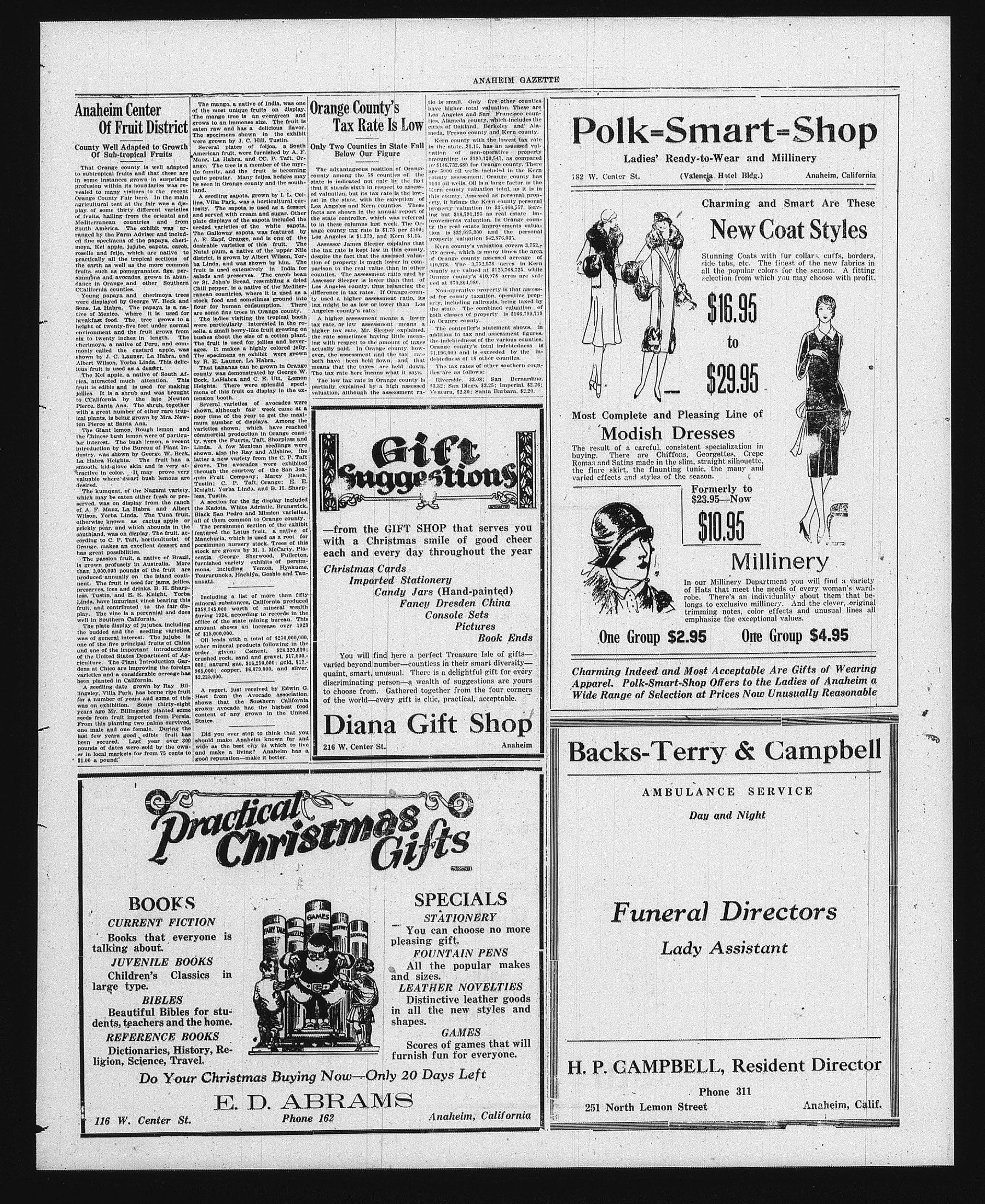
Anaheim Center Of Fruit District
County Well Adapted to Growth Of Sub-tropical Fruits
That Orange county is well adapted to subtropical fruits and that these are in some instances grown in surprising profusion within its boundaries was revealed to many visitors to the recent Orange County Fair here. In the main agricultural tent at the fair was a display of some thirty different varieties of fruits, hailing from the oriental and Mediterranean countries and from South America. The exhibit was arranged by the Farm Adviser and included fine specimens of the papaya, cherimoya, Kel apple, jujube, sapota, carob, roselle and feljo, which are native to practically all the tropical sections of the earth as well as the more common fruits such as pomegranates, figs, persimmons and avocados grown in abundance in Orange and other Southern California counties.
Young papaya and cherimoya trees were displayed by George W. Beck and Sons, La Habra. The papaya is a native of Mexico, where it is used for breakfast food. The tree grows to a height of twenty-five feet under normal environment and the fruit grows from six to twenty inches in length. The cherimoya, a native of Peru, and commonly called the custard apple, was shown by J. C. Launer, La Habra, and Albert Wilson, Yorba Linda. This delicious fruit is used as a dessert.
The Kei apple, a native of South Africa, attracted much attention. This fruit is edible and is used for making jellies. It is a shrub and was brought to California by the late Newton Pierce, Santa Ana. The shrub, together with a great number of other rare tropical plants, is being grown by Mrs. Newton Pierce at Santa Ana.
The Giant lemon, Rough lemon and the Chinese bush lemon were of particular interest. The bush lemon, a recent introduction by the Bureau of Plant In-
The mango, a native of India, was one of the most unique fruits on display. The mango tree is an evergreen and grows to an immense size. The fruit is eaten raw and has a delicious flavor. The specimens shown in the exhibit were grown by J. C. Hill, Tustin.
Several plates of feljo, a South American fruit, were furnished by A. F. Manz, La Habra, and CC. P. Taft, Orange. The tree is a member of the myrtle family, and the fruit is becoming quite popular. Many feljo hedges may be seen in Orange county and the southland.
A seedling sapota, grown by I. L. Collins, Villa Park, was a horticultural curiosity. The sapota is used as a dessert and served with cream and sugar. Other plate displays of the sapota included the seeded varieties of the white sapota. The Galloway sapota was featured by A. E. Zapf, Orange, and is one of the desirable varieties of this fruit. The Natal plum, a native of the upper Nile district, is grown by Albert Wilson, Yorba Linda, and was shown by him. The fruit is used extensively in India for salads and preserves. The carob or St John's Bread, resembling a dried Chill pepper, is a native of the Mediterranean countries, where it is used as a stock food and sometimes ground into flour for human consumption. There are some fine trees in Orange county.
The ladies visiting the tropical booth were particularly interested in the rosette, a small berry-like fruit growing on bushes about the size of a cotton plant. The fruit is used for jellies and beverages. It makes a highly colored jelly. The specimens on exhibit were grown by R. E. Launer, La Habra.
That bananas can be grown in Orange county was demonstrated by George W. Beck, LaHabra and C. E. Utt, Lemon Heights. There were splendid specimens of this fruit on display in the extension booth.
Several varieties of avocados were shown, although fair week came at a poor time of the year to get the maximum number of displays. Among the varieties shown, which have reached commercial production in Orange county, were the Fuente, Taft, Sharpless and Linda. A few Mexican seedlings were...
shown by J. C. Launer, La Habra, and Albert Wilson, Yorba Linda. This delicious fruit is used as a dessert.
The Kel apple, a native of South Africa, attracted much attention. This fruit is edible and is used for making jellies. It is a shrub and was brought to California by the late Newton Pierce, Santa Ana. The shrub, together with a great number of other rare tropical plants, is being grown by Mrs. Newton Pierce at Santa Ana.
The Giant lemon, Rough lemon and the Chinese bush lemon were of particular interest. The bush lemon, a recent introduction by the Bureau of Plant Industry, was shown by George W. Beck, La Habra Heights. The fruit has a smooth, kid-glove skin and is very attractive in color. It may prove very valuable where dwarf bush lemons are desired.
The kumquat, of the Nagami variety, which may be eaten either fresh or preserved, was on display from the ranch of A. F. Manz, La Habra and Albert Wilson, Yorba Linda. The Tuna fruit, otherwise known as cactus apple or prickly pear, and which abounds in the southland, was on display. The fruit, according to C. P. Taft, horticulturist of Orange, makes an excellent dessert and has great possibilities.
The passion fruit, a native of Brazil, is grown profusely in Australia. More than 3,000,000 pounds of the fruit are produced annually on the island continent. The fruit is used for jams, jellies, preserves, icees and drinks. B. H. Sharpless, Tustin, and E. E. Knight, Yorba Linda, have luxuriant vines bearing this fruit, and contributed to the fair display. The vine is a perennial and does well in Southern California.
The plate display of jujubes, including the budded and the seedling varieties, was of general interest. The jujube is one of the five principal fruits of China and one of the important introductions of the United States Department of Agriculture. The Plant Introduction Gardens at Chico are improving the foreign varieties and a considerable acreage has been planted in California.
A seedling date grown by Ray Billingsley, Villa Park, has borne ripe fruit for a number of years and some of this was on exhibition. Some thirty-eight years ago Mr. Billingsley planted some seeds from fruit imported from Persia. From this planting two palms survived, one male and one female. During the last few years good edible fruit has been secured. Last year over 300 pounds of dates were sold by the owner in local markets for from 75 cents to $1.00 a pound.
The specimens on exhibit were grown by R. E. Launer, La Habra.
That bananas can be grown in Orange county was demonstrated by George W. Beck, LaHabra and C. E. Utt, Lemon Heights. There were splendid specimens of this fruit on display in the extension booth.
Several varieties of avocados were shown, although fair week came at a poor time of the year to get the maximum number of displays. Among the varieties shown, which have reached commercial production in Orange county, were the Fuente, Taft, Sharpless and Linda. A few Mexican seedlings were shown, also the Ray and Allshine, the latter a new variety from the C. P. Taft grove. The avocados were exhibited through the courtesy of the San Joaquin Fruit Company; Marcy Ranch, Tustin; C. P. Taft; Orange; E. E. Knight, Yorba Linda, and B. H. Sharpless, Tustin.
A section for the fig display included the Kadota, White Adriatic, Brunswick, Black San Pedro and Mission varieties, all of them common to Orange county.
The persimmon section of the exhibit featured the Lotus fruit, a native of Manchuria, which is used as a root for persimmon nursery stock. Trees of this stock are grown by M. I. McCarty, Placentia George Sherwood, Fullerton, furnished variety exhibits of persimmons, including Yemon, Hyakume, Toururunoko, Hachiya, Goshlo and Tananashi.
Including a list of more than fifty mineral substances, California produced $358,745,000 worth of mineral wealth during 1924, according to records in the office of the state mining bureau. This amount shows an increase over 1923 of $15,000,000.
Oil leads with a total of $250,000,000; other mineral products following in the order given: Cement, $28,320,000; crushed rock, sand and gravel, $17,000,-000; natural gas, $16,250,000; gold, $12,-965,000; copper, $6,879,000; and silver,$2,225,000.
A report just received by Edwin G. Hart from the Avocado association shows that the Southern California grown avocado has the highest food content of any grown in the United States.
Did you ever stop to think that you should make Anaheim known far and wide as the best city in which to live and make a living? Anaheim has a good reputation—make it better.
Practical Christmas
BOOKS
CURRENT FICTION
Books that everyone is talking about.
JUVENILE BOOKS
Children's Classics in large type.
BIBLES
Beautiful Bibles for students, teachers and the home.
REFERENCE BOOKS
Dictionaries, History, Religion, Science, Travel.
Do Your Christmas Buying Now—
E. D. ABRAHAM
116 W. Center St.
Phone 162
ANAHEIM GAZETTE
Orange County’s Tax Rate Is Low
Only Two Counties in State Fall Below Our Figure
The advantageous position of Orange county among the 58 counties of the state is indicated not only by the fact that it stands sixth in respect to assessed valuation, but its tax rate is the lowest in the state, with the exception of Los Angeles and Kern counties. These facts are shown in the annual report of the state controller, which was referred to in these columns last week. The Orange county tax rate is $1.75 per 100; Los Angeles is $1.379, and Kern $1.15.
Assessor James Sleeper explains that the tax rate is kept low in this county, despite the fact that the assessed valuation of property is much lower in comparison to the real value than in other counties. The assessment ratio used by Assessor Sleeper is lower than that of Los Angeles county, thus balancing the difference in tax rates. If Orange county used a higher assessment ratio, its tax might be as low or lower than Los Angeles county's rate.
A higher assessment means a lower tax rate, or low assessment means a higher tax rate. Mr. Sleeper explained, the rate sometimes having little meaning with respect to the amount of taxes actually paid. In Orange county, however, the assessment and the tax rate both have been held down, and that means that the taxes are held down. The tax rate here means what it says.
The low tax rate in Orange county is partially explained by a high assessed valuation, although the assessment ratio is small. Only five other counties have higher total valuation. These are Los Angeles and San Francisco counties, Alameda county, which includes the cities of Oakland, Berkeley and Alameda, Fresno county and Kern county.
Kern county with the lowest tax rate in the state, $1.15, has an assessed valuation of non-operative property amounting to $180,120,547, as compared to $146,732,680 for Orange county. There are 5000 oil wells included in the Kern county assessment. Orange county has 1144 oil wells. Oil is a large factor in the Kern county valuation total, as it is in this county. Assessed as personal property, it brings the Kern county personal property valuation to $35,466,557, leaving but $18,791,195 as real estate improvements valuation. In Orange county the real estate improvements valuation is $32,925,300 and the personal property valuation $42,876,035.
Kern county's valuation covers 3,752,378 acres, which is many times the area of Orange county assessed acreage of 410,978. The 3,752,378 acres in Kern county are valued at $125,768,725, while Orange county's 410,978 acres are valued at $70,864,980.
Non-operative property is that assessed for county taxation, operative property, including railroads, being taxed by the state. The combined valuation of both classes of property is $166,799,719 in Orange county.
The controller's statement shows, in addition to tax and assessment figures, the indebtedness of the various counties. Orange county's total indebtedness is $1196,000 and is exceeded by the indebtedness of 18 other counties.
The tax rates of other southern counties are as follows:
Riverside, $3.08; San Bernardino, $3.32; San Diego, $3.25; Imperial, $2.26; Ventura, $2.30; Santa Barbara, $2.20.
Gift Suggestions
—from the GIFT SHOP that serves you with a Christmas smile of good cheer each and every day throughout the year
Christmas Cards
Imported Stationery
Candy Jars (Hand-painted)
Fancy Dresden China
Console Sets
Pictures
Book Ends
You will find here a perfect Treasure Isle of gifts—varied beyond number—countless in their smart diversity—quaint, smart, unusual. There is a delightful gift for every discriminating person—a wealth of suggestions are yours to choose from. Gathered together from the four corners of the world—every gift is chic, practical, acceptable.
Diana Gift Shop
216 W. Center St.
Anaheim
Christmas Gifts
SPECIALS
STATIONERY
You can choose no more pleasing gift.
FOUNTAIN PENS
All the popular makes and sizes.
LEATHER NOVELTIES
Distinctive leather goods in all the new styles and shapes.
GAMES
Scores of games that will furnish fun for everyone.
Buying Now—Only 20 Days Left
ABRAMS
phone 162
Anaheim, California
lk=Smart=Shop
Ladies' Ready-to-Wear and Millinery
er St. (Valencia Hotel Bldg.) Anaheim, California
Charming and Smart Are These
New Coat Styles
Stunning Coats with fur collars, cuffs, borders,
side tabs, etc. The finest of the new fabrics in
all the popular colors for the season. A fitting
selection from which you may choose with profit.
$16.95
to
$29.95
Complete and Pleasing Line of
Modish Dresses
$29.95
Complete and Pleasing Line of
Modish Dresses
of a careful, consistent specialization in
here are Chiffons, Georgettes, Crepe
hatins made in the slim, straight silhouette,
sirt, the flaunting tunic, the many and
and styles of the season.
Formerly to
$23.95—Now
$10.95
Millinery
In our Millinery Department you will find a variety
of Hats that meet the needs of every woman's wardrobe. There's an individuality about them that belongs to exclusive millinery. And the clever, original
trimming notes, color effects and unusual lines all
emphasize the exceptional values.
One Group $2.95 One Group $4.95
Indeed and Most Acceptable Are Gifts of Wearing
Polk-Smart-Shop Offers to the Ladies of Anaheim a
age of Selection at Prices Now Unusually Reasonable
Ks-Terry & Campbell
AMBULANCE SERVICE
Day and Night
AMBULANCE SERVICE
Day and Night
Funeral Directors
Lady Assistant
CAMPBELL, Resident Director
Phone 311
North Lemon Street Anaheim, Calif.