anaheim-gazette 1925-11-26
Scanned page
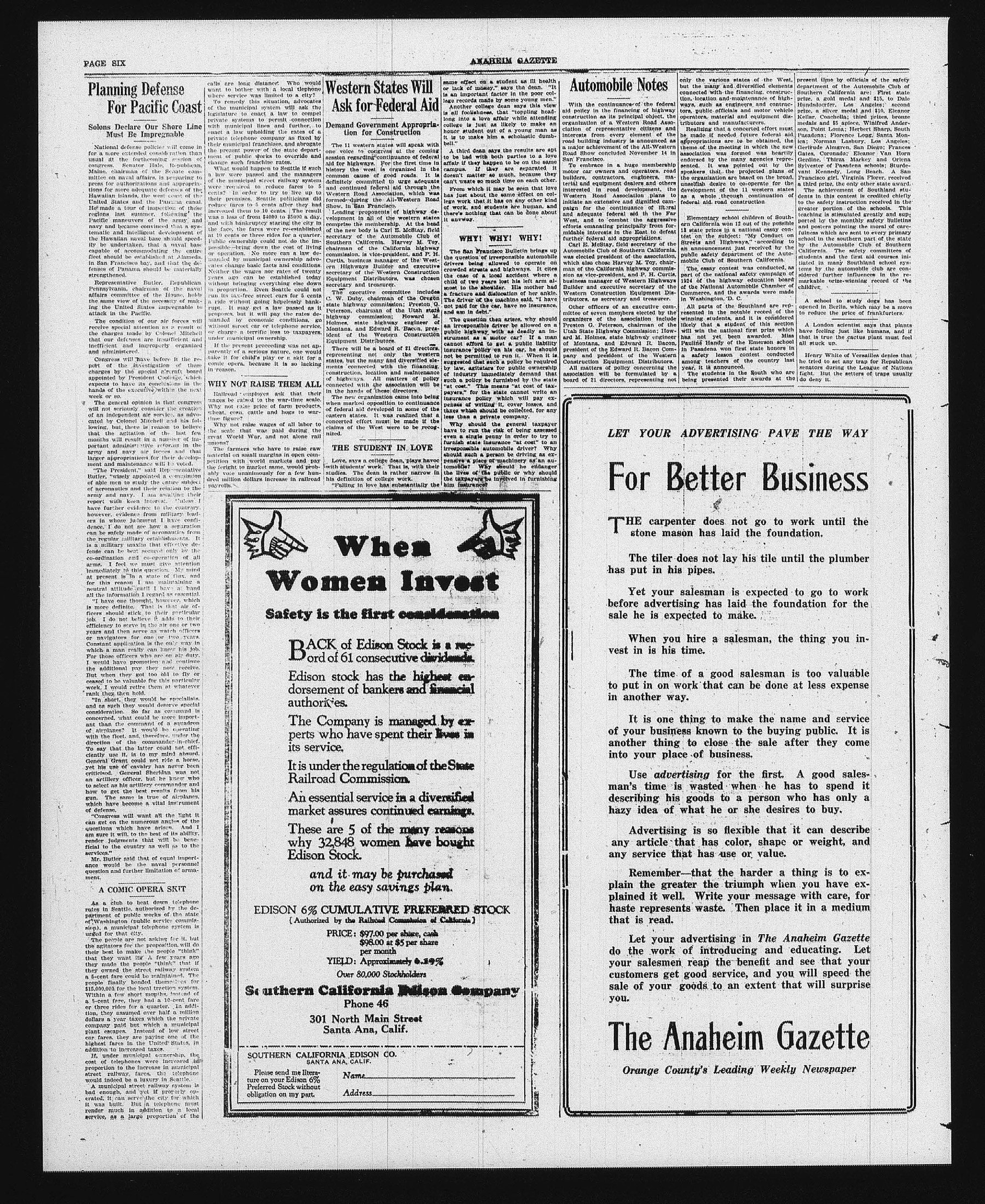
Searchable text
Planning Defense For Pacific Coast
Solons Declare Our Shore Line Must Be Impregnable
National defense policies will come in for a more extended consideration than usual at the forthcoming session of congress. Senator Hale, Republican, Maine, chairman of the Senate committee on naval affairs, is preparing to press for authorizations and appropriations for more adequate defenses of the Hawaiian islands, the west coast of the United States and the Panama canal. He made a tour of inspection of these regions last summer, following the Pacific maneuvers of the army and navy and became convinced that a systematic and intelligent development of the Hawaiian naval base should speedily be undertaken, that a naval base capable of accommodating the entire fleet should be established at Alameda, in San Francisco bay, and that the defenses of Panama should be materially strengthened.
Representative Butler, Republican, Pennsylvania, chairman of the naval affairs committee of the House, holds the same view of the necessity of making the United States impregnable to attack in the Pacific.
The condition of our air forces will receive special attention as a result of the charges made by Colonel Mitchell that our defenses are insufficient and inefficient and improperly organized and administered.
Congress will have before it the report of the investigation of these charges by the special aircraft board appointed by President Coolidge, which expects to have its conclusions in the hands of the executive within the next week or so.
The general opinion is that congress will not seriously consider the creation of an independent air service, as advocated by Colonel Mitchell and his following, but there is reason to believe that the agitation of the last few months will result in a number of important administrative reforms in the calls are long distance. Who would want to bother with a local telephone where service was limited to a city?
To remedy this situation, advocates of the municipal system will ask the legislature to enact a law to compel private systems to permit connection with municipal lines and further, to enact a law upholding the rates of a private telephone company as fixed by their municipal franchises, and abrogate the present power of the state department of public works to override and change such franchise rates.
What would happen to Seattle if such a law were passed and the managers of the municipal street railway system were required to reduce fares to 5 cents? In order to try to live up to their promises, Seattle politicians did reduce fares to 5 cents after they had increased them to 10 cents. The result was a loss of from $4000 to $5000 a day, and with bankruptcy staring the city in the face, the fares were re-established at 10 cents or three rides for a quarter. Public ownership could not do the impossible—bring down the cost of living or operation. No more can a law demanded by municipal ownership advocate change basic facts and conditions. Neither the wages nor rates of twenty years ago can be established today without bringing everything else down in proportion. Even Seattle could not run its tax-free street cars for 5 cents a ride without going hopelessly bankrupt. It may get a law passed as it proposes, but it will pay the rates demanded by economic conditions, go without street car or telephone service, or charge a terrific loss to taxpayers, under municipal ownership.
If the present proceeding was not apparently of a serious nature, one would take it for child's play or a skit for a comic opera, because it is so lacking in reason.
WHY NOT RAISE THEM ALL
Railroad employees ask that their wages be raised to the war-time scale. Why not raise price of farm products, wheat, corn, cattle and hogs to war-time figure?
Why not raise wages of all labor to the scale that was paid during the great World War, and not alone rail unions?
The farmers who have to raise raw calls are long distance. Who would want to bother with a local telephone where service was limited to a city?
To remedy this situation, advocates of the municipal system will ask the legislature to enact a law to compel private systems to permit connection with municipal lines and further, to enact a law upholding the rates of a private telephone company as fixed by their municipal franchises, and abrogate the present power of the state department of public works to override and change such franchise rates.
What would happen to Seattle if such a law were passed and the managers of the municipal street railway system were required to reduce fares to 5 cents? In order to try to live up to their promises, Seattle politicians did reduce fares to 5 cents after they had increased them to 10 cents. The result was a loss of from $4000 to $5000 a day, and with bankruptcy staring the city in the face, the fares were re-established at 10 cents or three rides for a quarter. Public ownership could not do the impossible—bring down the cost of living or operation. No more can a law demanded by municipal ownership advocate change basic facts and conditions. Neither the wages nor rates of twenty years ago can be established today without bringing everything else down in proportion. Even Seattle could not run its tax-free street cars for 5 cents a ride without going hopelessly bankrupt. It may get a law passed as it proposes, but it will pay the rates demanded by economic conditions, go without street car or telephone service, or charge a terrific loss to taxpayers, under municipal ownership.
If the present proceeding was not apparently of a serious nature, one would take it for child's play or a skit for a comic opera, because it is so lacking in reason.
WHY NOT RAISE THEM ALL
Railroad employees ask that their wages be raised to the war-time scale. Why not raise price of farm products, wheat, corn, cattle and hogs to war-time figure?
Why not raise wages of all labor to the scale that was paid during the great World War, and not alone rail unions?
The farmers who have to raise raw calls are long distance. Who would want to bother with a local telephone where service was limited to a city?
To remedy this situation, advocates of the municipal system will ask the legislature to enact a law to compel private systems to permit connection with municipal lines and further, to enact a law upholding the rates of a private telephone company as fixed by their municipal franchises, and abrogate the present power of the state department of public works to override and change such franchise rates.
What would happen to Seattle if such a law were passed and the managers of the municipal street railway system were required to reduce fares to 5 cents? In order to try to live up to their promises, Seattle politicians did reduce fares to 5 cents after they had increased them to 10 cents. The result was a loss of from $4000 to $5000 a day, and with bankruptcy staring the city in the face, the fares were re-established at 10 cents or three rides for a quarter. Public ownership could not do the impossible—bring down the cost of living or operation. No more can a law demanded by municipal ownership advocate change basic facts and conditions. Neither the wages nor rates of twenty years ago can be established today without bringing everything else down in proportion. Even Seattle could not run its tax-free street cars for 5 cents a ride without going hopelessly bankrupt. It may get a law passed as it proposes, but it will pay the rates demanded by economic conditions, go without street car or telephone service, or charge a terrific loss to taxpayers, under municipal ownership.
If the present proceeding was not apparently of a serious nature, one would take it for child's play or a skit for a comic opera, because it is so lacking in reason.
WHY NOT RAISE THEM ALL
Railroad employees ask that their wages be raised to the war-time scale. Why not raise price of farm products, wheat, corn, cattle and hogs to war-time figure?
Why not raise wages of all labor to the scale that was paid during the great World War, and not alone rail unions?
The farmers who have to raise raw calls are long distance. Who would want to bother with a local telephone where service was limited to a city?
To remedy this situation, advocates of the municipal system will ask the legislature to enact a law to compel private systems to permit connection with municipal lines and further, to enact a law upholding the rates of a private telephone company as fixed by their municipal franchises, and abrogate the present power of the state department of public works to override and change such franchise rates.
What would happen to Seattle if such a law were passed and the managers of the municipal street railway system were required to reduce fares to 5 cents? In order to try to live up to their promises, Seattle politicians did reduce fares to 5 cents after they had increased them to 10 cents. The result was a loss of from $4000 to $5000 a day, and with bankruptcy staring the city in the face, the fares were re-established at 10 cents or three rides for a quarter. Public ownership could not do the impossible—bring down the cost of living or operation. No more can a law demanded by municipal ownership advocate change basic facts and conditions. Neither the wages nor rates of twenty years ago can be established today without bringing everything else down in proportion. Even Seattle could not run its tax-free street cars for 5 cents a ride without going hopelessly bankrupt. It may get a law passed as it proposes, but it will pay the rates demanded by economic conditions, go without street car or telephone service, or charge a terrific loss to taxpayers, under municipal ownership.
If the present proceeding was not apparently of a serious nature, one would take it for child's play or a skit for a comic opera, because it is so lacking in reason.
WHY NOT RAISE THEM ALL
Railroad employees ask that their wages be raised to the war-time scale. Why not raise price of farm products, wheat, corn, cattle and hogs to war-time figure?
Why not raise wages of all labor to the scale that was paid during the great World War, and not alone rail unions?
The farmers who have to raise raw calls are long distance. Who would want to bother with a local telephone where service was limited to a city?
To remedy this situation, advocates of the municipal system will ask that legislature enact a law for highways history—the ww common cause definitely commits and continued Western Road-formed during Show. in San Secretary of State Southern Call chairman of commission; is Curtis; business Cern Highways secretary of Department D secretary and d.
The executu C.W.Duby.state highwayPeterson.challenghighway comHolmes.stateMontana,andidentoftheEquipmentDistrictTherewillberepresentingstates,butthemeansconnectconstruction.lofhighwaysconnectedwithinthehandsc.Onewrgewhenmarkedoffederalaidc.easternstates.concertedeffortclaimsoftheeized.
THE STUDIO
Congress will have before it the report of the investigation of these charges by the special aircraft board appointed by President Coolidge, which expects to have its conclusions in the hands of the executive within the next week or so.
The general opinion is that congress will not seriously consider the creation of an independent air service, as advocated by Colonel Mitchell and his following, but there is reason to believe that the agitation of the last few months will result in a number of important administrative reforms in the army and navy air forces and that larger appropriations for their development and maintenance will be voted.
"The President," said Representative Butler, "wisely appointed a commission of able men to study the entire subject of aeronautics and their relation to the army and navy. I am awaiting their report with keen interest. Unless I have further evidence to the contrary, however, evidence from military leaders in whose judgment I have confidence. I do not see how a separation can be safely made of aeronautics from the regular military establishments. It is a military maxim that effective defense can be best secured only by the co-ordination and co-operation of all arms. I feel we must give attention immediately to this question. My mind at present is in a state of flux, and for this reason I am maintaining a neutral attitude until I have at hand all the information I regard as essential.
"I have one thought, however, which is more definite. That is that air officers should stick to their particular job. I do not believe it adds to their efficiency to serve in the air one or two years and then serve as watch officers or navigators for one or two years. Constant application is the only way in which a man really can know his job. For those officers who are on air duty, I would have promotion and continue the additional pay they now receive. But when they got too old to fly or ceased to be valuable for this particular work, I would retire them at whatever rank they then hold.
"In short, they would be specialists, and as such they would deserve special consideration. So far as command is concerned, what could be more important than the command of a squadron of airplanes? It would be operating with the fleet, and, therefore, under the direction of the commander-in-chief. To say that the latter could not efficiently use it, is to my mind absurd. General Grant could not ride a horse, yet his use of cavalry has never been criticised. General Sheridan was not an artillery officer, but he knew who to select as his artillery commander and how to get the best results from his gun. The same is true of airplanes, which have become a vital instrument of defense."
Congress will want all the light it can get on the numerous angles of the questions which have arisen. And I am sure it will, to the best of its ability, render judgments that will be beneficial to the country as well as to the comic opera, because it is so lacking in reason.
WHY NOT RAISE THEM ALL
Railroad employees ask that their wages be raised to the war-time scale. Why not raise price of farm products, wheat, corn, cattle and hogs to war-time figure?
Why not raise wages of all labor to the scale that was paid during the great World War, and not alone rail unions?
The farmers who have to raise raw material on small margins in open competition with world markets and pay the fretight to market same, would probably vote unanimously for a few hundred million dollars increase in railroad payrolls.
Love says a with students' studies. The city his definition o "Falling in l
General Grant could not ride a horse, yet his use of cavalry has never been criticised. General Sheridan was not an artillery officer, but he knew who to select as his artillery commander and how to get the best results from his gun. The same is true of airplanes, which have become a vital instrument of defense.
"Congress will want all the light it can get on the numerous angles of the questions which have arisen. And I am sure it will, to the best of its ability, render judgments that will be beneficial to the country as well as to the services."
Mr. Butler said that of equal importance would be the naval personnel question and further limitation of armament.
A COMIC OPERA SKIT
As a club to beat down telephone rates in Seattle, authorized by the department of public works of the state of Washington (public service commission), a municipal telephone system is urged for that city.
The people are not asking for it, but the agitators for the proposition will do their best to make the people "think" that they want it. A few years ago they made the people "think" that if they owned the street railway system a 5-cent fare could be maintained. The people finally bonded themselves for $15,000,000, for the local traction system. Within a few short months, instead of a 5-cent fare, they had a 10-cent fare or three rides for a quarter. In addition, they assumed over half a million dollars a year taxes which the private company paid but which a municipal plant escapes. Instead of low street car fares, they are paying one of the highest fares in the United States, in addition to increased taxes.
If, under municipal ownership, the cost of telephones were increased in proportion to the increase in municipal street railway fares, the telephone would indeed be a luxury in Seattle.
A municipal street railway system is bad enough, and yet if properly operated, it can serve the city for which it was built. But a telephone must render much in addition to a local service, as a large proportion of the
Western States Will Ask for Federal Aid
Demand Government Appropriation for Construction
The 11 western states will speak with one voice to congress at the coming session regarding continuance of federal aid for highways. For the first time in history the west is organized in the common cause of good roads. It is definitely committed to urge adequate and continued federal aid through the Western Road Association, which was formed during the All-Western Road Show, in San Francisco.
Leading proponents of highway development in all of the western states comprise the membership. At the head of the new body is Carl E. McStay, field secretary of the Automobile Club of Southern California. Harvey M. Toy, chairman of the California highway commission, is vice-president, and P. H. Curtis, business manager of the Western Highways Builder and executive secretary of the Western Construction Equipment Distributors, was chosen secretary and treasurer.
The executive committee includes C. W. Duby, chairman of the Oregon state highway commission; Preston G. Peterson, chairman of the Utah state highway commission; Howard M. Holmes, state highway engineer of Montana, and Edward R. Bacon, president of the Western Construction Equipment Distributors.
There will be a board of 21 directors representing not only the western states, but the many diversified elements connected with the financing, construction, location and maintenance of highways. All matters of policy connected with the association will be in the hands of these directors.
The new organization came into being when marked opposition to continuance of federal aid developed in some of the eastern states. It was realized that a concerted effort must be made if the claims of the West were to be recognized.
THE STUDENT IN LOVE
same effect on a student as ill health or lack of money," says the dean. "It is an important factor in the poor college records made by some young men."
Another college dean says this view is all foolishness, that "toppling headlong into a love affair while attending college is just as likely to make an honor student out of a young man as it is to make him a scholastic dumbbell."
A third dean says the results are apt to be bad with both parties to a love affair if they happen to be on the same campus. If they are separated it doesn't matter so much, because they can't waste so much time on each other.
From which it may be seen that love has just about the same effect on college work that it has on any other kind of work, and students are human, and nothing that can be done about it anyway.
WHY! WHY! WHY!
The San Francisco Bulletin brings up the question of irresponsible automobile drivers being allowed to operate on crowded streets and highways. It cites the case of a local accident where a child of two years lost his left arm almost to the shoulder. His mother had a fracture and dislocation of her ankle. The driver of the machine said, "I have not paid for the car, have no insurance, and am in debt."
The question then arises, why should an irresponsible driver be allowed on a public highway with as deadly an instrument as a motor car? If a man cannot afford to get a public liability insurance policy on his car, he should not be permitted to run it. When it is suggested that such a policy be required by law, agitators for public ownership of industry immediately demand that such a policy be furnished by the state "at cost." This means "at cost of taxpayers," for the state cannot write an insurance policy which will pay expenses of writing it, cover losses, and taxes which should be collected, for any less than a private company.
Why should the general taxpayer have to run the risk of being assessed even a single penny in order to furnish state insurance "at cost" to an irresponsible automobile driver?
Automobile Notes
With the continuance of the federal aid policy in the financing of highway construction as its principal object, the organization of a Western Road Association of representative citizens and interests from every element of the road building industry is announced as a major achievement of the All-Western Road show concluded November 14 in San Francisco.
To embrace in a huge membership motor car owners and operators, road builders, contractors, engineers, material and equipment dealers and others interested in road development, the Western Road Association plans to initiate an extensive and dignified campaign for the continuance of liberal and adequate federal aid in the Far West, and to combat the aggressive efforts emanating principally from formidable interests in the East to defeat further federal aid appropriations.
Carl E. McStay, field secretary of the Automobile Club of Southern California, was elected president of the association, which also chose Harvey M. Toy, chairman of the California highway commission as vice-president, and P. H. Curtis, business manager of Western Highways Builder and executive secretary of the Western Construction Equipment Distributors, as secretary and treasurer.
Other officers of an executive committee of seven members elected by the organizers of the association include Preston G. Peterson, chairman of the Utah State Highway Commission; Howard M. Holmes, state highway engineer of Montana, and Edward R. Bacon, president of the Edward R. Bacon Company and president of the Western Construction Equipment Distributors.
All matters of policy concerning the association will be formulated by a board of 21 directors, representing not only but their connection with all ways, operations and tributes.
All present winners likely will have Pauline In Pa's assistance year.
The part of 1924 of the Commissio in War.
All present winners likely will have Pauline In Pa's assistance year.
The part of 1924 of the Commissio in War.
LET YOUR AD
representing not only the western states, but the many and diversified elements connected with the financing, construction, location and maintenance of highways. All matters of policy connected with the association will be in the hands of these directors.
The new organization came into being when marked opposition to continuance of federal aid developed in some of the eastern states. It was realized that a concerted effort must be made if the claims of the West were to be recognized.
THE STUDENT IN LOVE
Love, says a college dean, plays havoc with students' work. That is, with their studies. The dean is rather narrow in his definition of college work.
"Fulling in love has substantially the
When Women Invest
ety is the first consideration
BACK of Edison Stock is a record of 61 consecutive dividends.
Edison stock has the highest endorsement of bankers and financial authorities.
The Company is managed by experts who have spent their lives in its service.
It is under the regulation of the State Railroad Commission.
An essential service in a diversified market assures continued earnings.
These are 5 of the many reasons why 32,848 women have bought
It is under the regulation of the State Railroad Commission.
An essential service in a diversified market assures continued earnings.
These are 5 of the many reasons why 32,848 women have bought Edison Stock.
and it may be purchased on the easy savings plan.
6% Cumulative Preferred Stock
[Authorized by the Railroad Commission of California]
PRICE: $97.00 per share, cash
$98.00 at $5 per share
per month
YIELD: Approximately 0.19%
Over 80,000 Stockholders
Eastern California Edison Company
Phone 46
301 North Main Street
Santa Ana, Calif.
CALIFORNIA EDISON CO.
SANTA ANA, CALIF.
Name
Address
Mobil Notes
Advances of the federal financing of highway principal object, the Western Road Association citizens and every element of the industry is announced as part of the All-Western meeting November 14 in a huge membership and operators, road makers, engineers, manufacturers, material and equipment distributors and manufacturers.
Realizing that a concerted effort must be made if needed future federal aid appropriations are to be obtained, the theme of the meeting in which the new association was formed was heartily endorsed by the many agencies represented. It was pointed out by the speakers that the projected plans of the organization are based on the broad, unselfish desire to co-operate for the development of the 11 western states as a whole through continuation of federal aid road construction.
Elementary school children of Southern California won 12 out of the possible 13 state prizes in a national essay contest on the subject: "My Conduct on Streets and Highways," according to an announcement just received by the public safety department of the Automobile Club of Southern California.
The essay contest was conducted, as part of the national safety campaign of 1924 of the highway education board of the National Automobile Chamber of Commerce, and the awards were made in Washington, D.C.
All parts of the Southland are represented in the notable record of winning students, and it is considered likely that a student of this section will win the national first prize which has not yet been awarded. Miss Pauline Handy of the Emerson school in Pasadena won first state honors in a safety lesson contest conducted among teachers of the country last year, it is announced.
The students in the South who are being presented their awards at the present time by officials of the safety department of the Automobile Club of Southern California are: First state prize, a gold medal and $15, to Dale Hundslocferer, Los Angeles; second prize, a silver medal and $10, Eleanor Kellar, Conchella; third prizes, bronze medals and $5 apiece, Winifred Anderson, Point Loma; Herbert Sharp, South Pasadena; Florence Long, Santa Monica; Norman Lasbury, Los Angeles; Gertrude Almgren, San Diego; Frances Gates, Coronado; Eleanor Van Horn Gerdine, Thirza Markey and Orlena Sylvester of Pasadena schools; Sturdevant Kennedy, Long Beach. A San Francisco girl, Virginia Flerer, received a third prize, the only other state award.
The achievement of Southland students in this contest is credited chiefly to the safety instruction received in the greater portion of the schools. This teaching is stimulated greatly and supported by the monthly safety bulletins and posters pointing the moral of carefulness which are sent to every primary school in the southern part of the state by the Automobile Club of Southern California. The safety committees of students and the first aid courses initiated in many Southland school systems by the automobile club are considered further influences in the remarkable prize-winning record of the children.
A school to study dogs has been opened in Berlin, which may be a move to reduce the price of frankfurters.
A London scientist says that plants have feeling just like humans, and if that is true the cactus plant must feel all stuck up.
Henry White of Versailles denies that he tried to set any trap for Republican senators during the League of Nations fight. But the setters of traps usually do deny it.
SET YOUR ADVERTISING PAVE THE WAY
For Better Business
THE carpenter does not go to work until the stone mason has laid the foundation.
The tiler does not lay his tile until the plumber has put in his pipes.
Yet your salesman is expected to go to work before advertising has laid the foundation for the sale he is expected to make.
When you hire a salesman, the thing you invest in is his time.
The time of a good salesman is too valuable to put in on work that can be done at less expense another way.
It is one thing to make the name and service of your business known to the buying public. It is another thing to close the sale after they come into your place of business.
Use advertising for the first. A good salesman's time is wasted when he has to spend it describing his goods to a person who has only a lazy idea of what he or she desires to buy.
Advertising is so flexible that it can describe any article that has color, shape or weight, and
Use advertising for the first. A good salesman's time is wasted when he has to spend it describing his goods to a person who has only a lazy idea of what he or she desires to buy.
Advertising is so flexible that it can describe any article that has color, shape or weight, and any service that has use or value.
Remember—that the harder a thing is to explain the greater the triumph when you have explained it well. Write your message with care, for waste represents waste. Then place it in a medium that is read.
Let your advertising in The Anaheim Gazette do the work of introducing and educating. Let your salesmen reap the benefit and see that your customers get good service, and you will speed the sale of your goods to an extent that will surprise you.
The Anaheim Gazette
Orange County's Leading Weekly Newspaper