anaheim-gazette 1925-10-01
Scanned page
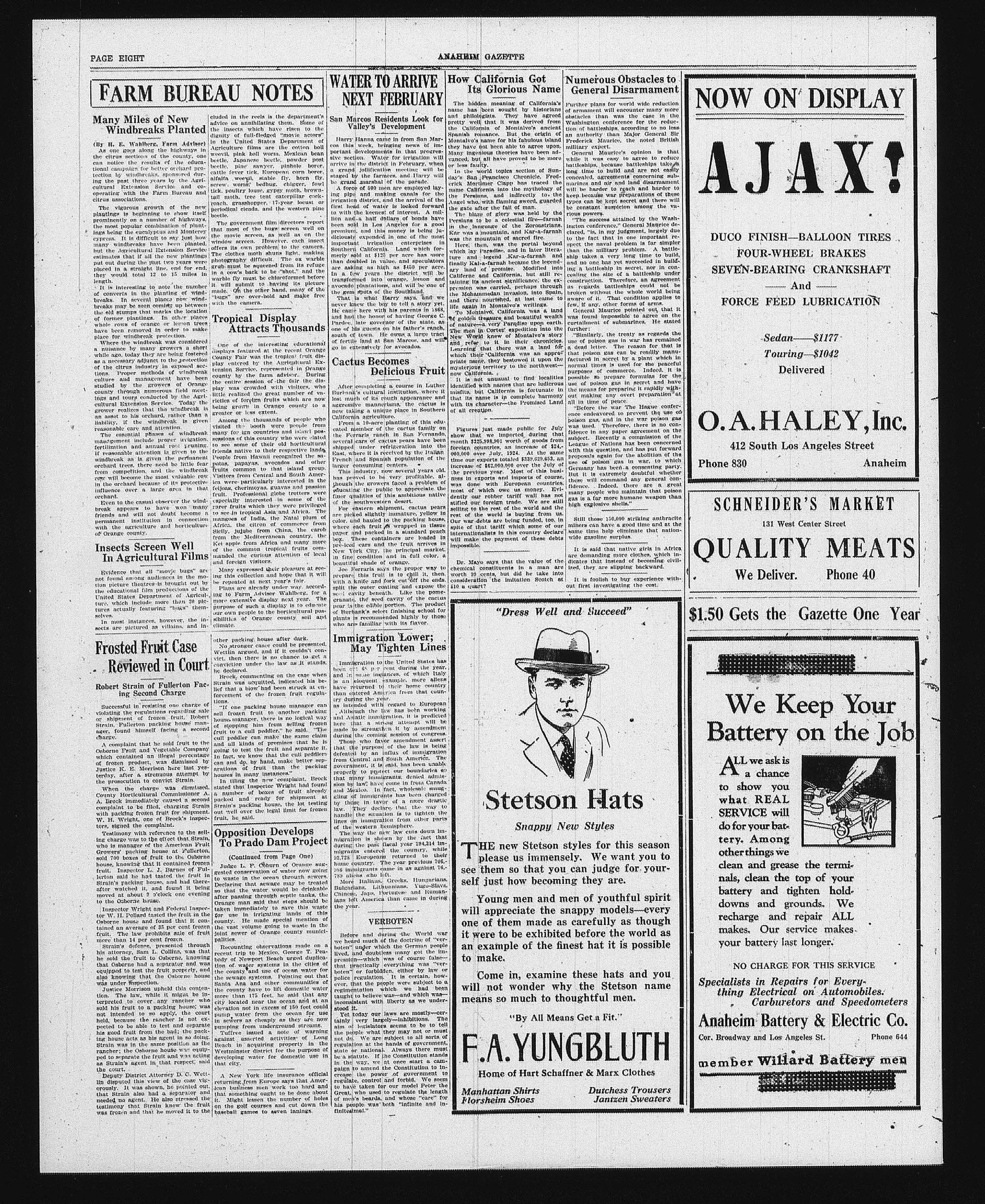
Searchable text
FARM BUREAU NOTES
Many Miles of New Windbreaks Planted
(By H. E. Wahlberg, Farm Advisor)
As one goes along the highways in the citrus sections of the county, one can notice the results of the educational campaign for better orchard protection by windbreaks, sponsored during the past three years by the Agricultural Extension Service and cooperating with the Farm Bureau and citrus associations.
The vigorous growth of the new plantings is beginning to show itself prominently on a number of highways, the most popular combination of plantings being the eucalyptus and Monterey cypress. It is difficult to say just how many windbreaks have been planted, but the Agricultural Extension Service estimates that if all the new plantings put out during the past two years were placed in a straight line, end for end, they would total 12 to 15 miles in length.
It is interesting to note the number of converts in the planting of windbreaks. In several places now windbreaks may be seen coming up between the old stumps that marks the location of former plantings. In other places whole rows of orange or lemon trees have been removed in order to make place for windbreak protection.
Where the windbreak was considered a nuisance by many growers a short while ago, today they are being fostered as a necessary adjunct to the protection of the citrus industry in exposed sections. Proper methods of windbreak culture and management have been studied by the growers of Orange county through numerous field meetings and tours conducted by the Agricultural Extension Service. Today the grower realizes that the windbreak is an asset to his orchard, rather than a liability, if the windbreak is given reasonable care and attention.
The essential phases of windbreak management include proper irrigation, fertilization and annual root pruning.
included in the reels is the department's advice on annihilating them. Some of the insects which have risen to the dignity of full-fledged "movie actors" in the United States Department of Agriculture films are the cotton boll weevil, pink boll worm, Mexican bean beetle, Japanese beetle, powder post beetle, pine sawyer, pinhole borer, cattle fever tick, European corn borer, alfalfa weevil, stable fly, horn fly, screw worm, bedbug, chigger, fowl tick, poultry louse, gypsy moth, brown-tail moth, tree tent caterpillar cockroach, grasshopper, 17-year locust or periodical cicada, and the western pine beetle.
The government film directors report that most of the bugs screen well on the movie screen, as well as on the window screen. However, each insect offers its own problem to the camera. The clothes moth shunts light, making photography difficult. The ox warble grub must be squeezed from its refuge in a cow's back to be "shot," and the warble fly must be chloroformed before it will submit to having its picture made. On the other hand, many of the "bugs" are over-bold and make free with the camera.
Tropical Display Attracts Thousands
One of the interesting educational displays featured at the recent Orange County Fair was the tropical fruit display entered by the Agricultural Extension Service, represented in Orange county by the farm advisor. During the entire session of the fair the display was crowded with visitors, who little realized the great number of varieties of foreign fruits which are now being grown in Orange county to a greater or less extent.
Among the thousands of people who visited the booth were people from many foreign countries and island possessions of this country who were elated to see some of their old horticultural lands.
while ago, today they are being fostered as a necessary adjunct to the protection of the citrus industry in exposed sections. Proper methods of windbreak culture and management have been studied by the growers of Orange county through numerous field meetings and tours conducted by the Agricultural Extension Service. Today the grower realizes that the windbreak is an asset to his orchard, rather than a liability, if the windbreak is given reasonable care and attention.
The essential phases of windbreak management include proper irrigation, fertilization and annual root pruning. If reasonable attention is given to the windbreak as is given the permanent orchard trees, there need be little fear from competition, and the windbreak row will become the most valuable row in the orchard because of its protective influence over a large area in that orchard.
Even to the casual observer the windbreak appears to have won many friends and will not doubt become a permanent institution in connection with the agriculture and horticulture of Orange county.
Insects Screen Well In Agricultural Films
Evidence that all "movie bugs" are not found among audiences in the motion picture theatres is brought out by the educational film productions of the United States Department of Agriculture, which include more than 20 pictures actually featuring "bugs" themselves.
In most instances, however, the insects are pictured as villains, and in other packing house after dark.
No stronger case could be presented. Wettlin argued, and if it couldn't convict, then there is no chance to get a conviction under the law as it stands, he declared.
Brock commenting on the case when Strain was acquitted, indicated his belief that a blow had been struck at enforcement of the frozen fruit regulations.
"If one packing house manager can sell frozen fruit to another packing house manager, there is no logical way of stopping him from selling frozen fruit to a cull peddler," he said. "The cull peddler can make the same claim and all kinds of promises that he is going to test the fruit and separate it. In fact, we know that the cull peddlers can and do, by hand, make better separations of fruit than the packing houses in many instances."
In filing the new complaint, Brock stated that Inspector Wright had found a number of boxes of fruit already packed and ready for shipment at Strain's packing house, the lot testing out well over the legal limit for frozen fruit, he said.
Opposition Develops To Prado Dam Project
After compiling Burbank's cut lost much of aggressive mail now taking California into account.
From a 10-cited member of the Ferraris several cars shipped uncleast East, where French and larger consuls.
This industry has proved through the educating the finer quality of the south.
For easter are picked up color, and here each paper and pog. These are pre-iced car New York City in fine cone beautiful shine.
Joe Ferrari prepare this with a knife split the our seed cavity granate, the pear is the oak of Burbank's plants is recalled who are fami
which contained an illegal percentage of frozen product, was dismissed by Justice K. E. Morrison here last yesterday, after a strenuous attempt by the prosecution to convict Strain.
When the charge was dismissed, County Horticultural Commissioner A. A. Brock immediately caused a second complaint to be filed, charging Strain with packing frozen fruit for shipment. W. H. Wright, one of Brock's inspectors, signed the complaint.
Testimony with reference to the selling charge was to the effect that Strain, who is manager of the American Fruit Growers' packing house at Fullerton, sold 700 boxes of fruit to the Osborne house, knowing that it contained frozen fruit. Inspector L. J. Barnes of Fullerton said he had tasted the fruit in Strain's packing house, and had thereafter watched it, and found it being moved at about 9 o'clock one evening to the Osborne house.
Inspector Wright and Federal Inspector W. H. Pollard tasted the fruit in the Osborne house and found that it contained an average of 35 per cent frozen fruit. The law prohibits sale of fruit more than 14 per cent frozen.
Strain's defense, presented through his attorney, Sam L. Collins, was that he sold the fruit to Osborne, knowing that Osborne had a separator and was equipped to test the fruit properly, and also knowing that the Osborne house was under inspection.
Justice Morrison upheld this contention. The law, while it might be interpreted to cover any rancher who sold his fruit to a packing house; was not intended to so apply, the court held, because the rancher is not expected to be able to test and separate his good fruit from the bad; the packing house acts as his agent in so doing. Strain was in the same position as the rancher; the Osborne house was equipped to separate the fruit and was acting as Strain's agent in that respect, said the court.
Deputy District Attorney D. C. Wettlin disputed this view of the case vigorously. It was shown, he pointed out, that Strain also had a separator and needed no agent. He also stressed the testimony that Strain knew the fruit was frozen and that he moved it to the
Opposition Develops To Prado Dam Project
(Continued from Page One)
Judge L. F. Coburn of Orange suggested conservation of water now going to waste in the ocean through sewers. Declaring that sewage may be treated so that the water would be drinkable after passing through septic tanks, the Orange man said that steps should be taken immediately to save this waste for use in irrigating lands of this county. He made special mention of the vast volume going to waste in the joint sewer of Orange county municipalities.
Recounting observations made on a recent trip to Mexico, George T. Peabody of Newport Beach urged duplication of water systems in the cities of the county and use of ocean water for the sewage systems. Pointing out that Santa Ana and other communities of the county have to lift domestic water more than 175 feet, he said that any city located near the ocean and at an elevation not in excess of 150 feet could pump water from the ocean for use in sewers as cheaply as they are now pumping from underground streams.
Tuffree issued a note of warning against asserted activities of Long Beach in acquiring property in the Westminster district for the purpose of developing water for domestic use in that city.
A New York life insurance official returning from Europe says that American business men work too hard and that something ought to be done about it. Might lessen the number of holes on the golf courses and cut down the baseball games to save innings.
In fact, we know that the can peeled can and do, by hand, make better separations of fruit than the packing houses in many instances."
In filling the new complaint, Brock stated that Inspector Wright had found a number of boxes of fruit already packed and ready for shipment at Strain's packing house, the lot testing out well over the legal limit for frozen fruit, he said.
WATER TO ARRIVE NEXT FEBRUARY
San Marcos Residents Look for Valley's Development
Harry Hanna came in from San Marcos this week, bringing news of important developments in that progressive section. Water for irrigation will arrive in the district in February, when a grand jollification meeting will be staged by the farmers, and Harry will be grand marshal of the parade.
A force of 500 men are employed laying pipe and making canals for the irrigation district, and the arrival of the first head of water is looked forward to with the keenest of interest. A million and a half dollars of bonds have been sold in Los Angeles for a good premium, and this money is being judiciously expended in one of the most important irrigation enterprises in Southern California. Land which formerly sold at $125 per acre has more than doubled in value, and speculators are asking as high as $450 per acre. In a few years the district will be transformed into orange, lemon and avocado plantations, and will be one of the gem spots of the Southland.
That is what Harry says, and we never knew the boy to tell a story yet. He came here with his parents in 1868, and had the honor of having George C. Pardee, late governor of the state, as one of his guests on his father's ranch, south of town. He owns a large tract of fertile land at San Marcos, and will go in extensively for avocados.
Cactus Becomes Delicious Fruit
After completing a course in Luther Burbank's cultural institution, where it lost much of its rough appearance and aggressive mannerisms, the cactus is now taking a unique place in Southern California agriculture.
From a 10-acre planting of this educated member of the cactus family on the Ferraris ranch in San Fernando, several cars of cactus pears have been shipped under refrigeration into the
How California Got Its Glorious Name
The hidden meaning of California's name has been sought by historians and philologists. They have agreed pretty well that it was derived from the California of Montalvo's ancient Spanish romance. But the origin of Montalvo's name for his fabulous island they have not been able to agree upon. Many ingenious theories have been advanced, but all have proved to be more or less faulty.
In the world topics section of Sunday's San Francisco Chronicle, Fredrick Mortier Clapp has traced the name California into the mythology of the Persians, and indirectly to the Angel who, with flaming sword, guarded the gate after the fall of man.
The blaze of glory was held by the Persians to be a celestial fire—farnah in the language of the Zoronastrians. Kar was a mountain, and Kar-a-farnah was the mountain of sacred fire.
Here then, was the portal beyond which lay Paradise, and in later literature and legend Kar-a-farnah and finally Kal-a-farnah became the legendary land of promise. Modified into Californie and California, but still retaining its ancient significance, the expression was carried, perhaps through the Mohammedan invasion, into Spain, and there nourished, at last came to life again in Montalvo's writings.
To Montalvo, California was a land of golden treasure, and beautiful wealth of nature—a very Paradise upon earth. The men in Cortez' expedition into the New World knew of Montalvo's story and refer to it in their chronicles. Learning that there was a land for which their 'California' was an appropriate name, they bestowed it upon the mysterious territory to the northwest—now California.
It is not unusual to find localities identified with names that are ludicrous misfits, but California is fortunate in that its name is in complete harmony with its character—the Promised Land of all creation.
Figures just made public for July show that we imported during that month $225,998,901 worth of goods from foreign countries, an increase of $24.3 million.
Numerous Obstacles to General Disarmament
Further plans for world wide reduction of armament will encounter many more obstacles than was the case in the Washington conference for the reduction of battleships, according to no less an authority than Major General Sir Frederick Maurice, the noted British military expert.
General Maurice's opinion is that while it was easy to agree to reduce battleships because battleships take a long time to build and are not easily concealed, agreements concerning submarines and air and land disarmament will be harder to reach and harder to keep because war preparations of these types can be kept secret and there will be constant suspicion among the various powers.
"The success attained by the Washington conference," General Maurice declared, "is, in my judgment, largely due to the fact that in one important respect the naval problem is far simpler than the military problem. A battleship takes a very long time to build, and no one has yet succeeded in building a battleship in secret, nor in concealing the size of a battleship under construction. Therefore, an agreement as regards battleships could not be broken without the whole world being aware of it. That condition applies to few, if any other forms of arms."
General Maurice pointed out that it was found impossible to agree on the curtailment of submarines. He stated further:
"Similarly, the treaty as regards the use of poison gas in war has remained a dead letter. The reason for that is that poison gas can be readily manufactured in secret by a plant which in normal times is used for the peaceful purposes of commerce. Indeed, it is possible to prepare formulas for the use of poison gas in secret and have means for preparing it rapidly without making any overt preparation at all in time of peace."
Before the war The Hague conference endeavored to prevent the use of poison gas, and in the war poison gas was used. Therefore, there is no confidence in any paper agreement on the subject. Recently a commission of the League of Nations has been concerned with this question and has put forward...
Cactus Becomes Delicious Fruit
After completing a course in Luther Burbank's cultural institution, where it lost much of its rough appearance and aggressive mannerisms, the cactus is now taking a unique place in Southern California agriculture.
From a 10-acre planting of this educated member of the cactus family on the Ferraris ranch in San Fernando, several cars of cactus pears have been shipped under refrigeration into the East, where it is received by the Italian French and Spanish population of the larger consuming centers.
This industry, now several years old, has proved to be very profitable, although the growers faced a problem of educating the public to appreciate the finer qualities of this ambitious native of the southwestern desert.
For eastern shipment, cactus pears are picked slightly immature, yellow in color, and hauled to the packing house, where each fruit is wrapped in tissue paper and packed in a standard peach bag. These containers are loaded in pre-iced cars and the fruit arrives in New York City, the principal market, in fine condition and in full color, a beautiful shade of orange.
Joe Ferraris says the proper way to prepare this fruit is to chill it, then with a knife and fork cut off the ends, split the outer coating and expose the seed cavity beneath. Like the pomegranate, the seed cavity of the cactus pear is the edible portion. The product of Burbank's select finishing school for plants is recommended highly by those who are familiar with its flavor.
Immigration Lower; May Tighten Lines
Immigration to the United States has been cut 65 percent during the year, and in some instances, of which Italy is an eloquent example, more aliens have returned to their home country than entered America from that country during the year.
As intended with regard to European Although the law has been working and Asiatic immigration, it is predicted here that a strong attempt will be made to strengthen it by amendment during the coming session of congress.
Those who favor amendment assert that the purpose of the law is being defeated by an influx of immigration from Central and South America. The government, it is said, has been unable properly to protect our boundaries so that many immigrants, denied admission by law, have come in from Canada and Mexico. In fact, wholesale smuggling of immigrants has been charged by those in favor of a more drastic law. They declare that the way to handle the situation is to tighten the lines on immigration from other parts of the western hemisphere.
The way the new law cuts down immigration is shown by the fact that during the past fiscal year 294,314 immigrants entered the country, while which their California was an appraisal name, they bestowed it upon the mysterious territory to the northwest—now California.
It is not unusual to find localities identified with names that are ludicrous misfits, but California is fortunate in that its name is in complete harmony with its character—the Promised Land of all creation.
Figures just made public for July show that we imported during that month $325,998,901 worth of goods from foreign countries, an increase of $24,-000,000 over July, 1924. At the same time our exports totaled $339,629,653, an increase of $62,000,000 over the July of the previous year. Most of this business in exports and imports of course was done with European countries, most of which owe us money. Evidently our robber tariff wall has not stified our foreign trade. We are still selling to the rest of the world and the rest of the world is buying from us. Our war debts are being funded, too, in spite of that tariff which some of our internationalists in this country declare will make the payment of these debts impossible.
Dr. Mayo says that the value of the chemical constituents in a man are worth 99 cents, but did he take into consideration the imitation Scotch at $10 a quart?
Still those 150,000 striking anthracite miners can have a good time and at the same time help eliminate that nationwide gasoline surplus.
It is said that native girls in Africa are demanding more clothes, which indicates that instead of becoming civilized, they are slipping backward.
It is foolish to buy experience without first investigating the cost.
"Dress Well and Succeed"
Stetson Hats
Snappy New Styles
THE new Stetson styles for this season
Stetson Hats
Snappy New Styles
THE new Stetson styles for this season please us immensely. We want you to see them so that you can judge for yourself just how becoming they are.
Young men and men of youthful spirit will appreciate the snappy models—every one of them made as carefully as though it were to be exhibited before the world as an example of the finest hat it is possible to make.
Come in, examine these hats and you will not wonder why the Stetson name means so much to thoughtful men.
"By All Means Get a Fit."
F.A.YUNGBLUTH
Home of Hart Schaffner & Marx Clothes
Manhattan Shirts
Florsheim Shoes
Dutchess Trousers
Jantzen Sweaters
Obstacles to Disarmament
NOW ON DISPLAY
AJAX!
DUCO FINISH—BALLOON TIRES
FOUR-WHEEL BRAKES
SEVEN-BEARING CRANKSHAFT
And
FORCE FEED LUBRICATION
Sedan——$1177
Touring——$1042
Delivered
O.A. HALEY, Inc.
412 South Los Angeles Street
Delivered
O.A.HALEY, Inc.
412 South Los Angeles Street
Phone 830 Anaheim
SCHNEIDER'S MARKET
131 West Center Street
QUALITY MEATS
We Deliver. Phone 40
$1.50 Gets the Gazette One Year
We Keep Your Battery on the Job
ALL we ask is a chance to show you what REAL SERVICE will do for your battery. Among
ALL we ask is a chance to show you what REAL SERVICE will do for your battery. Among other things we clean and grease the terminals, clean the top of your battery and tighten hold-downs and grounds. We recharge and repair ALL makes. Our service makes your battery last longer.
NO CHARGE FOR THIS SERVICE
Specialists in Repairs for Everything Electrical on Automobiles. Carburetors and Speedometers
Anaheim Battery & Electric Co.
Cor. Broadway and Los Angeles St. Phone 644
member Willard Battery men