anaheim-gazette 1925-10-01
Scanned page
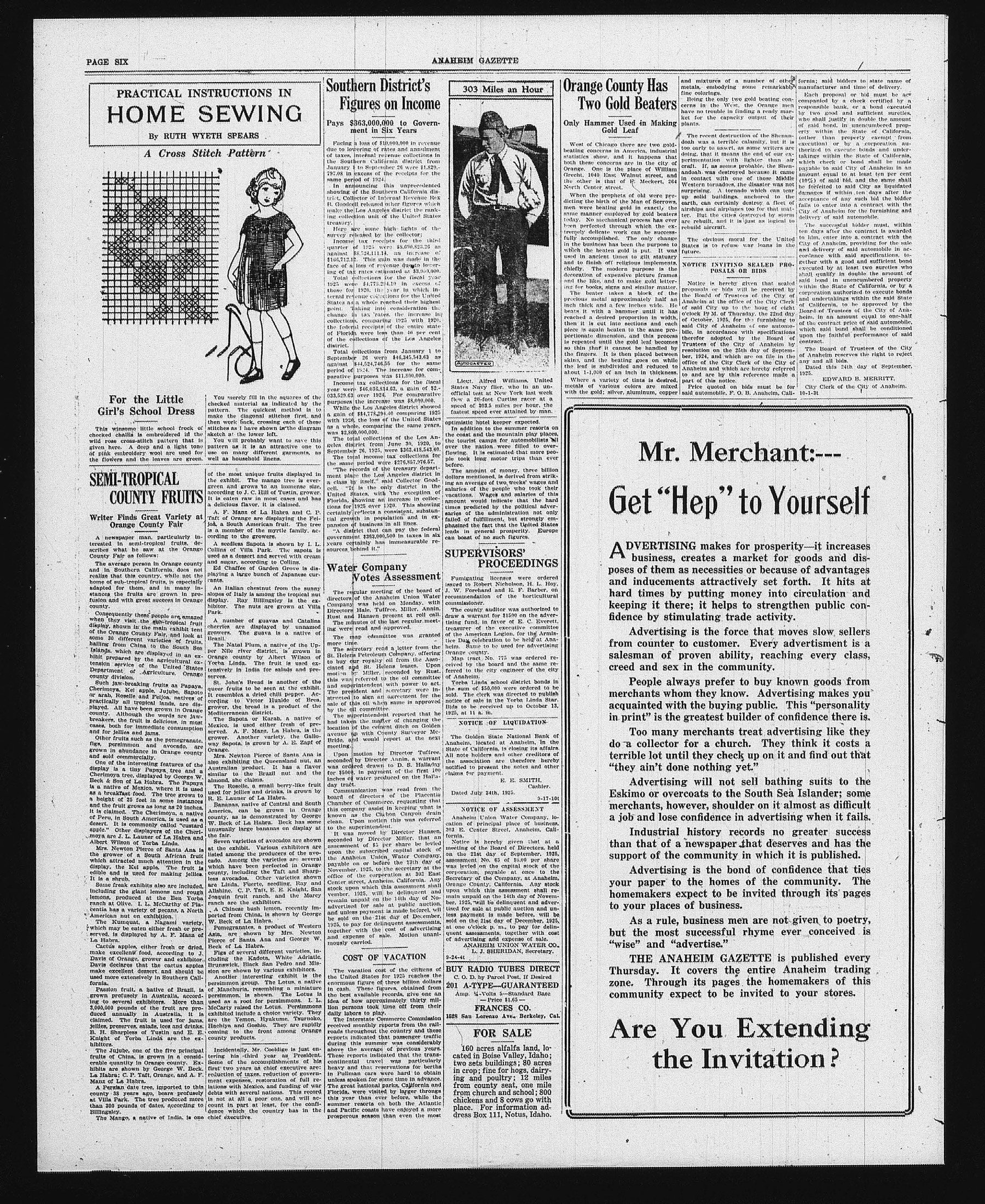
Searchable text
PRACTICAL INSTRUCTIONS IN
HOME SEWING
By RUTH WYETH SPEARS
A Cross Stitch Pattern
For the Little Girl's School Dress
This winsome little school frock of checked challis is embroidered in the wild rose cross-stitch pattern that is given here. A deep and a light tone
You merely fill in the squares of the checked material as indicated by the pattern. The quickest method is to make the diagonal stitches first, and then work back, crossing each of these stitches as I have shown in the diagram sketch at the lower left.
You will probably want to save this pattern as it is an attractive one to
For the Little Girl’s School Dress
This winsome little school frock of checked chalis is embroidered in the wild rose cross-stitch pattern that is given here. A deep and a light tone of pink embroidery wool are used for the flowers and the leaves are green.
SEMI-TROPICAL COUNTY FRUITS
Writer Finds Great Variety at Orange County Fair
A newspaper man, particularly interested in semi-tropical fruits, describes what he saw at the Orange County Fair as follows:
The average person in Orange county and in Southern California does not realize that this country, while not the home of sub-tropical fruits, is especially adapted for them, and in many instances the fruits are grown in profusion and with great success in Orange county.
Consequently these people are amazed when they visit the sub-tropical fruit display, shown in the main exhibit tent of the Orange County Fair, and look at some 30 different varieties of fruits, hailing from China to the South Sea Islands, which are displayed in an exhibit prepared by the agricultural extension service of the United States Department of Agriculture. Orange county division.
Such jaw-breaking fruits as Papaya, Cherimoya, Kei apple, Jujube, Sapota or arab, Roselle and Felja, natives of practically all tropical lands, are displayed. All have been grown in Orange county. Although the words are jawbreakers, the fruit is delicious, in most cases, both for immediate consumption and for jellies and jams.
Other fruits such as the pomegranate, figs, persimmon and avocado, are grown in abundance in Orange county and sold commercially.
One of the interesting features of the display is a tiny Papaya tree and a Cherimoya tree, displayed by George W. Beck & Son of La Habra. The Papaya is a native of Mexico, where it is used as a breakfast food. The tree grows to a height of 25 feet in some instances and the fruit grows as long as 20 inches. It is claimed. The Cherimoya, a native of Peru, in South America, is used as a desert. It is commonly called "custard apple." Other displayers of the Cherimoya are J. L. Launer of La Habra and Albert Wilson of Yorba Linda.
Mrs. Newton Pierce of Santa Ana is also exhibiting the Queensland nut, an Australian product. It has a flavor similar to the Brazil nut and the almond, she claims.
The Sapota or Karab, a native of Mexico, is used either fresh of preserved. A. F. Manz, La Habra, is the grower. Another variety, the Galloway Sapota, is grown by A. E. Zapf of Orange.
Mrs. Newton Pierce of Santa Ana is also exhibiting the Queensland nut, an Australian product. It has a flavor similar to the Brazil nut and the almond, she claims.
The Roselle, a small berry-like fruit used for jellies and drinks, is grown by R. E. Launer of La Habra.
Bananas, native of Central and South America, can be grown in Orange county, as is demonstrated by George W. Beck of La Habra. Beck has some unusually large bananas on display at the fair.
Seven varieties of avocados are shown at the exhibit. Various exhibitors are
of the most unique fruits displayed in the exhibit. The mango tree is evergreen and grows to an immense size, according to J. C. Hill of Tustin, grower. It is eaten raw in most cases and has a delicious flavor, it is claimed.
A. F. Manz of La Habra and C. P. Taft of Orange are displaying the Feljoa, a South American fruit. The tree is a member of the myrtle family, according to the growers.
A seedless Sapota is shown by I. L. Collins of Villa Park. The sapota is used as a dessert and served with cream and sugar, according to Collins.
Ed Chaffee of Garden Grove is displaying a large bunch of Japanese currants.
An Italian chestnut from the sunny slopes of Italy is among the tropical nut display. Ray Billingsley is the exhibitor. The nuts are grown at Villa Park.
A number of guavas and Catalina cherries are displayed by unnamed growers. The guava is a native of Brazil.
The Natal Plum, a native of the Upper Nile river district, is grown in Orange county by Albert Wilson of Yorba Linda. The fruit is used extensively in India for salads and preserves.
St. John's Bread is another of the queer fruits to be seen at the exhibit. It resembles a dried chili pepper. According to Victor Huaide of Brea, grower, the bread is a product of the Mediterranean district.
The Sapota or Karab, a native of Mexico, is used either fresh of preserved. A. F. Manz, La Habra, is the grower. Another variety, the Galloway Sapota, is grown by A. E. Zapf of Orange.
Mrs. Newton Pierce of Santa Ana is also exhibiting the Queensland nut, an Australian product. It has a flavor similar to the Brazil nut and the almond, she claims.
The Roselle, a small berry-like fruit used for jellies and drinks, is grown by R. E. Launer of La Habra.
Bananas, native of Central and South America, can be grown in Orange county, as is demonstrated by George W. Beck of La Habra. Beck has some unusually large bananas on display at the fair.
Seven varieties of avocados are shown at the exhibit. Various exhibitors are
September 20th against $44,555 per month; $633,529.63 over purposes; the last week: While the La gain of $$441 with 1920; there was a whole cost was $2,800,000.
The total costs district September 26th.
The total in the same period "The record ment place tha class by its cell." "It is United States Florida; show tions for 1925 certainly reflect growth in pansion of bus."
"A district government $3 years certainl sources behind."
Water Cottage
The regular directors of the Company was Directors Hale Rust and Han
The minutes were read.
The map more time.
The secretary St. Helena Petit to buy our rola ctated and S motion by M this was refer en and superinten The president struct to sh sale of this ol by the oil con
The superin had taken tha location o tha avenue up wi Bride; and w meeting.
Upon motio seconded by D was ordered o for $5000; in inches of water day tract.
Communicat board d dir Chamber of C this company y known as tha clean.Upon to tha superin
It was moved seconded by assessment o
One of the interesting features of the display is a tiny Papaya tree and a Cherimoya tree, displayed by George W. Beck & Son of La Habra. The Papaya is a native of Mexico, where it is used as a breakfast food. The tree grows to a height of 25 feet in some instances and the fruit grows as long as 20 inches. It is claimed. The Cherimoya, a native of Peru, in South America, is used as a desert. It is commonly called "custard apple." Other displayers of the Cherimoya are J. L. Launer of La Habra and Albert Wilson of Yorba Linda.
Mrs. Newton Pierce of Santa Ana is the grower of a South African fruit which attracted much attention in the display, the Kel apple. The fruit is edible and is used for making jellies. It is a shrub.
Some freak exhibits also are included, including the giant lemons and rough lemons, produced at the Ben Yorba ranch at Olive. I. L. McCarthy of Placeia has a variety of pecans, a North American nut on exhibition.
The Kumquat, a Nagami variety, which may be eaten either fresh or preserved, is displayed by A. F. Manz of La Habra.
Cactus apples, either fresh or dried, make excellent food, according to J. Davis of Orange, grower and exhibitor. Davis declares that the cactus apples make excellent dessert and should be used more extensively in Southern California.
Passion fruit, a native of Brazil, is grown profusely in Australia, according to several exhibitors. More than 3,000,000 pounds of the fruit are produced annually in Australia. It is claimed. The fruit is used for jams, jellies, preserves, salads, ice and drinks. B. H. Sharpless of Tustin and E. E. Knight of Yorba Linda are the exhibitors.
The Jujube, one of the five principal fruits of China, is grown in a considerable quantity in Orange county. Exhibits are shown by George W. Beck, La Habra; C. P. Taft, Orange, and A. F. Manz of La Habra.
A Persian date tree, imported to this county 38 years ago, bears profusely at Villa Park. The tree produced more than 300 pounds of dates, according to Billingsley.
The Mango, a native of India, is one Mrs. Newton Pierce of Santa Ana is also exhibiting the Queensland nut, an Australian product. It has a flavor similar to the Brazil nut and the almond, she claims.
The Roseille, a small berry-like fruit used for jellies and drinks, is grown by R. E. Launer of La Habra.
Bananas, native of Central and South America, can be grown in Orange county, as is demonstrated by George W. Beck of La Habra. Beck has some unusually large bananas on display at the fair.
Seven varieties of avocados are shown at the exhibit. Various exhibitors are listed among the producers of the avocado. Among the varieties are several which have been perfected in Orange county, including the Taft and Sharpless avocados. Other varieties shown are Linda, Fuente, seedling, Ray and Allshine. C. P. Taft, E. E. Knight, San Joaquin fruit ranch, and the Marcy ranch are the exhibitors.
A Chinese bush lemon, recently imported from China, is shown by George W. Beck of La Habra.
Pomegranates, a product of Western Asia, are shown by Mrs. Newton Pierce of Santa Ana and George W. Beck of La Habra.
Figs of several different varieties, including the Kadota, White Adriatic, Brunswick, Black San Pedro and Mission are shown by various exhibitors.
Another interesting exhibit is the persimmon group. The Lotus, a native of Manchuria, resembles a miniature persimmon is shown. The Lotus is used as a root for persimmons. I. L. McCarty raised the Lotus. Persimmons exhibited include a choice variety. They are the Yemon, Hyakume, Tsurnoko, Hachiya and Goshio. They are rapidly coming to the front among Orange county products.
Incidentally, Mr. Coolidge is just entering his third year as President. Some of the accomplishments of his first two years as chief executive are: reduction of taxes, reduction of government expenses, restoration of full relations with Mexico, and funding of war debts with several nations. This record is not at all a poor one, and will account in part at least, for the confidence which the country has in the chief executive.
The vacation received months through reports indicating during this season above the average These reports continental to heavy and thin in Pullman city unless spoken The great nath Florida were this year than summer resort and Pacific coast prosperous seas
Southern District’s Figures on Income
Pays $363,000,000 to Government in Six Years
Facing a loss of $10,000,000 in revenue due to lowering of rates and annulment of taxes, internal revenue collections in the Southern California district from January 1 to September 26 were $1,820,-797.08 in excess of the receipts for the same period of 1924.
In announcing this unprecedented showing of the Southern California district, Collector of Internal Revenue Rex B. Goodell released other figures which make the Los Angeles district the ranking collection unit of the United States treasury.
Here are some highlights of the survey released by the collector:
Income tax receipts for the third quarter of 1925 were $8,690,823.26 as against $8,724,111.14, an increase of $166,712.12. This gain was made in the face of a loss of revenue due to lowering of tax rates estimated at $3,000,000.
Total collections for the fiscal year 1925 were $4,778,294.10 in excess of those for 1920, the year in which internal revenue collections for the United States as a whole reached their highest point. Taking into consideration the change in tax rates, the increase in collections, comparing 1925 with 1920, the federal receipts of the entire state of Florida were less than 40 per cent of the collections of the Los Angeles district.
Total collections from January 1 to September 26 were $46,345,543.63 as against $44,524,746.55 for the same period of 1924. The increase for comparative purposes was $11,800,000.
Income tax collections for the fiscal year were $46,036,814.63, a gain of $2-033,529.63 over 1924. For comparative purposes the increase was $8,000,000.
While the Los Angeles district showed a gain of $4,778,294.40 comparing 1925 with 1920, the loss of the United States as a whole, comparing the same years, was $2,800,000,000.
The total collections of the Los Angeles district from June 30, 1920, to June 30, 1925 were $367,418,543.40.
Orange County Has Two Gold Beaters
Only Hammer Used in Making Gold Leaf
West of Chicago there are two gold-beating concerns in America, industrial statistics show, and it happens that both these concerns are in the city of Orange. One is the place of William Grecht, 1040 East Walnut street, and the other is that of E. Meckert, 264 North Center street.
When the prophets of old were predicting the birth of the Man of Sorrows, men were beating gold in exactly the same manner employed by gold beaters today. No mechanical process has ever been perfected through which the extremely delicate work can be successfully accomplished. The only change in the business has been the purpose to which the beaten gold is put. It was used in ancient times to gilt statuary and to finish off religious implements, chiefly. The modern purpose is the decoration of expensive picture frames and the like, and to make gold lettering for books, signs and similar matter.
The beater takes a block of the precious metal approximately half an inch thick and a few inches wide. He beats it with a hammer until it has reached a desired proportion in width; then it is cut into sections and each piece is again beaten to the same proportionate dimension, and this process is repeated until the gold leaf becomes so thin that it cannot be handled by the fingers. It is then placed between skins, and the beating goes on while the leaf is subdivided and reduced to about 1-1,000 of an inch in thickness.
Where a variety of tints is desired, metals of various colors are mixed with the gold; silver, aluminum, copper
optimistic hotel keeper expected.
In addition to the summer resorts on the coast and the mountain play places, the tourist camps for automobiles all over the nation were filled to over-
September 26 were $46,345,543.63 as against $44,524,746.55 for the same period of 1924. The increase for comparative purposes was $1,800,000.
Income tax collections for the fiscal year were $46,036,814.63, a gain of $2,033,529.63 over 1924. For comparative purposes the increase was $8,000,000.
While the Los Angeles district showed a gain of $4,778,294.40 comparing 1925 with 1920, the loss of the United States as a whole, comparing the same years, was $2,800,000,000.
The total collections of the Los Angeles district from June 30, 1920, to September 26, 1925, were $363,418,543.40.
The total income tax collections for the same period were $276,857,976.57.
"The records of the treasury department place the Los Angeles district in a class by itself," said Collector Goodcell. "It is the only district in the United States, with the exception of Florida, showing an increase in collections for 1925 over 1920. This showing certainly reflects a consistent substantial growth in population and in expansion of business in all lines."
"A district that can pay the federal government $363,000,500 in taxes certainly has immeasurable resources behind it."
Water Company Notes Assessment
The regular meeting of the board of directors of the Anaheim Union Water Company was held on Monday, with Directors Hale, Tuffree, Miller, Annin, Rust and Hansen present at roll call.
The minutes of the last regular meeting were read and approved.
The map committee was granted more time.
The secretary read a letter from the St. Helens Petroleum Company, offering to buy our royalty oil from the Associated and St. Helens leases. Upon motion by Miller, seconded by Rust, this was referred to the oil committee and superintendent with power to act.
The president and secretary were instructed to sign an agreement for the sale of this oil when same is approved by the oil committee.
The superintendent reported that he had taken the master of changing the location of the cement ditch on Golden avenue up with County Surveyor McBride, and would report at the next meeting.
Upon motion by Director Tuffree, seconded by Director Annin, a warrant was ordered drawn to D. S. Halladay for $5000. In payment of the first 100 inches of water produced on the Halladay tract.
Communication was read from the board of directors of the Placentia Chamber of Commerce, requesting that this company assist in keeping what is known as the Carbon Canyon drain clean. Upon motion this was referred to the superintendent.
It was moved by Director Hansen, seconded by Director Miller, that an assessment of $5 per share be levied on the subscribed capital stock of September 26 were $46,345,543.63 as against $44,524,746.55 for the same period of 1924. The increase for comparative purposes was $1,800,000.
Income tax collections for the fiscal year were $46,036,814.63, a gain of $2,033,529.63 over 1924. For comparative purposes the increase was $8,000,000.
While the Los Angeles district showed a gain of $4,778,294.40 comparing 1925 with 1920, the loss of the United States as a whole, comparing the same years, was $2,800,000,000.
The total collections of the Los Angeles district from June 30, 1920, to September 26, 1925, were $363,418,543.40.
The total income tax collections for the same period were $276,857,976.57.
"The records of the treasury department place the Los Angeles district in a class by itself," said Collector Goodcell. "It is the only district in the United States, with The exception of Florida, showing an increase in collections for 1925 over 1920. This showing certainly reflects a consistent substantial growth in population and in expansion of business in all lines."
"A district that can pay the federal government $363,000,500 in taxes certainly has immeasurable resources behind it."
SUPERVISORS' PROCEEDINGS
Fumigating licenses were ordered issued to Robert Nicholson, H. L. Hoy, J. W. Forehand and E. F. Barber, on recommendation of the horticultural commissioner.
The county auditor was authorized to draw a warrant for $1500 on the advertising fund, in favor of E. C. Everett, treasurer of the executive committee of the American Legion, for the Armistice Day celebration to be held at Anaheim. Same to be used for advertising Orange county.
Map tract No. 775 was ordered received by the board and the same referred to the city engineer of the city of Anaheim.
Yorba Linda school district bonds in the sum of $50,000 were ordered to be sold. The clerk was directed to publish notice of sale in the Yorba Linda Star Bldg to be received up to October 13, 1925, at 11 a.m.
NOTICE OF LIQUIDATION
The Golden State National Bank of Anaheim, located at Anaheim, in the State of California, is closing its affairs. All note holders and other creditors of the association are therefore hereby notified to present the notes and other claims for payment.
E. E. SMITH,
Cashier.
Dated July 24th, 1925.
9-17-10t
NOTICE OF ASSESSMENT
Anaheim Union Water Company, location of principal place of business,
203 E. Center Street, Anaheim,
California.
Notice is hereby given that at a meeting of the Board of Directors held
COST OF VACATION
The vacation cost of the citizens of the United States for 1925 reaches the enormous figure of three billion dollars in cash. These figures obtained from the best available records, give one idea of how approximately thirty million persons took time off from their daily labor to play.
The Interstate Commerce Commission received monthly reports from the railroads throughout the country and these reports indicated that passenger traffic during this summer was considerably above the average of previous years. These reports indicated that the transcontinental travel was particularly heavy and that reservations for berths in Pullman cars were hard to obtain unless spoken for some time in advance. The great national parks, California and Florida, were visited by larger throngs this year than ever before, while the summer resorts on both the Atlantic and Pacific coasts have enjoyed a more prosperous season than even the most
FOR SALE
160 acres alfalfa land, located in Boise Valley, Idaho; two sets buildings; 80 acres in crop; fine for hogs, dairying and poultry; 12 miles from county seat, one mile from church and school; 800 chickens and 8 cows go with place. For information address Box 111, Notus, Idaho.
County Has Gold Beaters
Used in Making Leaf
There are two gold in America, industrial and it happens that as are in the city of the place of William Walnut street, and of F. Meckert, 264 feet, sets of old were pre-The Man of Sorrows, gold in exactly the joyed by gold beaters logical process has ever brought which the exorcik can be successa. The only change been the purpose to gold is put. It was names to gilt statuary religious implements,ern purpose is the nensive picture frames to make gold letterings and similar matter. es a block of the approximately half an inch wide. He hammer until it has proportion in width, no sections and each ten to the same proton, and this process the gold leaf becomes cannot be handled by then placed between eating goes on while hidd and reduced to an inch in thickness. y of tints is desired, as colors are mixed over, aluminum, copper and mixtures of a number of other metals, embodying some remarkably fine colorings.
Being the only two gold beating concerns in the West, the Orange men have no trouble in finding a ready market for the capacity output of their plants.
The recent destruction of the Sheman-doh was a terrible calamity, but it is too early to assert, as some writers are doing, that it means the end of our experimentation with lighter than aircraft. If, as seems probable, the Sheman-doh was destroyed because it came in contact with one of those Middle Western tornadoes, the disaster was not surprising. A tornado which can tear up solid buildings, anchored to the earth, can certainly destroy a fleet of airships and airplanes too for that matter. But the cities destroyed by storm are rebuilt, and it is just as logical to rebuild aircraft.
The obvious moral for the United States is to refuse war loans in the future.
NOTICE INVITING SEALED PROPOSALS OR BIDS
Notice is hereby given that sealed proposals or bids will be received by the Board of Trustees of the City of Anaheim at the office of the City Clerk of said City up to the hour of eight o'clock P.M. of Thursday, the 22nd day of October, 1925, for the furnishing to said City of Anaheim of one automobile, in accordance with specifications therefor adopted by the Board of Trustees of the City of Anaheim by resolution on the 25th day of September, 1924, and which are on file in the office of the City Clerk of the City of Anaheim and which are hereby referred to and are by this reference made a part of this notice.
Price quoted on bids must be for said automobile, F. O. B. Anaheim, Cali-formia; said bidders to state name of manufacturer and time of delivery.
Each proposal or bid must be accompanied by a check certified by a responsible bank, or a bond executed by two good and sufficient sureties, who shall justify in double the amount of said bond, in unencumbered property within the State of California (other than property exempt from execution) or by a corporation authorized to execute bonds and undertakings within the State of California, which cheek or bond shall be made payable to said City of Anaheim in an amount equal to at least ten per cent (10%) of said bid, and the same shall be forfeited to said City as liquidated damages if within ten days after the acceptance of any such bid the bidder fails to enter into a contract with the City of Anaheim for the furnishing and delivery of said automobile.
The successful bidder must, within ten days after the contract is awarded to him, enter into a contract with the City of Anaheim, providing for the sale and delivery of said automobile in accordance with specified conditions, together with a good and sufficient bond executed by at least two sureties who shall qualify in double the amount of said bond in unencumbered property within the State of California, or by a corporation authorized to execute bonds and undertakings within the said State of California, to be approved by the Board of Trustees of the City of Anaheim, in an amount equal to one-half of the contract price of said automobile, which said bond shall be conditioned upon the faithful performance of said contract.
The Board of Trustees of the City of Anaheim reserves the right to reject any and all bids.
Dated this 24th day of September, 1925.
EDWARD B. MERRITT,
City Clerk of the City of Anaheim.
10-1-3t
Mr. Merchant:---
Get "Hep" to Yourself
ADVERTISING makes for prosperity—it increases business, creates a market for goods and disposes of them as necessities or because of advantages and inducements attractively set forth. It hits at hard times by putting money into circulation and keeping it there; it helps to strengthen public confidence by stimulating trade activity.
Advertising is the force that moves slow sellers from counter to customer. Every advertisement is a salesman of proven ability, reaching every class, need and sex in the community.
People always prefer to buy known goods from merchants whom they know. Advertising makes you acquainted with the buying public. This "personality print" is the greatest builder of confidence there is.
Too many merchants treat advertising like they do a collector for a church. They think it costs a terrible lot until they check up on it and find out that they ain't done nothing yet."
Advertising will not sell bathing suits to the skimo or overcoats to the South Sea Islander; some merchants, however, shoulder on it almost as difficult a job and lose confidence in advertising when it fails.
Industrial history records no greater success than that of a newspaper that deserves and has the
Advertising will not sell bathing suits to the Skimo or overcoats to the South Sea Islander; some merchants, however, shoulder on it almost as difficult as job and lose confidence in advertising when it fails.
Industrial history records no greater success than that of a newspaper that deserves and has the support of the community in which it is published.
Advertising is the bond of confidence that ties your paper to the homes of the community. The homemakers expect to be invited through its pages to your places of business.
As a rule, business men are not given to poetry, but the most successful rhyme ever conceived is "wise" and "advertise."
THE ANAHEIM GAZETTE is published every Thursday. It covers the entire Anaheim trading zone. Through its pages the homemakers of this community expect to be invited to your stores.
Are You Extending the Invitation?