anaheim-gazette 1925-09-24
Scanned page
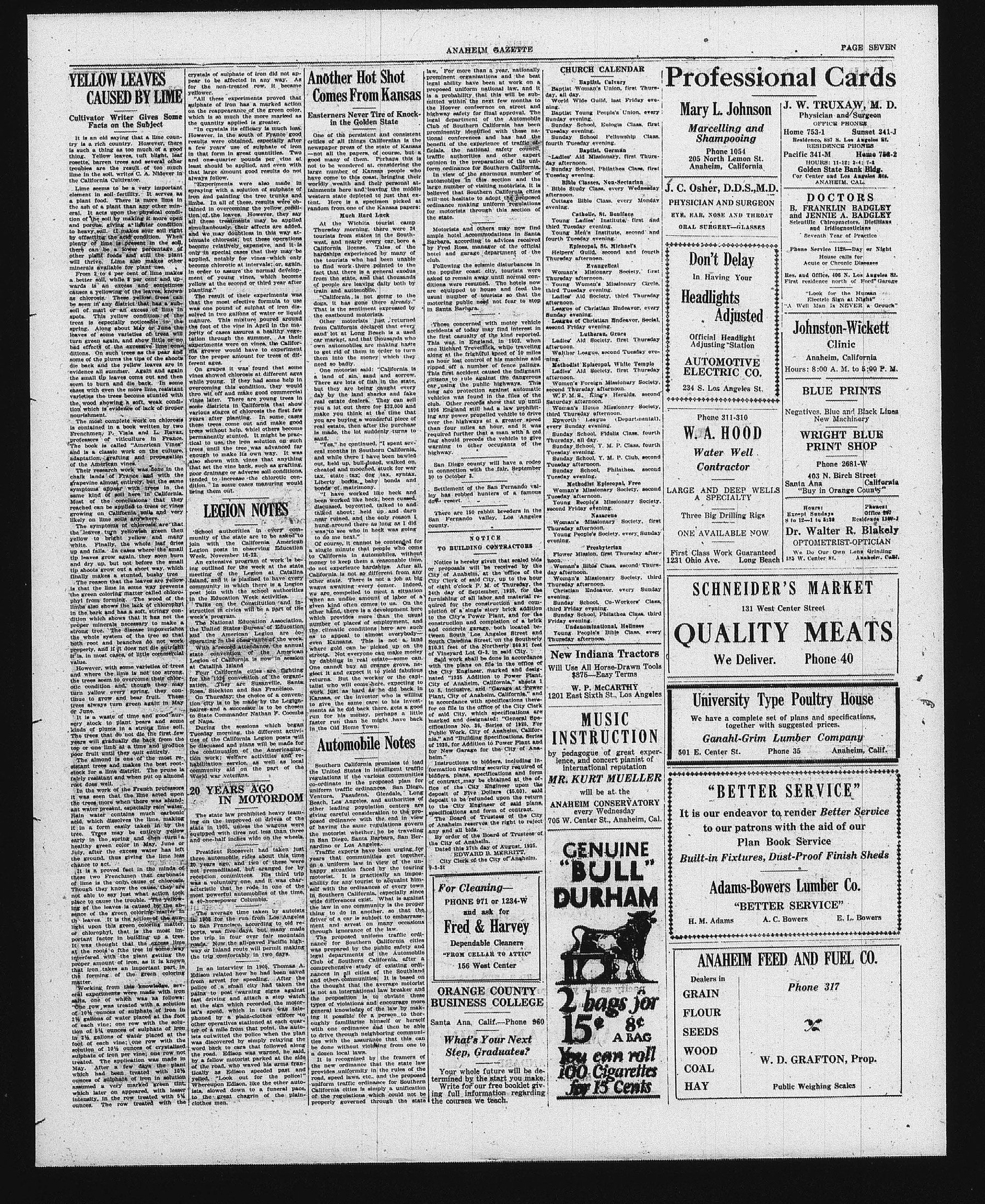
Searchable text
YELLOW LEAVES CAUSED BY LIME
Cultivator Writer Gives Some Facts on the Subject
It is an old saying that a lime country is a rich country. However, there is such a thing as too much of a good thing. Yellow leaves, tuft blight, leaf rosette, barren trees and several other troubles are the result of too much lime in the soil, writes C. A. Nidever in the California Cultivator.
Lime seems to be a very important element in soil fertility. It serves as a plant food. There is more lime in the ash of a plant than any other mineral. It acts upon the physical condition of the soil by making it more open and porous, giving a lighter condition to heavy soil. It makes sour soil right by offsetting the acid condition. When plenty of lime is present in the soil, there can be a lower percentage of other plant foods and still the plant will thrive. Lime also makes other minerals available for plant use.
From 2 to 6 per cent of lime makes a better soil, while 8 per cent and upwards is an excess and sometimes causes a yellowing of the leaves, known as chlorosis. These yellow trees can be seen in any district that has a subsoil of marl or an excess of lime in spots. This yellow condition of the trees is especially noticeable in the spring. Along about May or June the leaves of some varieties of trees will turn green again, and show little or no bad effects of the excessive lime conditions. On such trees as the pear and some of the plums the tips of the shoots die back and the yellow leaves are in evidence all summer. Again and again the small tip leaves come out and then seem to burn and die back. In some cases with even the more lime resistant varieties the trees become stunted with the wood showing a soft, weak condition which is evidence of lack of proper nourishment.
The most complete work on chlorosis is contained in a book written by two Frenchmen, P. Viala and L. Ravaz, professors of viticulture in France. The book is called "American Vines" crystals of sulphate of iron did not appear to be affected in any way. As for the non-treated row, it became yellower.
"All these experiments proved that sulphate of iron has a marked action on the reappearance of the green color, which is so much the more marked as the quantity applied is greater.
In crystals its efficacy is much less. However, in the south of France good results were obtained, especially after a few years' use of sulphate of iron in that form in great quantities. Two and one-quarter pounds per vine at least should be applied, and even with that large amount good results do not always follow.
Experiments were also made in spraying with a solution of sulphate of iron and painting the tree trunks and limbs. In all of these, results were obtained in overcoming the yellow condition of the leaves. However, they say all these treatments may be applied simultaneously, their affects are added, and we may doubtless in this way attenuate chlorosis; but these operations become relatively expensive, and it is only in special cases that they may be applied, notably for vines which only become chlorotic at intervals; or, again, in order to assure the normal development of young vines, which become yellow at the second or third year after planting."
The result of their experiments was that the most effective formula to use was one pound of sulphat of iron dissolved in two gallons of water or liquid manure. This mixture poured around the foot of the vine in April in the majority of cases assures a healthy vegetation through the summer. As their experiments were on vines, the California grower would have to experiment for the proper amount for trees of different ages.
On grapes it was found that some vines showed chlorosis at different ages while young. If they had some help in overcoming this condition, they would throttle off and make good commercial vines later. There are young trees in some districts in California that show various stages of chlorosis the first few years after planting. In some cases these trees come out and make good trees without help, whilst others become permanently stunted. It might be practical to use the iron solution on such trees until the tree was advanced far
On such trees the tips of the shoots die back and the yellow leaves are in evidence all summer. Again and again the small tip leaves come out and then seem to burn and die back. In some cases with even the more lime resistant varieties the trees become stunted with the wood showing a soft, weak condition which is evidence of lack of proper nourishment.
The most complete work on chlorosis is contained in a book written by two Frenchmen, P. Viala and L. Ravaz, professors of viticulture in France. The book is called "American Vines" and is a classic work on the culture, adaptation, grafting and propagation of the American vines.
Their research work was done in the chalk lands of France and with the grapevine almost entirely, but the same symptoms appear with trees in the same kind of soil here in California. Most of the conclusions that they reached can be applied to trees or vines growing on California soils and very likely on lime soils anywhere.
The symptoms of chlorosis are that the leaves turn yellowish green then yellow to bright yellow and many white. Finally, the whole leaf dries up and falls. In cases where the small tip leaves grow again, they soon burn and dry up, but not before the small tip shoots grow out a short way, which finally makes a stunted, bushy tree.
The reason that the leaves are yellow is that the lime in some way prevents the green coloring matter called chlorophyl from forming. The wood of the limbs also shows the lack of chlorophyl in the bark and has a soft, stringy condition which shows that it has not the proper minerals necessary to make a strong tree. The disease impoverishes the whole system of the tree so that both root and branches do not work properly, and if it does not die outright it is, in most cases, of little commercial value.
However, with some varieties of trees and where the limb is not too strong, the trees seem to overcome their chlorotic condition and, though they may turn yellow every spring, they continue to grow and bear fruit. These trees always turn green again in May or June.
It is a waste of time and good nursery stock to plant pears and some kinds of plums in a strong lime soil. The trees that do not die the first few years will gradually die back from the top or one limb at a time and produce poor fruit until they quit entirely.
The almond is one of the most resistant trees and makes the best rootstock for a lime district. The prune is fairly resistant and when put on almond root does well.
In the work of the French professors it was seen that the lime acted upon the trees more when there was abundant water present, especially rain water. Rain water contains much carbonic acid, which dissolves the lime, making it in a form easily taken in by the tree. Trzes may be entirely yellow early in the spring and then turn a healthy green color in May. June or July after the excess water has left on grapes it was found that some vines showed chlorosis at different ages while young. If they had some help in overcoming this condition, they would throttle off and make good commercial vines later. There are young trees in some districts in California that show various stages of chlorosis the first few years after planting. In some cases these trees come out and make good trees without help, whilst others become permanently stunted. It might be practical to use the iron solution on such trees until the tree was advanced far enough to make its own way. It was also shown with vines that anything that set the vine back, such as grafting, poor drainage or adverse soil conditions, tended to increase the chlorotic condition. In some cases manuring would bring them out.
LEGION NOTES
School authorities in every community of the state are to be asked to join with the California American Legion posts in observing Education Week, November 16-22.
An extensive program of work is being outlined for the week at the state meeting of the Legion at Catalina Island, and it is planned to have every community in which there is a Legion post join with the school authorities in the Education Week activities.
Talks on the Constitution and instruction in cities will be a part of the week's program.
The National Education Association, the United States Bureau of Education and the American Legion are cooperating in the observance of the week.
With a record attendance, the annual state convention of the American Legion of California is now in session at Catalina Island.
Four California cities are fighting for the 1926 convention of the organization. They are Susanville, Santa Rosa, Stockton and San Francisco.
On Thursday; the choice of a convention city is to be made by the Legionaires and a successor is to be chosen to State Commander Nathan F. Coombs of Napa.
During the sessions which began Tuesday morning, the different activities of the California Legion posts will be discussed and plans will be made for the continuation of the Americanization work; welfare activities and rehabilitation service, as well as local community aid on the part of World war veterans.
20 YEARS AGO IN MOTORDOM
The state law prohibited heavy teaming on the improved oil drives of the state in 1905, unless the wagons were equipped with tires not less than three and one-half inches wide on the wheels.
Postmaster Roosevelt had taken just for the proper amount for trees of different ages.
On grapes it was found that some vines showed chlorosis at different ages while young. If they had some help in overcoming this condition, they would throttle off and make good commercial vines later. There are young trees in some districts in California that show various stages of chlorosis the first few years after planting. In some cases these trees come out and make good trees without help, whilst others become permanently stunted. It might be practical to use the iron solution on such trees until the tree was advanced far enough to make its own way. It was also shown with vines that anything that set the vine back, such as grafting, poor drainage or adverse soil conditions, tended to increase the chlorotic condition. In some cases manuring would bring them out.
Yes," he continued eral months in South and while there I outd held up, bull-cheated and moohed tax, state tax; did Liberty bonds, bonds of matrimoil
"I have worked been worked like he discussed, boycotted talked about; he near ruined, and thung around there was to see who imit do me next."
Of course, it cannot a single minute that to California in au money to keep them do not experience ha Californias not so other state. There wages awaiting ever we are compelled to when an undue ame given kind often con other hand, there is which provides more number of places othe climatic condition as to appeal to even Kansans. Th where gold can be streets. Not everyone by dabbling in real One cannot buy an object it and expect returns. But the waltalist who will come work just as hard Kansas, or the invest to give the same cements as he did back run for his money faster run than he in the Old Home Te
Automobi
The almond is one of the most resistant trees and makes the best rootstock for a lime district. The prune is fairly resistant and when put on almond root does well.
In the work of the French professors it was seen that the lime acted upon the trees more when there was abundant water present, especially rain water. Rain water contains much carbonic acid, which dissolves the lime, making it in a form easily taken by the tree. Trzes may be entirely yellow early in the spring and then turn a healthy green color in May, June or July, after the excess water has left the ground, thus giving the lime less chance to act.
It is a proved fact in the minds of these two Frenchmen that carbonate of lime is the only cause of chlorosis. Though they know the cause, they are not able to say just what action took place to cause the trouble. The yellowing of the leaves is caused by the absence of the green coloring matter in the leaves. It is the action of the sunlight upon this green coloring matter, or chlorophyl, that is the most important factor in building up a tree. It was thought that the excess lime at the roots o' the tree in some way interfered with the plant getting the proper amount of iron, as it is known that iron takes an important part in the forming of the green coloring matter.
Working from this knowledge, several experiments were made with iron salts, one of which was as follows: "One row was treated with a solution of 10½ ounces of sulphate of iron in 2½ gallons of water placed at the foot of each vine; one row with the solution of 5¼ ounces of sulphate of iron in 2½ gallons of water placed at the foot of each vine; one row with the solution of 10½ ounces of crystallized sulphate of iron per vine; one row not treated. The application was made in May. After a few days the plant which had been treated with 10½ ounces of sulphate of iron in solution assumed a very marked green tint, which later on appeared, with lesser intensity, in the row treated with 5¼ ounces. The row treated with the
20 YEARS AGO IN MOTORDOM
The state law prohibited heavy teaming on the improved oil drives of the state in 1905, unless the wagons were equipped with tires not less than three and one-half inches wide on the wheels.
President Roosevelt had taken just three automobile rides about this time 20 years ago, and two of these were not premeditated, but arranged for by reception committees. His third trip was a voluntary one, and it was characteristic that he rode in one of the most powerful automobiles of the time, a 40-horsepower Columbia.
The average time taken by autoists in 1905 for the run from Los Angeles to San Francisco, according to old reports, was five days, but many made the trip in four over fair mountain roads. Now the all-paved Pacific highway or Inland route will permit making the trip comfortably in two days.
In an interview in 1905, Thomas A. Edison related how he had been saved from arrest for speeding. After the police of a small city had taken the pain to post warning signs against fast driving and attach a stop watch at the sign which recorded the motorist's speed, which in turn was telephoned by a plain-clothes officer to other operatives stationed at each quarter of a mile from that point. The autoists outwitted the police when the plan was discovered by simply relaying the word back to cars that followed along the road. Edison was warned, he said, by a fellow motorist parked at the side of the road, who waved his arms frantically as EdisonSpeed past and yelled, "Look out for the police!" Whereupon Edison, like the other autoists, slowed down to a funeral pace, to the great chagrin of the plain-clothes men.
Southern California in United States regulations if the vehicle traffic ordinance Ventura, Pasadena Beach, Los Angeles, other leading populous giving careful conscience posed ordinance with having the same motorist whether in San Diego, Santa Ana or Los Angeles Traffic experts have years that communion on a uniform law happy situation face motorist. It is probability for any tourist self with the ordinance in Southern California wide differences exist thing to do in and driver of a car is suction and arrest through ignorance of The proposed unification for Southern was prepared by the legal departments Club of Southern comprehensive studies in all cities and other communities thought that it is not an international types of violations a general knowledge it possible for ooughly familiarize with one ordinance to drive through new ties with the assurance be done without viola a dozen local laws.
It is recognized the new ordinance provides uniformity road, speed laws, et uniform traffic ordinance California cities is of the regulations properly governed
Another Hot Shot Comes From Kansas
Easterners Never Tire of Knock-in the Golden State
One of the persistent and consistent critics of all things Californian is the newspaper press of the state of Kansas—not all the papers, of course, but a good many of them. Perhaps this is not to be wondered at, considering the large number of Kansas people who have come to this coast, bringing their worldly wealth and their personal attentions here and leaving the middle western state depleted to just that extent. Here is a specimen picked at random from one of the Kansas papers:
Much Hard Luck
At the Wichita tourist camp Thursday morning, there were 24 tourists from states in the Southwest, and nearly every car bore a California license. Tales of the hardships experienced by many of the tourists who had been unable to find work there pointed to the fact that there is a general exodus from the state, and that thousands of people are leaving daily both by train and automobile.
"California, it has gone there already." That is the sentiment expressed by the eastbound motorists.
Other motorists just returned from California declared that every sand lot at Long Beach is a used car market, and that thousands who own automobiles are making haste to get rid of them in order to turn them into the money which they need so badly.
One motorist said: "California is a land of sin, sand and sorrow. There are lots of fish in the state, but they are being caught every day by the land sharks and fake real estate dealers. They can sell you a lot out there for $22,000 and make you think at the time that you are buying a wonderful piece of real estate, then after the purchase is made, the lot suddenly turns to sand."
"Yes," he continued. "I spent several days in Southern California law. For more than a year, nationally prominent organizations and the best legal ability have been at work on a proposed uniform national law, and it is a probability that this will be submitted within the next few months to the Hoover conference on street and highway safety for final approval. The legal department of the Automobile Club of Southern California has been prominently identified with these national conferences and has had the benefit of the experience of traffic officials, the national safety council, traffic authorities and other expert opinion in the preparation of the uniform ordinance for Southern California.
In view of the enormous number of automobiles in this section and the large number of visiting motorists, it is believed that Southern California cities will not hesitate to adopt the proposed ordinance making uniform regulations for motorists through this section of the state.
Motorists and others may now find ample hotel accommodations in Santa Barbara, according to advises received by Fred Ross, manager of the official hotel and garage department of the club.
Following the seismic disturbances in the popular coast city, tourists were asked to remain away until normal conditions were resumed. The hotels now are equipped to house and feed the usual number of tourists so that the motoring public need not fear to stop in Santa Barbara.
Those concerned with motor vehicle accidents of today may find interest in the first casualty of the kind reported. This was in England, in 1802, when one Richard Trevetflick, while traveling along at the frightful speed of 10 miles an hour lost control of his machine and ripped off a number of fence palings. This first accident caused the indignant citizens to rule against the dangerous car using the public highways. This long ago protection against automatic vehicles was found in the files of the club. Other records show that up until 1896 England still had a law prohibiting any power propelled vehicle to drive over the highways at a greater speed than four miles an hour, and it was required further that a man with a red flag should precede the vehicle to give warning to other occupants of the...
Automobile Notes
Southern California promises to lead the United States in intelligent traffic regulations if the various communities co-ordinate in the proposed plan for uniform traffic ordinances. San Diego, Ventura, Pasadena, Glendale, Long Beach, Los Angeles, and authorities of other leading population centers are giving careful consideration to the proposed ordinance with the end in view of having the same regulations govern the motorist whether he be traveling in San Diego, Santa Barbara, San Bernardino or Los Angeles.
One motorist said: "California is a land of sin, sand and sorrow. There are lots of fish in the state, but they are being caught every day by the land sharks and fake real estate dealers. They can sell you a lot out there for $22,000 and make you think at the time that you are buying a wonderful piece of real estate, then after the purchase is made, the lot suddenly turns to sand.
"Yes," he continued. "I spent several months in Southern California, and while there I have been bawled out, held up, bull-dozed, walked on, cheated and mooched, stuck for war tax, state tax; dog tax, syntax, Liberty bonds, baby bonds and bonds of matrimony.
"I have worked like heck and been worked like heck, been cussed, discussed, boycotted, talked to and talked about; held up and darn near ruined, and the only reason I hung around there as long as I did was to see who in heck was going to do me next."
Of course, it cannot be contended for a single minute that people who come to California in automobiles, without money to keep them a reasonable time, do not experience hardships. After all, California is not so different from any other state. There is not a job at big wages awaiting every comer. Indeed, we are compelled to meet a situation when an undue amount of labor of a given kind often comes to us. On the other hand, there is a development here which provides more than the usual number of places of employment, and the climatic conditions here are such as to appeal to almost everybody—even Kansans. This is not a land where gold can be picked up on the streets. Not everyone can make money by dabbling in real estate—some can one cannot buy an orange grove, neglect it and expect it to yield fabulous returns.
But the worker or the capitalist who will come here, expecting to work just as hard as he did back in Kansas, or the investor who is willing to give the same care to his investments as he did back there, gets a good run for his money, perhaps a little faster run than he might have back in the Old Home Town.
NOTICE TO BUILDING CONTRACTORS
Notice is hereby given that sealed bids or proposals will be received by the City of Anaheim, at the office of the City Clerk of said City, up to the hour of eight o'clock P.M. of Thursday, the 24th day of September, 1925, for furnishing of all labor and material required for the construction and completion of a single story brick addition to the City's Power Plant, and for the construction and completion of a brick and concrete garage, both located between South Los Angeles Street and South Claudina Street, on the Southerly $10.91 feet of the Northerly $60.91 feet of Vineyard Lot G-3, in said City.
Said work shall be done in accordance with the plans on file in the office of the City Engineer, marked and designated "1925 Addition to Power Plant, City of Anaheim, California," sheets 1 to 8, inclusive, and "Garage at Power Plant, City of Anaheim, California," and in accordance with specifications therefor on file in the office of the City Clerk of said City, which specifications are marked and designated: "General Specifications No. 36, Series of 1925. For Public Work, City of Anaheim, California," and "Building Specifications, Series of 1925. for Addition to Power Plant and for New Garage for the City of Anaheim."
Instructions to bidders, including information regarding security required of bidders, plans, specifications and form of contract may be obtained at the office of the City Engineer upon the deposit of Five Dollars ($5.00), said deposit to be refunded upon the return to the City Engineer of said plans, specifications and form of contract.
The Board of Trustees of the City of Anaheim reserves the right to reject any and all bids.
By order of the Board of Trustees of the City of Anaheim.
Dated this 27th day of August, 1925.
Southern California promises to lead the United States in intelligent traffic regulations if the various communities co-ordinate in the proposed plan for uniform traffic ordinances. San Diego, Ventura, Pasadena, Glendale, Long Beach, Los Angeles, and authorities of other leading population centers are giving careful consideration to the proposed ordinance with the end in view of having the same regulations govern the motorist whether he be traveling in San Diego, Santa Barbara, San Bernardino or Los Angeles.
Traffic experts have been urging for years that communities get together on a uniform law in view of the unhappy situation faced by the touring motorist. It is practically an impossibility for any tourist to acquaint himself with the ordinances of every town in Southern California, especially since wide differences exist. What is against the law in one community is the proper thing to do in another, so that the driver of a car is subject to embarrassment and arrest on many occasions through ignorance of the law.
The proposed uniform traffic ordinance for Southern California cities was prepared by the public safety and legal departments of the Automobile Club of Southern California, after a comprehensive study of existing ordinances in all cities of the Southland and other communities. It is based on the thought that the average motorist is not an international law breaker and the proposition is to obviate these types of violations and encourage more general knowledge of the law by making it possible for a person to thoroughly familiarize himself or herself with one ordinance and then be able to drive through neighboring communities with the assurance that this can be done without violating from one to a dozen local laws.
It is recognized by the framers of the new ordinance that the state law provides uniformity in the rules of the road, speed laws, etc., and the proposed uniform traffic ordinance for Southern California cities is simply a unification of the regulations which could not be properly governed through the state.
Instructions to bidders, including information regarding security required of bidders, plans, specifications and form of contract, may be obtained at the office of the City Engineer upon the deposit of Five Dollars ($5.00), said deposit to be refunded upon the return to the City Engineer of said plans, specifications and form of contract.
The Board of Trustees of the City of Anaheim reserves the right to reject any and all bids.
By order of the Board of Trustees of the City of Anaheim.
Dated this 27th day of August, 1925.
EDWARD B. MERRITT,
City Clerk of the City of Anaheim.
9-3-31
For Cleaning—
PHONE 971 or 1234-W
and ask for
Fred & Harvey
Dependable Cleaners
"FROM CELLAR TO ATTIC"
156 West Center
ORANGE COUNTY BUSINESS COLLEGE
Santa Ana, Calif.—Phone 960
What's Your Next Step, Graduates?
Your whole future will be determined by the start you make.
Write for our free booklet giving full information regarding the courses we teach.
PROFESSIONAL CARDS
Mary L. Johnson
Marcelling and Shampooing
Phone 1054
205 North Lemon St.
Anaheim, California
J. C. Osher, D.D.S., M.D.
PHYSICIAN AND SURGEON
EYE, EAR, NOSE AND THROAT
ORAL SURGERY—GLASSES
Don’t Delay
In Having Your
Headlights Adjusted
Official Headlight Adjusting Station
AUTOMOTIVE ELECTRIC CO.
234 S. Los Angeles St.
Phone 311-310
W. A. HOOD
J. W. TRUXAW, M. D.
Physician and Surgeon
OFFICE PHONES
Home 753-1 Sunset 341-J
Residence, 887 S. Los Angeles St.
RESIDENCE PHONES
Pacific 341-M Home 752-2
HOURS: 11-12; 2-4; 7-9
Golden State Bank Bldg.
Cor Center and Los Angeles St.
ANAHEIM, CAL.
DOCTORS
B. FRANKLIN BADGLEY
and JENNIE A. BADGLEY
Scientific Chiropractors, Dietitians
and Iridiagnosticians
Seventh Year of Practice
Phone Service 1128—Day or Night
House calls for
Acute or Chronic Diseases
Hes. and Office, 406 N. Los Angeles St.
First residence north of Ford* Garage
"Look for the Human Electric Sign at Night"
"A Well Man Is NEVER a Grouch"
Johnston-Wickett Clinic
Anaheim, California
Hours: 8:00 A.M. to 5:00 P.M.
BLUE PRINTS
Negatives, Blue and Black Lines
New Machinery
WRIGHT BLUE PRINT SHOP
AUTOMOTIVE ELECTRIC CO.
234 S. Los Angeles St.
Phone 311-310
W. A. HOOD
Water Well Contractor
LARGE AND DEEP WELLS
A SPECIALTY
Three Big Drilling Rigs
ONE AVAILABLE NOW
First Class Work Guaranteed
1231 Ohio Ave. Long Beach
Annaheim, California
Hours: 8:00 A.M. to 5:00 P.M.
BLUE PRINTS
Negatives, Blue and Black Lines
New Machinery
WRIGHT BLUE
PRINT SHOP
Phone 2681-W
403 N. Birch Street
Santa Ana California
"Buy in Orange County"
Hours:
Except Sundays
8 to 12—1 to 5:30
Dr. Walter R. Blakely
OPTOMETRIST-OPTICIAN
We Do Our Own Lens Grinding
183 W. Center St.
SCHNEIDER'S MARKET
131 West Center Street
QUALITY MEATS
We Deliver. Phone 40
University Type Poultry House
We have a complete set of plans and specifications,
together with suggested prices.
Ganahl-Grim Lumber Company
501 E. Center St. Phone 35 Anaheim, Calif.
"BETTER SERVICE"
It is our endeavor to render Better Service
to our patrons with the aid of our
Plan Book Service
"BETTER SERVICE"
It is our endeavor to render Better Service
to our patrons with the aid of our
Plan Book Service
Built-in Fixtures, Dust-Proof Finish Sheds
Adams-Bowers Lumber Co.
"BETTER SERVICE"
H. M. Adams A. C. Bowers E. L. Bowers
ANAHEIM FEED AND FUEL CO.
Dealers in
GRAIN
FLOUR
SEEDS
WOOD
COAL
HAY
Phone 317
W. D. GRAFTON, Prop.
Public Weighing Scales