anaheim-gazette 1925-08-27
Scanned page
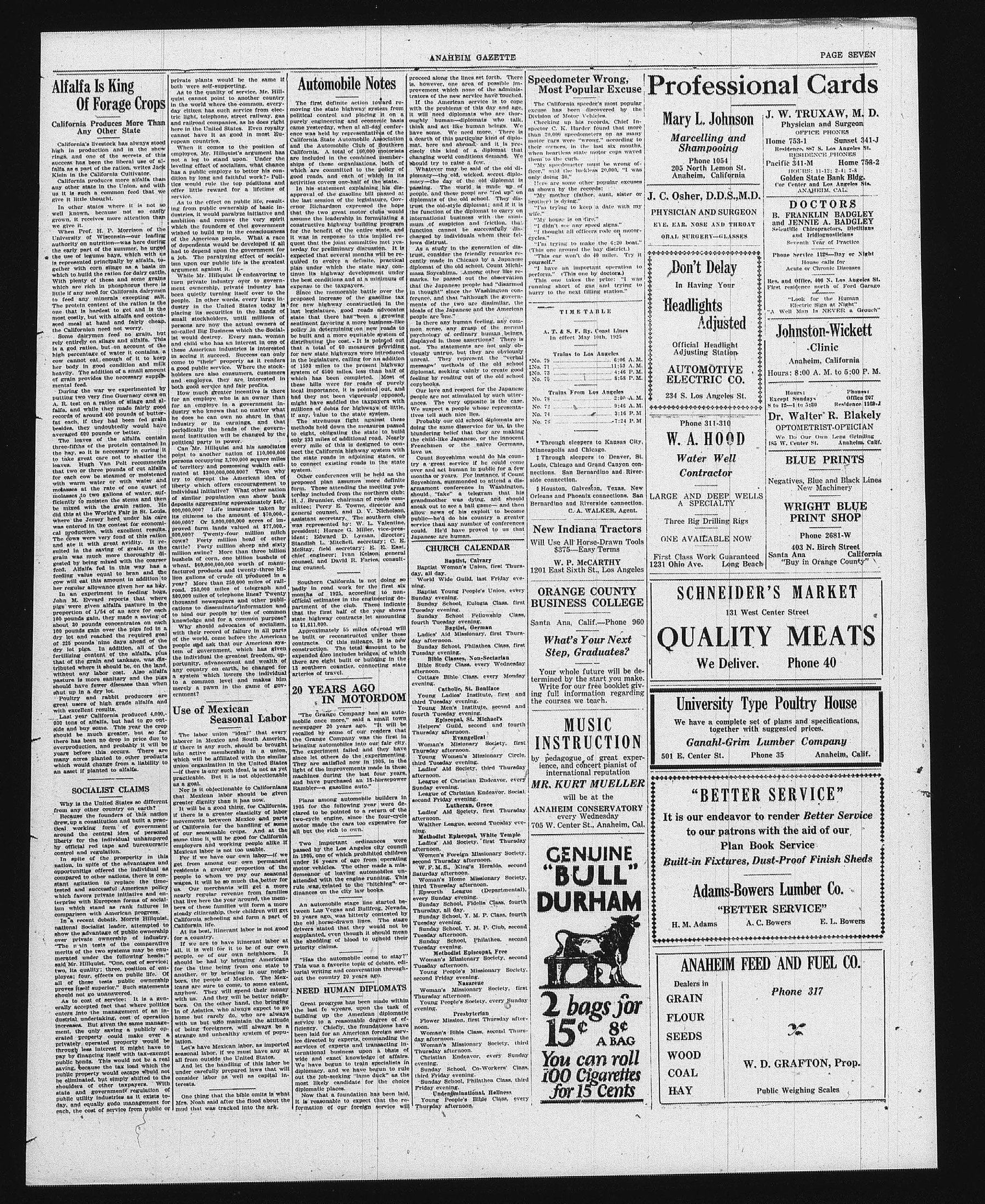
Searchable text
Alfalfa Is King Of Forage Crops
California Produces More Than Any Other State
California's livestock has always stood high in production and in the show rings, and one of the secrets of this success has been the liberal use of alfalfa as a part of the ration, writes Jack Klein in the California Cultivator.
California produces more alfalfa than any other state in the Union, and with us it is such a common feed that we give it little thought.
In other states where it is not so well known, because not so easily grown, it receives more attention than we give it.
When Prof. H. P. Morrison of the University of Wisconsin—our leading authority on nutrition—was here during the early part of the summer, he urged the use of legume hays, which with us is represented principally by alfalfa, together with corn silage as a basis on which to build the ration for dairy cattle. With plenty of these and some grains which are rich in phosphorus there is little if any need for California dairymen to feed any minerals except salt. The protein content of the ration is the one that is hardest to get and is the most costly, but with alfalfa and cottonseed meal at hand and fairly cheap, the Californian need not worry.
Some dairymen feed no grain, but rely entirely on silage and alfalfa. This is a god ration, but on account of the high percentage of water it contains, a cow cannot eat enough of it to keep her body in good condition and milk heavily. The addition of a small amount of grain provides the necessary supplemental feed.
During the war we experimented by putting two very fine Guernsey cows on A. R. test on a ration of silage and alfalfa, and while they made fairly good records of around 400 pounds of butter-fat each, if they had been fed grain besides, they undoubtedly would have averaged 600 pounds or better.
The leaves of the alfalfa contain three-fifths of the protein contained in private plants would be the same if both were self-supporting.
As to the quality of service, Mr. Hillquist cannot point to another country in the world where the common, everyday citizen has such service from electric light, telephone, street railway, gas and railroad companies, as he does right here in the United States. Even royalty cannot have it as good in most European countries.
When it comes to the position of employees, Mr. Hillquist's argument has not a leg to stand upon. Under the leveling effect of socialism, what chance has a public employee to better his condition by long and faithful work?- Politics would rule the top positions and offer little reward for a lifetime of service.
As to the effect on public life, resulting from public ownership of basic industries, it would paralyze initiative and ambition and remove the very spirit which the founders of the government wished to build up in the consciousness of the American people. What a race of dependents would be developed if all had to depend upon the government for a job. The paralyzing effect of socialism upon our public life is the greatest argument against it.
While Mr. Hillquist is endeavoring to turn private industry over to government ownership, private industry has been quietly turning itself over to the people. In other words, every large industry in the United States today is placing its securities in the hands of small stockholders, until millions of persons are now the actual owners of so-called Big Business which the Socialist would destroy. Every man, woman and child who has an interest in one of these American industries is interested in seeing it succeed. Success can only come to "their" property as it renders a good public service. Where the stockholders are also consumers, customers and employees, they are interested in both good service and fair profits.
How much greater incentive is there for an employee who is an owner than for an employee in a government industry who knows that no matter what he does he can own no share in that industry or its earnings, and that periodically the heads of the government institution will be changed by the political party in power.
Can Mr. Hillquist and his associates
Automobile M
The first definite action moving the state highway system political control and place purely engineering and economic came yesterday, when alfalfa was held by representatives California State Automobile and the Automobile Club California. A total of 160 are included in the combination which are committed to good roads, and each of their activities covers one-half of all activities covering approval of the gasoline by the last session of the legal error Richardson expresses that the two great motorists assume the leadership in constructive highway builds for the benefit of the entire nation was in response to this quest that the joint committee today for preliminary discussion expected that several months quired to evolve a definitive plan under which the state tune its highway development best conditions and at an expense to the taxpayers.
Since the memorable battle proposed increase of the for new highway construction legislature, good road state that there has been sentiment favoring a more policy in determining on how be built and a more equitable distributing the cost.- It is that a total of 60 measures for new state highways were in the legislature, calling for 1593 miles to the press system of 6500 miles, less which has been completed these bills were for road local importance, it is pointed had they not been vigorously might have saddled the tax millions of debts for highways if any, value to the state.
The strenuous fight among methods hold down me too eight, obligating the state only 233 miles of additional every mile of this is desirable.
During the war we experimented by putting two very fine Guernsey cows on A.R. test on a ration of silage and alfalfa, and while they made fairly good records of around 400 pounds of butter-fat each, if they had been fed grain besides, they undoubtedly would have averaged 600 pounds or better.
The leaves of the alfalfa contain three-fifths of the protein contained in hay, so it is necessary in curing it to take great care not to shatter the leaves. Hugh Van Pelt recommends that two or three pounds of cut alfalfa for each cow be steamed or molested with warm water or with water and molasses at the rate of one quart of molasses to two gallons of water, sufficiently to moisten the stems and then be mixed with the grain ration. He did this at the World's Fair in St. Louis, where the Jersey herd under his care was entered in the contest for economical production, with excellent results. The cows were very fond of this ration and ate it with great avidity. It resulted in the saving of grain, as the grain was much more thoroughly digested by being mixed with the coarser feed. Alfalfa fed in this way has a feeding value equal to bran and the cow will eat this amount in addition to her regular allowance given her as hay.
In an experiment in feeding hogs, John M. Evvard reports that where pigs were given alfalfa pasture in the proportion of 1/54 of an acre for each 100 pounds gain, they made a saving of about 30 pounds concentrates on each 100 pounds gain over the pigs fed in a dry lot and reached the required goal of 225 pounds nine days ahead of the dry lot pigs. In addition, all of the fertilizing content of the alfalfa, plus that of the grain and tankage, was distributed where it should be, on the land, without any labor cost. Also alfalfa pasture is more sanitary and the pigs should have fewer diseases than when shut up in a dry lot.
Poultry and rabbit producers are great users of high grade alfalfa and with excellent results.
Last year California produced 4,000-000 tons of alfalfa, but had to go outside and buy some. This year the crop should be much greater, but so far there has been no drop in price due to overproduction, and probably it will be years before this occurs. There are many acres planted to other products which would change from a liability to an asset if planted to alfalfa.
SOCIALIST CLAIMS
Why is the United States so different from any other country on earth?
Because the founders of this nation drew up a constitution and built a practical working form of government around the central idea of personal liberty for the individual unhampered by official red tape and bureaucratic
Use of Mexican Seasonal Labor
The labor union "ideal" that every laborer in Mexico and South America, if there is any such, should be brought into active membership in a union, which will be affiliated with the similar union organization in the United States—if there is any such ideal, is not as yet practicable. But it is not objectionable as a goal.
Nor is it objectionable to Californians that Mexican labor should be given greater dignity than it has now.
It will be a good thing, for California, if there is a greater elasticity of labor movements between Mexico and parts of California for the handling of some of our seasonable crops. And at the same time it will be good for California employers and working people alike if new state highway calls for 1593 miles to the press system of 6500 miles, less which has been completed these bills were for road local importance, it is point hard they not been vigorous might have saddled the tax millions of debts for highway if any, value to the state.
The strenuous fight against methods hold down the need to eight, obligating the state only 233 miles of additional every mile of this is designect the California highway the state roads in adjoinin to connect existing roads system.
Other conferences will be proposed plan assumes new form. Those attending the terday included from the north H.J. Brunnier, chairman omittee; Percy E. Towne general counsel, and D.V. assistant secretary. The was represented by: W.president; Horace G.Millident; Edward D.Lyman Standish L., Mitchell, secretary McStay, field secretary; chief engineer; Ivan Ke counsel, and David R.Faing counsel.
Southern California is badly in road work for months of 1925, according official estimates in the enartment of the club. That the first half of the state highway contracts led to $1,611,000.
Approximately 55 miles be built or reconstructed contracts. Of this mileage construction. The total expended also includes bridges there are eight built or built 13 southern counties, con- arteries of travel.
20 YEARS AGENT IN MOTOR
"The Grange Company mobile once more," said a newspaper 20 years ago. Recalled by some of our grange Company workers bringing automobiles into the experiment failed and since let others do the job They are satisfied now light of the improvements machines during the last and have purchased an Rambler—a gasoline auto.
Plans among automobile 1805 for the following year cleared to be pointed to a two-cycle engine, since motor made the cars too all but the rich to own.
Two important ordinances passed by the Los Angeles
SOCIALIST CLAIMS
Why is the United States so different from any other country on earth?
Because the founders of this nation drew up a constitution and built a practical working form of government around the central idea of personal liberty for the individual unhampered by official red tape and bureaucratic control and regulation.
In spite of the prosperity in this nation, in spite of the advantages and opportunities offered the individual as compared to other nations, there is constant agitation to replace the time-tested and successful American policy which favors private initiative and enterprise with European forms of socialism which stand as rank failures in comparison with American progress.
In a recent debate, Morris Hillquist, national Socialist leader, attempted to show the advantage of public ownership over private ownership of industry. "The main tests of the comparative merits of the two systems may be enumerated under the following heads:" said Mr. Hillquist. "One, cost of service; two, its quality; three, position of employees; four, effects on public life. Of all of these tests public ownership proves itself superior." Such statements should not go unanswered.
As to cost of service: It is a generally accepted fact that where politics enters into the management of an industrial undertaking, cost of operation increases. But given the same management, the only saving a publicly operated property could make over a privately operated property would be through less interest it might have to pay by financing itself with tax-exempt public bonds. This would not be a real saving, because the tax load which the public property would escape would not be eliminated, but simply shifted to the shoulders of other taxpayers. With state and government regulation of public utility industries as it exists today, and equally godo management for each, the cost of service from public or
For if we have our own labor—if we get from among our own permanent residents a greater proportion of the people to whom we pay our seasonal wages, it will be so much better for us. Our merchants will get a more nearly regular revenue from families that live here the year around, the members of these families will form a more steady citizenship, their children will get California schooling and form a part of California life.
At its best, itinerant labor is not good for a country.
If we are to have itinerant labor at all, it is well for it to be of our own people, or of our own neighbors. It should be had by bringing Americans for the time being from one state to another, or by bringing in our neighbors, the people of Mexico. The Mexicans are sure to come, to some extent, anyhow. They will spend their money with us. And they will be better neighbors. On the other hand, the bringing in of Asiatics, who always expect to go home but rarely do, who are always with us but who maintain the attitude of being foreigners, will always be a strange and unhealthy system of population.
Let's have Mexican labor, as imported seasonal labor, if we must have any at all from outside the United States.
And let the handling of this labor be under carefully prepared laws that will consider labor as well as capital interests.
One thing that the bible omits is what Mrs. Noah said after the flood about the mud that was tracked into the ark.
Nor is it objectionable to Californians that Mexican labor should be given greater dignity than it has now.
It will be a good thing, for California, if there is a greater elasticity of labor movements between Mexico and parts of California for the handling of some of our seasonable crops. And at the same time it will be good for California employers and working people alike if Mexican labor is not too usable.
For if we have our own labor—if we get from among our own permanent residents a greater proportion of the people to whom we pay our seasonal wages, it will be so much better for us. Our merchants will get a more nearly regular revenue from families that live here the year around, the members of these families will form a more steady citizenship, their children will get California schooling and form a part of California life.
At its best, itinerant labor is not good for a country.
If we are to have itinerant labor at all, it is well for it to be of our own people, or of our own neighbors. It should be had by bringing Americans for the time being from one state to another, or by bringing in our neighbors, the people of Mexico. The Mexicans are sure to come, to some extent, anyhow. They will spend their money with us. And they will be better neighbors. On the other hand, the bringing in of Asiatics, who always expect to go home but rarely do, who are always with us but who maintain the attitude of being foreigners, will always be a strange and unhealthy system of population.
Let's have Mexican labor, as imported seasonal labor, if we must have any at all from outside the United States.
And let the handling of this labor be under carefully prepared laws that will consider labor as well as capital interests.
One thing that the bible omits is what Mrs. Noah said after the flood about the mud that was tracked into the ark.
Nor is it objectionable to Californians that Mexican labor should be given greater dignity than it has now.
It will be a good thing, for California, if there is a greater elasticity of labor movements between Mexico and parts of California for the handling of some of our seasonable crops. And at the same time it will be good for California employers and working people alike if Mexican labor is not too usable.
For if we have our own labor—if we get from among our own permanent residents a greater proportion of the people to whom we pay our seasonal wages, it will be so much better for us. Our merchants will get a more nearly regular revenue from families that live here the year around, the members of these families will form a more steady citizenship, their children will get California schooling and form a part of California life.
At its best, itinerant labor is not good for a country.
If we are to have itinerant labor at all, it is well for it to be of our own people, or of our own neighbors. It should be had by bringing Americans for the time being from one state to another, or by bringing in our neighbors, the people of Mexico. The Mexicans are sure to come, to some extent, anyhow. They will spend their money with us. And they will be better neighbors. On the other hand, the bringing in of Asiatics, who always expect to go home but rarely do, who are always with us but who maintain the attitude of being foreigners, will always be a strange and unhealthy system of population.
Let's have Mexican labor, as imported seasonal labor, if we must have any at all from outside the United States.
And let the handling of this labor be under carefully prepared laws that will consider labor as well as capital interests.
One thing that the bible omits is what Mrs. Noah said after the flood about the mud that was tracked into the ark.
Nor is it objectionable to Californians that Mexican labor should be given greater dignity than it has now.
It will be a good thing, for California, if there is a greater elasticity of labor movements between Mexico and parts of California for the handling of some of our seasonable crops. And at the same time it will be good for California employers and working people alike if Mexican labor is not too usable.
For if we have our own labor—if we get from among our own permanent residents a greater proportion of the people to whom we pay our seasonal wages, it will be so much better for us. Our merchants will get a more nearly regular revenue from families that live here the year around, the members of these families will form a more steady citizenship, their children will get California schooling and form a part of California life.
At its best, itinerant labor is not good for a country.
If we are to have itinerant labor at all, it is well for it to be of our own people, or of our own neighbors. It should be had by bringing Americans for the time being from one state to another, or by bringing in our neighbors, the people of Mexico. The Mexicans are sure to come, to some extent, anyhow. They will spend their money with us. And they will be better neighbors. On the other hand, the bringing in of Asiatics, who always expect to go home but rarely do, who are always with us but who maintain the attitude of being foreigners, will always be a strange and unhealthy system of population.
Let's have Mexican labor, as imported seasonal labor, if we must have any at all from outside the United States.
And let the handling of this labor be under carefully prepared laws that will consider labor as well as capital interests.
One thing that the bible omits is what Mrs. Noah said after the flood about the mud that was tracked into the ark.
Nor is it objectionable to Californians that Mexican labor should be given greater dignity than it has now.
It will be a good thing, for California, if there is a greater elasticity of labor movements between Mexico and parts of California for the handling of some of our seasonable crops. And at the same time it will be good for California employers and working people alike if Mexican labor is not too usable.
For if we have our own labor—if we get from among our own permanent residents a greater proportion of the people to whom we pay our seasonal wages, it will be so much better for us. Our merchants will get a more nearly regular revenue from families that live here the year around, the members of these families will form a more steady citizenship, their children will get California schooling and form a part of California life.
At its best, itinerant labor is not good for a country.
If we are to have itinerant labor at all, it is well for it to be of our own people, or of our own neighbors. It should be had by bringing Americans for the time being from one state to another, or by bringing in our neighbors, the people of Mexico. The Mexicans are sure to come, to some extent, anyhow. They will spend their money with us. And they will be better neighbors. On the other hand, the bringing in of Asiatics, who always expect to go home but rarely do, who are always with us but who maintain the attitude of being foreigners, will always be a strange and unhealthy system of population.
Let's have Mexican labor, as imported seasonal labor, if we must have any at all from outside the United States.
And let the handling of this labor be under carefully prepared laws that will consider labor as well as capital interests.
One thing that the bible omits is what Mrs. Noah said after the flood about the mud that was tracked into the ark.
Nor is it objectionable to Californians that Mexican labor should be given greater dignity than it has now.
It will be a good thing, for California, if there is a greater elasticity of labor movements between Mexico and parts of California for the handling of some of our seasonable crops. And at the same time it will be good for California employers and working people alike if Mexican labor is not too usable.
For if we have our own labor—if we get from among our own permanent residents a greater proportion of the people to whom we pay our seasonal wages, it will be so much better for us. Our merchants will get a more nearly regular revenue from families that live here the year around, the members of these families will form a more steady citizenship, their children will get California schooling and form a part of California life.
At its best, itinerant labor is not good for a country.
If we are to have itinerant labor at all, it is well for it to be of our own people, or of our own neighbors. It should be had by bringing Americans for the time being from one state to another, or by bringing in our neighbors,the people of Mexico. The Mexicans are sure to come,to some extent,anyhow. They will spend their money with us. And they will be better neighbors. On the other hand,the bringing in of Asiatics,who always expect to go home but rarely do,who are always with us but who maintain the attitude of being foreigners,will always be a strange and unhealthy system of population.
Let's have Mexican labor,as imported seasonal labor,if we must have any at all from outside the United States.
And let the handling of this labor be under carefully prepared laws that will consider labor as well as capital interests.
One thing that the bible omits is what Mrs. Noah said after the flood about the mud that was tracked into the ark.
Nor is它 objectionable to Californians that Mexican labor should be given greater dignity than it has now."
Plans among automobile manufacturers in 1905 for the following year cleared to be pointed out by two-cycle engine since motor made cars too slow all but rich to own.
Two important orders passed by The Los Angeles in 1905,one of which prohibits under 16 years old age motor vehicles.
The other demeanor of leaving auto attended with the engine related with other drivers stated that they supplanted even though they shedding blood took priority claims.
"Has an automobile co-operation This was a favorite topic writing and conversing out country 20 years."
NEED HUMAN DEFENSE
Great progress has been seen last few years,upon building up America service to a reasonable efficiency。Chiefly,the four been laid for an American ice directed by experts,co-services of experts and their international business upon wide and exact knowledge diplomacy,and we have out-the job-seeking "lame most likely candidate for diplomatic places."
Now that a foundation has been formed,它 reasonable expectation o formation o our foreign
Automobile Notes
The first definite action toward removing the state highway system from political control and placing it on a purely engineering and economic basis came yesterday, when at all-day conference was held by representatives of the California State Automobile Association and the Automobile Club of Southern California. A total of 160,000 motorists are included in the combined memberships of these organizations, both of which are committed to the policy of good roads, and each of which in its activities covers one-half of the state.
In his statement explaining his disapproval of the gasoline bill passed at the last session of the legislature, Governor Richardson expressed the hope that the two great motor clubs would assume the leadership in formulating a constructive highway building program for the benefit of the entire state, and it was in response to this implied request that the joint committee met yesterday for preliminary discussion. It is expected that several months will be required to evolve a definite, practical plan under which the state may continue its highway development under the best conditions and at a minimum of expense to the taxpayers.
Since the memorable battle over the proposed increase of the gasoline tax for new highway construction in the last legislature, good roads advocates state that there has been a growing sentiment favoring a more business-like policy in determining on new roads to be built and a more equitable system of distributing the cost. It is pointed out that a total of 60 measures providing for new state highways were introduced in the legislature, calling for an addition of 1593 miles to the present highway system of 6500 miles, less than half of which has been completed. Most of these bills were for roads of purely local importance, it is pointed out, and had they not been vigorously opposed, might have saddled the taxpayers with millions of debts for highways of little, if any, value to the state system.
The strenuous fight against these methods hold down the measures passed to eight, obligating the state to build only 233 miles of additional road. Nearly every mile of this is designed to proceed along the lines set forth. There is, however, one area of possible improvement which none of the administrators of the new service have touched.
If the American service is to cope with the problems of this day and age, it will need diplomats who are thoroughly human—diplomats who talk, think and act like human beings. We have some. We need more. There is a dearth of this particular kind of diplomat, here and abroad, and it is precisely this kind of diplomat that changing world conditions demand. We should try to raise a few.
Whatever may be said of the old diplomacy—the old, wicked, secret diplomacy—the day of the old diplomat is passing. The world is made up of people, and these people are "fed up" on diplomats of the old school. They distrust the old-style diplomat; and if it is the function of the diplomat to carry on international business with the minimum of suspicion and friction, that function cannot be successfully discharged by individuals whom their fellows distrust.
As a study in the generation of distrust, consider the friendly remarks recently made in Chicago by a Japanese diplomat of the old school, Count Michimasa Soyeshima. Among other like remarks, he passed out the observation that the Japanese people had "disarmed in thought" since the Washington conference, and that "although the governments of the two are dissimilar, the ideals of the Japanese and the American people are one."
Is there any human feeling, any common sense, any grasp of the normal psychology of ordinary human beings, displayed in those assertions? There is not. The statements are not only obviously untrue, but they are obviously unreal. They represent the "verbal message" methods of the old school diplomat, seeking vainly to create good feeling by reading out of the old school copybooks.
Our love and respect for the Japanese people are not stimulated by such utterances. The very opposite is the case. We suspect a people whose representatives tell such nice lies.
Probably our old school diplomats are doing the same disservice for us, in the blundering belief that they are making the child-like Japanese, or the innocent Frenchmen or the naive Germans,
Speedometer Wrong, Most Popular Excuse
The California speeder's most popular excuse has been discovered by the Division of Motor Vehicles.
Checking up his records, Chief Inspector C. K. Harder found that more than 20,000 speedometers on as many motor cars were "wrong," according to their owners, in the last six months, when heartless state motor cops waved them to the curb.
"My speedometer must be wrong officer," said the luckless 20,000. "I was only doing 30."
Here are some other popular excuses as shown by the records:
"My mother (father, aunt, sister or brother) is dying."
"I'm trying to keep a date with my wife."
"My house is on fire."
"I didn't see any speed signs."
"I thought all officers rode on motorcycles."
"I'm trying to make the 6:20 boat." (This one around the bay district).
"This car won't do 40 miles. Try it yourself."
"I have an important operation to perform." (This one by doctors)
This one takes the prize: "I was running short of gas and trying to hurry to the next filling station."
TIME TABLE
A. T. & S. F. Ry. Coast Lines
In effect May 10th, 1925
Trains to Los Angeles
*No. 79 6:06 A.M.
*No. 71 11:53 A.M.
$No. 73 4:46 P.M.
No. 75 8:58 P.M.
Trains From Los Angeles
No. 78 2:00 A.M.
No. 72 9:46 A.M.
No. 74 3:16 P.M.
No. 76 7:24 P.M.
*Through sleepers to Kansas City,
Missouri and Chicago.*
in the legislature, calling for an addition of 1593 miles to the present highway system of 6500 miles, less than half of which has been completed. Most of these bills were for roads of purely local importance, it is pointed out, and had they not been vigorously opposed, might have saddled the taxpayers with millions of debts for highways of little, if any, value to the state system.
The strenuous fight against these methods held down the measures passed to eight, obligating the state to build only 233 miles of additional road. Nearly every mile of this is designed to connect the California highway system with the state roads in adjoining states, or to connect existing roads in the state system.
Other conferences will be held as the proposed plan assumes more definite form. Those attending the meeting yesterday included from the northern club: H. J. Brunnier, chairman of roads committee; Percy E. Towne, director and general counsel, and D. V. Nicholson, assistant secretary. The southern club was represented by: W. L. Valentine, president; Horace G. Miller, vice-president; Edward D. Lyman, director; Standish L. Mitchell, secretary; C. E. McStay, field secretary; E. E. East, chief engineer; Ivan Kelson, general counsel, and David R. Farles, consulting counsel.
Southern California is not doing so badly in road work for the first six months of 1925, according to non-official estimates in the engineering department of the club. These indicate that the first half of the year shows state highway contracts let amounting to $1,611,000.
Approximately 55 miles of road will be built or reconstructed under these contracts. Of this mileage, 38 is new construction. The total amount to be expended also includes bridges of which there are eight built or building in the 13 southern counties, connecting state arteries of travel.
20 YEARS AGO IN MOTORDOM
"The Grange Company has an automobile once more," said a small town newspaper 20 years ago. "It will be recalled by some of our readers that the Grange Company was the first in bringing automobiles into our fair city. The experiment failed and they have since let others do the experimenting. They are satisfied now in 1905, in the light of the improvements made in these machines during the last four years, and have purchased an 18-horsepower Rambler—a gasoline auto."
Plans among automobile builders in 1905 for the following year were declared to be pointed to a return of the two-cycle engine, since the four-cycle motor made the cars too expensive for all but the rich to own.
Two important ordinances were passed by the Los Angeles city council
CHURCH CALENDAR
Baptist, Calvary
Baptist Woman's Union, first Thursday, all day.
World Wide Guild, last Friday evening.
Baptist Young People's Union, every Sunday evening.
Sunday School, Eulogia Class, first Tuesday evening.
Sunday School Fellowship Class, fourth Tuesday evening.
Baptist, German
Ladies' Aid Missionary, first Thursday afternoon.
Sunday School, Philathea Class, first Tuesday evening.
Bible Classes, Non-Sectarian
Bible Study Class, every Wednesday afternoon.
Cottage Bible Class, every Monday evening.
Catholic, St. Boniface
Young Ladies' Institute, first and third Tuesday evening.
Young Men's Institute, second and fourth Tuesday evening.
Evangelical
Woman's Missionary Society, first Thursday afternoon.
Young Women's Missionary Circle, third Tuesday evening.
Ladies' Aid Society, third Thursday afternoon.
League of Christian Endeavor, every Sunday evening.
League of Christian Endeavor, Social second Friday evening.
Lutheran, Grace
Ladies' Aid Society, first Thursday afternoon.
Walther League, second Tuesday evening.
Methodist Episcopal, White Temple
Ladies' Aid Society, first Thursday afternoon.
Trains To Los Angeles
No. 79 6:06 A.M.
No. 71 11:53 A.M.
No. 73 4:46 P.M.
No. 75 8:58 P.M.
* Through sleepers to Kansas City, Minneapolis and Chicago.
† Through sleepers to Denver, St. Louis, Chicago and Grand Canyon connections. San Bernardino and River-side connection.
§ Houston, Galveston, Texas, New Orleans and Phoenix connections. San Bernardino and Riverside connection.
C.A.WALKER, Agent.
New Indiana Tractors
Will Use All Horse-Drawn Tools $375—Easy Terms
W.P.McCARTHY
1201 East Sixth St., Los Angeles
ORANGE COUNTY BUSINESS COLLEGE
Santa Ana, Calif.-Phone 960
What's Your Next Step, Graduates?
Your whole future will be determined by the start you make.
Write for our free booklet giving full information regarding the courses we teach.
MUSIC INSTRUCTION
by pedagogue of great experience, and concert pianist of international reputation
MR.KURT MUELLER
will be at the ANAHEIM CONSERVATORY every Wednesday
705 W.Center St., Anaheim, Cal.
since let others do the experimenting. They are satisfied now in 1905, in the light of the improvements made in these machines during the last four years, and have purchased an 18-horsepower Rambler—a gasoline auto."
Plans among automobile builders in 1905 for the following year were declared to be pointed to a return of the two-cycle engine, since the four-cycle motor made the cars too expensive for all but the rich to own.
Two important ordinances were passed by the Los Angeles city council in 1905, one of which prohibited children under 16 years of age from operating motor vehicles. The other made a misdemeanor of leaving automobiles unattended with the engine running. This rule was related to the "hitching" ordinances on the city law books.
An automobile stage line started between Las Vegas and Bullfrog, Nevada, 20 years ago, was bitterly contested by the old horse-drawn lines. The stage drivers stated that they would not be supplanted, even though it should mean the shedding of blood to uphold their priority claims.
"Has the automobile come to stay?" This was a favorite topic of debate, editorial writing and conversation throughout the country 20 years ago.
NEED HUMAN DIPLOMATS
Great progress has been made within the last five wyears, upon the task of building up the American diplomatic service to a reasonable degree of efficiency. Chiefly, the foundations have been laid for an American foreign service directed by experts, commanding the services of experts and transacting international business upon a basis of wide and exact knowledge of affairs. We have begun to train specialists in diplomacy, and we have begun to rule out the job-seeking "lame duck" as the most likely candidate for the choice diplomatic places.
Now that a foundation has been laid, it is reasonable to expect that the reformation of our foreign service will
Young Women's Missionary Circle, third Tuesday evening.
Ladies' Aid Society, third Thursday afternoon.
League of Christian Endeavor, every Sunday evening.
League of Christian Endeavor, Social second Friday evening.
Lutheran, Grace
Ladies' Aid Society, first Thursday afternoon.
Walther League, second Tuesday evening.
Methodist Episcopal, White Temple
Ladies' Aid Society, first Thursday afternoon.
Women's Foreign Missionary Society, second Thursday afternoon.
W.F.M.S., King's Heralds, second Saturday afternoon.
Woman's Home Missionary Society, third Thursday afternoon.
Epworth League (Departmental), every Sunday evening.
Sunday School, Fidelis Class, fourth Thursday, all day.
Sunday School, Y. M. P. Class, fourth Tuesday evening.
Sunday School, Y. M. P. Club, second Tuesday afternoon.
Sunday School, Philathea, second Tuesday evening.
Methodist Episcopal, Free
Woman's Missionary Society, second Tuesday afternoon.
Young People's Missionary Society, second Friday evening.
Nazarene
Woman's Missionary Society, first Thursday afternoon.
Young People's Society, every Sunday evening.
Presbyterian
Flower Mission, first Thursday afternoon.
Woman's Bible Class, second Thursday afternoon.
Woman's Missionary Society, third Thursday afternoon.
Christian Endeavor, every Sunday evening.
Sunday School, Co-Workers' Class, third Friday evening.
Sunday School, Philathea Class, third Friday evening.
Undeniational, Hellness
Young People's Bible Class, every Thursday afternoon.
MR. KURT MUELLER
will be at the ANAHEIM CONSERVATORY every Wednesday
705 W. Center St., Anaheim, Cal.
GENUINE "BULL" DURHAM
2 bags for 15¢ A BAG
You can roll 100 Cigarettes for 15 Cents
Professional Cards
Mary L. Johnson
Marcelling and Shampooing
Phone 1054
205 North Lemon St.
Anaheim, California
J. C. Osher, D.D.S., M.D.
PHYSICIAN AND SURGEON
EYE, EAR, NOSE AND THROAT
ORAL SURGERY—GLASSES
Don’t Delay
In Having Your
Headlights
Adjusted
Official Headlight
Adjusting Station
AUTOMOTIVE
ELECTRIC CO.
234 S. Los Angeles St.
Phone 311-310
W. A. HOOD
J. W. TRUXAW, M. D.
Physician and Surgeon
OFFICE PHONES
Home 753-1 Sunset 341-J
Residence, 887 S. Los Angeles St.
RESIDENCE PHONES
Pacific 341-M Home 758-2
HOURS: 11-12; 2-4; 7-8
Golden State Bank Bldg.
Cor Center and Los Angeles Sts.
ANAHEIM, CAL.
DOCTORS
B. FRANKLIN BADGLEY
and JENNIE A. BADGLEY
Scientific Chiropractors, Dietitians
and Iridlognosticians
Seventh Year of Practice
Phone Service 1128—Day or Night
House calls for
Acute or Chronic Diseases
Res. and Office, 406 N. Los Angeles St.
First residence north of Ford Garage
"Look for the Human Electric Sign at Night"
"A Well Man Is NEVER a Grouch"
Johnston-Wickett
Clinic
Anaheim, California
Hours: 8:00 A.M. to 5:00 P.M.
Hours:
Except Sundays
8 to 12—1 to 5:20
Office 207
Residence 1169-J
Dr. Walter R. Blakely
OPTOMETRIST-OPTICIAN
We Do Our Own Lens Grinding
185 W. Center St.
Anaheim, Calif.
AUTOMOTIVE ELECTRIC CO.
234 S. Los Angeles St.
Phone 311-310
W. A. HOOD
Water Well Contractor
LARGE AND DEEP WELLS
A SPECIALTY
Three Big Drilling Rigs
ONE AVAILABLE NOW
First Class Work Guaranteed
1231 Ohio Ave. Long Beach
Anaheim, California
Hours: 8:00 A.M. to 5:00 P.M.
Hours:
Except Sundays
N to 12—1 to 5:30
Phones:
Office 207
Residence 1169-J
Dr. Walter R. Blakely
OPTOMETRIST-OPTICIAN
We Do Our Own Lens Grinding
185 W. Center St.
Anaheim, Calif.
BLUE PRINTS
Negatives, Blue and Black Lines
New Machinery
WRIGHT BLUE PRINT SHOP
Phone 2681-W
403 N. Birch Street
Santa Ana California
"Buy in Orange County"
SCHNEIDER'S MARKET
131 West Center Street
QUALITY MEATS
We Deliver. Phone 40
University Type Poultry House
We have a complete set of plans and specifications,
together with suggested prices.
Ganahl-Grim Lumber Company
501 E. Center St. Phone 35 Anaheim, Calif.
"BETTER SERVICE"
It is our endeavor to render Better Service
to our patrons with the aid of our
Plan Book Service
"BETTER SERVICE"
It is our endeavor to render Better Service
to our patrons with the aid of our
Plan Book Service
Built-in Fixtures, Dust-Proof Finish Sheds
Adams-Bowers Lumber Co.
"BETTER SERVICE"
H. M. Adams A. C. Bowers E. L. Bowers
ANAHEIM FEED AND FUEL CO.
Dealers in
GRAIN
FLOUR
SEEDS
WOOD
COAL
HAY
Phone 317
W. D. GRAFTON, Prop.
Public Weighing Scales