anaheim-gazette 1925-08-06
Scanned page
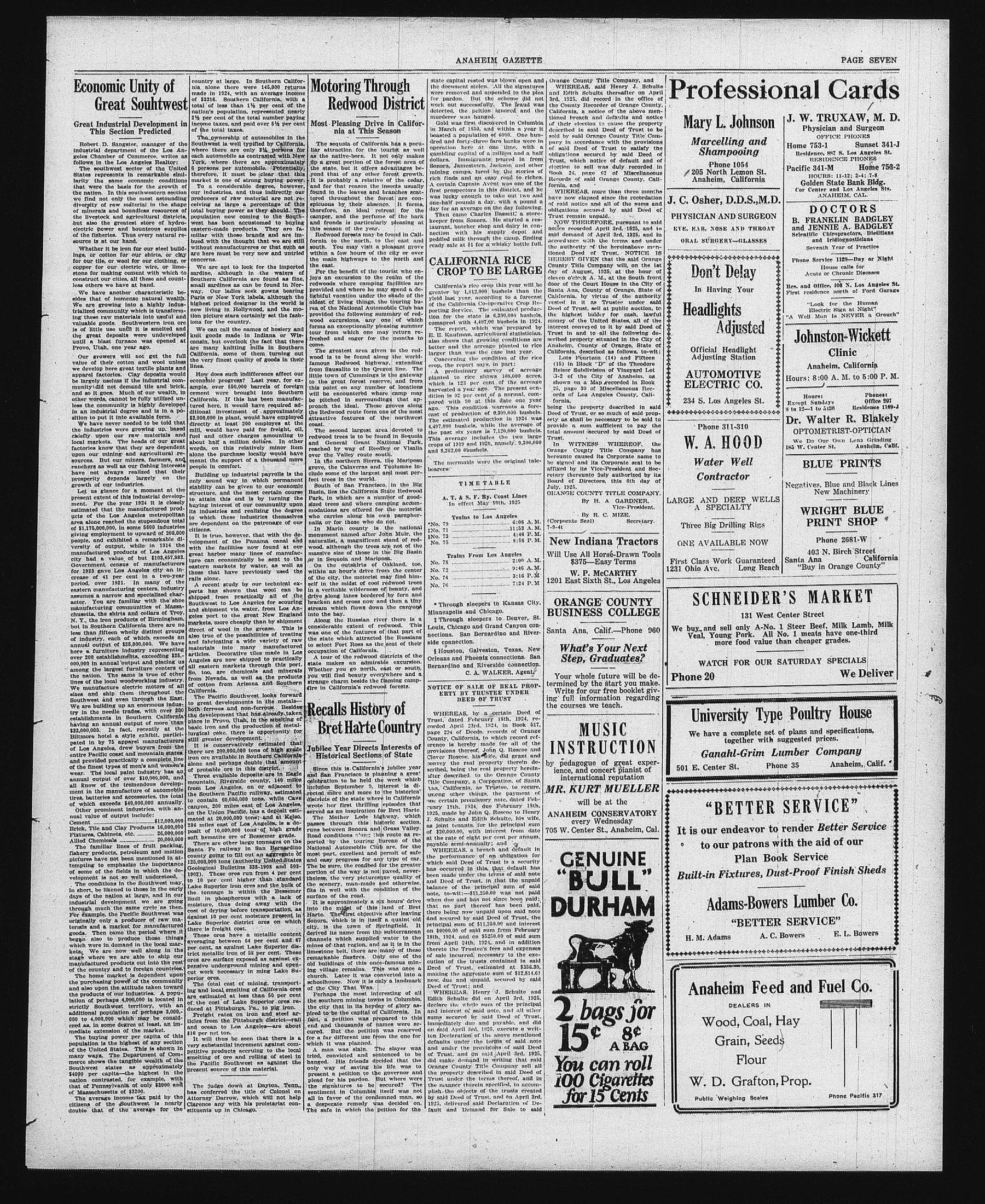
Searchable text
Economic Unity of Great Souhtwest
Great Industrial Development in This Section Predicted
Robert D. Sangster, manager of the industrial department of the Los Angeles Chamber of Commerce, writes as follows in the Los Angeles Realtor:
The southwest sector of the United States represents in remarkable similarity the same economic conditions that were the basis for the growth of the nation. In this southwestern section we find not only the most astounding diversity of raw material in the shape of minerals and boundless resources of the livestock and agricultural districts, but also the greatest store of hydroelectric power and bountiful supplies of the fisheries. Thus every natural resource is at our hand.
Whether it be iron for our steel buildings, or cotton for our shirts, or clay for our tile, or wool for our clothing, or copper for our electric wire, or lime-stone for making cement with which to construct our cities, all these and countless others we have at hand.
We have another characteristic besides that of immense natural wealth. We are growing into a highly industrialized community which is transforming these raw materials into useful and valuable goods. Southwestern iron ore is of little use until it is smelted and the great deposits were undeveloped until a blast furnace was opened at Provo, Utah, one year ago.
Our growers will not get the full value of their cotton and wool unless we develop here great textile plants and apparel factories. Clay deposits would be largely useless if the industrial community did not demand tile and brick, and so it goes. Much of our wealth, in other words, cannot be fully utilized unless the community is highly developed in an industrial degree and is in a position to put it into available form.
We have never needed to be told that the industries were growing up, based chiefly upon our raw materials and local markets. The heads of our great factories know that they are dependent country at large. In Southern California alone there were 145,000 returns made in 1924, with an average income of $3316. Southern California, with a total of less than 1½ per cent of the nation's population, represented nearly 2½ per cent of the total number paying income taxes, and paid over 5½ per cent of the total taxes.
The ownership of automobiles in the Southwest is well typified by California, where there are only 3½ persons for each automobile as contrasted with New York, where there are approximately 6 persons per automobile. Potentially therefore, it must be clear that this market is one of strong buying power.
To a considerable degree, however, our industries, and thus indirectly our producers of raw material are not receiving as large a percentage of this total buying power as they should. The population now coming to the Southwest has been accustomed to buying eastern-made products. They are familiar with those brands and are imbued with the thought that we are still without manufacturers or that such as are here must be very new and untried concerns.
We are apt to look for the imported sardine, although in the waters of Southern California are found as fine, small sardines as can be found in Norway. Our ladies seek gowns bearing Paris or New York labels, although the highest priced designer in the world is now living in Hollywood, and the motion picture stars certainly set fashions for the country.
We can call the names of hosiery and knit goods made in Indiana or Wisconsin, but overlook the fact that there are many knitting mills in Southern California, some of them turning out the very finest quality of goods in their lines.
How does such indifference affect our economic progress? Last year, for example, over 550,000 barrels of foreign cement were brought into Southern California. If this has been manufactured here, it would have required additional investment of approximately $2,000,000 in plant, would have employed directly at least 200 employees at the mill, would have paid for freight, oil, fuel and other charges amounting to about half a million dollars. In other words, on this relatively minor item country at large. In Southern California alone there were 145,000 returns made in 1924, with an average income of $3316. Southern California, with a total of less than 1½ per cent of the nation's population, represented nearly 2½ per cent of the total number paying income taxes, and paid over 5½ per cent of the total taxes.
The ownership of automobiles in the Southwest is well typified by California, where there are only 3½ persons for each automobile as contrasted with New York, where there are approximately 6 persons per automobile. Potentially therefore, it must be clear that this market is one of strong buying power.
To a considerable degree, however, our industries, and thus indirectly our producers of raw material are not receiving as large a percentage of this total buying power as they should. The population now coming to the Southwest has been accustomed to buying eastern-made products. They are familiar with those brands and are imbued with the thought that we are still without manufactureres or that such as are here must be very new and untried concerns.
We are apt to look for the imported sardine, although in the waters of Southern California are found as fine, small sardines as can be found in Norway. Our ladies seek gowns bearing Paris or New York labels, although the highest priced designer in the world is now living in Hollywood, and the motion picture stars certainly set fashions for the country.
We can call the names of hosiery and knit goods made in Indiana or Wisconsin, but overlook the fact that there are many knitting mills in Southern California, some of them turning out the very finest quality of goods in their lines.
How does such indifference affect our economic progress? Last year, for example, over 550,000 barrels of foreign cement were brought into Southern California. If this has been manufactured here, it would have required additional investment of approximately $2,000,000 in plant, would have employed directly at least 200 employees at the mill, would have paid for freight, oil, fuel and other charges amounting to about half a million dollars. In other words, on this relatively minor item country at large. In Southern California alone there were 145,000 returns made in 1924, with an average income of $3316. Southern California, with a total of less than 1½ per cent of the nation's population, represented nearly 2½ per cent of the total number paying income taxes, and paid over 5½ per cent of the total taxes.
The ownership of automobiles in the Southwest is well typified by California, where there are only 3½ persons for each automobile as contrasted with New York, where there are approximately 6 persons per automobile. Potentially therefore, it must be clear that this market is one of strong buying power.
To a considerable degree, however, our industries, and thus indirectly our producers of raw material are not receiving as large a percentage of this total buying power as they should. The population now coming to the Southwest has been accustomed to buying eastern-made products. They are familiar with those brands and are imbued with the thought that we are still without manufactureres or that such as are here must be very new and untried concerns.
We are apt to look for the imported sardine, although in the waters of Southern California are found as fine, small sardines as can be found in Norway. Our ladies seek gowns bearing Paris or New York labels, although the highest priced designer in the world is now living in Hollywood, and the motion picture stars certainly set fashions for the country.
We can call the names of hosiery and knit goods made in Indiana or Wisconsin, but overlook the fact that there are many knitting mills in Southern California, some of them turning out the very finest quality of goods in their lines.
How does such indifference affect our economic progress? Last year, for example, over 550,000 barrels of foreign cement were brought into Southern California. If this has been manufactured here, it would have required additional investment of approximately $2,000,000 in plant, would have employed directly at least 200 employees at the mill, would have paid for freight, oil, fuel and other charges amounting to about half a million dollars. In other words, on this relatively minor item country at large. In Southern California alone there were 145,000 returns made in 1924, with an average income of $3316. Southern California, with a total of less than 1½ per cent of the nation's population, represented nearly 2½ per cent of the total number paying income taxes, and paid over 5½ per cent of the total taxes.
The ownership of automobiles in the Southwest is well typified by California, where there are only 3½ persons for each automobile as contrasted with New York, where there are approximately 6 persons per automobile. Potentially therefore, it must be clear that this market is one of strong buying power.
To a considerable degree, however, our industries, and thus indirectly our producers of raw material are not receiving as large a percentage of this total buying power as they should. The population now coming to the Southwest has been accustomed to buying eastern-made products. They are familiar with those brands and are imbued with the thought that we are still without manufactureres or that such as are here must be very new and untied concerns.
We are apt to look for the imported sardine, although in the waters of Southern California are found as fine, small sardines as can be found in Norway. Our ladies seek gowns bearing Paris or New York labels, although the highest priced designer in the world is now living in Hollywood, and the motion picture stars certainly set fashions for the country.
We can call the names of hosiery and knit goods made in Indiana or Wisconsin, but overlook the fact that there are many knitting mills in Southern California, some of them turning out the very finest quality of goods in their lines.
How does such indifference affect our economic progress? Last year, for example, over 550,000 barrels of foreign cement were brought into Southern California. If this has been manufactured here, it would have required additional investment of approximately $2,000,000 in plant,would have employed directly at least 200 employees at the mill,would have paid for freight,oil, fuel and other charges amounting to about half a million dollars. In other words,on this relatively minor item country at large. In Southern California alone there were 145,000 returns made in 1924,with an average income of $3316. Southern California,with a total of less than 1½ per cent of the nation's population,represented nearly 2½ per cent of the total number paying income taxes,and paid over 5½ per cent of the total taxes.
The ownership of automobiles in the Southwest is well typified by California,where there are only 3½ persons for each automobile as contrasted with New York,where there are approximately 6 persons per automobile. Potentially therefore,it must be clear that this market is one of strong buying power.
To a considerable degree,however,our industries,and thus indirectly our producers of raw material are not receiving as large a percentage of this total buying power as they should. The population now coming to the Southwest has been accustomed to buying eastern-made products. They are familiar with those brands和are imbued withthe thought thatweare stillwithoutmanufactureresorthatsuchasareheremustbeverynewanduntiedconcerns.
We are apt to look for the imported sardine,althoughinthewatersofSouthernCaliforniaarefoundasfine,smallsardinesascanbefoundinNorway.TheloudestvacationunderdeliverythroughtheNationalAwardprovidedthefollowingwoodexcursions,andformasanexceptiontourfromwhichoncreshapedandcome.ThegreatestareaswoodistobefoundfamousRedwoodhillfromSausalito,totheGreatForestthispointonanymillionwillbeencounterbedipitchedinsurroundtheideal.Thelargedwoodrouteforattractivefeaturescost.
The second largest redwood trees is to be found General Grant reached by way off.
Our growers will not get the full value of their cotton and wool unless we develop here great textile plants and apparel factories. Clay deposits would be largely useless if the industrial community did not demand tile and brick, and so it goes. Much of our wealth, in other words, cannot be fully utilized unless the community is highly developed in an industrial degree and is in a position to put it into available form.
We have never needed to be told that the industries were growing up, based chiefly upon our raw materials and local markets. The heads of our great factories know that they are dependent upon our mining and agricultural resources. But our miners, farmers, and ranchers as well as our fishing interests have not always realized that their prosperity depends largely on the growth of our industries.
Let us glance for a moment at the present extent of this industrial development. For the year 1924 it is closely estimated that the manufactured products of the Los Angeles metropolitan area alone reached the stupendous total of $1,175,000,000, in some 5600 industries giving employment to upward of 200,000 people, and exhibited a remarkable diversity of output, while in 1914 the manufactured products of Los Angeles city had a value of but $103,457,993. Government census of manufacturers for 1923 gave Los Angeles city an increase of 41 per cent in a two-year period, over 1921. In many of the eastern manufacturing centers, industry assumes a narrow and specialized character. You are familiar with the shoe manufacturing communities of Massachusetts, the shirts and collars of Troy, N.Y., the iron products of Birmingham, but in Southern California there are no less than fifteen wholly distinct groups of industry, each of which exceeds an annual output of $25,000,000. We have here a furniture industry representing over 200 establishments, exceeding $25,000,000 in annual output and placing us among the largest furniture centers of the nation. The same is true of other lines of the local woodworking industry. We manufacture electric motors of all sizes and ship them throughout the Southwest and even through the East. We are building up an enormous industry in the needle trades, with over 200 establishments in Southern California having an annual output of more than $23,000,000. In fact, recently at the Biltmore hotel a style exhibit, participated in by 75 apparel manufacturers of Los Angeles, drew buyers from the entire Pacific coast and mountain states, and provided practically a complete line of the finest types of men's and women's wear. The local paint industry has an annual output of over $10,000,000, and all know of the tremendous development in the manufacture of automobile tires, batteries and accessories, the total of which exceeds $40,000,000 annually.
Other prominent industries, with annual value of output include:
Cement ... $12,000,000
Brick, Tile and Clay Products 16,000,000
Fixtures, Cabinets, etc. ... 26,000,000
Allied Chemicals ... 20,000,000
The familiar lines of fruit packing,
How does such indifference affect our economic progress? Last year, for example, over 550,000 barrels of foreign cement were brought into Southern California. If this has been manufactured here, it would have required additional investment of approximately $2,000,000 in plant, would have employed directly at least 200 employees at the mill, would have paid for freight, oil, fuel and other charges amounting to about half a million dollars. In other words, on this relatively minor item alone the purchase locally would have meant the support of a thousand more people in comfort.
Building up industrial payrolls is the only sound way in which permanent stability can be given to our economic structure, and the most certain course to attain this end is by turning the buying interest of our community upon its industries and realizing the degree to which these industries themselves are dependent on the patronage of our citizens.
It is true, however, that with the development of the Panama canal and with the facilities now found at our great harbor many lines of manufacture can economically be sent to the eastern markets by water, as well as those that have previously used the rails alone.
A recent study by our technical experts has shown that wool can be shipped from practically all of the Southwest to Los Angeles for scouring and shipment via water, from Los Angeles port to the great New England markets, more cheaply than by shipment direct of wool in the grease. This is also true of the possibilities of treating and fabricating a wide variety of raw materials into many manufactured articles. Decorative tiles made in Los Angeles are now shipped to practically all eastern markets through this port. So, too, are chemicals and minerals from Nevada, as well as the products of cotton from Arizona and Southern California.
The Pacific Southwest looks forward to great developments in the metals—both ferrous and non-ferrous. Besides the development that has already taken place in Provo, Utah, in the smelting of basic iron and the production of metal-lurgical coke, there is opportunity for still greater development.
It is conservatively estimated that there are 200,000,000 tons of high grade iron ore available in Southern California alone and perhaps double that amount of probable ore in this district.
Three available deposits are in Eagle mountain, Riverside county, 140 miles from Los Angeles; on or adjacent to the Southern Pacific railway; estimated to contain 60,000,000 tons; while Cave canyon, 200 miles east of Los Angeles; on the Union Pacific; has a deposit estimated at 20,000,000 tons; and at Kelso, 236 miles east of Los Angeles; is a deposit of 10,000,000 tons of high grade soft hematite ore of Bessemer grade.
There are other large tonnages on the Santa Fe railway in San Bernardino California, some of them turning out very fine quality of goods in their lines.
How does such indifference affect our economic progress? Last year, for example, over 550,000 barrels of foreign cement were brought into Southern California. If this has been manufactured here, it would have required additional investment of approximately $2,000,000 in plant, would have employed directly at least 200 employees at the mill, would have paid for freight, oil, fuel and other charges amounting to about half a million dollars. In other words, on this relatively minor item alone the purchase locally would have meant the support of a thousand more people in comfort.
Building up industrial payrolls is the only sound way in which permanent stability can be given to our economic structure, and the most certain course to attain this end is by turning the buying interest of our community upon its industries and realizing the degree to which these industries themselves are dependent on the patronage of our citizens.
It is true, however, that with the development of the Panama canal and with the facilities now found at our great harbor many lines of manufacture can economically be sent to the eastern markets by water, as well as those that have previously used the rails alone.
A recent study by our technical experts has shown that wool can be shipped from practically all of the Southwest to Los Angeles for scouring and shipment via water from Los Angeles port to the great New England markets; more cheaply than by shipment direct of wool in the grease. This is also true of the possibilities of treating and fabricating a wide variety of raw materials into many manufactured articles. Decorative tiles made in Los Angeles are now shipped to practically all eastern markets through this port. So too are chemicals and minerals from Nevada; as well as the products of cotton from Arizona and Southern California.
The Pacific Southwest looks forward to great developments in the metals—both ferrous and non-ferrous. Besides the development that has already taken place in Provo, Utah, in the smelting of basic iron and the production of metal-lurgical coke; there is opportunity for still greater development.
It is conservatively estimated that there are 200,000,000 tons of high grade iron ore available in Southern California alone and perhaps double that amount of probable ore in this district.
Three available deposits are in Eagle mountain, Riverside county, 140 miles from Los Angeles; on or adjacent to the Southern Pacific railway; estimated to contain 60,000,000 tons; while Cave canyon, 200 miles east of Los Angeles; on the Union Pacific; has a deposit estimated at 20,
The local paint industry has an annual output of over $10,000,000, and all know of the tremendous development in the manufacture of automobile tires, batteries and accessories, the total of which exceeds $40,000,000 annually.
Other prominent industries, with annual value of output include:
Cement ..... $12,000,000
Brick, Tile and Clay Products 16,000,000
Fixtures, Cabinets, etc. ..... 26,000,000
Allied Chemicals ..... 20,000,000
The familiar lines of fruit packing, fishery products, petroleum and motion pictures have not been mentioned in attempting to emphasize the importance of some of the fields in which the development is not so well understood.
The conditions in the Southwest may, in short, be likened to those in the early days of the nation at large, and in our industrial development we are going through much the same cycle as then. For example, the Pacific Southwest was originally only a producer of raw materials and a market for manufactured goods. Then came the period where it began also to produce those things which were in demand in the local markets. We are now well along in the stage where we are able to ship our manufactured products out into the rest of the country and to foreign countries.
The home market is dependent upon the purchasing power of the community and also upon the attitude taken toward the products of our industries. A population of perhaps 4,000,000 is located in strictly Southwest territory, with an additional population of perhaps 3,000,000 to 4,000,000 which may be considered as, in some degree at least, an immediate extension of the market.
The buying power per capita of this population is the highest of any section of the United States. This is shown in many ways. The Department of Commerce shows the tangible wealth of the Southwest states as approximately $4000 per capita—the highest in the nation contrasted, for example, with that of Pennsylvania of only $3000 and of Massachusetts of $3200.
The average income tax paid by the citizens of the Southwest is nearly double that of the average for the iron ore available in Southern California alone and perhaps double that amount of probable ore in this district.
Three available deposits are in Eagle mountain, Riverside county, 140 miles from Los Angeles, on or adjacent to the Southern Pacific railway, estimated to contain 60,000,000 tons, while Cave canyon, 200 miles east of Los Angeles, on the Union Pacific, has a deposit estimated at 20,000,000 tons; and at Kelso, 236 miles east of Los Angeles, is a deposit of 10,000,000 tons of high grade soft hematite ore of Bessemer grade.
There are other large tonnages on the Santa Fe railway in San Bernardino county going to fill out an aggregate of 125,000,000 tons (authority United States Geological Bulletins 338-1908 and 503-1902). These ores run from 4 per cent to 10 per cent higher than standard Lake Superior iron ores and the bulk of the tonnage is within the Bessemer limit in phosphorous with a lack of moisture, thus doing away with the cost of drying before transportation, as against 10 per cent moisture present in Lake Superior district ores on which there is freight cost.
These ores have a metallic content averaging between 64 per cent and 67 per cent, as against Lake Superior district metallic iron of 58 per cent. These ores are surface exposed as against expensive underground mining and open-cut work necessary in ming Lake Superior ores.
The total cost of mining, transporting and local smelting of California ores are estimated at less than 50 per cent of the cost of Lake Superior ores reduced at Pittsburgh district—rail and ocean to Los Angeles—are about $16 per net ton.
It will thus be seen that there is a very substantial increment against competitive products accruing to the local smelting of ore and rolling of steel in the Pacific Southwest as against the present source of this material.
The judge down at Dayton, Tenn., has conferred the title of Colonel on Attorney Darrow, which will not help Clarence any with his proletariat constituents up in Chicago.
Since this is California and San Francisco its celebration to be held includes September rected more and more districts of the state wrote her first thrill served as an inspirateur.
The Mother Lode passes through this runs between Sonora Road conditions along ported by the tour National Automobile most part, excellent fit and easy progress for The be sure,the road portion of the way is treeless,the very picture the scenery,man-made fits in well with the surface of the road.
It is approximately into the midst of Harte. The first object Sonora,which is in city,the town or derived its name from channels which supply mines of that region.limestone beltthere remarkable fishes.of old buildings of this ing village remains.church.Later it was schoolhouse.Now it of the City That We Perhaps the mostthe southern miningof the city that in its hirespired to be the capitalfact,a petition was end and thousands cured.But the petition for a far different use which it was plannedA man was slain,tried,c convicted and hanged.His friends only way of savingpresent a petition to plead for his pardonthe signatures to sentiment in Columbiaall in favor of the ca desperate remedy.The safe in which th
Motoring Through Redwood District
Most Pleasing Drive in California at This Season
The sequoia of California has a peculiar attraction for the tourist as well as the native-born. It not only makes up a great portion of the forest area of the state, but it offers advantages beyond that of any other forest growth. It is probably a relative of the cedar, and for that reason the insects usually found in the leaves and branches scattered throughout the forest are conspicuous by their absence. It forms, therefore, an ideal retreat for the camper, and the perfume of the bark and fronds is particularly pleasing at this season of the year.
Redwood forests may be found in California to the north, to the east and south. You may visit a pleasant grove within a few hours of the city or over the main highways to the north and the east.
For the benefit of the tourist who enjoys an excursion to the realm of the redwoods where camping facilities are provided and where he may spend a delightful vacation under the shade of the oldest of living things, the touring burea of the National Automobile Club has provided the following summary of redwood excursions, any one of which forms an exceptionally pleasing summer tour from which one may return refreshed and eager for the months to come.
The greatest area given to the redwood is to be found along the world-famous Redwood highway, extending from Sausalito to the Oregon line. The little town of Cummings is the gateway to the great forest reserve, and from this point on any number of locations will be encountered where camp may be pitched in surroundings that approach the ideal. These groves along the Redwood route form one of the most attractive features of the northwest coast.
The second largest area devoted to redwood trees is to be found in Sequoia and General Grant National Park, reached by way of Reedlev or Visalia state capital rested was blown open and the document stolen. All the signatures were removed and appended to the plea for pardon. But the scheme did not work out successfully. The fraud was detected, the petition ignored and the murderer was hanged.
Gold was first discovered in Columbia in March of 1850, and within a year it boasted a population of 6000. One hundred and forty-three faro banks were in operation here at one time, with a gambling capital of a million and a half dollars. Immigrants poured in from Sonora, Jamestown, Jackson and other mining camps, lured by the stories of rich finds and an easy road to riches. A certain Captain Avent was one of the first prospectors in this district, and he was lucky enough to take out two and one-half pounds a day, with a pound a day for an average on the day following.
Then came Charles Bassett, a storekeeper from Sonora. He started a restaurant, butcher shop and dairy in connection with his supply depot and peddled milk through the camp, finding ready sale at $1 for a whisky bottle full.
CALIFORNIA RICE CROP TO BE LARGE
California's rice crop this year will be greater by 1,812,000 bushels than the yield last year, according to a forecast of the California Co-operative Crop Reporting Service. The estimated production for the state is 6,300,000 bushels, compared with 4,497,000 bushels in 1924.
The report, which was prepared by E. E. Kaufman, agricultural statistician, also shows that growing conditions are better and the acreage planted to rice larger than was the case last year.
Concerning the condition of the rice crop, the report says, in part:
A preliminary survey of acreage planted to rice shows 108,000 acres, which is 123 per cent of the acreage harvested a year ago. The present condition is 92 per cent of a normal, compared with 90 at this date one year ago. This condition warrants a forecast of production of 9,300,000 bushels. The estimated production in 1924 was 4,497,000 bushels, while the average of the past six years is 7,120,000 bushels. This average includes the two large crops of 1919 and 1920, namely, 9,300,000 bushels.
Orange County Title Company, and WHEREAS, said Henry J. Schulte and Edith Schulte thereafter on April 3rd, 1925, did record in the office of the County Recorder of Orange County. California, a notice of the above mentioned breach and defaults and notice of their election to cause the property described in said Deed of Trust to be sold by said Orange County Title Company in accordance with the provisions of said Deed of Trust to satisfy the obligations secured by said Deed of Trust, which notice of default and election to sell was duly recorded in Book 26, page 62 of Miscellaneous Records of said Orange County, California,
WHEREAS, more than three months have now elapsed since the recording of said notice and all of the sums and obligations secured by said Deed of Trust remain unpaid.
NOW THEREBEY pursuant to said notice recorded April 3rd, 1925, and to said demand of April 3rd, 1925, and in accordance with the terms and under the authority of the herelinabove mentioned Deed of Trust. NOTICE IS HEREBY GIVEN that the said Orange County Title Company will, on the 1st day of August, 1925, at the hour of eleven o'clock A.M., at the South front door of the Court House in the City of Santa Ana, County of Orange, State of California, by virtue of the authority vested in it as Trustee under said Deed of Trust, sell at public auction, to the highest bidder for cash, lawful money of the United States, all of the interest conveyed to it by said Deed of Trust in and to all the following described property situated in the City of Anaheim, County of Orange, State of California, described as follows: to-wit:
Lots Fourteen (14) and Fifteen (15) in Block "D" of the Theodore Relser Subdivision of Vineyard Lot 3-2 of the City of Anaheim, as shown on a Map recorded in Book 25, page 30 of Miscellaneous Records of Los Angeles County, California,
being the property described in said Deed of Trust, or so much of said property as shall be necessary to be sold to provide a sum sufficient to pay the total amount secured by said Deed of Trust.
IN WITNESS WHEREOF, the Orange County Title Company has
Recalls History of Bret Harte Country
Jubilee Year Directs Interests of Historical Sections of State
Since this is California's jubilee year and San Francisco is planning a great celebration to be held the week which includes September 9, interest is directed more and more to the historical districts of the state where in California wrote her first thrilling episodes that served as an inspiration for Bret Harte.
The Mother Lode highway, which passes through this historic section, runs between Sonora and Grass Valley. Road conditions along this route as reported by the touring bureau of the National Automobile Club are, for the
Since this is California's jubilee year and San Francisco is planning a great celebration to be held the week which includes September 9, interest is directed more and more to the historical districts of the state where in California wrote her first thrilling episodes that served as an inspiration for Bret Harte.
The Mother Lode highway, which passes through this historic section, runs between Sonora and Grass Valley. Road conditions along this route as reported by the touring bureau of the National Automobile Club are, for the most part, excellent and permit of safe and easy progress for any type of car. The sure, the roadbed for the greater portion of the way is not paved, nevertheless, the very picturesque quality of the scenery, man-made and otherwise, fits in well with the condition of the surface of the road.
It is approximately a six hours' drive into the midst of this land of Bret Harte. The first objective after leaving Sonora, which is in itself a quaint old city, is the town of Springfield. It derived its name from the subterranean channels which supplied water to the mines of that region, and as it is in the limestone belt, there are many of these remarkable fissures. Only one of the old buildings of this once-famous mining village remains. This was once a church. Later it was converted into a schoolhouse. Now it is only a landmark of the City That Was.
Perhaps the most interesting of all the southern mining towns in Columbia, the city that in its heyday of glory aspired to be the capital of California. In fact, a petition was prepared to this end and thousands of names were secured. But the petition was reserved for a far different use from the one for which it was planned.
A man was slain. The slayer was tried, convicted and sentenced to be hanged. His friends decided that the only way of saving his life was to present a petition to the governor and plead for his pardon. But where were the signatures to be secured? The sentiment in Columbia itself was not all in favor of the condemned man, so a desperate remedy was decided on. The safe in which the petition for the Clover Roscoe, his wife, did grant and convey the real property herein-after described, to the Orange County Title Company, a Corporation of Santa Ana, California, as Trustee, to secure, unong other things, the payment of one certain promissory note, dated February 18th, 1924, due February 18th, 1925, made by John Q. Roscoe to Henry J. Schulte and Edith Schulte, his wife, as joint tenants, for the principal sum of $20,000.00, with interest from date at the rate of eight per cent per annum, payable semi-annually; and
WHEREAS, a breach and default in the performance of an obligation for which said Deed of Trust is a security has occurred in this, that default has been made under the terms of said note and Deed of Trust, in that the unpaid balance of the principal sum of said note, to-wit:—$11,250.00 was not paid when due and has not since been paid; that no part thereof has been paid, there being now unpaid upon said note and secured by said Deed of Trust, the principal sum of $11,250.00 and interest on $6000.00 of said sum from February 18th, 1924, and on $5250.00 of said sum from April 24th, 1924, and in addition thereto the Trustee's fees and expenses of sale incurred necessary to the execution of the trusts contained in said Deed of Trust, estimated at $356.30, making the aggregate sum of $12,$14.61 now, due and unpaid, secured by said Deed of Trust; and
WHEREAS, Henry J. Schulte and Edith Schulte did on April 3rd, 1925, declare the whole sum of the principal and interest of said note, and all other sums secured by said Deed of Trust, immediately due and payable, and did on April 3rd, 1925, execute a written Declaration of the above mentioned defaults under the terms of said note and under the provisions of said Deed of Trust, and on said April 3rd, 1925, did make demand in writing that said Orange County Title Company sell all the property described in said Deed of Trust under the terms thereof, and in the manner therein specified, to accomplish-the objects of the trusts created by said Deed of Trust, and on April 3rd, 1925, delivered said Declaration of Default and Demand for Sale to said
Professional Cards
Mary L. Johnson
Marcelling and Shampooing
Phone 1054
205 North Lemon St.
Anaheim, California
J. C. Osher, D.D.S., M.D.
PHYSICIAN AND SURGEON
EYE, EAR, NOSE AND THROAT
ORAL SURGERY—GLASSES
Don't Delay
In Having Your Headlights Adjusted
Official Headlight Adjusting Station
AUTOMOTIVE ELECTRIC CO.
234 S. Los Angeles St.
Phone 311-310
W. A. HOOD
J. W. TRUXAW, M. D.
Physician and Surgeon
OFFICE PHONES
Home 753-1 Sunset 341-J
Residence, 887 S. Los Angeles St.
RESIDENCE PHONES
Pacific 341-M Home 758-2
HOURS: 11-12; 2-4; 7-8
Golden State Bank Bldg.
Cor Center and Los Angeles Sts.
ANAHEIM, CAL.
DOCTORS
B. FRANKLIN BADGLEY
and JENNIE A. BADGLEY
Selentific Chiropractors, Dietitians
and Iridrologistsicians
Seventh Year of Practice
Phone Service 1128—Day or Night
House calls for Acute or Chronic Diseases
Res. and Office, 400 N. Los Angeles St.
First residence north of Ford Garage
"Look for the Human Electric Sign at Night"
"A Well Man Is NEVER a Grouch"
Johnston-Wickett Clinic
Anaheim, California
Hours: 8:00 A.M. to 5:00 P.M.
Hours:
Except Sundays
8 to 12—1 to 5:30
Residence 1169-J
Dr. Walter R. Blakely
OPTOMETRIST-OPTICIAN
We Do Our Own Lens Grinding
185 W. Center St.
Anaheim, Calif.
Adjusting Station
AUTOMOTIVE
ELECTRIC CO.
234 S. Los Angeles St.
Phone 311-310
W. A. HOOD
Water Well
Contractor
LARGE AND DEEP WELLS
A SPECIALTY
Three Big Drilling Rigs
ONE AVAILABLE NOW
First Class Work Guaranteed
1231 Ohio Ave. Long Beach
Ohio
Anaheim, California
Hours: 8:00 A.M. to 5:00 P.M.
Hours:
Except Sundays
8 to 12—1 to 5:30
Phones:
Office 207
Residence 1169-J
Dr. Walter R. Blakely
OPTOMETRIST-OPTICIAN
We Do Our Own Lens Grinding
185 W. Center St. Anaheim, Calif.
BLUE PRINTS
Negatives, Blue and Black Lines
New Machinery
WRIGHT BLUE
PRINT SHOP
Phone 2681-W
403 N. Birch Street
Santa Ana California
“Buy in Orange County”
SCHNEIDER'S MARKET
131 West Center Street
We buy and sell only A-No. 1 Steer Beef, Milk Lamb, Milk Veal, Young Pork. All No. 1 meats have one-third more food value than cheaper grades.
WATCH FOR OUR SATURDAY SPECIALS
Phone 20 We Deliver
University Type Poultry House
We have a complete set of plans and specifications,
together with suggested prices.
Ganahl-Grim Lumber Company
501 E. Center St. Phone 35 Anaheim, Calif.
“BETTER SERVICE”
It is our endeavor to render Better Service
to our patrons with the aid of our
"BETTER SERVICE"
It is our endeavor to render Better Service
to our patrons with the aid of our
Plan Book Service
Built-in Fixtures, Dust-Proof Finish Sheds
Adams-Bowers Lumber Co.
"BETTER SERVICE"
H. M. Adams A. C. Bowers E. L. Bowers
Anaheim Feed and Fuel Co.
DEALERS IN
Wood, Coal, Hay
Grain, Seeds
Flour
W. D. Grafton, Prop.
Public Weighing Scales Phone Pacific 317