anaheim-gazette 1925-08-06
Scanned page
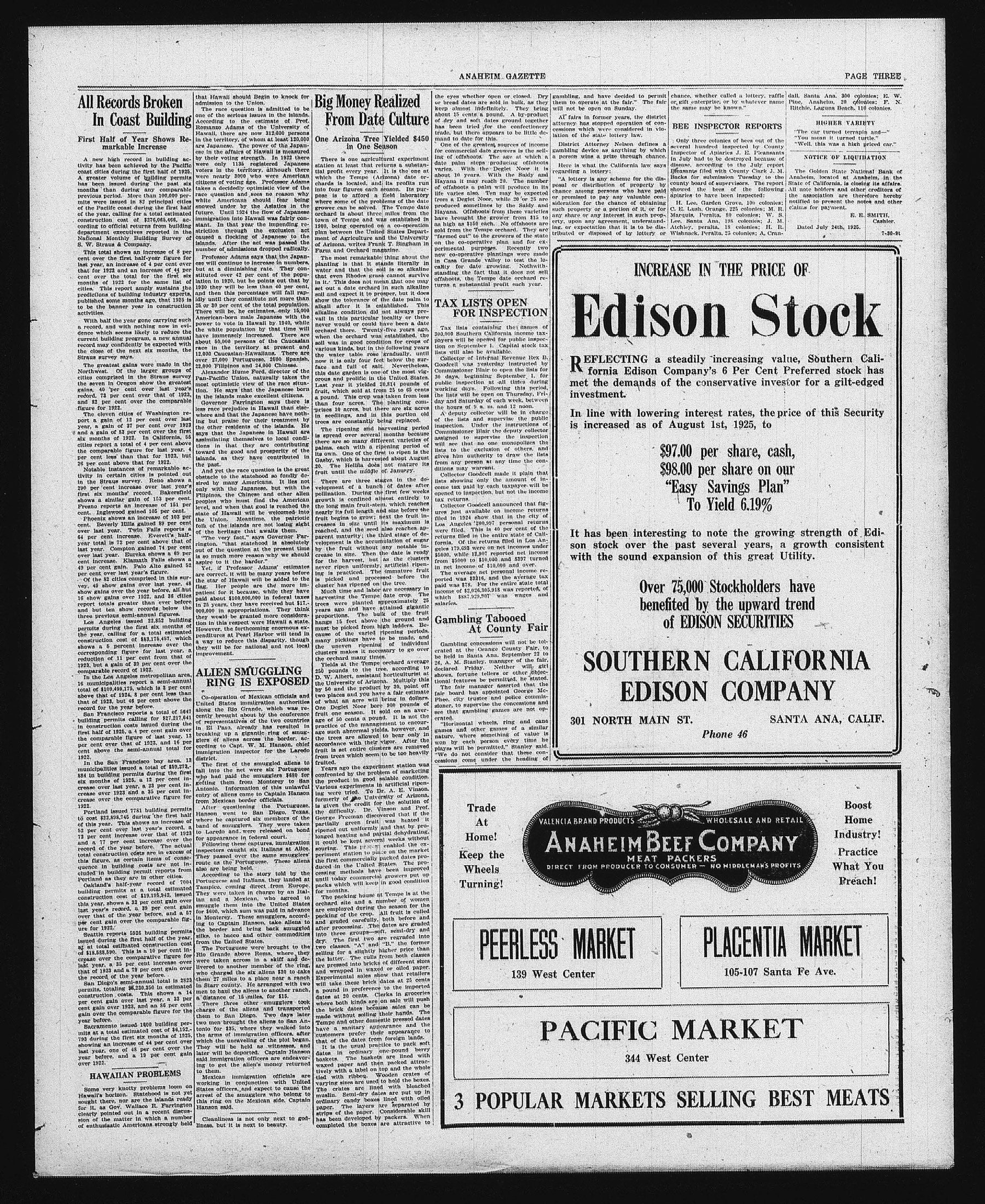
Searchable text
All Records Broken In Coast Building
First Half of Year Shows Remarkable Increase
A new high record in building activity has been achieved by the Pacific coast cities during the first half of 1925. A greater volume of building permits has been issued during the past six months than during any comparable previous period. More than 100,000 permits were issued in 82 principal cities of the Pacific coast during the first half of the year, calling for a total estimated construction cost of $276,065,466, according to official returns from building department executives reported in the National Monthly Building Survey of S. W. Straus & Company.
This total shows an increase of 8 per cent over the first half-year figure for last year, an increase of 4 per cent over that for 1923 and an increase of 44 per cent over the total for the first six months of 1922 for the same list of cities. This report amplify sustains the predictions of building industry experts, published some months ago, that 1925 is to be the banner year in construction activities.
With half the year gone carrying such a record, and with nothing now in evidence which seems likely to reduce the current building program, a new annual record may confidently be expected with the close of the next six months, the Straus survey says.
The greatest gains were made in the Northwest. Of the larger groups of cities comprised in the Straus survey the seven in Oregon show the greatest gains, 40 per cent over last year's record, 73 per cent over that of 1923, and 82 per cent over the comparable figure for 1922.
The eleven cities of Washington report a gain of 12 per cent over last year, a gain of 37 per cent over 1923 and a gain of 83 per cent over the first six months of 1922. In California, 55 cities report a total of 4 per cent above that Hawaii should Begin to knock for admission to the Union.
The race question is admitted to be one of the serious issues in the islands. According to the estimate of Prof. Romanzo Adams of the University of Hawaii, there are now 312,000 persons in the territory, of whom at least 120,000 are Japanese. The power of the Japanese in the affairs of Hawaii is measured by their voting strength. In 1922 there were only 1135 registered Japanese voters in the territory, although there were nearly 3000 who were American citizens of voting age. Professor Adams takes a decidedly optimistic view of the race question and sees no reason why white Americans should fear being snowed under by the Asiatics in the future. Until 1924 the flow of Japanese immigration into Hawaii was fairly constant. In that year the impending restriction through the exclusion act caused a flocking of Japanese to the islands. After the act was passed the number of admissions dropped radically.
Professor Adams says that the Japanese will continue to increase in numbers, but at a diminishing rate. They constituted over 42 per cent of the population in 1920, but he points out that by 1930 they will be less than 40 per cent, and then this percentage will fall rapidly until they constitute not more than 25 or 30 per cent of the total population. There will be, he estimates, only 15,000 American-born male Japanese with the power to vote in Hawaii by 1940, while the white population by that time will have immensely increased. There are about 50,000 persons of the Caucasian race in the territory at present and 12,000 Caucasian-Hawaiians. There are over 27,000 Portuguese, 2500 Spanish, 22,000 Filipinos and 24,000 Chinese.
Alexander Hume Ford, director of the Pan-Pacific Union, naturally takes the most optimistic view of the race situation. He says that the Japanese born in the islands make excellent citizens.
Governor Farrington says there is less race prejudice in Hawaii than elsewhere and that the Japanese have nothing but praise for their treatment by the other residents of the islands. He says that the Japanese in Hawaii are assimilating themselves to local conditions in that they are contributing that Hawaiian should Begin to knock for admission to the Union.
The race question is admitted to be one of the serious issues in the islands. According to the estimate of Prof. Romanzo Adams of the University of Hawaii, there are now 312,000 persons in the territory, of whom at least 120,000 are Japanese. The power of the Japanese in the affairs of Hawaii is measured by their voting strength. In 1922 there were only 1135 registered Japanese voters in the territory, although there were nearly 3000 who were American citizens of voting age. Professor Adams takes a decidedly optimistic view of the race question and sees no reason why white Americans should fear being snowed under by the Asiatics in the future. Until 1924 the flow of Japanese immigration into Hawaii was fairly constant. In that year the impending restriction through the exclusion act caused a flocking of Japanese to the islands. After the act was passed the number of admissions dropped radically.
Professor Adams says that the Japanese will continue to increase in numbers, but at a diminishing rate. They constituted over 42 per cent of the population in 1920, but he points out that by 1930 they will be less than 40 per cent, and then this percentage will fall rapidly until they constitute not more than 25 or 30 per cent of the total population. There will be, he estimates, only 15,000 American-born male Japanese with the power to vote in Hawaii by 1940, while the white population by that time will have immensely increased. There are about 50,000 persons of the Caucasian race in the territory at present and 12,000 Caucasian-Hawaiians. There are over 27,000 Portuguese, 2500 Spanish, 22,000 Filipinos and 24,000 Chinese.
Alexander Hume Ford, director of the Pan-Pacific Union, naturally takes the most optimistic view of the race situation. He says that the Japanese born in the islands make excellent citizens.
Governor Farrington says there is less race prejudice in Hawaii than elsewhere and that the Japanese have nothing but praise for their treatment by the other residents of the islands. He says that the Japanese in Hawaii are assimilating themselves to local conditions in that they are contributing that Hawaiian should Begin to knock for admission to the Union.
The race question is admitted to be one of the serious issues in the islands. According to the estimate of Prof. Romanzo Adams of the University of Hawaii, there are now 312,000 persons in the territory, of whom at least 120,000 are Japanese. The power of the Japanese in the affairs of Hawaii is measured by their voting strength. In 1922 there were only 1135 registered Japanese voters in the territory, although there were nearly 3000 who were American citizens of voting age. Professor Adams takes a decidedly optimistic view of the race question and sees no reason why white Americans should fear being snowed under by the Asiatics in the future. Until 1924 the flow of Japanese immigration into Hawaii was fairly constant. In that year the impending restriction through the exclusion act caused a flocking of Japanese to the islands. After the act was passed the number of admissions dropped radically.
Professor Adams says that the Japanese will continue to increase in numbers, but at a diminishing rate. They constituted over 42 per cent of the population in 1920, but he points out that by 1930 they will be less than 40 per cent, and then this percentage will fall rapidly until they constitute not more than 25 or 30 per cent of the total population. There will be, he estimates, only 15,000 American-born male Japanese with the power to vote in Hawaii by 1940, while the white population by that time will have immensely increased. There are about 50,000 persons of the Caucasian race in the territory at present and 12,000 Caucasian-Hawaiians. There are over 27,000 Portuguese, 2500 Spanish, 22,
The greatest gains were made in the Northwest. Of the larger groups of cities comprised in the Straus survey the seven in Oregon show the greatest gains, 40 per cent over last year's record, 73 per cent over that of 1923, and 82 per cent over the comparable figure for 1922.
The eleven cities of Washington report a gain of 12 per cent over last year, a gain of 37 per cent over 1923 and a gain of 83 per cent over the first six months of 1922. In California, 55 cities report a total of 4 per cent above the comparable figure for last year, 4 per cent less than that for 1923, but 26 per cent above that for 1922.
Notable instances of remarkable activity in certain cities is pointed out in the Straus survey. Reno shows a 290 per cent increase over last year's first six months' record. Bakersfield shows a similar gain of 153 per cent. Fresno reports an increase of 151 per cent. Inglewood gained 105 per cent.
Phoenix shows an increase of 103 per cent. Beverly Hills gained 89 per cent over last year. Twin Falls reports a 64 per cent increase. Everett's half-year total is 72 per cent above that of last year. Compton gained 74 per cent over last year. Eureka shows a 69 per cent increase. Klamath Falls shows a 49 per cent gain. Palo Alto gained 52 per cent over last year's figure.
Of the 82 cities comprised in this survey, 49 show gains over last year, 48 show gains over the year before, all but 16 show gains over 1922, and 36 cities report totals greater than ever before and but ten show records below the three previous semi-annual figures.
Los Angeles issued 22,852 building permits during the first six months of the year, calling for a total estimated construction cost of $83,175,457, which shows a 5 percent increase over the corresponding figure for last year, a reduction of 11 per cent from that of 1923, but a gain of 39 per cent over the comparable record of 1922.
In the Los Angeles metropolitan area, 16 municipalities report a semi-annual total of $109,499,179, which is 8 per cent above that of 1924, 8 per cent less than that of 1923, but 46 per cent above the record for the year before.
San Francisco reports a total of 5647 building permits calling for $27,217,641 in construction costs issued during the first half of 1925, a 4 per cent gain over the comparable figure of last year, 13 per cent over that of 1923, and 16 per cent above the semi-annual total for 1922.
In the San Francisco bay area, 13 municipalities issued a total of $59,273,-884 in building permits during the first six months of 1925, a 12 per cent increase over last year, a 23 per cent increase over 1923 and a 35 per cent increase over the comparative figure for 1922.
Portland issued 7781 building permits to cost $22,898,745 during the first half of this year. This shows an increase of 52 per cent over last year's record, a 73 per cent increase over that of 1923 and a 77 per cent increase over the record of the year before. The actual greatest gains were made in the Northwest. Of the larger groups of cities comprised in the Straus survey the seven in Oregon show the greatest gains, 40 per cent over last year's record, 73 per cent over that of 1923, but 26 per cent above that for 1922.
Notable instances of remarkable activity in certain cities is pointed out in the Straus survey. Reno shows a 290 per cent increase over last year's first six months' record. Bakersfield shows a similar gain of 153 per cent. Fresno reports an increase of 151 per cent. Inglewood gained 105 per cent.
Phoenix shows an increase of 103 per cent. Beverly Hills gained 89 per cent over last year. Twin Falls reports a 64 percent increase. Everett's half-year total is 72 per cent above that of last year. Compton gained 74 per cent over last year. Eureka shows a 69 per cent increase. Klamath Falls shows a 49 per cent gain. Palo Alto gained 52 per cent over last year's figure.
Of the 82 cities comprised in this survey, 49 show gains over last year, 48 show gains over the year before, all but 16 show gains over 1922, and 36 cities report totals greater than ever before and but ten show records below the three previous semi-annual figures.
Los Angeles issued 22,852 building permits during the first six months of the year, calling for a total estimated construction cost of $83,175,457, which shows a 5 percent increase over the corresponding figure for last year, a reduction of 11 per cent from that of 1923, but a gain of 39 per cent over the comparable record of 1922.
In the Los Angeles metropolitan area, 16 municipalities report a semi-annual total of $109,499,179, which is 8 percent above that of 1924, 8 per Cent less than that of 1923, but 46 per Cent above the record for the year before.
San Francisco reports a total of 5647 building permits calling for $27,217,641 in construction costs issued during the first half of 1925, a 4 per Cent gain over the comparable figure of last year, 13 per Cent over that of 1923, and 16 per Cent above the semi-annual total for 1922.
In the San Francisco bay area, 13 municipalities issued a total of $59,273,-884 in building permits during the first six months of this year. This shows an increase of 52 per Cent over last year's record, a 73 Per Cent increase over that of l923 and a
In the San Francisco bay area, 13 municipalities issued a total of $59,273,884 in building permits during the first six months of 1925, a 12 per cent increase over last year, a 23 per cent increase over 1923 and a 35 per cent increase over the comparative figure for 1922.
Portland issued 7781 building permits to cost $22,898,745 during the first half of this year. This shows an increase of 52 per cent over last year's record, a 73 per cent increase over that of 1923 and a 77 per cent increase over the record of the year before. The actual total construction costs are in excess of this figure, as certain items of consequence in building costs are not included in building permit reports from Portland as they are in other cities.
Oakland's half-year record of 7004 building permits at a total estimated construction cost of $19,195,942, issued this year, shows a 33 per cent gain over last year's record, a 39 per cent gain over that of the year before, and a 57 per cent gain over the comparable figure for 1922.
Seattle reports 5926 building permits issued during the first half of the year, at at total estimated construction cost of $18,588,590. This is a 10 per cent increase over the comparative figure for last year, a 35 per cent increase over that of 1923 and a 79 per cent gain over the record of the year before.
San Diego's semi-annual total is 2823 permits, totaling $6,230,350 in estimated construction costs. This shows a 14 per cent gain over last year, a 33 per cent gain over 1923, and an 86 per cent gain over the comparable figure for the year before.
Sacramento issued 1800 building permits at a total estimated cost of $6,192,793 during the first six months of 1925, showing an increase of 44 per cent over last year, one of 48 per cent over the year before, and a 19 per cent gain over 1922.
HAWAIIAN PROBLEMS
Some very knotty problems loom on Hawaii's horizon. Statehood is not yet sought there, nor are the islands ready for it, as Gov. Wallace R. Farrington clearly pointed out in a recent discussion of the matter in which a number of enthusiastic Americans strongly held
The first of the smuggled aliens to fall into the net were six Portuguese who had paid the smugglers $680 for getting them from Monterey to San Antonio. Information of this unlawful entry of aliens came to Captain Hanson from Mexican border officials.
After questioning the Portuguese, Hanson went to San Diego, Texas, where he captured six members of the band of smugglers. They were taken to Laredo and were released on bond for appearance in federal court.
Following these captures, immigration inspectors caught six Italians at Alice. They passed over the same smugglers' route as the Portuguese. These aliens also are being held.
According to the story told by the Portuguese and Italians, they landed at Tampaico, coming direct from Europe. They were taken in charge by an Italian and a Mexican, who agreed to smuggle them into the United States for $600, which sum was paid in advance in Monterey. These smugglers, according to Captain Hanson, take aliens to the border and bring back smuggled silks, to baco and other commodities from the United States.
The Portuguese were brought to the Rio Grande above Roma, where they were taken across in a skiff and delivered to another member of the ring, who charged the six aliens $30 to take them 27 miles to a place near a ranch in Starr county. He arranged with two men to haul the aliens to another ranch, a distance of 15 miles, for $15.
There three other smugglers took charge of the aliens and transported them to San Diego. Two days later two men brought the aliens to San Antonio for $35, where they walked into the arms of immigration officers, after which the unraveling of the plot began. They will be held as witnesses, and later will be deported. Captain Hanson said immigration officers are endeavoring to get the alien's money returned to them.
Mexican immigration officials are working in conjunction with United States officers, and expect to cause the arrest of the smugglers who belong to this ring on the Mexican side, Captain Hanson said.
Cleanliness is not only next to godliness, but it is next to beauty.
Years ago the ex confronted by the product in good Various experiment were tried. Formerly of the U.S. is given the credit for difficulty. George Freeman or partially green for ripened out uniform longed heating and it could be kept so souring. This preperiment station to the first commercial duced in the United States processing methods until today common packs which will last for months.
The packing house orchard site and are employed during packing of the crop and graded care after processing. Into three groups dry. The first two classes,"A" selling for a slight latter. The press are pressed into brass and wrapped in woven experimental sales will take these brass a pound in preferent dates at 20 cents where both kinds are made without solids Tempe and other ores have a sanitary customers prefer that of the dates.
It is the usual dates in ordinary baskets. The waxed paper and tinted with ribbon varying sizes are used muslin. Semi-dry ordinary candy bark paper. The layer strips of the paper has been developed completed the bo...
Big Money Realized From Date Culture
One Arizona Tree Yielded $450 in One Season
There is one agricultural experiment station at least that returns a substantial profit every year. It is the one at which the Tempe (Arizona) date orchards is located, and its profits run into four figures each season. Its purpose is to afford a field laboratory where some of the problems of the date grower can be solved. The Tempe date orchard is about three miles from the town of Tempe and was established in 1900, being operated on a co-operation plan between the United States Department of Agriculture and the University of Arizona, writes Frank T. Bingham in Farm and Orchard magazine.
The most remarkable thing about the planting is that it stands literally in water and that the soil is so alkaline that even Rhodes grass cannot survive in it. This does not mean that one may set out a date orchard in such alkaline soil and expect it to prosper, but it does show the tolerance of the date palm to alkali after it is established. This alkaline condition did not always prevail in this particular locality or there never would or could have been a date orchard there. Twenty-five years ago, when the orchard was established, the soil was in good condition for crops of various kinds, but in the following years the water table rose gradually, until now it is only four feet below the surface and full of salt. Nevertheless, this date garden is one of the most vigorous and prolific in the United States. Last year it yielded 20,814 pounds of fruit, which sold at from 25 to 65 cents a pound. This crop was taken from less than four acres. The planting comprises 10 acres, but there are six acres in seedlings, and in this portion old trees are constantly being replaced.
The ripening and harvesting period is spread over several months because there are so many different varieties of palms, each with a ripening period of the eyes whether open or closed. Dry or bread dates are sold in bulk, as they keep almost indefinitely. They bring about 15 cents a pound. A by-product of dry and soft dates ground together has been tried for the confectionery trade, but there appears to be little demand to date for this.
One of the greatest sources of income for commercial date growers is the selling offshoots. The age at which a date palm stops producing offshoots varies. With the Deglet Noor it is about 10 years. With the Saldy and Hayana it may reach 20. The number of offshoots a palm will produce in its life varies also. Ten may be expected from a Deglet Noor, while 20 or 25 are produced sometimes by the Saldy and Hayana. Offshoots from these varieties have brought the grower from $15 to as high as $150 each. No offshoots are sold from the Tempe orchard. They are "farmed out" to the growers of the state on the co-operative plan and for experimental purposes. Recently two new co-operative plantings were made in Casa Grande valley to test the locally for date growing. Nothwithstanding the fact that it does not sell offshoots, the Tempe date orchard returns a substantial profit each year.
TAX LISTS OPEN FOR INSPECTION
Tax lists containing the names of 300,000 Southern California income taxpayers will be opened for public inspection on September 1. Capital stock tax lists will also be available.
Collector of Internal Revenue Rex B. Goodcell was yesterday instructed by Commissioner Blair to open the lists for 30 days, beginning September 1, for public inspection at all times during working days. Following this period, the lists will be open on Thursday, Friday and Saturday of each week, between the hours of 9 a.m. and 12 noon.
A deputy collector will be in charge of the lists and supervise the public inspection. Under the instructions of Commissioner Blair the deputy collector assigned to supervise the inspection will see that no one monopolizes the lists to the exclusion of others.
INCREASE
REFLECTING a steadily increasing investment in line with lowering interest rates is increased as of August.$07.00$
REFLECTING a steadily increasing demand for investment in the agricultural sector, the state of California has been actively promoting its agricultural industry.
In line with lowering interest rates, the demands of the agricultural investment have increased.
The ripening and harvesting period is spread over several months because there are so many different varieties of palms, each with a ripening period of its own. One of the first to ripen is the Gasby, which is harvested about August 20. The Hellila does not mature its fruit until the middle of January.
There are three stages in the development of a bunch of dates after pollination. During the first few weeks growth is confined almost entirely to the long main fruit-stem, which reaches nearly its full length and size before the fruit begins to grow; next the fruit increases in size until its maximum is reached, and the seed also reaches apparent maturity; the third stage of development is the accumulation of sugar by the fruit without any notable increase in size. Then the date is ready for the harvest, but as the clusters never ripen uniformly, artificial ripening is practiced. The immature fruit is picked and processed before the cluster has ripened on the tree.
Much time and labor are necessary in harvesting the Tempe date crop. The trees were planted approximately 25 years ago and have attained gigantic proportions. The bulk of the fruit hangs 15 feet above the ground and must be picked from high ladders. Because of the varied ripening periods, many pickings have to be made, and the uneven ripening of individual clusters makes it necessary to go over the orchard many times.
Yields at the Tempe orchard average 250 pounds to the tree, according to D. W. Albert, assistant horticulturist at the University of Arizona. Multiply this by 50 and the product by 30, point off two places and you have a fair estimate of what an acre will bring in dollars. One Deglet Noor bore 900 pounds of fruit one season. It sold on an average of 50 cents a pound. It is not the practice of the management to encourage such abnormal yields, however, and the trees are allowed to bear only in accordance with their vigor. After the fruit is set entire clusters are removed from trees which seem to be too heavily fruited.
Years ago the experiment station was confronted by the problem of marketing the product in good salable condition. Various experiments in artificial ripening were tried. To Dr. A. E. Vinson, formerly of the University of Arizona, is given the credit for the solution of the difficulty. Dr. Vinson and Prof. George Freeman discovered that if the partially green fruit was heated it ripened out uniformly and that by prolonged heating and partial dehydrating, it could be kept several weeks without souring. This process enabled the collector of Internal Revenue Rex B. Goodcell was yesterday instructed by Commissioner Blair to open the lists for 30 days, beginning September 1, for public inspection at all times during working days. Following this period, the lists will be open on Thursday, Friday and Saturday of each week, between the hours of 9 a.m. and 12 noon.
A deputy collector will be in charge of the lists and supervise the public inspection. Under the instructions of Commissioner Blair the deputy collector assigned to supervise the inspection will see that no one monopolizes the lists to the exclusion of others, and gives him authority to draw the lists from any person at any time the conditions may warrant.
Collector Goodcell made it plain that lists showing only the amount of income tax paid by each taxpayer will be opened to inspection, but not the income tax returns.
Collector Goodcell announced that figures just available on income returns filed in 1924 show that in the city of Los Angeles '200,997 personal returns were filed. This is 40 per cent of the returns filed in the entire state of California. Of the returns filed in Los Angeles 179,693 were on net incomes under $5000, while 12,907 reported net income from $5000 to $10,000 and $897 turned in net income of $10,000 and over.
The average net personal income reported was $3316, and the average tax paid was $78. For the entire state total income of $2,026,305,918 was reported, of which $887,929,507 was wages and salaries.
Gambling Tabooed At County Fair
Gambling concessions will not be tolerated at the Orange County Fair, to be held in Santa Ana, September 22 to 26, A. M. Stanley, manager of the fair, declared Friday. Neither will girl shows, fortune tellers or other objectional features be permitted, he stated.
The fair manager asserted that the fair board has appointed George McPhee, city trustee and police commissioner, to supervise the concessions and see that gambling games are not operated.
"Horizontal wheels, ring and cane games and other games of a similar nature, where something of value is won by each person every time he plays will be permitted." Stanley said.
"We do not consider these concessions come under the heading of..."
Years ago the experiment station was confronted by the problem of marketing the product in good salable condition. Various experiments in artificial ripening were tried. To Dr. A. E. Vinson, formerly of the University of Arizona, is given the credit for the solution of the difficulty. Dr. Vinson and Prof. George Freeman discovered that if the partially green fruit was heated it ripened out uniformly and that by prolonged heating and partial dehydrating, it could be kept several weeks without souring. This process enabled the experiment station to place on the market the first commercially packed dates produced in the United States. The processing methods have been improved until today commercial growers put up packs which will keep in good condition for months.
The packing house at Tempe is at the orchard site and a number of women are employed during the season for the packing of the crop. All fruit is culled and graded carefully, both before and after processing. The dates are graded into three groups—soft, semi-dry and dry. The first two are regraded into two classes, "A" and "B," the former selling for a slightly higher price than the latter. The culls from both classes are pressed into bricks of different sizes and wrapped in waxed or oilled paper. Experimental sales show that retailers will take these brick dates at 25 cents a pound in preference to the imported dates at 20 cents. Clerks in groceries where both kinds are on sale will push the brick dates because sales can be made without soiling their hands. The Tempe and other domestic pressed dates have a sanitary appearance and the customers prefer their appearance to that of the dates from foreign lands.
It is the usual practice to pack soft dates in ordinary one-pound berry baskets. The baskets are lined with waxed paper and then packed attractively with a label on top and the whole with ribbons. Wooden crates of varying sizes are used to hold the boxes. The crates are lined with bleached muslin. Semi-dry dates are put up in ordinary candy boxes lined with oilled paper. The layers are separated by strips of the paper. Considerable skill has been developed by packers. When completed the boxes are attractive to
Trade At Home!
Keep the Wheels Turning!
PEERLESS MARKET
139 West Center
PACIFIC MARKET
344 West Cent
3 POPULAR MARKETS SE
PAGE THREE
decided to permit the fair sale."
The fair Sunday.
years, the district operation of considered in violation law.
Nelson defines a thing by which through chance California law says theme for the disposition of property by who have paid any valuable condition of it, or for best in such propetment, understand that it is to be disposed of by lottery or chance, whether called a lottery, raffle or gift enterprise; or by whatever name the same may be known."
BEE INSPECTOR REPORTS
Only three colonies of bees out of the several hundred inspected by County Inspector of Apiaries J. E. Pleansants in July had to be destroyed because of disease, according to the July report Pleansants filed with County Clark J. M. Backs for submission Tuesday to the county board of supervisors. The report showed the bees of the following apiaries to have been inspected:
H. Lee, Garden Grove, 100 colonies;
C. E. Lush, Orange, 225 colonies;
M. R. Marquis, Peralta, 80 colonies;
W. S. Lee, Santa Ana, 198 colonies;
J. M. Atheley, peralta, 18 colonies;
H. R. Wishnack, Peralta, 25 colonies;
A. Cran- dall. Santa Ana, 300 colonies; E. W. Pine, Anaheim, 20 colonies; F. N. Ritchie, Laguna Beach, 110 colonies.
HIGHER VARIETY
"The car turned terrapin and—"
"You mean it turned turtle."
"Well, this was a high priced car."
NOTICE OF LIQUIDATION
The Golden State National Bank of Anaheim, located at Anaheim, in the State of California, is closing its affairs. All note holders and other creditors of the association are therefore hereby notified to present the notes and other claims for payment.
E. E. SMITH,
Cashier.
Dated July 24th, 1925.
INCREASE IN THE PRICE OF Edison Stock
ACTING a steadily increasing value, Southern Cali- edison Company's 6 Per Cent Preferred stock has demands of the conservative investor for a gilt-edged suit.
With lowering interest rates, the price of this Security used as of August 1st, 1925, to
ACTING a steadily increasing value, Southern CaliEdison Company's 6 Per Cent Preferred stock has
demands of the conservative investor for a gilt-edged
at.
with lowering interest rates, the price of this Security
used as of August 1st, 1925, to
$97.00 per share, cash,
$98.00 per share on our
"Easy Savings Plan"
To Yield 6.19%
en interesting to note the growing strength of Ediover the past several years, a growth consistent
sound expansion of this great Utility.
Over 75,000 Stockholders have
benefited by the upward trend
of EDISON SECURITIES
Southern California
Edison Company
TH MAIN ST. SANTA ANA, CALIF.
Phone 46
Boost
Home
Industry!
DUCTS WHOLESALE AND RETAIL
IM BEEF COMPANY
MEAT PACKERS
PRODUCER TO CONSUMER — NO MIDDLEMAN'S PROFITS
Boost
Home
Industry!
Practice
What You
Preach!
ET
PLACENTIA MARKET
105-107 Santa Fe Ave.
FIC MARKET
344 West Center
MARKTS SELLING BEST MEATS