anaheim-gazette 1925-07-16
Scanned page
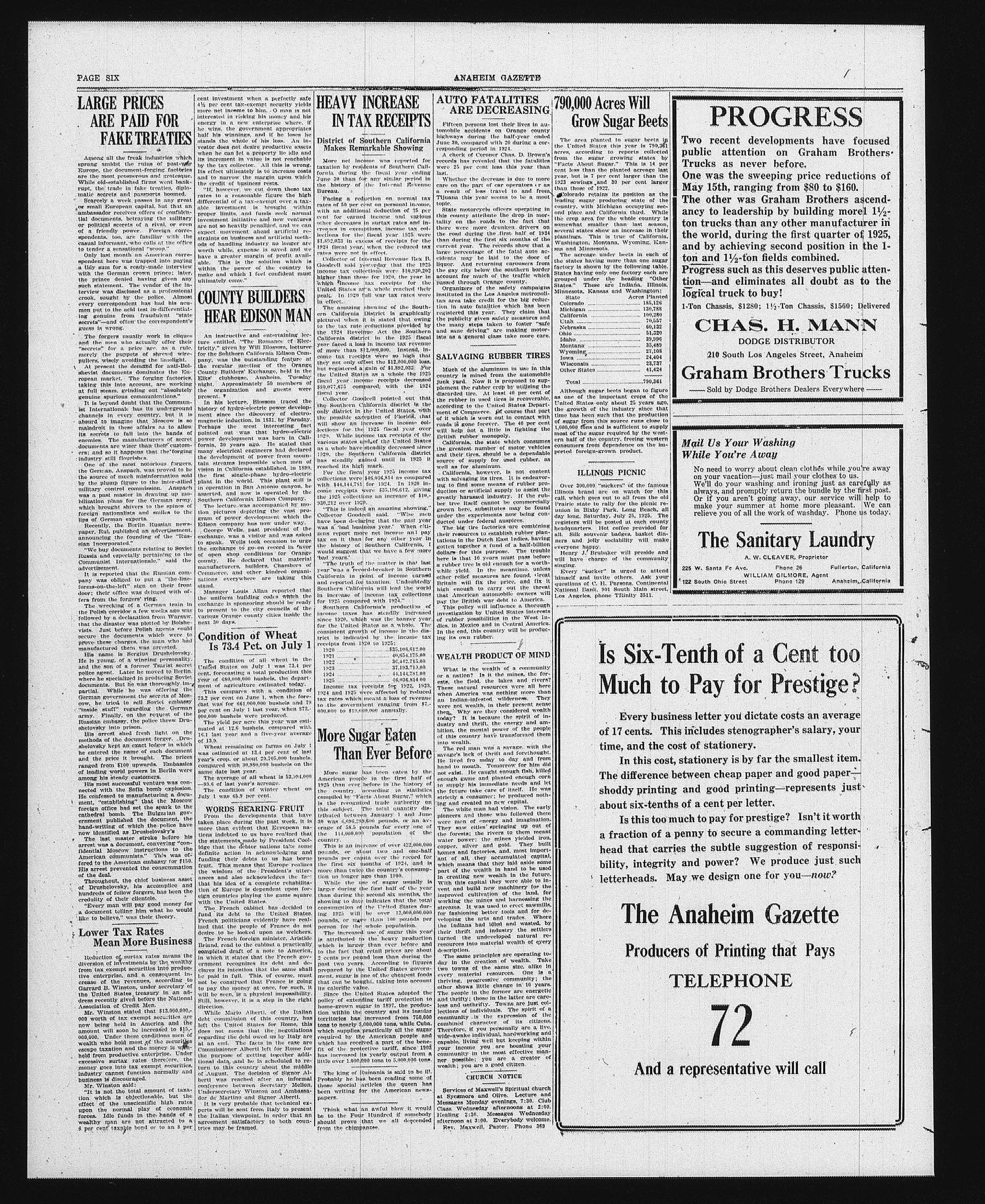
Searchable text
LARGE PRICES ARE PAID FOR FAKE TREATIES
Among all the freak industries which sprang amidst the ruins of post-war Europe, the document-forging factories are the most prosperous and grotesque. While old-established firms went bankrupt, the trade in fake treaties, diplomatic secrets and passports boomed.
Scarcely a week passes in any great or small European capital, but that an ambassador receives offers of confidential documents, betraying the military or political secrets of a rival, or even of a friendly power. Foreign correspondents, too, are familiar with the casual informant, who calls at the office to tender a sensational "scoop."
Only last month an American correspondent here was trapped into paying a tidy sum for a ready-made interview with the German crown prince; later, the prince denied having given any such statement. The vendor of the interview was disclosed as a professional crook, sought by the police. Almost every correspondent has had his acumen put to the acid test in differentiating genuine from fraudulent "state secrets"—and often the correspondent's guess is wrong.
The forgers usually work in cliques and the men who actually offer their "secrets" for a price are as a rule, merely the puppets of shrewd wirepullers, wisely avoiding the lineight.
At present the demand for anti-Bolshevist documents dominates the European market. The forging factories, taking this into account, are working at full steam, grinding out "absolutely genuine spurious communications."
It is beyond doubt that the Communist Internationale has its underground channels in every country, but it is aburd to imagine that Moscow is so maladroit in these affairs as to allow its secrets to fall into the hands of enemies. The manufacturers of secret documents are wiser than their custom-cent investment when a perfectly safe 4½ per cent tax-exempt security yields more net income to him. O man is not interested in risking his money and his energy in a new enterprise where, if he wins, the government appropriates half his winners, and if he loses he stands the whole of his loss. An investor does not desire productive assets when he can let a property lie idle and its increment in value is not reachable by the tax collector. All this is wrong. Its effect ultimately is to increase costs and to narrow the margin upon which the credit of business rests.
“If, however, we cut down these tax rates to a reasonable figure the high differential of a tax-exempt over a taxable investment is brought within proper limits, and funds seek normal investment initiative and new ventures are not so heavily penalized, and we can expect movement ahead artificial restraints on business and artificial methods of handling industry no longer are worth while, expense is saved and we have a greater margin of profit available. This is the solution which is within the power of the country to make and which I feel confident must ultimately come.”
COUNTY BUILDERS HEAR EDISON MAN
An instructive and entertaining lecture entitled, "The Romance of Electricity," given by Will Blossom, lecturer for the Southern California Edison Company, was the outstanding feature at the regular meeting of the Orange County Builders' Exchange, held in the Elks' clubhouse, Anaheim. Tuesday night. Approximately 50 members of the organization and guests were present.
In his lecture, Blossom traced the history of hydro-electric power development since the discovery of electromagnetic induction, in 1831, by Faraday. Perhaps the most interesting fact pointed out was that hydro-electric power development was born in California, 30 years ago. He stated that Collector Goodell the Southern Californiac district faced a loss of more than $12 million due to other decreases in exemplections for the United States fiscal year income $80,077,675 compared fiscal year.
Collector Goodell the Southern Californiac district only district in the possible excess will show an exections for the United States fiscal year income $80,077,675 compared fiscal year.
HEAVY IN TAX
District of South Makes Remain
More net income taxation by residing foronia during June 30 than forthe history of t Bureau.
Facing a reduc rates of 50 per cent with an additional cent for earned other decreases in exemplections for the United States are peak. In 1924 fiscal year, rates were not in effect.
The amazing sienn California D pictured when it to the tax rate rie 1924 Revein California district year faced a loss of more than $12 million due to other decreases in exemplections for the United States are peak. In 1924 fiscal year, rates were not in effect.
The amazing sienn California D pictured when it to the tax rate rie 1924 Revein California district year faced a loss of more than $12 million due to other decreases in exemplections for the United States are peak. In 1924 fiscal year, rates were not in effect.
At present the demand for anti-Bolshevik documents dominates the European market. The forging factories, taking this into account, are working at full steam, grinding out "absolutely genuine spurious communications."
It is beyond doubt that the Communist Internationale has its underground channels in every country, but it is aburd to imagine that Moscow is so maladroit in these affairs no to allow its secrets to fall into the hands of enemies. The manufacturers of secret documents are wiser than their customers; and so it happens that the forging industry still flourishes.
One of the most notorious forgers, the German, Anspach, was proved to be the source of much misinformation sold by the plump figure to the inter-allied military control commission. Anspach was a past master in drawing up mobilization plans for the German army, which brought shivers to the spines of foreign nationalists and smiles to the lips of German experts.
Recently, the Berlin Russian newspaper, Rul, published an advertisement announcing the founding of the "Russian Incorporated."
"We buy documents relating to Soviet Russia and especially pertaining to the Communist Internationale," said the advertisement.
It is reported that the Russian company was obliged to put a "the-line-forms-on-the-left" sign on their front door; their office was deluged with offers from the forgers' ring.
The wrecking of a German train in the Polish corridor a few weeks ago was followed by a declaration from Warsaw that the disaster was plotted by Bolshevists. Just before Polish agents could secure the documents which were to prove these charges, the man who had manufactured them was arrested.
His name is Sergius Drushelovsky. He is young, of a winning personality, and the son of a former Tsarist secret police agent. Later he moved to Berlin where he specialized in producing Soviet documents. But he was thoroughly impartial. While he was offering the German government the secrets of Moscow, he tried to sell Soviet embassy "inside stuff" regarding the German army. Finally, on the request of the Russian embassy, the police threw Drushelovsky into prison.
His arrest shed fresh light on the methods of the document forger. Drushelovsky kept an exact ledger in which he entered the name of each document and the price it brought. The prices ranged from $100 upwards. Embassies of leading world powers in Berlin were among his steady customers.
His most successful venture was connected with the Sofia bomb explosion. He confessed to manufacturing a document, "establishing" that the Moscow foreign office had set the spark to the cathedral bomb. The Bulgarian government published the document, the hand-writing of which the police have now identified as Drushelovsky's.
The last master stroke before his arrest was a document, conveying "confidential Moscow instructions to the merely the puppets of shred wire-pullers, wisely avoiding the lightning.
At present the demand for anti-Bolshevik documents dominates the European market. The forging factories, taking this into account, are working at full steam, grinding out "absolutely genuine spurious communications."
It is beyond doubt that the Communist Internationale has its underground channels in every country, but it is aburd to imagine that Moscow is so maladroit in these affairs no to allow its secrets to fall into the hands of enemies. The manufacturers of secret documents are wiser than their customers; and so it happens that the forging industry still flourishes.
One of the most notorious forgers, the German, Anspach, was proved to be the source of much misinformation sold by the plump figure to the inter-allied military control commission. Anspach was a past master in drawing up mobilization plans for the German army, which brought shivers to the spines of foreign nationalists and smiles to the lips of German experts.
Recently, the Berlin Russian newspaper, Rul, published an advertisement announcing the founding of the "Russian Incorporated."
"We buy documents relating to Soviet Russia and especially pertaining to the Communist Internationale," said the advertisement.
It is reported that the Russian company was obliged to put a "the-line-forms-on-the-left" sign on their front door; their office was deluged with offers from the forgers' ring.
The wrecking of a German train in the Polish corridor a few weeks ago was followed by a declaration from Warsaw that the disaster was plotted by Bolshevists. Just before Polish agents could secure the documents which were to prove these charges, the man who had manufactured them was arrested.
His name is Sergius Drushelovsky. He is young, of a winning personality, and the son of a former Tsarist secret police agent. Later he moved to Berlin where he specialized in producing Soviet documents. But he was thoroughly impartial. While he was offering the German government the secrets of Moscow, he tried to sell Soviet embassy "inside stuff" regarding the German army. Finally, on the request of the Russian embassy, the police threw Drushelovsky into prison.
His arrest shed fresh light on the methods of the document forger. Drushelovsky kept an exact ledger in which he entered the name of each document and the price it brought. The prices ranged from $100 upwards. Embassies of leading world powers in Berlin were among his steady customers.
His most successful venture was connected with the Sofia bomb explosion. He confessed to manufacturing a document, "establishing" that the Moscow foreign office had set the spark to the cathedral bomb. The Bulgarian government published the document, the hand-writing of which the police have now identified as Drushelovsky's.
The last master stroke before his arrest was a document, conveying "confidential Moscow instructions to the condition of all wheat in United States on July 1 was 73.4 per cent, forecasting a total production this year of 680,000,000 bushels, the department of agriculture estimated today.
This compares with a condition of 73.2 per cent on June 1, when the forecast was for 661,000,000 bushels and 79 per cent on July 1 last year, when 873,-000,000 bushels were produced.
The yield per acre this year was estimated at 12.6 bushels, compared with 16.1 last year and a five-year average of 13.9.
Wheat remaining on farms on July 1 was estimated at 13.4 per cent of last year's crop, or about 29,705,000 bushels, compared with 30,980,000 bushels on the same date last year.
The average of all wheat is 53,994,000—99.6 of last year's acreage.
The condition of winter wheat on July 1 was 65.9 per cent.
WORDS BEARING FRUIT
From the developments that have taken place during the past week, it is more than evident that European nations indebted to us have realized that the statements made by President Coolidge that the debtor nations take some come tax receipts they not only off but registered again by United States fiscal year income $50,077,675 compulsory year.
Collector Goodenough only district in this possible excection will show an indebtedness as a whole have since 1920. While income various states appear as a whole have since 1920, The Southern has steadily gained its high ticks.
For the fiscal collections were $44,144,751 from receipts we received in 1925 collections $330,212 over 1920.
"This is indeed Collector Goodenough have been declared was a 'bad business' report more tax on it than for the history of S would suggest that 'bad years.'"
"The truth of this year was a record California in poli- and reported for The Southern California in increase of I for 1925 compulsory taxes has since 1920, which for The United States consistent growth trict is indicated receipts from 1920.
Southern California income taxes have since 1920, which for The United States consistent growth trict is indicated receipts from 1920.
More sugar than American people 1925 than ever before country, acco- compiled by Factor is the recognized subject. This tributed between 30 was 6,696,289.6 erage of 58.5 pot- teh 114,000,000 country.
This is an increase
and the price it brought. The prices ranged from $100 upwards. Embassies of leading world powers in Berlin were among his steady customers.
His most successful venture was connected with the Sofia bomb explosion. He confessed to manufacturing a document, "establishing" that the Moscow foreign office had set the spark to the cathedral bomb. The Bulgarian government published the document, the hand-writing of which the police have now identified as Drushelovsky's.
The last master stroke before his arrest was a document, conveying "confidential Moscow instructions to the American communists." This was offered to the American embassy for $150. His arrest prevented the consummation of the deal.
Throughout, the chief business asset of Drushelovsky, his accomplice and hundreds of fellow forgers, has been the credulity of their clientele.
"Every man will pay good money for a document telling him what he would like to believe," was their theory.
Lower Tax Rates Mean More Business
Reduction of surtax rates means the diversion of investments by the wealthy from tax exempt securities into productive enterprise, and a consequent increase of the revenues, according to Garrard B. Winston, under secretary of the United States treasury in an address recently given before the National Association of Credit Men.
Mr. Winston stated that $13,000,000,000 worth of tax exempt securities are now being held in America and the amount will soon be increased to $15,000,000. Under these conditions men of wealth who hold most of the securities escape taxation and the money is withhold from productive enterprise. Under excessive surtax rates therefore, the money goes into tax exempt securities, industry cannot function normally and business is discouraged.
Mr. Winston said:
"It is not the total amount of taxation which is objectionable, but the effect of the unscientific high rates upon the normal play of economic forces. Idle funds in the hands of a wealthy man are not attracted to a 6 per cent taxable bond or to an 8 per cent year's crop, or about 29,705,000 bushels compared with 30,980,000 bushels on the same date last year.
The average of all wheat is 53,994,000—99.6 of last year's acreage.
The condition of winter wheat on July 1 was 65.9 per cent.
WORDS BEARING FRUIT
From the developments that have taken place during the past week, it is more than evident that European nations indebted to us have realized that the statements made by President Coolidge that the debtor nations take some definite action in acknowledging and funding their debts to us has borne fruit. This means that Europe realizes the wisdom of the President's utterances and also acknowledges the fact that his idea of a complete rehabilitation of Europe is dependent upon foreign countries playing the game square with the United States.
The French cabinet has decided to fund its debt to the United States. French politicians evidently have realized that the people of France do not desire to be looked upon as welchers.
The French foreign minister, Aristide Briand, read to the cabinet a practically completed draft of a note to America, in which it states that the French government recognizes its debt and declares its intention that the same shall be paid in full. This, of course, must not be construed that France is going to pay the money at once, for such, it will be seen, is a physical impossibility. Still, however, it is a step in the right direction.
While Mario Alberti, of the Italian debt commission of this country, left the United States for Rome, this does not mean that the negotiations regarding the debt owed us by Italy are at an end. The facts in the case are Commissioner Alberti left for Rome for the purpose of getting together additional data, and he is scheduled to return to this country about the middle of August. The decision of Signor Alberti was reached after an informal conference between Secretary Mellon, Underesecretary Winston and Ambassador de Martino and Signor Alberti.
It is very probable that technical experts will be sent from Italy to present the Italian viewpoint, in order that an agreement satisfactory to both countries may be framed.
More sugar than American people 1925 than ever before the country. A compiled by "Fact" is the recognized subject. The tributed between 30 was 6,696,289.6 percentage of 58.5 percent of 114,000,000 country.
This is an increase pounds, or about pounds per capita for the first six months more than twice this showing to date consumption of time 1925 will pounds, or more person for the year.
The increased interest attributed to which is larger to the fact that 2 cents per pound past two years prepared by the ment. sugar is one that can be bought its calorific value.
Since the United policy of extending home-grown sugar within the territories has in tons to nearly 3,000 which supplies prerequisite by the which has receive fit of the protec has increased its little over 1,000,000.
The king of Russia Probably he has those special arrows been writing for papers.
Think what can be to the Four should prove tha from the chimpan
HEAVY INCREASE IN TAX RECEIPTS
District of Southern California Makes Remarkable Showing
More net income was reported for taxation by residents of Southern California during the fiscal year ending June 30 than for any similar period in the history of the Internal Revenue Bureau.
Facing a reduction on normal tax rates of 50 per cent on personal income, with an additional deduction of 25 per cent for earned income and various other decreases in surtax rates and increases in exemptions, income tax collections for the fiscal year 1925 were $1,892,023 in excess of receipts for the 1924 fiscal year, when the reduced tax rates were not in effect.
Collector of Internal Revenue Rex B. Goodcell said yesterday that the 1925 income tax collections were $10,930,202 higher than those for 1920, the year in which income tax receipts for the United States are whole reached their peak. In 1920 full war tax rates were in effect.
The amazing showing of the Southern California District is graphically pictured when it is stated that owing to the tax rate reductions provided by the 1924 Revenue Act the Southern California district in the 1925 fiscal year faced a loss in income tax revenue of more than $12,000,000. Instead, income tax receipts were so high that they not only offset the $12,000,000 loss, but registered a gain of $1,892,033. For the United States as a whole the 1925 fiscal year income receipts decreased $80,077,675 compared with the 1924 fiscal year.
Collector Goodcell pointed out that the Southern California district is the only district in the United States, with the possible exception of Florida, that will show an increase in income collections for the 1925 fiscal year over 1920. While income tax receipts of the various states and of the United States as a whole have steadily decreased since
AUTO FATALITIES ARE DECREASING
Fifteen persons lost their lives in automobile accidents on Orange county highways during the half-year ended June 30, compared with 20 during a corresponding period in 1924.
A check of Coroner Chas. D. Brown's records has revealed that the fatalities were 25 per cent less this year than last.
Whether the decrease is due to more care on the part of car operators or as a result of less travel to and from Tijuana this year seems to be a moot topic.
State motorcycle officers operating in this county attribute the drop in mortality on the roads to the fact that there were more drunken drivers on the road during the first half-of-1924 than during the first six months of the current year. The records show that a large percentage of the fatal auto accidents may be laid to the door of liquor. And returning carousers from the gay city below the southern border account for much of the traffic which passed through Orange county.
Organizers of the safety campaigns instituted in the Los Angeles metropolitan area take credit for the big reduction in auto fatalities which has been registered this year. They claim that the publicity given safety measures and the many steps taken to foster "safe and safe driving" are making motorists as a general class take more care.
SALVAGING RUBBER TIRES
Much of the aluminum in use in this country is mined from the automobile junk yard. Now it is proposed to supplement the rubber crop by utilizing the discarded tire. At least 40 per cent of the rubber used tires is recoverable according to the United States Department of Commerce. Of course that part of it which is worn out in contact with roads is gone forever. The 40 per cent will help not a little in fighting the British rubber monopoly.
California, the state which consumes the greatest number of motor vehicles
790,000 Acres Will Grow Sugar Beets
The area planted to sugar beets in the United States this year is 790,361 acres, according to reports collected from the sugar growing states by "Facts About Sugar." This is 14 per cent less than the planted acreage last year, but is 7 per cent larger than the 1923 sowings and 30 per cent larger than those of 1922.
Colorado retains its position as the leading sugar producing state of the country, with Michigan occupying second place and California third. While the crop area for the whole country is somewhat smaller than last season, several states show an increase in their plantings. This is true of California, Washington, Montana, Wyoming, Kansas and Minnesota.
The average under beets in each of the states having more than one sugar factory is shown by the following table. States having only one factory each are grouped under the heading "Other States." These are Indiana, Illinois, Minnesota, Kansas and Washington:
State Acres Planted
Colorado 185,126
Michigan 130,788
California 100,280
Utah 70,557
Nebraska 60,132
Ohio 51,320
Idaho 39,996
Montana 35,489
Wyoming 27,108
Iowa 24,404
Wisconsin 23,737
Other States 41,424
Total 790,361
Although sugar beets began to figure as one of the important crops of the United States only about 25 years ago, the growth of the industry since that time has been such that the production of sugar from this source runs close to 1,000,000 tons and is sufficient to supply most of the sugar required by the western half of the country, freezing western consumers from dependence on the im-
More Sugar Eaten Than Ever Before
More sugar has been eaten by the American people in the first half of 1925 than ever before in the history of the country, according to statistics compiled by "Facts About Sugar," which is the recognized trade authority on this subject. The total quantity distributed between January 1 and June 30 was 6,696,289,600 pounds, or an average of 58.5 pounds for every one of the 114,000,000 population of the country.
This is an increase of over 422,000,000 come tax receipts were so high that they not only offset the $12,000,000 loss, but registered a gain of $1,892,033. For the United States as a whole the 1925 fiscal year income receipts decreased $80,077,675 compared with the 1924 fiscal year.
Collector Goodcell pointed out that the Southern California district is the only district in the United States, with the possible exception of Florida, that will show an increase in income collections for the 1925 fiscal year over 1920. While income tax receipts of the various states and of the United States as a whole have steadily decreased since 1920, the Southern California district has steadily gained until in 1925 it reached its high mark.
For the fiscal year 1925 income tax collections were $46,936,814 as compared with $44,144,781 for 1924. In 1920 income receipts were $35,106,612, giving the 1925 collections an increase of $10,-930,212 over 1920.
"This is indeed an amazing showing." Collector Goodcell said. "Wise men have been declaring that the past year was a 'bad business year.' When citizens report more net income and pay tax on it than for any other year in the history of Southern California, I would suggest that we have a few more 'bad years'."
"The truth of the matter is that last year was a record-breaker in Southern California in point of income earned and reported for taxation. Undoubtedly Southern California will lead the world in increase of income tax collections for 1925 compared with 1924."
Southern California's production of income taxes has steadily increased since 1920, which was the banner year for the United States as a whole. The consistent growth of income in the district is indicated by the income tax receipts from 1920 to 1925:
- 1920: $35,106,612.00
- 1921: 40,654,175.00
- 1922: 36,442,715.00
- 1923: 37,193,710.00
- 1924: 44,144,781.00
- 1925: 46,036,814.00
Income tax receipts for 1922, 1923, 1924 and 1925 were affected by reduced tax rates which meant a loss of revenue to the government ranging from $7,000,000 to $19,000,000 annually.
SALVAGING RUBBER TIRES
Much of the aluminum in use in this country is mined from the automobile junk yard. Now it is proposed to supplement the rubber crop by utilizing the discarded tire. At least 40 per cent of the rubber in used tires is recoverable, according to the United States Department of Commerce. Of course that part of it which is worn out in contact with roads is gone forever. The 40 per cent will help not a little in fighting the British rubber monopoly.
California, the state which consumes the greatest number of motor vehicles and their tires, should be a dependable source of supply for used rubber, as well as for aluminum.
California, however, is not content with salvaging its tires. It is endeavoring to find some means of rubber production or artificial supply to assist the greatly harassed industry. If the rubber tree itself cannot be commercially grown here, substitutes may be found under the experiments now being conducted under federal auspices.
The big tire factories are combining their resources to establish rubber plantations in the Dutch East Indies, having gotten together a fund of a half-billion dollars for this purpose. The trouble here is that 10 years must pass before a rubber tree is old enough for a worthwhile yield. In the meantime, unless other relief measures are found, great Britain will fix the price, and fix it high enough to carry out the threat that American automobile owners will pay the British war debt to America.
This policy will influence a thorough investigation by United States interests of rubber possibilities in the West Indies, in Mexico and in Central America. In the end, this country will be producing its own rubber.
WEALTH PRODUCT OF MIND
What is the wealth of a community or a nation? Is it the mines, the forests, the field, the lakes and rivers? These natural resources were all here when America was nothing more than an Indian-infested wilderness. They were not wealth, in their present sense then. Why are they considered wealth today? It is because the spirit of industry and thrift, the energy and ambition, the mental power of the people of this country have transformed them into wealth.
The red man was a savage, with the savage's lack of thrift and forethought. He lived fro mday to day and from hand to mouth. Tomorrow for him did not exist. He caught enough fish, killed enough game and planted enough corn to supply his immediate needs and let the future take care of itself. He was strictly a consumer; he produced nothing and created no new capital.
The white man had vision. The early pioneers and those who followed them were men of energy and imagination. They saw cities springing up out of the forests; the rivers to them meant water power; the mines yielded iron, copper, silver and gold. They built many buildings and most importing goods.
More sugar has been eaten by the American people in the first half of 1925 than ever before in the history of the country, according to statistics compiled by "Facts About Sugar," which is the recognized trade authority on this subject. The total quantity distributed between January 1 and June 30 was 6,696,289,600 pounds, or an average of 58.5 pounds for every one of the 114,000,000 population of the country.
This is an increase of over 422,000,000 pounds, or about two and one-half pounds per capita over the record for the first six months of 1924, and is more than twice the country's consumption no longer ago than 1900.
While the use of sugar usually is larger during the first half of the year than during the second six months, the showing to date indicates that the total consumption of the United States during 1925 will be over 12,000,000,000 pounds, or more than 100 pounds per person for the whole population.
The increased use of sugar this year is attributed to the heavy production which is larger than ever before and to the fact that retail prices are about 2 cents per pound less than during past two years. According to figures prepared by the United States government, sugar is one of the cheapest foods that can be bought, taking into account its calorific value.
Since the United States adopted the policy of extending tariff protection to home-grown sugar in 1897, the production within the country and its insular territories has increased from 750,000 tons to nearly 3,000,000 tons, while Cuba, which supplies practically all the sugar required by the American people and which has received a part of the benefit of the protective tariff, since 1903 has increased its yearly output from a little over 1,000,000 tons to 5,000,000 tons.
The king of Ruinania is said to be ill. Probably he has been reading some of those special articles the queen has been writing for the American newspapers.
Think what an awful blow it would be to the Four Hundred if somebody should prove that we all descended from the chimpanzee.
The same fro mday to day and from hand to mouth. Tomorrow for him did not exist. He caught enough fish, killed enough game and planted enough corn to supply his immediate needs and let the future take care of itself. He was strictly a consumer; he produced nothing and created no new capital.
The white man had vision. The early pioneers and those who followed them were men of energy and imagination. They saw cities springing up out of the forests; they rivers to them meant water power; the mines yielded iron, copper, silver and gold. They built homes and factories, and most important of all, they accumulated capital, which means that they laid aside some part of the wealth in hand to be used in creating new wealth in the future. With this capital they were able to invent and build new machinery for the improved cultivation of the land, for working the mines and harnessing the streams. It was used to erect sawmills, for fashioning better tools and for developing the arts and trades. Where the Indians had idled and wasted, by their thrift and industry the settlers turned the undeveloped natural resources into material wealth of every description.
The same principles are operating today in the creation of wealth. Take two towns of the same size, alike in every material resources. One is a thriving, progressive community; the other shows little change in 10 years. The people in the former are energetic and thrifty; those in the latter are careless and unthrifty. Towns are just collections of individuals. The spirit of a community is the expression of the combined character of its citizens. Therefore, if you personally are a live, wide-awake individual, hardworking and capable, living well but keeping within your income you are boosting your community in the most effective manner possible; you are a creator of wealth; you are a good citizen.
CHURCH NOTICE
Services of Maxwell's Spiritual church at Sycamore and Olive. Lecture and Messages Monday evenings, 7:30. Club Class Wednesday afternoons at 2:00. Healing 2:30. Messages Wednesday afternoon at 3:00. Everybody welcome.
Rev. Maxwell, Pastor. Phone 369
PROGRESS
Two recent developments have focused public attention on Graham Brothers Trucks as never before.
One was the sweeping price reductions of May 15th, ranging from $80 to $160.
The other was Graham Brothers ascendancy to leadership by building more 1½-ton trucks than any other manufacturer in the world, during the first quarter of 1925, and by achieving second position in the 1-ton and 1½-ton fields combined.
Progress such as this deserves public attention—and eliminates all doubt as to the logical truck to buy!
1-Ton Chassis, $1280; 1½-Ton Chassis, $1560; Delivered
CHAS. H. MANN
DODGE DISTRIBUTOR
210 South Los Angeles Street, Anaheim
Graham Brothers Trucks
— Sold by Dodge Brothers Dealers Everywhere —
Mail Us Your Washing
Mail Us Your Washing
While You're Away
No need to worry about clean clothes while you're away on your vacation—just mail your clothes to us.
We'll do your washing and ironing just as carefully as always, and promptly return the bundle by the first post.
Or if you aren't going away, our service will help to make your summer at home more pleasant. We can relieve you of all the work of washday. Phone us today.
The Sanitary Laundry
A. W. CLEAVER, Proprietor
225 W. Santa Fe Ave. Phone 26 Fullerton, California
WILLIAM GILMORE, Agent
122 South Ohio Street Phone 129 Anaheim, California
Six-Tenth of a Cent too much to Pay for Prestige?
Every business letter you dictate costs an average 7 cents. This includes stenographer's salary, your e, and the cost of stationery.
In this cost, stationery is by far the smallest item.
Difference between cheap paper and good paper—ddy printing and good printing—represents just out six-tenths of a cent per letter.
Is this too much to pay for prestige? Isn't it worth action of a penny to secure a commanding letter that carries the subtle suggestion of responsi-
In this cost, stationery is by far the smallest item.
A difference between cheap paper and good paper—
bddy printing and good printing—represents just
but six-tenths of a cent per letter.
Is this too much to pay for prestige? Isn’t it worth
action of a penny to secure a commanding letterd that carries the subtle suggestion of responsity, integrity and power? We produce just such
perheads. May we design one for you—now?
The Anaheim Gazette
Producers of Printing that Pays
TELEPHONE
72
And a representative will call