anaheim-gazette 1925-05-21
Scanned page
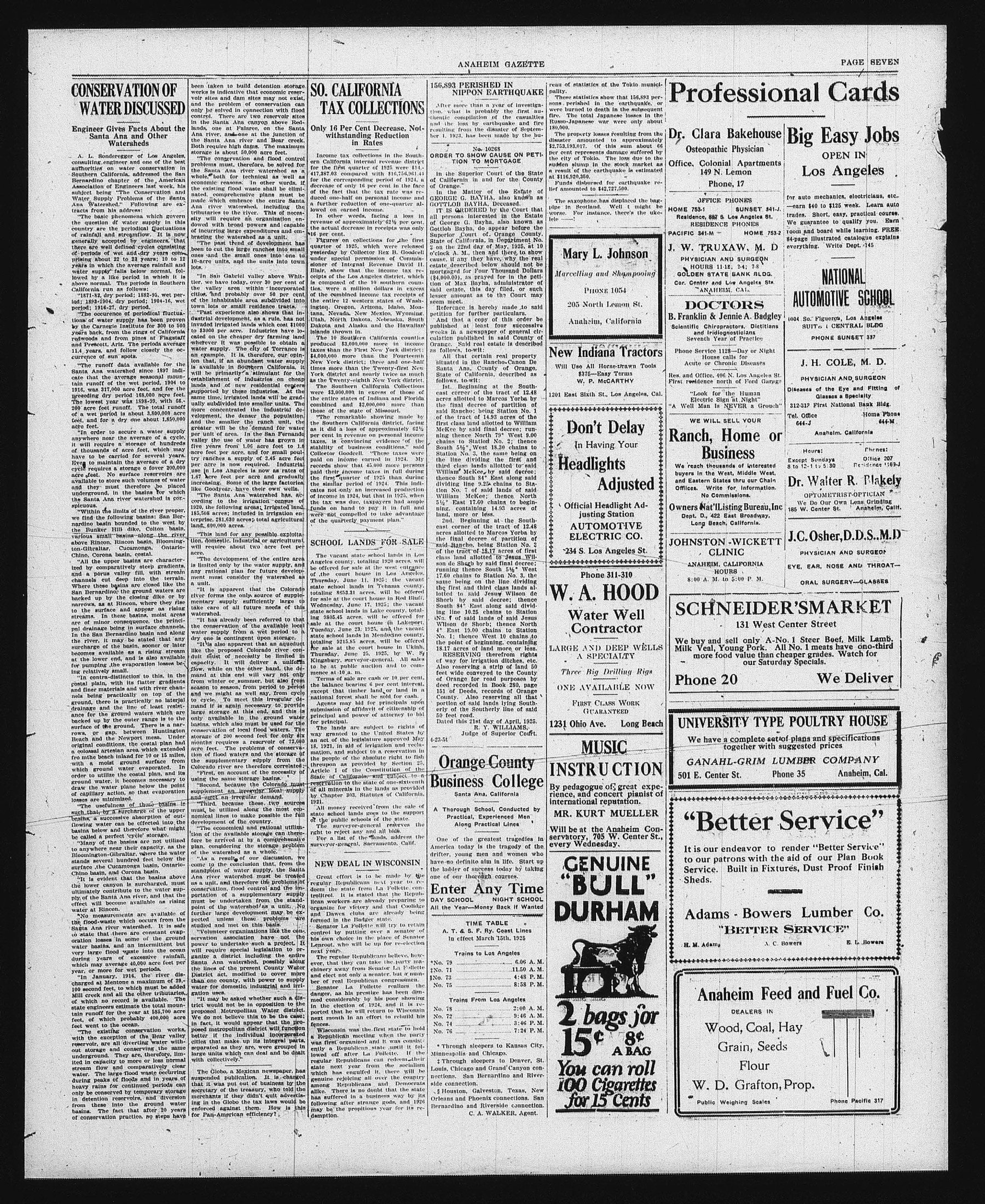
Searchable text
CONSERVATION OF WATER DISCUSSED
Engineer Gives Facts About the Santa Ana and Other Watersheds
A. L. Sonderegger of Los Angeles, consulting engineer and one of the best authorities on water conservation in Southern California, addressed the San Bernardino chapter of the American Association of Engineers last week, his subject being "The Conservation and Water Supply Problems of the Santa Ana Watershed." Following are extracts from his address:
"The basic phenomena which govern the question of water supply in this country are the periodical fluctuations of rainfall and streamflow. It is now generally accepted by engineers, that there are well defined cycles consisting of periods of wet and dry years comprising about 22 to 23 years; 10 to 12 years in which the average rainfall and water supply falls below normal, followed by a like period in which it is above normal. The periods in Southern California run as follows:
"1871-82, dry period; 1882-95, wet period; 1893-1904, dry period; 1904-16, wet period; 1916-27, dry period."
"The occurrence of periodical fluctuations of water supply has been proven by the Carnegie Institute for 300 to 500 years back, from the rings of California redwoods and from pines at Flagstaff and Prescott, Ariz. The periods average 11.4 years, and follow closely the occurrence of sun spots.
"The runoff data available for the Santa Ana watershed since 1897 indicate that the average seasonal mountain runoff of the wet period, 1904 to 1916, was 317,000 acre feet, and for the preceding dry period 168,000 acre feet. The lowest year was 1898-99, with 66.-200 acre feet runoff. The total runoff of a wet period is about 3,800,000 acre feet, and for a dry one about 1,850,000 acre feet."
"In order to secure a water supply anywhere near the average of a cycle, it will require a storage of hundreds been taken to build detention storage works is indicative that economic reservoir sites and dam sites may not exist, and the problem of conservation can only be solved in connection with flood control. There are two reservoir sites in the Santa Ana canyon above Redlands, one at Falarce, on the Santa Ana river, and one at the junction of the Santa Ana river and Bear creek. Both require high dams. The maximum storage is about 50,000 acre feet.
"The conservation and flood control problems must, therefore, be solved for the Santa Ana river watershed as a whole, both for technical as well as economic reasons. In other words, if the existing flood waste shall be eliminated, comprehensive plans must be made which embrace the entire Santa Ana river watershed, including the tributaries to the river. This of necessity will require an organization endowed with broad powers and capable of incurring large expenditures and embracing the watershed as a unit.
"The past trend of development has been to cut the large ranches into small ones and the small ones into one to 10-acre units, and the units into town lots.
"In San Gabriel valley above Whittier, we have today, over 30 per cent of the valley area within incorporated cities, and probably over 50 per cent of the inhabitable area subdivided into town lots or small residence tracts.
"Past experience also shows that industrial development, as a rule, has not invaded irrigated lands which cost $1000 to $3000 per acre. Industries have located on the cheaper dry farming land wherever it was possible to obtain a water supply. The city of Torrance is an example. It is, therefore, our opinion that, if an abundant water supply is available in Southern California, it will be primarily a stimulant for the establishment of industries on cheap lands and of new residential centers supported by these industries. At the same time, irrigated lands will be gradually subdivided into smaller units. The more concentrated the industrial development, the denser the population, and the smaller the ranch unit, the greater will be the demand for water per unit of area. In the San Fernando valley the use of water has grown in five years from 1.06 acre feet to 1.6 acre feet."
SO. CALIFORN TAX COLLECTION
Only 16 Per Cent withstanding in R
Income tax collection in California interim for the first quarter 417,387.03 compared for the corresponding decrease of only 16 percent of the fact that they deduced one-half on paid further reduction allowed in other words, revenue of approximately actual decrease of 16 per cent.
Figures on collected quarter of 1925, w yesterday by Collect under special permit sloner of Internal Blair, show that ceilings of the Los Anis composed of three tiles were a million of the combined income of the entire 12 westernington Oregon Arizona Nevada New York district times more than the York district and no as the Twenty-eighth The Southern Cal were $3,000.00 in all the entire states combined and $2.0 those of the state o
The remarkable Southern California as it did a loss of per cent in revenue taxes, is convincing stability of business
"The runoff data available for the Santa Ana watershed since 1897 indicate that the average seasonal mountain runoff of the wet period, 1904 to 1916, was 317,000 acre feet, and for the preceding dry period 168,000 acre feet. The lowest year was 1898-99, with 66,200 acre feet runoff. The total runoff of a wet period is about 3,800,000 acre feet, and for a dry one about 1,850,000 acre feet.
In order to secure a water supply anywhere near the average of a cycle, it will require a storage of hundreds of thousands of acre feet, which may have to be carried for several years. Even to maintain the average of a dry cycle requires a storage of over 200,000 acre feet. No surface reservoirs are available to store such volumes of water and they must therefore be placed underground, in the basins for which the Santa Ana river watershed is conspicuous.
"Within the limits of the river proper, we find the following basins: San Bernardino basin bounded to the west by the Bunker Hill dike, Colton basin, various small basins along the river above Rincon, Rincon basin, Bloomington-Gibraltar, Cucamonga, Ontario-Chino, Corona basin, costal.
"All the upper basins are characterized by comparatively steep gradients, and a porus valley fill, with stream channels cut deep into the terrain. Where these basins are closed like the San Bernardino, the ground waters are backed up by the closing dike or by narrows, as at Rincon, where they rise to the surface and appear as rising streams. In these basins, moist areas are of minor consequence, the principal drainage being in surface channels. In the San Bernardino basin and along the river, it may be stated that any surcharge of the basin, sooner or later becomes available as a rising stream at the lower end, and is also available for pumping, the evaporation losses being relatively small.
"In contra-distinction to this, in the coastal plain, with its flatter gradients and finer materials and with river channels being practically on top of the ground, there is practically no lateral drainage and the line of least resistance for the ground waters which are backed up by the outer range is to the surface of the ground. There is a narrow, or gap, between Huntington Beach and the Newport mesa. Under original conditions, the coastal plan had a colossal artesian area which extended fro mthe beach inland for 10 or 15 miles, with a moist ground surface from which ground water evaporated. In order to utilize the coastal plan, and its ground water, it becomes necessary to draw the water plane below the point of capillary action, so that evaporation losses are minimized.
"The usefulness of these basins is such that, by a surcharge of the upper basins, a successive absorption of outflowing water can be effected into the basins below and therefore what might be called a perfect 'cycle' storage."
Many of the basins are not utilized to anywhere near their capacity, as the example. It is therefore our opinion that, if an abundant water supply is available in Southern California, it will be primarily a stimulant for the establishment of industries on cheap lands and of new residential centers supported by these industries. At the same time, irrigated lands will be gradually subdivided into smaller units. The more concentrated the industrial development, the denser the population, and the smaller the ranch unit, the greater will be the demand for water per unit of area. In the San Fernando valley the use of water has grown in five years from 1.06 acre feet to 1.6 acre feet per acre, and for small poultry ranches a supply of 2.45 acre feet per acre is now required. Industrial use in Los Angeles is now as rates of 1.67 acre feet per acre and gradually increasing. Some of the large factories like Goodyear, have their own wells.
"The Santa Ana watershed has, according to the irrigation census of 1920, the following areas: Irrigated land 185,508 acres; included in irrigation enterprise, 281,630 acres; total agricultural land 600,000 acres."
"This land for any possible exploitation domestic, industrial or agricultural will require about two acre feet per acre.
"The development of the entire area is limited only by the water supply, and any rational plan for future development must consider the watershed as a unit.
"It is apparent that the Colorado river forms the only source of supplementary supply sufficiently large to take care of all future needs of this watershed.
"It has already been referred to that the conservation of the available local water supply from a wet period to a dry one is contingent upon storage.
"It is also apparent that an aqueduct like the proposed Colorado river conduit must of necessity be limited in capacity. It will deliver a uniform flow, while on the other hand, the demand at this end will vary not only from winter or summer, but also from season to season, from period to period and we might as well say, from cycle to cycle. To meet this irregular demand it is again necessary to provide large storage at this end, and this is only available in the ground water basins, which also must be used for the conservation of local flood waters. The storage of 200 second feet for only six months requires a reservoir of 72,000 acre feet. The problems of conservation of flood waters and the storage of the supplementary supply from Colorado river are therefore correlated."
First, on account of the necessity of using the same storage basins.
Second, because the Colorado must supplement an irregular local supply and meet an irregular demand.
Third, because these two sources must be utilized along the most economical lines to make possible the full development of the country.
The economical and rational utilization of the available storage can therefore be arrived at by a comprehensive plan considering the storage problem an example. It is therefore our opinion that, if an abundant water supply is available in Southern California, it will be primarily a stimulant for the establishment of industries on cheap lands and of new residential centers supported by these industries. At the same time, irrigated lands will be gradually subdivided into smaller units. The more concentrated the industrial development, the denser the population, and the smaller the ranch unit, the greater will be the demand for water per unit of area. In the San Fernando valley the use of water has grown in five years from 1.06 acre feet to 1.6 acre feet per acre and for small poultry ranches a supply of 2.45 acre feet per acre is now required. Industrial use in Los Angeles is now as rates of 1.67 acre feet per acre and gradually increasing. Some of the large factories like Goodyear, have their own wells.
"The Santa Ana watershed has, according to the irrigation census of 1920, the following areas: Irrigated land 185,508 acres; included in irrigation enterprise, 281,630 acres; total agricultural land 600,000 acres."
This land for any possible exploitation domestic, industrial or agricultural will require about two acre feet per acre.
"The development of the entire area is limited only by the water supply, and any rational plan for future development must consider the watershed as a unit.
"It is apparent that the Colorado river forms the only source of supplementary supply sufficiently large to take care of all future needs of this watershed."
"It has already been referred to that the conservation of the available local water supply from a wet period to a dry one is contingent upon storage.
"It is also apparent that an aqueduct like the proposed Colorado river conduit must of necessity be limited in capacity. It will deliver a uniform flow, while on the other hand, the demand at this end will vary not only from winter or summer, but also from season to season, from period to period and we might as well say, from cycle to cycle. To meet this irregular demand it is again necessary to provide large storage at this end, and this is only available in the ground water basins, which also must be used for the conservation of local flood waters. The storage of 200 second feet for only six months requires a reservoir of 72,000 acre feet. The problems of conservation of flood waters and the storage of the supplementary supply from Colorado River are therefore correlated."
First, on account of the necessity of using the same storage basins.
Second because the Colorado must supplement an irregular local supply and meet an irregular demand.
Third because these two sources must be utilized along the most economical lines to make possible the full development of the country.
The economical and rational utilization of the available storage can therefore be arrived at by a comprehensive plan considering the storage problem an example. It is therefore our opinion that, if an abundant water supply is available in Southern California, it will be primarily a stimulant for the establishment of industries on cheap lands and of new residential centers supported by these industries. At the same time, irrigated lands will be gradually subdivided into smaller units. The more concentrated the industrial development, the denser the population, and the smaller the ranch unit, the greater will be the demand for water per unit of area. In the San Fernando valley the use of water has grown in five years from 1.06 acre feet to 1.6 acre feet per acre and for small poultry ranches a supply of 2.45 acre feet per acre is now required. Industrial use in Los Angeles is now as rates of 1.67 acre feet per acre and gradually increasing. Some of the large factories like Goodyear, have their own wells.
"The Santa Ana watershed has, according to the irrigation census of 1920, the following areas: Irrigated land 185,508 acres; included in irrigation enterprise, 281,630 acres; total agricultural land 600,000 acres."
This land for any possible exploitation domestic,industrial or agricultural will require about two acre feet per acre.
"The development of the entire area is limited only bythe water supply,and any rational plan for future development must considerthewatershedasaunit."
"It is apparent thattheColoradoriverformstheonlysourceofsupplementarysupplysufficientlylargetotakecareofallfutureneedsofthiswatershed."
"Ithasalreadybeenreferredtothattheconservationoftheavailablelocalwatersupplyfromawetperiodtoadryoneiscontingentuponstorage."
"Itisalsoapparentthatan AqueductliketheproposedColoradoriverconduitmustofnecessitybelimitedincapacity.Itswilldeliverauniformflow,而ontheotherhand,thedemandatthisendwillvariynotonlyfromwinterorsummer,但alsofromseasontoseason,从periodtoperiodandwemightaswellsay,fromcycletocycle.Tomeethisirregulardemanditisagainnecessarytoviprovelargestorageatthisend,andthisisonlyavailableinthegroundwaterbasinswhichalsomustbemusedfortheconservationoflocalfloodwaters.Thestorageof200secondfeetforonlysixmonthsrequiresareservoirof72,000acrefeet.TheproblemsofconservationoffloodwatersandthestorageofthesupplementarysupplyfromtheColoradoriverarethereforecorrelated."
First.onaccountofthenecessityofusingthesamestoragebasins.
Second,becausetheColoradomustsupplementanirregularlocalsupplyandmeetanirregulardemand."
Thirdbecausethesetwo sourcesmustbeutilizedalongthemosteconomicallinestomakepossiblethefulldevelopmentofthecountry.
Theeconomicalandrationalutilizationoftheavailablestoragecanthereforebearrivedatbyacomprehensivelplanconsideringthestorageproblemanexample.itisthereforeouropinionthatifanabundantwatersupplyisavailableinSouthernCaliforniaitwillbeprimarilya stimulantfortheestablishmentindustriesthomelandsandofnewresidentialcentersoftheentirestatesofcombinedandthoseofthestatecouncilpaidoncertainstquarterofthecaterpillarsnotonlyaninfallofincomein1924butthetaxwasdue,tuftfundsonhandtoatthewassomenotcompelledofthequarterlypayable"
SCHOOL LAND
The vacant state Angeles county.totalbe offeredfor salea.ofthecourthouseThursday,june11.state schoollands.totalbeingatthecourtWednesday,june11.state schoollands.intotaling9215.85acreforsaleatthecourtThursday,june25.Kingsbay,surveyorbeatatpublicauctionamountat10.a.m.
Terms-ofsalearethebalancebearingexceptthattimbernationalforestshall Agentsmaybidsubmissionoffafficialprincipalandpowerforprincipal.
The lands are sway granted to them an act ofthelegislature18,1921,in aidofinfiation,andsubjectethepeopleoftheathreuponasprovideArticleIoftheOStateOfCaliforniareservationtothesumofallmineralsintherbyChapter303.State1921.
All money receivedstate schoollandsperformanceThesurveyor-generalrightto rejectanyagentFora listofthesurveyor-general.S
The usefulness of these basins is such that by a surcharge of the upper basins, a successive absorption of outflowing water can be effected into the basins below and therefore what might be called a perfect cycle storage.
Many of the basins are not utilized to anywhere near their capacity, as the Bloomington-Gibraltar, where the water stands several hundred feet below the surface, the Cucamonga basin, Ontario-Chino basin, and Corona basin.
It is evident that the basins above the lower canyon is surcharged, must ultimately contribute to the water supply of the Santa Ana river, and that the effect will become available as rising water at Rincon.
No measurements are available of the flood-waste which occurs from the Sagta Ana river watershed. It is safe to state that there are constant evaporation losses in some of the ground water basins, and an intermittent but very large flood waste into the ocean during years of excessive rainfall, which may average 40,000 acre feet per year, or more for wet periods.
In January, 1916, the river discharged at Mentone a maximum of 29.-100 second feet, to which must be added Mill creek and all the other tributaries, of which no record is available. The state engineers estimate the total mountain runoff for the year at 585,700 acre feet, of which probably 400,000 acre feet went to the ocean.
The existing conservation works, with the exception of the Bear valley reservoir, are all diverting water without storage and conserving the same underground. They are, therefore, limited in capacity to more or less normal stream flow and comparatively clear water. The large flood waste occurring during peaks of floods and in years of heavy rains for continued periods can only be conserved by temporary storage in detention reservoirs, and diversion from these into the ground water basins. The fact that after 20 years of conservation practice, no steps have
"First, on account of the necessity of using the same storage basins."
Second, because the Colorado must supplement an irregular local supply and meet an irregular demand.
Third, because these two sources must be utilized along the most economical lines to make possible the full development of the country.
"The economical and rational utilization of the available storage can therefore be arrived at by a comprehensive plan, considering the storage problem of the watershed as a whole."
As a result of our discussion, we come to the conclusion that, from the standpoint of water supply, the Santa Ana river watershed must be treated as a unit, and therefore the problems of conservation, flood control and the importation of a supplementary supply must be undertaken from the standpoint of the watershed as a unit. No further large development may be expected unless these problems are studied and met on this basis.
Volunteer organizations like the conservation association have not the power to undertake such a project. It will require special legislation to organize a district including the entire Santa Ana watershed, possibly along the lines of the present County Water District act, modified to cover more than one county, with power to supply water for domestic, industrial and irrigation uses.
"It may be asked whether such a district would not be in opposition to the proposed Metropolitan Water district. We do not believe this to be the case; in fact, it would appear that the proposed metropolitan district will function better if the individual incorporated cities that make up its integral parts, separated as they are, were grouped in large units which can deal and be dealt with collectively."
The Globo, a Mexican newspaper, has suspended publication. It is charged that it was put out of business by the secretary of the treasury, who told the merchants if they didn't quit advertising in the Globo the tax laws would be enforced against them. How is this for Pan-American efficiency?
SO. CALIFORNIA TAX COLLECTIONS
Only 16 Per Cent Decrease, Notwithstanding Reduction in Rates
Income tax collections in the Southern California internal revenue district for the first quarter of 1925 were $14,417,387.03 compared with $16,756,961.44 for the corresponding period of 1924, a decrease of only 16 per cent in the face of the fact that the tax rate was reduced one-half on personal income and a further reduction of one-quarter allowed on earned income.
In other words, facing a loss in revenue of approximately 62½ per cent, the actual decrease in receipts was only 16 per cent.
Figures on collections for the first quarter of 1925, which were released yesterday by Collector Rex B. Goodell under special permission of Commissioner of Internal Revenue David II Blair, show that the income tax receipts of the Los Angeles district, which is composed of the 10 southern counties, were a million dollars in excess of the combined income tax receipts of the entire 12 western states of Washington, Oregon, Arizona, Idaho, Montana, Nevada, New Mexico, Wyoming, Utah, North Dakota, Nebraska, South Dakota and Alaska and the Hawaiian islands thrown in.
The 10 Southern California counties produced $3,000,000 more in income taxes than the First New York district; $4,000,000 more than the Fourteenth New York district; three and one-half times more than the Twenty-first New York district and nearly twice as much as the Twenty-eighth New York district.
The Southern California Collections were $3,000,000 in excess of those of the entire states of Indiana and Florida combined and $2,000,000 more than those of the state of Missouri.
"The remarkable showing made by the Southern California district, facing as it did a loss of approximately 62½ per cent in revenue on personal income taxes, is convincing evidence of the stability of business conditions," said Mary L. Johnson.
156,893 PERISHED IN NIPPON EARTHQUAKE
After more than a year of investigation, what is probably the first authentic compilation of the casualties and the loss by earthquake and fire resulting from the disaster of September 1, 1923, has been made by the Superior Court of the State of California in and for the County of Orange.
In the Matter of the Estate of GEORGE G. BAYHA, also known as GOTTLOB BAYHA, deceased.
IT IS ORDERED by the Court that all persons interested in the Estate of George G. Bayha, also known as Gottlob Bayha, do appear before the Superior Court of Orange County. State of California, In Department No. 2 on the 22nd day of May, 1925, at 10 o'clock A.M., then and there to show cause, if any they have, why the real estate described below should not be mortgaged for Four Thousand Dollars ($4,000.00), as prayed for in the petition of Max Bayha, administrator of said estate, this day filed, or such lesser amount as to the Court may seem meet.
Reference is hereby made to said petition for further particulars.
And that a copy of this order be published at least four successive weeks in a newspaper of general circulation published in said County of Orange. Said real estate is described as follows: to-wit:
All that certain real property situated in the Rancho-Canon De Santa Ana, County of Orange, State of California, described as follows: to-wit:
Ist. Beginning at the Southeast corner of the tract of 12.48 acres allotted to Marcos Yorba by the final decree of partition of said Rancho; being Station No. 1 of the tract of 14.93 acres of the first class land allotted to William McKee by said final decree; running thence North 79° West 9.00 chains to Station No. 2; thence South 5½° West 18.30 chains to reaual statistics of the Tokio municipality.
These statistics show that 156,893 persons perished in the earthquake, or were burned to death in the subsequent fire. The total Japanese losses in the Russo-Japanese war were only about 180,000.
The property losses resulting from the disaster amounted to approximately $2,753,193.017. Of this sum about 66 per cent represents damage suffered by the city of Tokio. The loss due to the sudden slump in the stock market as a result of the earthquake is estimated at $116,920.350.
Funds disbursed for earthquake relief amounted to $42,727.500.
The saxophone has displaced the bagpipe in Scotland. Well it might be worse. For instance, there's the ukelele —
Mary L. Johnson
Marcelling and Shampooing
PHONE 1054
205 North Lemon St.
Anaheim, California
New Indiana Tractors
Will Use All Horse-Drawn Tools
$375—Easy Terms
W. P. McCARTHY
1201 East Sixth St., Los Angeles, Cal.
Don't Delay
In Having Your
SCHOOL LANDS FOR SALE
The vacant state school lands in Los Angeles county, totaling 1920 acres, will be offered for sale at the west entrance of the court house in Los Angeles. Thursday, June 11, 1925; the vacant state school lands in Tchama county, totaling 8653.31 acres, will be offered for sale at the court house in Red Bluff, Wednesday, June 17, 1925; the vacant state school lands in Lake county, totaling 9805.45 acres, will be offered for sale at the court house in Lakeport, Tuesday, June 23, 1925, and the vacant state school lands in Mendocino county, totaling 9215.85 acres, will be offered for sale at the court house in Ukiah, Thursday, June 25, 1925, by W. S. Kingsbury, surveyor-general. All sales to be at public auction and to commence at 10 a.m.
Terms of sale are cash or 10 per cent, the balance bearing 6 per cent interest, except that timber land or land in a national forest shall be sold for cash.
Agents may bid for principals upon submission of affidavit of citizenship of principal and power of attorney to bid for principal.
The lands are subject to rights of way granted to the United States by an act of the legislature approved May 18, 1921, in aid of irrigation and reclamation, and subject to a reservation in the people of the absolute right to fish threepon as provided by Section 25. Article I of the Constitution of the State of California, and subject to a reservation to the state of one-sixteenth of all minerals in the lands as provided by Chapter 203, Statutes of California, 1921.
All money received from the sale of state school lands goes to the support of the public schools of the state.
The surveyor-general reserves the right to reject any and all bids.
For a list of the lands, address the surveyor-general, Sacramento, Calif.
All that certain real property situated in the Rancho-Canon De Santa Ana, County of Orange, State of California, described as follows, to-wit:
1st. Beginning at the Southeast corner of the tract of 12.48 acres allotted to Marcos Yorba by the final decree of partition of said Rancho; being Station No. 1 of the tract of 14.93 acres of the first class land allotted to William McKee by said final decree; running thence North 79° West 9.00 chains to Station No. 2; thence South 5½° West 18.30 chains to Station No. 3, the same being on the line dividing the first and third class lands allotted to said William McKee; by said decree; thence South 84° East along said dividing line 9.25 chains to Station No. 7 of said lands of said William McKee; thence North 5½° East 17.60 chains to beginning, containing 14.93 acres of land, more or less.
2nd. Beginning at the Southeast corner of the tract of 12.48 acres allotted to Marcos Yorba by the final decree of partition of said Rancho, being Station No. 2 of the tract of 18.17 acres of first class land allotted to Jesus Wilson de Shahr by said final decree; running thence South 5½° West 17.60 chains to Station No. 3, the same being on the line dividing the first and third class lands allotted to said Jesus Wilson de Shahr by said decree; thence South 84° East along said dividing line 10.25 chains to Station No. 4 of said lands of said Jesus Wilson de Shahr; thence North 4° East 19.00 chains to Station No. 1; thence West 10 chains to the point of beginning, containing 18.17 acres of land more or less.
RESERVING therefrom rights of way for irrigation ditches, etc. Also reserving a strip of land 50 feet wide conveyed to the County of Orange for road purposes by deed recorded in Book 280, page 151 of Deeds, records of Orange County. Also reserving all that portion of said lands lying Southerly of the Southerly line of said 50 feet road.
Dated this 21st day of April, 1925.
R. Y. WILLIAMS,
Judge of Superior Court.
4-23-5t
Orange County Business College
Santa Ana, California
A Thorough School, Conducted by Practical, Experienced Men Along Practical Lines
One of the greatest tragedies in America today is the tragedy of the
Orange County Business College
Santa Ana, California
A Thorough School, Conducted by Practical, Experienced Men Along Practical Lines
One of the greatest tragedies in America today is the tragedy of the drifter, young men and women who have no definite aim in life. Start up the ladder of success today by taking one of our thorough courses.
Enter Any Time
DAY SCHOOL NIGHT SCHOOL
All the Year—Money Back If Wanted
TIME TABLE
A. T. & S. F. Ry, Coast Lines
In effect March 15th, 1925
Trains to Los Angeles
*No. 79 ... 6.06 A.M.
‡No. 71 ... 11.50 A.M.
§No. 73 ... 4:48 P.M.
No. 75 ... 8:58 P.M.
Trains From Los Angeles
No. 78 ... 2:00 A.M.
No. 72 ... 9:46 A.M.
No. 74 ... 3:46 P.M.
No. 76 ... 7:24 P.M.
* Through sleepers to Kansas City, Minneapolis and Chicago.
‡ Through sleepers to Denver, St. Louis, Chicago and Grand Canyon connections. San Bernardino and Riverside connection.
§ Houston, Galveston, Texas, New Orleans and Phoenix connections. San Bernardino and Riverside connection.
C. A. WALKER, Agent.
Professional Cards
Dr. Clara Bakehouse
Osteopathic Physician
Office. Colonial Apartments
149 N. Lemon
Phone, 17
OFFICE PHONES
HOME 753-1
SUNSET 341-J.
Residence, 882 & Los Angeles St.
RESIDENCE PHONES
PACIFIC 341-M
HOME 753-2
J. W. TRUXAW, M. D
PHYSICIAN AND SURGEON
HOURS 11-12, 2-4; 7-8
GOLDEN STATE BANK BLDG.
Cor. Center and Los Angeles Sta.
ANAHEIM, CA.
DOCTORS
B. Franklin & Jennie A. Badgley
Scientific Chiropractors, Dietitians and Iridiagnosticians
Seventh Year of Practice
Phone Service 1128—Day or Night
House calls for Acute or Chronic Diseases
Res. and Office, 406 N. Los Angeles St.
First residence north of Ford Garage
"Look for the Human Electric Sign at Night"
"A Well Man Is NEVER a Grouch"
WE WILL SELL YOUR Ranch, Home or
Big Easy Jobs
OPEN IN Los Angeles
for auto mechanics, electricians, etc.
earn $40 to $125 week. Learn auto trades. Short, easy, practical course.
We guarantee to qualify you. Barn room and board while learning. FREE 84-page illustrated catalogue explains everything. Write Dept. -145
NATIONAL AUTOMOTIVE SCHOOL
1004 So. Figueroa, Los Angeles
SUITE 4 CENTRAL BLDG
PHONE SUNSET 337
J. H. COLE, M. D.
PHYSICIAN AND SURGEON
Diseases of the Eye and Fitting of Glasses a Specialty
312-312 First National Bank Bldg.
Tel. Office
644-J
Home Phone
644-M
Anaheim, California
House calls for Acute or Chronic Diseases
Res. and Office, 406 N. Los Angeles St.
First residence north of Ford Garage
"Look for the Human Electric Sign at Night"
"A Well Man Is NEVER a Grouch"
WE WILL SELL YOUR
Ranch, Home or Business
We reach thousands of interested buyers in the West, Middle West, and Eastern States thru our Chain Offices. Write for Information. No Commissions.
Owners Nat'l Listing Bureau, Inc
Dept. D., 422 East Broadway,
Long Beach, California.
JOHNSTON-WICKETT CLINIC
ANAHEIM, CALIFORNIA
HOURS
8:00 A.M. to 5:00 P.M.
J. H. COLE, M. D.
PHYSICIAN AND SURGEON
Diseases of the Eye and Fitting of Glasses a Specialty
312-312 First National Bank Bldg.
Tel. Office Home Phone
644-J 644-M
Anaheim, California
Hours:
Except Sundays 8 to 12-1 to 5:30 Residence 1169-J
Dr. Walter R. Blakely
OPTOMETRIST-OPTICIAN
We Do Our Own Lens Grinding
185 W. Center St. Anaheim, Calif.
J.C. Osher, D.D.S..M.D
PHYSICIAN AND SURGEON
EYE, EAR, NOSE AND THROAT—ORAL SURGERY—GLASSES
SCHNEIDER'S MARKET
131 West Center Street
We buy and sell only A-No. 1 Steer Beef, Milk Lamb, Milk Veal, Young Pork. All No. 1 meats have ono-third more food value than cheaper grades. Watch for our Saturday Specials.
Phone 20 We Deliver
UNIVERSITY TYPE POULTRY HOUSE
We have a complete set of plans and specifications together with suggested prices
GANAHL-GRIM LUMBER COMPANY
501 E. Center St. Phone 35 Anaheim, Cal.
"Better Service"
It is our endeavor to render "Better Service"
GANAHL-GRIM LUMBER COMPANY
501 E. Center St. Phone 35 Anaheim, Cal.
"Better Service"
It is our endeavor to render "Better Service" to our patrons with the aid of our Plan Book Service. Built in Fixtures, Dust Proof Finish Sheds.
Adams - Bowers Lumber Co.
"BETTER SERVICE"
H. M. Adams A. C. Bowers E. L. Bowers
Anaheim Feed and Fuel Co.
DEALERS IN
Wood, Coal, Hay
Grain, Seeds
Flour
W. D. Grafton, Prop.
Public Weighing Scales Phone Pacific 317