anaheim-gazette 1925-04-09
Scanned page
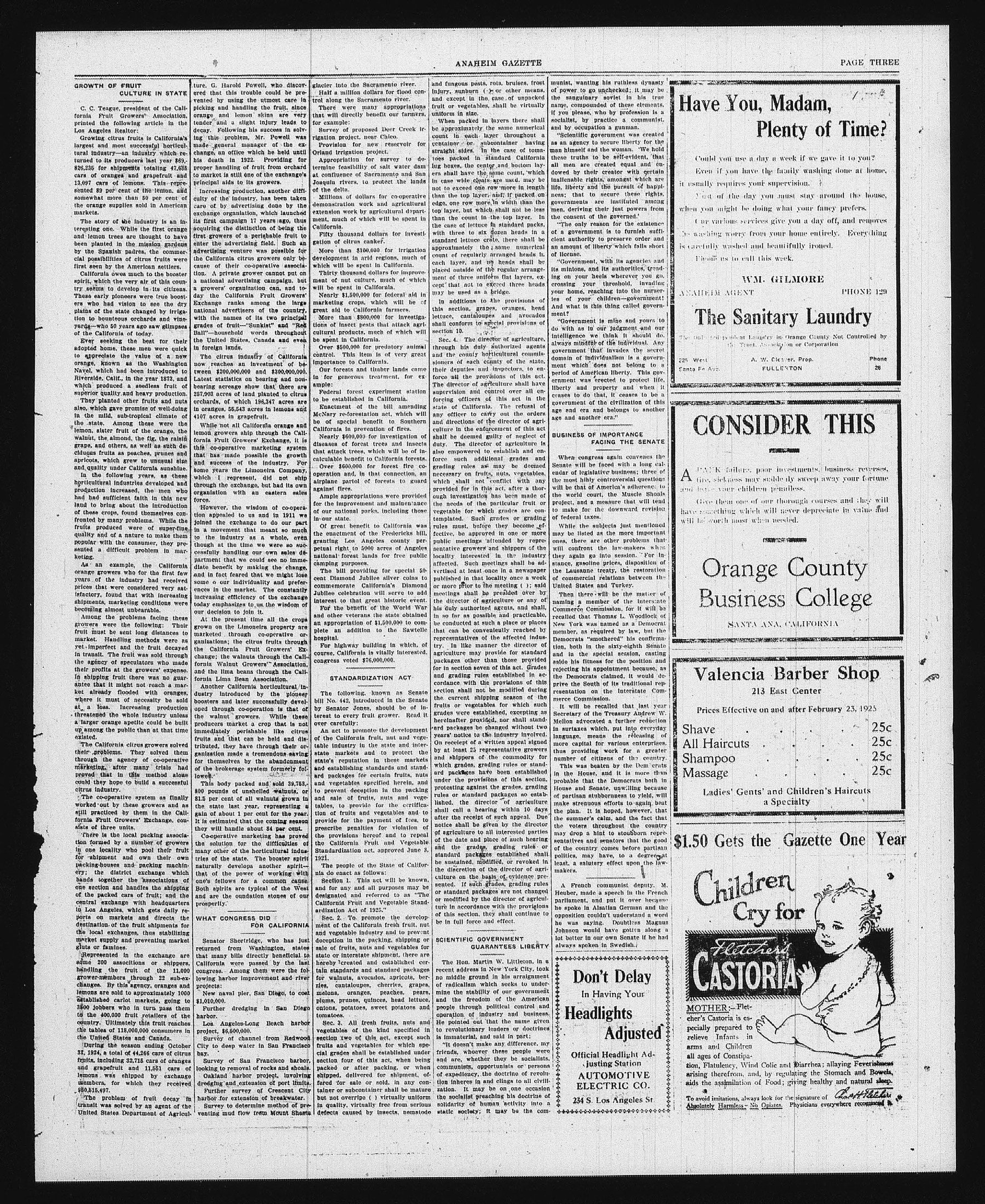
Searchable text
GROWTH OF FRUIT
CULTURE IN STATE
C. C. Teague, president of the California Fruit Growers' Association, printed the following article in the Los Angeles Realtor:
Growing citrus fruits is California's largest and most successful horticultural industry—an industry which returned to its producers last year $69,826,235 for shipments totaling 47,635 cars of oranges and grapefruit and 13,097 cars of lemons. This represented 89 per cent of the lemon, and somewhat more than 50 per cent of the orange supplies sold in American markets.
The story of the industry is an interesting one. While the first orange and lemon trees are thought to have been planted in the mission gardens by the Spanish padres, the commercial possibilities of citrus fruits were first seen by the American settlers.
California owes much to the booster spirit, which the very air of this country seems to develop in its citizens. These early pioneers were true boosters who had vision to see the dry plains of the state changed by irrigation to bountiful orchards and vineyards—who 50 years ago saw glimpses of the California of today.
Ever seeking the best for their adopted home, these men were quick to appreciate the value of a new orange, known as the Washington Navel, which had been introduced to Riverside, Calif., in the year 1873, and which produced a seedless fruit of superior quality and heavy production.
They planted other fruits and nuts also, which gave promise of well-doing in the mild, sub-tropical climate of the state. Among these were the lemon, sister fruit of the orange, the walnut, the almond, the fig, the raisin grape, and others, as well as such de-
ture, G. Harold Powell, who discovered that this trouble could be prevented by using the utmost care in picking and handling the fruit, since orange and lemon skins are very tender and a slight injury leads to decay. Following his success in solving this problem, Mr. Powell was made general manager of the exchange, an office which he held until his death in 1922. Providing for proper handling of fruit from orchard to market is still one of the exchange's principal aids to its growers.
Increasing production, another difficulty of the industry, has been taken care of by advertising done by the exchange organization, which launched its first campaign 17 years ago, thus acquiring the distinction of being the first growers of a perishable fruit to enter the advertising field. Such an advertising venture was possible for the California citrus growers only because of their co-operative association. A private grower cannot put on a national advertising campaign, but a grower's organization can, and today the California Fruit Growers' Exchange ranks among the large national advertisers of the country, with the names of its two principal grades of fruit—"Sunkist" and "Red Ball"—household words throughout the United States, Canada and even in foreign lands.
The citrus industry of California now reaches an investment of between $200,000,000 and $300,000,000. Latest statistics on bearing and non-bearing acreage show that there are 257,903 acres of land planted to citrus orchards, of which 196,347 acres are in oranges, 55,543 acres in lemons and 4107 acres in grapefruit.
While not all California orange and lemon growers ship through the California Fruit Growers' Exchange, it is this co-operative marketing system glacier into the Sea.
Half a million dollars control along the Sacramento There were many that will directly benefit for example:
Survey of propagation project, no Provision for Orland irrigation plan Appropriation for termine feasibility at confluence of S.Joaquin rivers, to of the delta.
Millions of dollars demonstration work extension work by ment, much of which California.
Fifty thousand gation of citrus can More than $100 development in arid which will be spent Thirty thousand ment of nut culture will be spent in C Nearly $1,500,000 marketing crops great aid to California More than $800 tions of insect pest cultural products be spent in California Over $500,000 for control. This item importance to California Our forests and in for generous ample: Federal forest to be established Enactment of McNary re-forestation be of special bear California in prev Nearly $600,000 diseases of forest
to appreciate the value of a new orange, known as the Washington Navel, which had been introduced to Riverside, Calif., in the year 1873, and which produced a seedless fruit of superior quality and heavy production.
They planted other fruits and nuts also, which gave promise of well-doing in the mild, sub-tropical climate of the state. Among these were the lemon, sister fruit of the orange, the walnut, the almond, the fig, the raisin grape, and others, as well as such deciduous fruits as peaches, prunes and apricots, which grew to unusual size and quality under California sunshine.
In the following years, as these horticultural industries developed and production increased, the men who had had sufficient faith in this new land to bring about the introduction of these crops, found themselves confronted by many problems. While the fruits produced were of super-fine quality and of a nature to make them popular with the consumer, they presented a difficult problem in marketing.
As an example, the California orange growers who for the first few years of the industry had received prices that were considered very satisfactory, found that with increasing shipments, marketing conditions were becoming almost unbearable.
Among the problems facing these growers were the following: Their fruit must be sent long distances to market. Handling methods were as yet imperfect and the fruit decayed in transit. The fruit was sold through the agency of speculators who made their profits at the growers' expense. In shipping fruit there was no guarantee that it might not reach a market already flooded with oranges, where it must of necessity be sold at a loss. Increasing production threatened the whole industry unless a larger orange apetite could be built up among the public than at that time existed.
The California citrus growers solved their problems. They solved them through the agency of co-operative marketing, after many trials had proved that in this method alone could they hope to build a successful citrus industry.
The co-operative system as finally worked out by these growers and as still practiced by them in the California Fruit Growers' Exchange, consists of three units.
There is the local packing association formed by a number of growers in one locality who pool their fruit.
The citrus industry of California now reaches an investment of between $200,000,000 and $300,000,000. Latest statistics on bearing and non-bearing acreage show that there are 257,903 acres of land planted to citrus orchards, of which 198,347 acres are in oranges, 55,543 acres in lemons and 4107 acres in grapefruit.
While not all California orange and lemon growers ship through the California Fruit Growers' Exchange, it is this co-operative marketing system that has made possible the growth and success of the industry. For some years the Limoneira Company, which I represent, did not ship through the exchange, but had its own organization with an eastern sales force.
However, the wisdom of co-operation appealed to us and in 1911 we joined the exchange to do our part in a movement that meant so much to the industry as a whole, even though at the time we were so successfully handling our own sales department that we could see no immediate benefit by making the change, and in fact feared that we might lose some o our individuality and preferences in the market. The constantly increasing efficiency of the exchange today emphasizes us on the wisdom of our decision to join it.
At the present time all the crops grown on the Limoneira property are marketed through co-operative organizations; the citrus fruits through the California Fruit Growers' Exchange; the walnuts through the California Walnut Growers' Association, and the lima beans through the California Lima Bean Association.
Another California horticultural industry introduced by the pioneer boosters and later successfully developed through co-operation is that of the walnut growers. While these producers market a crop that is not immediately perishable like citrus fruits and that can be held and distributed, they have through their organization made a tremendous saving for themselves by the abandonment of the brokerage system formerly followed.
This body packed and sold 39,763,800 pounds of unshelled walnuts, or 81.5 per cent of all walnuts grown in the state last year, representing a gain of about 1 per cent for the year. It is estimated that the coming season they will handle about 84 per cent.
Co-operative marketing has proved the solution for the difficulties of many other of the horticultural indices.
The following bill No. 442, introduced by Senator Jones terest to every fraternity over carefully:
An act to promote of the California table industry in state markets a state's reputation and establishing sard packages for and vegetables spice to prevent deceptive sale of fruit tables, to provide tion of fruits and provide for the prescribe penaltitie the provisions hethe California Fruit Standardization a
through the agency of co-operative marketing, after many trials had proved that in this method alone could they hope to build a successful citrus industry.
The co-operative system as finally worked out by these growers and as still practiced by them in the California Fruit Growers' Exchange, consists of three units.
There is the local packing association formed by a number of growers in one locality who pool their fruit for shipment and own their own packing-houses and packing machinery; the district exchange which bands together the associations of one section and handles the shipping of the packed cars of fruit; and the central exchange with headquarters in Los Angeles, which gets daily reports on markets and directs the destination of the fruit shipments for the local exchanges, thus stabilizing market supply and preventing market gluts or famines.
Represented in the exchange are some 200 associations or shippers, handling the fruit of the 11,000 grower-members through 22 sub-exchanges. By this agency, oranges and lemons are sold to approximately 1000 established carlot markets, going to 3800 jobbers who in turn pass them to the 400,000 fruit retailers of the country. Ultimately this fruit reaches the tables of 118,000,000 consumers in the United States and Canada.
During the season ending October 31, 1924, a total of 44,266 cars of citrus fruits, including 32,715 cars of oranges and grapefruit and 11,551 cars of lemons was shipped by exchange members, for which they received $80,515,497.
The problem of fruit decay in transit was solved by an agent of the United States Department of Agricul-
WHAT CONGRESS DID FOR CALIFORNIA
Senator Shortridge, who has just returned from Washington, states that many bills directly beneficial to California were passed by the last congress. Among them were the following harbor improvement and river projects:
New naval pier, San Diego, to cost $1,010,000.
Further dredging in San Diego harbor.
Los Angeles-Long Beach harbor project, $6,500,000.
Survey of channel from Redwood City to deep water in San Francisco bay.
Survey of San Francisco harbor, looking to removal of rocks and shoals.
Oakland harbor project, involving dredging and extension of port limits.
Further survey of Crescent City harbor for extension of breakwater.
Survey to determine method of preventing mud flow from Mount Shasta for themselves by the abandonment of the brokerage system formerly followed.
This body packed and sold 39,753,800 pounds of unshelled walnuts, or 81.5 per cent of all walnuts grown in the state last year, representing a gain of about 1 per cent for the year. It is estimated that the coming season they will handle about 84 per cent.
Co-operative marketing has proved the solution for the difficulties of many other of the horticultural industries of the state. The booster spirit naturally develops another spirit—that of the power of working with one's fellows for a common cause. Both spirits are typical of the West and are the oundation stones of our prosperity.
SEC. 2. To present of the California and vegetable industry deception in the sale of fruits, nut state or interstate hereby created a tain standards and for walnuts, avocies, cantaloupes melons, oranges plums, prunes, quinions potatoes tomatoes.
SEC. 3. All free vegetables of this section two of the fruits and vegetal grades shall section four of the packed or after shipped, delivered for sale or tainer or subcontract but not overripe in quality, virtual defects caused by
ANAHEIM GAZETTE
glacier into the Sacramento river.
Half a million dollars for flood control along the Sacramento river.
There were many appropriations that will directly benefit our farmers, for example:
Survey of proposed Deer Creek irrigation project, near Chico.
Provision for new reservoir for Orland irrigation project.
Appropriation for survey to determine feasibility of salt water dam at confluence of Sacramento and San Joaquin rivers, to protect the lands of the delta.
Millions of dollars for co-operative demonstration work and agricultural extension work by agricultural department, much of which will be spent in California.
Fifty thousand dollars for investigation of citrus canker.
More than $100,000 for irrigation development in arid regions, much of which will be spent in California.
Thirty thousand dollars for improvement of nut culture, much of which will be spent in California.
Nearly $1,500,000 for federal aid in marketing crops, which will be of great aid to California farmers.
More than $800,000 for investigations of insect pests that attack agricultural products, much of which will be spent in California.
Over $500,000 for predatory animal control. This item is of very great importance to California.
Our forests and timber lands came in for generous treatment, for example:
Federal forest experiment station to be established in California.
Enactment of the bill amending McNary re-forestation act, which will be of special benefit to Southern California in prevention of fires.
Nearly $600,000 for investigation of diseases of forest trees and insects and fungous pests, rots, bruises, frost injury, sunburn (or) or other means, and except in the case of unpacked fruit or vegetables, shall be virtually uniform in size.
When packed in layers there shall be approximately the same numerical count in each layer throughout a container or subcontainer having straight sides. In the case of tomatoes packed in standard California lug boxes, the center and bottom layers shall have the same count, which in case wide cleats are used, may not to exceed one row more in length than the top layer; and if packed on edge, one row more in width than the top layer, but which shall not be less than the count in the top layer. In the case of lettuce in standard packs, with three to six dozen heads in a standard lettuce crate, there shall be approximately the same numerical count of regularly arranged heads in each layer, and no heads shall be placed outside of the regular arrangement of three uniform flat layers, except that act to exceed three heads may be used as a bridge.
In additions to the provisions of this section, grapes, oranges, head lettuce, cantaloupes and avocados shall conform to special provisions of section 10.
Sec. 4. The director of agriculture, through his duly authorized agents and the county horticultural commissioners of each county of the state, their deputies and inspectors, to enforce all the provisions of this act. The director of agriculture shall have supervision and control over all enforcing officers of this act in the state of California. The refusal of any officer to carry out the orders and directions of the director of agriculture in the enforcement of this act shall be deemed guilty of neglect of duty. The director of agriculture is munist, wanting his ruthless dynasty of power to go unchecked; it may be the sanguinary soviet in his true name, compounded of these elements, if you please, who by profession is a socialist, by practice a communist, and by occupation a gunman.
"Scientific government was created as an agency to secure liberty for the man himself and the woman." We hold these truths to be self-evident, that all men are created equal and endowed by their creator with certain innatenable rights, amongst which are life, liberty and the pursuit of happiness; that to secure these rights, governments are instituted among men, deriving their just powers from the consent of the governed."
"The only reason for the existence of a government is to furnish sufficient authority to preserve order and an amount of liberty which falls short of license.
"Government, with its agencies and its minions, and its authorities, treading on your heels wherever you go, crossing your threshold, invading your home, reaching into the nurseries of your children—government! And what is this thing called government?
"Government is mine and yours to do with as in our judgment and our intelligence we think it should do. always mindful of the individual. Any government that invades the secret domain of individualism is a government which does not belong to a period of American liberty. This government was erected to protect life, liberty and property and when it ceases to do that, it ceases to be a government of the civilization of this age and era and belongs to another age and another era."
STANDARDIZATION ACT
The following, known as Senate bill No. 442, introduced in the Senate by Senator Jones, should be of interest to every fruit grower. Read it over carefully:
An act to promote the development of the California fruit, nut and vegetable industry in the state and interstate markets and to protect the state's reputation in these markets and establishing standards and standard packages for certain fruits, nuts and vegetables specified herein, and to prevent deception in the packing and sale of fruits, nuts and vegetables, to provide for the certification of fruits and vegetables and to provide for the payment of fees, to prescribe penalties for violation of the provisions hereof and to repeal the California Fruit and Vegetable Standardization act approved June 3.
BUSINESS OF IMPORTANCE FACING THE SENATE
When congress again convenes the Senate will be faced with a long calendar of legislative business; three of the most hibly controversial questions will be that of America's adherence to the world court, the Muscle Shoals project, and a measure that will tend to make for the downward revision of federal taxes.
While the subjects just mentioned may be listed as the more important ones, there are other problems that will confront the law-makers when they again go into session. For instance, gasoline prices, disposition of the Lausanne treaty, the restoration of commercial relations between the United States and Turkey.
Then there will be the matter of naming a member of the intersate Commerce Commission, for it will be recalled that Thomas L. Woodlock of New York was named as a Democrat member, as required by law, but the Democrats "smothered" his confirmation, both in the sixty-eighth Senate and in the special session, casting aside his fitness for the position and rejecting his appointment because, as the Democrats claimed, it would deprive the South of its traditional representation on the Interstate Commerce Commission.
It will be recalled that last year Secretary of the Treasury Andrew W. Mellon advocated a further reduction in surtaxes which, put into everyday language, means the releasing of more capital for various enterprises, thus providing work for a greater number of citizens of the country.
This was beaten by the Democrats in the House, and it is more than probable that the Democrats both in House and Senate, unwilling because of partisan stubbornness to yield, will make strenuous efforts to again beat the plan. It is hoped, however, that the summer's calm, and the fact that the voters throughout the country may drop a hint to stoubborn representatives and senators that the good of the country comes before partisan
state's reputation in these markets and establishing standards and standard packages for certain fruits, nuts and vegetables specified herein, and to prevent deception in the packing and sale of fruits, nuts and vegetables, to provide for the certification of fruits and vegetables and to provide for the payment of fees, to prescribe penalties for violation of the provisions hereof and to repeal the California Fruit and Vegetable Standardization Act, approved June 3, 1921.
The people of the State of California do enact as follows:
Section 1. This act will be known, and for any and all purposes may be designated and referred to as "The California Fruit and Vegetable Standardization Act of 1925."
Sec. 2. To promote the development of the California fresh fruit, nut and vegetable industry and to prevent deception in the packing, shipping or sale of fruits, nuts and vegetables for state or interstate shipment, there are hereby created and established certain standards and standard packages for walnuts, avocados, apricots, berries, cantaloupes, cherries, grapes, melons, oranges, peaches, pears, plums, prunes, quinces, head lettuce, onions, potatoes, sweet potatoes and tomatoes.
Sec. 3. All fresh fruits, nuts and vegetables of the kind specified in section two of this act, except such fruits and vegetables for which special grades shall be established under section four of this act, when being packed or after packing, or when shipped, delivered for shipment, offered for sale or sold, in any container or subcontainer shall be mature but not overripe ( ) virtually uniform in quality, virtually free from serious defects caused by insects, nematode and shippers of the commodity for which grades, grading rules or standard packages have been established under the provisions of this section, protesting against the grades, grading rules or standard packages so established, the director of agriculture shall call a hearing within 10 days after the receipt of such appeal. Due notice shall be given by the director of agriculture to all interested parties of the date and place of such hearing and the grades, grading rules or standard packages established shall be sustained, modified, or revoked in the discretion of the director of agriculture on the basis of evidence presented. If such grades, grading rules or standard packages are not changed or modified by the director of agriculture in accordance with the proviglions of this section, they shall continue to be in full force and effect.
SCIENTIFIC GOVERNMENT GUARANTEES LIBERTY
The Hon. Martin W. Littleton, in a recent address in New York City, took no middle ground in his arraignment of radicalism which seeks to undermine the stability of our government and the freedom of the American people through political control and operation of industry and business. He pointed out that the name given to revolutionary leaders or doctrines is immaterial, and said in part:
"It doesn't make any difference, my friends, whoever these people were and are, whether they be socialists, communists, opportunists or persons of expediency, the doctrine of revolution inheres in and clings to all civilization. It may be on one occasion the socialist preaching his doctrine of solidarity of human activity into a static society; it may be the com-
number of citizens of the country.
This was beaten by the Democrats in the House, and it is more than probable that the Democrats both in House and Senate, unwilling because of partisan stubbornness to yield, will make strenuous efforts to again beat the plan. It is hoped, however, that the summer's calm, and the fact that the voters throughout the country may drop a hint to stoubborn representatives and senators that the good of the country comes before partisan politics, may have, to a degree at least, a salutary effect upon the lawmakers.
A French communist deputy, M. Heuber, made a speech in the French parliament, and put it over because he spoke in Alsatian German and the opposition couldn't understand a word he was saying. Doubtless Magnus Johnson would have gotten along a lot better in our own Sonate if he had always spoken in Swedish."
Have You, Madam,
Plenty of Time?
Could you use a day a week if we gave it to you?
Even if you have the family washing done at home,
it usually requires your supervision.
Most of the day you must stay around the house,
when you might be doing what your fancy prefers.
Our various services give you a day off, and removes
be washing worry from your home entirely. Everything
is carefully washed and beautifully ironed.
Please us to call this week.
WM. GILMORE
ANAHEIM AGENT PHONE 129
The Sanitary Laundry
The Only Independent Laundry in Orange County Not Controlled by
the Trust, Association or Corporation
225 West A. W. Cleaver, Prop.
Santa Fe Ave. FULLERTON 26
CONSIDER THIS
CONSIDER THIS
A PARK failure, poor investments, business reverses,
fire, sickness may suddenly sweep away your fortune
and leave your children penniless.
Give them one of our thorough courses and they will
have something which will never depreciate in value and
will be worth most when needed.
Orange County
Business College
SANTA ANA, CALIFORNIA
Valencia Barber Shop
213 East Center
Prices Effective on and after February 23, 1925
Shave . . . . . . . . . 25c
All Haircuts . . . . . . . 25c
Shampoo . . . . . . . . 25c
Massage . . . . . . . . 25c
Ladies' Gents' and Children's Haircuts
a Specialty
$1.50 Gets the Gazette One Year
$1.50 Gets the Gazette One Year
Children Cry for
Fletcher's Castoria
MOTHER:—Fletcher's Castoria is especially prepared to relieve Infants in arms and Children all ages of Constipation, Flatulency, Wind Colic and Diarrhea; allaying Feverishness arising therefrom, and, by regulating the Stomach and Bowels, aids the assimilation of Food; giving healthy and natural sleep.
To avoid imitations, always look for the signature of Absolutely Harmless - No Opiates. Physicians everywhere recommended