anaheim-gazette 1925-03-12
Scanned page
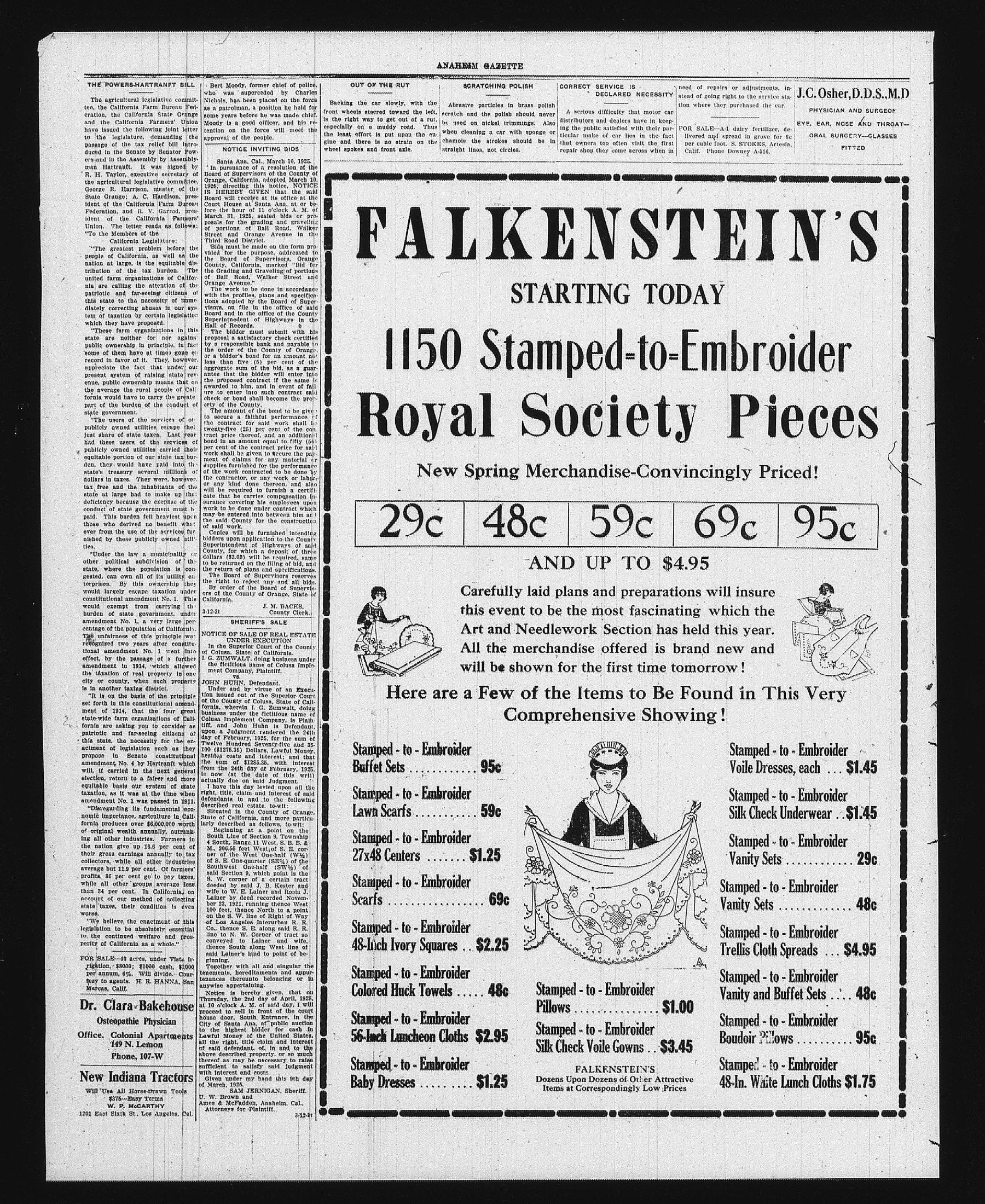
Searchable text
THE POWERS-HARTRANFT BILL
The agricultural legislative committee, the California Farm Bureau Federation, the California State Grange and the California Farmers' Union have issued the following joint letter to the legislature, demanding the passage of the tax relief bill introduced in the Senate by Senator Powers and in the Assembly by Assemblyman Hartranft. It was signed by R. H. Taylor, executive secretary of the agricultural legislative committee, George R. Harrison, master of the State Grange; A. C. Hardison, president of the California Farm Bureau Federation, and R. V. Garrod, president of the California Farmers' Union. The letter reads as follows: "To the Members of the California Legislature:
"The greatest problem before the people of California, as well as the nation at large, is the equitable distribution of the tax burden. The united farm organizations of California are calling the attention of the patriotic and far-seeking citizens of this state to the necessity of immediately correcting abuses in our system of taxation by certain legislation which they have proposed.
"These farm organizations in this state are neither for nor against public ownership in principle, in fact some of them have at times gone on record in favor of it. They, however, appreciate the fact that under our present system of raising state revenue, public ownership means that on the average the rural people of California would have to carry the greater part of the burden of the conduct of state government.
"The users of the services of our publicly owned utilities escape their just share of state taxes. Last year had these users of the services of publicly owned utilities carried their Bert Moody, former chief of police, who was superceded by Charles Nichols, has been placed on the force as a patrolman, a position he held for some years before he was made chief. Moody is a good officer, and his retention on the force will meet the approval of the people.
NOTICE INVITING BIDS
Santa Ana, Cal., March 10, 1925.
In pursuance of a resolution of the Board of Supervisors of the County of Orange, California, adopted March 10, 1925, directing this notice, NOTICE IS HEREBY GIVEN that the said Board will receive at its office at the Court House at Santa Ana, at or before the hour of 11 o'clock A.M. of March 31, 1925, sealed bids or proposals for the grading and graveling of portions of Ball Road, Walker Street and Orange Avenue in the Third Road District.
Bids must be made on the form provided for the purpose, addressed to the Board of Supervisors, Orange County, California, marked "Bid for the Grading and Graveling of portions of Ball Road, Walker Street and Orange Avenue."
The work to be done in accordance with the profiles, plans and specifications adopted by the Board of Supervisors, on file in the office of said Board and in the office of the County Superintendent of Highways in the Hall of Records.
The bidder must submit with his proposal a satisfactory check certified by a responsible bank and payable to the order of the County of Orange, or a bidder's bond for an amount not less than five (5) per cent of the aggregate sum of the bid, as a guarantee that the bidder will enter into the proposed contract if the same is awarded to him, and in event of failure to enter into such contract said check or bond shall become the property of the County.
The amount of the bond to be given to secure a faithful performance of the contract for said work shall be twenty-five (25) per cent of the contract price thereof, and an additional bond in an amount equal to fifty (50) per cent of the contract price for said
"The users of the services of our publicly owned utilities escape their just share of state taxes. Last year had these users of the services of publicly owned utilities carried their equitable portion of our state tax burden, they would have paid into the state's treasury several millions of dollars in taxes. They were, however, tax free and the inhabitants of the state at large had to make up that deficiency because the exepnse of the conduct of state government must be paid. This burden fell heaviest upon those who derived no benefit what ever from the use of the services furnished by these publicly owned utilities.
"Under the law a municipality or other political subdivision of the state, where the population is congested, can own all of its utility enterprises. By this ownership they would largely escape taxation under constitutional amendment No. 1. This would exempt from carrying the burden of state government, under amendment No. 1, a very large percentage of the population of California. The unfairness of this principle was recognized two years after constitutional amendment No. 1 went into effect, by the passage of a further amendment in 1914, which allowed the taxation of real property in one city or county, when such property is in another taxing district.
"It is on the basis of the principle set forth in this constitutional amendment of 1914, that the four great state-wide farm organizations of California are asking you to consider as patriotic and far-seeing citizens of this state, the necessity for the enactment of legislation such as they propose in Senate constitutional amendment No. 4 by Hartranft which will, if carried in the next general election, return to a fairer and more equitable basis our system of state taxation, as it was at the time when amendment No. 1 was passed in 1911."
"Disregarding its fundamental economic importance, agriculture in California produces over $6,000,000 worth of original wealth annually, outranking all other industries. Farmers in the nation give up 16.6 per cent of record in favor of it. They, however, appreciate the fact that under our present system of raising state revenue, public ownership means that on the average the rural people of California would have to carry the greater part of the burden of the conduct of state government.
"The users of the services of our publicly owned utilities escape their just share of state taxes. Last year had these users of the services of publicly owned utilities carried their equitable portion of our state tax burden, they would have paid into the state's treasury several millions of dollars in taxes. They were, however, tax free and the inhabitants of the state at large had to make up that deficiency because the exepnse of the conduct of state government must be paid. This burden fell heaviest upon those who derived no benefit what ever from the use of the services furnished by these publicly owned utilities.
"Under the law a municipality or other political subdivision of the state, where the population is congested, can own all of its utility enterprises. By this ownership they would largely escape taxation under constitutional amendment No. 1. This would exempt from carrying the burden of state government, under amendment No. 1, a very large percentage of the population of California. The unfairness of this principle was recognized two years after constitutional amendment No. 1 went into effect, by the passage of a further amendment in 1914, which allowed the taxation of real property in one city or county, when such property is in another taxing district.
"It is on the basis of the principle set forth in this constitutional amendment of 1914, that the four great state-wide farm organizations of California are asking you to consider as patriotic and far-seeing citizens of this state, the necessity for the enactment of legislation such as they propose in Senate constitutional amendment No. 4 by Hartranft which will, if carried in the next general election, return to a fairer and more equitable basis our system of state taxation, as it was at the time when amendment No. 1 was passed in 1911."
"Disregarding its fundamental economic importance, agriculture in California produces over $6,000,000 worth of original wealth annually, outranking all other industries. Farmers in the nation give up 16.6 per cent of record in favor of it. They, however, appreciate the fact that under our present system of raising state revenue, public ownership means that on the average the rural people of California would have to carry the greatest part of the burden of the conduct of state government."
"The users of the services of our publicly owned utilities escape their just share of state taxes. Last year had these users of the services of publicly owned utilities carried their equitable portion of our state tax burden, they would have paid into the state's treasury several millions of dollars in taxes. They were, however, tax free and the inhabitants of the state at large had to make up that deficiency because the exepnse of the conduct of state government must be paid. This burden fell heaviest upon those who derived no benefit what ever from the use of the services furnished by these publicly owned utilities."
"Under the law a municipality or other political subdivision of the state, where the population is congested, can own all of its utility enterprises. By this ownership they would largely escape taxation under constitutional amendment No. 1. This would exempt from carrying the burden of state government, under amendment No. 1, a very large percentage of the population of California. The unfairness of this principle was recognized two years after constitutional amendment No. 1 went into effect, by the passage of a further amendment in 1914, which allowed the taxation of real property in one city or county, when such property is in another taxing district."
"It is on the basis of the principle set forth in this constitutional amendment of 1914, that the four great state-wide farm organizations of California are asking you to consider as patriotic and far-seeing citizens of this state, the necessity for the enactment of legislation such as they propose in Senate constitutional amendment No. 4 by Hartranft which will, if carried in the next general election, return to a fairer and more equitable basis our system of state taxation, as it was at the time when amendment No. 1 was passed in 1911."
"Disregarding its fundamental economic importance, agriculture in California produces over $6,000,000 worth of original wealth annually, outranking all other industries. Farmers in the nation give up 16.6 per cent of record in favor of it. They, however, appreciate the fact that under our present system of raising state revenue, public ownership means that on the average the rural people of California would have to carry the greatest part of the burden of state government."
"The users of the services of our publicly owned utilities escape their just share of state taxes. Last year had these users of the services of publicly owned utilities carried their equitable portion of our state tax burden, they would have paid into the state's treasury several millions of dollars in taxes. They were, however, tax free and the inhabitants of the state at large had to make up that deficiency because the exepnse of the conduct of state government must be paid. This burden fell heaviest upon those who derived no benefit what ever from the use of the services furnished by these publicly owned utilities."
"Under the law a municipality or other political subdivision of the state, where the population is congested, can own all of its utility enterprises. By this ownership they would largely escape taxation under constitutional amendment No. 1. This would exempt from carrying the burden of state government, under amendment No. 1, a very large percentage of the population of California. The unfairness of this principle was recognized two years after constitutional amendment No. 1 went into effect, by the passage of a further amendment in 1914, which allowed the taxation of real property in one city or county, when such property is in another taxing district."
"It is on the basis of the principle set forth in this constitutional amendment of 1914, that the four great state-wide farm organizations of California are asking you to consider as patriotic and far-seeing citizens of this state, the necessity for the enactment of legislation such as they propose in Senate constitutional amendment No. 4 by Hartranft which will, if carried in the next general election, return to a fairer and more equitable basis our system of state taxation, as it was at the time when amendment No. 1 was passed in 1911."
propose in Senate constitutional amendment No. 4 by Hartranft which will, if carried in the next general election, return to a fairer and more equitable basis our system of state taxation, as it was at the time when amendment No. 1 was passed in 1911.
"Disregarding its fundamental economic importance, agriculture in California produces over $6,000,000 worth of original wealth annually, outranking all other industries. Farmers in the nation give up 16.6 per cent of their gross earnings annually to tax collectors, while all other industries average but 11.9 per cent. Of farmers' profits, 86 per cent go to pay taxes, while all other groups average less than 34 per cent. In California, on account of our method of collecting state taxes, their condition is even worse.
"We believe the enactment of this legislation to be absolutely essential to the continued welfare and prosperity of California as a whole."
FOR SALE—40 acres, under Vista irrigation; $8000; $1000 cash; $1000 per annum, 6%. Will divide. Courtesy to agents. H. R. HANNA, San Marcas, Calif.
Dr. Clara Bakehouse
Osteopathic Physician
Office. Colonial Apartments
149 N. Lemon
Phone, 107-W
New Indiana Tractors
Will Use All Horse-Drawn Tools
$375—Easy Terms
W. P. McCARTHY
1201 East Sixth St., Los Angeles, Cal.
ANAHEIM GAZETTE
OUT OF THE RUT
Backing the car slowly, with the front wheels steered toward the left, is the right way to get out of a rut, especially on a muddy road. Thus the least effort is put upon the engine and there is no strain on the wheel spokes and front axle.
SCRATCHING POLISH
Abrasive particles in brass polish scratch and the polish should never be used on nickel trimmings. Also when cleaning a car with sponge or chamois the strokes should be in straight lines, not circles.
CORRECT SERVICE IS DECLARED NECESSITY
A serious difficulty that motor car distributors and dealers have in keeping the public satisfied with their particular make of car lies in the fact that owners too often visit the first repair shop they come across when in
FALKENST
STARTING TODAY
1150 Stamped=to=E Royal Society
1150 Stamped to Royal Society
New Spring Merchandise-Convince
29c 48c 59c
AND UP TO $4.9
Carefully laid plans and preparations
this event to be the most fascinating
Art and Needlework Section has he
All the merchandise offered is bran
will be shown for the first time tom
Here are a Few of the Items to Be For
Comprehensive Showi
Stamped - to - Embroider
Buffet Sets ..... 95c
Stamped - to - Embroider
Lawn Scarfs ..... 59c
Stamped - to - Embroider
Buffet Sets ... $95c
Stamped - to - Embroider
Lawn Scarfs ... $59c
Stamped - to - Embroider
27x48 Centers ... $1.25
Stamped - to - Embroider
Scarfs ... $69c
Stamped - to - Embroider
48-Inch Ivory Squares ... $2.25
Stamped - to - Embroider
Colored Huck Towels ... $48c
Stamped - to - Embroider
56-Inch Luncheon Cloths $2.95
Stamped - to - Embroider
Baby Dresses ... $1.25
Stamped - to - Embroider
Pillows ... $1.00
Stamped - to - Embroider
Silk Check Voile Gowns ... $3.45
FALKENSTEIN'S
Dozens Upon Dozens of Other Attractive
Items at Correspondingly Low Prices
CE IS
RERED NECESSITY
city that motor car
alers have in keepfied with their parlar lies in the fact
ten visit the first
me across when in
need of repairs or adjustments, instead of going right to the service station where they purchased the car.
FOR SALE—A-1 dairy fertilizer, delivered and spread in grove for 8c
per cubic foot. S. STOKES, Artesia,
Calif. Phone Downey A-516.
J.C. Osher, D.D.S., M.D
PHYSICIAN AND SURGEON
EYE, EAR, NOSE AND THROAT—
ORAL SURGERY—GLASSES
FITTED
STEIN'S
G TODAY
=to= Embroider
ety Pieces
Embroidered
Quilt Pieces
se-Convincingly Priced!
9c 69c 95c
TO $4.95
preparations will insure
t fascinating which the
ction has held this year.
ferred is brand new and
rst time tomorrow!
s to Be Found in This Very
ve Showing!
Stamped - to - Embroider
Voile Dresses, each ... $1.45
Stamped - to - Embroider
Silk Check Underwear ..$1.45
Stamped - to - Embroider
Voile Dresses, each ... $1.45
Stamped - to - Embroider
Silk Check Underwear ... $1.45
Stamped - to - Embroider
Vanity Sets ... 29c
Stamped - to - Embroider
Vanity Sets ... 48c
Stamped - to - Embroider
Trellis Cloth Spreads ... $4.95
Stamped - to - Embroider
Vanity and Buffet Sets ... 48c
Stamped - to - Embroider
Boudoir Pillows ... 95c
Stamped - to - Embroider
48-In. White Lunch Cloths $1.75