anaheim-gazette 1924-09-25
Scanned page
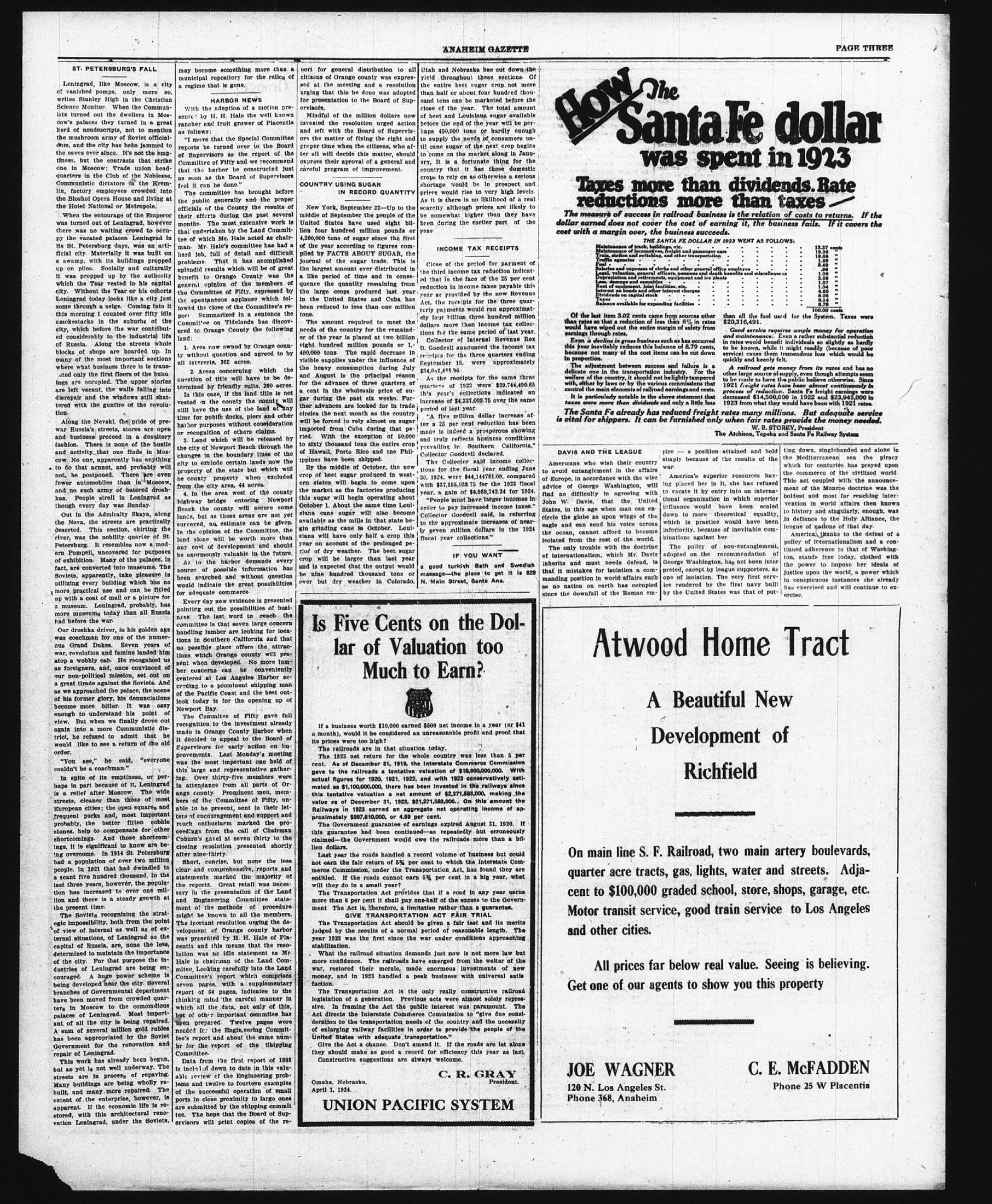
Searchable text
ST. PETERSBURG'S FALL
Leningrad, like Moscow, is a city of vanished pomps, only more so, writes Stanley High in the Christian Science Monitor. When the Communists turned out the dwellers in Moscow's palaces they turned in a great herd of nondescripts, not to mention the mushroom army of Soviet officials, and the city has been jammed to the eaves ever since. It's not the emptiness, but the contrasts that strike one in Moscow: Trade union headquarters in the Club of the Noblesse, Communistic dictators in the Kremlin, factory employees crowded into the Bloshol Opera House and living at the Hotel National or Metropole.
When the entourage of the Emperor was turned out of Leningrad, however there was no waiting crowd to occupy the vacated palaces. Leningrad in its St. Petersburg days, was an artificial city. Materially it was built on a swamp, with its buildings propped up on piles. Socially and culturally it was propped up by the authority which the Tsar vested in his capital city. Without the Tsar or his cohorts Leningrad today looks like a city just some through a seige. Coming into it this morning I counted over fifty idle smokestacks in the suburbs of the city, which before the war contributed considerably to the industrial life of Russia. Along the streets whole blocks of shops are boarded up. In many of the most important sections where what business there is is transacted only the first floors of the buildings are occupied. The upper stories are left vacant, the walls falling into disrepair and the windows still shattered with the gunfire of the revolution.
Along the Nevski, the pride of pre-war Russia's streets, stores are open and business proceed in a desultory fashion. There is none of the bustle may become something more than a municipal repository for the relics of a regime that is gone.
HARBOR NEWS
With the adoption of a motion presented by H. H. Hale the well known rancher and fruit grower of Placentia as follows:
"I move that the Special Committee reports be turned over to the Board of Supervisors as the report of the Committee of Fifty and we recommend that the harbor be constructed just as soon as the Board of Supervisors feel it can be done."
The committee has brought before the public generally and the proper officials of the County the results of their efforts during the past several months. The most extensive work is that undertaken by the Land Committee of which Mr. Hale acted as chairman. Mr. Hale's committee has had a hard job, full of detail and difficult problems. That it has accomplished splendid results which will be of great benefit to Orange County was the general opinion of the members of the Committee of Fifty, expressed by the spontaneous applause which followed the close of the Committee's report. Summarized in a sentence the Committee on Tidelands has discovered to Orange County the following land:
1. Area now owned by Orange county without question and agreed to by all interests, 365 acres.
2. Areas concerning which the question of title will have to be determined by friendly suits, 260 acres.
In this case, if the land title is not vested in the county the county will still have the use of the land at any time for public docks, pliers and other harbor purposes without consideration or recognition of others claims.
3. Land which will be released by the city of Newport Beach through the port for general distribution citizens of Orange county sed at the meeting and urging that this be done for presentation to the servisors.
Mindful of the million invested the resolution and left with the Boardors the matter of fixing proper time when the cater all will decide this express their approval on careful program of impo
COUNTRY USING SUCK IN RECORD
New York, September middle of September thru United States have ullion four hundred million 4,200,000 tons of sugar of the year according to pilled by FACTS ABOUT journal of the sugar largest amount ever a like period of time sequence the quantity ru large crops produce in the United States been reduced to less than tons.
The amount required needs of the country for o尔er of the year is placed eight hundred million 400,000 tons. The rapid visible supplies under t he heavy consumption and August is the pror for the advance of three cent in the wholesal gar during the past thir advanced are looked circles next month will be forced to rely al imported from Cuba dried. With the excepto sixty thousand tons
Along the Nevski, the pride of prewar Russia's streets, stores are open and business proceed in a desultory fashion. There is none of the bustle and activity that one finds in Moscow. No one, apparently has anything to do that acnot, and probably will not, be postponed. There are even fewer automobiles than in Moscow, and no such army of battered droskas. People stroll in Leningrad as though every day was Sunday.
Out in the Admiralty Skaya, along the Neva, the streets are practically deserted. This section, skirting the river, was the nobility quarter of St. Petersburg. It resembles now a modern Pompeii, uncovered for purposes of exhibition. Many of the palaces, in fact, are converted into museums. The Soviets, apparently, take pleasure in utilizing every building which has no more practical use and can be fitted up with a coat of mail or a picture for a museum. Leningrad, probably, has more museums today than all Russia had before the war.
Our droskka driver, in his golden age was coachman for one of the numerous Grand Dukes. Seven years of war, revolution and famine landed him atop a wobbly cab. He recognized us as foreigners, and, once convinced of our non-political mission, set out on a great tirade against the Soviets. And as we approached the palace, the scene of his former glory, his denunciations become more bitter. It was easy enough to understand his point of view. But when we finally drove out again into a more Communist district, he refused to admit that he would like to see a return of the old order.
"You see," he said, "everyone couldn't be a coachman."
In spite of its emptiness, or perhaps in part because of it, Leningrad is a relief after Moscow. The wide streets, cleaner than those of most European cities; the open squares and frequent parks and, most important probably, the better fitten cobble stones, help to compensate for other shortcomings. And those shortcomings, it is significant to know are by all interests, 365 acres.
2. Areas concerning which the question of title will have to be determined by friendly suits, 260 acres.
In this case, if the land title is not vested in the county the county will still have the use of the land at any time for public docks, piers and other harbor purposes without consideration or recognition of others claims.
3. Land which will be released by the city of Newport Beach through the changes in the boundary lines of the city to exclude certain lands now the property of the state but which will be county property when excluded from the city area, 44 acres.
4. In the area west of the county highway bridge entering Newport Beach the county will secure some lands, but as these areas are not yet surveyed, no estimate can be given. In the opinion of the Committee, the land alone will be worth more than any cost of development and should be enormously valuable in the future.
As to the harbor demands every source of possible information has been searched and without question would indicate the great possibilities for adequate commerce.
Every day new evidence is presented pointing out the possibilities of business. The last word to reach the committee is that seven large concern handling lumber are looking for locations in Southern California and that no possible place offers the attractions which Orange county will present when developed. No more lumber concerns can be conveniently centered at Los Angeles Harbor according to a prominent shipping man of the Pacific Coast and the best outlook today is for the opening up of Newport Bay.
The Committee of Fifty gave full recognition to the investment already made in Orange County Harbor when it decided to appeal to the Board of Supervisors for early action on improvements. Last Monday's meeting was the most important one held of this large and representative gathering. Over thirty-five members were in attendance from all parts of Orange county. Prominent men, members of the Committee of Fifty, unable to be present, sent in their letters of encouragement and support and much enthusiasm marked the proceedings from the call of Chairman Coburn's gavel at seven thirty to the closing resolution presented shortly
If a business works a month), would it its prices were too low? The railroads are The 1923 net rent cent. As of December gave to the railroad actual figures for 1 mated as $1,100,000 this tentative value as of December Railways in 1923 proximately $997,611 The Government this guarantee had claimed—the Government dollars.
"You see," he said, "everyone couldn't be a coachman."
In spite of its emptiness, or perhaps in part because of it, Leningrad is a relief after Moscow. The wide streets, cleaner than those of most European cities; the open squares and frequent parks and, most important probably, the better fitted cobble stones, help to compensate for other shortcomings. And those shortcomings, it is significant to know are being overcome. In 1914 St. Petersburg had a population of over two million people. In 1921 that had dwindled to a scant five hundred thousand. In the last three years, however, the population has increased to over one million and there is a steady growth at the present time.
The Soviets recognizing the strategic impossibility, both from the point of view of internal as well as of external situations, of Leningrad as the capital of Russia, are, none the less, determined to maintain the importance of the city. For that purpose the industries of Leningrad are being encouraged. A huge power scheme is being developed near the city. Several branches of Governmental department have been moved from crowded quarters in Moscow to the comomdious palaces of Leningrad. Most important of all the city is being repaired. A sum of several million gold rubles has been appropriated by the Soviet Government for the renovation and repair of Leningrad.
This work has already been begun, but as yet is not well underway. The streets are in process of repaving. Many buildings are being wholly rebuilt, and many more repaired. The extent of the enterprise, however, is apparent. If the economic life is restored, with this architectural renovation Leningrad, under the Soviets,
Last Monday's meeting was the most important one held of this large and representative gathering. Over thirty-five members were in attendance from all parts of Orange county. Prominent men, members of the Committee of Fifty, unable to be present, sent in their letters of encouragement and support and much enthusiasm marked the proceedings from the call of Chairman Coburn's gavel at seven thirty to the closing resolution presented shortly after nine-thirty.
Short, concise, but none the less clear and comprehensive, reports and statements marked the majority of the reports. Great retail was necessary in the presentation of the Land and Engineering Committee statement of the methods of procedure might be known to all the members. The important resolution urging the development of Orange county harbor was presented by H. H. Hale of Placentia and this means that the resolution was no idle statement as Mr. Hale is chairman of the Land Committee's report which comprises seven pages, with a supplementary report of 64 pages, indicates to the thinking mind the careful manner in which all the data, not only of this, but of other important committee has been prepared. Twelve pages were needed for the Engineerearing Committee's report and about the same number for the report of the Shipping Committee.
Data from the first report of 1888 is included down to date in this valuable review of the Engineering problems and twelve to fourteen examples of the successful operation of small ports in close proximity to large ones are submitted by the shipping committee. The hope that the Board of Supervisors will print copies of the re-
port for general distribution to all citizens of Orange county was expressed at the meeting and a resolution urging that this be done was adopted for presentation to the Board of Supervisors.
Mindful of the million dollars now invested the resolution urged action and left with the Board of Supervisors the matter of fixing the right and proper time when the citizens, who after all will decide this matter, should express their approval of a general and careful program of improvement.
COUNTRY USING SUGAR IN RECORD QUANTITY
New York, September 22—Up to the middle of September the people of the United States have used eight billion four hundred million pounds or 4,200,000 tons of sugar since the first of the year according to figures compiled by FACTS ABOUT SUGAR, the journal of the sugar trade. This is the largest amount ever distributed in a like period of time and in consequence the quantity remaining from the large crops produced last year in the United States and Cuba has been reduced to less than one million tons.
The amount required to meet the needs of the country for the remainder of the year is placed at two billion eight hundred million pounds or 1,400,000 tons. The rapid decrease in visible supplies under the influence of the heavy consumption during July and August is the principal reason for the advance of three quarters of a cent in the wholesale price of sugar during the past six weeks. Further advances are looked for in trade circles the next month as the country will be forced to rely almost on sugar imported from Cuba during that period. With the exception of 50,000 to sixty thousand tons the entire crop Utah and Nebraska has cut down the yield throughout these sections. Of the entire beet sugar crop not more than half or about four hundred thousand tons can be marketed before the close of the year. The total amount of beet and Louisiana sugar available before the end of the year will be perhaps 450,000 tons or hardly enough to supply the needs of consumers until cane sugar of the next crop begins to come on the market along in January. It is a fortunate thing for the country that it has these domestic crops to rely on as otherwise a serious shortage would be in prospect and prices would rise to very high levels. As it is there is no likelihood of a real scarcity although prices are likely to be somewhat higher than they have been during the earlier part of the year.
INCOME TAX RECEIPTS
Close of the period for payment of the third income tax reduction indicated that in face of the 25 per cent reduction in income taxes payable this year as provided by the new Revenue Act, the receipts for the three quarterly payments would run approximately four billion three hundred million dollars more than income tax collections for the same period of last year.
Collector of Internal Revenue Rex B. Goodcell announced the income tax receipts for the three quarters ending September 15. were approximately $34,681,498.90.
As the receipts for the same three quarters of 1923 were $29,744,490.65 this year's collections indicated an increase of $4,337,008.75 over the same period of last year.
"A five million dollar increase after a 25 per cent reduction has been made is indeed a prosperous showing and truly reflects business conditions prevailing in Southern California."
Taxes more than reductions move
The measure of success in railroad business dollar earned does not cover the cost of cost with a margin over, the business size.
THE SANTA FE DOLLARS
Maintenance of track, buildings, etc.
Maintenance of locomotives, freight and passenger trains, station and switching, and other transport traffic agencies.
Fuel.
Salaries and expenses of clerks and other general legal, valuation, general officers, pensions and Depreciation and retirement equipment and loss, damage and casualties.
Rent of equipment, joint facilities, etc.
Interest on bonds and other interest charges.
Dividends on capital stock.
Taxes.
Balance available for expanding facilities.
Of the last item 3.02 cents came from sources than rates so that a reduction of less than 6% in would have wiped out the entire margin of safety earnings through rates.
Even a decline in gross business such as has occurred this year inevitably reduces this balance of 8.79 because not many of the cost items can be cut in proportion.
The adjustment between success and failure delicately one in the transportation industry. For welfare of the country, it should not be lightly tampered with either by laws or by the various commission control the main elements of railroad earnings and it is particularly notable in the above statement taxes were more than dividends and only a little.
The Santa Fe already has reduced free is vital for shippers. It can be furnished.
Is Five Cents on the Dollar of Valuation too Much to Earn?
If a business worth $10,000 earned $500 net income in a year (or $41 a month), would it be considered an unreasonable profit and proof that its prices were too high?
The railroads are in that situation today.
The 1923 net return for the whole country was less than 5 per cent. As of December 31, 1919, the Interstate Commerce Commission gave to the railroads a tentative valuation of $18,900,000,000. With actual figures for 1920, 1921, 1922, and with 1923 conservatively estimated as $1,100,000,000, there has been invested in the railways since this tentative valuation a net amount of $2,371,583,000, making the value as of December 31, 1923, $21,271,583,000.. On this amount the Railways in 1923 earned an aggregate net operating income of approximately $997,610,000, or 4.69 per cent.
The Government guarantee of earnings expired August 31, 1920. If this guarantee had been continued—as repeatedly but erroneously claimed—the Government would owe the railroads more than a billion dollars.
The 1923 net return for the whole country was less than 5 per cent. As of December 31, 1919, the Interstate Commerce Commission gave to the railroads a tentative valuation of $18,000,000,000. With actual figures for 1920, 1921, 1922, and with 1923 conservatively estimated as $1,100,000,000, there has been invested in the railways since this tentative valuation a net amount of $2,371,583,000, making the value as of December 31, 1923, $21,271,583,000. On this amount the Railways in 1923 earned an aggregate net operating income of approximately $997,610,000, or 4.69 per cent.
The Government guarantee of earnings expired August 31, 1920. If this guarantee had been continued—as repeatedly but erroneously claimed—the Government would owe the railroads more than a billion dollars.
Last year the roads handled a record volume of business but could not earn the fair return of 5% per cent to which the Interstate Commerce Commission, under the Transportation Act, has found they are entitled. If the roads cannot earn 5% per cent in a big year, what will they do in a small year?
The Transportation Act provides that if a road in any year earns more than 6 per cent it shall pay one-half of the excess to the Government. The Act is, therefore, a limitation rather than a guarantee.
GIVE TRANSPORTATION ACT FAIR TRIAL
The Transportation Act should be given a fair test and its merits judged by the results of a normal period of reasonable length. The year 1923 was the first since the war under conditions approaching stabilization.
What the railroad situation demands just now is not more law but more confidence. The railroads have emerged from the welter of the war, restored their morale, made enormous investments of new money, and in 1923 handled a peak business with universal satisfaction.
The Transportation Act is the only really constructive railroad legislation of a generation. Previous acts were almost solely repressive. In framing the Act the public interest was paramount. The Act directs the Interstate Commerce Commission to "give due consideration to the transportation needs of the country and the necessity of enlarging railway facilities in order to provide the people of the United States with adequate transportation."
Give the Act a chance. Don't amend it. If the roads are let alone they should make as good a record for efficiency this year as last.
Constructive suggestions are always welcome.
C. R. GRAY
President.
Omaha, Nebraska.
April 1, 1924.
UNION PACIFIC SYSTEM
The Santa Fe dollar was spent in 1923
more than dividends. Rate reductions more than taxes
success in railroad business is the relation of costs to returns. If the cost of track, buildings, etc.
of locomotives, freight and passenger cars
on and switching, and other transportation
inclines
and expenses of clerks and other general office employees
ation, general officers, pensions and death benefits and miscellaneous
ion and retirements, equipment and ice plants
age and casualties
equipment, joint facilities, etc.
bonds and other interest charges
capital stock
available for expanding facilities
THE SANTA FE DOLLAR IN 1923 WENT AS FOLLOWS:
price of track, buildings, etc.
price of locomotives, freight and passenger cars
price of switchings, and other transportation
prices
expenses of clerks and other general office employees
ation, general officers, pensions and death benefits and miscellaneous
ion and retirements, equipment and ice plants
age and casualties
equipment, joint facilities, etc.
bonds and other interest charges
capital stock
available for expanding facilities
100.00 cents came from sources other reduction of less than 6% in rates but the entire margin of safety from gross business such as has occurred reduces this balance of 8.79 cents of the cost items can be cut down between success and failure is a transportation industry. For the day it should not be lightly tampered or by the various commissions that mentions of railroad earnings and costs. notable in the above statement that man dividends and only a little less already has reduced freight rates many millions. But adequate service rates. It can be furnished only when fair rates provide the money needed.
W. B. STOREY, President
The Atchison, Topeka and Santa Fe Railway System
A railroad gets money from its rates and has no other large source of supply, even though attempts seem to be made to have the public believe otherwise. Since 1921 freight rates have been almost continuously in process of reduction. Santa Fe freight earnings were decreased $14,500,000 in 1922 and $23,945,000 in 1923 from what they would have been with 1921 rates.
Already has reduced freight rates many millions. But adequate service wars. It can be furnished only when fair rates provide the money needed.
W. B. STOREY, President
The Atchison, Topeka and Santa Fe Railway System
LEAGUE
neir country
the affairs
with the wise Kington, will freeing with the United man can enwings of the voice across to become the world.
the doctrine is Mr. Davis defend, is nation a com-affairs such as occupied Roman em-pire — a position attained and held simply because of the results of the war.
America's superior resources having placed her in it, she has refused to vacate it by entry into an international organization in which superior influence would have been scaled down to mere theoretical equality, which in practice would have been inferiority, because of inevitable combinations against her.
The policy of non-entanglement, adopted on the recommendation of George Washington, has not been inter preted, except by league supporters, as one of isolation. The very first service rendered by the first navy built by the United States was that of putting down, singlehanded and alone in the Mediterranean sea the piracy which for centuries has preyed upon the commerce of the civilized world.
This act coupled with the announcement of the Monroe doctrine was the boldest and most far reaching intervention in world affairs then known to history and singularly, enough, was in defiance to the Holy Alliance, the league of nations of that day.
America thanks to the defeat of a policy of internationalism and a continued adherence to that of Washington, stands free today, clothed with the power to impose her ideals of justice upon the world, a power which in conspicuous instances she already has exercised and will continue to exercise.
wood Home Tract
A Beautiful New Development of Richfield
Richfield
Line S. F. Railroad, two main artery boulevards,
are tracts, gas, lights, water and streets. Adja00,000 graded school, store, shops, garage, etc.
transit service, good train service to Los Angeles
cities.
Services far below real value. Seeing is believing.
If our agents to show you this property
AGNER
Angeles St.
Anaheim
C. E. McFADDEN
Phone 25 W Placentia