anaheim-gazette 1924-07-24
Scanned page
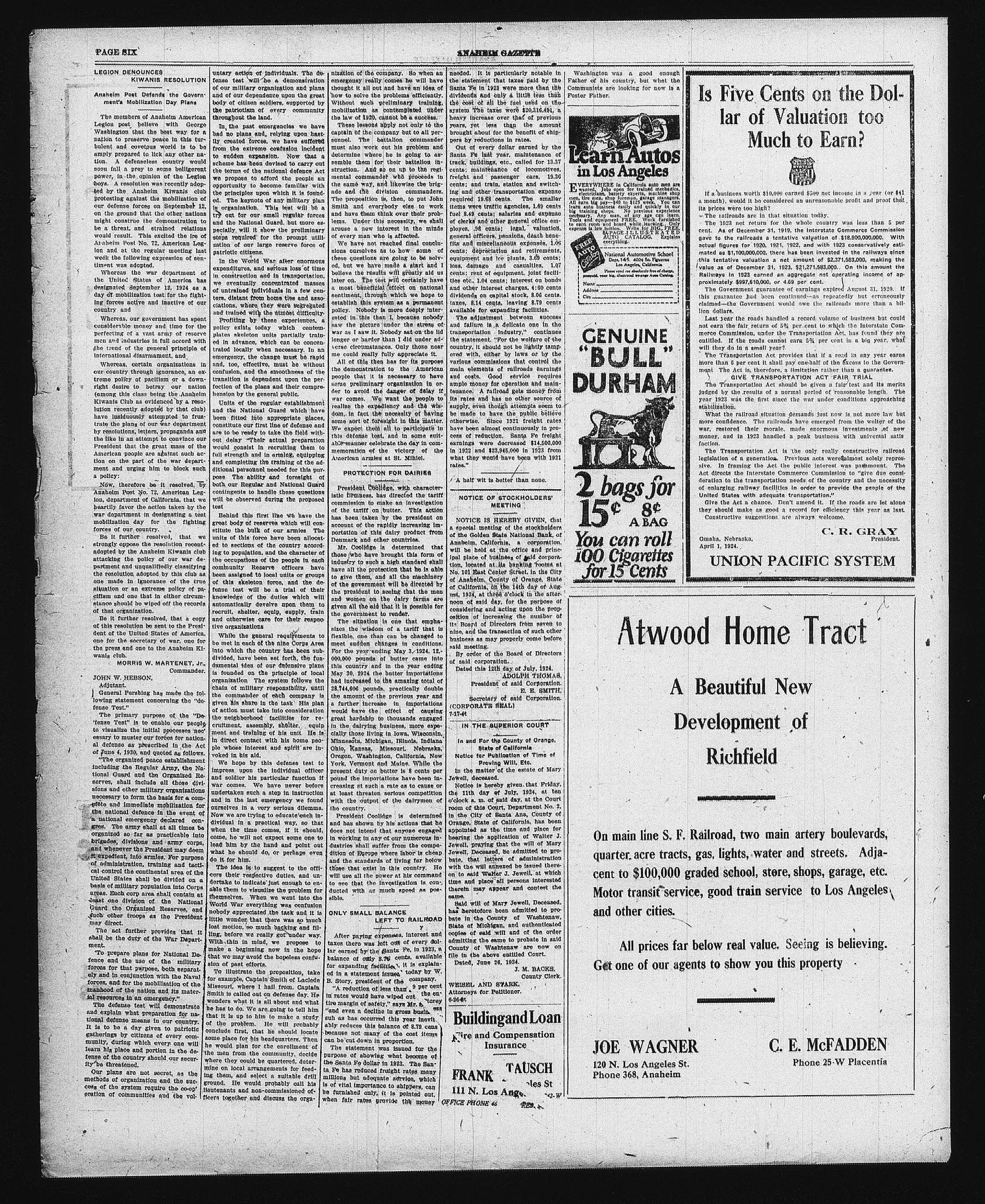
Searchable text
LEGION DENOUNCES
KIWANIS RESOLUTION
Anaheim Post Defends the Government's Mobilization Day Plans
The members of Anaheim American Legion post believe with George Washington that the best way for a nation to preserve peace in this turbulent and covetous world is to be amply prepared to lick any other nation. A defenseless country would soon fall a prey to some belligerent power, in the opinion of the Legion boys. A resolution was recently adopted by the Anaheim Kiwanis club protesting against the mobilization of our defense forces on September 12, on the ground that the other nations might construe the demonstration to be a threat, and strained relations would result. This excited the里 of Anaheim Post No. 72, American Legion and at the regular meeting last week the following expression of sentiment was adopted.
Whereas the war department of the United States of America has designated September 12, 1924 as a day of mobilization test for the fighting forces active and inactive of our country and
Whereas, our government has spent considerable money and time for the perfecting of a vast army of reserve men and industries in full accord with the trend of the general principle of international disarmament, and
Whereas, certain organizations in our country through ignorance, an extreme policy of pacifism or a downright desire to betray our nation (among this class being the Anaheim Kiwanis Club as evidenced by a resolution recently adopted by that club) have insidiously attempted to frustrate the plans of our war department by resolutions, letters, propaganda and the like in an attempt to convince our President that the great mass of the unitary action of individuals. The defense test will be a demonstration of our military organization and plans and of our dependence upon the great body of citizen soldiers, supported by the patriotism of every community throughout the land.
In the past emergencies we have had no plans and, relying upon hastily created forces, we have suffered from the extreme confusion incident to sudden expansion. Now that a scheme has been devised to carry out the terms of the national defence Act we propose to afford the people an opportunity to become familiar with the principles upon which it is founded. The keynote of any military plan is organization. This test will be a try out for our small regular forces and the National Guard, but more especially will it show the preliminary steps required for the prompt utilization of our large reserve force of patriotic citizens.
In the World War after enormous expenditures, and serious loss of time in construction and in transportation, we eventually concentrated masses of untrained individuals in a few centers, distant from home ties and associations, where they were segregated and trained with the utmost difficulty.
Profiting by these experiences, a policy exists today which contemplates skeleton units partially trained in advance, which can be concentrated locally when necessary. In an emergency, the change must be rapid and, too effective, must be without confusion, and the smoothness of the transition is dependent upon the perfection of the plans and their comprehension by the general public.
Units of the regular establishment and the National Guard which have been fitted into appropriate places, constitute our first line of defense and are to be ready to take the field without delay. Their actual preparation would consist in recruiting them to
Whereas, certain organizations in our country through ignorance, an extreme policy of pacifism or a downright desire to betray our nation (among this class being the Anaheim Kiwanis Club as evidenced by a resolution recently adopted by that club) have insidiously attempted to frustrate the plans of our war department by resolutions, letters, propaganda and the like in an attempt to convince our President that the great mass of the American people are against such action on the part of the war department and urging him to block such a policy:
Now, therefore be it resolved, by Anaheim Post No. 72, American Legion, department of California, that we heartily favor the action taken by the war department in designating a test mobilization day for the fighting forces of our country.
Be it further resolved, that we strongly oppose the resolution recently adopted by the Anaheim Kiwanis club attacking the policy of our war department and unqualifiedly classifying the resolution adopted by this club as one made in ignorance of the true situation or an extreme policy of pacifism and one that in either circumstance should be wiped off the records of that organization.
Be it further resolved, that a copy of this resolution be sent to the President of the United States of America, one for the secretary of war, one for the press and one to the Anaheim Kiwanis club.
MORRIS W. MARTENET, Jr., Commander.
JOHN W. HEBSON,
Adjutant.
General Pershing has made the following statement concerning the "defense Test."
The primary purpose of the "Defense Test" is to enable our people to visualize the initial processes necessary to muster our forces for national defense as prescribed in the Act of June 4, 1920, and quoted as follows.
"The organized peace establishment including the Regular Army, the National Guard and the Organized Reserves, shall include all those divisions and other military organizations necessary to form the basis for a complete and immediate mobilization for the national defence in the event of a national emergency declared congress. The army shall at all times be organized so far as practicable into brigades, divisions and army corps, and whenever the President may deem emergency, the change must be rapid and, too effective, must be without confusion, and the smoothness of the transition is dependent upon the perfection of the plans and their comprehension by the general public.
Units of the regular establishment and the National Guard which have been fitted into appropriate places, constitute our first line of defense and are to be ready to take the field without delay Their actual preparation would consist in recruiting them to full strength and in arming, equipping and completing the training of the additional personnel needed for this purpose The ability and foresight of both our Regular and National Guard contingents to handle these questions will be observed during the proposed test.
Behind this first line we have the great body of reserves which will constitute the bulk of our armies The units of this force have been allocated to sections of the country according to population, and the character of the occupations of the people in each community Reserve officers have been assigned to local units or groups of this skeleton force, and the defense test will be a trial of their knowledge of the duties which will automatically develve upon them to recruit, shelter, equip, supply, train and otherwise care for their respective organizations.
While the general requirements to be met in each of the nine Corps Area into which the country has been subdivided, have been set forth, the fundamental idea of our defensive plans is founded on the principle of local organization The system follows the chain of military responsibility, until the commander of each company is given his share in the task His plan of action must take into consideration the neighborhood facilities for recruitment, assembly, shelter, equipment and training of his unit He is in direct contact with his home people whose interest and spirit are invoked in his aid.
We hope by this defense test to impress upon the individual officer and soldier his particular function if war comes. We have never before undertaken such a step in instruction and in the last emergency we found ourselves in a very serious dilemma Now we are trying to educate each individual in a practical way, so that when the time comes, if it should come, he will not expect some one to lead him by the hand and point out emergency, the change must be rapid and, too effective, must be without confusion, and the smoothness of the transition is dependent upon the perfection of the plans and their comprehension by the general public.
All of thisthe demonstrative people that some preliminaries der to avoid war comes realize they dom., in fact some sort of We expect this defense able manner memoration American art
PROTECT
President Istic firmness commission of the tariff has been taken account of the portion of Denmark and Mr. Coolidge those who have industry to save have all they give them of the governors president and women given all they governs The situa sizes they flexible one meet sudden For the year 000,000 pounds this country May 30, 1924 had increased 28,744,606 pounds amounta further in would have great hardship in the dairy clally those Minnesota. Ohio, Kansas Oregon. War York. Vermont present duty pound the increasing at least three with outthe country.
President and has show does not intolerate in working in dustries shall
"The organized peace establishment including the Regular Army, the National Guard and the Organized Reserves, shall include all those divisions and other military organizations necessary to form the basis for a complete and immediate mobilization for the national defence in the event of a national emergency declared congress. The army shall at all times be organized so far as practicable into brigades, divisions and army corps, and whenever the President may deem it expedient, into armies. For purpose of administration, training and tactical control the continental area of the United States shall be divided on a basis of military population into Corps areas. Each corp area shall contain at least one division of the National Guard the Organized Reserves, and such other troops as the President may direct.
The act further provides that it shall be the duty of the War Department.
"To prepare plans for National Defence and the use of the military forces for that purpose, both separately and in conjunction with the Naval forces, and for the mobilization of the manhood of the nation and its material resources in an emergency."
The defense test will demonstrate and explain what preparation for national defense means in our country. It is to be a day given to patriotic gatherings by citizens of every community, during which every one will learn his place and portion in the defense of the country should our security be threatened.
Our plans are not secret, as the methods of organization and the success of the system require the co-opération of communities and the vol-
We hope by this defense test to impress upon the individual officer and soldier his particular function if war comes. We have never before undertaken such a step in instruction and in the last emergency we found ourselves in a very serious dilemma. Now we are trying to educate each individual in a practical way, so that when the time comes, if it should come, he will not expect some one to lead him by the hand and point out what he should do, or perhaps even do it for him.
The idea is to suggest to the officers their respective duties, and undertake to indicate just enough to enable them to visualize the problem for themselves. When we went into the World War everything was confusion nobody appreciated the task and it is little wonder that there was so much lost motion, so much backing and filling, before we really got under way. With thin in mind, we propose to make a beginning now in the hope that we may avoid the hopeless confusion of past efforts.
To illustrate the proposition, take for example, Captain Smith of Laclede Missouri, where I hail from. Captain Smith is called out on defense day. He wonders what it is all about and what he has to do. We are going to tell him that it is up to him to make a study of the problem. He will probably conclude first, that he should locate some place for his headquarters. Then he would plan for the enrollment of the men from the community, decide where they could be quartered, determine on local arrangements for feeding them, and select a suitable drill ground. He would probably call his lieutenants and non-commissioned officers together and discuss the orga-
The demonstration on plans and the great support by community has we have upon hastily suffered incident now that a to carry out defence Act people an familiar with it is found military plan but will be a regular forces about more preliminary prompt utilise force of enormous loss of time transportation, massed in a few cents and associed most difficulty experiences, such contemntially train be concen- tessary. In an must be rapid be withoutness of the upon the per- former compre- plicial establishment which have relate places, defense and field with preparation them to nization of the company. So when an emergency really comes he will have thought it all out and have an idea of how to solve the problems efficiently. Without such preliminary training, mobilization as contemplated under the law of 1920, cannot be a success.
These lessons apply not only to the captain of the company but to all personnel. The battalion commander must also work out his problem and determine where he is going to assemble them for their battalion instruction. And so on up to the regimental commander who proceeds in the same way, and likewise the brigade and the division commanders. The proposition is, then, to put John Smith and everybody else to work and have them think over their problems. Under this necessity, we shall arouse a new interest in the minds of every man who is affected.
We have not reached final conclusions ourselves as to how some of these questions are going to be solved, but we have made a start and I believe the results will greatly aid us later on. The test will certainly have a most beneficial effect on national sentiment, through which we hope to establish this system as a permanent policy. Nobody is more deeply interested in this than I, because nobody saw the picture under the stress of war as I saw it. Nobody sat on the lid longer or harder than I did under adverse circumstances. Only those near me could really fully appreciate it.
All of this then has for its purpose the demonstration to the American people that it is necessary to have some preliminary organization in order to avoid the danger of delay if war comes. We want the people to realize the expediency and the wisdom, in fact the necessity of having some sort of foresight in this matter. We expect them all to participate in this defense test, and in some suitable manner celebrate the day in com- needed. It is particularly notable in the statement that taxes paid by the Santa Fe in 1923 were more than the dividends and only a little less thin the cost of all the fuel used on the system. The taxes were $20,316,491, a heavy increase over that of previous years, yet less than the amount brought about for the benefit of shipers by reductions in rates.
Out of every dollar earned by the Santa Fe last year, maintenance of track, buildings, etc., called for 13.37 cents; maintenance of locomotives, freight and passenger cars, 19.36 cents; and train, station and switching and other transportation expense required 19.68 cents. The smaller items were traffic agencies, 1.69 cents fuel 8.49 cents; salaries and expense of chefs and other general office employees, .98 cents; legal, valuation, general officers, pensiones, death benefits and miscellaneous expenses, 1.06 cents; depreciation and retirements, equipment and ice plants, 3.69 cents; loss, damage and casualties, 1.07 cents; rent of equipment, joint facilities etc., 1.04 cents; interest on bonds and other interest charges, 4:60 cents dividends on capital stock, 8.06 cents taxes, 8.14 cents, leaving 8.79 cents available for expanding facilities.
The adjustment between success and failure is a delicate one in the transportation industry," continues the statement. "For the welfare of the country, it should not be lightly tampered with, either by laws or by the various commissions that control the main elements of railroads earnings and costs. Good service requires ample money for operation and maintenance. A railroad gets money from its rates and has no other source of supply, even though attempts seem to be made to have the public bollieve otherwise. Since 1921 freight rates have been almost continuously in process of reduction. Santa Fe freight earnings were decreased $14,500,000."
Washington was a good enough Father of his country, but what the Communists are looking for now is a Foster Father.
Learn Autos in Los Angeles
EVERYWHERE in California auto mans are wanted for help for trained mechanics, electricians, battery experts, machine shop men, tire men, shop foreman, garage managers. All earn big pay-$40 to $125 week. You can learn auto business easily and quickly in our big training shops. No previous experience necessary. Any man of any age can learn. To learn and expand FREE work furnished to earn room and board while learning. Only expense is low hiton.
Write for BIG.FREE.
8 & PAGE ILLUSTRATED AUTO CATALOG. Explains everything.
GENUINE "BULL" DURHAM
PROTECTION FOR DAIRIES
President Coolidge, with characteristic firmness, has directed the tariff commission to make an investigation of the tariff on butter. This action has been taken by the president on account of the rapidly increasing importation of this dairy product from Denmark and other countries.
Mr. Coolidge is determined that those who have brought this form of industry to such a high standard shall have all the protection that he is able to give them, and all the machinery of the government will be directed by the president to seeing that the men and women on the dairy farms are given all the aid that it is possible for the government to render.
The situation is one that emphasizes the wisdom of a tariff that is flexible, one than can be changed to meet sudden changes in conditions. For the year ending May 3, 1924, 12,000,000 pounds of butter came into this country and in the year ending May 30, 1924 the butter importations had increased to the amazing total of 28,744,606 pounds, practically double the amount of the previous year and a further increase in importations would have the effect of causing great hardship to thousands engaged in the dairy business, more especially those living in Iowa, Wisconsin, Minnesota, Michigan, Illinois, Indiana Ohio, Kansas, Missouri, Nebraska, Oregon, Washington, California, New York, Vermont and Maine. While the present duty on butter is 8 cents per pound the importations have been increasing at such a rate as to cause or at least threaten serious competition with the output of the dairymen of the country.
President Coolidge is determined and has shown by his actions that he does not intend that anyone engaged in working in any of our numerous industries shall suffer from the compreered with either by laws or by the various commissions that control the main elements of railroads earnings and costs. Good service requires ample money for operation and maintenance. A railroad gets money from its rates and has no other source of supply, even though attempts seem to be made to have the public believe otherwise. Since 1921 freight rates have been almost continuously in process of reduction. Santa Fe freight earnings were decreased $14,500,000 in 1922 and $23,945,000 in 1923 from what they would have been with 1921 rates."
A half wit is better than none.
NOTICE OF STOCKHOLDERS' MEETING
NOTICE IS HEREBY GIVEN, that a special meeting of the stockholders of the Golden State National Bank, of Anaheim, California, a corporation, will be held at the office and principal place of business of said corporation, located at its banking room at No. 101 East Center Street, in the City of Anaheim, County of Orange, State of California, on the 14th day of August, 1924, at three o'clock in the afternoon of said day, for the purpose of considering and acting upon the proposition of increasing the number of its Board of Directors from seven to nine, and the transaction of such other business as may properly come before said meeting.
By order of the Board of Directors of said corporation.
Dated this 12th day of July, 1924.
ADOLPH THOMAS.
President of said Corporation.
E. E. SMITH.
Secretary of said Corporation.
(CORPORATE SEAL)
7-17-4t
IN THE SUPERIOR COURT
In and For the County of Orange,
State of California
Notice for Publication of Time of Proving Will, Etc.
In the matter of the estate of Mary Jewell, deceased.
Notice is hereby given that Friday, the 11th day of July, 1924, at ten o'clock a.m. of said day, at the Court room of this Court, Department No. 2.
In the City of Santa Ana, County of Orange, State of California, has been appointed as the time and place for hearing the application of Walter J. Jewell, praying that the will of Mary Jewell be admitted to pro-
ONLY SMALL BALANCE
LEFT TO RAILROAD
After paying expenses, interest and taxes there was left out of every dollar earned by the Santa Fe in 1923, a balance of only 8.76 cents, available for expanding facilities. It is explained in a statement issued today by W. B. Story, president of the company.
"A reduction of less than 9 per cent in rates would have wiped out the entire margin of safety," says Mr. Storey "and even a decline in gross business as has occurred this year inevitably reduces this balance of 8.79 cents because not many of the cost items can be cut down in proportion.
The statement was issued for the purpose of showing what become of the Santa Fe dollar in 1923. The Santa Fe has reduced freight rates many millions but adequate service, which is of vital importance to shippers, can be furnished only; it is pointed out, when fair rates provide the money.
Notice for Publication or Time of Proving Will, Ete.
In the matter of the estate of Mary Jewell, deceased.
Notice is hereby given that Friday, the 11th day of July, 1924, at ten o'clock a.m. of said day, at the Court room of this Court, Department No. 2, in the City of Santa Ana, County of Orange, State of California, has been appointed as the time and place for hearing the application of Walter J. Jewell, praying that the will of Mary Jewell, deceased, be admitted to probate, that letters of administration with the will annexed be issued thereon to said Walter J. Jewell, at which time and place all persons interested therein may appear and contest the same.
Said will of Mary Jewell, deceased, has bereftore been admitted to probate in the County of Washtenaw, State of Michigan, and authenticated copies of said will and of the order admitting the same to probate in said County of Washtenaw are now on file in the above entitled Court.
Dated, June 26, 1924.
J. M. BACKS,
County Clerk.
WEISEL AND STARK.
Attorneys for Petitioner.
6-26-St
Building and Loan
Fire and Compensation Insurance
FRANK TAUSCH
111 N. Los Angeles St.
OFFICE PHONE 46
Is Five Cents on the Dollar of Valuation too Much to Earn?
If a business worth $10,000 earned $500 net income in a year (or $41 a month), would it be considered an unreasonable profit and proof that its prices were too high?
The railroads are in that situation today.
The 1923 net return for the whole country was less than 5 per cent. As of December 31, 1919, the Interstate Commerce Commission gave to the railroads a tentative valuation of $18,900,000,000. With actual figures for 1920, 1921, 1922, and with 1923 conservatively estimated as $1,100,000,000, there has been invested in the railways since this tentative valuation a net amount of $2,371,583,000, making the value as of December 31, 1923, $21,271,583,000. On this amount the Railways in 1923 earned an aggregate net operating income of approximately $997,610,000, or 4.69 per cent.
The Government guarantee of earnings expired August 31, 1920. If this guarantee had been continued—as repeatedly but erroneously claimed—the Government would owe the railroads more than a billion dollars.
Last year the roads handled a record volume of business but could not earn the fair return of 5% per cent to which the Interstate Commerce Commission, under the Transportation Act, has found they are entitled. If the roads cannot earn 5% per cent in a big year, what will they do in a small year?
The Transportation Act provides that if a road in any year earns more than 6 per cent it shall pay one-half of the excess to the Government. The Act is, therefore, a limitation rather than a guarantee.
GIVE TRANSPORTATION ACT FAIR TRIAL
The Transportation Act should be given a fair test and its merits judged by the results of a normal period of reasonable length. The year 1923 was the first since the war under conditions approaching stabilization.
What the railroad situation demands just now is not more law but more confidence. The railroads have emerged from the welter of the war, restored their morale, made enormous investments of new money, and in 1923 handled a peak business with universal satisfaction.
The Transportation Act provides that if a road in any year earns more than 6 per cent it shall pay one-half of the excess to the Governmant. The Act is, therefore, a limitation rather than a guarantee.
GIVE TRANSPORTATION ACT FAIR TRIAL
The Transportation Act should be given a fair test and its merits judged by the results of a normal period of reasonable length. The year 1923 was the first since the war under conditions approaching stabilization.
What the railroad situation demands just now is not more law but more confidence. The railroads have emerged from the welter of the war, restored their morale, made enormous investments of new money, and in 1923 handled a peak business with universal satisfaction.
The Transportation Act is the only really constructive railroad legislation of a generation. Previous acts were almost solely repressive. In framing the Act the public interest was paramount. The Act directs the Interstate Commerce Commission to "give due consideration to the transportation needs of the country and the necessity of enlarging railway facilities in order to provide the people of the United States with adequate transportation."
Give the Act a chance. Don't amend it. If the roads are let alone they should make as good a record for efficiency this year as last.
Constructive suggestions are always welcome.
C. R. GRAY
President.
Omaha, Nebraska,
April 1, 1924.
UNION PACIFIC SYSTEM
Atwood Home Tract
A Beautiful New Development of Richfield
main line S. F. Railroad, two main artery boulevards,
main line S. F. Railroad, two main artery boulevards,
water acre tracts, gas, lights, water and streets. Adjato $100,000 graded school, store, shops, garage, etc.
or transit service, good train service to Los Angeles
other cities.
All prices far below real value. Seeing is believing.
one of our agents to show you this property
C. WAGNER
Los Angeles St.
368, Anaheim
C. E. McFADDEN
Phone 25·W Placentia