anaheim-gazette 1924-07-24
Scanned page
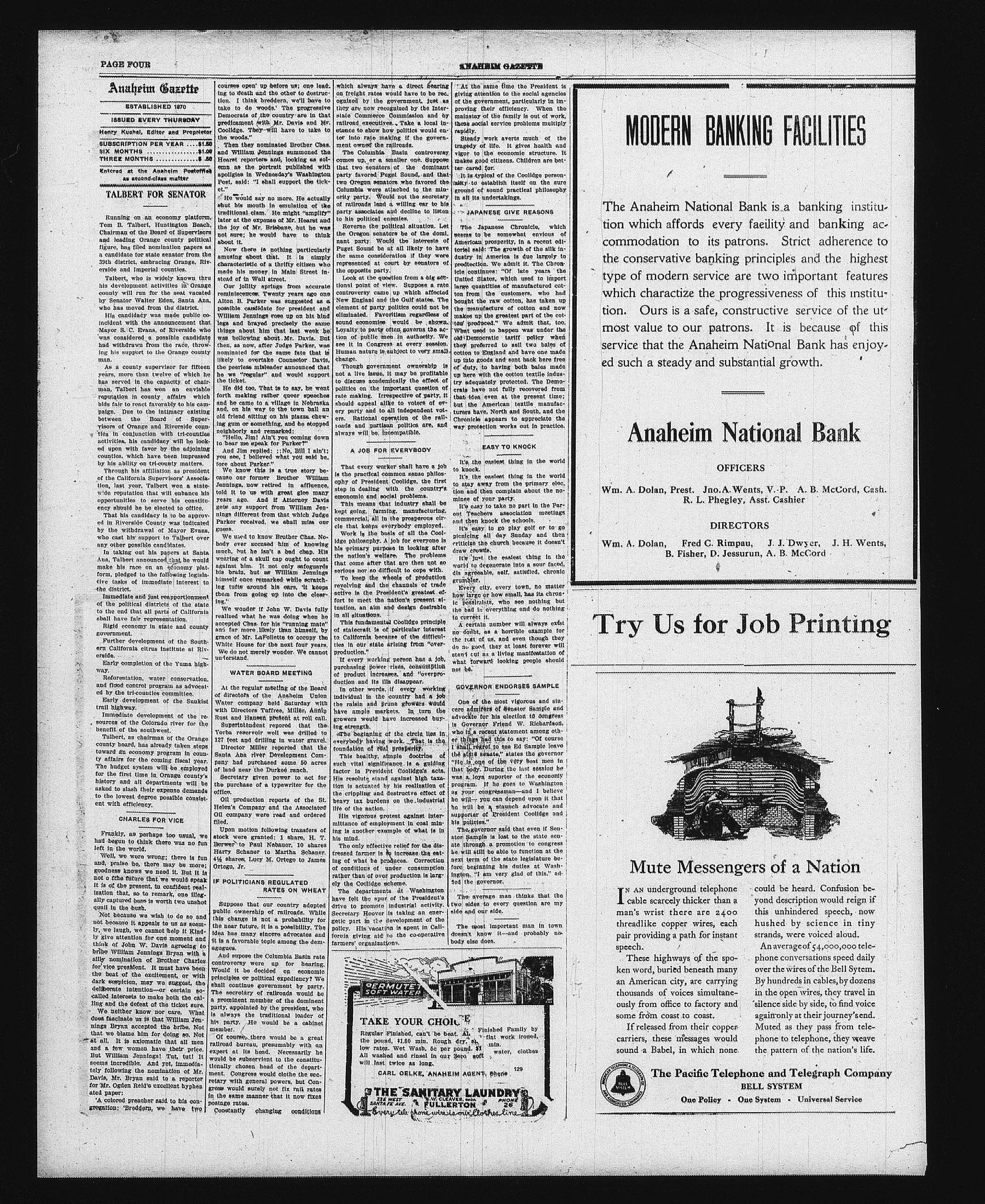
Searchable text
Anaheim Gazette
ESTABLISHED 1870
ISSUED EVERY THURSDAY
Henry Kuehel, Editor and Proprietor
SUBSCRIPTION PER YEAR ... $1.50
SIX MONTHS ... $1.00
THREE MONTHS ... $ .50
Entered at the Anaheim Postoffice as second-class matter
TALBERT FOR SENATOR
Running on an economy platform, Tom B. Talbert, Huntington Beach, Chairman of the Board of Supervisors and leading Orange county political figure, has filed nomination papers as a candidate for state senator from the 39th district, embracing Orange, Riverside and Imperial counties.
Talbert, who is widely known thru his development activities in Orange county will run for the seat vacated by Senator Walter Eden, Santa Ana, who has moved from the district.
His candidacy was made public coincident with the announcement that Mayor S. C. Evans, of Riverside who was considered a possible candidate had withdrawn from the race, throwing his support to the Orange county man.
As a county supervisor for fifteen years, more than twelve of which he has served in the capacity of chairman, Talbert has won an enviable reputation in county affairs which bids fair to react favorably to his campaign. Due to the intimacy existing between the Board of Supervisors of Orange and Riverside counties in conjunction with tri-counties activities, his candidacy will be looked upon with favor by the adjoining courses open' up before us; one leading to death and the other to destruction. I think breddern, we'll have to take to de woods.' The progressive Democrats of the country are in that predicament with Mr. Davis and Mr. Coolidge. They will have to take to the woods."
Then they nominated Brother Chas. and William Jennings summoned the Hearst reporters and, looking as solemn as the portrait published with apoligies in Wednesday's Washington Post, said: "I shall support the ticket."
He would say no more. He actually shut his mouth in emulation of the traditional clam. He might "amplify" later at the expense of Mr. Hearst and the joy of Mr. Brisbane, but he was not sure; he would have to think about it.
Now there is nothing particularly amusing about that. It is simply characteristic of a thrifty citizen who made his money in Main Street instead of in Wall street.
Our jollity springs from accurate reminiscences. Twenty years ago one Alton B. Parker was suggested as a possible candidate for president and William Jennings rose up on his hind legs and brayed precisely the same things about him that last week he was bellowing about Mr. Davis. But then, as now, after Judge Parker, was nominated for the same fate that is likely to overtake Counselor Davis, the peerless misleader announced that he was "regular" and would support the ticket.
He did too. That is to say, he went forth making rather queer speeches and he came to a village in Nebraska and, on his way to the town hall an old friend elitting on his plaza chewing gum or something, and he stopped neighborly and remarked:
"Hello, Jim! Ain't you coming down to hear me speak for Parker?"
Reverse to the Oregonnant party Puget Sound the same represented the opposition.
Look at tional point controversy New England element of eliminated sound economy Loyalty to nation of pu get see it in Human nat change.
Though not a live to discuss politics on rate making should applery party sers. Ratios roads and always will
As a county supervisor for fifteen years, more than twelve of which he has served in the capacity of chairman, Talbert has won an enviable reputation in county affairs which bids fair to react favorably to his campaign. Due to the intimacy existing between the Board of Supervisors of Orange and Riverside counties in conjunction with tri-counties activities, his candidacy will be looked upon with favor by the adjoining counties, which have been impressed by his ability on tri-county matters.
Through his affiliation as president of the California Supervisors' Association, last year, Talbert won a statewide reputation that will enhance his opportunities to serve his constituency should he be elected to office.
That his candidacy is to be approved in Riverside County was indicated by the withdrawal of Mayor Evans, who cast his support to Talbert over any other possible candidates.
In taking out his papers at Santa Ana, Talbert announced that he would make his race on an economy platform, pledged to the following legislative tasks of immediate interest to the district.
Immediate and just reapportionment of the political districts of the state to the end that all parts of California shall have fair representation.
Rigid economy in state and county government.
Further development of the Southern California citrus institute at Riverside.
Early completion of the Yuma highway.
Reforestation, water conservation, and flood control program as advocated by the tri-counties committee.
Early development of the Sunkist trail highway.
Immediate development of the resources of the Colorado river for the benefit of the southwest.
Talbert, as chairman of the Orange county board, has already taken steps toward an economy program in county affairs for the coming fiscal year. The budget system will be employed for the first time in Orange county's history and all departments will be asked to slash their expense demands to the lowest degree possible consistent with efficiency.
CHARLES FOR VICE
Frankly, as perhaps too usual, we had begun to think there was no fun left in the world.
WATER BOARD MEETING
At the regular meeting of the Board of directors of the Anaheim Union Water company held Saturday with Directors Tuffree, Miller, Annin Rust and Hansen present at roll call.
Superintendent reported that the Yorba reservoir well was drilled to 127 feet and drilling in water gravel.
Director Miller reported that the Santa Ana river Development Company had purchased some 50 acres of land near the Durkee ranch.
Secretary given power to act for the purchase of a typewriter for the office.
Oil production reports of the St. Helen's Company and the Associated Oil company were read and ordered filed.
Upon motion following transfers of stock were granted: 1 share, H. T. Berwer to Paul Nebauer, 10 shares nominated for the same fate that is likely to overtake Counsel Davis, the peerless misleader announced that he ws "regular" and would support the ticket.
He did too. That is to say, he went forth making rather queer speeches and he came to a village in Nebraska and, on his way to the town hall an old friend sitting on his plaza chewing gum or something, and he stopped neighborly and remarked:
"Hello, Jim! Ain't you coming down to hear me speak for Parker?"
And Jim replied: ;;No, Bill I ain't; you see, I believed what you said be fore about Parker."
We know this is a true story because our former Brother William Jennings, now retired in affluence, told it to us with great glee many years ago. And if Attorney Davis gets any support from William Jennings different from that which Judge Parker received, we shall miss our guesss.
We used to know Brother Chas. Nobody ever accused him of knowing much, but he isn't a bad chap. His wearing of a skull cap ought to count against him. It not only safeguards his brain, but as William Jennings himself once remarked while scratching tufts around his ears, 'it keeps them from going up into the clearing.'
We wonder if John W. Davis fully realized what he was doing when he accepted Chas. for his "running mate" and far more likely than himself, by grace of Mr. LaFollette to occupy the White House for the next four years.
We do not merely wonder. We cannot understand.
CHARLES FOR VICE
Frankly, as perhaps too usual, we had begun to think there was no fun left in the world.
CHARLES FOR VICE
Frankly, as perhaps too usual, we had begun to think there was no fun left in the world.
Well, we were wrong; there is fun and praise be, there may be more; goodness knows we need it. But it is not of the future that we would speak it is of the present, in confident realization that, so to remark, one illegally captured base is worth two unshot quail in the bush.
Not because we wish to do so and not because it appeals to us as seemly, we laugh, we cannot help it Kindly give attention for one moment and think of John W. Davis agreeing to bribe William Jennings Bryan with a silly nomination of Brother Charles for vice president. It must have been the beat of the excitement, or with dark suspicion, may we suggest, the deliberate intention—or certain so-called interests to make both the calling and the defeat of the ticket sure.
We neither know nor care. What does fascinate us is that William Jennings Bryan accepted the bribe. Not that we blame him for doing so. Not at all. It is axiomatic that all men and a few women have their price. But William Jennings! Tut, tut! It seems incredible. And yet, immediately following the nomination of Mr. Davis, Mr. Bryan said to a reporter for Mr. Ogden Reid's excellent hyphenated paper:
'A colored preacher said to his congregation: 'Breddern, we have two
Secretary given power to act for the purchase of a typewriter for the office.
Oil production reports of the St. Helen's Company and the Associated Oil company were read and ordered filed.
Upon motion following transfers of stock were granted: 1 share, H. T. Berwer to Paul Nebauer, 10 shares Harry Schaner to Martha Schaner. 4½ shares, Lucy M. Ortego to James Ortego, Jr.
IF POLITICIANS REGULATED RATES ON WHEAT
Suppose that our country adopted public ownership of railroads. While this change is not a probability for the near future, it is a possibility. The idea has many sincere advocates and it is a favorable topic among the demagogues.
And suppose the Columbia Basin rate controversy were up for hearing. Would it be decided on economic principles or political expediency? We shall continue government by party. The secretary of railroads would be a prominent member of the dominant party, appointed by the president, who is always the traditional leader of his party. He would be a cabinet member.
Of course, there would be a great railroad bureau, presumably with an expert at its head. Necessarily he would be subservient to the constitutionally chosen head of the department. Congress would clothe the secretary with general powers, but Congress would surely not fix rail rates in the same manner that it now fixes postage rates.
Constantly changing conditions
which always have a direct bearing on freight rates would have to be recognized by the government, just as they are now recognized by the Interstate Commerce Commission and by railroad executives. Take a local instance to show how politics would enter into rate making if the government owned the railroads.
The Columbia Basin controversy comes up, or a smaller one. Suppose that two senators of the dominant party favored Puget Sound, and that two Oregon senators who favored the Columbia were attached to the minority party. Would not the secretary of railroads lend a willing ear to his party associates and decline to listen to his political enemies.
Reverse the political situation. Let the Oregon senators be of the dominant party. Would the interests of Puget Sound be at all likely to have the same consideration if they were represented at court by senators of the opposite party.
Look at the question from a big sectional point of view. Suppose a rate controversy came up which affected New England and the Gulf states. The element of party politics could not be eliminated. Favoritism regardless of sound economies would be shown. Loyalty to party often governs the action of public men in authority. We see it in Congress at every session. Human nature is subject to very small change.
Though government ownership is not a live issue, it may be profitable to discuss academically the effect of politics on the important question of rate making. Irrespective of party, it should appeal alike to voters of every party and to all independent voters. Rational operation of the railroads and partisan politics are, and always will be incompatible.
At the same time the President is giving attention to the social agencies of the government, particularly in improving their efficiency. When the mainstay of the family is out of work, these social service problems multiply rapidly.
Steady work averts much of the tragedy of life. It gives health and vigor to the economic structure. It makes good citizens. Children are better cared for.
It is typical of the Coolidge personality to establish itself on the sure ground of sound practical philosophy in all its undertakings.
JAPANESE GIVE REASONS
The Japanese Chronicle, which seems to be somewhat envious of American prosperity, in a recent editorial said: The growth of the silk industry in America is due largely to prodtection. We admit it. The Chronicle continues: "Of late years the United States, which used to import large quantities of manufactured cotton from the customers, who had bought the raw cotton, has taken up the manufacture of cotton and now makes up the greatest part of the cotton produced." We admit that, too. What used to happen was under the old Democratic tariff policy when they preferred to sell two bales of cotton to England and have one made up into goods and sent back here free of duty, to having both bales made up here with the cotton textile industry adequately protected. The Democrats have not fully recovered from that idea even at the present time; but the American textile manufacturers have North and South, and the Chronicle appears to appreciate the way protection works out in practice.
MODERN
The Anaheim Nation which afforded commodation to the conservative type of modern society which characterize it. Ours is a most value to our service that the Anaheim ed such a steady
Though government ownership is not a live issue, it may be profitable to discuss academically the effect of politics on the important question of rate making. Irrespective of party, it should appeal alike to voters of every party and to all independent voters. Rational operation of the railroads and partisan politics are, and always will be incompatible.
A JOB FOR EVERYBODY
That every worker shall have a job is the practical common sense philosophy of President Coolidge, the first step in dealing with the country's economic and social problems.
This means that industry shall be kept going, farming, manufacturing, commercial, all in the prosperous circle that keeps everybody employed.
Work is the basis of all the Coolidge philosophy. A job for everyone is his primary purpose in looking after the nation's welfare. The problems that come after that are then not so serious nor so difficult to cope with.
To keep the wheels of production revolving and the channels of trade active is the President's greatest effort to meet the nation's present situation, an aim and design desirable in all situations.
This fundamental Coolidge principle of statecraft is of particular interest to California because of the difficulties in our state arising from "overproduction."
If every working person has a job, purchasing power rises, consumption of product increases, and "overproduction and its ills disappear.
In other words, if every working individual in the country had a job the raisin and prune growers would have ample markets. In turn the growers would have increased buying strength.
The beginning of the circle lies in everybody having work. That is the foundation of real prosperity.
This healthy, simple doctrine of such vital significance is a guiding factor in President Coolidge's acts. His resolute stand against high taxation is actuated by his realization of the crippling and destructive effect of heavy tax burdens on the industrial life of the nation.
His vigorous protest against intermittance of employment in coal mining is another example of what is in his mind.
The only effective relief for the dis-
EASY TO KNOCK
It's the easiest thing in the world to knock.
It's the easiest thing in the world to stay away from the primary election and then complain about the nominee of your party.
It's easy to take no part in the Parent Teachers association meetings and then knock the schools.
It's easy to go play golf or to go picnicing all day Sunday and then criticize the church because it doesn't draw crowds.
It's just the easiest thing in the world to degenerate into a sour faced, dis agreeable, self satisfied, chronic grumbler.
Every city, every town, no matter how large or how small, has its chronic pessimists, who see nothing but the bad in everything and do nothing to correct it.
A certain number will always exist no doubt, as a horrible example for the rest of us, and even though they do no good they at least forever will stand out as a living manifestation of what forward looking people should not be.
GOVERNOR ENDORSES SAMPLE
One of the most vigorous and sincere admirers of Senator Sample and advocate for his election to Congress is Governor Friend W. Richardson, who in a recent statement among other things had this to say: "Of course I shall regret to see Ed Sample leave the state senate," states the governor "He is one of the very best men in that body. During the last session he was a loya supporter of the economy program. If he goes to Washington as your congressman—and I believe he will—you can depend upon it that he will be a staunch advocate and supporter of President Coolidge and his policies."
The governor said that even if Senator Sample is lost to the state senate through a promotion to congress
This healthy, simple doctrine of such vital significance is a guiding factor in President Coolidge's acts. His resolute stand against high taxation is actuated by his realization of the crippling and destructive effect of heavy tax burdens on the industrial life of the nation.
His vigorous protest against intermittance of employment in coal mining is another example of what is in his mind.
The only effective relief for the distressed farmer is to increase the eating of what he produces. Correction of conditions of under consumption rather than of over production is largely the Coolidge scheme.
The departments at Washington have felt the spur of the President's drive to promote industrial activity. Secretary Hoover is taking an energetic part in the development of the policy. His vacation is spent in California giving aid to the co-operative farmers' organizations.
The governor said that even if Senator Sample is lost to the state senate through a promotion to congress he will still be able to function at the next term of the state legislature before beginning his duties at Washington. "I am very glad of this," added the governor.
The average man thinks that the two sides to every question are my side and our side.
The most important man in town doesn't know it—and probably nobody else does.
TAKE YOUR CHOICE
Regular Finished, can't be beat. All finished Family by the pound, $1.50 min. Rough dry, all min. Low rates. Wet Wash, 5¢ per pound. $1 water, clothes will last twice as long.
CARL OELKE, ANAHEIM AGENT, Phone
THE SANITARY LAUNDRY
232 WEST
SANTA FE AVENUE
FULLERTON
Phone 26
Every telephone wire is our clothes line
MODERN BANKING FACILITIES
The Anaheim National Bank is a banking institution which affords every facility and banking accommodation to its patrons. Strict adherence to conservative banking principles and the highest type of modern service are two important features which characterize the progressiveness of this institution. Ours is a safe, constructive service of the utmost value to our patrons. It is because of this service that the Anaheim National Bank has enjoy such a steady and substantial growth.
Anaheim National Bank
such a steady and substantial growth.
Anaheim National Bank
OFFICERS
n. A. Dolan, Prest. Jno.A.Wents, V.-P. A. B. McCord, Cash.
R. L. Phegley, Asst. Cashier
DIRECTORS
n. A. Dolan, Fred C. Rimpau, J. J. Dwyer, J. H. Wents,
B. Fisher, D. Jessurun, A. B. McCord
ry Us for Job Printing
Mute Messengers of a Nation
IN AN underground telephone cable scarcely thicker than a man's wrist there are 2400 threadlike copper wires, each pair providing a path for instant speech.
These highways of the spoken word, buried beneath many an American city, are carrying thousands of voices simultaneously from office to factory and some from coast to coast.
If released from their copper carriers, these messages would sound a Babel, in which none could be heard. Confusion beyond description would reign if this unhindered speech, now hushed by science in tiny strands, were voiced aloud.
An average of 54,000,000 telephone conversations speed daily over the wires of the Bell Sytem. By hundreds in cables, by dozens in the open wires, they travel in silence side by side, to find voice again only at their journey's end.
Muted as they pass from telephone to telephone, they weave the pattern of the nation's life.
The Pacific Telephone and Telegraph Company
BELL SYSTEM
One Policy - One System - Universal Service