anaheim-gazette 1924-07-03
Scanned page
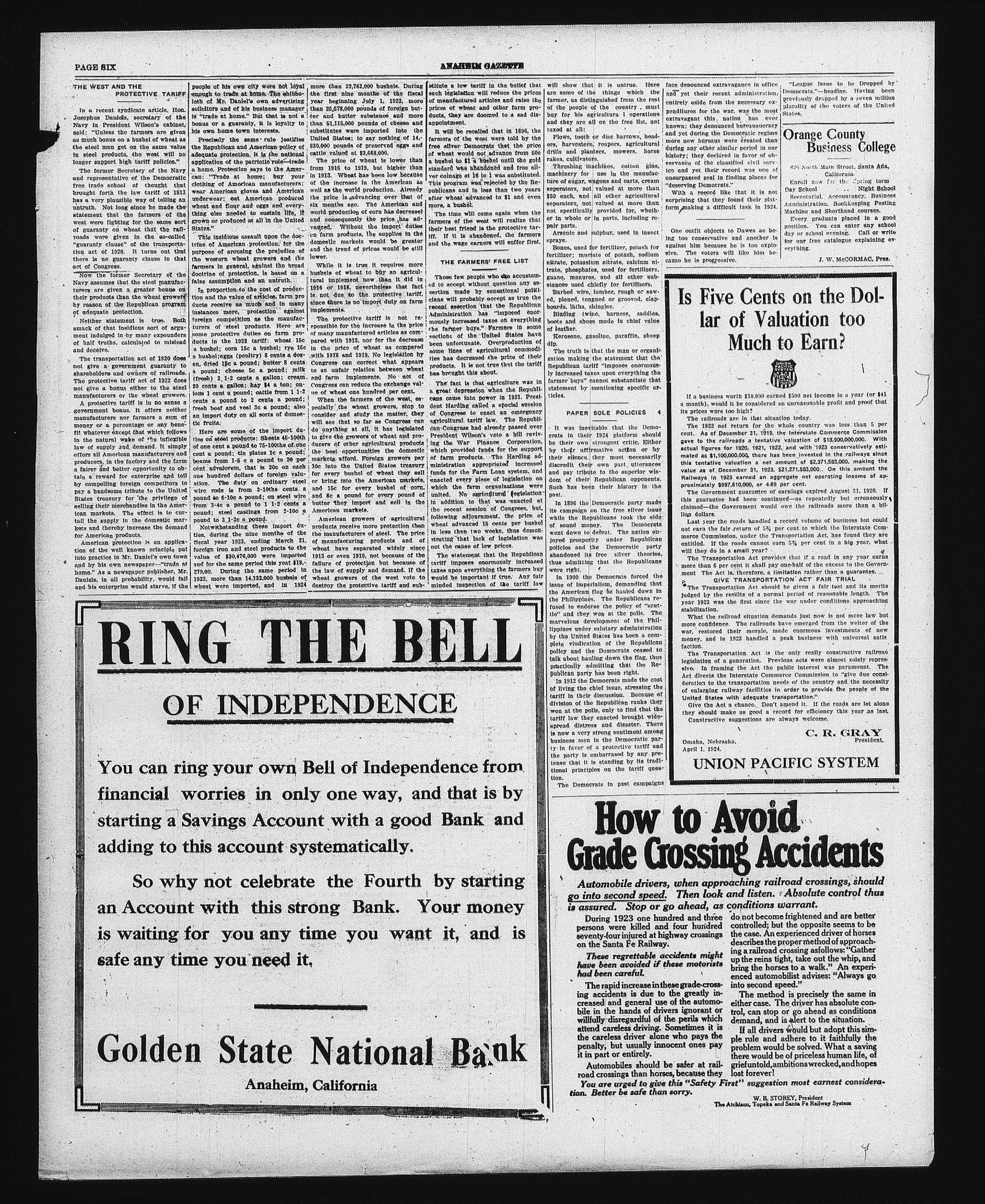
Searchable text
THE WEST AND THE PROTECTIVE TARIFF
In a recent syndicate article, Hon. Josephus Daniels, secretary of the Navy in President Wilson's cabinet, said: "Unless the farmers are given as much bonus on a bushel of wheat as the steel men get on the same value in steel products, the west will no longer support high tariff policies."
The former Secretary of the Navy and representative of the Democratic free trade school of thought that brought forth the law tariff of 1913 has a very plausible way of telling an untruth. Not long since he made the statement that the farmers of the west were fighting for the same sort of guaranty on wheat that the railroads were given in the so-called "guaranty clause" of the transportation act of 1920. It turns out that there is no guaranty clause in that act of Congress.
Now the former Secretary of the Navy assumes that the steel manufacturers are given a greater bonus on their products than the wheat growers by reason of the Republican program of adequate protection.
Neither statement is true. Both smack of that insidious sort of argument indulged in by many expounders of half truths, calculated to mislead and deceive.
The transportation act of 1920 does not give a government guarantee to shareholders and owners of railroads. The protective tariff act of 1922 does not give a bonus either to the steel manufacturers or the wheat growers.
A protective tariff is in no sense a government bonus. It offers neither manufacturers nor farmers a sum of money or a percentage or any benefit whatever except that which follows in the natural wake of the inflexible law of supply and demand. It simply people of his own city were not loyal enough to trade at home. The shibboleth of Mr. Daniel's own advertising solicitors and of his business manager is "trade at home." But that is not a bonus or a guaranty, it is loyalty to his own home town interests.
Precisely the same rule justifies the Republican and American-policy of adequate protection. It is the national application of the patriotic rule—trade a home. Protection says to the American: "Trade at home; buy your clothing of American manufacturers; wear American gloves and American underwear; eat American produced wheat and flour and eggs and everything else needed to sustain life, if grown or produced at all in the United States."
This insidious assault upon the doctrine of American protection, for the purpose of arousing the prejudice of the western wheat growers and the farmers in general, against the broad doctrine of protection, is based on a false assumption and an untruth.
In proportion to the cost of production and the value of articles, farm products receive as much and in many instances more, protection against foreign competition as the manufacturers of steel products. Here are some protective duties on farm products in the 1922 tariff: wheat 15c a bushel; corn 15c a bushel; rye 15c a bushel; eggs (poultry) 8 cents a dozen, dried 18c a pound; butter 8 cents a pound; cheese 5c a pound; milk (fresh) 2-1-2 cents a gallon; cream 20 cents a gallon; hay $4 a ton; onions 1 cent a pound; cattle from 1-1-2 cents a pound to 2 cents a pound; fresh beef and veal 3c a pound; also an import duty on all sorts of domestic fruits.
Here are some of the import duties on steel products: Sheets 45-100th of one cent a pound to 75-100ths of one more than 22,762,000 years beginning. Juvenile than 25,578,000 pounds per year and butter superseded than 51,115,000 pounds substitutes were in United States; to superseded than 830,000 pounds of cattle valued at $3,999.
The price of wheat from 1916 to 1919, in 1913. Wheat has of the increase in well as the world price is advancing six months ago. World production of and consequently vanished. Without on farm products, domestic markets and the trend of prices lower.
While it is true bushels of wheat tural implement no 1916 or 1918, never is not due to this since there is no im implements.
The protective treponsible for the im of many manufactures pared with 1913, now in the price of weth with 1918 and 1919. Congress can correct to an unfair relation and farm implement Congress can reduce use of wheat one hour.
When the farmer pecially the wheat consider and study will see that so far do anything at all to give the growers ducers of other ag
The transportation act of 1920 does not give a government guaranty to shareholders and owners of railroads. The protective tariff act of 1922 does not give a bonus either to the steel manufacturers or the wheat growers.
A protective tariff is in no sense a government bonus. It offers neither manufacturers nor farmers a sum of money or a percentage or any benefit whatever except that which follows in the natural wake of the inflexible law of supply and demand. It simply offers all American manufacturers and producers, in the factory and the farm a fairer and better opportunity to obtain a reward for enterprise and toll by compelling foreign competitors to pay a handsome tribute to the United States treasury for the privilege of selling their merchandise in the American markets. The effect is to curtail the supply in the domestic markets and thereby increase the demand for American products.
American protection is an application of the well known principle put into practice in Mr. Daniel's own town and by his own newspaper—"trade at home." As a newspaper publisher, Mr. Daniels, in all probability, would fail and his enterprise would starve, if the bushel; eggs (poultry) 8 cents a dozen, dried 18c a pound; butter 8 cents a pound; cheese 5c a pound; milk (fresh) 2-1-2 cents a gallon; cream 20 cents a gallon; hay $4 a ton; onions 1 cent a pound; cattle from 1-1-2 cents a pound to 2 cents a pound; fresh beef and veal 3c a pound; also an import duty on all sorts of domestic fruits.
Here are some of the import duties on steel products: Sheets 45-100th of one cent a pound to 75-100th of one cent a pound; tin plates 1c a pound; beams from 1-5 c a pound to 20 per cent advalorem, that is 20c on each one hundred dollars of foreign valuation. The duty on ordinary steel wire rods is from 3-10ths cents a pound to 6-10c a pound; on steel wire from 3-4c a pound to 1-1-2 cents a pound; steel castings from 2-10c a pound to 3-1-2c a pound.
Notwithstanding these import duties, during the nine months of the fiscal year 1923, ending March 31, foreign iron and steel products to the value of $30,476,000 were imported and for the same period this yeat $18,-279,00. During the same period in 1923, more than 14,132,000 bushels of wheat were imported, and in 1924 with 1918 and 1919 Congress can correct to an unfair relation and farm implement Congress can reduce of wheat one hour.
When the farmer peculiarly the wheat consider and study will see that so far do anything at all to give the growersducers of other agthe best opportunemarkets afford. For 30c into the United for every bushel oor bring into theand 15c for everand 8c a pound fbutter they importAmerican markets.
American growersproducts receive mthe manufacturersof manufacturingwheat have separ1913 or even 1919,failure of protectihe law of supplywheat growersofdestroy the protec
RING THE
OF INDEPEND
You can ring your own Bell of Lily financial worries in only one way starting a Savings Account with adding to this account systematic
So why not celebrate the New Account with this strong Bank is waiting for you any time you safe any time you need it,
Golden State Nat
Anaheim, Californi
ANAHBM GAZETTE
more than 22,762,000 bushels. During the first nine months of the fiscal year beginning July 1, 1923, more than 25,578,000 pounds of foreign butter and butter substance and more than 51,115,000 pounds of cheese and substitutes were imported into the United States; to say nothing of 14,830,000 pounds of preserved eggs and cattle valued at $3,668,000.
The price of wheat is lower than from 1916 to 1919, but higher than in 1913. Wheat has been low because of the increase in the American as well as the world production. Already the price is advancing over that of six months ago. The American and world production of corn has decreased and consequently the price has advanced. Without the import duties on farm products, the supplies in the domestic markets would be greater and the trend of prices would be still lower.
While it is true it requires more bushels of wheat to buy an agricultural implement now than it did in 1916 or 1918, nevertheless that fact is not due to the protective tariff, since there is no import duty on farm implements.
The protective tariff is not responsible for the increase in the price of many manufactured articles as compared with 1913, nor for the decrease in the price of wheat as compared with 1918 and 1919. No legislation by Congress can correct what appears to an unfair relation between wheat and farm implements. No act of Congress can reduce the exchange value of wheat one hundred per cent.
When the farmers of the west, especially the wheat growers, stop to consider and study the matter, they will see that so far as Congress can do anything at all, it has legislated to give the growers of wheat and producers of other agricultural products a low tariff in the belief that such legislation will reduce the prices of manufactured articles and raise the prices of wheat and other farm products, they are doomed to a sad disappointment.
It will be recalled that in 1896, the farmers of the west were told by the free silver Democrats that the price of wheat would not advance from 50c a bushel to $1 a bushel until the gold standard was abandoned and free silver collage at 16 to 1 was substituted. This program was rejected by the Republicans and in less than two years after wheat advanced to $1 and even more, a bushel.
The time will come again when the farmers of the west will realize that their best friend is the protective tariff. If it is abandoned, the farmers and the wage earners will suffer first.
THE FARMERS' FREE LIST
Those few people who accustomed to accept without question any assertion made by sensational politicians will probably accept as true the recent assertion that the Republican Administration has "imposed enormously increased taxes on everything the farmer buys." Farmers in some sections of the United States have unfortunate. Overproduction of some lines of agricultural commodities has decreased the price of their products. It is not true that the tariff has brought this about.
The fact is that agriculture was in a great depression when the Republicans came into power in 1921. President Harding called a special session of Congress to enact an emergency agricultural tariff law. The Republican Congress had already passed over President Wilson's veto a bill reviving the War Finance Corporation, which provided funds for the support will show that it is untrue. Here are some of the things which the farmer, as distinguished from the rest of the people of the country, must buy for his agriculture operations and they are all on the free list, not taxed at all:
Plows, tooth or disc harrows, headers, harvesters, reapers, agricultural drills and planters, mowers, horse rakes, cultivators.
Threshing machines, cotton gins, machinery for use in the manufacture of sugar, wagons and carts, cream separators, not valued at more than $50 each, and all other agricultural separators, not valued at more than not specifically provided for, whether in whole or in parts, including repair parts.
Arsenic and sulphur, used in insect sprays.
Bones, used for fertilizer, potash for fertilizer; muriate of potash, sodium nitrate, potassium nitrate, calcium nitrate, phosphates, used for fertilizers, guano, manures, and all other substances used chiefly for fertilizers.
Barbed wire, lumber, rough or sawed, planed, tongued or grooved, clapboards, laths, shingles.
Binding twine, harness, saddles, boots and shoes made in chief value of leather.
Kerosene, gasoline, paraffin, sheep dip.
The truth is that the man or organization making the statement that the Republican tariff "imposes enormously increased taxes upon everything the farmer buys" cannot substantiate that statement by mentioning specific articles.
PAPER SOLE POLICIES
It was inevitable that the Democrats in their 1924 platform should be their own strongest critic. Either face denounce and yet entirely assail penditures; extravagant known; then end yet duck more new during any history; then servance oice and yew unsurpasses "deserving With a surprising form makl
THE BELL
DEPENDENCE
In Bell of Independence from only one way, and that is by count with a good Bank and systematically.
The fact is that agriculture was in a great depression when the Republicans came into power in 1921. President Harding called a special session of Congress to enact an emergency agricultural tariff law. The Republican Congress had already passed over President Wilson's veto a bill reviving the War Finance Corporation, which provided funds for the support of farm products. The Harding administration appropriated increased funds for the Farm Loan system, and enacted every piece of legislation on which the farm organizations were united. No agricultural legislation in addition to that was enacted at the recent session of Congress, but following adjournment, the price of wheat advanced 15 cents per bushel in less than two weeks, thus demonstrating that lack of legislation was not the cause of low prices.
The statement that the Republican tariff imposes enormously increased taxes upon everything the farmers buy would be important if true. Any fair-minded inspection of the tariff law
It was inevitable that the Democrats in their 1924 platform should be their own strongest critic. Either by their affirmative action or by their silence they must necessarily discredit their own past utterances and pay tribute to the superior wisdom of their Republican opponents. Such has been their history in the past.
In 1896 the Democratic party made its campaign on the free silver issue while the Republicans took the side of sound money. The Democrats went down to defeat. The nation enjoyed prosperity under Republican policies and the Democratic party abandoned its free silver theories, thus admitting that the Republicans were right.
In 1900 the Democrats forced the issue of imperialism, demanding that the American flag be hauled down in the Philippines. The Republicans refused to endorse the policy of "seattle" and they won at the polls. The marvelous development of the Philippines under salutary administration by the United States has been a complete vindication of the Republican policy and the Democrats ceased to talk about hauling down the flag, thus practically admitting that the Republican party has been right.
In 1912 the Democrats made the cost of living the chief issue, stressing the tariff in their discussion. Because of division of the Republican ranks they won at the polls, only to find that the tariff law they enacted brought widespread distress and disaster. There is now a very strong sentiment among business men in the Democratic party in favor of a protective tariff and the party is embarrassed by any pretense that it is standing by its traditional principles on the tariff question.
The Democrats in past campaigns
Bell of Independence from only one way, and that is by count with a good Bank and systematically.
Rate the Fourth by starting strong Bank. Your money time you want it, and is it,
National Bank
im, California
How to Grade Cross
Automobile drivers, when go into second speed. There is assured. Stop or go ahead.
During 1923 one hundred and persons were killed and four seventy-four injured at highway cr on the Santa Fe Railway.
These regrettable accidents have been avoided if these man had been careful.
The rapid increase in these grading accidents is due to the gre creased and general use of the abile in the hands of drivers igno willfully disregardful of the perils attend careless driving. Sometimes the careless driver alone who p penalty, but usually innocent on it in part or entirely.
Automobiles should be safer road crossings than horses, because You are urged to give this "S tion. Better be safe than sorry.
face denounced extravagance in office and yet their recent administration; entirely aside from the necessary expenditures for the war, was the most extravagant this nation has ever known; they denounced bureaucracy and yet during the Democratic regime more new bureaus were created than during any other similar period in our history; they declared in favor of observance of the classified civil service and yet their record was one of unsurpassed zeal in finding places for "deserving Democrats."
With a record like that it is not surprising that they found their platform making a difficult task in 1924.
One outfit objects to Dawes as being too conservative and another is against him because he is too explosive. The voters will like him because he is progressive.
"League Issue to be Dropped by Democrats."—headline. Having been previously dropped by a seven million plurality of the voters of the United States.
Orange County Business College
826 North Main Street, Santa Ana, California.
Enroll now for the Spring term Day School ... Night School
Secretarial, Accountancy, Business Administration, Bookkeeping Posting Machine and Shorthand courses.
Every graduate placed in a good position. You can enter any school day or school evening. Call or write for our free catalogue explaining everything.
J. W. McCORMAC, Pres.
Is Five Cents on the Dollar of Valuation too Much to Earn?
If a business worth $10,000 earned $500 net income in a year (or $41 a month), would it be considered an unreasonable profit and proof that its prices were too high?
The railroads are in that situation today.
The 1923 net return for the whole country was less than 5 per cent. As of December 31, 1919, the Interstate Commerce Commission gave to the railroads a tentative valuation of $18,900,000,000. With actual figures for 1920, 1921, 1922, and with 1923 conservatively esti-
If a business worth $10,000 earned $500 net income in a year (or $41 a month), would it be considered an unreasonable profit and proof that its prices were too high?
The railroads are in that situation today.
The 1923 net return for the whole country was less than 5 per cent. As of December 31, 1919, the Interstate Commerce Commission gave to the railroads a tentative valuation of $18,900,000,000. With actual figures for 1920, 1921, 1922, and with 1923 conservatively estimated as $1,100,000,000, there has been invested in the railways since this tentative valuation a net amount of $2,371,583,000, making the value as of December 31, 1923, $21,271,583,000. On this amount the Railways in 1923 earned an aggregate net operating income of approximately $997,610,000, or 4.69 per cent.
The Government guarantee of earnings expired August 31, 1920. If this guarantee had been continued—as repeatedly but erroneously claimed—the Government would owe the railroads more than a billion dollars.
Last year the roads handled a record volume of business but could not earn the fair return of 5% per cent to which the Interstate Commerce Commission, under the Transportation Act, has found they are entitled. If the roads cannot earn 5% per cent in a big year, what will they do in a small year?
The Transportation Act provides that if a road in any year earns more than 6 per cent it shall pay one-half of the excess to the Government. The Act is, therefore, a limitation rather than a guarantee.
GIVE TRANSPORTATION ACT FAIR TRIAL
The Transportation Act should be given a fair test and its merits judged by the results of a normal period of reasonable length. The year 1923 was the first since the war under conditions approaching stabilization.
What the railroad situation demands just now is not more law but more confidence. The railroads have emerged from the welter of the war, restored their morale, made enormous investments of new money, and in 1923 handled a peak business with universal satisfaction.
The Transportation Act is the only really constructive railroad legislation of a generation. Previous acts were almost solely repressive. In framing the Act the public interest was paramount. The Act directs the Interstate Commerce Commission to "give due consideration to the transportation needs of the country and the necessity of enlarging railway facilities in order to provide the people of the United States with adequate transportation."
Give the Act a chance. Don't amend it. If the roads are let alone they should make as good a record for efficiency this year as last.
Constructive suggestions are always welcome.
C. R. GRAY
President
Omaha, Nebraska,
April 1, 1924.
UNION PACIFIC SYSTEM
HOW to Avoid
Mile Crossing Accidents
Mobile drivers, when approaching railroad crossings, should avoid speed. Then look and listen. Absolute control thus Stop or go ahead, as conditions warrant.
In 1923 one hundred and three were killed and four hundred were injured at highway crossings in Santa Fe Railway.
Regrettable accidents might be avoided if these motorists careful.
An increase in these grade-crossings is due to the greatly increased general use of the automobiles hands of drivers ignorant or unregardful of the perils which less driving. Sometimes it is the driver alone who pays the cost usually innocent ones pay entirely.
Miles should be safer at railings than horses, because they are urged to give this "Safety First" suggestion most earnest considera-ble be safe than sorry.
W. B. STOREY, President
The Atchison, Topeka and Santa Fe Railway System