anaheim-gazette 1924-06-26
Scanned page
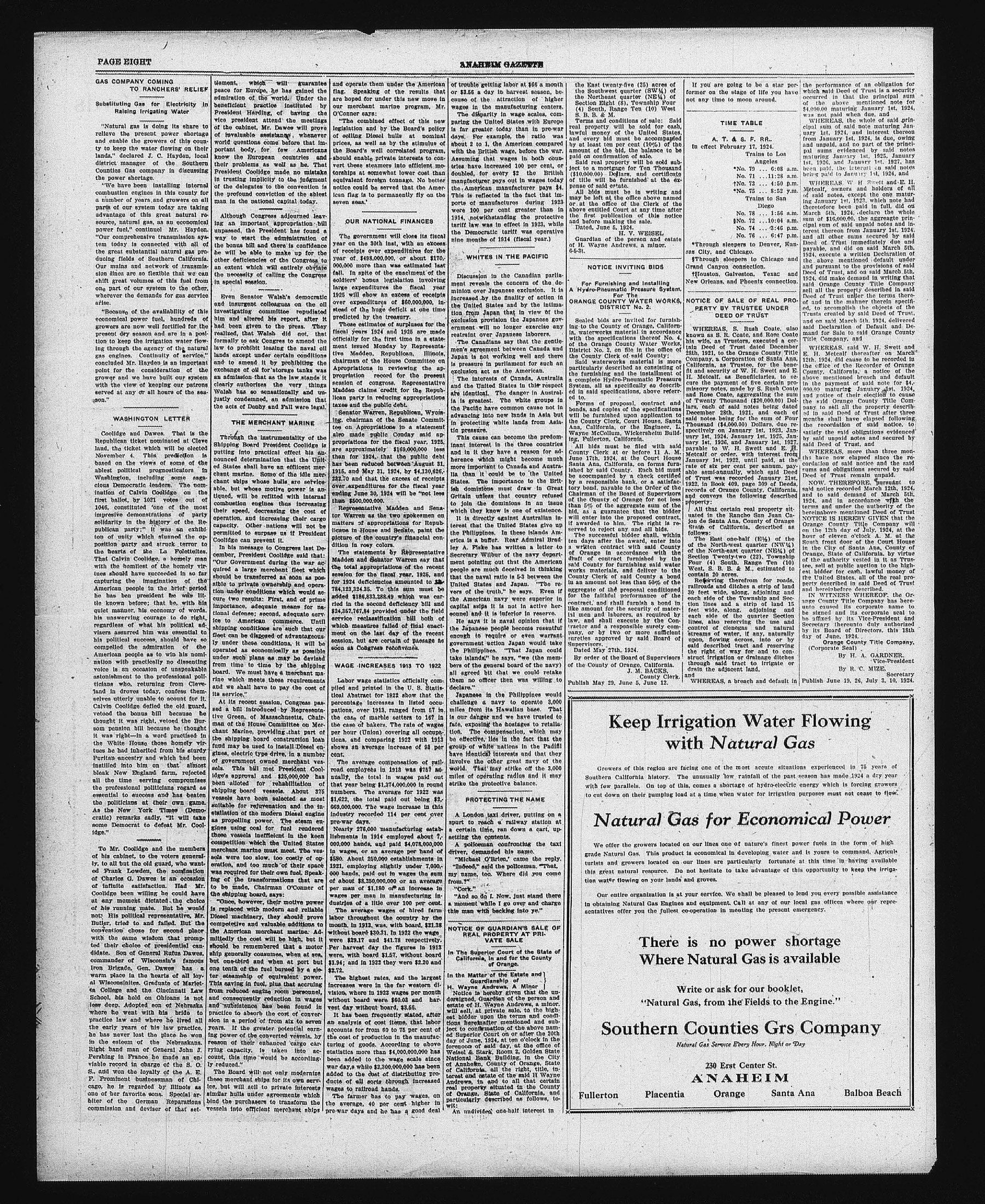
Searchable text
GAS COMPANY COMING TO RANCHERS' RELIEF
Substituting Gas for Electricity in Raising Irrigating Water
"Natural gas is doing its share to relieve the present power shortage and enable the growers of this county to keep the water flowing on their lands," declared J. C. Hayden, local district manager of the Southern Counties Gas company in discussing the power shortage.
"We have been installing internal combustion engines in this county for a number of years and growers on all parts of our system today are taking advantage of this great natural resource, natural gas, as an economical power fuel," continued Mr. Hayden.
"Our comprehensive transmission system today is connected with all of the great substantial natural gas producing fields of Southern California. Our mains and network of transmission lines are so flexible that we can shift great volumes of this fuel from one part of our system to the other, wherever the demands for gas service arise."
"Because of the availability of this economical power fuel, hundreds of growers are now well fortified for the present dry season and are in a position to keep the irrigation water flowing through the agency of the natural gas engines. Continuity of service," concluded Mr. Hayden is an important point for the consideration of the grower and we have built our system with the view of keeping our patrons served at any or all hours of the season."
WASHINGTON LETTER
Coolidge and Dawes. That is the Republican ticket nominated at Cleve land, the ticket which will be elected
tlement, which will guarantee peace for Europe, he has gained the admiration of the world. Under the beneficial practice instituted by President Harding, of having the vice president attend the meetings of the cabinet, Mr. Dawes will prove of invaluable assistance, whenever world questions come before that important body, for few Americans know the European countries and their problems as well as he. That President Coolidge made no mistake in trusting implicitly to the judgment of the delegates to the convention is the profound conviction of the ablest man in the national capital today.
Although Congress adjourned leaving an important appropriation bill unpassed, the President has found a way to start the administration of the bonus bill and there is confidence he will be able to make up for the other deficiencies of the Congress to an extent which will entirely obviate the necessity of calling the Congress in special session.
Even Senator Walsh's democratic and insurgent colleagues on the oil investigating committee repudiated him and altered his report, after it had been given to the press. They realized, that Walsh did not, that formally to ask Congress to amend the law to prohibit leasing the naval oil lands except under certain conditions and to amend it by prohibiting the exchange of oil for storage tanks was an admission that as the law stands it clearly authorizes the very things Walsh has so sensationally and unjustly condemned, an admission that the acts of Denby and Fall were legal.
THE MERCHANT MARINE
Through the instrumentality of the Shipping Board President Coolidge is and operates flag. Speakers are hoped for our merchant O'Conner said.
"The commission is of selling prices, as well as the Board's should enable vert these sorships at equivalent notice couldican flag is seven seas."
WASHINGTON LETTER
Coolidge and Dawes. That is the Republican ticket nominated at Cleve land, the ticket which will be elected November 4. This prediction is based on the views of some of the ablest political prognosticators in Washington, including some sagacious Democratic leaders. The nomination of Calvin Coolidge on the first ballot, by 1021 votes out of 1046, constituted 'one of the most impressive demonstrations of party solidarity in the history of the Republican party;" it was an exhibition of unity which stunned the opposition party and struck terror to the hearts of the La Folettesites. That Calvin Coolidge, a homely man with the homilest of the homely virtues should have succeeded in so far capturing the imagination of the American people in the brief period he has been president he was little known before; that he, with his quiet manner, his economy of words, his unswerving courage to do right, regardless of what his political advisers assured him was essential to his political success, should have so compelled the admiration of the American people as to win his nomination with practically no dissenting voice is an occasion of unspeakable astonishment to the professional politicians who, returning from Cleveland in droves today, confess themselves utterly unable to account for it. Calvin Coolidge defied the old guard, vetoed the bonus bill because he thought it was right, vetoed the Bur-som pension bill because he thought it was right—in a word practised in the White House those homely virtues he had inherited from his sturdy Puritan ancestry and which had been instilled into him on that almost bleak New England farm, rejected all the time serving compromises the professional politicians regard as essential to success and has beaten the politicians at their own game. As the New York Times (Democratic) remarks sadly, "It will take some Democrat to defeat Mr. Coolidge."
To Mr. Coolidge and the members through the instrumentality of the Shipping Board President Coolidge is putting into practical effect his announced determination that the United States shall have an efficient merchant marine. Some of the idle merchant ships whose hulls are serviceable, but whose motive power is antiqued, will be refitted with internal combustion engines thus increasing their speed, decreasing the cost of operation, and increasing their cargo capacity. Other nations will not be permitted to surpass us if President Coolidge can prevent it.
In his message to Congress last December, President Coolidge said that: "Our Government during the war acquired a large merchant fleet which should be transferred as soon as possible to private ownership and operation under conditions which would secure two results: First, and of prime importance, adequate means for national defense; second, adequate service to American commerce. Until shipping conditions are such that our fleet can be disposed of advantageously under these conditions, it will be operated as economically as possible under such plans as may be devised from time to time by the shipping board. We must have a merchant marine which meets these requirements and we shall have to pay the cost of its service."
At its recent session, Congress passed a bill introduced by Representative Green, of Massachusetts, Chairman of the House Committee on Merchant Marine, providing that part of the shipping board construction loan fund may be used to install Diesel engines, electric type drive, in a number of government owned merchant vessels. This bill met President Coolidge's approval and $25,000,000 has been allotted for rehabilitation of shipping board vessels. About 375 vessels have been selected as most suitable for rejuvenation and the installation of the modern Diesel engine as propelling power. The steam engines using coal for fuel rendered these vessels inefficient in the keen competition which the United States merchant marine must meet. The year before lands except under certain conditions and to amend it by prohibiting the exchange of oil for storage tanks was an admission that as the law stands it clearly authorizes the very things Walsh has so sensationally and unjustly condemned, an admission that the acts of Denby and Fall were legal.
THE MERCHANT MARINE
Through the instrumentality of the Shipping Board President Coolidge is putting into practical effect his announced determination that the United States shall have an efficient merchant marine. Some of the idle merchant ships whose hulls are serviceable, but whose motive power is antiqued, will be refitted with internal combustion engines thus increasing their speed, decreasing the cost of operation, and increasing their cargo capacity. Other nations will not be permitted to surpass us if President Coolidge can prevent it.
In his message to Congress last December, President Coolidge said that: "Our Government during the war acquired a large merchant fleet which should be transferred as soon as possible to private ownership and operation under conditions which would secure two results: First, and of prime importance, adequate means for national defense; second, adequate service to American commerce. Until shipping conditions are such that our fleet can be disposed of advantageously under these conditions, it will be operated as economically as possible under such plans as may be devised from time to time by the shipping board. We must have a merchant marine which meets these requirements and we shall have to pay the cost of its service."
At its recent session, Congress passed a bill introduced by Representative Green, of Massachusetts, Chairman of the House Committee on Merchant Marine, providing that part of the shipping board construction loan fund may be used to install Diesel engines, electric type drive, in a number of government owned merchant vessels. This bill met President Coolidge's approval and $25,000,000 has been alloted for rehabilitation of shipping board vessels. About 375 vessels have been selected as most suitable for rejuvenation and the installation of the modern Diesel engine as propelling power. The steam engines using coal for fuel rendered these vessels inefficient in the keen competition which the United States merchant marine must meet. The year before lands except under certain conditions and to amend it by prohibiting the exchange of oil for storage tanks was an admission that as the law stands it clearly authorizes the very things Walsh has so sensationally and unjustly condemned, an admission that the acts of Denby and Fall were legal.
THE MERCHANT MARINE
Through the instrumentality of the Shipping Board President Coolidge is putting into practical effect his announced determination that the United States shall have an efficient merchant marine. Some of the idle merchant ships whose hulls are serviceable, but whose motive power is antiqued, will be refitted with internal combustion engines thus increasing their speed, decreasing the cost of operation, and increasing their cargo capacity. Other nations will not be permitted to surpass us if President Coolidge can prevent it.
In his message to Congress last December, President Coolidge said that: "Our Government during the war acquired a large merchant fleet which should be transferred as soon as possible to private ownership and operation under conditions which would secure two results: First, and of prime importance, adequate means for national defense; second, adequate service to American commerce. Until shipping conditions are such that our fleet can be disposed of advantageously under these conditions, it will be operated as economically as possible under such plans as may be devised from time to time by the shipping board. We must have a merchant marine which meets these requirements and we shall have to pay the cost of its service."
Puritan ancestry and which had been instilled into him on that almost bleak New England farm, rejected all the time serving compromises the professional politicians regard as essential to success and has beaten the politicians at their own game. As the New York Times (Democratic) remarks sadly, "It will take some Democrat to defeat Mr. Coolidge."
To Mr. Coolidge and the members of his cabinet, to the voters generally, to all but the old guard, who wanted Frank Lowden, the nomination of Charles G. Dawes is an occasion of infinite satisfaction. Had Mr. Coolidge been willing he could have at any moment dictated the choice of his running mate. But he would not. His political representative, Mr. Butler, tried to and failed. But the convention chose for second place with the same wisdom that prompted their choice of presidential candidate. Son of General Rufus Dawes, commander of Wisconsin's famous Iron Brigade, Gen. Dawes has a warm place in the hearts of all loyal Wisconsinites. Graduate of Marlatta College and the Cincinnati Law School, his hold on Ohioans is not less deep. Adopted son of Nebraska where he went with his bride to practice law and where he lived all the early years of his law practice, he has never lost the place he won in the esteem of the Nebraskans. Right hand man of General John J. Pershing in France he made an enviable record in charge of the S. O. S., and won the loyalty of the A. E. F. Prominent businessman of Chicago, he is regarded by Illinois as one of her favorite sons. Special arbiter of the German Reparations commission and deviser of that set-
"Once, however, their motive power is replaced with modern and reliable Diesel machinery, they should prove competitive and valuable additions to the American merchant marine. Admittedly the cost will be high, but it should be remembered that a motor ship generally consumes, when at sea, but one-third and when at port but one tenth of the fuel burned by a sleater steamship of equivalent power. This saving in fuel, plus that accruing from reduced engine room personnel, and consequently reduction in wages and subsistence has been found in practice to absorb the cost of conversion in a period of from six to seven years. If the greater potential earning power of the converted vessels, by reason of their enhanced cargo carrying capacity, is taken into account, this time would be accordingly reduced."
The Board will not only modernize these merchant ships for its own service, but will sell to private interests similar hulls under agreements which blind the purchasers to transform the vessels into efficient merchant ships.
The average road employee annually, the that year before numbers. The $1,622, the $669,000,000. The industry records pre-war days. Nearly 276,000 installations in 000,000 hands in wages, or $580. About 1921, employed 000 hands, per about $8.25 per man of wages per man dustries of a.
The average labor through month, in 1911 without boards were $29.17. Per harvest were, with both $1.94; and in $2.72.
The highest increases were vision, where without boards vest day with it has been an analysis of accounts for the cost of procuring of good statistics more been added to war days while added to the ducts of all wages to railroads.
The farmer the average, pre-war days
guarantee has gained the Under the instituted by having the meetings will prove whenever before that Americans countries and as he. That no mistake the judgment convention is of the ablest total today.
grown leav-epiration bill has found a administration of its confidence up for the Congress to irrely obviate the Congress democratic on the oil repudiated short, after it express. They not, that no amend the naval oil conditions exhibiting the ore tanks was law stands it every things really and uncommission that were legal.
MARINE totality of the Coolidge is
and operate them under the American flag. Speaking of the results that are hoped for under this new move in our merchant marine program, Mr. O'Conner says:
"The combined effect of this new legislation and by the Board's policy of selling Diesel hulls at nominal prices, as well as by the stimulus of the Board's well correlated program, should enable private interests to convert these steamers into efficient motorships at somewhat lower cost than equivalent foreign tonnage. No better notice could be served that the American flag is to permanently fly on the seven seas."
OUR NATIONAL FINANCES
The government will close its fiscal year on the 30th inst., with an excess of receipts over expenditures for the year of $498,000,000, or about $170,000,000 more than was estimated last fall. In spite of the enactment of the soldiers' bonus legislation involving large expenditures the fiscal year 1925 will show an excess of receipts over expenditures of $60,000,000, instead of the huge deficit at one time predicted by the treasury.
These estimates of surpluses for the fiscal years 1924 and 1925 are made officially for the first time in a statement issued Monday by Representative Madden, Republican, Illinois, chairman of the House Committee on Apropriations in reviewing the appropriation record for the present session of congress. Representative Madden claims credit for the Republican party in reducing appropriations taxes and the public debt.
Senator Warren, Republican, Wyoming, chairman of the Senate Committee on Apropriations in a statement also made public Conday said appropriations for the fiscal year, 1925, are approximately $169,000,000 less of trouble getting labor at $66 a month or $3.56 a day in harvest season, because of the attraction of higher wages in the manufacturing centers.
The disparity in wage scales, comparing the United States with Europe is far greater today than in pre-war days. For example, the ratio was about 2 to 1, the American compared with the British wage, before the war. Assuming that wages in both countries have increased 100 per cent, or doubled, for every $2 the British manufacturer pays out in wages today the American manufacturer pays $4. This is reflected in the fact that imports of manufactures during 1923 were 100 per cent greater than in 1914, notwithstanding the protective tariff law was in effect in 1923, while the Democratic tariff was operative nine months of 1914 (fiscal year).
WHITES IN THE PACIFIC
Discussion in the Canadian parliament reveals the concern of the dominion over Japanese exclusion. It is increased by the finality of action in the United States and by the intimation from Japan that in view of the exclusion provision the Japanese government will no longer exercise any restraint over Japanese laborers.
The Canadians say that the gentlemen's agreement between Canada and Japan is not working well and there is pressure in parliament for such an exclusion act as the American.
The interests of Canada, Australia and the United States in this respect are identical. The danger in Australia is greatest. The white groups in the Pacific have common cause not in advancing into new lands in Asia but in protecting white lands from Asian pressure.
This cause can become the predominant interest in the three countries.
the East twenty-five (25) acres of the Southwest quarter (SW¼) of the Northeast quarter (NE½) of Section Eight (8), Township Four (4) South, Range Ten (10) West S. B. B. & M.
Terms and conditions of sale: Said real property will be sold for cash, lawful money of the United States, and every bid must be accompanied by at least ten per cent (10%) of the amount of the bid, the balance to be paid on confirmation of sale.
Said real property will be sold subject to a mortgage for Ten Thousand ($10,000.00) Dollars, and certificate of title will be furnished at the expense of said estate.
All bids must be in writing and may be left at the office above named or at the office of the Clerk of the above entitled Court at any time after the first publication of this notice and before making the sale.
Dated, June 5, 1924.
H. V. WEISEL
Guardian of the person and estate of H. Wayne Andrews, a minor.
6-5-3t.
NOTICE INVITING BIDS
For Furnishing and Installing A Hydro-Pneumatic Pressure System.
For The ORANGE COUNTY WATER WORKS,
DISTRICT No. 2.
Sealed bids are invited for furnishing to the County of Orange, California; waterworks material in accordance with the specifications thereof No. 4; of the Orange County Water Works, District No. 2, on file in the office of the County Clerk of said County;
Said waterworks material is more particularly described as consisting of the furnishing and the installment of a complete Hydro-Pneumatic Pressure System, all as specifically so described in said specifications, above referred to.
Forms of proposal, contract and bonds, and copies of the specifications will be furnished upon application to the County Clerk, Court House, Santa Ana, California, or the Engineer, L. Wayne McCollum, Wickersheim Building, Fullerton, California.
All bids must be filed with said
MARINE
totality of the Coolidge is defective which soon as pos and operch would send of prime means for naequate servicerce. Until such that our advantageous it will be as possible be devised the shipping merchant ma requirements the cost of congress pass Representaets, Chairtee on Mer that part of construction loan Call Diesel enin a number merchant vesident Coolidge000,000 has illitation of About 375 died as most and the inlesel engine is steam enin a number merchant vesident Coolidge000,000 has illitation of About 375 died as most and the inlesel engine is steam enin a number merchant vesident Coolidge000,000 has illitation of About 375 died as most and the inlesel engine is steam enin a number merchant vesident Coolidge000,000 has illitation of About 375 died as most and the inlesel engine is steam enin a number merchant vesident Coolidge000,000 has illitation of About 375 died as most and the inlesel engine is steam enin a number merchant vesident Coolidge000,000 has illitation of About 375 died as most and the inlesel engine is steam enin a number merchant vesident Coolidge000,000 has illitation of About 375 died as most and the inlesel engine is steam enin a number merchant vesident Coolidge000,000 has illitation of About 375 died as most and the inlesel engine is steam enin a number merchant vesident Coolidge000,000 has illitation of About 375 died as most and the inlesel engine is steam enin a number merchant vesident Coolidge000,000 has illitation of About 375 died as most and the inlesel engine is steam enin a number merchant vesident Coolidge000,000 has illitation of About 375 died as most and the inlesel engine is steam enin a number merchant vesident Coolidge000,000 has illitation of About 375 died as most and the inlesel engine is steam enin a number merchant vesident Coolidge000,000 has illitation of About 375 died as most and the inlesel engine is steam enin a number merchant vesident Coolidge000,000 has illiation of About 375 died as most and the inlesel engine is steam enin a number merchant vesident Coolidge000,000 has illiation of About 375 died as most and the inlesel engine is steam enin a number merchant vesident Coolidge000,000 has illiation of About 375 died as most and the inlesel engine is steam enin a number merchant vesident Coolidge
The average compensation of railroad employees in 1918 was $757 annually, the total in wages paid out that year being $1,374,000,000 in round numbers. The average for 1922 was $1,622, the total paid out being $2,669,000,000. The wage increase in this industry recorded 114 per cent over pre-war days.
Nearly 276,000 manufacturing establishments in 1914 employed about 7,000,000 hands, and paid $4,078,000,000 in wages, or an average per hand of $580. About 250,000 establishments in 1921, employing slightly under 7,000,000 hands, paid out in wages the sum of about $8,250,000,000 or an average per man of $1,180 or an increase in wages per man in manufacturing industries of a little over 100 per cent.
The average wages of hired farm labor throughout the country by the month, in 1913, was with board, $21.38 without board $30.31. In 1922 the wage were $29.17 and $41.78 respectively. Per harvest day the figures in 1913 were, with board $1.57, without board $1.94; and in 1922 they were $2.20 and $2.72.
The highest rates, and the largest increases were in the far western division, where in 1922 wages per month without board were $60.03 and harvest day without board, $3.56.
It has been frequently stated, after an analysis of cost items, that labor accounts for from 60 to 75 per cent of the cost of production in the manufacturing of goods. According to above statistics more than $4,000,000,000 has been added to the wage scale since war days while $2,300,000,000 has been added to the cost of distributing products of all sorts through increased wages to railroad hands.
The farmer has to pay wages on the average, 40 per cent higher in pre-war days and he has a good deal involve the other great navy of the world. That may strike off the 3,000 miles of operating radius and it may strike the protective balance.
PROTECTING THE NAME
A London taxi driver, putting on a spurt to reach a railway station at a certain time, ran down a cart, upsetting the contents.
A policeman confronting the taxi driver, demanded his name.
"Michael O'Brien," came the reply. "Indeed," said the policeman. "That, my name, too. Where did you come from?"
"Cork."
"And so do I. Now, just stand there a moment while I go over and charge this man with backing into ye."
NOTICE OF GUARDIAN'S SALE OF REAL PROPERTY AT PRIVATE SALE
In The Superior Court of the State of California, in and for the County of Orange.
In the Matter of the Estate and Guardianship of H. Wayne Andrews, A Minor
Notice is hereby given that the undersigned, Guardian of the person and estate of H. Wayne Andrews, a minor, will sell at private sale, to the highest bidder upon the terms and conditions hereafter mentioned and subject to confirmation of the above named Superior Court on or after the 20th day of June, 1924, at ten o'clock in the forenoon of said day, at the office of Weisel & Stark, Room 2, Golden State National Bank Building, in the City of Anaheim, County of Orange, State of California, all the right title, interest and estate of the said H Wayne Andrews, in and to all that certain real property situated in the County of Orange, State of California, and particularly described as follows: to wit:
An undivided one-half interest in
If you are going to be a star performer on the stage of life you have not any time to moon around.
TIME TABLE
A. T. & S. F. RR.
In effect February 17, 1924.
Trains to Los Angeles
*No. 79 ... 6:08 a.m.
No. 71 ... 11:28 a.m.
†No. 73 ... 4:50 p.m.
*No. 75 ... 8:52 y.m.
Trains to San Diego
No. 78 ... 1:56 a.m.
§No. 72 ... 10:04 a.m.
No. 74 ... 3:46 p.m.
No. 76 ... 6:47 p.m.
*Through sleepers to Denver, Kansas City, and Chicago.
§Through sleepers to Chicago and Grand Canyon connection.
†Houston, Galveston, Texas and New Orleans, and Phoenix connection.
NOTICE OF SALE OF REAL PROPERTY BY TRUSTEE UNDER DEED OF TRUST
WHEREAS, S. Rush Coate, also known as S. R. Coate, and Rose Coate his wife, as Trustors, executed a certain Deed of Trust dated December 28th, 1921, to the Orange County Title Company, a Corporation of Santa Ana, California, as Trustee, for the benefit and security of W. H. Swett and E. H. Metcalf, as Beneficiaries, to secure the payment of five certain promissory notes, made by S. Rush Coate and Rose Coate, aggregating the sum of Twenty Thousand ($20,000.00) Dollars, each of said notes being dated December 28th, 1921, and each of said notes being for the sum of Four Thousand ($4,000.00) Dollars, due respectively on January 1st, 1923, January 1st, 1924, January 1st, 1925, January 1st, 1926, and January 1st, 1927, payable to W. H. Swett and E. H.
the performance of an obligation for which said Deed of Trust is a security occurred in that the principal sum of the above mentioned note for $4,000.00 maturing January 1st, 1924, was not paid when due, and
WHEREAS, the whole of said principal sum of said note maturing January 1st, 1924, is due, owing and unpaid, and no part of the principal sums evidenced by said notes maturing January 1st, 1925, January 1st, 1926, and January 1st, 1927, has been paid the interest on said notes being paid to January 1st, 1924, and
WHEREAS, W. H. Swett and E. H. Metcalf owners and holders of all of said notes, except the one maturing January 1st, 1923, which note had theretofore been paid in full, did on March 5th, 1924, declare the whole sum of $16,000.00, the aggregate principal sum of said unpaid notes and interest therefrom from January 1st, 1924, and all other sums secured by said Deed of Trust immediately due and payable, and did on said March 5th, 1924, execute a written Declaration of the above mentioned default under and pursuant to the provisions of said Deed of Trust, and on said March 5th, 1924, did make demand in writing that said Orange County Title Company sell all the property described in said Deed of Trust under the terms thereof and in the manner therein specified, to accomplish the objects of the Trusts created by said Deed of Trust, and on said March 5th, 1924, delivered said Declaration of Default and Demand for Sale to said Orange County Title Company,
WHEREAS, said W. H. Swett and E. H. Metcalf thereafter on March 12th, 1924, did cause to be recorded in the office of the Recorder of Orange County, California, a notice of the above mentioned breach and default in the payment of said note for $4,000.00 maturing January 1st, 1924, and notice of their election to cause the said Orange County Title Company to sell all the property described in said Deed of Trust after three months shall have elapsed following the recordation of said notice, to satisfy the said obligations evidenced by said unpaid notes and secured by said Deed of Trust,
and
Keep Irrigation Water Flowing with Natural Gas
of this region are facing one of the most acute situations experienced in 75 years of California history. The unusually low rainfall of the past season has made 1924 a dry year parallels. On top of this, comes a shortage of hydro-electric energy which is forcing growers on their pumping load at a time when water for irrigation purposes must not cease to flow.
Natural Gas for Economical Power
for the growers located on our lines one of nature's finest power fuels in the form of high
Natural Gas for Economical Power
For the growers located on our lines one of nature's finest power fuels in the form of high
natural Gas. This product is economical in developing water and is yours to command. Agriculture growers located on our lines are particularly fortunate at this time in having available
natural resource. Do not hesitate to take advantage of this opportunity to keep the irrigaflowing on your lands and groves.
The tire organization is at your service. We shall be pleased to lend you every possible assistance
using Natural Gas Engines and equipment. Call at any of our local gas offices where our represent offer you the fullest co-operation in meeting the present emergency.
There is no power shortage
Where Natural Gas is available
Write or ask for our booklet,
"Natural Gas, from the Fields to the Engine."
Southern Counties Grs Company
Natural Gas Service Every Hour, Night or Day
230 Erst Center St.
ANAHEIM
Placentia Orange Santa Ana Balboa Beach