anaheim-gazette 1924-06-26
Scanned page
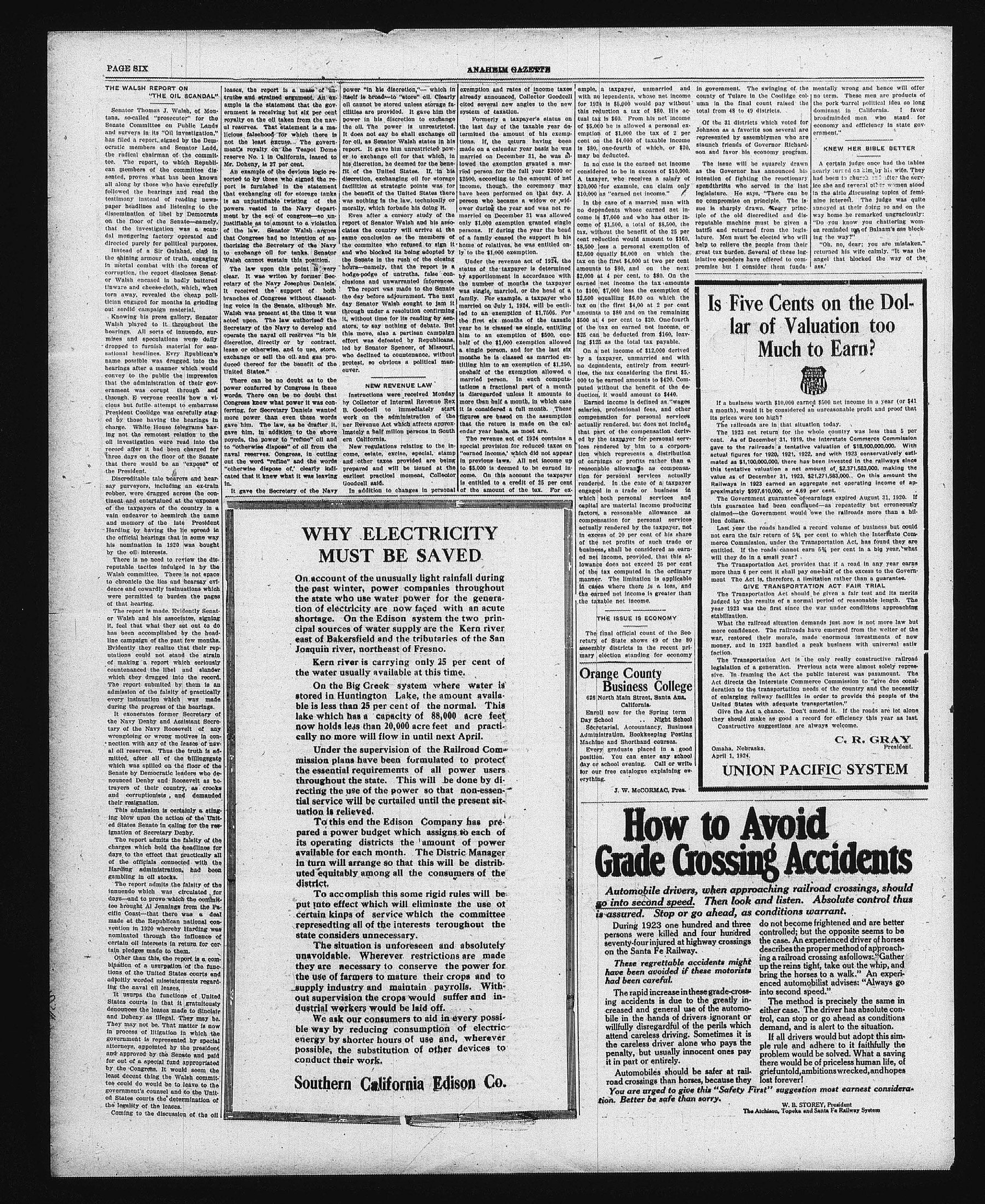
Searchable text
THE WALSH REPORT ON
"THE OIL SCANDAL"
Senator Thomas J. Walsh, of Montana, so-called "prosecutor" for the Senate Committee on Public Lands and surveys in its "Oil investigation," has filed a report, signed by the Democratic members and Senator Ladd, the radical chairman of the committee. The report, to which Republican members of the committee disorted, proves what has been known all along by those who have carefully followed the hearings and read the testimony instead of reading newspaper headlines and listening to the dissemination of libel by Democrats on the floor of the Senate—namely, that the investigation was a scandal mongering factory operated and directed purely for political purposes.
Instead of a Sir Galahad, clad in the shining armour of truth, engaging in mortal combat with the forces of corruption, the report discloses Senator Walsh encased in badly battered tinware and cheese-cloth, which, when torn away, revealed the cheap politician engaged for months in grinding out sordid campaign material.
Knowing his press gallery, Senator Walsh played to it throughout the hearings. All sorts of innuendo, surmises and speculations were daily dropped to furnish material for sensational headlines. Evry Rpublican's name possible was dragged into the hearings after a manner which would convey to the public the impression that the administration of their government was corrupt through and through. Everyone recalls how a vicious but futile attempt to embarrass President Coolidge was carefully staged by those having the hearings in charge. White House telegrams having not the remotest relation to the oil investigation were read into the record after it had been charged for leases, the report is a mass of untruths and strained argument. An example is the statement that the government is receiving but six per cent royalty on the oil taken from the naval reserves. That statement is a malicious falsehood for which there is not the least excuse. The government's royalty on the Teapot Dome reserve No. 1 in California, leased to Mr. Doheny, is 27 per cent.
An example of the devious logic resorted to by those who signed the report is furnished in the statement that exchanging oil for storage tanks is an unjustifiable twisting of the powers vested in the Navy department by the act of congress—so unjustifiable as to amount to a violation of the law. Senator Walsh argues that Congress had no intention of authorizing the Secretary of the Navy to exchange oil for tanks. Senator Walsh cannot sustain this position.
The law upon this point is very clear. It was written by former Secretary of the Navy Josephus Daniels. It received the support of both branches of Congress without dissenting voice in the Senate, although Mr. Walsh was present at the time it was acted upon. The law authorized the Secretary of the Navy to develop and operate the naval oil reserves "in his discretion, directly or by contract, lease or otherwise, and to use, store, exchange or sell the oil and gas produced thereof for the benefit of the United States."
There can be no doubt as to the power conferred by Congress in these words. There can be no doubt that Congress knew what power it was conferring, for Secretary Daniels wanted more power than even these words gave him. The law, as he drafter it, gave him, in addition to the above poyeds, the power to "refine" oil and to "otherwise dispose" of oil from the
name possible was dragged into the hearings after a manner which would convey to the public the impression that the administration of their government was corrupt through and through. Everyone recalls how a vicious but futile attempt to embarrass President Coolidge was carefully staged by those having the hearings in charge. White House telegrams having not the remotest relation to the oil investigation were read into the record after it had been charged for three days on the floor of the Senate that there would be an "expose" of the President.
Discreditable tale bearers and hear-say purveyors, including an ex-train robber, were dragged across the continent and entertained at the expense of the taxpayers of the country in a vain endeavor to besmirch the name and memory of the late President Harding by having the lie spread in the official hearings that in some way his nomination in 1920 was bought by the oil interests.
There is no need to review the disreputable tactics indulged in by the Walsh committee. There is not space to chronicle the lies and hearsay evidence and cowardly insinuations which were permitted to burden the pages of that hearing.
The report is made. Evidently Senator Walsh and his associates, signing it, feel that what they set out to do has been accomplished by the headline campaign of the past few months. Evidently they realize that their reputations could not stand the strain of making a report which seriously countenanced the libel and slander which they dragged into the record. The report submitted by them is an admission of the falsity of practically every insinuation which was made during the progress of the hearings.
It exonerates former Secretary of the Navy Denby and Assistant Secretary of the Navy Roosevelt of any wrongdoing or wrong motives in connection with any of the leases of naval oil reserves. Thus the truth is admitted, after all of the billingsgate which was spilled on the floor of the Senate by Democratic leaders who denounced Denby and Roosevelt as betrayers of their country, as crooks and corruptionists, and demanded their resignation.
This admission is certainly a stinging blow upon the action of the United States Senate in calling for the resignation of Secretary Denby.
The report admits the falsity of the charges which held the headlines for exchange or sell the oil and gas produced thereof for the benefit of the United States."
WHY I MUST
On account of the past winter, the state who used electricity shortage. On this cipal sources of west east of Bakersfield Joaquin river, now holds less cally no more water.
Under the submission plans have the essential requirement throughout the service will be uation is relieved.
To this end prepared a power bu its operating di
mitted, after all of the billingsgate which was spilled on the floor of the Senate by Democratic leaders who denounced Denby and Roosevelt as betrayers of their country, as crooks and corruptionists, and demanded their resignation.
This admission is certainly a stinging blow upon the action of the United States Senate in calling for the resignation of Secretary Denby.
The report admits the falsity of the charges which held the headlines for days to the effect that practically all of the officials connected with the Harding administration, had been gambling in oil stocks.
The report admits the falsity of the innuendo which was circulated for days—and to prove which the committee brought Al Jennings from the Pacific Coast—that there was a deal made at the Republican national convention in 1920 whereby Harding was nominated through the influence of certain oil interests in return for certain pledges made to them.
Other than this, the report is a combination of a usurpation of the functions of the United States courts and poorly worded misstatements regarding the naval oil leases.
It usurps the functions of United States courts in that it gratuitously denounces the leases made to Sinclair and Doheny as illegal. They may be. They may not be. That matter is now in process of litigation in which the government is represented by special attorneys, appointed by the president and approved by the Senate and paid for out of a special fund appropriated by the Congress. It would seem the least decent thing the Walsh committee could do would be to leave to the government's counsel and to the United States courts the determination of the legality of the leases.
Coming to the discussion of the oil mission plans have essential requirements throughout the service will be uplifted equitably and district.
To accomplish put into effect certain kinps of represeding all or state considers use.
The situation unavoidable. When they are necessary the use of farmers supply industry out supervision to dustrial workers.
We ask our able way by reducing energy by shorter possible, the subduct their work.
ANAHEIM GAZETTE
power "in his discretion,"—which in itself is broad—to "store" oil. Clearly oil cannot be stored unless storage facilities are provided. It gave him the power in his discretion to exchange the oil. The power is unrestricted. It does not say he shall exchange oil for oil, as Senator Walsh states in his report. It gave him unrestricted power to exchange oil for that which, in his discretion, he deemed for the benefit of the United States. If, in his discretion, exchanging oil for storage facilities at strategic points was for the benefit of the United States there was nothing in the law, technically or morally, which forbade his doing it.
Even after a cursory study of the report of Senator Walsh and his associates the country will arrive at the same conclusion as the members of the committee who refused to sign it and who blocked its being adopted by the Senate in the rush of the closing hours—namely, that the report is a hodge-podge of untruths, false conclusions and unwarranted inferences.
The report was made to the Senate the day before adjournment. The next day Senator Walsh sought to jam it through under a resolution confirming it, without time for its reading by senators, to say nothing of debate. But this move, also a partisan campaign effort was defeated by Republicans, led by Senator Spencer, of Missouri, who declined to countenance, without protest, so obvious a political maneuver.
NEW REVENUE LAW
Instructions were received Monday by Collector of Internal Revenue Rex B. Goodcell to immediately start work on the administration of theNER Revenue Act which affects approximately a half million persons in Southern California.
New regulations relating to the exemption and rates of income taxes already announced, Collector Goodcell cited several new angles to the new system of taxation.
Formerly a taxpayer's status on the last day of the taxable year determined the amount of his exemptions. If, the return having been made on a calendar year basis he was married on December 31, he was allowed the exemption granted a married person for the full year $2000 or $2500, according to the amount of net income, though, the ceremony may have been performed on that day. A person who became a widow or widower during the year and was not married on December 31 was allowed only $1,000 exemption granted single persons. If during the year the head of a family ceased the support in his home of relatives, he was entitled only to the $1,000 exemption.
Under the revenue act of 1924, the status of the taxpayer is determined by apportionment in accordance with the number of months the taxpayer was single, married, or the head of a family. For example, a taxpayer who married on July 1, 1924, will be entitled to an exemption of $1,7505. For the first six months of the taxable year he is classed as single, entitling him to an exemption of $500, one-half of the $1,000 exemption allowed a single person, and for the last six months he is classed as married entitlement to an exemption of $1,250, one-half of the exemption allowed a married person. In such computations a fractional part of a month is disregarded unless it amounts to more than half a month, in which case it is considered a full month. These figures are based on the assumption that the return is made on the calendar year basis, as most are.
The revenue act of 1924 contains a special provision for reduced taxes onample, a taxpayer, unmarried and with no dependents, whose net income for 1924 is $5,000 would pay without this reduction a tax of $80. His actual tax is $60. From his net income of $5,000 he is allowed a personal exemption of $1,000 the tax of 2 per cent on the $4,000 of taxable income is $80, one-fourth of which, or $20, may be deducted.
In no case is the earned net income considered to be in excess of $10,000. A taxpayer who receives a salary of $20,000 for example, can claim only $10,000 as "earned net income."
In the case of a married man with no dependents whose earned net income is $7,000 and who has other income of $1,500, a total of $8,500, the tax without the benefit of the 25 per cent reduction would amount to $160, $8,500 less a personal exemption of $2,500 equally $6,000 on which the tax on the first $4,000 at two per cent amounts to $80, and on the next $2,000 at 4 per cent, to $80. On the earned net income the tax amounts to $100, $7,000 less the exemption of $2,500 equalling $6,00 on which the tax on the first $4,00 at 2 per cent amounts to $80 and on the remaining $500 at 4 per cent to $20. One-fourth of the tax on earned net income, or $25 can be deducted from $160, leaving $125 as the total tax payable.
On a net income of $12,000 derived by a taxpayer, unmarried and with no dependents, entirely from securities,the tax considering the first $5.00 to be earned amounts to $420.Computed without the benefit of the deduction it would amount to $440.
Earned income is defined as "wages salaries, professional fees,and other compensation for personal services actually rendered but does not include that part of the compensation derived by the taxpayer for personal services rendered by him to a corpora-
WHY ELECTRICITY MUST BE SAVED
On account of the unusually light rainfall during the past winter, power companies throughout the state who use water power for the generation of electricity are now faced with an acute shortage. On the Edison system the two principal sources of water supply are the Kern river east of Bakersfield and the tributaries of the San Joaquin river, northeast of Fresno.
Kern river is carrying only 25 per cent of the water usually available at this time.
On the Big Creek system where water is stored in Huntington Lake, the amount available is less than 25 per cent of the normal. This lake which has a capacity of 88,000 acre feet now holds less than 20,000 acre feet and practically no more will flow in until next April.
Under the supervision of the Railroad Commission plans have been formulated to protect the essential requirements of all power users throughout the state. This will be done by directing the use of the power so that non-essential service will be curtailed until the present situation is relieved.
To this end the Edison Company has prepared a power budget which assigns to each of its operating districts the amount of power months he is classed as married entitled him to an exemption of $1,250, onehalf of the exemption allowed a married person. In such computations a fractional part of a month is disregarded unless it amounts to more than half a month, in which case it is considered a full month. These figures are based on the assumption that the return is made on the calendar year basis, as most are.
The revenue act of 1924 contains a special provision for reduced taxes on "earned income," which did not appear in previous laws. All net income up to $5,000 is deemed to be earned income. On this account the taxpayer is entitled to a credit of 25 per cent of the amount of the tax. For ex-
by a taxpayer, unmarried and with no dependents, entirely from securities, the tax considering the first $5,000 to be earned amounts to $420. Computed without the benefit of the deduction, it would amount to $440.
Earned income is defined as "wages salaries, professional fees, and other compensation for personal services actually rendered, but does not include that part of the compensation derived by the taxpayer for personal services rendered by him to a corporation which represents a distribution of earnings or profits rather than a reasonable allowance as compensation for personal services actually rendered. In the case of a taxpayer engaged in a trade or business in which both personal services and capital are material income producing factors, a reasonable allowance as compensation for personal services actually rendered by the taxpayer, not in excess of 20 per cent of his share of the net profits of such trade or business, shall be considered as earned net income, provided that this allowance does not exceed 25 per cent of the tax computed in the ordinary manner. The limitation is applicable in cases where there is a loss, and the earned net income is greater than the taxable net income.
THE ISSUE IS ECONOMY
The final official count of the Secretary of State shows 49 of the 80 assembly districts in the recent primary election standing for economy
Orange County Business College
626 North Main Street, Santa Ana,
California.
Enroll now for the Spring term Day School ... Night School
Secretarial, Accountancy, Business Administration, Bookkeeping Posting Machine and Shorthand courses.
Every graduate placed in a good position. You can enter any school day or school evening. Call or write for our free catalogue explaining everything.
J. W. McCORMAC, Pres.
mission plans have been formulated to protect the essential requirements of all power users throughout the state. This will be done by directing the use of the power so that non-essential service will be curtailed until the present situation is relieved.
To this end the Edison Company has prepared a power budget which assigns to each of its operating districts the amount of power available for each month. The Distric Manager in turn will arrange so that this will be distributed equitably among all the consumers of the district.
To accomplish this some rigid rules will be put into effect which will eliminate the use of certain kinps of service which the committee represedting all of the interests throughout the state considers unnecessary.
The situation is unforeseen and absolutely unavoidable. Wherever restrictions are made they are necessary to conserve the power for the use of farmers to mature their crops and to supply industry and maintain payrolls. Without supervision the crops would suffer and industrial workers would be laid off.
We ask our consumers to aid in every possible way by reducing consumption of electric energy by shorter hours of use and, wherever possible, the substitution of other devices to conduct their work.
Southern California Edison Co.
in government. The swinging of the county of Tulare in the Coolidge column in the final count raised the total from 48 to 49 districts.
Of the 31 districts which voted for Johnson as a favorite son several are represented by assemblymen who are staunch friends of Governor Richardson and favor his economy program.
The issue will be squarely drawn as the Governor has announced his intention of fighting the reactionary spendthrifts who served in the last legislature. He says, "There can be no compromise on principle. The issue is sharply drawn. Every principle of the old discredited and disreputable machine must be given a battle and returned from the legislature. Men must be elected who will help to relieve the people from their great tax burden. Several of these legislative spenders have offered to compromise but I consider them fundamentally wrong and hence will offer no term. These men are products of the pork-barrel political idea so long dominant in California. I favor broadminded men who stand for economy and efficiency in state government."
KNEW HER BIBLE BETTER
A certain judge once had the tables nearly turned on him by his wife. They had been to church and after the service she and several other women stood in the aisle discussing topics of feminine interest. The judge was quite annoyed at their doing so and on the way home he remarked ungraciously: "Do you know you chattering women reminded me of Balaam's ass blocking the way?"
"Oh, no, dear; you are mistaken." returned his wife calmly. "It was the angel that blocked the way of the ass."
Is Five Cents on the Dollar of Valuation too Much to Earn?
If a business worth $10,000 earned $500 net income in a year (or $41 a month), would it be considered an unreasonable profit and proof that its prices were too high?
The railroads are in that situation today.
The 1923 net return for the whole country was less than 5 per cent. As of December 31, 1919, the Interstate Commerce Commission gave to the railroads a tentative valuation of $18,900,000,000. With
If a business worth $10,000 earned $500 net income in a year (or $41 a month), would it be considered an unreasonable profit and proof that its prices were too high?
The railroads are in that situation today.
The 1923 net return for the whole country was less than 5 per cent. As of December 31, 1919, the Interstate Commerce Commission gave to the railroads a tentative valuation of $18,900,000,000. With actual figures for 1920, 1921, 1922, and with 1923 conservatively estimated as $1,100,000,000, there has been invested in the railways since this tentative valuation a net amount of $2,371,583,000, making the value as of December 31, 1923, $21,271,583,000. On this amount the Railways in 1923 earned an aggregate net operating income of approximately $997,610,000, or 4.69 per cent.
The Government guarantee of earnings expired August 31, 1920. If this guarantee had been continued—as repeatedly but erroneously claimed—the Government would owe the railroads more than a billion dollars.
Last year the roads handled a record volume of business but could not earn the fair return of 5% per cent to which the Interstate Commerce Commission, under the Transportation Act, has found they are entitled. If the roads cannot earn 5% per cent in a big year, what will they do in a small year?
The Transportation Act provides that if a road in any year earns more than 6 per cent it shall pay one-half of the excess to the Government. The Act is, therefore, a limitation rather than a guarantee.
GIVE TRANSPORTATION ACT FAIR TRIAL
The Transportation Act should be given a fair test and its merits judged by the results of a normal period of reasonable length. The year 1923 was the first since the war under conditions approaching stabilization.
What the railroad situation demands just now is not more law but more confidence. The railroads have emerged from the welter of the war, restored their morale, made enormous investments of new money, and in 1923 handled a peak business with universal satisfaction.
The Transportation Act is the only really constructive railroad legislation of a generation. Previous acts were almost solely repressive. In framing the Act the public interest was paramount. The Act directs the Interstate Commerce Commission to "give due consideration to the transportation needs of the country and the necessity of enlarging railway facilities in order to provide the people of the United States with adequate transportation."
Give the Act a chance. Don't amend it. If the roads are let alone they should make as good a record for efficiency this year as last.
Constructive suggestions are always welcome.
C. R. GRAY
President.
Omaha, Nebraska,
April 1, 1924.
UNION PACIFIC SYSTEM
How to Avoid Grade Crossing Accidents
Automobile drivers, when approaching railroad crossings, should not second speed. Then look and listen. Absolute control thus ensured. Stop or go ahead, as conditions warrant.
During 1923 one hundred and three seasons were killed and four hundred twenty-four injured at highway crossings in the Santa Fe Railway.
These regrettable accidents might have been avoided if these motorists had been careful.
The rapid increase in these grade-cross accidents is due to the greatly increased and general use of the automobiles in the hands of drivers ignorant or fully disregardful of the perils which tend careless driving. Sometimes it is careless driver alone who pays the penalty, but usually innocent ones pay part or entirely.
Automobiles should be safer at railroad crossings than horses, because they you are urged to give this "Safety First" suggestion most earnest considera-Better be safe than sorry.
W. B. STOREY, President
The Atchison, Topeka and Santa Fe Railway System