anaheim-gazette 1924-06-19
Scanned page
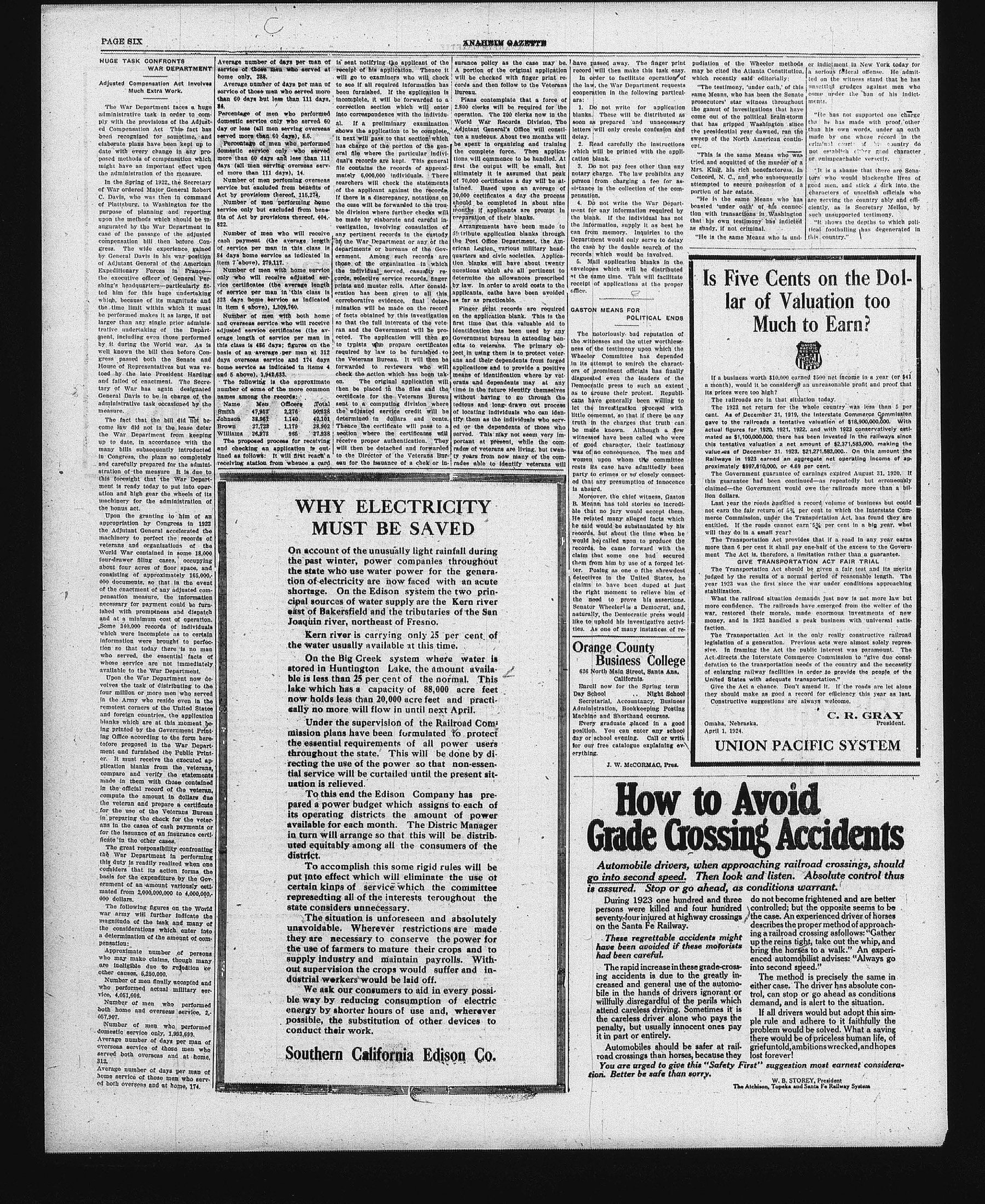
Searchable text
HUGE TASK CONFRONTS WAR DEPARTMENT
Adjusted Compensation Act Involves Much Extra Work.
The War Department faces a huge administrative task in order to comply with the provisions of the Adjusted Compensation Act. This fact has been recognized for sometime, and elaborate plans have been kept up to date with every change in any proposed methods of compensation which might have an important effect upon the administration of the measure.
In the Spring of 1922, the Secretary of War ordered Major General Robert C. Davis, who was then in command of Plattsburg, to Washington for the purpose of planning and reporting upon the methods which should be inaugurated by the War Department in case of the passage of the adjusted compensation bill then before Congress. The wide experience gained by General Davis in his war position of Adjutant General of the American Expeditionary Forces in France—the executive officer of General Pershing's headquarters—particularly fitted him for this huge undertaking which, because of its magnitude and the time limit within which it must be performed makes it as large, if not larger than any single prior administrative undertaking of the Department, including even those performed by it during the World war. As is well known the bill then before Congress passed both the Senate and House of Representatives but was vetoed by the late President Harding and failed of enactment. The Secretary of War has again designated General Davis to be in charge of the administrative task occasioned by the measure.
The fact that the bill did not become law did not in the lease deter the War Department from keeping up to date, in accordance with the many bills subsequently introduced.
Average number of days per man of service of those men who served at home only, 288.
Average number of days per man of service of those men who served more than 60 days but less than 111 days, 84.
Percentage of men who performed domestic service only who served more than 60 days and less than 111 days (all men serving overseas served more than 60 days), 8.5.
Percentage of men who performed domestic service only who served more than 60 days and less than 111 days (all men serving overseas served more than 111 days), 14.
Number of men performing overseas service but excluded from benefits of Act by provisions thereof, 115,274.
Number of men performing home service only but excluded from benefits of Act by provisions thereof, 404,822.
Number of men who will receive cash payment (the average length of service per man in this class is 84 days home service as indicated in item 7 above), 279,117.
Number of men with home service only who will receive adjusted service certificates (the average length of service per man in this class is 223 days home service as indicated in item 6 above), 1,309,760.
Number of men with both home and overseas service who will receive adjusted service certificates (the average length of service per man in this class is 486 days; figures on the basis of an average per man at 312 days overseas service and 174 days home service as indicated in items 4 and 5 above), 1,942,633.
The following is the approximate number of some of the more common names among the records:
Name Men Officers Total
Smith 47,952 2,376 60,328
Johnson 38,961 1,140 40,101
Brown 27,723 1,179 28,902
Williams 26,973 965 27,938
The proposed process for receiving and checking an application is out. It is sent not receipt of will go to see if it has chargederal file wi dual's recordfile containmately 6,0searchersof the applIf there isthe case while divisionbe made byvestigationany pertinentof the War departmentermment.thoseoftheindividualcords selecfprintsandoperationhascorroborationminationwsof factsobso thattheran and threected.Tho typistsrequiredbytheVeteranforwardedchecktheen.Thenbepl certificate sent toa the adjustdeterminedThence the sectionwillreceiveprowillthen
gress passed both the Senate and House of Representatives but was veoed by the late President Harding and failed of enactment. The Secretary of War has again designated General Davis to be in charge of the administrative task occasioned by the measure.
The fact that the bill did not become law did not in the lease deter the War Department from keeping up to date, in accordance with the many bills subsequently introduced in Congress, the plans so completely and carefully prepared for the administration of the measure. It is due to this foresight that the War Department is ready today to put into operation and high gear the wheels of its machinery for the administration of the bonus act.
Upon the granting to him of an appropriation by Congress in 1922 the Adjutant General accelerated the machinery to perfect the records of veterans and organizations of the World War contained in some 18,000 four-drawer filing cases, occupying about four acres of floor space, and consisting of approximately 165,000 documents, so that in the event of the enactment of any adjusted compensation measure, the information necessary for payment could be furnished with promptness and dispatch and at a minimum cost of operation. Some 340,000 records of individuals which were incomplete as to certain information were brought to perfection so that today there is no man who served, the essential facts of whose service are not immediately available to the War Department.
Upon the War Department now devolves the task of distributing to the four million or more men who served in the Army who reside even in the remotest corners of the United States and foreign countries, the application blanks which are at this moment being printed by the Government Printing Office according to the form herefore proposed in the War Department and furnished the Public Printer. It must receive the executed application blanks from the veterans, compare and verify the statements made in them with those contained in the official record of the veteran, compute the amount in dollars due the veteran and prepare a certificate for the use of the Veterans Bureau in preparing the check for the veterans in the cases of cash payments or for the issuance of an insurance certificate in the other cases.
The great responsibility confronting
It must receive the executed application blanks from the veterans,
compare and verify the statements made in them with those contained
in the official record of the veteran,
compute the amount in dollars due
the veteran and prepare a certificate
for the use of the Veterans Bureau in preparing the check for the veterans in the cases of cash payments or
for the issuance of an insurance certificate in the other cases.
The great responsibility confronting the War Department in performing this duty is readily realized when one considers that its action forms the basis for the expenditure by the Government of an amount variously estimated from 2,000,000,000 to 4,000,000,000 dollars.
The following figures on the World war army will further indicate the magnitude of the task and many of the considerations which enter into a determination of the amount of compensation:
Approximate number of persons who may make claims, though many are ineligible due to rejection or other causes, 5,250,000.
Number of men finally accepted and who performed actual military service, 4,051,606.
Number of men who performed both home and overseas service, 2,057,907.
Number of men who performed domestic service only, 1,993,699.
Average number of days per man of overseas service of those men who served both overseas and at home, 312.
Average number of days per man of home service of those men who served both overseas and at home, 174.
ANAHEIM GAZETTE
is sent notifying the applicant of the receipt of his application. Thence it will go to examiners who will check to see if all required information has been furnished. If the application is incomplete, it will be forwarded to a correction section which will enter into correspondence with the individual.
If a preliminary examination shows the application to be complete, it next will pass to that section which has charge of the portion of the general file where the particular individual's records are kept. This general file contains the records of approximately 6,000,000 individuals. There searchers will check the statements of the applicant against the records. If there is a discrepancy, notations on the case will be forwarded to the trouble division where further checks will be made by elaborate and careful investigation, involving consultation of any pertinent records in the custody of the War Department or any of the departments or bureaus of the Government. Among such records are those of the organization in which the individual served, casuity records, selective service records, finger prints and muster rolls. After consideration has been given to all this corroborative evidence, final determination will be made on the record of facts obtained by this investigation so that the full interests of the veteran and the Government will be protected. The application will then go to typists who prepare certificates required by law to be furnished to the Veterans Bureau. It will then be forwarded to reviewers who will check the action which has been taken.
The original application will then be placed in the files and the certificate for the Veterans Bureau sent to a computing division where the adjusted service credit will be determined in dollars and cents. Thence the certificate will pass to a section where the certificates will receive proper authentication. They will then be detached and forwarded.
insurance policy as the case may be. A portion of the original application will be checked with finger print records and then follow to the Veterans Bureau.
Plans contemplate that a force of 2,800 clerks will be required for the operation. The 200 clerks now in the World War Records Division, The Adjutant General's Office will constitute a nucleous. About two months will be spent in organizing and training the complete force. Then applications will commence to be handled. At first the output will be small, but ultimately it is assumed that peak of 70,000 certificates a day will be attained. Based upon an average of 30,000 certificates a day the process should be completed in about nine months if applicants are prompt in preparation of their blanks.
Arrangements have been made to distribute application blanks through the Post Office Department, the American Legion, various military headquarters and civic societies. Application blanks will have about twenty questions which are all pertinent to determine the allowances prescribed by law. In order to avoid costs to the applicants, oaths have been avoided as far as practicable.
Finger print records are required on the application blank. This is the first time that this valuable aid to identification has been used by any Government bureau in extending benefits to veterans. The primary object in using them is to protect veterans and their dependents from forged applications and to provide a positive means of identification whereby veterans and dependents may at any time in the future identify themselves without having to go through the tedious and long drawn out process of locating individuals who can identify them as the individuals who served or the dependents of those who served. This may not seem very important at present, while the comrades of veterans are living but twen
have passed away. The finger print record will then make this task easy.
In order to facilitate operation of the law, the War Department requests cooperation in the following particulars:
1. Do not write for application blanks. These will be distributed as soon as prepared and unnecessary letters will only create confusion and delay.
2. Read carefully the instructions which will be printed with the application blank.
3. Do not pay fees other than any notary charge. The law prohibits any person from charging a fee for assistance in the collection of the compensation.
4. Do not write the War Department for any information required by the blank. If the individual has not the information, supply it as best he can from memory. Inquiries to the Department would only serve to delay the case by the double search of the records which would be involved.
5. Mail application blanks in the envelopes which will be distributed at the same time. This will facilitate receipt of applications at the proper office.
GASTON MEANS FOR POLITICAL ENDS
The notoriously bad reputation of the witnesses and the utter worthlessness of the testimony upon which the Wheeler Committee has depended in its attempt to smirch the characters of prominent officials has finally disgusted even the leaders of the Democratic press to such an extent as to arouse their protest. Republicans have generally been willing to let the investigation proceed with little comment, so that if there be any truth in the charges that truth can be made known. Although a few witnesses have been called who were of good character, their testimony
WHY ELECTRICITY MUST BE SAVED
On account of the unusually light rainfall during the past winter, power companies throughout the state who use water power for the generation of electricity are now faced with an acute shortage. On the Edison system the two principal sources of water supply are the Kern river east of Bakersfield and the tributaries of the San Joaquin river, northeast of Fresno.
Kern river is carrying only 25 per cent of the water usually available at this time.
On the Big Greek system where water is stored in Huntington Lake, the amount available is less than 25 per cent of the normal. This lake which has a capacity of 88,000 acre feet now holds less than 20,000 acre feet and practically no more will flow in until next April.
Under the supervision of the Railroad Commission plans have been formulated to protect the essential requirements of all power users throughout the state. This will be done by directing the use of the power so that non-essential service will be curtailed until the present situation is relieved.
To this end the Edison Company has prepared a power budget which assigns to each of its operating districts the amount of power available for each month. The Distric Manager in turn will arrange so that this will be distributed equitably among all the consumers of the
To this end the Edison Company has prepared a power budget which assigns to each of its operating districts the amount of power available for each month. The Distric Manager in turn will arrange so that this will be distributed equitably among all the consumers of the district.
To accomplish this some rigid rules will be put into effect which will eliminate the use of certain kinps of service which the committee presedting all of the interests throughout the state considers unnecessary.
The situation is unforeseen and absolutely unavoidable. Wherever restrictions are made they are necessary to conserve the power for the use of farmers to mature their crops and to supply industry and maintain payrolls. Without supervision the crops would suffer and industrial workers would be laid off.
We ask our consumers to aid in every possible way by reducing consumption of electric energy by shorter hours of use and, wherever possible, the substitution of other devices to conduct their work.
Southern California Edison Co.
way. The finger print can make this task easy. Facilitate operation of War Department requests the following particular write for application will be distributed as red and unnecessary by create confusion and carefully the instructions printed with the appli-ny fees other than any. The law prohibits any charging a fee for as collection of the com-write the War Depart-formation required by the individual has not supply it as best he inquiries to the hold only serve to delay double search of the would be involved. Application blanks in the will be distributed ee. This will facilitate occations at the proper
pudiation of the Wheeler methods may be cited the Atlanta Constitution, which recently said editorially:
"The testimony, 'under oath,' of this same Means, who has been the Senate prosecutors' star witness throughout the gamut of investigations that have come out of the political brain-storm that has gripped Washington since the presidential year dawned, ran the sweep of the North American continent.
"This is the same Means who was tried, and acquitted of the murder of a Mrs. King, his rich benefactor, in Concord, N.C., and who subsequently attempted to secure possession of a portion of her estate.
"He is the same Means who has boasted 'under oath' of his connection with transactions in Washington that his own testimony has indicted as shady, if not criminal.
"He is the same Means who is und-er indictment in New York today for a serious federal offense. He admitted on the witness stand that he has unsettled grudges against men who come under the ban of his indictments.
"He has not supported one charge that he has made with proof other than his own words, under an oath made by one whose record in the criminal court of his country do not establish either good character or unimpeachable veracity.
"It is a shame that there are Senators who would blacken the lives of good men, and stick a dirk into the characters of unselfish officials who are serving the country ably and efficiently, as is Secretary Mellon, by such unsupported testimony.
"It shows the depths to which political footballing has degenerated in this country."
Is Five Cents on the Dollar of Valuation too Much to Earn?
If a business worth $10,000 earned $500 net income in a year (or $41 a month), would it be considered an unreasonable profit and proof that its prices were too high?
The railroads are in that situation today.
The 1923 net return for the whole country was less than 5 per cent. As of December 31, 1919, the Interstate Commerce Commission gave to the railroads a tentative valuation of $18,900,000,000. With actual figures for 1920, 1921, 1922, and with 1923 conservatively estimated as $1,100,000,000, there has been invested in the railways since this tentative valuation a net amount of $2,371,583,000, making the
If a business worth $10,000 earned $500 net income in a year (or $41 a month), would it be considered an unreasonable profit and proof that its prices were too high?
The railroads are in that situation today.
The 1923 net return for the whole country was less than 5 per cent. As of December 31, 1919, the Interstate Commerce Commission gave to the railroads a tentative valuation of $18,900,000,000. With actual figures for 1920, 1921, 1922, and with 1923 conservatively estimated as $1,100,000,000, there has been invested in the railways since this tentative valuation a net amount of $2,371,583,000, making the value as of December 31, 1923, $21,271,583,000. On this amount the Railways in 1923 earned an aggregate net operating income of approximately $997,610,000 or 4.69 per cent.
The Government guarantee of earnings expired August 31, 1920. If this guarantee had been continued—as repeatedly but erroneously claimed—the Government would owe the railroads more than a billion dollars.
Last year the roads handled a record volume of business but could not earn the fair return of 5% per cent to which the Interstate Commerce Commission, under the Transportation Act, has found they are entitled. If the roads cannot earn 5% per cent in a big year, what will they do in a small year?
The Transportation Act provides that if a road in any year earns more than 6 per cent it shall pay one-half of the excess to the Government. The Act is, therefore, a limitation rather than a guarantee.
GIVE TRANSPORTATION ACT FAIR TRIAL
The Transportation Act should be given a fair test and its merits judged by the results of a normal period of reasonable length. The year 1923 was the first since the war under conditions approaching stabilization.
What the railroad situation demands just now is not more law but more confidence. The railroads have emerged from the welter of the war, restored their morale, made enormous investments of new money, and in 1923 handled a peak business with universal satisfaction.
The Transportation Act is the only really constructive railroad legislation of a generation. Previous acts were almost solely repressive. In framing the Act the public interest was paramount. The Act directs the Interstate Commerce Commission to "give due consideration to the transportation needs of the country and the necessity of enlarging railway facilities in order to provide the people of the United States with adequate transportation."
Give the Act a chance. Don't amend it. If the roads are let alone they should make as good a record for efficiency this year as last.
Constructive suggestions are always welcome.
C. R. GRAY
Omaha, Nebraska,
April 1, 1924.
UNION PACIFIC SYSTEM
How to Avoid Traffic Crossing Accidents
Automobile drivers, when approaching railroad crossings, should slow down second speed. Then look and listen. Absolute control thus ensured. Stop or go ahead, as conditions warrant.
During 1923 one hundred and three automobiles were killed and four hundred forty-four injured at highway crossings in the Santa Fe Railway.
These regrettable accidents might have been avoided if these motorists were careful.
The rapid increase in these grade-cross accidents is due to the greatly increased and general use of the automobiles in the hands of drivers ignorant or only disregardful of the perils which careless driving. Sometimes it is careless driver alone who pays the city, but usually innocent ones pay heart or entirely.
Automobiles should be safer at railcrossings than horses, because they are urged to give this "Safety First" suggestion most earnest considera- better be safe than sorry.
W. B. STOREY, President
The Atchison, Topeka and Santa Fe Railway System