anaheim-gazette 1924-06-12
Scanned page
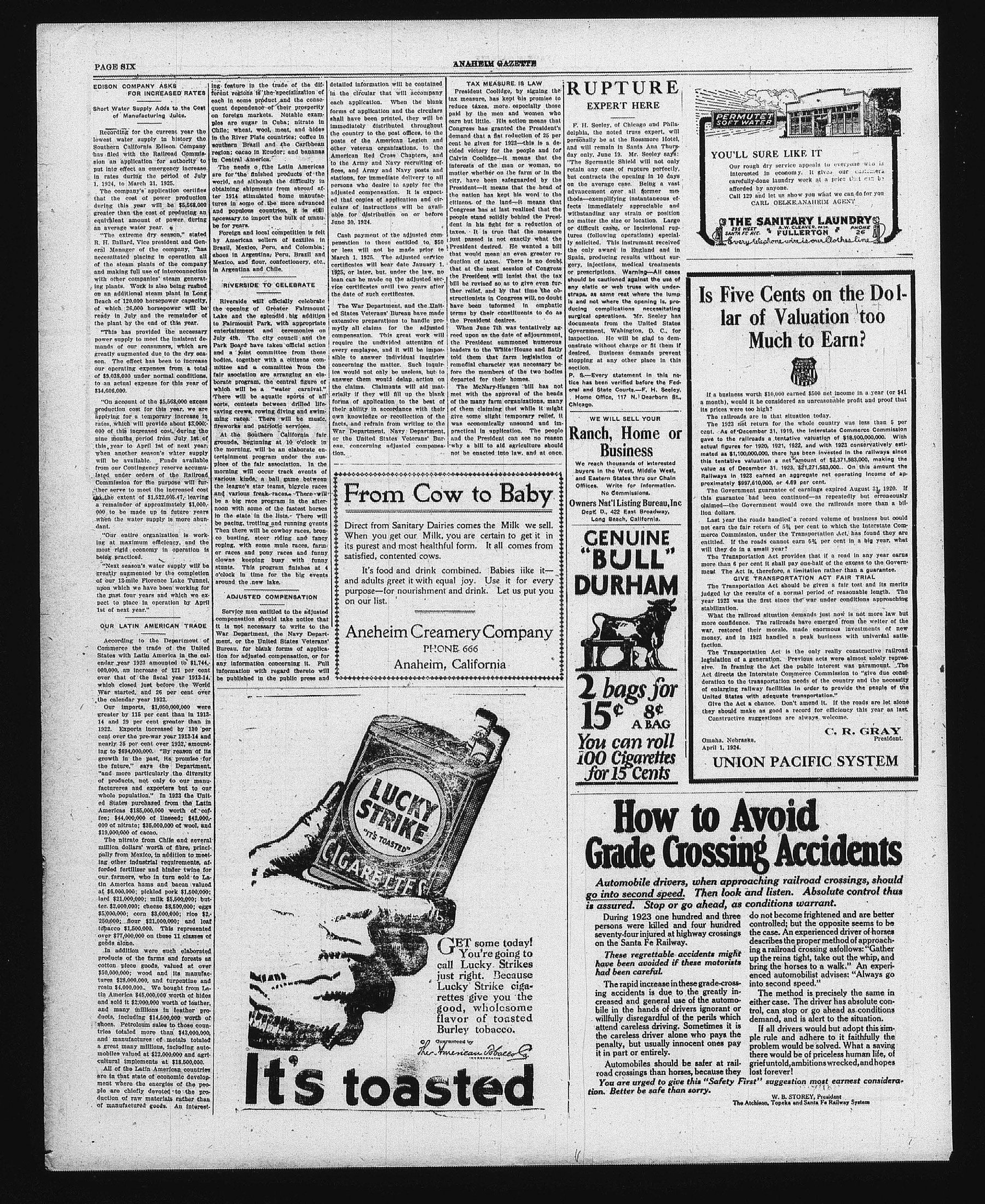
Searchable text
EDISON COMPANY ASKS FOR INCREASED RATES
Short Water Supply Adds to the Cost of Manufacturing Juice.
Recording for the current year the lowest water supply in history the Southern California Edison Company has filed with the Railroad Commission an application for authority to put into effect an emergency increase in rates during the period of July 1, 1924, to March 31, 1925.
The company's application certifies that the cost of power production during this year will be $5,568,000 greater than the cost of producing an equivalent amount of power during an average water year.
"The extreme dry season," stated R. H. Ballard, Vice president and General Manager of the company, "has necessitated placing in operation all of the steam plants of the company and making full use of interconnection with other companies' steam generating plants. Work is also being rushed on an additional steam plant in Long Beach of 120,000 horsepower capacity, of which 26,000 horsepower will be ready in July and the remainder of the plant by the end of this year.
"This has provided the necessary power supply to meet the insistent demands of our consumers, which are greatly augmented due to the dry season. The effect has been to increase our operating expenses from a total of $9,038,000 under normal conditions, to an actual expense for this year of $14,606,000."
"On account of the $5,568,000 excess production cost for this year, we are applying for a temporary increase in rates, which will provide about $3,000; 000 of this increased cost, during the nine months period from July 1st of this year to April 1st of next year; ing feature in the trade of the different regions is the specialization of each in some product and the consequent dependence of their prosperity on foreign markets. Notable examples are sugar in Cuba; nitrate in Chile; wheat, wool, meat, and hides in the River Plate countries; coffee in southern Brazil and the Caribbean region; cacao in Ecuador; and bananas in Central America.
The needs o fthe Latin Americas are for 'the finished products of the world, and although the difficulty in obtaining shipments from abroad after 1914 stimulated home manufactures in some of the more advanced and populous countries, it is still necessary to import the bulk of manu- be for years.
Foreign and local competition is felt by American sellers of textiles in Brazil, Mexico, Peru, and Colombia; shoes in Argentina; Peru, Brazil and Mexico, and flour, confectionery, etc., in Argentina and Chile.
RIVERSIDE TO CELEBRATE
Riverside will officially celebrate the opening of Greater Fairmount Lake and the splendid big addition to Fairmount Park, with appropriate entertainment and ceremonies on July 4th. The city council and the Park Board have taken official action and a joint committee from these bodies, together with a citizens committee and a committee from the fair association are arranging an elaborate program, the central figure of which will be a "water carnival." There will be aquatic sports of all sorts, contests between drilled lifesaving crews, rowing diving and swimming races. There will be music, fireworks and patriotic services.
At the Southern California fair grounds, beginning at 10 o'clock in the morning will be an elaborate on-detailed information in the circuit each applicable forms of appl- ce form have been immediately posted on the other veterans American Ri- to the Army flices, and Air stations, for persons who adjusted com- pleted that copi- culars of im- able for di June 30, 1924.
Cash payment permission to or less will March 1, 1925; certificates w 1925, or later loan can be device certifica- tion date of s
The War I ed States Vee extensive pro- mptly all cli compensation require ther every empla- sible to an concerning les would not answer them the claims. orially if ther forms of ap- their ability own knowledge facts, and re War Depart- or the Unit eau. concern
"On account of the $5,568,000 excess production cost for this year, we are applying for a temporary increase in rates, which will provide about $3,000,000 of this increased cost, during the nine months period from July 1st of this year to April 1st of next year; when another season's water supply will be available. Funds available from our Contingency reserve accumulated under orders of the Railroad Commission for the purpose will further serve to meet the increased cost to the extent of $1,522,605.47, leaving a remainder of approximately $1,000,000 to be made up in future years when the water supply is more abundant.
Our entire organization is working at maximum efficiency, and the most rigid economy in operation is being practiced.
Next season's water supply will be greatly augmented by the completion of our 13-mile Florence Lake Tunnel, upon which we have been working for the past four years and which we expect to place in operation by April 1st of next year."
OUR LATIN AMERICAN TRADE
According to the Department of Commerce the trade of the United States with Latin America in the calendar year 1923 amounted to $1,744,000,000, an increase of 121 per cent over that of the fiscal year 1913-14, which closed just before the World War started, and 26 per cent over the calendar year 1922.
Our imports, $1,050,000,000 were greater by 115 per cent than in 1913-14 and 29 per cent greater than in 1922. Exports increased by 130 per cent over the pre-war year 1913-14 and nearly 25 per cent over 1922; amounting to $694,000,000. "By reason of its growth in the past, its promise for the future," says the Department, "and more particularly the diversity of products, not only to our manufacturers and exporters but to our whole population." In 1923 the United States purchased from the Latin Americas $185,000,000 worth of coffee; $44,000,000 of linseed; $42,000,000 of nitrate; $35,000,000 of wool, and $19,000,000 of cacao.
The nitrate from Chile and several million dollars' worth of fibre, principally to aid bodies together with a citizens committee and a committee from the fair association are arranging an elaborate program, the central figure of which will be a "water carnival." There will be aquatic sports of all sorts, contests between drilled lifesaving crews, rowing diving and swimming races. There will be music, fireworks and patriotic services.
At the Southern California fair grounds, beginning at 10 o'clock in the morning, will be an elaborate entertainment program under the auspices of the fair association. In the morning will occur track events of various kinds, a ball game between the league's star teams, bicycle races and various freak races. There will be a big race program in the afternoon with some of the fastest horses in the state in the lists. There will be pacing, trotting and running events. Then there will be cowboy races, bronco busting, steer riding and fancy roping, with some mule races, farmer races and pony races and funny clowns keeping busy with funny stunts. This program finishes at 4 o'clock in time for the big events around the new lake.
ADJUSTED COMPENSATION
Service men entitled to the adjusted compensation should take notice that it is not necessary to write to the War Department, or the United States Veterans Bureau, for blank forms of application for adjusted compensation, or for any information concerning it. Full information with regard thereto will be published in the public press and
growth in the past, its promise for
the future," says the Department,
"and more particularly the diversity
of products, not only to our manufacturers and exporters but to our
whole population." In 1923 the United States purchased from the Latin
Americas $185,000,000 worth of coffee;
$44,000,000 of linseed; $42,000,
000 of nitrate; $35,000,000 of wool, and
$19,000,000 of cacao.
The nitrate from Chile and several
million dollars' worth of fibre, principally from Mexico, in addition to meeting other industrial requirements, afforded fertilizer and binder twine for
our farmers, who in turn sold to Latin America hams and bacon valued at $6,000,000; pickled pork $1,500,000;
lard $21,000,000; milk $5,500,000; butter $2,000,000; cheese $8,500,000; eggs $5,000,000; corn $3,000,000; rice $2,
250,000; flour $21,000,000; and leaf tobacco $1,500,000. This represented over $77,000,000 on these 11 classes of goods alone.
In addition were such elaborated
products of the farms and forests as cotton piece goods, valued at over $50,000,000; wood and its manufactures $28,000,000, and turpentine and rosin $4,000,000. We bought from Latin America $45,000,000 worth of hides and sold it $2,000,000 worth of leather, and many millions in leather products, including $14,500,000 worth of shoes. Petroleum sales to those countries totaled more than $43,000,000, and manufactures of metals totaled a great many millions, including automobiles valued at $22,000,000 and agricultural implements at $18,500,000.
All of the Latin American countries are in that state of economic development where the energies of the people are chiefly devoted to the production of raw materials rather than of manufactured goods. An interest-
ANAHEIM GAZETTE
detailed information will be contained in the circular that will accompany each application. When the blank forms of application and the circulars shall have been printed, they will be immediately distributed throughout the country to the post offices, to the posts of the American Legion and other veteran organizations, to the American Red Cross Chapters, and to the Army and Navy recruiting offices, and Army and Navy posts and stations, for immediate delivery to all persons who desire to apply for the adjusted compensation. It is expected that copies of application and circulars of instructions will be available for distribution on or before June 30, 1924.
Cash payment of the adjusted compensation to those entitled to $50 or less will not be made prior to March 1, 1925. The adjusted service certificates will bear date January 1, 1925, or later, but under the law, no loan can be made on the adjusted service certificates until two years after the date of such certificates.
The War Department, and the United States Veterans' Bureau have made extensive preparations to handle promptly all claims for the adjusted compensation. This great work will require the undivided attention of every employee, and it will be impossible to answer individual inquiries concerning the matter. Such inquiries would not only be useless, but to answer them would delap action on the claims. Claimants will aid materially if they will fill up the blank forms of application to the best of their ability in accordance with their own knowledge or recollection of the facts, and refrain from writing to the War Department, Navy Department, or the United States Veterans' Bureau, concerning adjusted compensation.
TAX MEASURE IS LAW
President Coolidge, by signing the tax measure, has kept his promise to reduce taxes, more especially those paid by the men and women who earn but little. His action means that Congress has granted the President's demand that a flat reduction of 25 per cent be given for 1923—this is a decided victory for the people and for Calvin Coolidge—it means that the interests of the man or woman, no matter whether on the farm or in the city, have been safeguarded by the President—it means that the head of the nation has kept his word to the citizens of the land—it means that Congress has at last realized that the people stand solidly behind the President in his fight for a reduction of taxes. It is true that the measure just passed is not exactly what the President desired. He wanted a bill that would mean an even greater reduction of taxes. There is no doubt that at the next session of Congress the President will insist that the tax bill be revised so as to give even further relief, and by that time the obstructionists in Congress will, no doubt have informed in emphatic terms by their constituents to do as the President desires.
When June 7th was tentatively agreed upon as the date of adjournment, the President summoned numerous leaders to the White House and flatly told them that farm legislation of remedial character was necessary before the members of the two bodies departed for their homes.
The McNary-Haugen bill has not met with the approval of the heads of many farm organizations, many of them claiming that while it might give some slight temporary relief, it was economically unsound and impractical in application. The people and the President can see no reason why a bill to aid agriculture should
RUPTURE EXPERT HERE
F. H. Seeley, of Chicago and Philadelphia, the noted truss expert, will personally be at the Rossmore Hotel, and will remain in Santa Ana Thursday only, June 19. Mr. Seeley says: "The Spermatic Shield will not only retain any case of rupture perfectly, but contracts the opening in 10 days on the average case. Being a vast advancement over all former methods—exemplifying instantaneous effects immediately appreciable and withstanding any strain or position no matter the size or location. Large or difficult cases, or Incissional ruptures (following operations) specially solicited. This instrument received the only award in England and in Spain, producing results without surgery, injections, medical treatments or prescriptions. Warning—All cases should be cautioned against the use of any elastic or web truss with understraps, as same rest where the lump is and not where the opening is, producing complications necessitating surgical operations. Mr. Seeley has documents from the United States Government, Washington, D. C., for inspection. He will be glad to demonstrate without charge or fit them if desired. Business demands prevent stopping at any other place in this section.
P. S.—Every statement in this notice has been verified before the Federal and State Courts. F. H. Seeley. Home Office, 117 N. Dearborn St., Chicago.
WE WILL SELL YOUR Ranch, Home or Business
From Cow to Baby
Direct from Sanitary Dairies comes the Milk we sell. When you get our Milk, you are certain to get it in its purest and most healthful form. It all comes from satisfied, contented cows.
It's food and drink combined. Babies iike it—and adults greet it with equal joy. Use it for every purpose—for nourishment and drink. Let us put you on our list.
Aneheim Creamery Company
PHONE 666
Anaheim, California
LUCKY STRIKE
"IT'S TOASTED"
WE WILL SELL YOUR Ranch, Home or Business
We reach thousands of interested buyers in the West, Middle West, and Eastern States thru our Chain Offices. Write for Information. No Commissions.
Owners Nat'l Listing Bureau, Inc
Dept. D., 422 East Broadway, Long Beach, California.
GENUINE "BULL" DURHAM
2 bags for 15¢ A BAG
You can roll 100 Cigarettes for 15 Cents
LUCKY
STRIKE
"IT'S TOASTED"
CIGARETTES
GET some today!
You're going to call Lucky Strikes just right. Because Lucky Strike cigarettes give you the good, wholesome flavor of toasted Burley tobacco.
Guaranteed by
The American Tobacco Co.
S toasted
100 Cigarettes for 15 Cents
How to Grade Cross
Automobile drivers, use go into second speed. It is assured. Stop or go.
During 1923 one hundred persons were killed and seventy-four injured at highw on the Santa Fe Railway.
These regrettable accia have been avoided if these had been careful.
The rapid increase in these ing accidents is due to the creased and general use of bile in the hands of drivers willfully disregardful of the attend careless driving. Some the careless driver alone w penalty, but usually innocet it in part or entirely.
Automobiles should be s road crossings than horses,
You are urged to give th tion. Better be safe than so
PERMUTET SOFT WATER
YOU'LL SURE LIKE IT
Our rough dry service appeals to everyone who is interested in economy. It gives our customers carefully-done laundry work at a price that can be afforded by anyone.
Call 129 and let us show you what we can do for you
CARL OELKE, ANAHEIM AGENT
THE SANITARY LAUNDRY
225 WEST
SANTA FE AV. A.W. CLEAVER, PHONE
FULLERTON 26
Every telephone wire is our clothes line
Is Five Cents on the Dollar of Valuation too Much to Earn?
If a business worth $10,000 earned $500 net income in a year (or $41 a month), would it be considered an unreasonable profit and proof that its prices were too high?
The railroads are in that situation today.
The 1923 net return for the whole country was less than 5 per cent. As of December 31, 1919, the Interstate Commerce Commission gave to the railroads a tentative valuation of $18,900,000,000. With actual figures for 1920, 1921, 1922, and with 1923 conservatively esti-
If a business worth $10,000 earned $500 net income in a year (or $41 a month), would it be considered an unreasonable profit and proof that its prices were too high?
The railroads are in that situation today.
The 1923 net return for the whole country was less than 5 per cent. As of December 31, 1919, the Interstate Commerce Commission gave to the railroads a tentative valuation of $18,900,000,000. With actual figures for 1920, 1921, 1922, and with 1923 conservatively estimated as $1,100,000,000, there has been invested in the railways since this tentative valuation a net amount of $2,371,583,000, making the value as of December 31, 1923, $21,271,583,000.. On this amount the Railways in 1923 earned an aggregate net operating income of approximately $997,610,000, or 4.69 per cent.
The Government guarantee of earnings expired August 31, 1920. If this guarantee had been continued—as repeatedly but erroneously claimed—the Government would owe the railroads more than a billion dollars.
Last year the roads handled a record volume of business but could not earn the fair return of 5% per cent to which the Interstate Commerce Commission, under the Transportation Act, has found they are entitled. If the roads cannot earn 5% per cent in a big year, what will they do in a small year?
The Transportation Act provides that if a road in any year earns more than 6 per cent it shall pay one-half of the excess to the Government. The Act is, therefore, a limitation rather than a guarantee.
GIVE TRANSPORTATION ACT FAIR TRIAL
The Transportation Act should be given a fair test and its merits judged by the results of a normal period of reasonable length. The year 1923 was the first since the war under conditions approaching stabilization.
What the railroad situation demands just now is not more law but more confidence. The railroads have emerged from the welter of the war, restored their morale, made enormous investments of new money, and in 1923 handled a peak business with universal satisfaction.
The Transportation Act is the only really constructive railroad legislation of a generation. Previous acts were almost solely repressive. In framing the Act the public interest was paramount. The Act directs the Interstate Commerce Commission to "give due consideration to the transportation needs of the country and the necessity of enlarging railway facilities in order to provide the people of the United States with adequate transportation."
Give the Act a chance. Don't amend it. If the roads are let alone they should make as good a record for efficiency this year as last.
Constructive suggestions are always welcome.
C. R. GRAY
President.
Omaha, Nebraska,
April 1, 1924.
UNION PACIFIC SYSTEM
How to Avoid Traffic Crossing Accidents
Automobile drivers, when approaching railroad crossings, should slow down second speed. Then look and listen. Absolute control thus ensured. Stop or go ahead, as conditions warrant.
During 1923 one hundred and three cars were killed and four hundred people-four injured at highway crossings in Santa Fe Railway.
These regrettable accidents might have been avoided if these motorists were careful.
A rapid increase in grade-crossing incidents is due to the greatly increased and general use of the automobiles on the hands of drivers ignorant or only disregardful of the perils which careless driving. Sometimes it is wireless driver alone who pays the way, but usually innocent ones pay heart or entirely.
Automobiles should be safer at railcrossings than horses, because they are urged to give this "Safety First" suggestion most earnest considera- better be safe than sorry.
W. B. STOREY, President
The Atchison, Topeka and Santa Fe Railway System