anaheim-gazette 1924-06-05
Scanned page
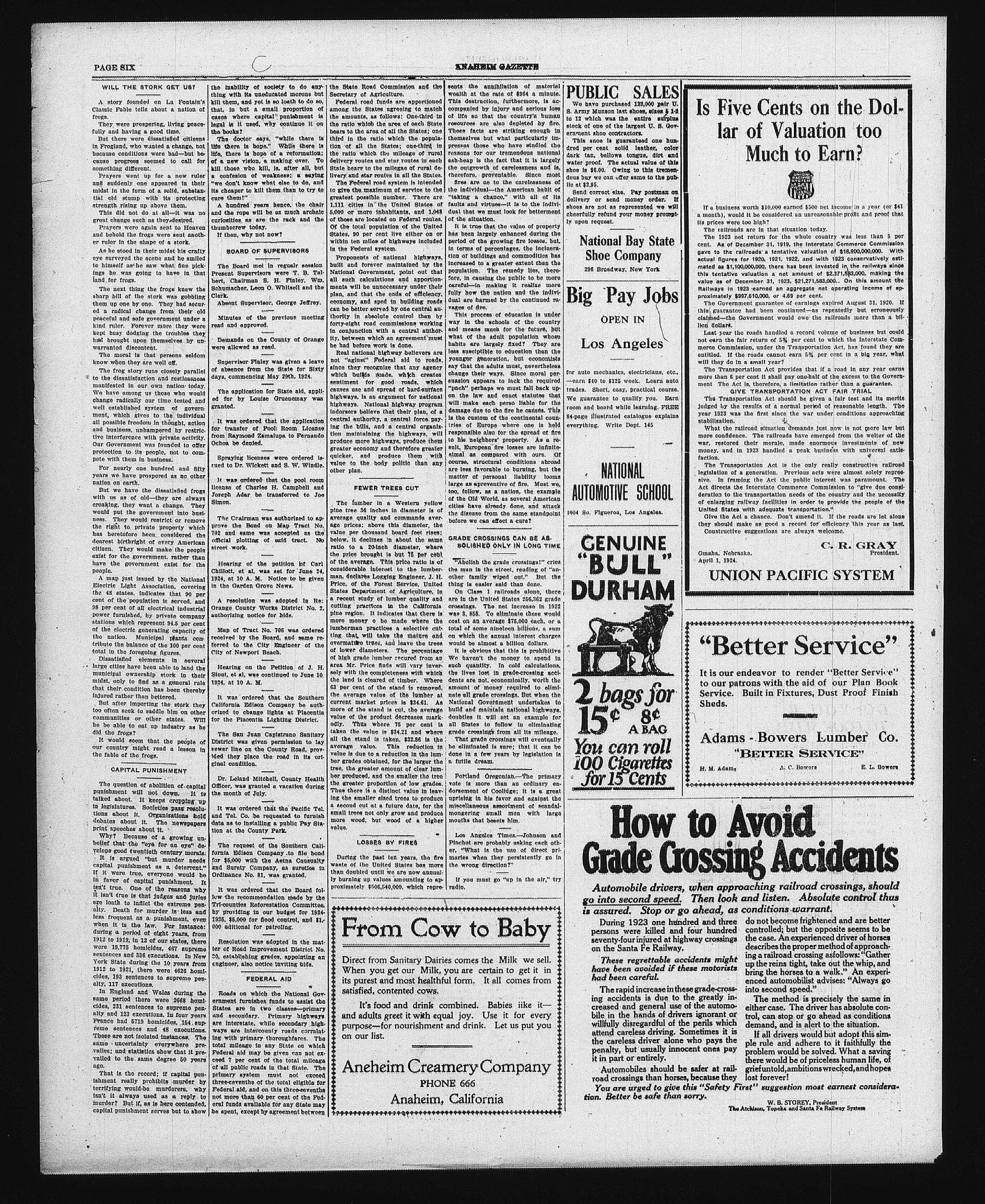
Searchable text
WILL THE STORK GET US?
A story founded on La Fontain's Classic Fable tells about a nation of frogs.
They were prospering, living peacefully and having a good time.
But there were dissatisfied citizens in Frogland, who wanted a change, not because conditions were bad—but because progress seemed to call for something different.
Prayers went up for a new ruler and suddenly one appeared in their midst in the form of a solid, substantial old stump with its protecting strength rising up above them.
This did not do at all—it was no great change such as they desired.
Prayers were again sent to Heaven and behold the frogs were sent another ruler in the shape of a stork.
As he stood in their midst his crafty eye surveyed the scene and he smiled to himself as he saw what fine pickings he was going to have in that land for frogs.
The next thing the frogs knew the sharp bill of the stork was gobbling them up one by one. They had secured a radical change from their old peaceful and safe government under a kind ruler. Forever more they were kept busy dodging the troubles they had brought upon themselves by unwarranted discontent.
The moral is that persons seldom know when they are well off.
The frog story runs closely parallel to the dissatisfaction and restlessness manifested in our own nation today. We have among us those who would change radically our time tested and well established system of government, which gives to the individual all possible freedom in thought, action and business, unhampered by restrictive interference with private activity. Our Government was founded to offer the inability of society to do anything with its uneducated morons but kill them, and yet is so loath to do so, that, in but a small proportion of cases where capital punishment is legal is it used, why continue it on the books?
The doctor says, "while there is life there is hope." While there is life, there is hope of a reformation; of a new vision, a making over. To kill those who kill, is, after all, but a confession of weakness; a saying "we don't know what else to do, and its cheaper to kill them than to try to cure them!"
A hundred years hence, the chair and the rope will be as much archaic curiosities as are the rack and the thumbscrew today.
If then, why not now?
BOARD OF SUPERVISORS
The Board met in regular session Present Supervisors were T. B. Talbert, Chairman S. H. Finley, Wm. Schumacher, Leon O. Whitsell and the Clerk.
Absent Supervisor, George Jeffrey.
Minutes of the previous meeting read and approved.
Demands on the County of Orange were allowed as read.
Supervisor Finley was given a leave of absence from the State for Sixty days, commencing May 29th, 1924.
The application for State aid, applied for by Louise Gruenemay was granted.
It was ordered that the application for transfer of Pool Room License from Raymond Zamalupa to Fernando Ochoa be denied.
the State Roof Secretary of
Federal rooftop among the States the amounts, the ratio while bears to the third in the nation of all the ratio while delivery route State bears to livery and state
The Federals to give the most greatest possessions 1,111 cities 5,000 or more of those are Of the total States, 90 peaks within ten miles in the Federal
Proponents built and for National Gov't all such calculations will be plan, and the economy, and can be better thrority in a forty-eight rooftops between them be had before
Real nation not "against" since they rebuilt which build sentiment causes use at highways, is highways. No indorsers belong central authority in billing tion maintain produce more greater economic
The moral is that persons seldom know when they are well off.
The frog story runs closely parallel to the dissatisfaction and restlessness manifested in our own nation today. We have among us those who would change radically our time tested and well established system of government, which gives to the individual all possible freedom in thought, action and business, unhampered by restrictive interference with private activity. Our Government was founded to offer protection to its people, not to compete with them in business.
For nearly one hundred and fifty years we have prospered as no other nation on earth.
But we have the dissatisfied frogs with us as of old—they are always croaking, they want a change. They would put the government into business. They would restrict or remove the right to private property which has heretofore been considered the dearest birthright of every American citizen. They would make the people exist for the government, rather than have the government exist for the people.
A map just issued by the National Electric Light Association, covering the 48 states, indicates that 90 per cent of the population is served, and 98 per cent of all electrical industrial power furnished, by private company stations which represent 94.5 per cent of the electric generating capacity of the nation. Municipal plants contribute the balance of the 100 per cent total in the foregoing figures.
Dissatisfied elements in several large cities have been able to land the municipal ownership stork in their midst, only to find as a general rule that their condition has been thereby injured rather than bettered.
But after importing the stork they too often seek to saddle him on other communities or other states. Will he be able to eat up industry as he did the frogs?
It would seem that the people of our country might read a lesson in the fable of the frogs.
CAPITAL PUNISHMENT
The question of abolition of capital punishment will not down. It is talked about. It keeps cropping up in legislatures. Societies pass resolutions about it. Organizations hold debates about it. The newspapers print speeches about it.
Why? Because of a growing unbelief that the "eye for an eye" develops good twentieth-century supervisor Finley was given a leave of absence from the State for Sixty days, commencing May 29th, 1924.
The application for State aid, applied for by Louise Gruenemay was granted.
It was ordered that the application for transfer of Pool Room License from Raymond Zamalupa to Fernando Ochoa be denied.
Spraying licenses were ordered issued to Dr. Wickett and S. W. Windle.
It was ordered that the pool room license of Charles H. Campbell and Joseph Adar be transferred to Joe Simon.
The Chairman was authorized to approve the Bond on Map Tract No. 702 and same was accepted as the official plotting of said tract. No street work.
Hearing of the petition of Carl Chillott, et al., was set for June 24, 1924, at 10 A.M. Notice to be given in the Garden Grove News.
A resolution was adopted In Re: Orange County Works District No. 2, authorizing notice for bids.
Map of Tract No. 706 was ordered received by the Board, and same referred to the City Engineer of the City of Newport Beach.
Hearing on the Petition of J. H. Stout, et al., was continued to June 10, 1924, at 10 A.M.
It was ordered that the Southern California Edison Company be authorized to change lights at Placentia for the Placentia Lighting District.
The San Juan Capistrano Sanitary District was given permission to lay sewer line on the County Road, provided they place the road in its original condition.
Dr. Leland Mitchell, County Health Officer, was granted a vacation during the month of July.
It was ordered that the Pacific Tel. and Tel. Co. be requested to furnish data as to installing a public Pay Station at the County Park.
The request of the Southern Calliope not "against" since they relied which build sentiment for causes use highways, highways. No indorsers believe central authority producing more greater economic quicker, and value to the other plan.
FEW
The lumber pine tree 36 average quality prices; value per inch below; it decords ratio to a price break of the average considerable man, declared Price, of the States Department a recent study cutting prairie region. More money lumberman pitting that we overmatured of lower diastolic area Mr. Price solely with the land is costing 63 per cent the average current market more of the value of the eddy. Thus taken the value all the standards average value is due ber grades of tree, the greener produced the greater Thus there is ing the small second cut small trees more wood value.
CAPITAL PUNISHMENT
The question of abolition of capital punishment will not down. It is talked about. It keeps cropping up in legislatures. Societies pass resolutions about it. Organizations hold debates about it. The newspapers print speeches about it.
Why? Because of a growing unbelief that the "eye for an eye" develops good twentieth century morals.
It is argued "but murder needs capital punishment as a deterrent." If it were true, everyone would be in favor of capital punishment. It isn't true. One of the reasons why it isn't true is that judges and juries are loath to inflict the extreme penalty. Death for murder is less and less frequent as a punishment, even when it is the law. For instance: during a period of eight years, from 1912 to 1919, in 12 of our states, there were 19,775 homicides, 467 supreme sentences and 336 executions. In New York State during the 10 years from 1912 to 1921, there were 4626 homicides, 193 sentences to supreme penalty, 117 executions.
In England and Wales during the same period there were 2668 homicides, 231 sentences to supreme penalty and 123 executions. In four years France had 5719 homicides, 154 supreme sentences and 48 executions. These are not isolated instances. The same uncertainty everywhere prevails; and statistics show that it prevailed to the same degree 50 years ago.
That is the record; if capital punishment really prohibits murder by terrifying would-be murderers, why isn't it always used as a reply to murder? But if, as is here contended, capital punishment serves but to show
Dr. Leland Mitchell, County Health Officer, was granted a vacation during the month of July.
It was ordered that the Pacific Tel. and Tel. Co. be requested to furnish data as to installing a public Pay Station at the County Park.
The request of the Southern California Edison Company to file bond for $5,000 with the Aetna Causualty and Surety Company, as sureties in Ordinance No. 81, was granted.
It was ordered that the Board follow the recommendation made by the Tri-counties Reforestation Committee, by providing in our budget for 1924-1925, $5,000 for flood control, and $1,000 additional for patrolling.
Resolution was adopted in the matter of Road Improvement District No. 20, establishing grades, appointing an engineer, also notice inviting bids.
FEDERAL AID
Roads on which the National Government furnishes funds to assist the States are in two classes—primary and secondary. Primary highways are interstate, while secondary highways are intercounty roads correlating with primary thoroughfares. The total mileage in any State on which Federal aid may be given can not exceed 7 per cent of the total mileage of all public roads in that State. The primary system must not exceed three-sevenths of the total eligible for Federal aid, and on this three-sevenths not more than 60 per cent of the Federal funds available for any State may be spent, except by agreement between
the State Road Commission and the Secretary of Agriculture.
Federal road funds are apportioned among the States agreeing to match the amounts, as follows: One-third in the ratio which the area of each State bears to the area of all the States; one third in the ratio which the population of all the States; one-third in the ratio which the mileage of rural delivery routes and star routes in each State bears to the mileage of rural delivery and star routes in all the States.
The Federal road system is intended to give the maximum service to the greatest possible number. There are 1,111 cities in the United States of 5,000 or more inhabitants, and 1,048 of these are located on Federal routes. Of the total population of the United States, 90 per cent live either on or within ten miles of highways included in the Federal system.
Proponents of national highways, built and forever maintained by the National Government, point out that all such calculations and apportions will be unnecessary under their plan, and that the ends of efficiency, economy, and speed in building roads can be better served by one central authority in absolute control than by forty-eight road commissions working in conjunction with a central authority, between which an agreement must be had before work is done.
Real national highway believers are not "against" Federal aid to roads, since they recognize that any agency which builds roads, which creates sentiment for good roads, which causes use and spread of hard-surface highways, is an argument for national highways. National highway program indorsers believe that their plan, of a central authority, a central force paying the bills, and a central organization maintaining the highways, will produce more highways, produce them greater economy and therefore greater presents the annihilation of material wealth at the rate of $964 a minute. This destruction, furthermore, is accompanied by injury and serious loss of life so that the country's human resources are also depleted by fire. These facts are striking enough in themselves but what particularly impresses those who have studied the reasons for our tremendous national ash-heap is the fact that it is largely the outgrowth of carelessness and is, therefore, preventable. Since most fires are due to the carelessness of the individual—the American habit of "taking a chance," with all of its faults and virtues—it is to the individual that we must look for betterment of the situation.
It is true that the value of property has been largely enhanced during the period of the growing fire losses, but, in terms of percentages, the incineration of buildings and commodities has increased to a greater extent than the population. The remedy lies, therefore, in causing the public to be more careful—in making it realize more fully how the nation and the individual are harmed by the continued ravages of fire.
This process of education is under way in the schools of the country and means much for the future, but what of the adult population whose habits are largely fixed? They are less susceptible to education than the younger generation, but economists say that the adults must, nevertheless change their ways. Since moral persuasion appears to lack the required "pnch" perhaps we must fall back upon the law and enact statutes that will make each person liable for the damage due to the fire he causes. This is the custom of the continental countries of Europe where one is held responsible also for the spread of fire to his neighbors' property. As a result, European fire losses are infinite.
PUBLIC SALES
We have purchased 122,000 pair U. S. Army Munson last shoes, sizes 5 1/2 to 12 which was the entire surplus stock of one of the largest U. S. Government shoe contractors.
This shoe is guaranteed one hundred per cent solid leather, color dark tan, bellows tongue, dirt and water proof. The actual value of this shoe is $6.00. Owing to this tremendous buy we can offer same to the public at $2.95.
Send correct size. Pay postman on delivery or send money order. If shoes are not as represented we will cheerfully refund your money promptly upon request.
National Bay State Shoe Company
296 Broadway, New York
Big Pay Jobs
OPEN IN
Los Angeles
for auto mechanics, electricians, etc., earn $40 to $125 week. Learn auto trades. Short, easy, practical course. We guarantee to qualify you. Earn room and board while learning. FREE 84-page illustrated catalogue explains everything. Write Dept. 145
NOT "aginst" Federal aid to roads, since they recognize that any agency which builds roads, which creates sentiment for good roads, which causes use and spread of hard-surface highways, is an argument for national highways. National highway program indorsers believe that their plan, of a central authority, a central force paying the bills, and a central organization maintaining the highways, will produce more highways, produce them greater economy and therefore greater quicker, and produce them with value to the body politic than any other plan.
FEWER TREES CUT
The lumber in a Western yellow pine tree 36 inches in diameter is of average quality and commands average prices; above this diameter, the value per thousand board feet rises; below, it declines in about the same ratio to a 20-inch diameter, where the price brought is but 75 per cent of the average. This price ratio is of considerable interest to the lumberman, declares Logging Engineer, J. H. Price, of the Forest Service, United States Department of Agriculture, in a recent study of lumber quality and cutting practices in the California pine region. It indicates that there is more money o be made where the lumberman practices a selective cutting that will take the mature and overmature trees, and leave the trees of lower diameters. The percentage of high grade lumber secured from an area Mr. Price finds will vary inversely with the completeness with which the land is cleared of timber. Where 63 per cent of the stand is removed, the average value of the lumber at current market prices is $34.61. As more of the stand is cut, the average value of the product decreases markedly. Thus where 75 per cent is taken the value is $34.21 and where all the stand is taken, $32.86 is the average value. This reduction in value is due to a reduction in the lumber grades obtained, for the larger the tree, the greater amount of clear lumber produced, and the smaller the tree the greater proportion of low grades. Thus there is a distinct value in leaving the smaller sized trees to produce a second cut at a future date, for the small trees not only grow and produce more wood, but wood of a higher value.
LOSSES BY FIRES
for auto mechanics, electricians, etc., earn $40 to $125 week. Learn auto trades. Short, easy, practical course. We guarantee to qualify you. Earn room and board while learning. FREE 84-page illustrated catalogue explains everything. Write Dept. 145
GRADE CROSSINGS CAN BE ABOLISHED ONLY IN LONG TIME
"Abolish the grade crossings!" cries the man in the street, reading of "another family wiped out." But the thing is easier said than done.
On Class 1 railroads alone, there are in the United States 256,362 grade crossings. The net increase in 1922 was 3,855. To eliminate these would cost on an average $75,000 each, or a total of some nineteen billion, a sum on which the annual interest charges would be almost a billion dollars.
It is obvious that this is prohibitive We haven't the money to spend in such quantity. In cold calculations, the lives lost in grade-crossing accidents are not economically, worth the amount of money required to eliminate all grade crossings. But when the National Government undertakes to build and maintain national highways, doubts it will set an example for all States to follow in eliminating grade crossings from all its mileage.
That grade crossings will eventually be eliminated is sure; that it can be done in a few years by legislation is a futile dream.
Portland Oregonian.-The primary vote is more than an ordinary endorsement of Coolidge; it is a great uprising in his favor and against the miscellaneous assortment of scandal-mongering small men with large mouths that besets him.
Los Angeles Times.-Johnson and Pinchot are probably asking each other: "What is the use of direct pri-
From Cow to Baby
Direct from Sanitary Dairies comes the Milk we sell. When you get our Milk, you are certain to get it in its purest and most healthful form. It all comes from satisfied, contented cows.
It's food and drink combined. Babies iike it—and adults greet it with equal joy. Use it for every purpose—for nourishment and drink. Let us put you on our list.
Aneheim Creamery Company
PHONE 666
Anaheim, California
Is Five Cents on the Dollar of Valuation too Much to Earn?
If a business worth $10,000 earned $500 net income in a year (or $41 a month), would it be considered an unreasonable profit and proof that its prices were too high?
The railroads are in that situation today.
The 1923 net return for the whole country was less than 5 per cent. As of December 31, 1919, the Interstate Commerce Commission gave to the railroads a tentative valuation of $18,900,000,000. With actual figures for 1920, 1921, 1922, and with 1923 conservatively estimated as $1,100,000,000, there has been invested in the railways since this tentative valuation a net amount of $2,371,583,000, making the value as of December 31, 1923, $21,271,583,000.. On this amount the Railways in 1923 earned an aggregate net operating income of approximately $997,610,000, or 4.69 per cent.
The Government guarantee of earnings expired August 31, 1920. If this guarantee had been continued—as repeatedly but erroneously claimed—the Government would owe the railroads more than a billion dollars.
Last year the roads handled a record volume of business but could not earn the fair return of 5% per cent to which the Interstate Commerce Commission, under the Transportation Act, has found they are entitled. If the roads cannot earn 5% per cent in a big year, what will they do in a small year?
The Transportation Act provides that if a road in any year earns more than 6 per cent it shall pay one-half of the excess to the Government. The Act is, therefore, a limitation rather than a guarantee.
GIVE TRANSPORTATION ACT FAIR TRIAL
The Transportation Act should be given a fair test and its merits judged by the results of a normal period of reasonable length. The year 1923 was the first since the war under conditions approaching stabilization.
What the railroad situation demands just now is not more law but more confidence. The railroads have emerged from the welter of the war, restored their morale, made enormous investments of new materials and equipment. In 1933, handled with universal care.
The Transportation Act provides that if a road in any year earns more than 6 per cent it shall pay one-half of the excess to the Government. The Act is, therefore, a limitation rather than a guarantee.
GIVE TRANSPORTATION ACT FAIR TRIAL
The Transportation Act should be given a fair test and its merits judged by the results of a normal period of reasonable length. The year 1923 was the first since the war under conditions approaching stabilization.
What the railroad situation demands just now is not more law but more confidence. The railroads have emerged from the welter of the war, restored their morale, made enormous investments of new money, and in 1923 handled a peak business with universal satisfaction.
The Transportation Act is the only really constructive railroad legislation of a generation. Previous acts were almost solely repressive. In framing the Act the public interest was paramount. The Act directs the Interstate Commerce Commission to "give due consideration to the transportation needs of the country and the necessity of enlarging railway facilities in order to provide the people of the United States with adequate transportation."
Give the Act a chance. Don't amend it. If the roads are let alone they should make as good a record for efficiency this year as last.
Constructive suggestions are always welcome.
C. R. GRAY
President.
Omaha, Nebraska.
April 1, 1924.
UNION PACIFIC SYSTEM
"Better Service"
It is our endeavor to render "Better Service" to our patrons with the aid of our Plan Book Service. Built in Fixtures, Dust Proof Finish Sheds.
Adams - Bowers Lumber Co.
"BETTER SERVICE"
H. M. Adams
A. C. Bowers
E. L. Bowers
How to Avoid Traffic Crossing Accidents
Mobile drivers, when approaching railroad crossings, should slow down at second speed. Then look and listen. Absolute control thus ensured. Stop or go ahead, as conditions warrant.
In 1923 one hundred and three mobile drivers were killed and four hundred were injured at highway crossings in Santa Fe Railway.
Regrettable accidents might be avoided if these motorists were careful.
A rapid increase in grade-crossing incidents is due to the greatly increased and general use of the automobiles the hands of drivers ignorant or disregardful of the perils which careless driving. Sometimes it is a careless driver alone who pays the cost, but usually innocent ones pay little or entirely.
Mobiles should be safer at railroad crossings than horses, because they do not become frightened and are better controlled; but the opposite seems to be the case. An experienced driver of horses describes the proper method of approaching a railroad crossing as follows: "Gather up the reins tight, take out the whip, and bring the horses to a walk." An experienced automobilist advises: "Always go into second speed."
The method is precisely the same in either case. The driver has absolute control, can stop or go ahead as conditions demand, and is alert to the situation.
If all drivers would but adopt this simple rule and adhere to it faithfully the problem would be solved. What a saving there would be of priceless human life, of grief untold, ambitions wrecked, and hopes lost forever!
We are urged to give this "Safety First" suggestion most earnest consideration be safe than sorry.
W. B. STOREY, President
The Atchison, Topeka and Santa Fe Railway System