anaheim-gazette 1924-05-15
Scanned page
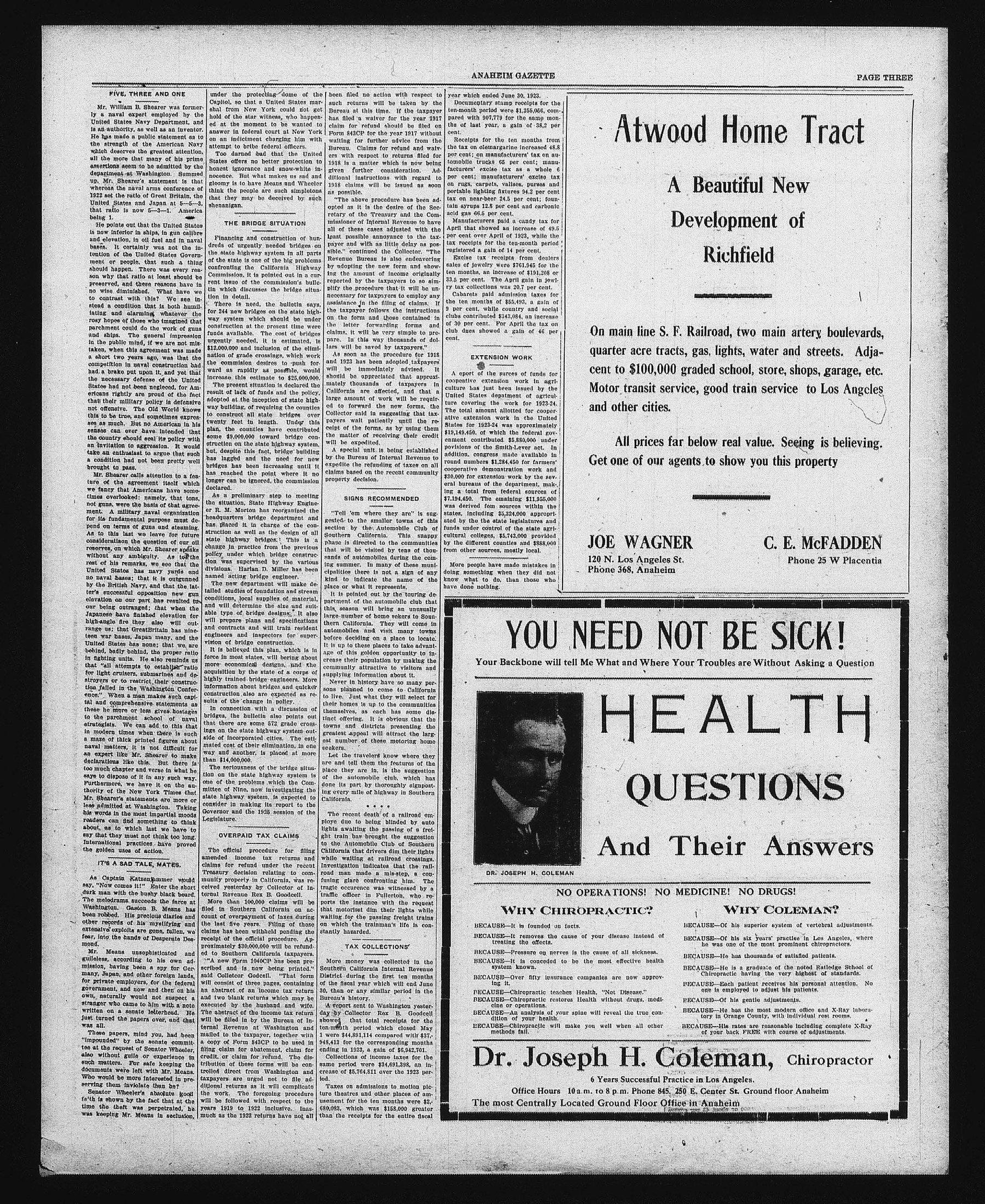
Searchable text
FIVE, THREE AND ONE
Mr. William B. Shearer was formerly a naval expert employed by the United States Navy Department, and is an authority, as well as an inventor. He has made a public statement as to the strength of the American Navy which deserves the greatest attention, all the more that many of his prime assertions seem to be admitted by the department at Washington. Summed up, Mr. Shearer's statement is that whereas the naval arms conference of 1922 set the ratio of Great Britain, the United States and Japan at 5—5—3, that ratio is now 5—3—1. America being 1.
He points out that the United States is now inferior in ships, in gun calibre and elevation, in oil fuel and in naval bases. It certainly was not the intention of the United States Government or people, that such a thing should happen. There was every reason why that ratio at least should be preserved, and these reasons have in no wise diminished. What have we to contrast with this? We see instead a condition that is both humiliating and alarming whatever the rosy hopes of those who imagined that parchment could do the work of guns and ships. The general impression in the public mind, if we are not mistaken, when this agreement was made a short two years ago, was that the competition in naval construction had had a brake put upon it, and yet that the necessary defense of the United States had not been neglected, for Americans rightly are proud of the fact that their military policy is defensive not offensive. The Old World knows this to be true, and sometimes expresses as much. But no American in his senses can ever have intended that the country should seal its policy with an invitation to aggression. It would under the protecting dome of the Capitol, so that a United States marshal from New York could not get hold of the star witness, who happened at the moment to be wanted to answer in federal court at New York on an indictment charging him with attempt to bribe federal officers.
Too darned bad that the United States offers no better protection to honest ignorance and snow-white innocence. But what makes us sad and gloomy is to have Means and Wheeler think the people are such simpletons that they may be deceived by such shenanigan.
THE BRIDGE SITUATION
Financing and construction of hundreds of urgently needed bridges on the state highway system in all parts of the state is one of the big problems confronting the California Highway Commission, it is pointed out in a current issue of the commission's bulletin which discusses the bridge situation in detail.
There is need, the bulletin says, for 244 new bridges on the state highway system which should be under construction at the present time were funds available. The cost of bridges urgently needed, it is estimated, is $12,000,000 and inclusion of the elimination of grade crossings, which work the commission desires to push forward as rapidly as possible, would increase this estimate to $25,000,000.
The present situation is declared the result of lack of funds and the policy, adopted at the inception of state highway building, of requiring the counties to construct all state bridges over twenty feet in length. Under this plan, the counties have contributed some $9,000,000 toward bridge construction on the state highway system,
been filed no such returns Bureau at tha has filed a w claim for re Form 843CP waiting for Bureau. Claims with resi 1918 is a ma given further ditional instr 1918 claims as possible.
"The above opted as it is retary of the missioner of N all of these least possible payer and wil sible." continue Revenue Burge by adopting t ing the amount reported by t plyf y the proc ess necessary for assistance in the taxpayer on the form i he letter i claims, it will pare. In this lars will be s
As soon as and 1923 has will be immi should be ap mately thousa California are large amount ed to forward Collector said payers wait ceil of the f othe matter o will be expe
a short two years ago, was that the competition in naval construction had had a brake put upon it, and yet that the necessary defense of the United States had not been neglected, for Americans rightly are proud of the fact that their military policy is defensive not offensive. The Old World knows this to be true, and sometimes expresses as much. But no American in his senses can ever have intended that the country should seal its policy with an invitation to aggression. It would take an enthusiast to argue that such a condition had not been pretty well brought to pass.
Mr. Shearer calls attention to a feature of the agreement itself which we fancy that Americans have sometimes overlooked: namely, that tons, not guns, were the basis of that agreement. A military naval organization for its fundamental purpose must depend on terms of guns and steaming. As to this last we leave for future consideration the question of our oil reserves, on which Mr. Shearer speaks without any ambiguity. As to the rest of his remarks, we see that the United States has navy yards and no naval bases; that it is outgunned by the British Navy, and that the latter's successful opposition new gun elevation on our part has resulted in our being outranged; that when the Japanese have finished elevation for high-angle fire they also will outrange us; that Great Britain has nineteen war bases, Japan many, and the United States has none; that we are behind, badly behind, the proper ratio in fighting units. He also reminds us that "all attempts to establish ratio for light cruisers, submarines and destroyers or to restrict their construction failed in the Washington Conference." When a man makes such capital and comprehensive statements as these he more or less gives hostages to the parchment school of naval strategists. We can add to this that in modern times when there is such a maze of thick printed figures about naval matters, it is not difficult for an expert like Mr. Shearer to make declarations like this. But there is too much chapter and verse in what he says to dispose of it in any such way. Furthermore, we have it on the authority of the New York Times that Mr. Shearer's statements are more or less admitted at Washington. Taking his words in the most impartial mood readers can find something to think about, as to which last we have to say that they must not think too long. International practices have proved the golden uses of action.
The present situation is declared the result of lack of funds and the policy, adopted at the inception of state highway building, of requiring the counties to construct all state bridges over twenty feet in length. Under this plan, the counties have contributed some $9,000,000 toward bridge construction on the state highway system, but despite this fact, bridge building has lagged and the need for new bridges has been increasing until it has reached the point where it no longer can be ignored, the commission declared.
As a preliminary step to meeting the situation, State Highway Engineer R. M. Morton has reorganized the headquarters bridge department and has placed it in charge of the construction as well as the design of all state highway bridges. This is a change in practice from the previous policy under which bridge construction was supervised by the various divisions. Harlan D. Miller has been named acting bridge engineer.
The new department will make detailed studies of foundation and stream conditions, local supplies of material, and will determine the size and suitable type of bridge designs. It also will prepare plans and specifications and contracts and will train resident engineers and inspectors for supervision of bridge construction.
It is believed this plan, which is in force in most states, will bering about more economical designs, and the acquisition by the state of a corps of highly trained bridge engineers. More information about bridges and quicker construction also are expected as results of the change in policy.
In connection with a discussion of bridges, the bulletin also points out that there are some 572 grade crossings on the state highway system outside of incorporated cities. The estimated cost of their elimination, in one way and another, is placed at more than $14,000,000.
The seriousness of the bridge situation on the state highway system is one of the problems which the Committee of Nine, now investigating the state highway system, is expected to consider in making its report to the Governor and the 1925 session of the Legislature.
OVERPAID TAX CLAIMS
The official procedure for filing nation of grade crossings, which work the commission desires to push forward as rapidly as possible, would increase this estimate to $25,000,000.
The present situation is declared the result of lack of funds and the policy, adopted at the inception of state highway building, of requiring the counties to construct all state bridges over twenty feet in length. Under this plan, the counties have contributed some $9,000,000 toward bridge construction on the state highway system, but despite this fact, bridge building has lagged and the need for new bridges has been increasing until it has reached the point where it no longer can be ignored, the commission declared.
As a preliminary step to meeting the situation, State Highway Engineer R. M. Morton has reorganized the headquarters bridge department and has placed it in charge of the construction as well as the design of all state highway bridges. This is a change in practice from the previous policy under which bridge construction was supervised by the various divisions. Harlan D. Miller has been named acting bridge engineer.
The new department will make detailed studies of foundation and stream conditions, local supplies of material, and will determine the size and suitable type of bridge designs. It also will prepare plans and specifications and contracts and will train resident engineers and inspectors for supervision of bridge construction.
It is believed this plan, which is in force in most states, will bering about more economical designs, and the acquisition by the state of a corps of highly trained bridge engineers. More information about bridges and quicker construction also are expected as results of the change in policy.
In connection with a discussion of bridges, the bulletin also points out that there are some 572 grade crossings on the state highway system outside of incorporated cities. The estimated cost of their elimination, in one way and another, is placed at more than $14,000,000.
The seriousness of the bridge situation on the state highway system is one of the problems which the Committee of Nine, now investigating the state highway system, is expected to consider in making its report to the Governor and the 1925 session of the Legislature.
OVERPAID TAX CLAIMS
The official procedure for filing nation of grade crossings, which work the commission desires to push forward as rapidly as possible, would increase this estimate to $25,000,000.
The present situation is declared the result of lack of funds and the policy, adopted at the inception of state highway building, of requiring the counties to construct all state bridges over twenty feet in length. Under this plan, the counties have contributed some $9,000,000 toward bridge construction on the state highway system, but despite this fact, bridge building has lagged and the need for new bridges has been increasing until it has reached the point where it no longer can be ignored, the commission declared.
As soon as asked by the Bureau expedite the reclaims based on property decisions,
SIGNS
"Tell 'em what gested to you section by th Southern California phase is direct that will be wands of automobiles before deciding it up to these age of this go create their po community att supplying inform
Never in hist sons planned to live. Just w their homes is themselves, assist offering towns and dis greatest appeal est number o seekers.
Let the traveller are and tell them place they are off of the automobile done its part b ing every mile o California.
The recent de ploye due to b lights awaiting ght train has b lo to the Automotive California that o
IT'S A SAD TALE, MATES.
As Captain Katzenjimmer would say, "Now comes it!" Enter the short dark man with the bushy black beard. The melodrama succeeds the farce at Washington. Gaston B. Means has been robbed. His precious diaries and other records of his mystifying and extensive exploits are gone, fallen, we fear, into the hands of Desperate Desmond.
Mr. Means unsophisticated and guileless, according to his own admission, having been a spy for Germany, Japan, and other foreign lands, for private employers, for the federal government, and now and then on his own, naturally would not suspect a stranger who came to him with a note written on a senate letterhead. He just turned the papers over, and that was all.
These papers, mind you, had been "impounded" by the senate committee at the request of Senator Wheeler, also without guile or experience in such matters. For safe keeping the documents were left with Mr. Means. Who would be more interested in preserving them inviolate than he?
Senator Wheeler's absolute good faith is shown by the fact that at the time the theft was perpetrated, he was keeping Mr. Means in seclusion,
The official procedure for filing amended income tax returns and claims for refund under the recent Treasury decision relating to community properly in California, was received yesterday by Collector of Internal Revenue Rex B. Goodcell.
More than 100,000 claims will be filed in Southern California on account of overpayment of taxes during the last five years. Filling of these claims has been withheld pending the receipt of the official procedure. Approximately $30,000,000 will be refunded to Southern California taxpayers.
"A new Form 1040CP has been prescribed and is now being printed." said Colletcor Godcell. "That form will consist of three pages, containing an abstract of an income tax return and two blank returns which may be executed by the husband and wife. The abstract of the income tax return will be filled in by the Bureau of Internal Revenue at Washington and mailed to the taxpayer, together with a copy of Form 843CP to be used in filing claim for abatement, claim for credit, or claim for refund. The distribution of these forms will be controlled direct from Washington and taxpayers are urged not to file additional returns as it will complicate the work. The foregoing procedure will be followed with respect to the years 1919 to 1922 inclusive. Inasmuch as the 1923 returns have not all than $14,000,000.
The seriousness of the bridge situation on the state highway system is one of the problems which the Committee of Nine, now investigating the state highway system, is expected to consider in making its report to the Governor and the 1925 session of the Legislature.
OVERPAID TAX CLAIMS
More money from Southern California District during the fiscal year 30, than or any Bureau's history.
A report sent day by Colletcor showed that the ten-month period 1 were $44,891,111,948,413 for the ending in 1923.
Collections of same period were crease of $5,764,104.
Taxes on admiration theatres and usement for the 680,083, which than the receipt
ANAHEIM GAZETTE
been filed no action with respect to such returns will be taken by the Bureau at this time. If the taxpayer has filed a waiver for the year 1917 claim for refund should be filed on Form 843CP for the year 1917 without waiting for further advice from the Bureau. Claims for refund and waivers with respect to returns filed for 1918 is a matter which is now being given further consideration. Additional instructions with regard to 1918 claims will be issued as soon as possible.
"The above procedure has been adopted as it is the desire of the Secretary of the Treasury and the Commissioner of Internal Revenue to have all of these cases adjusted with the least possible annoyance to the taxpayer and with as little delay as possible." continued the Collector. "The Revenue Bureau is also endeavoring by adopting the new form and showing the amount of income originally reported by the taxpayers to so simplify the procedure that it will be unnecessary for taxpayers to employ any assistance in the filing of claims. If the taxpayer follows the instructions on the form and those contained in the letter forwarding forms and claims, it will be very simple to prepare. In this way thousands of dollars will be saved by taxpayers."
As soon as the procedure for 1918 and 1923 has been adopted taxpayers will be immediately advised. It should be appreciated that approximately thousands of taxpayers in California are affected, and that a large amount of work will be required to forward the new forms, the Collector said in suggesting that taxpayers wait patiently until the receipt of the forms, as by using them the matter of receiving their credit will be expedited.
A year which ended June 30, 1923.
Documentary stamp receipts for the ten-month period were $1,255,056 compared with 907,779 for the same months of last year, a gain of 38.2 per cent.
Receipts for the ten months from the tax on olemargarine increased 48.8 per cent; on manufacturers' tax on automobile trucks 65 per cent; manufacturers' excise tax as a whole 6 per cent; manufacturers' excise tax on rugs, carpets, valises, purses and portable lighting fixtures 94.2 per cent tax on near-beer 24.5 per cent; fountain syrups 12.8 per cent and carbonic acid gas 66.5 per cent.
Manufacturers paid a candy tax for April that showed an increase of 49.5 per cent over April of 1923, while the tax receipts for the ten-month period registered a gain of 14 per cent.
Excise tax receipts from dealers sales of jewelry were $761,945 for the ten months, an increase of $191,208 or 33.5 per cent. The April gain in jewlry tax collections was 20.7 per cent.
Cabarets paid admission taxes for the ten months of $55,493, a gain of 9 per cent, while country and social clubs contributed $343,084, an increase of 30 per cent. For April the tax on club dues showed a gain of 46 per cent.
EXTENSION WORK
A sport of the surces of funds for cooperative extension work in agriculture has just been issued by the United States department of agriculture covering the work for 1923-24. The total amount allotted for cooperative extension work in the United States for 1923-24 was approximately $19,149,450, of which the federal government contributed $5,880,000 under provisions of the Smith-Lever act.
As soon as the procedure for 1918 and 1923 has been adopted, taxpayers will be immediately advised. It should be appreciated that approximately thousands of taxpayers in California are affected, and that a large amount of work will be required to forward the new forms, the Collector said in suggesting that taxpayers wait patiently until the receipt of the forms, as by using them the matter of receiving their credit will be expedited.
A special unit is being established by the Bureau of Internal Revenue to expedite the refunding of taxes on all claims based on the recent community property decision.
SIGNS RECOMMENDED
"Tell 'em where they are" is suggested to the smaller towns of this section by the Automobile Club of Southern California. This snappy phase is directed to the communities that will be visited by tens of thousands of automobiles during the coming summer. In many of these municipalities there is not a sign of any kind to indicate the name of the place or what it represents.
It is pointed out by the touring department of the automobile club that this season will bring an unusually large number of home seekers to Southern California. They will come in automobiles and visit many towns before deciding on a place to locate. It is up to these places to take advantage of this golden opportunity to increase their population by making the community attractive to visitors and supplying information about it.
Never in history have so many persons planned to come to California to live. Just what they will select for their homes is up to the communities themselves, as each has some distinct offering. It is obvious that the towns and districts presenting the greatest appeal will attract the largest number of these motoring home seekers.
Let the travelers know where they are and tell them the features of the place they are in, is the suggestion of the automobile club, which has done its part by thoroughly signposting every mile of highway in Southern California.
The recent death of a railroad employee due to being blinded by auto lights awaiting the passing of a freight train has brought the suggestion to the Automobile Club of Southern California that drivers dim their lights.
EXTENSION WORK
A sport of the surges of funds for cooperative extension work in agriculture has just been issued by the United States department of agriculture covering the work for 1923-24. The total amount allotted for cooperative extension work in the United States for 1923-24 was approximately $19,149,450, of which the federal government contributed $5,880,000 under provisions of the Smith-Lever act. In addition, congress made available in round numbers $1,284,450 for farmers' cooperative demonstration work and $30,000 for extension work by the several bureaus of the department, making a total from federal sources of $7,194,450. The emaining $11,955,000 was derived from sources within the states, including $5,324,000 appropriated by the state legislatures and funds under control of the state agricultural colleges, $5,743,000 provided by the different counties and $888,000 from other sources, mostly local.
More people have made mistakes in doing something when they did not know what to do, than those who have done nothing.
YOU NEED NOT
Your Backbone will tell Me What and Where Your
The recent death of a railroad employee due to being blinded by auto lights awaiting the passing of a freight train has brought the suggestion to the Automobile Club of Southern California that drivers dim their lights while waiting at railroad crossings. Investigation indicates that the railroad man made a mis-step, a confusing glare confronting him. The tragic occurrence was witnessed by a traffic officer in Fullerton, who reports the instance with the request that motorist dim their lights while waiting for the passing freight trains on which the trainman's life is constantly hazarded.
TAX COLLECTIONS
More money was collected in the Southern California Internal Revenue District during the first ten months of the fiscal year which will end June 30, than or any similar period in the Bureau's history.
A report sent to Washington yesterday by Collector Rex B. Goodcell showed that total receipts for the ten-month period which closed May 1 were $44,891,114 compared with $37,948,413 for the corresponding months ending in 1923, a gain of $6,942,701.
Collections of income taxes for the same period were $34,691,398, an increase of $5,764,811 over the 1923 period.
Taxes on admissions to motion picture theatres and other places of amusement for the ten months were $2,680,083, which was $158,000 greater than the receipts for the entire fiscal
NO OPERATIONS! NO MEDICAL WHY CHIROPRACTIC?
BECAUSE—It is founded on facts.
BECAUSE—It removes the cause of your disease instead of treating the effects.
BECAUSE—Pressure on nerves is the cause of all sickness.
BECAUSE—It is conceded to be the most effective health system known.
BECAUSE—Over fifty insurance companies are now approving it.
BECAUSE—Chiropractic teaches Health, "Not Disease."
BECAUSE—Chiropractic restores Health without drugs, medicine or operations.
BECAUSE—An analysis of your spine will reveal the true condition of your health.
BECAUSE—Chiropractic will make you well when all other methods fail.
Dr. Joseph H. Coleman
6 Years Successful Practice
Office Hours 10 a.m. to 8 p.m. Phone 845. 250 E.
The most Centrally Located Ground Floor Office in
Atwood Home Tract
A Beautiful New
Development of
Richfield
rain line S. F. Railroad, two main artery boulevards,
water acre tracts, gas, lights, water and streets. Adjato $100,000 graded school, store, shops, garage, etc.
transit service, good train service to Los Angeles
other cities.
All prices far below real value. Seeing is believing.
to $100,000 graded school, store, shops, garage, etc.
transit service, good train service to Los Angeles
other cities.
All prices far below real value. Seeing is believing.
one of our agents to show you this property
WAGNER
Los Angeles St.
368, Anaheim
C. E. McFADDEN
Phone 25 W Placentia
ED NOT BE SICK!
and Where Your Troubles are Without Asking a Question
HEALTH
QUESTIONS
nd Their Answers
QUESTIONS
and Their Answers
NOTES! NO MEDICINE! NO DRUGS!
CTIC?
WHY COLEMAN?
BECAUSE—Of his superior system of vertebral adjustments.
BECAUSE—Of his six years' practice in Los Angeles, where he was one of the most prominent chiropractors.
BECAUSE—He has thousands of satisfied patients.
BECAUSE—He is a graduate of the noted Ratledge School of Chiropractic having the very highest of standards.
BECAUSE—Each patient receives his personal attention. No one is employed to adjust his patients.
BECAUSE—Of his gentle adjustments.
BECAUSE—He has the most modern office and X-Ray laboratory in Orange County, with individual rest rooms.
BECAUSE—His rates are reasonable including complete X-Ray of your back FREE with course of adjustments.
H. Coleman, Chiropractor
Successful Practice in Los Angeles.
m. Phone 845. 250 E. Center St. Ground floor Anaheim
Floor Office in Anaheim