anaheim-gazette 1924-04-24
Scanned page
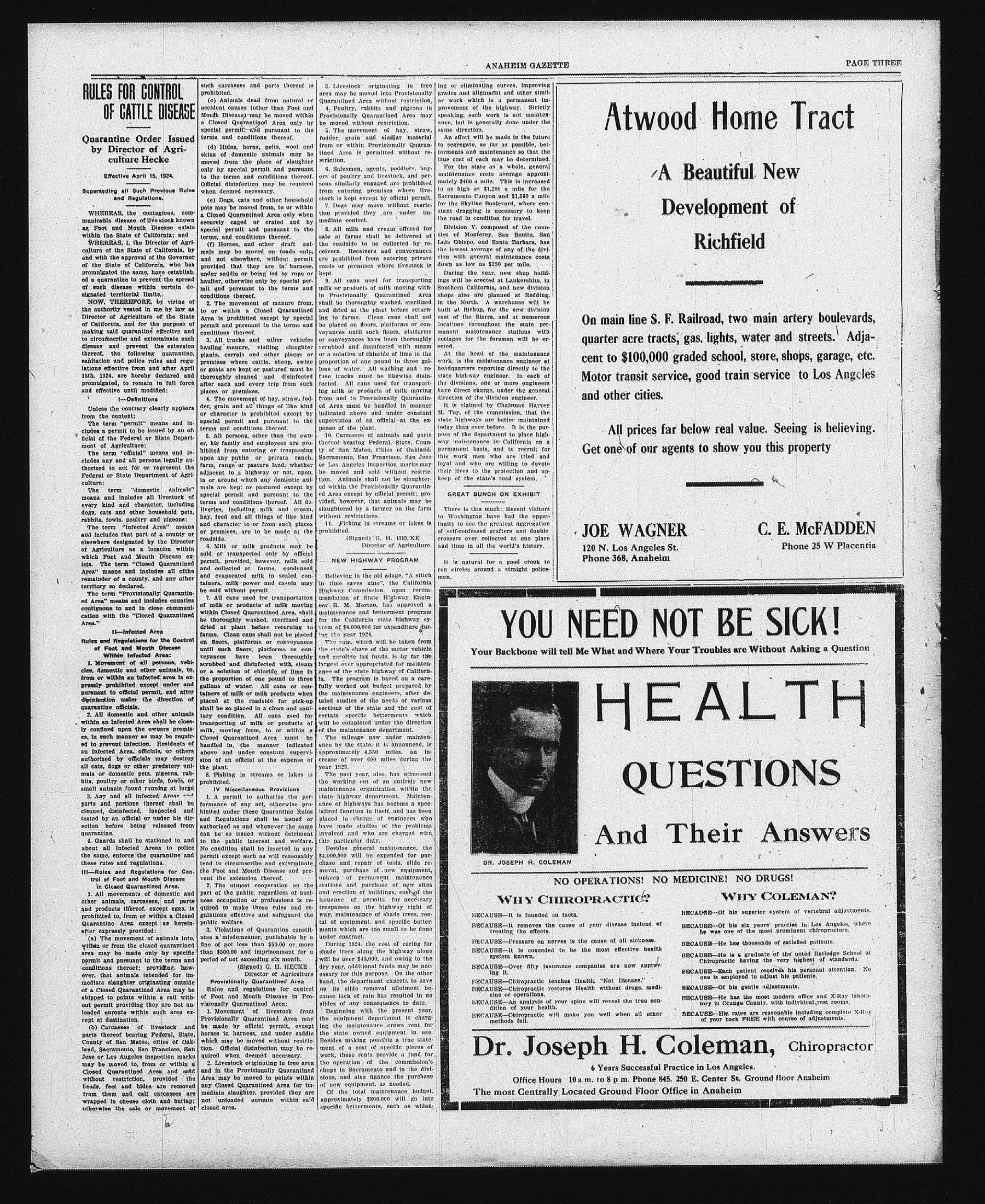
Searchable text
RULES FOR CONTROL OF CATTLE DISEASE
Quarantine Order Issued by Director of Agriculture Hecke
Effective April 15, 1924.
Supereding all Such Previous Rules and Regulations.
WHEREAS, the contagious, communicable disease of livestock known as Foot and Mouth Disease exists within the State of California; and
WHEREAS, I, the Director of Agriculture of the State of California, by and with the approval of the Governor of the State of California, who has promulgated the same, have established a quarantine to prevent the spread of such disease within certain designated territorial limits.
NOW, THEREFORE, by virtue of the authority vested in me by law as Director of Agriculture of the State of California, and for the purpose of making said quarantine effective and to circumscribe and exterminate such disease and prevent the extension thereof, the following quarantine, sanitation and police rules and regulations effective from and after April 15th, 1924, are hereby declared and promulgated, to remain in full force and effective until modified:
I—Definitions
Unless the contrary clearly appears from the context;
The term "permit" means and includes a permit to be issued by an official of the Federal or State Department of Agriculture:
such carcasses and parts thereof is prohibited.
(c) Animals dead from natural or accident causes (other than Foot and Mouth Disease) may be moved within a Closed Quarantined Area only by special permit and pursuant to the terms and conditions thereof.
(d) Hides, horns, pelts, wool and skins of domestic animals may be moved from the place of slaughter only by special permit and pursuant to the terms and conditions thereof. Official disinfection may be required when deemed necessary.
(e) Dogs, cats and other household pets may be moved from, to or within a Closed Quarantined Area only when securely caged or crated and by special permit and pursuant to the terms, and conditions thereof.
(f) Horses, and other draft animals may be moved on roads only, and not elsewhere, without permit provided that they are in harness, under saddle or being led by rope or haulter, otherwise only by special permit and pursuant to the terms and conditions thereof.
2. The movement of manure from, to or within a Closed Quarantined Area is prohibited except by special permit and pursuant to the terms and conditions thereof.
3. All trucks and other vehicles hauling manure, visiting slaughter plants, corrals and other places or premises where cattle, sheep, swine or goats are kept or pastured must be thoroughly cleaned and disinfected after each and every trip from such places or premises.
4. The movement of hay, straw, fodder, grain and all things of like kind or character is prohibited except by special permit and pursuant to the terms and conditions thereof.
5. All persons, other than the owner, his family and employees are prohibited from entering or working in such areas.
6. Livestock area may be moved Quarantined Area.
7. Poultry, raisers of poultry and sons similarly enclosed from entering stock is kept except dogs may tion provided the mediate control.
8. All milk are sale at farms since the roadside to celvers. Receive are prohibited for roads or premises kept.
9. All cans use milk or products in Provisionally shall be thorough and dried at the ing to farms. Be placed on floe voyances until sor conveyances scrubbed and dri or a solution of proportion of onions of water. Fuse trucks must fused. All can ing milk or proc from and to Provided Area must be indicated above supervision of a sense of the place.
10. Carcasses thereof bearing
I—Definitions
Unless the contrary clearly appears from the context:
The term "permit" means and includes a permit to be issued by an official of the Federal or State Department of Agriculture:
The term "official" means and includes any and all persons legally authorized to act for or represent the Federal or State Department of Agriculture:
The term "domestic animals" means and includes all livestock of every kind and character, including dogs, cats and other household pets, rabbits, fowls, poultry and pigeons:
The term "Infected Area" means and includes that part of a county or elsewhere designated by the Director of Agriculture as a location within which Foot and Mouth Disease exists. The term "Closed Quarantined Area" means and includes all of the remainder of a county, and any other territory so declared.
The term "Provisionally Quarantined Area" means and includes counties contiguous to and in close communication with the "Closed Quarantined Area."
II—Infected Area
Rules and Regulations for the Control of Foot and Mouth Disease
Within Infected Area:
1. Movement of all persons, vehicles, domestic and other animals, to, from or within an infected area is expressly prohibited except under and pursuant to official permit, and after disinfection under the direction of quarantine officials.
2. All domestic and other animals within an Infected Area shall be closely confined upon the owners premises, in such manner as may be required to prevent infection. Residents of an Infected Area, officials, or others authorized by officials may destroy all cats, dogs or other predatory animals or domestic pets, pigeons, rabbits, poultry or other birds, fowls, or small animals found running at large.
3. Any and all infected Areas and parts and portions thereof shall be cleaned, disinfected, inspected and tested by an official or under his direction before being released from quarantine.
4. Guards shall be stationed in and about all Infected Areas to police plants, corrals and other places or premises where cattle, sheep, swine or goats are kept or pastured must be thoroughly cleaned and disinfected after each and every trip from such places or premises.
5. All persons, other than the owner, his family and employees are prohibited from entering or trespassing upon any public or private ranch, farm, range or pasture land; whether adjacent to a highway or not, upon, in or around which any domestic animals are kept or pastured except by special permit and pursuant to the terms and conditions thereof. All deliveries, including milk and cream, hay, feed and all things of like kind and character (or from such places or premises, are to be made at the roadside.
6. Milk or milk products may be sold or transported only by official permit, provided, however, milk sold and collected at farms, condensed and evaporated milk in sealed containers, milk power and casein may be sold without permit.
7. All cans used for transportation of milk or products of milk moving within Closed Quarantined Area, shall be thoroughly washed, sterilized and dried at plant before returning to farms. Clean cans shall not be placed on floors, platforms or conveyances until such floors, platforms or conveyances have been thoroughly scrubbed and disinfected with steam or a solution of chloride of lime in the proportion of one pound to three gallons of water. All cans or containers of milk or milk products when placed at the roadside for pick-up shall be so placed in a clean and sanitary condition. All cans used for transporting of milk or products of milk, moving from, to or within a Closed Quarantined Area must be handled in the manner indicated above and under constant supervision of an official at the expense of the plant.
8. Fishing in streams or lakes is prohibited.
IV Miscellaneous Provisions
1. A permit to authorize the performance of any act, otherwise prohibited under these Quarantine Rules and Regulations shall be issued or authorized as and whenever the same can be so issued without detriment to the public interest and welfare. No condition shall be inserted in any
authorized by officials may destroy all cats, dogs or other predatory animals or domestic pets, pigeons, rabbits, poultry or other birds, fowls, or small animals found running at large.
3. Any and all infected Areas and parts and portions thereof shall be cleaned, disinfected, inspected and tested by an official or under his direction before being released from quarantine.
4. Guards shall be stationed in and about all Infected Areas to police the same, enforce the quarantine and these rules and regulations.
III—Rules and Regulations for Control of Foot and Mouth Disease in Closed Quarantined Area.
1. All movements of domestic and other animals, carcasses, and parts and products thereof, except eggs, is prohibited to, from or within a Closed Quarantine Area except as herein-after expressly provided:
(a) The movement of animals into, within or from the closed quarantined area may be made only by specific permit and pursuant to the terms and conditions thereof; providing, however, that animals intended for immediate slaughter originating outside of a Closed Quarantined Area may be shipped to points within a rail without permit providing they are not unloaded enroute within such area except at destination.
(b) Carcasses of livestock and parts thereof bearing Federal, State, County of San Mateo, cities of Oakland, Sacramento, San Francisco, San Jose or Los Angeles inspection marks may be moved to, from or within a Closed Quarantined Area and sold without restriction, provided the heads, feet and hides are removed from them and calf carcasses are wrapped in cheese cloth and burlap; otherwise the sale or movement of animal of an official at the expense of the plant.
8. Fishing in streams or lakes is prohibited.
IV Miscellaneous Provisions
1. A permit to authorize the performance of any act, otherwise prohibited under these Quarantine Rules and Regulations shall be issued or authorized as and whenever the same can be so issued without detriment to the public interest and welfare. No condition shall be inserted in any permit except such as will reasonably tend to circumscribe and exterminate the Foot and Mouth Disease and prevent the extension thereof.
2. The utmost cooperation on the part of the public, regardless of business occupation or professions is required to make these rules and regulations effective and safeguard the public welfare.
3. Violations of Quarantine constitutes a misdemeanor, punishable by a fine of not less than $50.00 or more than $500.00 and imprisonment for a period of not exceeding six month.
(Signed) G. H. HECKE
Director of Agriculture
Provisionally Quarantined Area
Rules and regulations for control of Foot and Mouth Disease in provisionally Quarantined Area;
1. Movement of livestock from Provisionally Quarantined Area may be made by official permit, except horses in harness, and under saddle which may be moved without restriction. Official disinfection may be required when deemed necessary.
2. Livestock originating in free area and in the Provisionally Quarantined Area may be moved to points within any Closed Quarantined Area for immediate slaughter, provided they are not unloaded enroute within said closed area.
Beginning with the equipment being the maintenance state owner Besides making a cost work, these remit the operation of shops in Sacramento, and also of new equipment.
Of the total approximately 5 specific bettermen
3. Livestock originating in free area may be moved into Provisionally Quarantined Area without restriction.
4. Poultry, rabbits and pigeons in Provisionally Quarantined Area may be moved without restriction.
5. The movement of hay, straw, fodder, grain and similar material from or within Provisionally Quarantined Area is permitted without restriction.
6. Salesmen, agents, peddlers, buyers of poultry and livestock, and persons similarly engaged are prohibited from entering premises where livestock is kept except by official permit.
7. Dogs may move without restriction provided they are under immediate control.
8. All milk and cream offered for sale at farms shall be delivered at the roadside to be collected by receivers. Receivers and conveyances are prohibited from entering private roads or premises where livestock is kept.
9. All cans used for transporting milk or products of milk moving within Provisionally Quarantined Area shall be thoroughly washed, sterilized and dried at the plant before returning to farms. Clean cans shall not be placed on floors, platforms or conveyances until such floors, platforms or conveyances have been thoroughly scrubbed and disinfected with steam or a solution of chloride of lime in the proportion of one pound to three gallons of water. All washing and refuse trucks must be likewise disinfected. All cans used for transporting milk or products of milk moving from and to Provisionally Qaurantinied Area must be handled in manner indicated above and under constant supervision of an official—at the expense of the plant.
10. Carcasses of animals and parts thereof bearing Federal, State, County or San Mateo Cities of Oakland ing or eliminating curves, improving grades and alignment and other similar work which is a permanent improvement of the highway. Strictly speaking, such work is not maintenance, but is generally done under the same direction.
An effort will be made in the future to segregate, as far as possible, betterments and maintenance so that the true cost of each may be determined.
For the state as a whole, general maintenance costs average approximately $400 a mile. This is increased to as high as $1,200 a mile for the Sacramento Canyon and $1,500 a mile for the Skyline Boulevard, where constant dragging is necessary to keep the road in condition for travel.
Division V, composed of the counties of Monterey, San Benito, San Luis Obispo, and Santa Barbara, has the lowest average of any of the division with general maintenance costs down as low as $300 per mile.
During the year, new shop buildings will be erected at Lankershim, in Southern California, and new division shops also are planned at Redding, in the North. A warehouse will be built at Bishop, for the new division east of the Sierra, and at numerous locations throughout the state permanent maintenance stations with cottages for the foremen will be erected.
At the head of the maintenance work, is the maintenance engineer at headquarters reporting directly to the state highway engineer. In each of the divisions, one or more engineers have direct charge, under the general direction of the division engineer.
It is claimed by Chairman Harvey M. Toy, of the commission, that the state highways are better maintained today than ever before. It is the purpose of the department to place highway maintenance in California on a permanent basis, and to recruit for
NEW HIGHWAY PROGRAM
Believing in the old adage, "A stitch in time saves nine", the California Highway Commission upon recommendation of State Highway Engineer R. M. Morton, has approved a maintenance and betterment program for the California state highway system of $4,000,000 for expenditure during the year 1924.
The sum, which will be taken from the state's share of the motor vehicle and gasoline tax funds, is by far the largest ever appropriated for maintenance of the state highway of California. The program is based on a carefully worked out budget prepared by the maintenance engineers, after detailed studies of the needs of various sections of the state and the cost of certain specific betterments which will be completed under the direction of the maintenance department.
The mileage now under maintenance by the state, it is announced, is approximately 4,550 miles, an increase of over 600 miles during the year 1923.
The past year, also, has witnessed the working out of an entirely new maintenance organization within the state highway department. Maintenance of highways has become a specialized function in itself, and has been placed in charge of engineers who have made studies of the problems involved and who are charged with this particular duty.
Besides general maintenance, the work is the maintenance engineer at headquarters reporting directly to the state highway engineer. In each of the divisions, one or more engineers have direct charge, under the general direction of the division engineer.
It is claimed by Chairman Harvey M. Toy, of the commission, that the state highways are better maintained today than ever before. It is the purpose of the department to place highway maintenance in California on a permanent basis, and to recruit for this work men who are tried and loyal and who are willing to devote their lives to the protection and upkeep of the state's road system.
GREAT BUNCH ON EXHIBIT
There is this much: Recent visitors to Washington have had the opportunity to see the greatest aggregation of self-confessed grafters and double crossers ever collected at one place and time in all the world's history.
It is natural for a good crook to run circles around a straight police man.
YOU NEED NOT
Your Backbone will tell Me What and Where Your T
The past year, also, has witnessed the working out of an entirely new maintenance organization within the state highway department. Maintenance of highways has become a specialized function in itself, and has been placed in charge of engineers who have made studies of the problems involved and who are charged with this particular duty.
Besides general maintenance, the $4,000,000 will be expended for purchase and repair of tools, slide removal, purchase of new equipment, upkeep of permanent maintenance stations and purchase of new sites and erection of buildings, cost of the issuance of permits for necessary trespasses on the highway right of way, maintenance of shade trees, rental of equipment, and specific betterments which are too small to be done under contract.
During 1924, the cost of caring for shade trees along the highway alone will be over $40,000, and owing to the dry year, additional funds may be necessary for this purpose. On the other hand, the department expects to save on its slide removal allotment because lack of rain has resulted in no slides of any consequence to date.
Beginning with the present year, the equipment department is charging the maintenance crews rent for the state owned equipment in use. Besides making possible a true statement of a cost of specific pieces of work, these rents provide a fund for the operation of the commission's shops in Sacramento and in the divisions, and also finance the purchase of new equipment, as needed.
Of the total maintenance budget, approximately $800,000 will go into specific betterments, such as widening.
Atwood Home Tract
A Beautiful New Development of Richfield
In line S. F. Railroad, two main artery boulevards,
acre tracts, gas, lights, water and streets. Adja-
$100,000 graded school, store, shops, garage, etc.
transit service, good train service to Los Angeles
ner cities.
All prices far below real value. Seeing is believing.
of our agents to show you this property
$100,000 graded school, store, shops, garage, etc.
transit service, good train service to Los Angeles
ner cities.
All prices far below real value. Seeing is believing.
e of our agents to show you this property
WAGNER
Los Angeles St.
68, Anaheim
C. E. McFADDEN
Phone 25 W Placentia
D NOT BE SICK!
and Where Your Troubles are Without Asking a Question
HEALTH
QUESTIONS
nd Their Answers
QUESTIONS
and Their Answers
ONS! NO MEDICINE! NO DRUGS!
CTIC?
WHY COLEMAN?
BECAUSE—Of his superior system of vertebral adjustments.
BECAUSE—Of his six years' practice in Los Angeles, where he was one of the most prominent chiropractors.
BECAUSE—He has thousands of satisfied patients.
BECAUSE—He is a graduate of the noted Ratledge School of Chiropractic having the very highest of standards.
BECAUSE—Each patient receives his personal attention. No one is employed to adjust his patients.
BECAUSE—Of his gentle adjustments.
BECAUSE—He has the most modern office and X-Ray laboratory in Orange County, with individual rest rooms.
BECAUSE—His rates are reasonable including complete X-Ray of your back FREE with course of adjustments.
H. Coleman, Chiropractor
Successful Practice in Los Angeles.
m. Phone 845. 250 E. Center St. Ground floor Anaheim
Floor Office in Anaheim