anaheim-gazette 1924-04-10
Scanned page
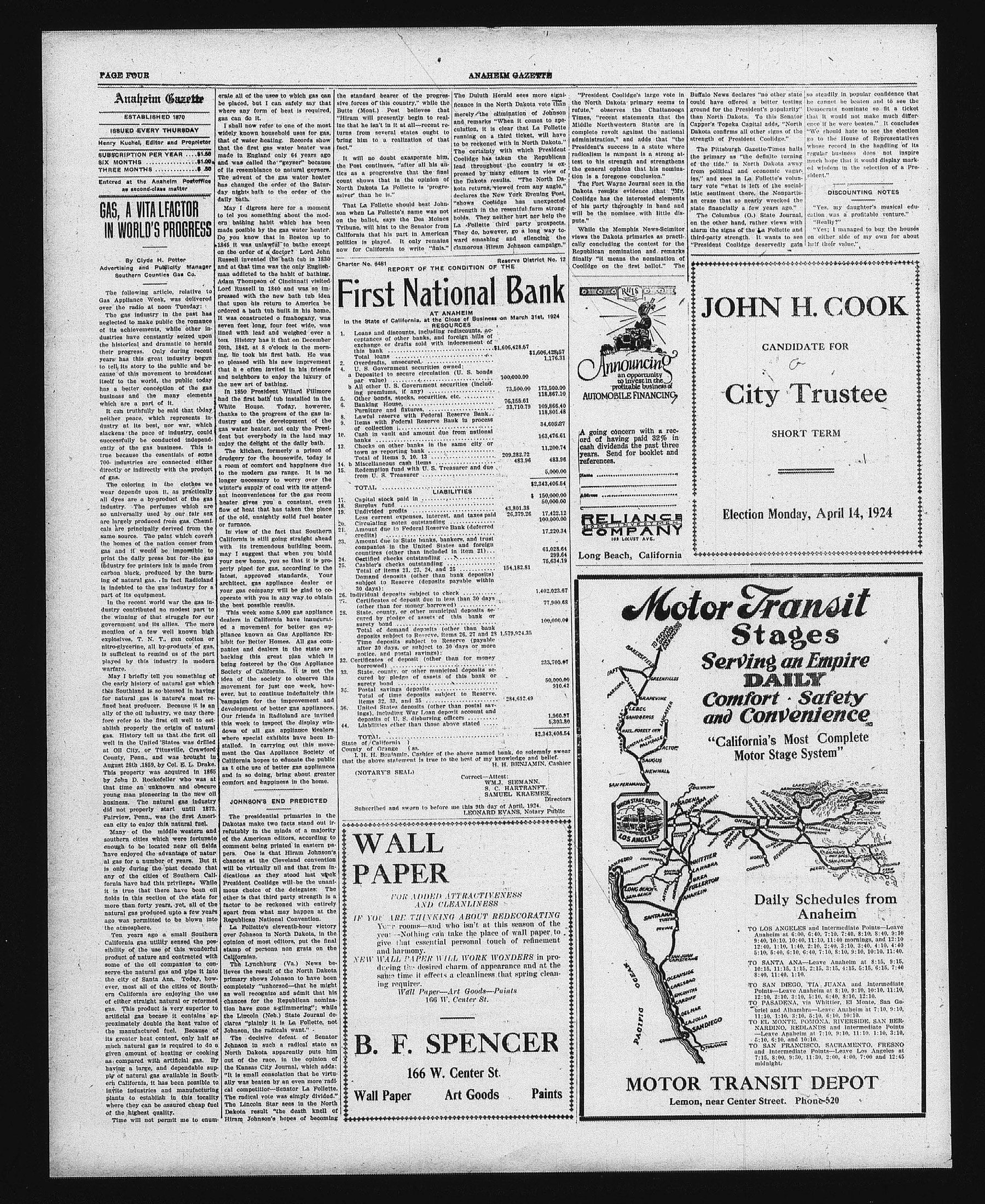
Searchable text
PAGE FOUR
Anaheim Gazette
ESTABLISHED 1870
ISSUED EVERY THURSDAY
Henry Kuchel, Editor and Proprietor
SUBSCRIPTION PER YEAR ... $1.50
SIX MONTHS ... $1.09
THREE MONTHS ... $ .50
Entred at the Anaheim Postoffice as second-class matter
GAS, A VITA LFACTOR IN WORLD'S PROGRESS
By Clyde H. Potter
Advertising and Publicity Manager
Southern Counties Gas Co.
The following article, relative to Gas Appliance Week, was delivered over the radio at noon Tuesday:
The gas industry in the past has neglected to make public the romance of its achievements, while other industries have constantly seized upon the historical and dramatic to herald their progress. Only during recent years has this great industry begun to tell its story to the public and because of this movement to broadcast itself to the world, the public today has a better conception of the gas business and the many elements which are a part of it.
It can truthfully be said that today neither peace, which represents industry at its best, nor war, which slackens the pace of industry, could successfully be conducted independently of the gas business. This is erate all of the uses to which gas can be placed, but I can safely say that where any form of heat is required, gas can do it.
I shall now refer to one of the most widely known household uses for gas, that of water heating. Records show that the first gas water heater was made in England only 64 years ago and was called the "geyser" because of its resemblance to natural geysers. The advent of the gas water heater has changed the order of the Saturday night bath to the order of the daily bath.
May I digress here for a moment to tell you something about the modern bathing habit which has been made possible by the gas water heater. Do you know that in Boston up to 1845 it was unlawful to bathe except on the order of a doctor? Lord John Russell invented the bath tub in 1830 and at that time was the only Englishman addicted to the habit of bathing. Adam Thompson of Cincinnati visited Lord Russell in 1840 and was so impressed with the new bath tub idea that upon his return to America he ordered a bath tub built in his home. It was constructed o fmahogany, was seven feet long, four feet wide, was lined with lead and weighed over a ton. History has it that on December 20th, 1842, at 8 o'clock in the morning, he took his first bath. He was so pleased with his new improvement that he often invited in his friends and neighbors to enjoy the luxury of the new art of bathing.
In 1850 President Wilard Fillmore had the first bath tub installed in the White House. Today, however, thanks to the progress of the gas industry and the development of the gas water heater, not only the President but everybody in the land may enjoy the delight of the daily bath.
years has this great industry begun to tell its story to the public and because of this movement to broadcast itself to the world, the public today has a better conception of the gas business and the many elements which are a part of it.
It can truthfully be said that today neither peace, which represents industry at its best, nor war, which slackens the pace of industry, could successfully be conducted independently of the gas business. This is true because the essentials of some 700 industries are connected either directly or indirectly with the product of gas.
The coloring in the clothes we wear depends upon it, as practically all dyes are a by-product of the gas industry. The perfumes which are so universally used by our fair sex are largely produced from gas. Chemicals are principally derived from the same source. The paint which covers the homes of the nation comes from gas and it would be impossible to print the daily press but for-the-gas industry for printers ink is made from carbon black, produced by the burning of natural gas. In fact Radioland is indebted to the gas industry for a part of its equipment.
In the recent world war the gas industry contributed no modest part to the winning of that struggle for our government and its allies. The mere mention of a few well known high explosives, T. N. T., gun cotton or nitro-glycerine, all by-products of gas, is sufficient to remind us of the part played by this industry in modern warfare.
May I briefly tell you something of the early history of natural gas which this Southland is so blessed in having for natural gas is nature's most refined heat producer. Because it is an ally of the oil industry, we may therefore refer to the first oil well to establish properly the origin of natural gas. History tells us that the first oil well in the United States was drilled at Oil City, or Titusville, Crawford County, Penn., and was brought in August 28th, 1859, by Col. E. L. Drake. This property was acquired in 1865 by John D. Rockefeller who was at that time an unknown and obscure young man pioneering in the new oil business. The natural gas industry did not properly start until 1872. Fairview, Penn., was the first American city to enjoy this natural fuel.
Many of the middle western and southern cities which were fortunate enough to be located near oil fields he took his first bath. He was so pleased with his new improvement that he often invited in his friends and neighbors to enjoy the luxury of the new art of bathing.
In 1850 President Wilard Fillmore had the first bath tub installed in the White House. Today, however, thanks to the progress of the gas industry and the development of the gas water heater, not only the President but everybody in the land may enjoy the delight of the daily bath.
The kitchen, formerly a prison of druggery for the housewife, today is a room of comfort and happiness due to the modern gas range. It is no longer necessary to worry over the winter's supply of coal with its attendant inconveniences for the gas room heater gives you a constant, even flow of heat that has taken the place of the old, unsightly solid fuel heater or furnace.
In view of the fact that Southern California is still going straight ahead with its tremendous building boom, may I suggest that when you build your new home, you see that it is properly piped for gas, according to the latest approved standards. Your architect, gas appliance dealer or your gas company will be glad to cooperate with you in any way to obtain the best possible results.
This week some 5,000 gas appliance dealers in California have inaugurated a movement for better gas appliances known as Gas Appliance Exhibit for Better Homes. All gas companies and dealers in the state are backing this great plan which is being fostered by the Gas Appliance Society of California. It is not the idea of the society to observe this movement for just one week, however, but to continue indefinitely this campaign for the improvement and development of better gas appliances. Our friends in Radioland are invited this week to inspect the display windows of all gas appliance dealers where special exhibits have been installed. In carrying out this movement the Gas Appliance Society of California hopes to educate the public as t othe use of better gas appliances and in so doing, bring about greater comfort and happiness in the home.
JOHNSON'S END PREDICTED
The presidential primaries in the Dakotas make two facts stand out irrefutably in the minds of a majority of the American editors, according to comment being printed in eastern pa-
County, Penn., and was brought in August 28th, 1859, by Col. E. L. Drake. This property was acquired in 1865 by John D. Rockefeller who was at that time an unknown and obscure young man pioneering in the new oil business. The natural gas industry did not properly start until 1872. Fairview, Penn., was the first American city to enjoy this natural fuel.
Many of the middle western and southern cities which were fortunate enough to be located near oil fields have enjoyed the advantage of natural gas for a number of years. But it is only during the past decade that any of the cities of Southern California have had this privilege. While it is true that there have been oil fields in this section of the state for more than forty years, yet, all of the natural gas produced up to a few years ago was permitted to be blown into the atmosphere.
Ten years ago a small Southern California gas utility sensed the possibility of the use of this wonderful product of nature and contracted with some of the oil companies to conserve the natural gas and pipe it into the city of Santa Ana. Today, however, most all of the cities of Southern California are enjoying the use of either straight natural or reformed gas. This product is very superior to artificial gas because it contains approximately double the heat value of the manufactured fuel. Because of its greater heat content, only half as much natural gas is required to do a given amount of heating or cooking as compared with artificial gas. By having a large, and dependable supply of natural gas available in Southern California, it has been possible to invite industries and manufacturing plants to establish in this locality where they can be assured cheap fuel of the highest quality.
Time will not permit me to enum-
The presidential primaries in the Dakotas make two facts stand out irrebutably in the minds of a majority of the American editors, according to comment being printed in eastern papers. One is that Hiram Johnson's chances at the Cleveland convention will be virtually nil and that from indications as they stood last week President Coolidge will be the unanimous choice of the delegates: The other is that third party strength is a factor to be reckoned with entirely apart from what may happen at the Republican National Convention.
La Follette's eleventh-hour victory over Johnson in North Dakota, in the opinion of most editors, put the final stamp of persona non grata on the Californian.
The Lynchburg (Va.) News believes the result of the North Dakota primary shows Johnson to have been completely "unhorsed—that he might as well recognize and admit that his chances for the Republican nomination have gone a-glimmering"; while the Lincoln (Neb.) State Journals declares "plainly it is La Follette, not Johnson, the radicals want."
The decisive defeat of Senator Johnson in such a radical state as North Dakota apparently puts him out of the race, in the opinion of the Kansas City Journal, which adds: "It is small consolation that he virtually was beaten by an even more radical competitor—Senator La Follette. The radical vote was simply divided." The Lincoln Star sees in the North Dakota result "the death knell of Hiram Johnson's hopes of becoming
ANAHEIM GAZETTE
the standard bearer of the progressive forces of this country," while the Butte (Mont.) Post believes that "Hiram will presently begin to realize that he isn't in it at all—recent returns from several states ought to bring him to a realization of that fact."
It will no doubt exasperate him, the Post continues, "after all his antics as a progressive that the final count shows that in the opinion of North Dakota La Follette is 'progressiver' than he is."
That La Follette should beat Johnson when La Follette's name was not on the ballot, says the Des Moines Tribune, will hint to the Senator from California that his part in American politics is played. It only remains now for California to write "finis."
The Duluth Herald sees more significance in the North Dakota vote than merely the elimination of Johnson and remarks "When it comes to speculation, it is clear that La Follette running on a third ticket, will have to be reckoned with in North Dakota." The certainty with which President Coolidge has taken the Republican lead throughout the country is expressed by many editors in view of the Dakota results. "The North Dakota returns; viewed from any angle," declares the New York Evening Post, "shows Coolidge has unexpected strength in the resentful farm strongholds. They neither hurt nor help the La-Follette third party prospects. They do, however, go a long way toward smashing and silencing the clamorous Hiram Johnson campaign."
"President Coolidge's large vote in the North Dakota primary seems to refute," observes the Chattanooga Times, "recent statements that the Middle Northwestern States are in complete revolt against the national administration," and adds that "President's success in a state where radicalism is rampant is a strong attempt to his strength and strengthens the general opinion that his nomination is a foregone conclusion."
The Fort Wayne Journal sees in the Dakota results evidence that "Mr. Coolidge has the interested elements of his party thoroughly in hand and will be the nominee with little dispute."
While the Memphis News-Scimitor views the Dakota primaries as practically concluding the contest for the Republican nomination and remarks finally "it means the nomination of Coolidge on the first ballot." The
Charter No. 6481
REPORT OF THE CONDITION OF THE
First National Bank
AT ANAHEIM
In the State of California, at the Close of Business on March 31st, 1924
RESOURCES
1. Loans and discounts, including rediscounts, acceptances of other banks, and foreign bills of exchange or drafts sold with indorsement of this bank ... $1,606,428.57
Total loans ... $1,606,428.57
2. Overdrafts, unsecured ... 1,176.31
4. U.S. Government securities owned;
a Deposited to secure circulation (U.S. bonds par value) ... 100,000.00
b All other U.S. Government securities (including premiums, if any) ... 73,500.00 173,500.00
5. Other bonds, stocks, securities, etc. ... 118,867.10
6. Banking House ... 76,155.61
Furniture and fixtures ... 33,710.79 109,866.40
8. Lawful reserve with Federal Reserve Bank ... 118,801.48
9. Items with Federal Reserve Bank in process of collection ... 34,605.87
10. Cash in vault and amount due from national banks ... 163,476.61
13. Checks on other banks in the same city or ... 11,200.74
Announcing an opportunity to invest in the profitable business of AUTOMOBILE FINANCING
A going concern with a record of having paid 32% in cash dividends the past three
Total loans ... $1,000,000.00
2. Overdrafts, unsecured ... 1,176.31
4. U.S. Government securities owned:
a Deposited to secure circulation (U.S. bonds par value) ... 100,000.00
b All other U.S. Government securities (including premiums, if any) ... 73,500.00
c Other bonds, stocks, securities, etc. ... 73,500.00
d Banking House, Furniture and fixtures... 76,155.61
e Lawful reserve with Federal Reserve Bank ... 33,710.79
f Items with Federal Reserve Bank in process of collection ... 109,866.40
g Cash in vault and amount due from national banks ... 34,605.87
h Checks on other banks in the same city or town as reporting bank ... 11,200.74
Total of Items 9, 10, 13 ... 209,282.72
b Miscellaneous cash items ... 483.96
Redemption fund with U.S. Treasurer and due from U.S. Treasurer ... 5,000.00
TOTAL ... $2,343,406.54
LIABILITIES
17. Capital stock paid in ... $150,000.00
18. Surplus fund ... $50,000.00
19. Undivided profits ... $43,801.38
Less current expenses, interest, and taxes paid ... $26,379.26
Circulating notes outstanding ... $17,220.34
Amount due to Federal Reserve Bank (deferred credits) ... $61,028.64
Amount due to State banks, bankers, and trust companies in the United States and foreign countries (other than included in item 21) ... $299.64
Certified checks outstanding ... $75,634.19
Cashier's checks outstanding ... $154,182.81
Total of Items 21, 23, 24, and 25 Demand deposits (other than bank deposits) subject to Reserve (deposits payable within 30 days):
26. Individual deposits subject to check ... $1,402,023.67
27. Certificates of deposit due in less than 30 days (other than for money borrowed) ... $77,900.68
State county, or other municipal deposits secured by pledge of assets of this bank or surety bond ... $100,000.00
Total of demand deposits (other than bank deposits subject to Reserve, items 26, 27 and 28 Time deposits subject to Reserve (payable after 30 days, or subject to 30 days or more notice, and postal savings):
32. Certificates of deposit (other than for money borrowed) ... $233,702.67
State county, or other municipal deposits secured by pledge of assets of this bank or surety bond ... $50,000.00
Postal savings deposits ... $910.42
Total of time deposits subject to Reserve, items 32, 33, and 35 ... $284,612.49
United States deposits (other than postal savings), including War Loan deposit account and deposits of U.S. disbursing officers ... $1,960.87
Liabilities other than those above stated ... $5,303.80
TOTAL ... $2,343,406.54
State of California )
County of Orange (ss.
L.H.H.Benjamin,Cashier of the above named bank,do solemnly swear that the above statement is true to the best of my knowledge and belief.
H.H.BENJAMIN,Cashier
(NOTARY'S SEAL)
Correct—Attest:
WM.J.SIEMANN.
S.C.HARTRANFT.
SAMUEL KRAEMER.
Subscribed and sworn to before me this 9th day of April, 1924.
LEONARD EVANS.Notary Public
WALL
PAPER
FOR ADDED ATTRACTIVENESS
AND CLEANLINESS
IF YOU ARE THINKING ABOUT REDECORATING
Your rooms—and who isn't at this season of the year—Nothing can take the place of wall paper to give that essential personal touch of refinement and harmony.
NEW WALL PAPER WILL WORK WONDERS in producing the desired charm of appearance and at the same time it effects a cleanliness that spring cleaning requires.
Wall Paper—Art Goods—Paints
166 W. Center St.
B. F. SPENCER
166 W. Center St.
Wall Paper Art Goods Paints
Buffalo News declares "no other state could have offered a better testing ground for the President's popularity" than North Dakota. To this Senator Capper's Topeka Capital adds, "North Dakota confirms all other signs of the strength of President Coolidge."
The Pittsburgh Gazette-Times halls the primary as "the definite turning of the tide." In North Dakota away from political and economic vagaries," and sees in La Follette's voluntary vote "what is left of the socialistic sentiment there, the Nonpartisan craze that so nearly wrecked the state financially a few years ago."
The Columbus (O.) State Journal, on the other hand, rather views with alarm the signs of the La Follette and third-party strength. It wants to see "President Coolidge deservedly gain so steadily in popular confidence that he cannot be beaten and to see the Democrats nominate so fit a ticket that it would not make much difference if he were beaten." It concludes "We should hate to see the election go to the House of Representatives whose record in the handling of its regular business does not inspire much hope that it would display marked wisdom in the selection of a President."
DISCOUNTING NOTES
"Yes, my daughter's musical education was a profitable venture."
"Really?"
"Yes; I managed to buy the houses on either side of my own for about half their value."
JOHN H. COOK
CANDIDATE FOR
City Trustee
SHORT TERM
City Trustee
SHORT TERM
Election Monday, April 14, 1924
Motor Transit Stages
Serving an Empire DAILY
Comfort · Safety and Convenience
“California’s Most Complete Motor Stage System”
Daily Schedules from Anaheim
TO LOS ANGELES and Intermediate Points—Leave Anaheim at 6:00, 6:40, 7:10, 7:40, 8:10, 8:40, 9:10, 9:40, 10:10, 10:40, 11:10, 11:40 mornings, and 12:10, 12:40, 1:10, 1:40, 2:10, 2:40, 3:10, 3:40, 4:10, 4:40, 5:10, 5:40, 6:10, 6:40, 7:10, 8:10, 9:10, 10:10, 11:40.
TO SANTA ANA—Leave Anaheim at 8:15, 9:15, 10:15, 11:15, 1:15, 2:15, 3:15, 4:15, 5:15, 6:15, 7:40, 8:40, 11:40, 1:10.
TO SAN DIEGO, TIA JUANA and Intermediate Points—Leave Anaheim at 8:10, 9:10, 10:10, 11:10, 12:10, 2:10, 3:10, 5:10, 6:40, 8:10, 12:10.
TO PASADENA, via Whittier, El Monte, San Gabriel and Alhambra—Leave Anaheim at 7:10, 9:10, 11:10, 1:10, 3:10, 5:10, 6:10, 10:10.
TO EL MONTE, POMONA, RIVERSIDE, SAN BERNARDINO, REDLANDS and Intermediate Points—Leave Anaheim at 7:10, 9:10, 11:10, 1:10, 3:10, 5:10, 6:10,and 10:10.
TO SAN FRANCISCO, SACRAMENTO,FRESNO and Intermediate Points—Leave Los Angeles at 7:15,8:00,9:30,11:30,2:00,4:00,7:00 and 12:45 midnight.
MOTOR TRANSIT DEPOT
Lemon, near Center Street. Phone-520