anaheim-gazette 1924-02-21
Scanned page
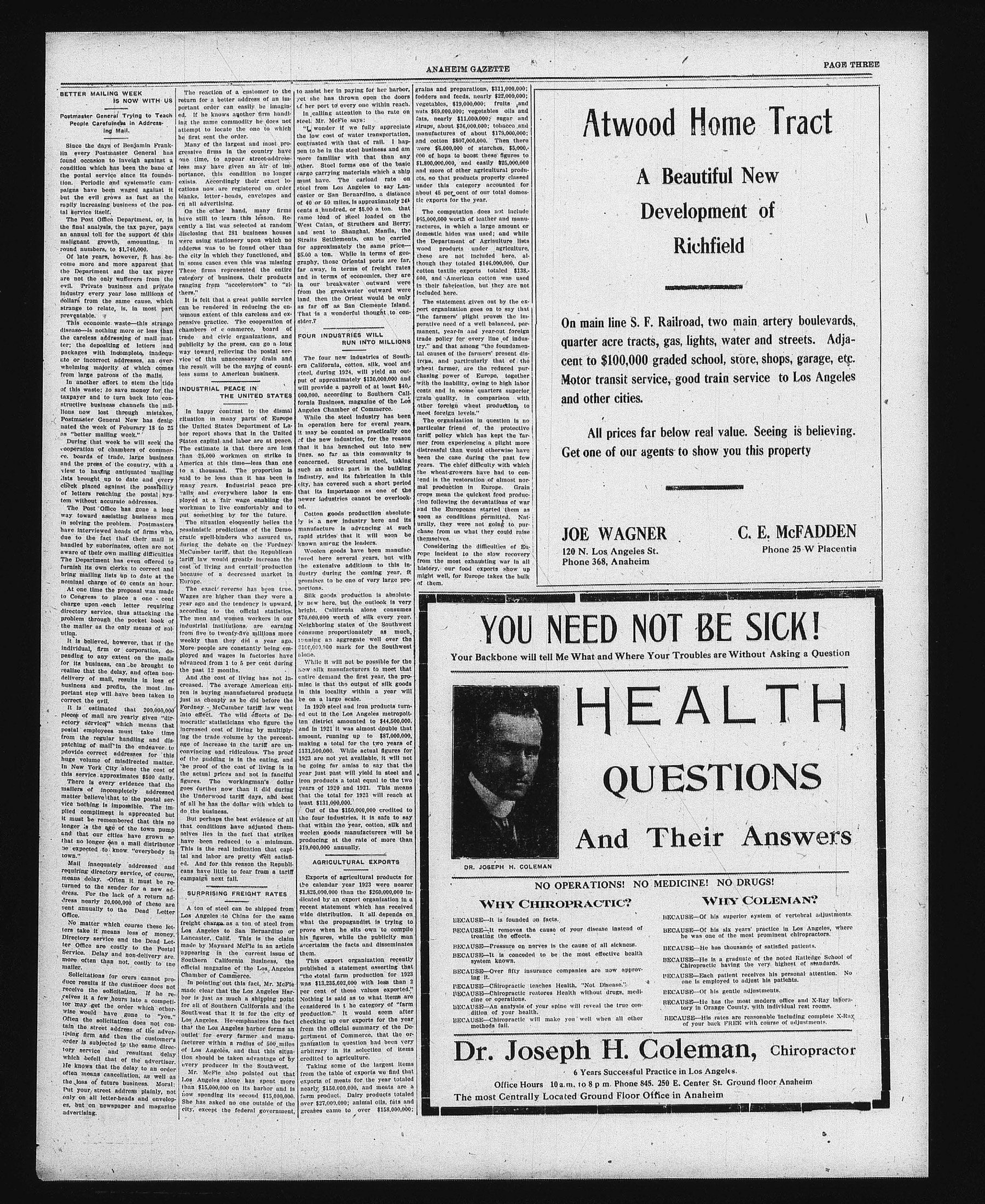
Searchable text
BETTER MAILING WEEK
IS NOW WITH US
Postmaster General Trying to Teach People Carefulness in Addressing Mail.
Since the days of Benjamin Franklin every Postmaster General has found occasion to inveigh against a condition which has been the bane of the postal service since its foundation. Periodic and systematic campaigns have been waged against it but the evil grows as fast as the rapidly increasing business of the postal service itself.
The Post Office Department, or, in the final analysis, the tax payer, pays an annual toll for the support of this malignant growth, amounting, in round numbers, to $1,740,000.
Of late years, however, it has become more and more apparent that the Department and the tax payer are not the only sufferers from the evil. Private business and private industry every year lose millions of dollars from the same cause, which strange to relate, is, in most part preventable.
This economic waste—this strange disease—is nothing more or less than the careless addressing of mail matter; the depositing of letters and packages with incomplete, inadequate or incorrect addresses, an overwhelming majority of which comes from large patrons of the mails.
In another effort to stem the tide of this waste; to save money for the taxpayer and to turn back into constructive business channels the millions now lost through mistakes, Postmaster General New has designated the week of February 18 to 25 as "better mailing week."
During that week he will seek the cooperation of chambers of commerce.
The reaction of a customer to the return for a better address of an important order can easily be imagined. If he knows another firm handling the same commodity he does not attempt to locate the one to which he first sent the order.
Many of the largest and most progressive firms in the country have one time, to appear street-address-less may have given an air of importance, this condition no longer exists. Accordingly their exact locations now are registered on order blanks, letter-heads, envelopes and on all advertising.
On the other hand, many firms have still to learn this lesson. Recently a list was selected at random disclosing that 281 business houses were using stationery upon which no addresse was to be found other than the city in which they functioned, and in some cases even this was missing. These firms represented the entire category of business, their products ranging from "accelerators" to "zithers."
It is felt that a great public service can be rendered in reducing the enormous extent of this careless and expensive practice. The cooperation of chambers of commerce, board of trade and civic organizations, and publicity by the press, can go a long way toward relieving the postal service of this unnecessary drain and the result will be the saving of countless sums to American business.
INDUSTRIAL PEACE IN THE UNITED STATES
In happy contrast to the dismal situation in many parts of Europe the United States Department of Labor report shows that in the United States capital and labor are at peace. The estimate is that there are less to assist her in paying for yet she has thrown off her port to every one.
In calling attention to steel: Mr. McFlee says:
"I wonder if we find the low cost of water contrasted with that of open to be in the steel bus more familiar with the other. Steel forms one cargo carrying materials must have. The carriage from Los Angeles caster or San Bernardino of 40 or 50 miles, is appents a hundred, or $5.00 rame load of steel lo West Catan, of Struthen and sent to Shanghai Straits Settlements, can for approximately the $5.00 a ton. While in graphic, those Oriental far away, in terms of economy and in terms of economy in our breakwater from the greakwater land then the Orient as far off as San Clovis That is a wonderful thinner."
In another effort to stem the tide of this waste; to save money for the taxpayer and to turn back into constructive business channels the millions now lost through mistakes, Postmaster General New has designated the week of February 18 to 25 as "better mailing week."
During that week he will seek the cooperation of chambers of commerce, boards of trade, large business and the press of the country, with a view to having antiquated mailing lists brought up to date and every check placed against the possibility of letters reaching the postal system without accurate addresses.
The Post Office has gone a long way toward assisting business men in solving the problem. Postmasters have interviewed heads of firms who, due to the fact that their mail is handled by suborinates, often are not aware of their own mailing difficulties. The Department has even offered to furnish its own clerks to correct and bring mailing lists up to date at the nominal charge of 60 cents an hour.
At one time the proposal was made to Congress to place a one-cent charge upon each letter requiring directory service, thus attacking the problem through the pocket book of the mailer as the only means of solution.
It is believed, however, that if the individual, firm or corporation, depending on any extent on the mails for its business, can be brought to realize that the delay, and often non-delivery of mail, results in loss of business and profits, the most important step will have been taken to correct the evil.
It is estimated that 200,000,000 pieces of mail are yearly given "directory service" which means that postal employees must take time from the regular handling and dispatching of mail in the endeavor to provide correct addresses for this huge volume of misdirected matter. In New York City alone the cost of this service approximates $500 daily.
There is every evidence that the mailers of incompletely addressed matter believe that to the postal service nothing is impossible. The implied compliment is appreciated but it must be remembered that this no longer is the age of the town pump and that our cities have grown so that no longer can a mail distributor be expected to know "everything."
INDUSTRIAL PEACE IN THE UNITED STATES
In happy contrast to the dismal situation in many parts of Europe the United States Department of Labor report shows that in the United States capital and labor are at peace. The estimate is that there are less than 25,000 workmen on strike in America at this time—less than one to a thousand. The proportion is said to be less than it has been in many years. Industrial peace prevails and everywhere labor is employed at a fair wage enabling the workman to live comfortably and to put something by for the future.
The situation eloquently belies the pessimistic predictions of the Democratic spell-binders who assured us during the debate on the Fordney-McCumber tariff, that the Republican tariff law would greatly increase the cost of living and curtail production because of a decreased market in Europe.
The exact reverse has been true. Wages are higher than they were a year ago and the tendency is upward, according to the official statistics. The men and women workers in our industrial institutions are earning from five to twenty-five millions more weekly than they did a year ago. More people are constantly being employed and wages in factories have advanced from 1 to 5 per cent during the past 12 months.
And the cost of living has not increased. The average American citizen is buying manufactured products just as cheaply as he did before the Fordney-McCumber tariff law went into effect. The wild efforts of Democratic statisticians who figure the increased cost of living by multiplying the trade volume by the percentage of increase in the tariff are unconvincing and ridiculous. The proof of the pudding is in the eating, and the proof of the cost of living is in the actual prices and not in fanciful figures. The workingman's dollar goes further now than it did during the Underwood tariff days, and best of all he has the dollar with which to do the business.
But perhaps the best evidence of all that conditions have adjusted themselves lies in the fact that strikes have been reduced to a minimum. This is the real indication that capital of this unnecessary drain and the result will be the saving of countless sums to American business.
INDUSTRIAL PEACE IN THE UNITED STATES
While the steel industry in operation here for it may be counted as part of the new industries, that it has branched lines, so far as this concerned. Structural such an active part in industry, and its fabric city, has covered such that its importance among newer industries cannot be ignored.
Cotton goods produced by a new industry manufacture is advantage rapid strides that it will known among the leaders.
Woolen goods have matured here several years; the extensive addition of dustry during the cold promises to be one of its portions.
Silk goods production by new here, but the old bright. California also $70,000,000 worth of silk Neighboring states of consume proportionately running an aggregate $100,000,000 mark for alone.
While it will not be new silk manufacturers entire demand for first mise is that the output in this locality within be on a large scale.
In 1920 steel and iron ed out in the Los Angeles district amounted to and in 1921 it was almost amount, running up to making a total for then $131,500,000. While act 1923 are not yet available he going far amiss to year just past will yield iron products a total ee years of 1920 and 1921 that the total for 1923 least $131,000,000.
Out of the $150,000,000, four industries, it that within the year, woolen goods manufacturing at the rate $19,000,000 annually.
huge volume of misdirected matter. In New York City alone the cost of this service approximates $500 daily.
There is every evidence that the mailers of incompletely addressed matter believe that to the postal service nothing is impossible. The implied compliment is appreciated but it must be remembered that this no longer is the age of the town pump and that our cities have grown so that no longer can a mail distributor be expected to know "everybody in town."
Mail inaequately addressed and requiring directory service, of course, means delay. Often it must be returned to the sender for a new address. For the lack of a return address nearly 20,000,000 of these are sent annually to the Dead Letter Office.
No matter which course these letters take it means loss of money. Directory service and the Dead Letter Office are costly to the Postal Service. Delay and non-delivery are more often than not, costly to the mailer.
Solicitations for orers cannot produce results if the custmoer does not receive the solicitation. If he receives it a few hours late a competitor may get the order which otherwise would have gone to "you." Often the solicitation does not contain the street address of the advertising firm and then the customer's order is subjected to the same directory service and resultant delay which befell that of the advertiser.
He knows that the delay to an order often means cancellation, as well as the loss of future business. Moral: Put your street address plainly, not only on all letter-heads and envelopes, but on newspaper and magazine advertising.
A ton of steel can be shipped from Los Angeles to China for the same freight charge as a ton of steel from Los Angeles to San Bernardino or Lancaster. Calif. This is the claim made by Maynard McFie in an article appearing in the current issue of Southern California Business, the official magazine of the Los Angeles Chamber of Commerce.
In pointing out this fact, Mr. McFie made clear that the Los Angeles Harbor is just as much a shipping point for all of Southern California and the Southwest that it is for the city of Los Angeles. He emphasizes the fact that the Los Angeles harbor forms an outlet for every farmer and manufacturer within a radius of 500 miles of Los Angeles, and that this situation should be taken advantage of by every producer in the Southwest.
Mr. McFie also pointed out that Los Angeles alone has spent more than $15,000,000 on its harbor and is now spending its second $15,000,000. She has asked no one outside of the city, except the federal government, of the pudding is in the eating, and the proof of the cost of living is in the actual prices and not in fanciful figures. The workingman's dollar goes further now than it did during the Underwood tariff days, and best of all he has the dollar with which to do the business.
But perhaps the best evidence of all that conditions have adjusted themselves lies in the fact that strikes have been reduced to a minimum. This is the real indication that capital and labor are pretty well satisfied. And for this reason the Republicans have little to fear from a tariff campaign next fall.
SURPRISING FREIGHT RATES
A ton of steel can be shipped from Los Angeles to China for the same freight charge as a ton of steel from Los Angeles to San Bernardino or Lancaster. Calif. This is the claim made by Maynard McFie in an article appearing in the current issue of Southern California Business, the official magazine of the Los Angeles Chamber of Commerce.
In pointing out this fact, Mr. McFie made clear that the Los Angeles Harbor is just as much a shipping point for all of Southern California and the Southwest that it is for the city of Los Angeles. He emphasizes the fact that the Los Angeles harbor forms an outlet for every farmer and manufacturer within a radius of 500 miles of Los Angeles, and that this situation should be taken advantage of by every producer in the Southwest.
Mr. McFie also pointed out that Los Angeles alone has spent more than $15,000,000 on its harbor and is now spending its second $15,000,000. She has asked no one outside of the city, except the federal government, of the pudding is in the eating, and the proof of the cost of living is in the actual prices and not in fanciful figures. The workingman's dollar goes further now than it did during the Underwood tariff days, and best of all he has the dollar with which to do the business.
But perhaps the best evidence of all that conditions have adjusted themselves lies in the fact that strikes have been reduced to a minimum. This is the real indication that capital and labor are pretty well satisfied. And for this reason the Republicans have little to fear from a tariff campaign next fall.
AGRICULTURAL
Exports of agriculture to the calendar year 1923 $1,825,000,000 than the dedicated by an export or recent statement which wide distribution. It what the propagandist prove when he sits on his figures, while they ascertainthe facts an them.
This export organization published a statement: "the total farm product was $13,235,602,000 while per cent of these values Nothing is said as to considered in t he cat production." It would checking up our export from the official summer department of Commerce organization in question arbitrary in its selected to agriculture.
Taking some of the from the table of exports exports of meats for nearly $150,000,000, an farm product. Dairy product over $27,000,000; animal greases came to over
to assist her in paying for her harbor, yet she has thrown open the doors of her port to every one within reach.
In calling attention to the rate on steel, Mr. McFie says:
"I wonder if we fully appreciate the low cost of water transportation, contrasted with that of rail. I happen to be in the steel business and am more familiar with that than any other. Steel forms one of the basic cargo carrying materials which a ship must have. The carload rate on steel from Los Angeles to say Lancaster or San Bernardino, a distance of 40 or 50 miles, is approximately 24 cents a hundred, or $5.00 a ton. That same load of steel loaded on the West Catan, of Struthers and Berry; and sent to Shanghai, Manila, the Straits Settlements, can be carried for approximately the same price—$5.00 a ton. While in terms of geography, those Oriental ports are far, far away, in terms of freight rates and in terms of economics, they are in our breakwater outward were from the greakwater outward were land then the Orient would be only as far off as San Clemente Island. That is a wonderful thought to consider."
FOUR INDUSTRIES WILL RUN INTO MILLIONS
The four new industries of Southern California, cotton, silk, wool and steel, during 1924, will yield an output of approximately $130,000,000 and will provide a payroll of at least $40,000,000, according to Southern California Business magazine of the Los Angeles Chamber of Commerce.
While the steel industry has been in operation here for everal years, it may be counted as practically one of the new industries, for the reason that it has branched out into new grains and preparations, $311,000,000; fodders and feeds, nearly $22,000,000; vegetables, $19,000,000; fruits and nuts $69,000,000; vegetables oils and fats, nearly $11,000,000; sugar and sirups, about $36,000,000; tobacco and manufactures of about $179,000,000; and cotton $807,000,000. Then there were $6,000,000 of starches, $5,000,000 of hops to boost these figures to $1,800,000,000, and easily $25,000,000 and more of other agricultural products, so that products properly classed under this category accounted for about 45 per cent of our total domestic exports for the year.
The computation does not include $65,000,000 worth of leather and manufactures, in which a large amount or domestic hides was used; and while the Department of Agrisulture lists wood products under agriculture, these are not included here, although they totaled $146,000,000. Our cotton textile exports totaled $138,000, and American cotton was used in their fabrication, but they are not included here.
The statement given out by the export organization goes on to say that "the farmers' plight proves the imperative need of a well balanced, permanent, year-in and year-out foreign trade policy for every line of industry." and that among "the fundamental causes of the farmers' present distractions, and particularly that of the wheat farmer, are the reduced purchasing power of Europe, together with the inability, owing to high labor costs and in some quarters superior grain quality," in comparison with other foreign wheat production to meet foreign levels."
The organization in question is no particular friend of the protective tariff policy which has kept the farmer from experiencing a plight more distressful than would otherwise have.
The four new industries of Southern California, cotton, silk, wool and steel, during 1924, will yield an output of approximately $130,000,000 and will provide a payroll of at least $40,000,000, according to Southern California Business, magazine of the Los Angeles Chamber of Commerce.
While the steel industry has been in operation here for ever years, it may be counted as practically one of the new industries, for the reason that it has branched out into new lines, so far as this community is concerned. Structural steel, taking such an active part in the building industry, and its fabrication in this city, has covered such a short period that its importance as one of the newer industries cannot be overlooked.
Cotton goods production absolutely is a new industry here and its manufacture is advancing at such rapid strides that it will soon be known among the leaders.
Woolen goods have been manufactured here several years, but with the extensive additions to this industry during the coming year, it promises to be one of very large proportions.
Silk goods production is absolutely new here, but the outlook is very bright. California alone consumes $70,000,000 worth of silk every year. Neighboring states of the Southwest consume proportionately as much, running an aggregate well over the $100,000,000 mark for the Southwest alone.
While it will not be possible for the new silk manufacturers to meet that entire demand the first year, the promise is that the output of silk goods in this locality within a year will be on a large scale.
In 1920 steel and iron products turned out in the Los Angeles metropolitan district amounted to $44,500,000, and in 1921 it was almost double that amount, running up to $87,000,000, making a total for the two years of $131,500,000. While actual figures for 1923 are not yet available, it will not be going far amiss to say that the year just past will yield in steel and iron products a total equal to the two years of 1920 and 1921. This means that the total for 1923 will reach at least $131,000,000.
Out of the $150,000,000 credited to the four industries, it is safe to say that within the year, cotton, silk and woolen goods manufacturers will be producing at the rate of more than $19,000,000 annually.
The organization in question is no particular friend of the protective tariff policy which has kept the farmer from experiencing a plight more distressful than would otherwise have been the case during the past few years. The chief difficulty with which the wheat-growers have had to contend is the restoration of almost normal production in Europe. Grain crops mean the quickest food production following the devastations of war and the Europeans started them as soon as conditions permitted. Naturally, they were not going to purchase from us what they could raise themselves.
Considering the difficulties of Europe incident to the slow recovery from the most exhausting war in all history, our food exports show up might well, for Europe takes the bulk of them.
YOU NEED NOT
Your Backbone will tell Me What and Where Your Troubles
HEA
QUES
And The
1923 are not yet available, it will not be going far amiss to say that the year just past will yield in steel and iron products a total equal to the two years of 1920 and 1921. This means that the total for 1923 will reach at least $131,000,000.
Out of the $150,000,000 credited to the four industries, it is safe to say that within the year, cotton, silk and woolen goods manufacturers will be producing at the rate of more than $19,000,000 annually.
AGRICULTURAL EXPORTS
Exports of agricultural products for the calendar year 1923 were nearer $1,825,000,000 than the $260,000,000 indicated by an export organization in a recent statement which has received wide distribution. It all depends on what the propagandist is trying to prove when he sits own to compile his figures, while the publicity man accretains the facts and disseminates them.
This export organization recently published a statement asserting that "the total farm production for 1923 was $13,235,602,000 with less than 2 per cent of these values exported." Nothing is said as to what items are considered in the category of "farm production." It would seem after checking up our exports for the year from the official summary of the Department of Commerce, that the organization in question had been very arbitrary in its selection of items credited to agriculture.
Taking some of the largest items from the table of exports we find that exports of meats for the year totaled nearly $150,000,000, and meats are a farm product. Dairy products totaled over $27,000,000; animal oils, fats and greases came to over $158,000,000;
NO OPERATIONS! NO MEDICINING!
WHY CHIROPRACTIC?
BECAUSE—It is founded on facts.
BECAUSE—It removes the cause of your disease instead of treating the effects.
BECAUSE—Pressure on nerves is the cause of all sickness.
BECAUSE—It is conceded to be the most effective health system known.
BECAUSE—Over fifty insurance companies are now approving it.
BECAUSE—Chiropractic teaches Health, "Not Disease."
BECAUSE—Chiropractic restores Health without drugs, medicine or operations.
BECAUSE—An analysis of your spine will reveal the true condition of your health.
BECAUSE—Chiropractic will make you well when all other methods fail.
Dr. Joseph H. Cole
6 Years Successful Practice in Lon
Office Hours 10 a.m. to 8 p.m. Phone 845. 250 E. Cen
The most Centrally Located Ground Floor Office in An
wood Home Tract
A Beautiful New
Development of
Richfield
ne S. F. Railroad, two main artery boulevards,
e tracts, gas, lights, water and streets. Adja0,000 graded school, store, shops, garage, etc.
sit service, good train service to Los Angeles
cities.
ices far below real value. Seeing is believing.
0,000 graded school, store, shops, garage, etc.
sit service, good train service to Los Angeles
cities.
ices far below real value. Seeing is believing.
our agents to show you this property
AGNER
Angeles St.
naheim
C. E. McFADDEN
Phone 25-W Placentia
NOT BE SICK!
Where Your Troubles are Without Asking a Question
EALTH
QUESTIONS
d Their Answers
QUESTIONS
and Their Answers
S! NO MEDICINE! NO DRUGS!
C?
WHY COLEMAN?
BECAUSE—Of his superior system of vertebral adjustments.
BECAUSE—Of his six years' practice in Los Angeles, where he was one of the most prominent chiropractors.
BECAUSE—He has thousands of satisfied patients.
BECAUSE—He is a graduate of the noted Ratledge School of Chiropractic having the very highest of standards.
BECAUSE—Each patient receives his personal attention. No one is employed to adjust his patients.
BECAUSE—Of his gentle adjustments.
BECAUSE—He has the most modern office and X-Ray laboratory in Orange County, with individual rest rooms.
BECAUSE—His rates are reasonable Including complete X-Ray of your back FREE with course of adjustments.
I. Coleman, Chiropractor
Successful Practice in Los Angeles.
Phone 845. 250 E. Center St. Ground floor Anaheim
Floor Office in Anaheim