anaheim-gazette 1924-02-07
Scanned page
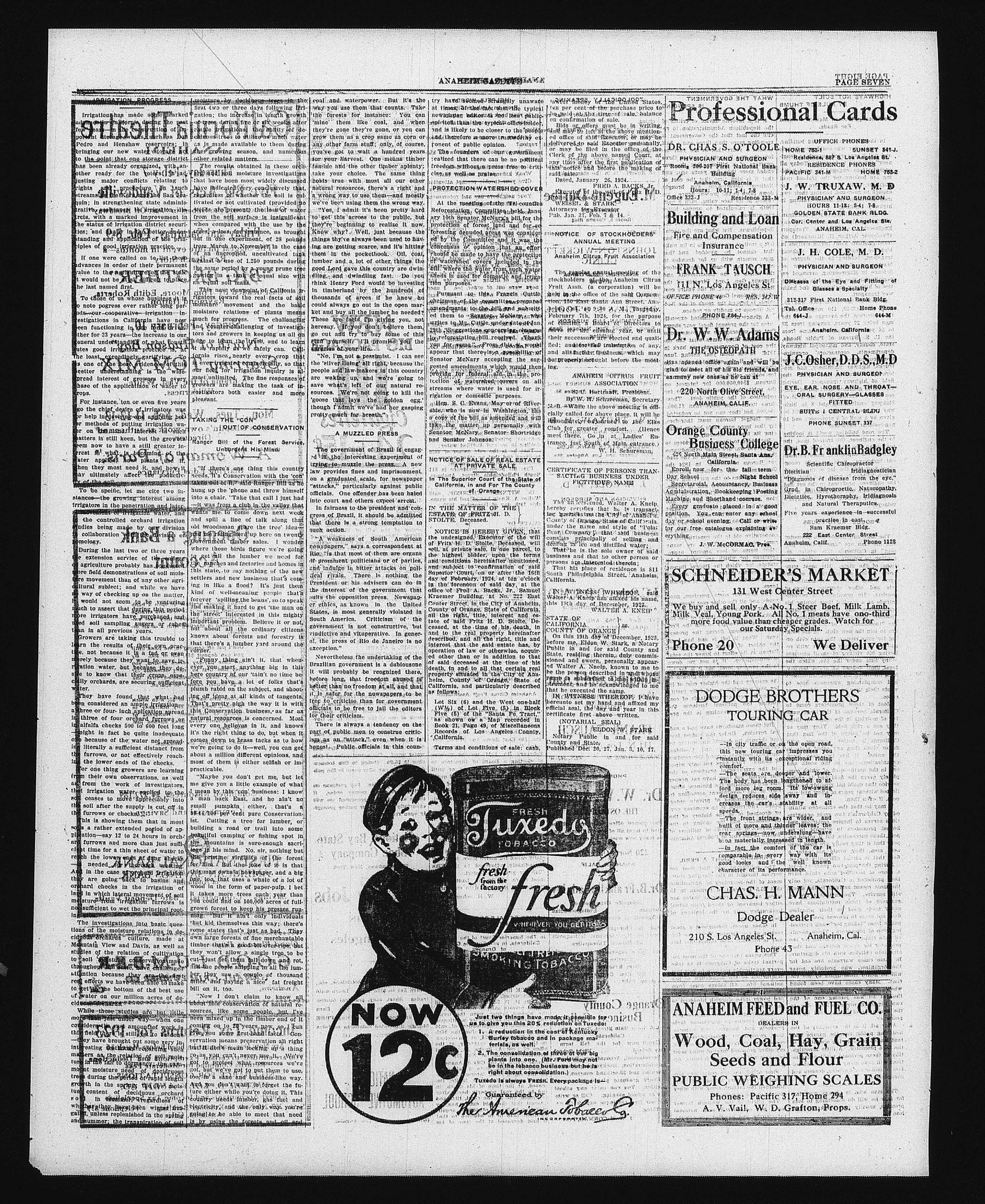
Searchable text
IRRIGATION PROGRESS
Irrigation has made some marked advancement in California during the past few years—in the construction of important storage works such as Don Pedro and Henshaw reservoirs; in bringing our new water storage to the point that one storage district has been already organized, with another ready for the voters in justifying major conflicts relating to rights and procedure on such streams and rivers like the San Joaquin; in strengthening state administrations to irrigation districts, with a marked improvement in the status of irrigation district securities; and finally in the better understanding and application of the principles of good irrigation practice.
If one were called on to list these advances in order of their permanent value to the agriculture on the state it would not be difficult to place the last named first.
To those of us whose business is so note pogress over rather long periods—our cooperative irrigation investigations in California have now been functioning in one town for 23 years—the increase in our general understanding of what constitutes good irrigation practice is, at the least, exceedingly gartlying. To is one of the best evidences of this better understanding is the widespread interest of growers in every phase of the application of water to crops.
For instance, ten or even five years go the chief desire of irrigators was or help increasing one amount per method of putting irrigation water on the land. Interest in such matters is still keen, but the grower seem now to have a still greater inclination by doubtless trees in the first two or three days following irrigation; the increase in length growth of trees during fire or six weeks after canine irrigations; the ability of deciduous trees to utilize as much water as is made available to them during their growing season, and numerous other related matters.
The results obtained in these orchid and soil moisture investigations that have been most widely discussed have indicated very conclusively that, regardless of whether the soil is cultivated or not cultivated (provided no needles are present) the loss of water from the soil surface is insignificant when compared with the use by the trees or loss, for instance, as brought out in one experiment, of 28 pounds from March to November. In the case of an uncrowned, uncultivated tank against a use of 1,250 pounds during the same period by a young prune tree growing in a tank of equal size with an equal soil mass.
This new viewpoint of California irrigators toward the real facts of soil moisture movement and the basic moisture relations of plants means much for progress. The challenging and counter-challenging of investigators and growers in keeping us all on edge to learn the truth, and to learn it as rapidly as we safely can. California rises nearly every crop that is ever irrigated commercially, so that our field for irrigation inquiry is almost unlimited. The fine responses of growers are making the task of investigators both easier and more pleasant.
TAKING THE "CON" OUT OF CONSERVATION
Ranger Bill of the Forest Service,
Highland His Mint
the least, exceedingly gartifying. To is one of the best evidences of this better understanding is the widespread interest of growers in every phase of the application of water to crops.
For instance, ten or even five years ago the chief desire of irrigators was or help in providing one amount of methods of putting irrigation water on the land. Interest in such matters is still keen, but the grower seem now to have a still greater interest in what is becoming of the water applied; how plants use it when they most need it, and how it may ultimately affect the productivity of the soil.
To be specific, let me cite two instances—the growing interest among irrigators in the penetration and later movement of irrigation water, and in the controlled orchard irrigation studies being made by our division in collaboration with the Division of homology.
During the last two or three years the extension service of the college of agriculture probably has conducted more field demonstrations of soil moisture movement than of any other agricultural subject; and while we have no way of checking up on the matter, it would not seem to be venturing much to assert that during this period more irrigators have purchased, and used soil sampling sugars or rubbers than in all previous years.
Growers are taking this trouble to learn the results of their own practice, not because it is in a bad or even merely because they want to save irrigation water, but because they desire to know that their crops especially orchards, are securing sufficient water.
They have found that what had been considered an simple irrigation—a three or four-inch application spread in three of four orchard furrows on alfalfa checks 500 to 600 feet long—might in fact be quite inadequate one because of the water not spread literally a sufficient distance from the furrows, or not effectively reaching the lower ends of the checks.
For one thing growers are learning from their own observations, as well as from the work of investigators, that irrigation water applied to the soil ceases to move appreciably into the soil after the supply is cut off in the furrows or checks.
This is showing them that in most soils a rather extended period of application—say 12 to 24 hours in orchard furrows and more than just sufficient time for a thin sheet of water to formia rises nearly every crop that is ever irrigated commercially, so that our field for irrigation inquiry is almost unlimited. The fine responses of growers are making the task of investigators both easier and more pleasant.
TAKING THE "CON"
OUT OF CONSERVATION
Ranger Bill of the Forest Service,
Unborders His Mind:
"If there's one thing this country needs, it's Conservation with the 'con' taken out of it," said Ranger Bill as he hung up the phone and threw himself into a chair. "Take that call I just had—it was from a club in the valley that wants me to come down next week and spill a line of talk along that old woodsman spare the tree idea—and has fallen hard up here on twenty Government timber sales. I wonder where those birds figure we're going to get all the lumber we need for the ranches and factories and homes in this state, to say nothing of the new settlers and new business that's coming in like a flood? It's just them kind of well-meaning people that's forever 'spilling the beans,' so to speak and making it hard to get 'the man on the street' interested in this mighty important problem. Believe it or not, but about all the ordinary citizens knows about forests and forestry is that there's a lumber yard around the corner.
Funny thing isn't it, that whenever you start anything big in this here country of our tain't no time before you have a lot of folks that's plumb rabid on the subject, and shooting off ideas at all kinds of tangents. That's pretty nigh the way it is with this Conservation business, as far as natural resources is concerned. Most every one believes in it, and knows it's the right thing to do, but when it comes down to brass tacks as to how we're going to do it—well, you can get about a million different opinions, and most of them is either selfish or impracticable.
Maybe you don't get me, but let me give you a little example of what I mean by this con business: I know a man back East, and he ain't no small pumpkin either, that's a 99.44700 per cent pure Conservationist. Cutting a tree for lumber, or building a road or trail into some beautiful camping or fishing spot in the mountains is sure-enough sacrilege in his mind. No sir, nothing but..."
For one thing growers are learning from their own observations, as well as from the work of investigators, that irrigation water applied to the soil ceases to move appreciably into the soil after the supply is cut off in the furrows or checks. This is showing them that in most soils a rather extended period of application—say 12 to 24 hours in orchard furrows and more than just sufficient time for a thin sheet of water to reach the lower ends of long checks—needed for thorough weeding. And in the case of proposed irrigation they are going back to basins and orchard checks in the irrigation of land in which lateral movement of soil moisture from irrigation furrows is not sufficient to wet the principal rooting zone.
The investigations into basic questions of the moisture relations in deciduous orchards culture, made at Mountain View and Davis, as well as studies of the relation of cultivation to soil moisture conservation made throughout the state, have challenged attention because they are the first real efforts we have been able to make to get in the bottom of the best use of water on our million acres of deciduous orchards.
While these studies are but little more than just minor way—when one considers the vast amount of work in this field they is still left to do some—they have brought out some very interesting test methods using small matters as the relation of soil moisture in the fall to dormancy, the permanent moisture need of deciduous trees during the period of rapid length growth in the spring, the new moisture content of deciduous orchard soil in summer, regardless of whether they have been winter irrigated, unless replenished in the spring and summer; the transpiration of soil
"Maybe you don't get me, but let me give you a little example of what I mean by this con business: I know a man back East, and he ain't no small pumpkin either, that's a 98/44/100 per cent pure Conservationist. Cutting a tree for lumber, or building a road or trail into some beautiful camping or fishing spot in the mountains is sure-enough sacrifice in his mind. No, sir, nothing but pristine virginity of the forest for him. But the joke of it is that this man owns a newspaper, and a big one too, that uses a whale of a lot of wood in the form of paper-pulp. I bet it takes more trees each year than you could find on 100,000 acres of full-grown forest to keep his presses running. But it isn't only individuals that kid themselves this way; there's some states that's just as bad. They own large forests of fine morchantable timber that's in good bit overripe, but they won't allow a single tree to be cut—just let them fall down and rot, find the people shipping in all the lumber they use a couple of thousand miles, and paying a nice fat freight bill on it, too.
"Now I don't claim to know all about this conservation of natural resources, like some people, but I've been mixed up in the timber end of it coming on to 20 years now, so I can give you some first-hand facts. Conservation means preservation all right but it doesn't mean locking up a thing as you can't never use it. We've got to protect what resources we've got, but we've got to put them to use, too in a same and business-like way. And you don't want to forget the future either while you're doing it. This country needs lumber, gas fuel and electricity, and the only way you're going to be able to meet that need is by using the forests and oil and
ANAHEIM CITRUS FRUIT ASSOCIATION
A MUZZLED PRESS
The government of Brazil is engaged in coal and waterpower. But it's the way you use them that counts. Take the forests for instance: You can mine them like coal, and when they're gone they're gone, or you can grow them as a crop same as corn or any other farm stuff; only, of course, you've got to wait a hundred years for your harvest. One means timber family and the other timber plenty; take your choice. The same thing holds true with most all our other natural resources, there's a right and a wrong way to use them—and mostly we've been using them the wrong way.
"Yes, I admit it's been pretty hard to get this across to the public, but they're beginning to realize it now. Know why? Well, just because the things they've always been used to having are getting scarce, and it's hitting them in the pocketbook. Oil, coal, lumber and a lot of other things the good Lord gave this country are dwindling, and dwindling fast. Do you think Henry Ford would be investing in timberland by the hundreds of thousands of acres if he knew he could always go out in the open market and buy all the lumber he needed? These are facts I'm giving you, not heresay. If you don't believe them, go out and try to buy some of this stuff yourself. I'll promise you the advantages of your life.
"No, I'm not a peasmist. I can see the 'silver lining' all right, because the people and law-makers in this country are waking up, and we're going to save what's left of our natural resources. We're not going to kill the 'goose that lays the golden egg,' though I admit we've had gasping pretty much for breath."
At the meeting of the Tel-counties Reforestation Committee held January 10th Senator McNary's bill for the protection of forest land and for forested degraded areas was considered by the Committee and it was the consensus of opinion that an offer should be made to have the protection of watershed covers included in the bill where the water from such watersheds is used for domestic and irrigation purposes.
Pursuant to this Francis Cuttle chairman of the committee prepared amendments to the bill and submitted them to Senator McNary writes to Mr. Cuttle undergate of Jan 24th Suggestions concerning reforestation bill received. Thank you will appear that there is opportunity of Senator McNary accepting the suggested amendments which would then provide for federal and in the protection of watershed covers on all streams where water is used for irrigation or domestic purposes.
Hon. S. O. Evans, May or October side who is now in Washington, has a copy of the bill as amended and will take the matter up personally with Senator McNary, Senator Shortridge and Senator Johnson.
ANAHEIM CITRUS FRUIT ASSOCIATION
By W. H. Schureman, Secretary.
N.B. While the above meeting is officially called for above place, it will be immediately adjourned to the Elks Club for greater comfort. (Hence meet there. Go in at Ladies' Entrance, just South of Main entrance.)
A MUZZLED PRESS
The government of Brazil is engaged in the interesting experiment of trying to muzzle the press. A new law provides fines and imprisonment on a graduated scale, for newspaper "attacks," particularly against public officials. One offender has been haled into court and others expect arrest.
In fairness to the president and congress of Brazil, it should be admitted that there is a strong temptation to such action.
"A weakness of South American newspapers," says a correspondent at Rio, is that most of them are organs of prominent politicians or of parties, and indulge in bitter attacks on political rivals. There is nothing the President or his advisers can do in the interest of the government that augurs the opposition press. Newspaper ethics, as known in the United States, is most generally violated in South America. Criticism of the government is not constructive, but vindictive and vituperative. In general, the press of Rio de Janeiro is no exception.
Nevertheless the undertaking of the Brazilian government is a dubious one it will probably be recognized there, before long, that freedom abused is better than no freedom at all, and that it is safer for the newspapers to be free to criticise than for government officials to be free to jail the editors for their criticism.
There is always a tendency on the part of public men to construe criticism as an "attack," even when it is honest. Public officials in this coun-
Senator McNary accepting the suggested amendments which would then provide for federal aid in the protection of watershed rivers on all streams where water is used for irrigation or domestic purposes.
Hon. S. O. Evans, Mayor of Riverdale, who is now in Washington, hills a copy of the bill as amended and will take the matter up personally with Senator McNary. Senator Shortridge and Senator Johnson.
NOTICE OF SALE OF REAL ESTATE AT PRIVATE SALE
In The Superior Court of the State of California, in And For The County of Orange.
IN THE MATTER OF THE ESTATE OF FRITZ H. D. STOLTE, Deceased.
NOTICE IS HEREBY GIVEN, that the undersigned Executor of the will Fritz H. D. Stolte, deceased, will sell, at private sale, in one parcel, to the highest bidder upon the terms and conditions herbiafter mentioned, and subject to confirmation of said Superior Court, on or after the 16th day of February, 1924, at ten o'clock in the forenoon of said day, at the office of Fred A. Backs, Jr., Samuel Kraemer Building, at No. 222 East Center Street in the City of Anaheim, County of Orange, State of California, all the right, title, interest and estate of said Fritz H. D. Stolte, deceased, at the time of his death, in and to the real property hereinafter described, and all the right, title and interest that the said estate has, by operation of law or otherwise, acquired other than or in addition to that said deceased at the time of his death, in and to all that certain real property situated in the City of Anaheim, County of Orange, State of California, and particularly described as follows:
Lot Six (6) and the West one-half (W/2) of Lot Five (5) in Block Five (5) of the "Santa Fe Tract," as shown on a Map recorded in Book 21, Page 49, of Miscellaneous Records of Los Angeles County, California.
Terms and conditions of sale: cash,
ANAHEIM ORTUS FRUIT ASSOCIATION
By W. H. Schureman, Secretary N.B.
While the above meeting is officially called for above place, it will be immediately adjourned to the Ellis Club for greater comfort. (Hence meet there. Go in at Ladies' Entrance just South Main entrance.) W. H. Schureman.
CERTIFICATE OF PERSONS TRANSACTING BUSINESS UNDER FICTITIOUS NAME
The uncertified Walter A. Knelp hereby certifies that he is transacting contracts in the City of Anaheim County of Orange State of California under the name and style of "Polar Bear Company," that said business consists principally of selling and dealing in ice and distilled water; That he is the sole owner of said business and that no other person or persons are interested therein; That his place of residence is 811 South Philadelphia Street, Anaheim California.
IN WITNESS WHEREOF, said Walter A. Knelp has affixed his name this 19th day of December, 1923. WALTER A. KNEIP
STATE OF CALIFORNIA COUNTY OF ORANGE
On this 19th day of December, 1923, before me, Eldon W. Stark, a Notary Public in and for said County and State, redding therein daily commissioned and sworn personally appeared Walter A. Knelp, known to me to be the person described in and whose name is subscribed to the edicts in statement and he acknowledged to me that he executed the same.
IN WITNESS WHEREOF I have hereunto set my hand and affixed my official seal, the day and year in this certificate first above written.
(NOTARIAL SEAL)
ELDON W. STARK
Notary Public in and for said County and State Published Dec. 20, 27 Jan. 3, 10, 17.
FRESH
Tuxedo
TOBACCO
fresh
from the
factory
fresh
WHEREVER YOU GET IT!
SMOKING TOBACCO
NOW
12c
Just two things have made it possible for us to give you this 20% reduction on Tuxedo:
1. A reduction in the cost of Kentucky Burley tobacco and in package materials, as well!
2. The consolidation of three of our big plants into one. (Mr. Ford may not be in the tobacco business but he is right about consolidation.)
Tuxedo is always FRESH: Every package is guaranteed by
The American Tobacco Co.
Professional Cards
DR. CHAS S. O'TOLE
PHYSICIAN AND SURGEON
Room 206-207 First National Bank Building
Anaheim, California
Hours: 10-11; 14-78
Office 333-J Residence 333-M
Building and Loan Fire and Compensation Insurance
FRANK TAUSCH
111 N. Los Angeles St.
OFFICE PHONE 462-512-W
Dr. W. W. Adams
THE OSTEOPATH
220 North Olive Street,
ANAHEIM, CALIF.
Orange County Business College
OFFICE PHONES
HOME 753-1 SUNSET 341-J
Residences 887 S. Los Angeles St.
RESIDENCE PHONES
PACIFIC 341-M HOME 753-2
J. W. TRUXAW, M. D
PHYSICIAN AND SURGEON
HOURS 11-12; 2-4; 7-8
GOLDEN STATE BANK BLDG.
Corr. Center and Los Angeles St.
ANAHEIM, CAL.
J. H. COLE, M. D
PHYSICIAN AND SURGEON
Diseases of the Eye and Fitting of Glasses a Specialty
312-312 First National Bank Bldg.
Tel. Office Home Phone
644-J Anaheim, California
J.C.Osher, D.D.S, M.D
PHYSICIAN AND SURGEON
EYE, EAR, NOSE AND THROAT—ORAL SURGERY—GLASSES FITTED
SUITE I CENTRAL BLDG
PHONE SUNSET 337
Dr. R. Franklin Rodoley
Orange County Business College
226 North Main Street, Santa Ana, California.
Enroll now for the fall term.
Day School
Night School
Secretarial, Accountancy, Business Administration, Bookkeeping, Posting Machines and Shorthand courses.
Every graduate placed in a good position.
You can enter any school day or school evening.
Call or write for our free catalogue explaining everything.
J. W. McCORMAC, Pross.
Dr. B. Franklin Badgley
Scientific Chiropractor
Dietitian
Iridiagnostician
Diagnosis of disease from the eye.
Grad in Chiropractic, Naturopathy, Dietetics, Hyrotheraphy, Iridiagnosis and Natural Therapeutics.
Five years experience—in successful practice in east Sam Kraemer Bldg.
222 East Center Street
Anaheim, Calif.
Phone 1128
SCHNEIDER'S MARKET
131 West Center Street
We buy and sell only A-No. 1 Steer Beef, Milk Lamb, Milk Veal, Young Pork. All No. 1 meats have ono-third more food value than cheaper grades. Watch for our Saturday Specials.
Phone 20
We Deliver
DODGE BROTHERS TOURING CAR
In city traffic or on the open road,
this now touring car impresses you instantly with its exceptional riding comfort.
The seats are deeper and lower.
The body has been lengthened to afford more leg room.
Its low-swing design reduces side away and increases the car's stability at all speeds.
The front strings are wider and built of more and thinner leaves; the rear springs—now underslung—have been materially increased in length.
In fact the comfort of the car is
INSTANTLY WITH ITS EXCEPTIONAL RIDING COMfort.
The seats are deeper and lower.
The body has been lengthened to afford more leg room. Its low-swing design reduces side away and increases the car's stability at all speeds.
The front strings are wider and built of more and thinner leaves; the rear springs—now underslung—have been materially increased in length.
In fact the comfort of the car is comparable in every way with its good looks and the well known character of its performance.
CHAS. H. MANN
Dodge Dealer
210 S. Los Angeles St.
Anaheim, Cal.
Phone 43
ANAHEIM FEED and FUEL CO.
DEALERS IN
Wood, Coal, Hay, Grain Seeds and Flour
PUBLIC WEIGHING SCALES
Phones: Pacific 317 Home 294
A. V. Vail, W. D. Grafton, Props.