anaheim-gazette 1924-02-07
Scanned page
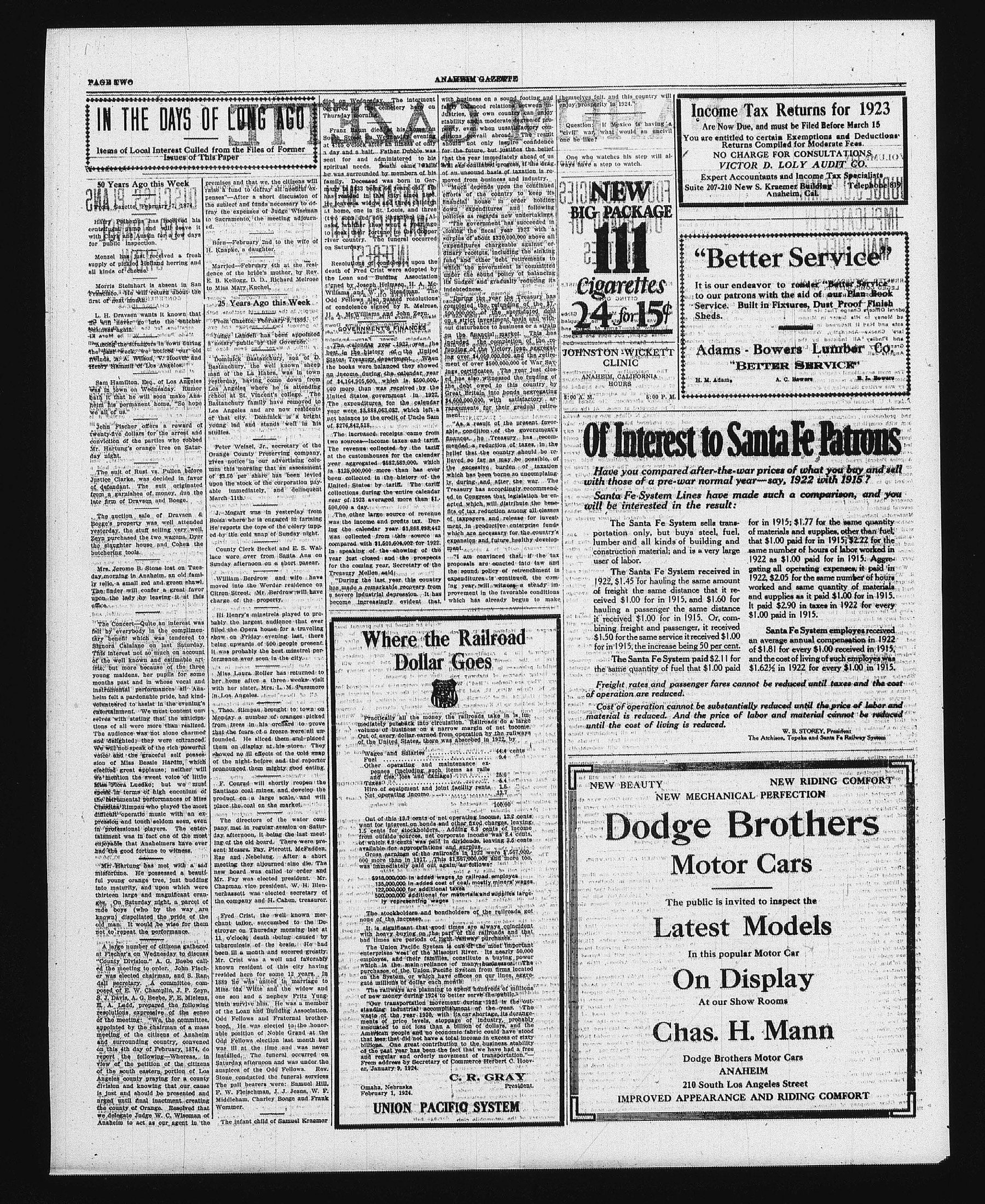
Searchable text
IN THE DAYS OF LONG AGO
Items of Local Interest Culled from the Files of Former Issues of This Paper
50 Years Ago this Week
From Gazette, February 7, 1874.
Harry Polhams has received his centrifugal pump and will leave it with Clary and Austin for a few days for public inspection.
Menzel has just received a fresh supply of pickled hiband herring and all kinds of cheese.
Morris Steinhart is absent in San Francisco. He will return about the first of next month.
L. H. Dravsen wants it known that he will never go into the butcher business again.
Among the strangers in town during the last week we noticed our old friend, A. A. Wilson, V. Hoover and Henry Hamill of Los Angeles.
Sam Hamilton, Esq., of Los Angeles was in town on Wednesday. Rumor bait it that he will soon make Anaheim his permanent home. "So hope we all of us."
John Fischer offers a reward of twenty-five dollars for the arrest and conviction of the parties who robbed Mr. Hartung's orange tree on Saturday.
premises and that we, the citizens will raise a fund to defray all needful expenses—After a short discussion of the subject and funds necessary to defray the expenses of Judge Wiseman to Sacramento, the meeting adjourned.
Born—February 2nd to the wife of H. Knapke, a daughter.
Married—February 4th at the residence of the bride's mother, by Rev. E. B. Kellogg, D. D., Richard Melrose to Miss Mary Kuchel.
25 Years Ago this Week
From Gazette, February 9, 1895.
Judge Landell has been appointed notary public by the Governor.
Dominick Bastanchury, son of D. Bastanchury, the well-known sheep man of the La Habra, was in town yesterday, having come down from Los Angeles where he is attending school at St. Vincent's college. The Bastanchury family have removed to Los Angeles and are now residents of that city. Dominick is a bright young lad and stands well in his studies.
Peter Weisel, Jr., secretary of the
Sam Hamilton, Esq., of Los Angeles was in town on Wednesday. Rumor bait it that he will soon make Anaheim his permanent home. "So hope we all of us."
John Fischer offers a reward of twenty-five dollars for the arrest and conviction of the parties who robbed Mr. Hartung's orange tree on Saturday night.
The suit of Rust vs. Pullen before Justice Clarke, was decided in favor of defendant. The suit originated from a garnishea of money, due the late firm of Dravsen and Boege.
The auction sale of Dravsen & Boege's property was well attended yesterday, the stuff selling very well. Zeyn purchased the two wagons, Dyer the slaughter house and Cohen the butchering tools.
Mrs. Jerome B. Stone lost on Tuesday morning in Anaheim, an old family relic, a small red and green shawl. The finder will confer a great favor upon the lady by leaving it at this office.
The Concert—Quite an interest was felt by everybody in the complimentary benefit which was tendered to Signora Calalano on last Saturday. This interest not so much on account of the well known and estimable artists, but more because of the three young malds, her pupils for some months past and in whose vocal and instrumental performances all Anaheim felt a pardonable pride, had kindly volunteered to assist in the evening's entertainment. We must content ourselves with stating that the anticipations of all were more than realized. The audience was not alone charmed and delighted; they were entranced. We will not speak of the rich powerful voice and the graceful self possession of Miss Bessie Hardin, which elicited great applause; neither will we mention the sweet voice of little Miss Flora Luedke; but we must spend in terms of high enconium of the instrumental performances of Miss Claudia Rimpau who played the most difficult operatic music with an expression and touch seldom seen, even in professional players. The entertainment was in fact one of the most enjoyable that Anaheimers have ever had.
Dominick Bastanchury, son of D. Bastanchury, the well known sheep man of La Habra, was in town yesterday, having come down from Los Angeles where he is attending school at St. Vincent's college. The Bastanchury family have removed to Los Angeles and are now residents of that city. Dominick is a bright young lad and stands well in his studies.
Peter Weisel, Jr., secretary of the Orange County Preserving company, gives notice in our advertising columns this morning that an assessment of $3.50 per share has been levied upon the stock of the corporation payable immediately, and delinquent March 11th.
J. Mogart was in yesterday from Bolsa where he is engaged in farming. He reports the tops of the celery inppeled by the cold snap of Sunday night.
County Clerk Becket and E. S. Wallace were over from Santa Ana on Sunday afternoon on a short passar.
William Berdrow and wife have moved into the Werder residence on Citron Street. Mr. Berdrow will have charge of the property.
Hi Henry's minstrels played to probably the largest audience that ever filled the Opera house for a traveling show on Friday evening last, there being upwards of 500 people present. It was probably the best minstrel performance ever seen in the city.
Miss Laura Roller has returned to her home after a three weeks visit with her sister, Mrs. L. M. Passmore in Los Angeles.
Theo. Rimpau brought to town on Monday a number of oranges picked from trees in his orchard to prove that the fears of a freeze were all unfounded. He sliced them and placed them on display at his store. They showed no ill effects of the cold snap of the night before and the reporter pronounced them mighty good eating.
F. Conrad will shortly reopen the Santiago coal mines, and develop the product on a large scale, and will place the coal on the market.
The directors of the water company met in regular session on Saturday afternoon, it being the last meeting of the old board. There were present Mosga, Bay, Pierotti, McFadden...
Mr. Hartung has met with a sad misfortune. He possessed a beautiful young orange tree, just budding into maturity, and upon which were thirteen large and magnificent oranges. On Saturday night, a parcel of male boys (who by the way are known) disposited the pride of the old man. It would be wise for them not to repeat the performance.
A large number of citizens gathered at Fischer's on Wednesday to discuss "County Division." A. G. Beebe called the meeting to order. John Fischer was elected chairman, and S. Randall secretary. A committee composed of E. W. Champlin, J. P. Zeyn, S. J. Davis, A. G. Beebe, F. E. Mielenz, E. A. Ladd, prepared the following resolutions expressive of the sense of the meeting: "We, the committee, appointed by the chairman of a mass meeting of the citizens of Anaheim and surrounding country, convened on this 4th day of February, 1874, do report the following—Whereas, in view of the petition of the citizens of the south eastern portion of Los Angeles county praying for a county division and knowing that our cause is just and should be presented and urged until final enactment creating the county of Orange. Resolved that we delegate Judge W. C. Wiseman of Anaheim to act as our agent in the voice and the graceful self possession of Miss Bessie Hardie, which elicited great applause; neither will mention the sweet voice of little Miss Flora Luedke; but we must speak in terms of high enconium of the instrumental performances of Miss Claudia Rimpau who played the most difficult operatic music with an expression and touch seldom seen, even in professional players. The entertainment was in fact one of the most enjoyable that Anaheimers have ever had the good fortune to witness.
F. Conrad will shortly reopen the Santiago coal mines, and develop the product on a large scale, and will place the coal on the market.
The directors of the water company, met in regular session on Saturday afternoon, it being the last meeting of the old board. There were present Messara Bay, Pierotti McFadden, Rag and Nebelung. After a short meeting they alljourned sine die. The new board was called to order and Mr. Fay was elected president. Mr. Chapman vice president, W. H. Blenerhassett was elected secretary of the company and H. Cahen, treasurer.
Fred Crist, the well known merchant tailor, succumbed to the destroyer on Thursday morning last at 11 o'clock, death being caused by tuberculosis of the brain. He had been ill a month and succeeded greatly; Mr. Crist was a well and favorably known resident of this city having resided here for some 12 years. In 1889 he was united in marriage to Miss Ida White and the widow and one son and a nephew Fritz Yungbluth survive him. He was a member of the Loan and Building Association. Odd Fellows and Fraternal brotherhood. He was elected to the honorable position of Noble Grand at the Odd Fellows election last month but was ill at the time and was never installed. The funeral occurred on Saturday afternoon and was under the auspices of the Odd Fellows. Rev. Stone conducted the funeral services The pall bearers were: Samuel Hill, F. W. Fleischman, J. J. Jeann, W. F. Middleham, Charley Booge and Frank Wommer.
The infant child of Samuel Kraemer
died on Wednesday. The interment occurred in the cemetery here on Thursday morning.
Franz Kahn died at his home on South Street on Wednesday evening at 1:55 o'clock after an illness of only a day and a half. Father Dubble was sent for and administered to his spiritual needs. Death came while he was surrounded by members of his family. Decased was born in Germany in 1833 being 60 years old. He resided in this city since 1890. He leaves a widow and three children at home, one in St. Louis, and three (two sons and one daughter) in Alaska, whither they went a year ago to seek their fortune in the Copper River country. The funeral occurred on Saturday.
Resolutions of condolence upon the death of Fred Crist were adopted by the Loan and Building Association signed by Joseph Helmsen, H. A. McWilliams, and W. F. Steadman. The Odd Fellows also passed resolutions of condolence signed by R. Melrose, J. A. McWilliams, and John Zeyn.
GOVERNMENT'S FINANCES
The calendar year 1822 was the beat in the history of the United States Treasury department. When the books were balanced they showed an income during the calendar year of $4,164,905,600, which is $500,000,000 more than was received by the United States government in 1922. The expenditures for the calendar year were $3,888,063,082, which left a net balance to the credit of Uncle Sam of $276,842,518.
The increased receipts came from two sources—income taxes and tariff. The revenue collected by the tariff with business on a sound footing and fairly balanced relations between industries, our own country can enjoy stability and a moderate degree of property, even when unsatisfactory conditions prevail abroad. The result should not only inspire confidence for the future, but justifies the belief that the year immediately ahead of us will also conflated progress. If the drag of an unsound basis of taxation is removed from business and industry.
Much depends upon the continued efforts of the country to keep its financial house in order holding down expenditures and following policies as regards new undertakings.
The government has succeeded in closing the fiscal year 1923 with a surplus of about $310,000,000 above all expenditures chargeable against ordinary receipts, including the sinking fund and other debt retirements to which the government is committed under the sound policy of balancing its budget and gradually reducing its indebtedness.
During the year the Treasury has completed the refunding of the $7,600,000,000 of the short-deferred debt on a strict investment basis and without disturbance to business or a strain on the financial market. This has included the completion of the refunding of the Victory loan aggregating over $4,050,000,000 and the retirement of over $500,000,000 of War Savings certificates. The year just closed has also witnessed the funding of the debt owed to this country by Great Britain into bonds aggregating $4,600,000,000 with satisfactory arrangements for their gradual retirement.
As a result of the present favorable condition of the government's finances, he Treasury has recommended a reduction of taxes, in the
States Treasury department. When the books were balanced they showed an income during the calendar year of $4,164,905,600, which is $500,000 more than was received by the United States government in 1922. The expenditures for the calendar year were $3,888,063,082, which left a net balance to the credit of Uncle Sam of $276,842,518.
The increased receipts came from two sources—income taxes and tariff. The revenue collected by the tariff at the customhouses for the calendar year aggregated $582,589,000, which is $125,000,000 more than has ever been collected in the history of the United States by tariff. The tariff collections during the entire calendar year of 1923 averaged more than $1,500,000 a day.
The other large source of revenue was the income and profits tax. During the calendar year $1,368,998,442 was collected from this source as compared with $1,501,604,002 for 1922. In speaking of the showing of the year just closed and the prospects for the coming year, Secretary of the Treasury Mollon said:
"During the last year, this country has made a remarkable recovery from a severe industrial depression. It has become increasingly evident that,
Where the Railroad Dollar Goes
Practically all the money the railroads take in is immediately put back into circulation. Railroads do a large volume of business on a narrow margin of net income. Out of every dollar earned from operation by the railways of the United States there was absorbed in 1922 by
Wages and Salaries ... 44.4 cents
Fuel ... 9.4
Other operating and maintenance expenses (including such items as rails and tires, floats and damage) ... 25.6
Taxes ... 8.4
Hire of equipment and joint facility rents ... 1.5
Net operating income ... 13.7
Out of this 13.7 cents of net operating income, 12.2 cents want for interest on bonds and other fixed charges, leaving 1.5 cents for stockholders. Adding 8.9 cents of income from outside sources, net corporate income was 8.4 cents, of which 4.9 cents was paid in dividends, leaving 3.5 cents available for appropriations and surplus."
Out of this 13.7 cents of net operating income, 12.2 cents want for interest on bonds and other fixed charges, leaving 1.5 cents for stockholders. Adding 6.9 cents of income from outside sources, net corporate income was 8.4 cents, of which 4.9 cents was paid in dividends, leaving 3.5 cents available for appropriations and surplus.
Gross earnings of the railroads in 1922 were $1,567,000,000 more than in 1917. This $1,567,000,000 was immediately paid out again as follows:
$918,000,000 in added wages to railroad employees.
135,000,000 in added cost of coal, mostly miners' wages.
122,000,000 for additional taxes.
500,000,000 additional for materials and supplies largely representing wages.
The stockholders and bondholders of the railroads got none of the increase.
It is significant that good times are always coincident with heavy buying on the part of the railroads and that bad times are periods of light railway purchases.
The Union Pacific System is one of the most important enterprises west of the Missouri River. Its nearly 50,000 employees, and their families, constitute a buying power which is the main reliance of many businesses. The purchases of the Union Pacific System from firms located on the System, or which have offices on our lines, aggregate millions of dollars each month.
The railways are planning to expand hundreds of millions of new money during 1924 to better serve the public.
Our transportation movement during 1923 is the outstanding industrial accomplishment of the year. The waste of the year 1920, with its car shortage, its derangements of price levels, stoppage of industry, probably amounted to not less than a billion of dollars, and the American people and no economic fabric could have stood that less; that did not have a total income in excess of sixty billions. One great contribution to the business stability of the past year has been the fact that we have had a free and regular and orderly movement of transportation."
From address by Secretary of Commerce Herbert C. Hoover, January 9, 1924.
C. R. GRAY
Omaha, Nebraska
President.
February 1, 1924.
UNION PACIFIC SYSTEM
Income Tax Returns for 1923
Are Now Due, and must be Filed Before March 15
You are entitled to certain Exemptions and Deductions
Returns Compiled for Moderate Fees.
NO CHARGE FOR CONSULTATIONS
VICTOR D. LOLY AUDIT CO.
Expert Accountants and Income Tax Specialists
Suite 207-210 New S. Kraemer Building
Telephone: 809
Anaheim, Cal.
"Better Service"
It is our endeavor to render "Better Service"
to our patrons with the aid of our Plan Book
Service. Built in Fixtures, Dust Proof Finish
Sheds.
Adams - Bowers Lumber Co.
"BETTER SERVICE"
H. M. Adams
A. C. Bowers
B. L. Bowers
INTEREST TO Santa Fe Patrons
If you compared after-the-war prices of what you buy and sell before of a pre-war normal year—say, 1922 with 1915?
Santa Fe System Lines have made such a comparison, and you interested in the result:
The Santa Fe System sells transportation only, but buys steel, fuel, and all kinds of building and construction material; and is a very large labor.
The Santa Fe System received in 1915 $1.45 for hauling the same amount right the same distance that it re-used $1.00 for in 1915, and $1.60 for taking a passenger the same distance traveled $1.00 for in 1915. Or, commuting freight and passenger, it received for the same service it received $1.00 in 1915; the increase being 50 per cent.
The Santa Fe System paid $2.11 for the quantity of fuel that $1.00 paid for in 1915; $1.77 for the same quantity of materials and supplies, other than fuel; that $1.00 paid for in 1915; $2.22 for the same number of hours of labor worked in 1922 as $1.00 paid for in 1915. Aggregating all operating expenses, it paid in 1922, $2.05 for the same number of hours worked and same quantity of materials and supplies as it paid $1.00 for in 1915.
It paid $2.90 in taxes in 1922 for every $1.00 paid in 1915.
Santa Fe System employees received an average annual compensation in 1922 of $1.81 for every $1.00 received in 1915; and the cost of living of such employees was $1.62½ in 1922 for every $1.00 in 1915.
Halt rates and passenger fares cannot be reduced until taxes and the cost of operation are reduced.
Of operation cannot be substantially reduced until the price of labor and fuel is reduced. And the price of labor and material cannot be reduced the cost of living is reduced.
W. B. STOREY, President
The Atchison, Topeka and Santa Fe Railway System
BEAUTY NEW RIDING COMFORT
NEW MECHANICAL PERFECTION
Dodge Brothers
Motor Cars
The public is invited to inspect the
Latest Models
In this popular Motor Car
On Display
At our Show Rooms
Chas. H. Mann
Dodge Brothers Motor Cars
ANAHEIM
210 South Los Angeles Street
IMPROVED APPEARANCE AND RIDING COMFORT