anaheim-gazette 1923-12-27
Scanned page
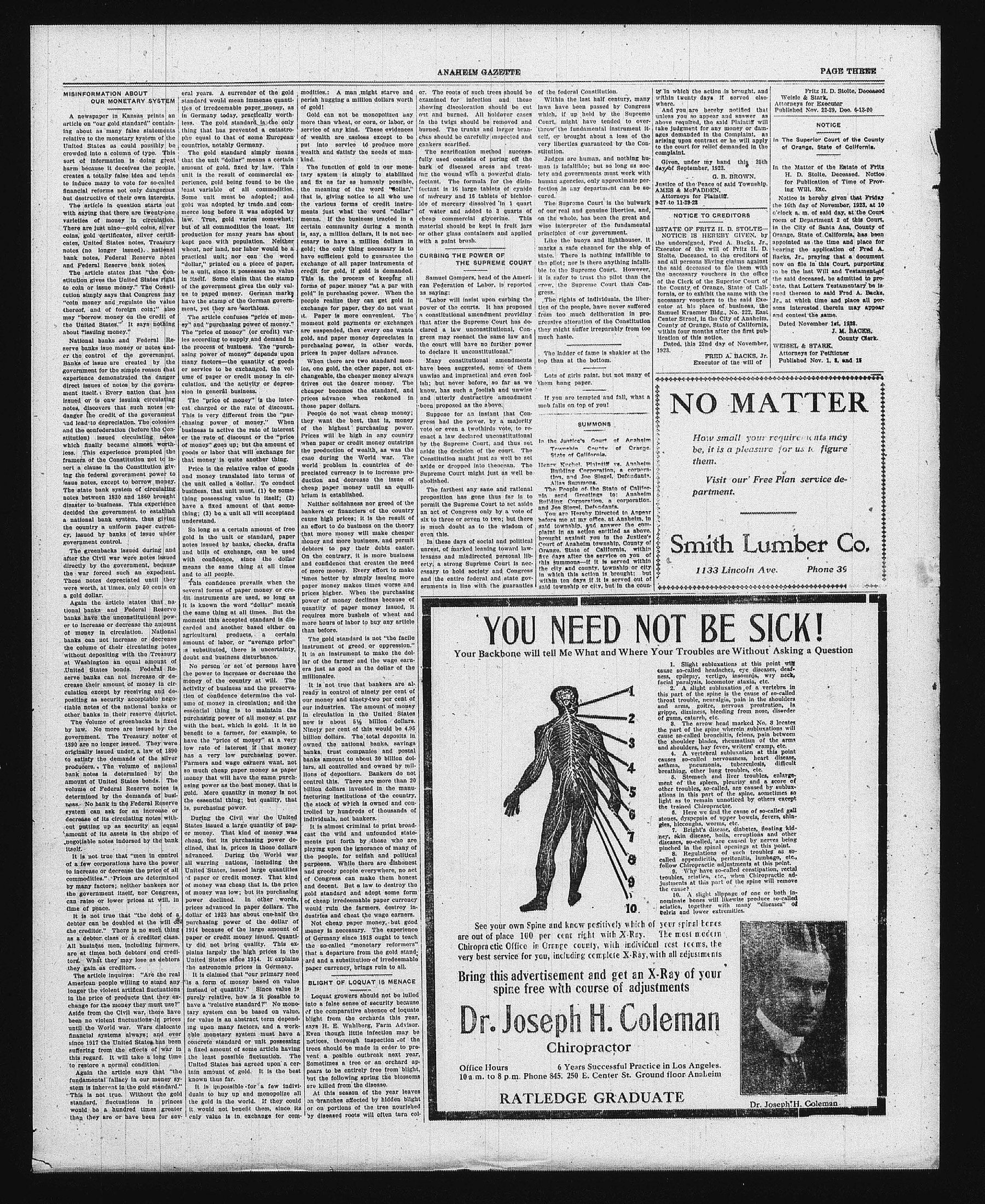
Searchable text
MISINFORMATION ABOUT
OUR MONETARY SYSTEM
A newspaper in Kansas prints an article on "our gold standard" containing about as many false statements relative to the monetary system of the United States as could possibly be crowded into a column of type. This sort of information is doing great harm because it deceives the people, creates a totally false idea and tends to induce many to vote for so-called financial reforms not only dangerous but destructive of their own interests.
The article in question starts out with saying that there are twenty-one varieties of money in circulation. There are just nine—gold coins, silver coins, gold certificates, silver certificates, United States notes, Treasury notes (no longer issued), national bank notes, Federal Reserve notes and Federal Reserve bank notes.
The article states that "the Constitution gives the United States right to coin or issue money." The Constitution simply says that Congress may "coin money and regulate the value thereof, and of foreign coin;" also may "borrow money on the credit of the United States." It says nothing about "issuing money."
National banks and Federal Reserve banks issue money or notes under the control of the government. Banks of issue are created by the government for the simple reason that experience demonstrated the danger direct issues of notes by the government itself. Every nation that has issued or is onew issuink circulating notes, discovers that such notes endanger the credit of the government and lead to depreciation. The colonies and the confederation (before the Constitution) issued circulating notes which finally became almost worthless years. A surrender of the gold standard would mean immense quantities of irredeemable paper money, as in Germany today, practically worthless. The gold standard is the only thing that has prevented a catastrophe equal to that of some European countries, notably Germany.
The gold standard simply means that the unit "dollar" means a certain amount of gold, fixed by law. This unit is the result of commercial experience, gold being found to be the least variable of all commodities. Some unit must be adopted; and gold was adopted by trade and commerce long before it was adopted by law. True, gold varies somewhat; but of all commodities the least. Its production for many years has about kept pace with population. Neither wheat, nor land, nor labor would be a practical unit; nor can the word "dollar," printed on a piece of paper, be a unit, since it possesses no value in itself. Some claim that the stamp of the government gives the only value to paped money. German marks have the stamp of the German government, yet they are worthless.
The article confuses "price of money" and "purchasing power of money." The "price of money" (or credit) varies according to supply and demand in the process of business. The "purchasing power of money" depends upon many factors—the quantity of goods or service to be exchanged, the volume of paper or credit money in circulation, and the activity or depression in general business.
The "price of money" is the interest charged or the rate of discount. This is very different from the "purchasing power of money." When business is active the rate of interest or the rate of discount or the "price of money" goes up; but the amount of modities.: A man milled perish hugging a million of gold!
Gold can not be more than wheat, or coarse service of any kind. Of wealth are useless put into service to wealth and satisfy the kind.
The function of gold tary system is simple and fix as far as hurt the meaning of the that is, giving notice to various forms of men just what they means. If the business certain community does say, a million dollar essary to have a mill gold; the only thing I have sufficient gold to exchange of all paper credit for gold, if gold This is the process forms of paper money gold" in purchasing people realize they can exchange for paper, then it. Paper is more common gold payments are suspended, then even gold, and paper money purchasing power, in prices in paper dollars.
When there are two lies, one gold, the other changeable, the cheaper drives out the dearer cheaper becomes the prices advance when those paper dollars.
People do not want they want the best, of the highest purity Prices will be high when paper or credit r
er the control of the government. Banks of issue are created by the government for the simple reason that experience demonstrated the danger direct issues of notes by the government itself. Every nation that has issued or is onew issuink circulating notes, discovers that such notes endanger the credit of the government and lead to depreciation. The colonies and the confederation (before the Constitution) issued circulating notes which finally became almost worthless. This experience prompted the framers of the Constitution not to insert a clause in the Constitution giving the federal government power to issue notes, except to borrow money. The state bank system of circulating notes between 1830 and 1860 brought disaster to business. This experience decided the government to establish a national bank system, thus giving the country a uniform paper currency, issued by banks of issue under government control.
The greenbacks issued during and after the Civil war were notes issued directly by the government, because the war forced such an expedient. These notes depreciated until they were worth, at times, only 50 cents on a gold dollar.
Again the article states that national banks and Federal Reserve banks have the unconstitutional power to increase or decrease the amount of money in circulation. National banks can not increase or decrease the column of their circulating notes without depositing with the Treasury at Washington an equal amount of United States bonds. Federal Reserve banks cannot increase or decrease their amount of money in circulation except by receiving and depositing as security acceptable negotiable notes of the national banks or other banks in their reserve district.
The volume of greenbacks is fixed by law. No more are issued by the government. The Treasury notes of 1890 are no longer issued. They were originally issued under a law of 1890 to satisfy the demands of the silver producers. The volume of national bank notes is determined by the amount of United States bonds. The volume of Federal Reserve notes is determined by the demands of business. No bank in the Federal Reserve system can ask for an increase or decrease of its circulating notes without putting up as security an equal amount of its assets in the shape of negotiable notes indorsed by the bank itself.
The "price of money" is the interest charged or the rate of discount. This is very different from the "purchasing power of money." When business is active the rate of interest or the rate of discount or the "price of money" goes up; but the amount of goods or labor that will exchange for that money is quite another thing.
Price is the relative value of goods and money translated into terms of the unit called a dollar. To conduct business, that unit must, (1) be something possessing value in itself; (2) have a fixed amount of that something; (3) be a unit all will accept and understand.
So long as a certain amount of free gold is the unit or standard, paper notes issued by banks, checks, drafts and bills of exchange, can be used with confidence, since the dollar means the same thing at all times and to all people.
This confidence prevails when the several forms of paper money or credit instruments are used, so long as it is known the word "dollar" means the same thing at all times. But the moment this accepted standard is discarded and another based either on agricultural products, a certain amount of labor, or "average price" is substituted, there is uncertainty, doubt and business disturbance.
No person or set of persons have the power to increase or decrease the money of the country at will. The activity of business and the preservation of confidence determine the volume of money in circulation; and the essential thing is to maintain the purchasing power of all money at par with the best, which is gold. It is no benefit to a farmer, for example, to have the "price of money" at a very low rate of interest if that money has a very low purchasing power. Farmers and wage earners want, not so much cheap paper money as paper money that will have the same purchasing power as the best money, that is gold. More quantity in money is not the essential thing; but quality, that is, purchasing power.
During the Civil war the United States issued a large quantity of paper money. That kind of money was cheap, but its purchasing power declined, that is, prices in those dollars using power of money depends upon many factors—the quantity of goods or service to be exchanged, the volume of paper or credit money in circulation, and the activity or depression in general business.
The "price of money" is the interest charged or the rate of discount. This is very different from the "purchasing power of money." When business is active the rate of interest or the rate of discount or the "price of money" goes up; but the amount of goods or labor that will exchange for that money is quite another thing.
Price is the relative value of goods and money translated into terms of the unit called a dollar. To conduct business, that unit must, (1) be something possessing value in itself; (2) have a fixed amount of that something; (3) be a unit all will accept and understand.
So long as a certain amount of free gold is the unit or standard, paper notes issued by banks, checks, drafts and bills of exchange, can be used with confidence, since the dollar means the same thing at all times and to all people.
This confidence prevails when the several forms of paper money or credit instruments are used, so long as it is known the word "dollar" means the same thing at all times. But the moment this accepted standard is discarded and another based either on agricultural products, a certain amount of labor, or "average price" is substituted, there is uncertainty, doubt and business disturbance.
No person or set of persons have the power to increase or decrease the money of the country at will. The activity of business and the preservation of confidence determine the volume of money in circulation; and the essential thing is to maintain the purchasing power of all money at par with the best, which is gold. It is no benefit to a farmer, for example, to have the "price of money" at a very low rate of interest if that money has a very low purchasing power. Farmers and wage earners want, not so much cheap paper money as paper money that will have the same purchasing power as the best money, that is gold. More quantity in money is not the essential thing; but quality, that is, purchasing power.
When there are two lies, one gold, the other changeable, the cheaper drives out the dearer cheaper becomes when those paper dollars.
People do not want they want the best, but of the highest purity. Prices will be high when paper or credit runs production of weaker case during The World world problem in co-operative currency is production and decrease cheap paper money uranium is established.
Neither selfishness nor bankers or financiers cause high prices; it can an effort to do business that more money will pay money and more business debtors to pay them On the contrary, it is and confidence that cost more money. Every time better by simpler paper money makes prices higher. When a power of money declines quantity of paper may require more bushels more hours of labor too than before.
The gold standard is instrument of greed It is an instrument toalar of farmer and workers just as good as thm millionaire.
It is not true that ready in control of nine our money and ninety our industries. The aim in circulation in these now is about 5½ Niney per cent of thm billion dollars. The ownedthe national banks trust company banks amount to about lars all controlled anlionsof depositors control this. There are billion dollars invested facturing institutionsthe stock of which is troiled by hundreds individuals, not banks
It is almost criminal castthe wild and umements put forth by playing uponthe ignor
to satisfy the demands of the silver producers. The volume of national bank notes is determined by the amount of United States bonds. The volume of Federal Reserve notes is determined by the demands of business. No bank in the Federal Reserve system can ask for an increase or decrease of its circulating notes without putting up as security an equal amount of its assets in the shape of negotiable notes indorsed by the bank itself.
It is not true that "men in control of a few corporations have the power to increase or decrease the price of all commodities." Prices are determined by many factors; neither bankers nor the government itself, nor Congress, can raise or lower prices at will, in time of peace.
It is not true that "the debt of a debtor can be doubled at the will of the creditor." There is no such thing as a debtor class or a creditor class. All business men, including farmers, are at times both debtors and creditors. What they may lose as debtors they gain as creditors.
The article inquires: "Are the real American people willing to stand any longer the violent artificial fluctuations in the price of products that they exchange for the money they must use?" Aside from the Civil war, there have been no violent fluctuations in prices until the World war. Wars dislocate financial systems always; and ever since 1917 the United States has been suffering from the effects of war in this regard. It will take a long time to restore a normal condition.
Again the article says that "the fundamental fallacy in our money system is inherent in the gold standard." This is not true. Without the gold standard, fluctuations in princes would be a hundred times greater than they are or have been for several years.
During the Civil war the United States issued a large quantity of paper money. That kind of money was cheap, but its purchasing power declined, that is, prices in those dollars advanced. During the World war all warring nations, including the United States, issued large quantities of paper or credit money. That kind of money was cheap that is, the price of money was low; but its purchasing power declined. In other words, prices advanced in paper dollars. The dollar of 1923 has about one-half the purchasing power of the dollar of 1914 because of the large amount of paper or credit money issued. Quantity did not bring quality. This explains largely the high prices in the United States since 1914. It explains the astronomic prices in Germany.
It is claimed that "our primary need is a form of money based on value instead of quantity." Since value is purely relative, how is it possible to have a "relative standard?" No monetary system can be based on value, for value is an abstract term depending upon many factors, and a workable monetary system must have a concrete standard or unit possessing a fixed amount of some article having the least possible fluctuation. The United States has agreed upon a certain amount of gold. It is the best known thus far.
It is impossible for a few individuals to buy up and monopolize all the gold in the world. If they could it would not benefit them, since its only value is in exchange for banks amount to about lars, all controlled and millions of depositors. Control this. There are billion dollars invested facturing institutions in the stock of which is trolled by hundreds of individuals, not banks.
It is almost criminal cast the wild and wicked put forth by playing upon the ignorant people, for selfish purposes. While these and greedy people even of Congress can man and decent. But a la gold standard and a cheap irredeemable would ruin the farm dustries and cheat the Not cheap paper money is necessary. Of Germany since 1917 the so-called "money that a departure from ard and a substitution paper currency, brings
BLIGHT OF LOQUAT
Loquat growers show into a false sense of of the comparative light from the ores says H. E. Wahlberg. Even though little notices, thorough in trees should be made vent a possible outward Sometimes a tree or pears to be entirely but the following space are killed from the d
At this season of on branches affected or on portions of th by diseased roots w
ANAHELM GAZETTE
modities.: A man might starve and perish hugging a million dollars worth of gold!
Gold can not be monopolized any more than wheat, or corn, or labor, or service of any kind. These evidences of wealth are useless except to be put into service to produce more wealth and satisfy the needs of mankind.
The function of gold in our monetary system is simply to stabilize and fix as far as humanly possible, the meaning of the word "dollar," that is, giving notice to all who use the various forms of credit instruments just what the word "dollar" means. If the business traced in a certain community during a month is, say, a million dollars, it is not necessary to have a million dollars in gold; the only thing necessary is to have sufficient gold to guarantee the exchange of all paper instruments of credit for gold, if gold is demanded. This is the process of keeping all forms of paper money "at a par with gold" in purchasing power. When the people realize they can get gold in exchange for paper, they do not want it. Paper is more convenient. The moment gold payments or exchanges are suspended, then every one wants gold, and paper money depreciates in purchasing power, in other words, prices in paper dollars advance.
When there are two standard monies, one gold, the other paper, not exchangeable, the cheaper money always drives out the dearer money. The cheaper becomes the standard, and prices advance when reckoned in those paper dollars.
People do not want cheap money; they want the best, that is, money of the highest purchasing power. Prices will be high in any country when paper or credit money outstrips the production of wealth so was the
or. The roots of such trees should be examined for infection and those showing discoloration should be cut out and burned. All hollover cases in the twigs should be removed and burned. The trunks and larger branches should be carefully inspected and cankers scarified.
The scarification method successfully used consists of paring off the bark of diseased areas and treating the wound with a powerful disinfectant. The formula for the disinfectant is 16 large tablets of cynide of mercury and 16 tablets of blechloride of mercury dissolved in 1 quart of water and added to 3 quarts of cheap commercial glycerine. This material should be kept in fruit jars or other glass containers and applied with a paint brush.
CURBING THE POWER OF THE SUPREME COURT
Samuel Gompers, head of the American Federation of Labor, is reported as saying:
"Labor will insist upon curbing the power of the courts. It has proposed a constitutional amendment providing that after the Supreme Court has declared a law unconstitutional, Congress may reenact the same law and the court will have no further power to declare it unconstitutional."
Many constitutional amendments have been suggested, some of them unwise and impractical and even foolish; but never before, so far as we know, has such a foolish and unwise and utterly destructive amendment been proposed as the above.
Suppose for an instant that Congress had the power, by a majority vote or even a twothirds vote, to re-enact a law declared unconstitutional by the Supreme Court, and thus set of the federal Constitution.
Within the last half century, many laws have been passed by Congress which, if up held by the Supreme Court, might have tended to overthrow the fundamental instrument itself, or brought about a loss of the very liberties guaranteed by the Constitution.
Judges are human, and nothing human is infallible; but so long as society and governments must work with human agencies, only approximate perfection in any department can be secured.
The Supreme Court is the bulwark of our real and genuine liberties, and, on the whole, has been the great and wise interpreter of the fundamental principles of our government.
Like the buoys and lighthouses, it marks a safe channel for the ship of state. There is nothing infallible to the pilot; nor is there anything infallible to the Supreme Court. However, it is safer to trust the pilot than the crew, the Supreme Court than Congress.
The rights of individuals, the liberties of the people, have never suffered from too much deliberation in progressive alteration of the Constitution they might suffer irreparably from too much haste.
The ladder of fame is shakier at the top than at the bottom.
Lots of girls paint, but not many of them hang paper.
If you are tempted and fall, what a mob falls on top of you!
SUMMONS
In the Justice's Court of Anaheim Township County of Oranje
When there are two standard monies, one gold, the other paper, not exchangeable, the cheaper money always drives out the dearer money. The cheaper becomes the standard, and prices advance when reckoned in those paper dollars.
People do not want cheap money; they want the best, that is, money of the highest purchasing power. Prices will be high in any country when paper or credit money outstrips the production of wealth, as was the case during the World war. The world problem in countries of depreciated currency is to increase production and decrease the issue of cheap paper money until an equilibrium is established.
Neither selfishness nor greed of the bankers or financiers of the country cause high prices; it is the result of an effort to do business on the theory that more money will make cheaper money and more business, and permit debtors to pay their debts easier. On the contrary, it is more business and confidence that creates the need of more money. Every effort to make times better by simply issuing more paper money makes times worse and prices higher. When the purchasing power of money declines because of quantity of paper money issued, it requires more bushels of wheat and more hours of labor to buy any article than before.
The gold standard is not "the facile instrument of greed or oppression." It is an instrument to make the dollar of the farmer and the wage earners just as good as the dollar of the millionaire.
It is not true that bankers are already in control of ninety per cent of our money and ninety-two per cent of our industries. The amount of money in circulation in the United States now is about 5½ billion dollars. Ninety per cent of this would be 4.95 billion dollars. The total deposits in owned the national banks, savings banks, trust companies and postal banks amount to about 30 billion dollars, all controlled and owned by millions of depositors. Bankers do not control this. There are more than 20 billion dollars invested in the manufacturing institutions of the country, the stock of which is owned and controlled by hundreds of thousands of individuals, not bankers.
It is almost criminal to print broadcast the wild and unfounded statements put forth by those who are playing upon the ignorance of many of
Many constitutional amendments have been suggested, some of them unwise and impractical and even foolish; but never before, so far as we know, has such a coolish and unwise and utterly destructive amendment been proposed as the above.
Suppose for an instant that Congress had the power, by a majority vote or even a twothirds vote, to enact a law declared unconstitutional by the Supreme Court, and thus set aside the decision of the court. The Constitution might just as well be set aside or dropped into the ocean. The Supreme Court might just as well be abolished.
The farthest any sane and rational proposition has gone thus far is to permit the Supreme Court to set aside an act of Congress only by a vote of six to three or seven to two; but there is much doubt as to the wisdom of even this.
In these days of social and political unrest, of marked leaning toward less ness and misdirected personal liberty, a strong Supreme Court is necessary to hold society and Congress and the entire federal and state governments in line with the guarantees
1. Slight cause so-calledness, epilepsy, facial paralysis.
2. A slim part of the throat trouble and arms, gripe, dizziness of gums, cataracts.
3. The part of the cause so-calledness, epilepsy, facial paralysis.
4. A vague causes so-calledness, epilepsy, facial paralysis.
5. Stomachment of the other troubles in this light as to rest the trained C.
6. Here stones, dyspegles, hiccoughs.
7. Bright eyes, skin diseases, so-called in th
banks amount to about 30 billion dollars, all controlled and owned by millions of depositors. Bankers do not control this. There are more than 20 billion dollars invested in the manufacturing institutions of the country, the stock of which is owned and controlled by hundreds of thousands of individuals, not bankers.
It is almost criminal to print broadcast the wild and unfounded statements put forth by those who are playing upon the ignorance of many of the people, for selfish and political purposes. While there are dishonest and greedy people everywhere, no act of Congress can make them honest and decent. But a law to destroy the gold standard and adopt some form of cheap irredeemable paper currency would ruin the farmers, destroy industries and cheat the wage earners.
Not cheap paper money, but good money is necessary. The experience of Germany since 1918 ought to teach the so-called "monetary reformers" that a departure from the gold standard and a substitution of irredeemable paper currency, brings ruin to all.
BLIGHT OF LOQUAT IS MENACE
Loquat growers should not be lulled into a false sense of security because of the comparative absence of loquate blight from the orchards this year, says H. E. Wahlberg, Farm Advisor. Even though little infection may be noticed, thorough inspection of the trees should be made in order to prevent a possible outbreak next year. Sometimes a tree or an orchard appears to be entirely free from blight, but the following spring the blossoms are killed from the disease.
At this season of the year leaves on branches affected by hidden blight or on portions of the tree nourished by diseased roots will often turn col-
See your own Spine and know positively which of your spines are out of place 100 per cent right with X-Ray. The most reliable Chiropractic Office in Orange county, with individual rest room very best service for you, including complete X-Ray, with all adjustments.
Bring this advertisement and get an X-Ray of your spine free with course of adjustments
Dr. Joseph H. Coleman
Chiropractor
Office Hours
6 Years Successful Practice in Los Angeles
10 a.m. to 8 p.m. Phone 845. 250 E. Center St. Ground floor An
RATLEDGE GRADUATE
In which the action is brought, and within twenty days if served elsewhere.
And you are hereby notified that unless you so appear and answer as above required, the said Plaintiff will take judgment for any money or damages demanded in the Complaint, as arising upon contract or he will apply to the court for relief demanded in the complaint.
Given, under my hand this 25th day of September, 1923.
G. B. BROWN,
Justice of the Peace of said Township.
AMES & McFADDEN,
Attorneys for Plaintiff.
9-27 to 11-29-23
NOTICE TO CREDITORS
ESTATE OF FRITZ H. D. STOLTE—NOTICE IS HEREBY GIVEN, by the undersigned, Fred A. Backs, Jr., Executor of the will of Fritz H. D. Stolte, Deceased, to the creditors of and all persons having claims against the said deceased to file them with the necessary vouchers in the office of the Clerk of the Superior Court of the County of Orange, State of California, or to exhibit the same with the necessary vouchers to the said Executor at his place of business, the Samuel Kraamer Bldg., No. 222, East Center Street, in the City of Anaheim, County of Orange, State of California, within four months after the first publication of this notice.
Dated, this 22nd day of November, 1923.
FRED A. BACKS, Jr.
Executor of the will of
Fritz H. D. Stolte, Decased
Weisle & Stark,
Attorneys for Executor
Published Nov. 22-29, Dec. 6-13-20
NOTICE
In The Superior Court of the County of Orange, State of California.
In the Matter of the Estate of Fritz H. D. Stolte, Deceased. Notice for Publication of Time of Proving Will, Etc.
Notice is hereby given that Friday the 16th day of November, 1923, at 10 o'clock a.m. of said day, at the Court room of Department 2 of this Court, in the City of Santa Ana, County of Orange, State of California, has been appointed as the time and place for hearing the application of Fred A. Backs, Jr., praying that a document now on file in this Court, purporting to be the last Will and Testament of the said deceased, be admitted to probate, that Letters Testamentary be issued thereon to said Fred A. Backs, Jr., at which time and place all persons interested therein may appear and contest the same.
Dated November 1st, 1923.
J. M. BACKS,
County Clerk.
WEISEL & STARK,
Attorneys for Petitioner
Published Nov. 1, 8, and 18
NO MATTER
How small your requirements may be, it is a pleasure for us to figure them.
Visit our Free Plan service department.
Smith Lumber Co.
1133 Lincoln Ave. Phone 39
NOT BE SICK!
Where Your Troubles are Without Asking a Question
1. Slight subluxations at this point will cause so-called headaches, eye diseases, deafness, epilepsy, vertigo, insomnia, wry neck, facial paralysis, locomotor ataxia, etc.
2. A slight subluxation of a vertebra in this part of the spine is the cause of so-called throat trouble, neuralgia, pain in the shoulders and arms, goitre, nervous prostration, la gripe, dizziness, bleeding from nose, disorder of gums, catarrh, etc.
3. The arrow head marked No. 8 locates the part of the spine wherein subluxations will cause so-called bronchitis, felons, pain between the shoulder blades, rheumatism of the arms and shoulders, hay fever, writers' cramp, etc.
4. A vertebral subluxation at this point causes so-called nervousness, heart disease, asthma, pneumonia, tuberculosis, difficult breathing, other lung troubles, etc.
5. Stomach and liver troubles, enlargement of the spleen, pleurisy and a score of other troubles, so-called, are caused by subluxations in this part of the spine, sometimes so light as to remain unnoticed by others except the trained Chiropractor.
6. Here we find the cause of so-called gall stones, dyspepsia of upper bowels, fevers, shingles, hiccoughs, worms, etc.
7. Bright's disease, diabetes, floating kidney, skin disease, boils, eruptions and other diseases, so-called are caused by nerves being pinched in the spinal openings at this point.
causes so-called nervousness, heart disease,
asthma, pneumonia, tuberculosis, difficult
breathing, other lung troubles, etc.
5. Stomach and liver troubles, enlargement of the spleen, pleurisy and a score of
other troubles, so-called, are caused by subluxations in this part of the spine, sometimes so
light as to remain unnoticed by others except
the trained Chiropractor.
6. Here we find the cause of so-called gall
stones, dyspepsia of upper bowels, fevers, shingles, hiccoughs, worms, etc.
7. Bright's disease, diabetes, floating kidney, skin disease, boils, eruptions and other
diseases, so-called, are caused by nerves being
pinched in the spinal openings at this point.
8. Regulations of such troubles as socalled appendicitis, peritonitis, lumbago, etc.,
follow Chiropractic adjustments at this point.
9. Why have so-called constipation, rectal
troubles, sciatica, etc., when Chiropractic adjustments at this part of the spine will remove
the cause?
10. A slight slippage of one or both innominate bones will likewise produce so-called
sciatica, together with many "diseases" of
belvis and lower extremities.
Dr. Joseph H. Coleman