anaheim-gazette 1923-12-13
Scanned page
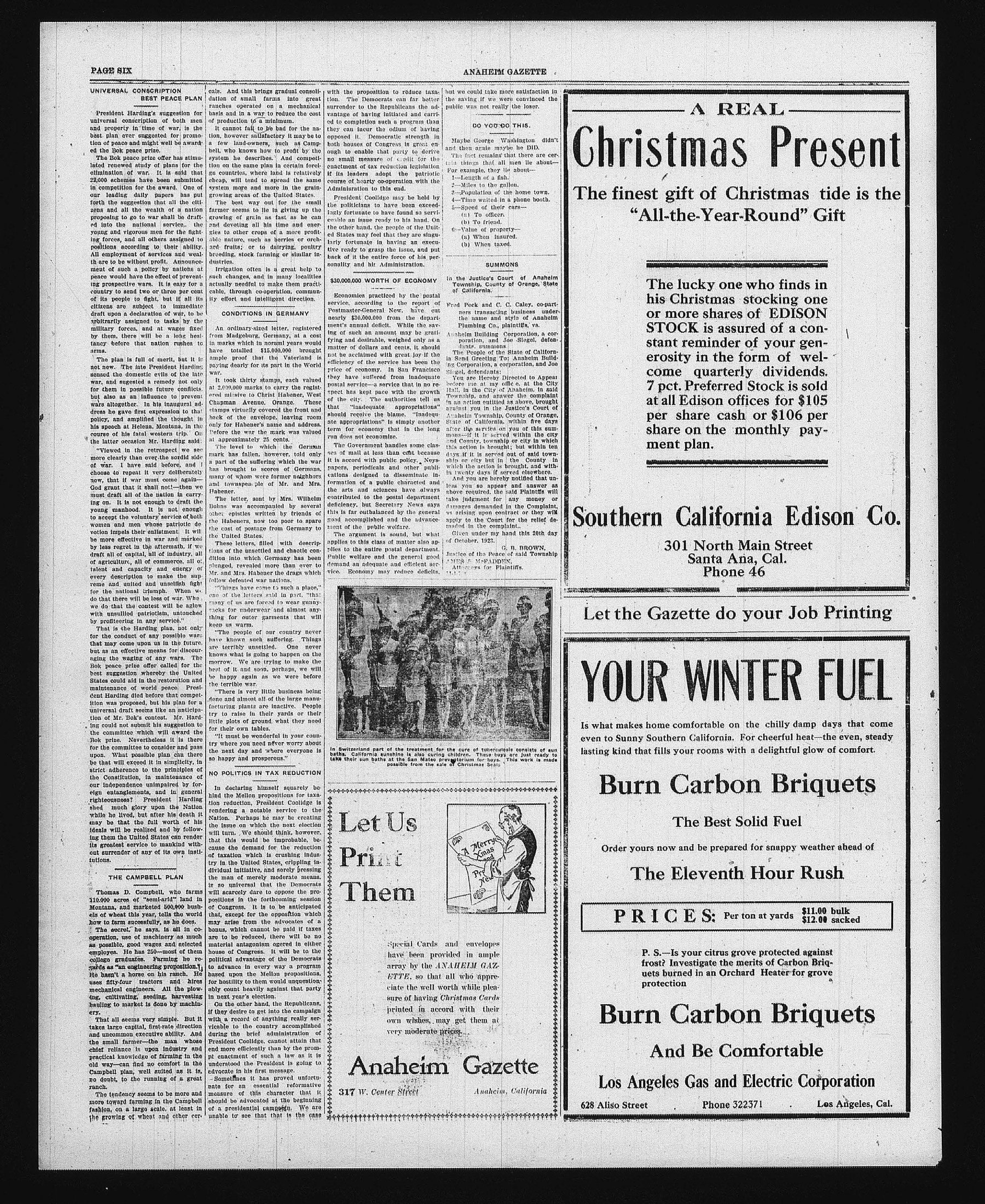
Searchable text
UNIVERSAL CONSCRIPTION
BEST PEACE PLAN
President Harding's suggestion for universal conscription of both men and property in time of war, is the best plan ever suggested for promotion of peace and might well be awarded the Bok peace prize.
The Bok peace prize offer has stimulated renewed study of plans for the elimination of war. It is said that 22,000 schemes have been submitted in competition for the award. One of our leading daily papers has put forth the suggestion that all the citizens and all the wealth of a nation proposing to go to war shall be drafted into the national service, the young and vigorous men for the fighting forces, and all others assigned to positions according to their ability. All employment of services and wealth are to be without profit. Announcement of such a policy by nations at peace would have the effect of preventing prospective wars. It is easy for a country to send two or three per cent of its people to fight, but if all its citizens are subject to immediate draft upon a declaration of war, to be arbitrarily assigned to tasks by the military forces, and at wages fixed by them, there will be a long hesitancy before that nation rushes to arms.
The plan is full of merit, but it is not new. The late President Harding sensed the domestic evils of the late war, and suggested a remedy not only for them in possible future conflicts, but also as an influence to prevent wars altogether. In his inaugural address he gave first expression to that policy, and amplified the thought in his speech at Helena, Montana, in the course of his fatal western trip. On the latter occasion Mr. Harding said:
And this brings gradual consolidation of small farms into great ranches operated on a mechanical basis and in a way to reduce the cost of production to a minimum.
It cannot fail to be bad for the nation, however satisfactory it may be to a few land-owners, such as Campbell, who knows how to profit by the system he describes. And competition on the same plan in certain foreign countries, where land is relatively cheap, will tend to spread the same system more and more in the grain-growing areas of the United States.
The best way out for the small farmer seems to lie in giving up the growing of grain as fast as he can and devoting all his time and energies to other crops of a more profitable nature, such as berries or orchard fruits; or to dairying, poultry breeding, stock farming or similar industries.
Irrigation often is a great help to such changes, and in many localities actually needful to make them practicable, through co-operation, community effort and intelligent direction.
CONDITIONS IN GERMANY
An ordinary-sized letter, registered from Madgeburg, Germany, at a cost in marks which in noraml years would have totalled $15,000,000 brought ample proof that the Vaterland is paying dearly for its part in the World war.
It took thirty stamps, each valued at 2,000,000 marks to carry the registered missive to Christ Haboner, West Chapman Avenue, Orange. These stamps virtually covered the front and back of the envelope, leaving room only for Habener's name and address. Before the war the mark was valued at approximately 25 cents.
The level to which the German with the propulsion. The Destroyer to vantage of having opposed it. Both houses owe no small men enactment of it if its leaders course of heart Administration.
President C. the politician ingly fortunate ceable an issue the other hand ed States may larly fortunate ready to back of it the sonality and $30,000,000 W
Economies service, acco Postmaster-Ge nearly $30,000 annual ing of such a fying and des matter of dol not be acclaim efficiency of t price of econ they have su postal service spect has key of the city. that "inade should receive appropriate term for eco run does not c The Govern
The plan is full of merit, but it is not new. The late President Harding sensed the domestic evils of the late war, and suggested a remedy not only for them in possible future conflicts, but also as an influence to prevent wars altogether. In his inaugural address he gave first expression to that policy, and amplified the thought in his speech at Helena, Montana, in the course of his fatal western trip. On the latter occasion Mr. Harding said:
"Viewed in the retrospect we see more clearly than ever the sordid side of war. I have said before, and I choose to repeat it very deliberately now, that if war must come again—God grant that it shall not!—then we must draft all of the nation in carrying on. It is not enough to draft the young manhood. It is not enough to accept the voluntary service of both women and men whose patriotic devotion impels their enlistment. It will be more effective in war and marked by less regret in the aftermath. If we draft all of capital, all of industry, all of agriculture, all of commerce, all of talent and capacity and energy of every description to make the supreme and united and unselfish fight for the national triumph. When we do that there will be less of war. Where we do that the contest will be aglow with unsullied patriotism, untouched by profiteering in any service."
That is the Harding plan, not only for the conduct of any possible wars that may come upon us in the future, but as an effective means for discouraging the waging of any wars. The Bok peace prize offer called for the best suggestion whereby the United States could aid in the restoration and maintenance of world peace. President Harding died before that competition was proposed, but his plan for a universal draft seems like an anticipation of Mr. Bok's contest. Mr. Harding could not submit his suggestion to the committee which will award the Bok prize. Nevertheless it is there for the committee to consider and pass upon. What possible plan can there be that will exceed it in simplicity, in strict adherence to the principles of the Constitution, in maintenance of our independence unimpaired by foreign entanglements, and in general righteousness? President Harding shed much glory upon the Nation while he lived, but after his death it may be that the full worth of his ideals will be realized and by following them the United States can render its greatest service to mankind with sample proof that the Vaterland is paying dearly for its part in the World war.
It took thirty stamps, each valued at 2,000,000 marks to carry the registered missive to Christ Habener, West Chapman Avenue, Orange. These stamps virtually covered the front and back of the envelope, leaving room only for Habener's name and address. Before the war the mark was valued at approximately 25 cents.
The level to which the German mark has fallen, however, told only a part of the suffering which the war has brought to scores of Germans, many of whom were former neighbors and townspeople of Mr. and Mrs. Habener.
The letter, sent by Mrs. Wilhelm Bohns was accompanied by several other epistles written by friends of the Habeners, now too poor to spare the cost of postage from Germany to the United States.
These letters filled with descriptions of the unsettled and chaotic condition into which Germany has been plunged, revealed more than ever to Mr. and Mrs. Habener the drags which follow defeated war nations.
"Things have come to such a place," one of the letters said in part, "that many of us are forced to wear gunny-sacks for underwear and almost anything for outer garments that will keep us warm.
"The people of our country never have known such suffering. Things are terribly unsettled. One never knows what is going to happen on the morrow. We are trying to make the best of it and soon, perhaps, we will be happy again as we were before the terrible war.
"There is very little business being done and almost all of the large manufacturing plants are inactive. People try to raise in their yards or their little plots of ground what they need for their own tables.
"It must be wonderful in your country where you need never worry about the next day and where everyone is so happy and prosperous."
NO POLITICS IN TAX REDUCTION
In declaring himself squarely behind the Mellon propositions for taxation reduction, President Coolidge is rendering a notable service to the Nation. Perhaps he may be creating the issue on which the next election will turn. We should think, however, that this would be improbable, because the demand for the reduction
THE CAMPBELL PLAN
Thomas D. Campbell, who farms 110,000 acres of "semi-arid" land in Montana, and marketed 500,000 bushels of wheat this year, tells the world how to farm successfully, as he does.
The secret, he says, is all in cooperation, use of machinery as much as possible, good wages and selected employees. He has 250—most of them college graduates. Farming he regards as "an engineering proposition." He hasn't a horse on his ranch. He uses fifty-four tractors and hires mechanical engineers. All the plowing, cultivating, seeding, harvesting hauling to market is done by machinery.
That all seems very simple. But it takes large capital, first-rate direction and uncommon executive ability. And the small farmer—the man whose chief reliance is upon industry and practical knowledge of farming in the old way—can find no comfort in the Campbell plan, well suited as it is, no doubt, to the running of a great ranch.
The tendency seems to be more and more toward farming in the Campbell fashion, on a large scale, at least in the growing of wheat and other cereals.
NO POLITICS IN TAX REDUCTION
In declaring himself squarely behind the Mellon propositions for taxation reduction, President Coolidge is rendering a notable service to the Nation. Perhaps he may be creating the issue on which the next election will turn. We should think, however, that this would be improbable, because the demand for the reduction of taxation which is crushing industry in the United States, crippling individual initiative, and sorely pressing the man of merely moderate means, is so universal that the Democrats will scarcely dare to oppose the propositions in the forthcoming session of Congress. It is to be anticipated that, except for the opposition which may arise from the advocates of a bonus, which cannot be paid if taxes are to be reduced, there will be no material antagonism ogered in either house of Congress. It will be to the political advantage of the Democrats to advance in every way a program based upon the Mellon propositions, for hostility to them would unquestionably count heavily against that party in next year's election.
On the other hand, the Republicans, if they desire to get into the campaign with a record of anything really servicable to the country accomplished during the brief administration of President Coolidge, cannot attain that end more efficiently than by the prompt enactment of such a law as it is understood the President is going to advocate in his first message.
Sometimes it has proved unfortunate for an essential reformative measure of this character that it should be advocated at the beginning of a presidential campaign. We are unable to see that that is the case.
ANAHEIM GAZETTE
with the proposition to reduce taxation. The Democrats can far better surrender to the Republicans the advantage of having initiated and carried to completion such a program than they can incur the odium of having opposed it. Democratic strength in both houses of Congress is great enough to enable that party to derive no small measure of credit for the enactment of tax reduction legislation if its leaders adopt the patriotic course of hearty co-operation with the Administration to this end.
President Coolidge may be held by the politicians to have been exceedingly fortunate to have found so serviceable an issue ready to his hand. On the other hand, the people of the United States may feel that they are singularly fortunate in having an executive ready to grasp the issue, and put back of it the entire force of his personality and his Administration.
$30,000,000 WORTH OF ECONOMY
Economies practiced by the postal service, according to the report of Postmaster-General Now, have cut nearly $30,000,000 from the department's annual deficit. While the saving of such an amount may be gratifying and desirable, weighed only as a matter of dollars and cents, it should not be acclaimed with great joy if the efficiency of the service has been the price of economy. In San Francisco they have suffered from inadequate postal service—a service that in no respect has kept pace with the growth of the city. The authorities tell us that "inadequate appropriations" should receive the blame. "Inadequate appropriations" is simply another term for economy that in the long run does not economize.
The Government handles some clas-
but we could take more satisfaction in the saving if we were convinced the public was not really the loser.
DO YOU DO THIS.
Maybe George Washington didn't and then again maybe he DID.
The fact remains that there are certain things that all men lie about—For example, they lie about—
1—Length of a fish.
2—Miles to the gallon.
3—Population of the home town.
4—Time waited in a phone booth.
5—Speed of their cars—
(a) To officer.
(b) To friend.
6—Value of property—
(a) When insured.
(b) When taxed.
SUMMONS
In the Justice's Court of Anaheim Township, County of Orange, State of California.
Fred Peck and C. C. Caley, co-partners transacting business under the name and style of Anaheim Plumbing Co., plaintiffs, vs.
Anaheim Building Corporation, a corporation, and Joe Siegel, defendants,
The People of the State of California Send Greeting To: Anaheim Building Corporation, a corporation, and Joe Siegel, defendants;
You are Hereby Directed to Appear before me at my office e, at the City Hall, in the City of Anaheim, in said Township, and answer the complaint in an action entitled as above, brought against you in the Justice's Court of Anaheim Township, County of Orange, State of California, within five days after the service on you of this summons—if it is served within the city and County, township or city in which this action is brought; but within ten
The Government handles some classes of mail at less than cost because it is accord with public policy. Neyspapers, periodicals and other publications designed to disseminate information of a public character and the arts and sciences have always contributed to the postal department deficiency, but Secretary News says this is far outbalanced by the general good accomplished and the advancement of the public welfare.
The argument is sound, but what applies to this class of matter also applies to the entire postal department. Public welfare and the general good demand an adequate and efficient service. Economy may reduce deficits.
In Switzerland part of the treatment for the cure of tuberculosis consists of sun baths. California sunshine is also curing children. These boys are just ready to take their sun baths at the San Mateo preventorium for boys. This work is made possible from the sale of Christmas Seals.
Send Greeting To: Anaheim Building Corporation, a corporation, and Joe Siegel, defendants:
You are hereby Directed to Appear before me at my office, at the City Hall, in the City of Anaheim, in said Township, and answer the complaint in an action entitled as above, brought against you in the Justice's Court of Anaheim Township, County of Orange, State of California, within five days after the service on you of this summons—if it is served within the city and County, township or city in which this action is brought; but within ten days if it is served out of said township or city but in the County in which the action is brought, and within twenty days if served elsewhere.
And you are hereby notified that unless you so appear and answer as above required, the said Plaintiffs will take judgment for any money or damages demanded in the Complaint, us arising upon contract or they will apply to the Court for the relief demanded in the complaint.
Given under my hand this 20th day of October, 1923.
G. B. BROWN,
Justice of the Peace of said Township
AMES & McFADDEN,
Attorneys for Plaintiffs.
Let Us Print Them
Special Cards and envelopes have been provided in ample array by the ANAHEIM GAZETTE, so that all who appreciate the well worth while pleasure of having Christmas Cards printed in accord with their own wishes, may get them at very moderate prices.
Anaheim Gazette
317 W. Center Street Anaheim, California
A REAL
Christmas Present
finest gift of Christmas tide is the
"All-the-Year-Round" Gift
The lucky one who finds in his Christmas stocking one or more shares of EDISON STOCK is assured of a constant reminder of your generosity in the form of welcome quarterly dividends. 7 pct. Preferred Stock is sold at all Edison offices for $105 per share cash or $106 per share on the monthly payment plan.
erosity in the form of welcome quarterly dividends.
7 pct. Preferred Stock is sold at all Edison offices for $105 per share cash or $106 per share on the monthly payment plan.
Southern California Edison Co.
301 North Main Street
Santa Ana, Cal.
Phone 46
the Gazette do your Job Printing
OUR WINTER FUEL
makes home comfortable on the chilly damp days that come Sunny Southern California. For cheerful heat—the even, steady mind that fills your rooms with a delightful glow of comfort.
Carbon Briquets
The Best Solid Fuel
er yours now and be prepared for snappy weather ahead of
Return Carbon Briquets
The Best Solid Fuel
After yours now and be prepared for snappy weather ahead of
The Eleventh Hour Rush
PRICES: Per ton at yards $11.00 bulk
$12.00 sacked
P. S.—Is your citrus grove protected against frost? Investigate the merits of Carbon Briquets burned in an Orchard Heater for grove protection
Return Carbon Briquets
And Be Comfortable
Los Angeles Gas and Electric Corporation
O Street Phone 322371 Los Angeles, Cal.