anaheim-gazette 1923-12-06
Scanned page
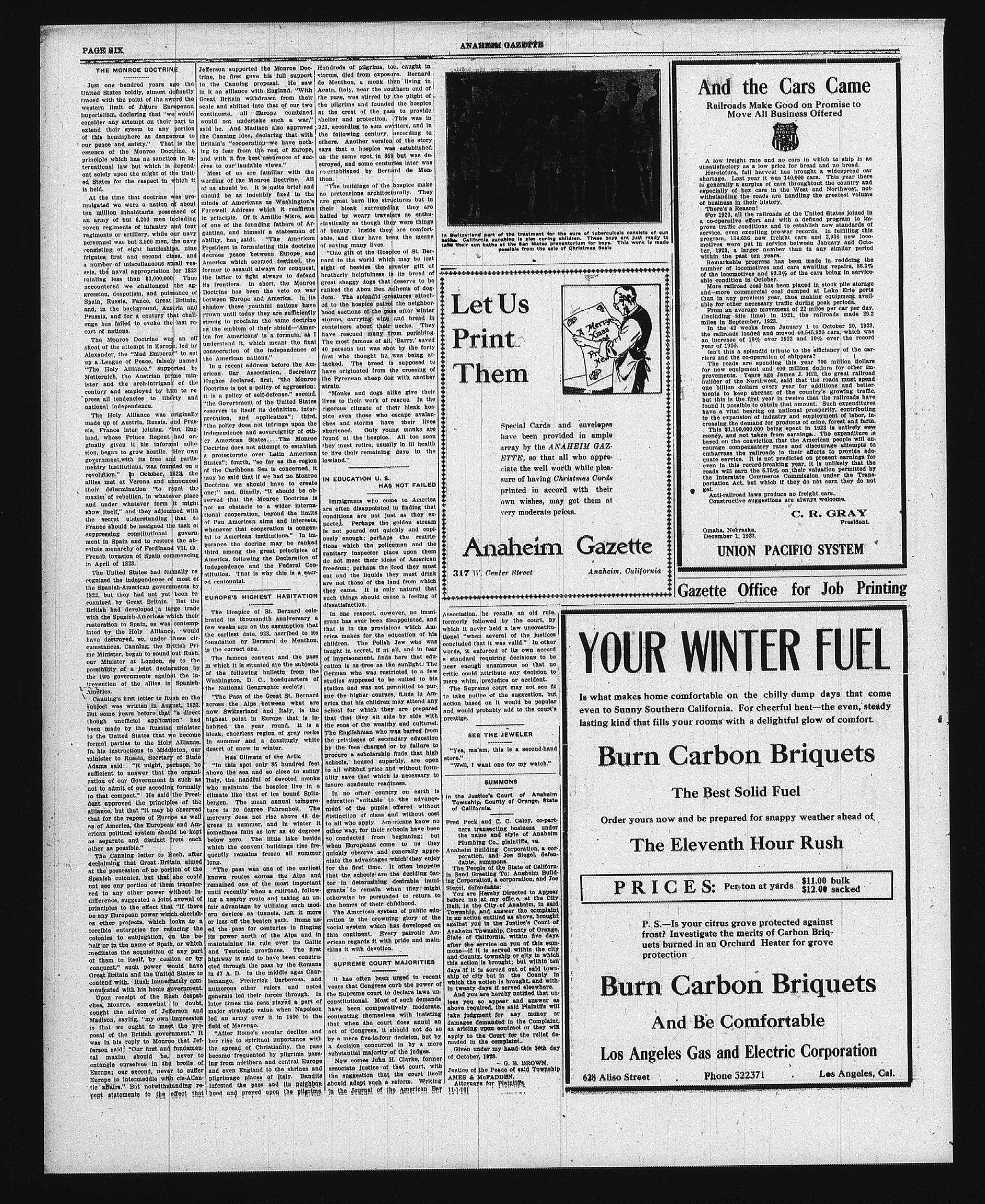
Searchable text
THE MONROE DOCTRINE
Just one hundred years ago the United States boldly, almost defiantly traced with the point of the sword the western limit of future European imperialism, declaring that "we would consider any attempt on their part to extend their system to any portion of this hemisphere as dangerous to our peace and safety." That is the essence of the Monroe Doctrine, a principle which has no sanction in international law but which is dependent solely upon the might of the United States for the respect in which it is held.
At the time that doctrine was promulgated we were a nation of about ten million inhabitants possessed of an army of but 6,200 men including seven regiments of infantry and four regiments or artillery, while our navy personnel was but 3,500 men, the navy consisting of eight battleships, nine frigates first and second class, and a number of miscellaneous small vessels, the naval appropriation for 1823 totaling less than $3,000,000. Thus accountered we challenged the aggression, despotism, and pulsance of Spain, Russia, France, Great Britain, and, in the background, Austria and Prussia, and for a century that challenge has failed to evoke the last resort of nations.
The Monroe Doctrine was an off shoot of the attempt in Europe, led by Alexander, the "Mad Emperor" to set up a League of Peace, falsely named "The Holy Alliance," supported by Metternich, the Austrian prime minister and the arch-intrigant of the century and employed by him to repress all tendencies to liberty and national independence.
The Holy Alliance was originally made up of Austria, Russia, and Prussia, France later joining, "but England, whose Prince Regent had originally given it his informal adhere Jefferson supported the Monroe Doctrine, he first gave his full support to the Canning proposal. He saw in it an alliance with England. "With Great Britain withdrawn from their scale and shifted into that of our two continents, all Europe combined would not undertake such a war," said he. And Madison also approved the Canning idea, declaring that with Britain's "cooperation—we have nothing to fear from the rest of Europe, and with it the best assurance of success to our laudable views."
Most of us are familiar with the wording of the Monroe Doctrine. All of us should be. It is quite brief and should be as indelibly fixed in the minds of Americans as Washington's Farewell Address which it reaffirms in principle. Of it Amillo Mitre, son of one of the founding fathers of Argentina, and himself a statesman of ability, has said: "The American President in formulating this doctrine decrees peace between Europe and America which seemed destined, the former to assault always for conquest, the latter to fight always to defend its frontiers. In short, the Monroe Doctrine has been the veto on war between Europe and America. In its shadow these youthful nations have grown until today they are sufficiently strong to proclaim the same doctrine as the emblem of their shield—'America for Americans' is a formula, as I understand it, which meant the final consecration of the independence of the American nations."
In a recent address before the American Bar Association, Secretary Hughes declared first, "the Monroe Doctrine is not a policy of aggression; it is a policy of self-defense." second, "the Government of the United States reserves to itself its definition, interpretation, and application"; third, "the policy does not infringe upon the independence and sovereignty of other American States... The Monroe Doctrine does not attempt to establish Hundreds of pilgrims, died from de Menthon, a Acata, Italy, near the pass, was stitched the pilgrims and at the crest of shelters and protected 923, according to the following others. Another says that a host on the same spot stroyed, and some re-established both.
"The buildings no pretensions are great barn their bleak hailed by wearer elastically as the beauty. Instable, and they do of saving many." One gift to the world sight of besider brotherly helpfor great shaggy dog ranked the Abovdom. The splendid to the hospicehood sections of storms, carrying containers about have rescued The most famous 40 persons but first who thought tacked. The have originated the Pyrenean strain.
"Monks and lives to their w rigorous climate piece even those chees and storm shortened. Or found at the last they must retire."
The Holy Alliance was originally made up of Austria, Russia, and Prussia, France later joining, but England, whose Prince Regent had originally given it its informal adhesion, began to grow hostile. Her own government, with its free and parliamentary institutions, was founded on a revolution. In October, 1823, the allies met at Verona and announced their determination "to repel the maxim of rebellion, in whatever place and under whatever form it might show itself," and they adjourned with the secret understanding that France should be assigned the task of suppressing constitutional government in Spain and to restore the absolute monarchy of Ferdinand VII, the French invasion of Spain commencing in April of 1823.
The United States had formally recognized the independence of most of the Spanish-American governments by 1822, but they had not yet been recognized by Great Britain. But the British had developed a large trade with the Spanish-Americas which their restoration to Spain, as was contemplated by the Holy Alliance, would have destroyed, so, under these circumstances, Canning, the British Prime Minister, began to sound out Rush, our Minister at London, as to the possibility of a joint declaration by the two governments against the intervention of the allies in Spanish America.
Canning's first letter to Rush on the subject was written in August, 1823. But some years before that "a direct though unofficial application" had been made by the Russian minister to the United States that we become formal parties to the Holy Alliance. In his instructions to Middleton, our minister to Russia, Secretary of State Adams said: "It might, perhaps, be sufficient to answer that the organization of our Government as such as to admit of our acceding formally to that compact." He said the President approved the principles of the alliance, but that "it may be observed that for the repose of Europe as well as of America, the European and American political system should be kept as separate and distinct from each other as possible."
In a recent address before the American Bar Association, Secretary Hughes declared, first, "the Monroe Doctrine is not a policy of aggression; it is a policy of self-defense." second, "the Government of the United States reserves to itself its definition, interpretation, and application"; third, "the policy does not infringe upon the independence and sovereignty of other American States... The Monroe Doctrine does not attempt to establish a protectorate over Latin American States"; fourth, "so far as the region of the Caribbean Sea is concerned, it may be said that if we had no Monroe Doctrine we should have to create one;" and finally, "It should be observed that the Monroe Doctrine is not an obstacle to a wider international cooperation, beyond the limits of Pan American aims and interests, whenever that cooperation is congenial to American institutions." In importance the doctrine may be ranked third among the great principles of America, following the Declaration of Independence and the Federal Constitution. That is why this is a sacred centennial.
EUROPE'S HIGHEST HABITATION
The Hospice of St. Bernard celebrated its thousandth anniversary a few weeks ago on the assumption that the earliest date, 923, ascribed to its foundation by Bernard de Menton, is the correct one.
The famous convent and the pass in which it is situated are the subjects of the following bulletin from the Washington, D. C., headquarters of the National Geographic society:
"The Pass of the Great St. Bernard across the Alps between what are now Switzerland and Italy, is the highest point in Europe that is inhabited the year round. It is a bleak, cheerless region of gray rocks in summer and a dazzlingly white desert of snow in winter.
Has Climate of the Article
"In this spot only 85 hundred feet above the sea and so close to sunny Italy, the handful of devoted monks who maintain the hospice live in a climate like that of ice bound Spitzbergen. The mean annual temperature is 30 degree Fahrenheit. The mercury does not rise above 48 degrees in summer, and in winter it sometimes falls as low as 40 degrees below zero. The little lake beside which the convent buildings rise freestream."
Immigrants who are often disappearance conditions are expected. Perhaps is not poured easily enough; tions which the sanitary inspector do not meet the freedom; perhaps eat and die are not those of they came. It such things she dissatisfaction.
In one respect grant has ever that is in the erica makes for children. The taught in secret of imprisonment is as a German who studies support station and waits for the higher erica that his school for whata that theythe sons of tha The Englishmanthe privilegesbythe feesc procure a schoools,housesto all without ality save thasinsure academiainno other education" suitment of the distinction ofo all who apply other way,forges so conducted when European
minister to Russia, Secretary of State Adams said: "It might, perhaps, be sufficient to answer that the organization of our Government as such as not to admit of our acceding formally to that compact." He said the President approved the principles of the alliance, but that "it may be observed that for the repose of Europe as well as of America, the European and American political system should be kept as separate and distinct from each other as possible."
The Canning letter to Rush, after declaiming that Great Britain aimed at the possession of no portion of the Spanish colonies, but that she could not see any portion of them transferred to any other power without indifference, suggested a joint avowal of principles to the effect that "If there be any European power which cherishes other projects, which looks to a forcible enterprise for reducing the colonies to subjugation, on the behalf or in the name of Spain, or which meditates the acquisition of any part of them to itself, by cession or by conquest," such power would have Great Britain and the United States to contend with. Rush immediately communicated with his home government.
Upon receipt of the Rush despatches, Monroe, somewhat in doubt, sought the advice of Jefferson and Madison, saying, "my own impression is that we ought to meet the proposal of the British government." It was in his reply to Monroe that Jefferson said: "Our first and fundamental maxim should be, never to entangle ourselves in the broils of Europe; our second, never to suffer Europe to intermiddle with cis-Atlantic affairs." But notwithstanding recent statements to the effect that
Has Climate of the Article
"In this spot only 85 hundred feet above the sea and so close to sunny Italy, the handful of devoted monks who maintain the hospice live in a climate like that of ice bound Spitzbergen. The mean annual temperature is 30 degree Fahrenheit. The mercury does not rise above 48 degrees in summer, and in winter it sometimes falls as low as 40 degrees below zero. The little lake beside which the convent buildings rise frequently remains frozen all summer long.
"The pass was one of the earliest known routes across the Alps and remained one of the most important until recently when a railroad, following a nearby route and taking an unfair advantage by utilizing such modern devices as tunnels, left it more or less off the beaten path. Rome used the pass for centuries in flinging its power north of the Alps and in maintaining its rule over its Gallic and Teutonic provinces. The first highway is said to have been constructed through the pass by the Romans in 47 A.D. In the middle ages Charlemagne, Frederick Barbarosa, and numerous other rulers and noted generals led their forces through. In later times the pass played a part of major strategic value when Napoleon led an army over it in 1800 to the field of Marengo.
"After Rome's secular decline and her rise to spiritual importance with the spread of Christianity, the pass became frequented by pilgrims passing from northern and central Europe and even England to the shrines and pilgrimage places of Italy. Bandits infested the pass and its neighborhood and preyed upon the pilgrims."
It has often years that Congress constituted have been contenting that when the act of Congregation by a mere five a decision on substantial matters.
Now comes associate just the suggestion should adapt in the Journ
ANAHEIM GAZETTE
Hundreds of pilgrims, too, caught in storms, died from exposure. Bernard de Menthon, a monk then living in Acosta, Italy, near the southern end of the pass, was stirred by the plight of the pilgrims and founded the hospice at the crest of the pass to provide shelter and protection. This was in 1823, according to some ewriters, and in the following century, according to others. Another version of the story says that a hospice was established on the same spot in 1859 but was destroyed, and some centuries later was re-established by Bernard de Menthon.
"The buildings of the hospice make no pretensions architecturally. They are great barn like structures but in their bleak surrounding they are hailed by weary travelers as enthusiastically as though they were things of beauty. Inside they are comfortable, and they have been the means of saving many lives.
"One gift of the Hospice of St. Bernard to the world which may be lost sight of besides the greater gift of brotherly helpfulness is its breed of great shaggy dogs that deserve to be ranked the Abou Ben Adhems of dogdom. The splendid creatures attached to the hospice patrol the neighborhood sections of the pass after winter storms, carrying wine and bread in containers about their necks. They have rescued many from perishing. The most famous of all, 'Barry,' saved 40 persons but was shot by the forty first who thought he was being attacked. The breed is supposed to have originated from the crossing of the Pyrenean sheep dog with another strain.
"Monks and dogs alike give their lives to their work of rescue. In the rigorous climate of their bleak hospice even those who escape avalanches and storms have their lives shortened. Only young monks are found at the hospice. All too soon they must retire, usually in ill health."
In Switzerland part of the treatment for the cure of tuberculosis consists of sun baths. California sunshine is also euring children. These boys are just ready to take their sun baths at the San Mateo preventarium for boys. This work is made possible from the sale of Christmas Seals.
Let Us Print Them
Special Cards and envelopes have been provided in ample array by the ANAHEIM GAZ-
THE AMERICAN SECRETARY'S MONROE REGION: "second, red States on, inter-; third, upon the city of oth-Monroe establish American the region occurred, it to Monroe to create would be objection is interna-the limits interests, congen-en." In image rankedciples of liberation of general Con-isis a sacr-tation
IN EDUCATION U.S.
HAS NOT FAILED
Immigrants who come to America are often disappointed in finding that conditions are not just as they expected. Perhaps the golden stream is not poured out quickly and copiously enough; perhaps the restrictions which the policeman and the sanitary inspector place upon them do not meet their ideas of American freedom; perhaps the food they must eat and the liquids they must drink are not those of the land from which they came. It is only natural that such things should cause a feeling of dissatisfaction.
In one respect, however, no immigrant has ever been disappointed, and that is in the provisions which America makes for the education of his children. The Polish Jew who was taught in secret, if at all, and in fear of imprisonment, finds here that education is as free as the sunlight. The German who was restricted to a few studies supposed to be suited to his station and was not permitted to pursue the higher courses, finds in America that his children may attend any school for which they are prepared that they sit side by side with the sons of the wealthy and cultured. The Englishman who was barred from the privileges of secondary education by the fees charged or by failure to procure a scholarship finds that high schools, housed superbly, are open to all without price and without formality save that which is necessary to insure academic readiness.
In no other country on earth is education "suitable to the advancement of the pupils offered without distinction of class and without cost to all who apply. Americans know no other way, for their schools have been so conducted from beginning; but when Europeans come to us they first who thought he was being attacked. The breed is supposed to have originated from the crossing of the Pyrenean sheep dog with another strain.
"Monks and dogs alike give their lives to their work of rescue. In the rigorous climate of their bleak hospice even those who escape avalanches and storms have their lives shortened. Only young monks are found at the hospice. All too soon they must retire, usually in ill health to live their remaining days in the lowland."
IN EDUCATION U.S.
HAS NOT FAILED
Anaheim Gazette
317 W. Center Street
Anaheim, California
Association, he recalls an old rule, formerly followed by the court, by which it never held a law unconstitutional "when several of the justices concluded that it was valid." In other words, it enforced of its own accord a standard requiring decisions to be near enough unanimous so that no critic could attribute any decision to mere whim, prejudice or accident.
The Supreme court may not see fit to take notice of the suggestion, but action based on it would be popular and would probably add to the court's prestige.
SEE THE JEWELER
"Yes, ma'am, this is a second-hand store."
"Well, I want one for my watch."
SUMMONS
In the Justice's Court of Anaheim Township, County of Orange, State of California.
Fred Peck and C. C. Caley, co-partners transacting business under the name and style of Anaheim Plumbing Co., plaintiffs, vs.
Anaheim Building Corporation, a cor-
In the Justice's Court of Anaheim Township, County of Orange, State of California.
Fred Peck and C. C. Caley, co-partners transacting business under the name and style of Anaheim Plumbing Co., plaintiffs vs. Anaheim Building Corporation, a corporation, and Joe Siegel, defendants.
The People of the State of California Send Greeting To: Anaheim Building Corporation, a corporation, and Joe Siegel, defendants:
You are Hereby Directed to Appear before me at my office, at the City Hall, in the City of Anaheim, in said Township, and answer the complaint in an action entitled as above, brought against you in the Justice's Court of Anaheim Township, County of Orange, State of California, within five days after the service on you of this summons—if it is served within the city and County, township or city in which this action is brought; but within ten days if it is served out of said township or city but in the County in which the action is brought, and with in twenty days if served elsewhere.
And you are hereby notified that unless you so appear and answer as above required, the said Plaintiffs will take judgment for any money or damages demanded in the Complaint, as arising upon contract or they will apply to the Court for the relief demanded in the complaint.
Given under my hand this 20th day of October, 1923.
G. B. BROWN,
Justice of the Peace of said Township
AMES & McFADDEN;
Attorneys for Plaintiffs:
11-1-10f
And the Cars Came
Railroads Make Good on Promise to
Move All Business Offered
A low freight rate and no cars in which to ship is as unsatisfactory as a low price for bread and no bread.
Heretofore, fall harvest has brought a widespread car shortage. Last year it was 140,000 cars. This year there is generally a surplus of cars throughout the country and especially of box cars in the West and Northwest, notwithstanding the roads are handling the greatest volume of business in their history.
There’s a Reason!
For 1923, all the railroads of the United States joined in a co-operative effort and with a defined program to improve traffic conditions and to establish new standards of service, even excelling pre-war records. In fulfilling this program, 134,636 new freight cars and 2,936 new locomotives were put in service between January and October, 1923, a larger number than in any similar period within the past ten years.
Remarkable progress has been made in reducing the number of locomotives and cars awaiting repairs, 86.3% of the locomotives and 93.3% of the cars being in serviceable condition in October.
More railroad coal has been placed in stock pile storage and more commercial coal dumped at Lake Erie ports than in any previous year, thus making equipment available for other necessary traffic during peak periods.
From an average movement of 22 miles per car per day, (including idle time) in 1921, the railroads made 29.2 miles in September, 1923.
In the 42 weeks from January 1 to October 20, 1923, the railroads loaded and moved 40,545,920 cars, which was an increase of 18% over 1922 and 10% over the record year of 1920.
Isn’t this a splendid tribute to the efficiency of the carriers and the co-operation of shippers?
The roads are spending this year 700 million dollars for new equipment and 400 million dollars for other improvements. Years ago James J. Hill, the great railroad builder of the Northwest, said that the roads must spend one billion dollars every year for additions and betterments to keep ahead of the country's growing traffic, but this is the first year in twelve that the railroads have found it possible to obtain that amount. Such expenditures have a vital bearing on national prosperity, contributing to the expansion of industry and employment of labor, increasing the demand for products of mine, forest and farm.
This $1,100,000,000 being spent in 1923 is entirely new money, and not taken from earnings. The expenditure is based on the conviction that the American people will encourage compensatory rates and discourage attempts to
The roads are spending this year 700 million dollars for new equipment and 400 million dollars for other improvements. Years ago James J. Hill, the great railroad builder of the Northwest, said that the roads must spend one billion dollars every year for additions and betterments to keep ahead of the country's growing traffic, but this is the first year in twelve that the railroads have found it possible to obtain that amount. Such expenditures have a vital bearing on national prosperity, contributing to the expansion of industry and employment of labor, increasing the demand for products of mine, forest and farm.
This $1,100,000,000 being spent in 1923 is entirely new money, and not taken from earnings.. The expenditure is based on the conviction that the American people will encourage compensatory rates and discourage attempts to embarrass the railroads in their efforts to provide adequate service. It is not predicted on present earnings for even in this record-breaking year, it is unlikely that the roads will earn the 5.75% on their valuation permitted by the Interstate Commerce Commission under the Transportation Act, but which if they do not earn they do not get.
Anti-railroad laws produce no freight cars.
Constructive suggestions are always welcome.
C. R. GRAY
President.
Omaha, Nebraska,
December 1, 1923.
UNION PACIFIC SYSTEM
Gazette Office for Job Printing
OUR WINTER FUEL
makes home comfortable on the chilly damp days that come Sunny Southern California. For cheerful heat—the even, steady mind that fills your rooms with a delightful glow of comfort.
Return Carbon Briquets
The Best Solid Fuel
er yours now and be prepared for snappy weather ahead of
The Eleventh Hour Rush
Return Carbon Briquets
The Best Solid Fuel
After yours now and be prepared for snappy weather ahead of
The Eleventh Hour Rush
PRICES: Per ton at yards $11.00 bulk $12.00 sacked
P. S.—Is your citrus grove protected against frost? Investigate the merits of Carbon Briquets burned in an Orchard Heater for grove protection
Return Carbon Briquets
And Be Comfortable
Los Angeles Gas and Electric Corporation
O Street Phone 322371 Los Angeles, Cal.