anaheim-gazette 1923-11-08
Scanned page
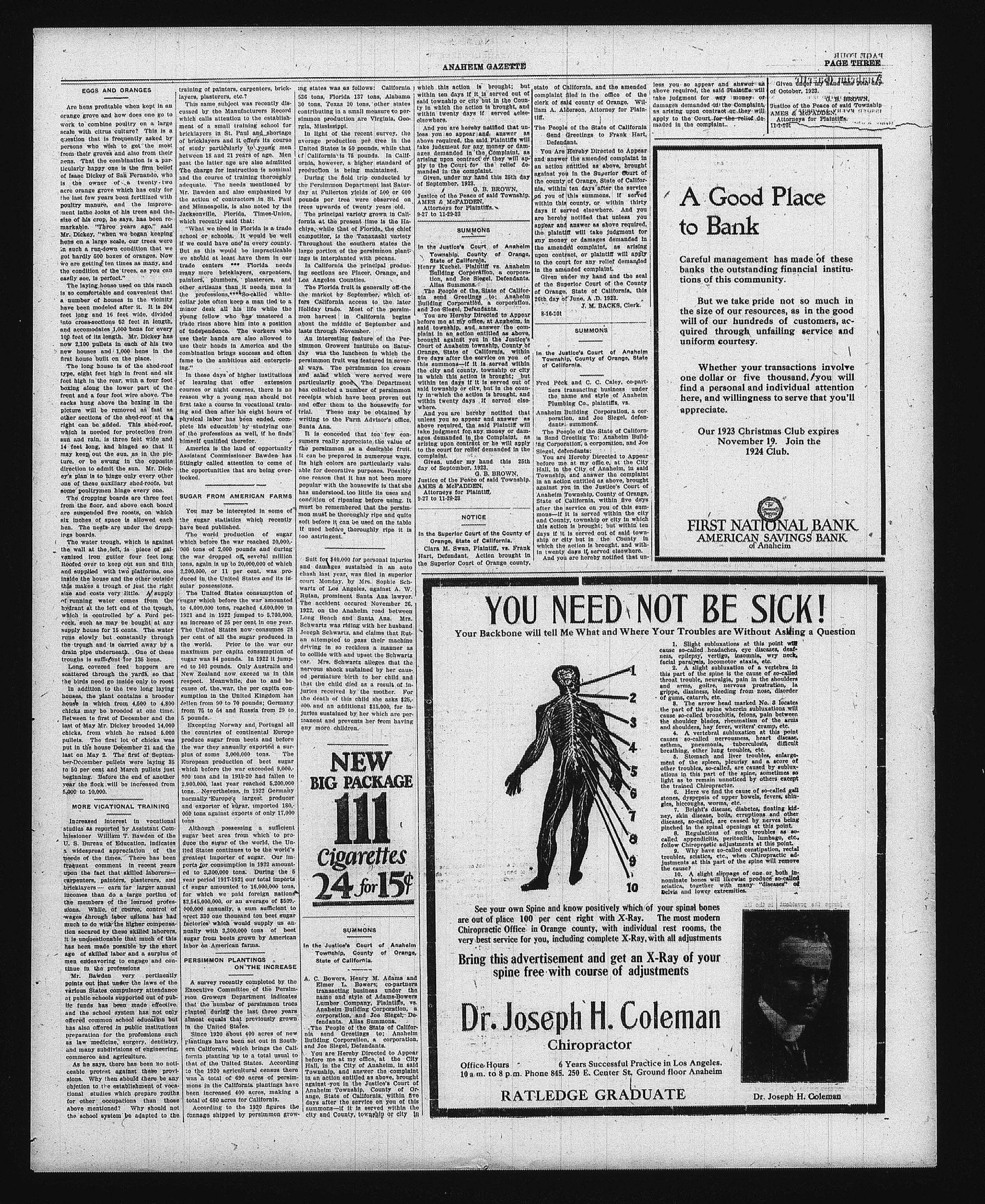
Searchable text
EGGS AND ORANGES
Are hens profitable when kept in an orange grove and how does one go to work to combine poultry on a large scale with citrus culture? This is a question that is frequently asked by persons who wish to get the most from their groves and also from their nests. That the combination is a particularly happy one is the firm belief of Isaac Dickey of San Fernando, who is the owner of a twenty-two acre orange grove which has only for the last few years been fertilized with poultry manure, and the improvement in the looks of his trees and the size of his crop, he says, has been remarkable. "Three years ago," said Mr. Dickey, "when we began keeping hens on a large scale, our trees were in such a run-down condition that we got hardly 500 boxes of oranges. Now we are getting ten times as many, and the condition of the trees, as you can easily see, is perfect."
The laying house used on this ranch is so comfortable and convenient that a number of houses in the vicinity have been modeled after it. It is 204 feet long and 16 feet wide, divided into cross-sections 52 feet in length, and accommodates 1,000 hens for every 100 feet of its length. Mr. Dickey has now 2,100 pullets in each of his two new houses and 1,000 hens in the first house built on the place.
The long house is of the shed-roof type, eight feet high in front and six feet high in the rear, with a four foot boxing along the lower part of the front and a four foot wire above. The sacks hung above the boxing in the picture will be removed as fast as other sections of the shed-roof at the right can be added. This shed-roof, which is needed for protection from sun and rain, is three feet wide and 14 feet long, and hinged so that it training of painters, carpenters, brick-layers, plasterers, etc.?
This same subject was recently discussed by the Manufacturers Record which calls attention to the establishment of a small training school for bricklayers in St. Paul and shortage of bricklayers and it offers its course of study particularly to young men between 18 and 21 years of age. Men past the latter age are also admitted. The charge for instruction is nominal and the course of training thoroughly adequate. The needs mentioned by Mr. Bawden and also emphasized by the action of contractors in St. Paul and Minneapolis, is also noted by the Jacksonville, Florida, Times-Union, which recently said that:
"What we need in Florida is a trade school or schools. It would be well if we could have one in every county. But as this would be impracticable we should at least have them in our trade centers *** Florida needs many more bricklayers, carpenters, painters, plumbers, plasterers, and other artisans than it needs men in the professions,**** So-called white-collar jobs often keep a man tied to a minor desk all his life while the young fellow who has mastered a trade rises above him into a position of independence. The workers who use their hands are also allowed to use their heads in America and the combination brings success and often fame to the ambitious and enterprising."
In these days of higher institutions of learning that offer extension courses or night courses, there is no reason why a young man should not first take a course in vocational training and then after his eight hours of physical labor has been ended, complete his education by studying one of the professions as well, if he finds himself qualified therefor.
America is the land of opportunity
ing states was as follow:
536 tons, Florida 137
30 tons, Texas 20 tons contributing in a small m
simmon production are
Mississippi.
In light of the recent average production per United States is 50 pounds of California is 75 pounds of Minnesota, however, a higher production is being made.
During the field trip the Persimmon Department day at Fullerton yields pounds per tree were trees upwards of twenty.
The principal variety for chiya, while that of Fliccomputer, is the Tama Throughout the southern large portion of the perennials is interplanted with.
In California the prizing sections are Places Los Angeles Counties.
The Florida fruit is get the market by Septemfers California access Holiday trade. Most of mon harvest in Cali about the middle of S lasts through November.
An interesting feature simmon Growers Institution was the luncheon persimmon fruit was feal al ways. The persimmon and salad which were particularly good. There has collected a number receipts which have been and offer them to the trial. These may be writing to the Farm A Santa Ana.
It is conceded that sumers really appreciate the persimmon as a c
The long house is of the shed-roof type, eight feet high in front and six feet high in the rear, with a four-foot boxing along the lower part of the front and a four-foot wire above. The sacks hung above the boxing in the picture will be removed as fast as other sections of the shed-roof at the right can be added. This shed-roof, which is needed for protection from sun and rain, is three feet wide and 14 feet long, and hinged so that it may keep out the sun, as in the picture, or be swung in the opposite direction to admit the sun. Mr. Dickey's plan is to hinge only every other one of these auxiliary shed-roofs, but some poultrymen hinge every one.
The dropping boards are three feet from the floor, and above each board are suspended five roosts, on which six inches of space is allowed each hen. The nests are under the droppings boards.
The water trough, which is against the wall at the left, is piece of galvanized iron gutter four feet long. Roofed over to keep out sun and filth, and supplied with two platforms, one inside the house and the other outside this makes a trough of just the right size and costs very little. A supply of running water comes from the hydrant at the left end of the trough, which is controlled by a Ford pet-cock, such as may be bought at any supply house for 15 cents. The water runs slowly but constantly through the trough and is carried away by a drain pipe underneath. One of these troughs is sufficient for 125 hens.
Long, covered feed hoppers are scattered through the yards, so that the birds need go inside only to roost.
In addition to the two long laying houses, the plant contains a brooder house in which from 4,500 to 4,800 chicks may be brooded at one time. Between te first of December and the last of May Mr. Dickey brooded 14,000 chicks, from which he raised 5,000 pullets. The first lot of chicks was put in the house December 21 and the last on May 2. The first of September-December pullets were laying 35 to 50 per cent and March pullets just beginning. Before the end of another year the flock will be increased from 5,000 to 10,000.
MORE VICATIONAL TRAINING
Increased interest in vocational studies as reported by Assistant Commissioner William T. Bawden of the U.S. Bureau of Education, indicates a widespread appreciation of the combination brings success and often fame to the ambitious and enterprising."
In these days of higher institutions of learning that offer extension courses or night courses, there is no reason why a young man should not first take a course in vocational training and then after his eight hours of physical labor has been ended, complete his education by studying one of the professions as well, if he finds himself qualified therefor.
America is the land of opportunity Assistant Commissioner Bawden has fittedly called attention to come of the opportunities that are being overlooked.
SUGAR FROM AMERICAN FARMS
You may be interested in some of the sugar statistics which recently have been published.
The world production of sugar which before the war reached 20,000,000 tons of 2,000 pounds and during the war dropped off several million tons, again is up to 20,000,000 of which 2,200,000, or 11 per cent, was produced in the United States and its insular possessions.
The United States consumption of sugar which before the war amounted to 4,000,000 tons, reached 4,600,000 in 1921 and in 1922 jumped to 5,700,000, an increase of 25 per cent in one year. The United States now consumes 28 per cent of all the sugar produced in the world.
Prior to the war our maximum per capita consumption of sugar was 84 pounds. In 1922 it jumped to 103 pounds. Only Australia and New Zealand now exceed us in this respect. Meanwhile; due to and because of, the war, the per capita consumption in the United Kingdom has fallen from 90 to 70 pounds; Germany from 75 to 54 and Russia from 29 to 5 pounds.
Excepting Norway and Portugal all the countries of continental Europe produce sugar from beets and before the war they annually export a surplus of some 3,000,000 tons. The European production of beet sugar which before the war exceeded 9,000,000 tons and in 1919-20 had fallen to 2,900,000, last year reached 5,200,000 tons. Nevertheless, in 1922 Germany normally Europe's largest producer and exporter of sugar, imported 180,000 tons against exports of only 17,000 tons.
Although possessing a sufficient sugar beet area from which to produce the sugar of the world, the United States continues to be the world's
MORE VICATIONAL TRAINING
Increased interest in vocational studies as reported by Assistant Commissioner William T. Bawden of the U.S. Bureau of Education, indicates a widespread appreciation of the needs of the times. There has been frequent comment in recent years upon the fact that skilled laborers—carpenters, painters, plasterers, and bricklayers—earn far larger annual incomes than do a large portion of the members of the learned professions. While, of course, control of wages through labor unions has had much to do with the higher compensation secured by these skilled laborers, it is unquestionable that much of this has been made possible by the short age of skilled labor and a surplus of men endeavoring to engage and continue in the professions.
Mr. Bawden very pertinently points out that under the laws of the various States compulsory attendance at public schools supported out of public funds has been made effective. and the school system has not only offered common school education but has also offered in public institutions preparation for the professions such as law medicine, surgery, dentistry, and many subdivisions of engineering, commerce and agriculture.
As he says, there has been no noticeable protest against these provisions. Why then should there be any objection to the establishment of vocational studies which prepare youths for other occupations than those above mentioned? Why should not the school system be adapted to the
ANAHEIM GAZETTE
ing states was as follows: California 536 tons, Florida 137 tons, Alabama 30 tons, Texas 20 tons, other states contributing in a small measure to persimmon production are Virginia, Georgia, Mississippi.
In light of the recent survey, the average production per tree in the United States is 50 pounds, while that of California is 75 pounds. In California, however, a higher standard of production is being maintained.
During the field trip conducted by the Persimmon Department last Saturday at Fullerton yields of 500 or 600 pounds per tree were observed on trees upwards of twenty years old.
The principal variety grown in California at the present time is the Hachiya, while that of Florida, the chief competitor, is the Tanananashi variety Throughout the southern states the large portion of the persimmon plantings is interplanted with pecans.
In California the principal producing sections are Placer, Orange, and Los Angeles Counties.
The Florida fruit is generally off-the market by September, which offers California access to the later Holiday trade. Most of the persimmon harvest in California begins about the middle of September and lasts through November.
An interesting feature of the Persimmon Growers Institute on Saturday was the luncheon in which the persimmon fruit was featured in several ways. The persimmon ice cream and salad which were served were particularly good. The Department has collected a number of persimmon receipts which have been proven out and offer them to the housewife for trial. These may be obtained by writing to the Farm Advisor's office, Santa Ana.
It is conceded that too few consumers really appreciate the value of the persimmon as a desirable fruit.
which this action is brought; but within ten days if it is served out of said township or city but in the County in which the action is brought, and within twenty days if served elsewhere.
And you are hereby notified that unless you so appear and answer as above required, the said Plaintiff will take judgment for any money or damages demanded in the Complaint, as arising upon contract or they will apply to the Court for the relief demanded in the complaint.
Given, under my hand this 25th day of September, 1923.
G. B. BROWN,
Justice of the Peace of said Township.
AMES & McFADDEN,
Attorneys for Plaintiffs.
9-27 to 11-29-23
SUMMONS
In the Justice's Court of Anaheim Township, County of Orange, State of California.
Henry Kuchel, Plaintiff vs. Anaheim Building Corporation, a corporation, and Joe Siegel, Defendants, Allas Summons.
The People of the State of California send Greetings to: Anaheim Building Corporation, a corporation, and Joe Siegel, Defendants.
You are hereby Directed to Appear before me at my office, at Anaheim, in said township, and answer the complaint in an action entitled as above, brought against you in the Justice's Court of Anaheim township, County of Orange, State of California, within five days after the service on you of this summons—if it is served within the city and county, township or city in which this action is brought; but within ten days if it is served out of said township or city, but in the county in which the action is brought, and within twenty days if served elsewhere.
And you are hereby notified that unless you so appear and answer as above required, the said Plaintiff will take judgment for any money or damages demanded in the Complaint, as arising upon contract or he will apply to the court for relief demanded in the complaint.
Given under my hand and the seal of the Superior Court of the County of Orange, State of California, this 26th day of June, A.D. 1923.
J. M. BACKS, Clerk.
8-16-10t
SUMMONS
In the Justice's Court of Anaheim Township, County of Orange, State of California.
Fred Péck and C. C. Caley, co-partners transacting business under the name and style of Anaheim Plumbing Co., plaintiffs, vs.
Anaheim Building Corporation, a corporation, and Joe Siegel, defendants summons.
The People of the State of California Send Greeting To: Anaheim Building Corporation, a corporation, and Joe
Suit for $40,000 for personal injuries and damages sustained in an auto chash last year, was filed in superior court Monday, by Mrs. Sophie Schwartz of Los Angeles, against A. W. Rutan, prominent Santa Ana lawyer. The accident occurred November 26, 1922, on the Anaheim road between Long Beach and Santa Ana. Mrs. Schwartz was riding with her husband Joseph Schwartz, and claims that Rutan attempted to pass their machine driving in so reckless a manner as to collide with and upset the Schwartz car. Mrs. Schwartz alleges that the nervous shock sustained by her caused permature birth to her child and that the child died as a result of injuries received by the mother. For the death of this child she asks $25,000 and an additional $15,000, for injuries sustained by her which are permanent and prevents her from having any more children.
NEW BIG PACKAGE
111
NEW
BIG PACKAGE
111
Cigarettes
24 for 15¢
SUMMONS
In the Justice's Court of Anaheim Township, County of Orange, State of California.
A. C. Bowers, Henry M. Adams and Elmer L. Bowers; co-partners transacting business under the name and style of Adams-Bowers Lumber Company, Plaintiffs, vs. Anahelm Building Corporation, a corporation, and Joe Siegel, Defendants. Alias Summons.
The People of the State of California send Greetings to: Anahelm Building Corporation, a corporation, and Joe Siegel, Defendants.
You are Hereby Directed to Appear before me at my office, at the City Hall, in the City of Anaheim, in said Township, and answer the complaint in an action entitled as above, brought against you in the Justice's Court of Anaheim Township, County of Orange, State of California, within five days after the service on you of this summons—if it is served within the city and County, township or city in
See your own Spine and know positively which of your spinal are out of place 100 per cent right with X-Ray. The most m Chiropractic Office in Orange county, with individual rest room very best service for you, including complete X-Ray, with all adjust
Bring this advertisement and get an X-Ray of spine free with course of adjustments
Dr. Joseph H. Coleman
Chiropractor
Office Hours
6 Years Successful Practice in Los Angeles
10 a.m. to 8 p.m. Phone 845. 250 E. Center St. Ground floor A
RATLEDGE GRADUATE
A Good Place to Bank
Careful management has made of these banks the outstanding financial institutions of this community.
But we take pride not so much in the size of our resources, as in the good will of our hundreds of customers, acquired through unfailing service and uniform courtesy.
Whether your transactions involve one dollar or five thousand, you will find a personal and individual attention here, and willingness to serve that you'll appreciate.
Our 1923 Christmas Club expires November 19. Join the
Whether your transactions involve one dollar or five thousand, you will find a personal and individual attention here, and willingness to serve that you'll appreciate.
Our 1923 Christmas Club expires November 19. Join the 1924 Club.
FIRST NATIONAL BANK
AMERICAN SAVINGS BANK
of Anaheim
NOT BE SICK!
Where Your Troubles are Without Asking a Question
1. Slight subluxations at this point will cause so-called headaches, eye discases, deafness, epilepsy, vertigo, insomnia, wry neck, facial paralysis, locomotor ataxia, etc.
2. A slight subluxation of a vertebra in this part of the spine is the cause of so-called throat trouble, neuralgia, pain in the shoulders and arms, goitre, nervous prostration, la gripe, disziness, bleeding from nose, disorder of gums, catarrh, etc.
8. The arrow head marked No. 3 locates the part of the spine wherein subluxations will cause so-called bronchitis, felons, pain between the shoulder blades, rheumatism of the arms and shoulders, hay fever, writers' cramp, etc.
4. A vertebral subluxation at this point causes so-called nervousness, heart disease, asthma, pneumonia, tuberculosis, difficult breathing, other lung troubles, etc.
5. Stomach and liver troubles, enlargement of the spleen, pleurisy and a score of other troubles, so-called, are caused by subluxations in this part of the spine, sometimes so light as to remain unnoticed by others except the trained Chiropractor.
6. Here we find the cause of so-called gall stones, dyspepsia of upper bowels, fevers, shingles, hiccoughs, worms, etc.
7. Bright's disease, diabetes, floating kidney, skin disease, boils, eruptions and other diseases, so-called, are caused by nerves being pinched in the spinal openings at this point.
8. Regulations of such troubles as so-called appendicitis, peritonitis, lumbago, etc., follow Chiropractic adjustments at this point.
5. Stomach and liver troubles, enlargement of the spleen, pleurisy and a score of other troubles, so-called, are caused by subluxations in this part of the spine, sometimes so light as to remain unnoticed by others except the trained Chiropractor.
6. Here we find the cause of so-called gall stones, dyspepsia of upper bowels, fevers, shingles, hiccoughs, worms, etc.
7. Bright's disease, diabetes, floating kidney, skin disease, boils, eruptions and other diseases, so-called, are caused by nerves being pinched in the spinal openings at this point.
8. Regulations of such troubles as so-called appendicitis, peritonitis, lumbago, etc., follow Chiropractic adjustments at this point.
9. Why have so-called constipation, rectal troubles, sciatics, etc., when Chiropractic adjustments at this part of the spine will remove the cause?
10. A slight slippage of one or both innominate bones will likewise produce so-called sciatica, together with many "diseases" of delvis and lower extremities.
which of your spinal bones
X-Ray. The most modern individual rest rooms, the X-Ray, with all adjustments
et an X-Ray of your adjustment
Coleman
ful Practice in Los Angeles.
St. Ground floor Anaheim
ADUATE
Dr. Joseph H. Coleman