anaheim-gazette 1923-10-04
Scanned page
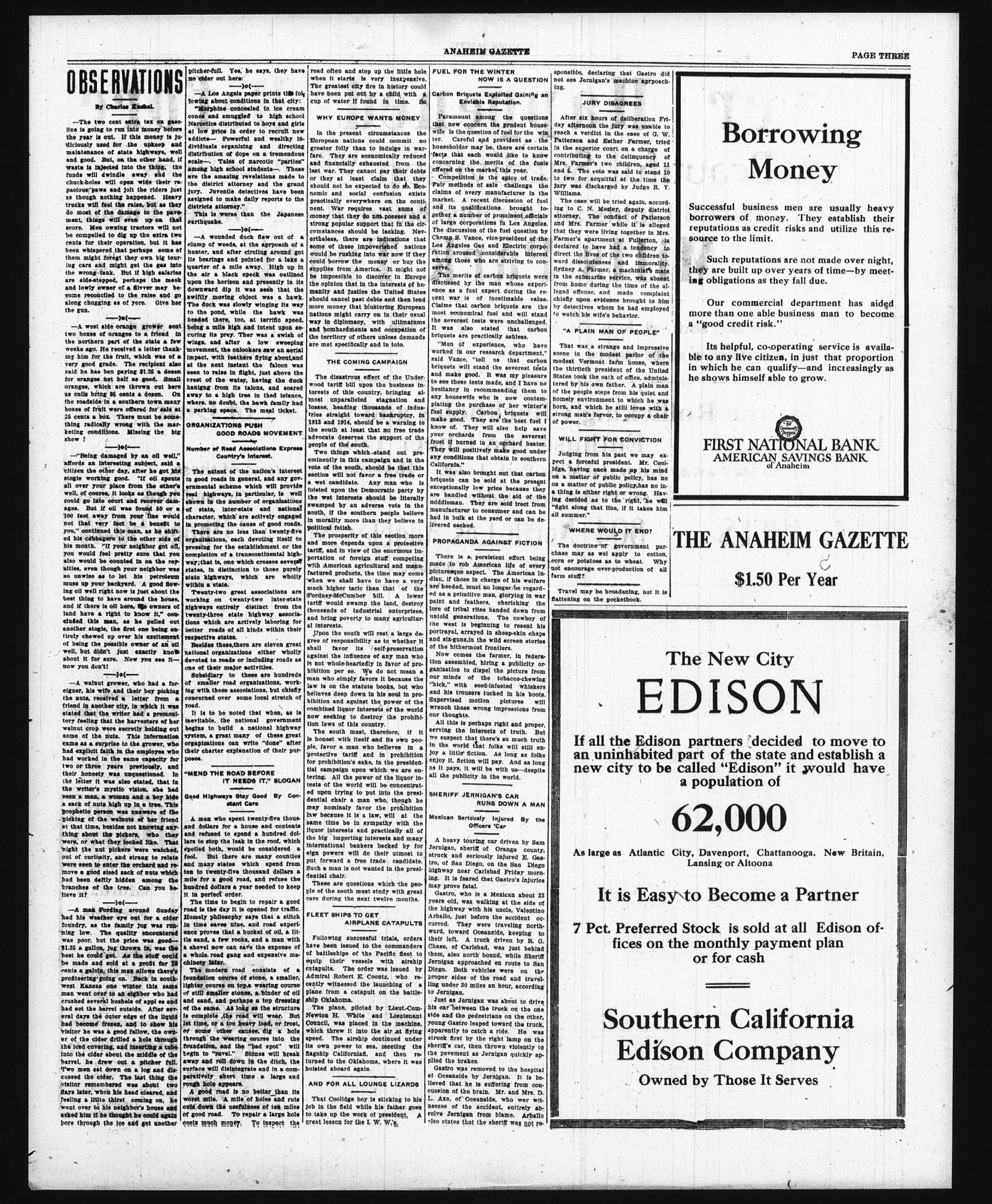
Searchable text
OBSERVATIONS
By Charles Kuehl.
The two cent extra tax on gasoline is going to run into money before the year is out. If this money is judiciously used for the upkeep and maintenance of state highways, well and good. But, on the other hand, if waste is injected into the thing, the funds will dwindle away and the chuck-holes will open wide their rapaulous paws and jolt the riders just as though nothing happened. Heavy trucks will feel the raise, but as they do most of the damage to the pavement, things will even up on that score. Men owning tractors will not be compelled to dig up the extra two cents for their operation, but it has been whispered that perhaps some of them might foregret they own big touring cars and might get the gas into the wrong-tank. But if high salaries are side-stepped, perhaps the meek and lowly owner of a fliver may become reconciled to the raise and go along chugging as of yore. Give her the gun.
A west side orange grower sent two boxes of oranges to a friend in the northern part of the state a few weeks ago. He received a letter thanking him for the fruit, which was of a very good grade. The recipient also said he has ben paying $1.25 a dozen for oranges not half as good. Small oranges, which are thrown out here as culls bring 86 cents a dozen. On the roadside in a southern town many boxes of fruit were offered for sale at 35 cents a box. There must be something radically wrong with the marketing conditions. Missing the big show!
A Los Angeles paper prints this following about conditions in that city:
"Morphine concealed in ice cream cones and smuggled to high school Narcotics distributed to boys and girls at low price in order to recruit new addicts—Powerful and wealthy individuals organizing and directing distribution of dope on a tremendous scale. Tales of narcotic "parties" among high school students. These are the amazing revelations made to the district attorney and the grand jury. Juvenile detectives have been assigned to make daily reports to the districts attorney."
This is worse than the Japanese earthquake.
A wounded duck flew out of a clump of weeds, at the aprpoach of a hunter, and after circling around got its bearings and pointed for a lake a quarter of a mile away. High up in the air a black speck was outlined upon the horizon and presently in its downward dip it was seen that the swiftly moving object was a hawk. The duck was slowly winging its way to the pond, while the hawk was headed there, too, at terrific speed, being a mile high and intent upon securing its prey. Ther was a swish of wings, and after a low sweeping movement, the onlookers saw an aerial impact, with feathers flying about, and at the next instant the falcon was seen to raise in flight, just above the crest of the water, having the duck hanging from its talons, and soared away to a high tree in the distance, where, no doubt, the hawk family had a parking space. The meal ticket.
ORGANIZATIONS PUSH
GOOD ROADS MOVEMENT
Number of Road Associations Express road often and stops when it starts is The greatest city fills have been put out cup of water if found WHY EUROPE W
In the present European nations greater folly than fare. They are economically exhausted war. They cannot or should not be expected nomic and social practically everywhere. War requires money that they do strong popular supplies circumstances should not arthelless, there are some of these impure would be rushing into could borrow the supplies from America be impossible to die the opinion that in manly and justice should cancel past d more money that blends nation might carry way in diplomacy, and bombardments the territory of others are met specifically THE COMING
The disastrous effect wood tariff bill upon forests of this country most unparalleled losses, heading those fries straight toward 1913 and 1914, should the south at least advocate deserves the people of the south.
being him for the fruit, which was of a very good grade. The recipient also said he has ben paying $1.25 a dozen for oranges not half as good. Small oranges, which are thrown out here as culls bring 85 cents a dozen. On the roadside in a southern town many boxes of fruit were offered for sale at 35 cents a box. There must be something radically wrong with the marketing conditions. Missing the big show!
"Being damaged by an oil well," affords an interesting subject, said a citizen the other day, after he got his stogie working good. "If oil spouts all over your place from the other's well, of course, it looks as though you could go into court and recover damages. But if oil was found 50 or a 100 feet away from your line would not that very fact be a benefit to you," continued this man, as he shifted his cabbage to the other side of his mouth. "If your neighbor got off, you would feel pretty sure that you also would be counted in on the royalties, even though your neighbor was so unwise as to let his petroleum muss up your backyard. A good flowing oil well right now is just about the best thing to have around the house, and if there is oil here, the owners of land have a right to know it," concluded this man, as he pulled out another stogie, the first one being entirely chewed up over his excitement of being the possible owner of an oil well, but didn't just exactly know about it for sure. Now you see it—now you don't!
A walnut grower, who had a foreigner, his wife and their boy picking the nuts, received a letter from a friend in another city, in which it was stated that the writer had a premonitory feeling that the harvesters of her walnut crop were secretly holding out some of the nuts. This information came as a surprise to the grower, who had explicit faith in the employees who had worked in the same capacity for two or three years previously, and their honesty was unquestioned. In the letter it was also stated, that in the writer's mystic vision, she had seen a man, a woman and a boy hide a sack of nuts high up in a tree. This prophetic person was unaware of the pickling of the walnuts of her friend at that time, besides not knowing anything about the pickers, who they were, or what they looked like. That night the nut pickers were watched.
ORGANIZATIONS PUSH
GOOD ROADS MOVEMENT
Number of Read Associations Express Country's Interest.
The extent of the nation's interest in good roads in general, and any governmental scheme which will provide real highways, in particular, is well shown in the number of organizations of state, inter-state and national character, which are actively engaged in promoting the cause of good roads.
There are no less than twenty-five organizations, each devoting itself to pressing for the establishment or the completion of a transcontinental highway; that is, one which crosses several states, in distinction to those purely state highways, which are wholly within a state.
Twenty-two great associations are working on twenty-two inter-state highways entirely distinct from the twenty-three state highway associations which are actively laboring for better roads of all kinds within their respective states.
Besides these, there are eleven great national organizations either wholly devoted to roads or including roads as one of their major activities.
Subsidiary to these are hundreds of smaller road organizations, working with these associations, but chiefly concerned over some local stretch of road.
It is to be noted that when, as is inevitable, the national government begins to build a national highway system, a great many of these great organizations can write "done" after their charter explanation of their purposes.
"MEND THE ROAD BEFORE IT NEEDS IT," SLOGAN
Good Highways Stay Good By Constant Care
A man who spent twenty-five thousand dollars for a house and contents and refused to spend a hundred dollars to stop the leak in the roof, which spoiled both, would be considered a impact, with feathers flying about, and at the next instant the falcon was seen to raise in flight, just above the breast of the water, having the duck hanigng from its talons, and soared away to a high tree in the tled instance, where, no doubt, the hawk family had a parking space. The meal ticket.
THE COMING
The disastrous effect wood tariff bill upon forests of this country most unparalleled losses, heading thiries straight toward 1913 and 1914, should the south at least advocate deserves the people of the south.
Two things which eminently in this case vote of the south, shall section will not favor a wet candidate.
A foliated upon the Dethe wet interests shall swamped by an adv south, if the southern in morality more than political fetish.
The prosperity of and more depends on tariff, and in view of portation of foreign with American agriculture factured products, that when we shall have much higher taric thie Fordney-McCumber tariff would swamp thousands of industry and bring poverty to al interests.
Upon the south will gree of responsibility shall favor its against the influence is not whole-hearted libition per se. We man who simply favors law is on the statute believes deep down in libition and against combined liquor interest now seeking to design laws of this county.
The south must is honest with itself ple. favor a man who protective tariff and for prohibition's sake trial campaign upon wtering. All the power tests of the world w ed upon trying to put dental chair a man may nominaly favor law because it is a same time be in syli liquor interests and if the big importing international banker
had worked in the same capacity for two or three years previously, and their honesty was unquestioned. In the letter it was also stated that in the writer's mystic vision, she had been a man, a woman and a boy hide a sack of nuts high up in a tree. This prophetic person was unaware of the picking of the walnuts of her friend at that time, besides not knowing anything about the pickers, who they were, or what they looked like. That night the nut pickers were watched, out of curiosity, and strang to relate were seen to enter the orchard and remove a good sized sack of nuts which had been deftly hidden among the branches of the tree. Can you believe it?
—)e(—
A man Fording around Sunday had his weather eye out for a clder foundry, as the family jug was running low. The quality encountered was poor, but the price was good—$1.25 a gallon, jug thrown in, was the best he could get. As the stuff could be made and sold at a profit for 10 cents a galolp, this man allows there's profiteering going on. Back in southwest Kansas one winter this same man went over to an neighbor who had crushed several bushels of apples and had set the barrel outside. After several days the outer edge of the liquid had become frozen, and to show his visitor he was a good fellow, the owner of the cider drilled a hole through the ice covering, and inserting a tube into the cider about the middle of the barrel, he drew out a pitcher full. Two men sat down on a log and discussed the cider. The last thing the visitor remembered was about two days later, when his head cleared, and feeling a litte thirst coming on, he went over to his neighbor's house and asked him if he thought he could again bore through the ice and get another poses.
"MEND THE ROAD BEFORE IT NEEDS IT," SLOGAN
Good Highway Stay Good By Constant Care
A man who spent twenty-five thousand dollars for a house and contents and refused to spend a hundred dollars to stop the leak in the roof, which spoiled both, would be considered a fool. But there are many counties and many states which spend from ten to twenty-five thousand dollars a mile for a good road, and refuse the hundred dollars a year needed to keep it in perfect order.
The time to begin to repair a good road is the day it is opened for traffic. Homely philosophy says that a stitch in time saves nine, and road experience proves that a bucket of oil, a little sand, a few rocks, and a man with a shovel now can save the expense of a whole road gang and expensive machinery later.
The modern road consists of a foundation course of stone, a smaller, lighter course on top, a wearing course of still smaller stones, a binder of oil and sand, and perhaps a top dressing of the same. As long as the structure is complete, the road will wear. But let time, or a too heavy load, or frost, or some other cause, dig a hole through the wearing course into the foundation, and the "bad spot" will begin to "ravel." Stones will break away and roll down in the ditch, the surface will disintegrate and in a comparatively short time a large and rough hole appears.
A good road is no better than its worst mile. A mile of holes and ruts cuts down the usefulness of ten miles of good road. To repair a large hole costs much money. To inspect the
ANAHEIM GAZETTE
road often and stop up the little hole when it starts is very inexpensive. The greatest city fire in history could have been put out by a child with a cup of water if found in time. So
WHY EUROPE WANTS MONEY
In the present circumstances the European nations could commit no greater folly than to indulge in warfare. They are economically reduced and financially exhausted from the last war. They cannot pay their debts or they at least claim that they should not be expected to do so. Economic and social confusion exists practically everywhere on the continent. War requires vast sums of money that they do not possess and a strong popular support that in the circumstances should be lacking. Nevertheless, there are indications that some of these impoverished nations would be rushing into war now if they could borrow the money or buy the supplies from America. It might not be impossible to discover in Europe the opinion that in the interests of humanity and justice the United States should cancel past debts and then lend more money that blustering European nations might carry on in their usual way in diplomacy, with ultimatums and bombardments and occupation of the territory of others unless demands are met specifically and in toto.
THE COMING CAMPAIGN
The disastrous effect of the Underwood tariff bill upon the business interests of this country, bringing almost unparalleled stagnation and losses, heading thousands of industries straight toward bankruptcy, in 1913 and 1914, should be a warning to the south at least that no free trade advocate deserves the support of the people of the south.
FUEL FOR THE WINTER
NOW IS A QUESTION
Carbon Briquets Exploited Gaining an Enviable Reputation.
Paramount among the questions that now concern the prudent housewife is the question of fuel for the winter. Careful and provident as the householder may be, there are certain facts that each would like to know concerning the merits of the fuels offered on the market this year.
Competition is the spice of trade. Fair methods of sale challenge the claims of every manufacturer in the market. A recent discussion of fuel and its qualifications brought together a number of prominent officials of large corporations in Los Angeles. The discussion of the fuel question by Champ S. Vance, vice-president of the Los Angeles Gas and Electric corporation aroused considerable interest among those who are striving to conserve.
The merits of carbon briquets were discussed by the man whose experience as a fuel expert during the recent war is of inestimable value. Claims that carbon briquets are the most economical fuel and will stand the severest tests were unchallenged. It was also stated that carbon briquets are practically asless.
"Men of experience, who have worked in our research department," said Vance, "tell us that carbon briquets will stand the severest tests and make good. It was my pleasure to see these tests made, and I have no hesitancy in recommending them to any housewife who is now contemplating the purchase of her winter's fuel supply. Carbon briquets will make good. They are the best fuel I know of. They will also help save your orchards from the severest frost if burned in an orchard heater. They will positively deprive you of Jernigan's machine aprpoaching."
JURY DISAGREES
After six hours of deliberation Friday afternoon the jury was unable to reach a verdict in the case of G. W. Patterson and Eather Farmer, tried in the superior court on a charge of contributing to the delinquency of Mrs. Farmer's two children, aged 11 and 5. The vote was said to stand 10 to two for acquittal at the time the jury was discharged by Judge R. Y. Williams.
The case will be tried again, according to C. N. Mozley, deputy district attorney. The conduct of Patterson and Mrs. Farmer while it is alleged that they were living together in Mrs. Farmer's apartment at Fullerton, is declared to have had a tendency to direct the lives of the two children toward dissolutionness and immorality. Sydney A. Farmer, a machinist's mate in the submarine service, was absent from home during the time of the alleged offense, and made complaint chiefly upon evidence brought to him by detectives whom he had employed to watch his wife's behavior.
"A PLAIN MAN OF PEOPLE"
That was a strange and impressive scene in the modest parlor of the modest Vermont farm house, where the thirtieth president of the United States took the oath of office, administered by his own father. A plain man of the people steps from his quiet and homely environment to which he was born, and which he still loves with a strong man's fervor, to occupy a chair of power.
WILL FIGHT FOR CONVICTION
THE COMING CAMPAIGN
The disastrous effect of the Underwood tariff bill upon the business interests of this country, bringing almost unparalleled stagnation and losses, heading thousands of industries straight toward bankruptcy, in 1913 and 1914, should be a warning to the south at least that no free trade advocate deserves the support of the people of the south.
Two things which stand out prominently in this campaign and in the vote of the south, should be that this section will not favor a free trade or a wet candidate. Any man who is foiled upon the Democratic party by the wet interests should be literally swamped by an adverse vote in the south, if the southern people believe in morality more than they believe in political fetish.
The prosperity of this section more and more depends upon a protective tariff, and in view of the enormous importation of foreign stuff competing with American agricultural and manufactured products, the time may come when we shall have to have a very much higher taric than that of the Fordney-McCumber bill. A lower tariff would swamp the land, destroy thousands of industrial enterprises, and bring poverty to many agricultural interests.
Upon the south will rest a large degree of responsibility as to whether it shall favor its self-preservation against the influence of any man who is not whole-heartedly in favor of prohibition per se. We do not mean a man who simply favors it because the law is on the statute books, but who believes deep down in his soul in prohibition and against the power of the combined liquor interests of the world now seeking to destroy the prohibition laws of this country.
The south must, therefore, if it is honest with itself and its own people, favor a man who believes in a protective tariff and in prohibition for prohibition's sake, in the presidential campaign upon which we are entering. All the power of the liquor interests of the world will be concentrated upon trying to put into the presidential chair a man who, though he may nominally favor the prohibition law because it is a law, will at the same time be in sympathy with the liquor interests and practically all of the big importing interests and many international bankers backed by for said Vance, "tell us that carbon briquets will stand the severest tests and make good. It was my pleasure to see these tests made, and I have no hesitancy in recommending them to any housewife who is now contemplating the purchase of her winter's fuel supply. Carbon briquets will make good. They are the best fuel I know of. They will also help save your orchards from the severest frost if burned in an orchard heater. They will positively make good under any conditions that obtain in southern California."
It was also brought out that carbon briquets can be sold at the present exceptionally low price because they are handled without the aid of the middleman. They are sold direct from manufacturer to consumer and can be had in bulk at the yard or can be delivered sacked.
PROPAGANDA AGAINST FICTION
There is a persistent effort being made to rob American life of every picturesque aspect. The American Indian, if those in charge of his welfare are heeded, must no longer be regarded as a primitive man, glorying in war paint and feathers, cherishing the lore of tribal rites handed down from untold generations. The cowboy of the west is beginning to resent his portrayal, arrayed in sheep-skin chaps and six-guns, in the wild screen stories of the hithermost frontiers.
Now comes the farmer, in federation assembled, hiring a publicity organization to dispel the picture from our minds of the tobacco-chewing "hick," with seed-infested whiskers and his trousers tucked in his boots. Supervised motion pictures will wrench these wrong impressions from our thoughts.
All this is perhaps right and proper, serving the interests of truth. But we suspect that there's so much truth in the world that folks will still enjoy a little fiction. As long as folks enjoy it, fiction will pay. And as long as it pays, it will be with us—despite all the publicity in the world.
SHERIFF JERNIGAN'S CAR RUNS DOWN A MAN
Mexican Seriously Injured By the Officers 'Car
A heavy touring car driven by Sam Jernigan, sheriff of Orange county
FLEET SHIPS TO GET AIRPLANE CATAPULTS
Following successful trials, orders have been issued to the commanders of battleships of the Pacific fleet to equip their vessels with airship catapults. The order was issued by Admiral Robert E. Coontz, who recently witnessed the launching of a plane from a catapult on the battleship Oklahoma.
The plane, piloted by Lieut-ComNewton H. White and Lieutenant Council, was placed in the machine, which threw it into the air at flying speed. The airship continued under its own power to sea, meeting the flagship Californiai, and then returned to the Oklahoma, where it was hoisted aboard again.
AND FOR ALL LOUNGE LIZARDS
That Coolidge boy is sticking to his job in the field while his father goes to take up the work of president. A great lesson for the I. W. W.'e.
Borrowing Money
Successful business men are usually heavy borrowers of money. They establish their reputations as credit risks and utilize this resource to the limit.
Such reputations are not made over night, they are built up over years of time—by meeting obligations as they fall due.
Our commercial department has aided more than one able business man to become a "good credit risk."
Its helpful, co-operating service is available to any live citizen, in just that proportion in which he can qualify—and increasingly as he shows himself able to grow.
FIRST NATIONAL BANK
FIRST NATIONAL BANK
AMERICAN SAVINGS BANK
of Anaheim
THE ANAHEIM GAZETTE
$1.50 Per Year
The New City
EDISON
The Edison partners decided to move to inhabited part of the state and establish a city to be called "Edison" it would have a population of
62,000
enabled part of the state and establish a city to be called "Edison" it would have a population of
62,000
Atlantic City, Davenport, Chattanooga, New Britain,
Lansing or Altoona
is Easy to Become a Partner
Preferred Stock is sold at all Edison offices on the monthly payment plan or for cash
Southern California
Edison Company
Owned by Those It Serves