anaheim-gazette 1923-10-04
Scanned page
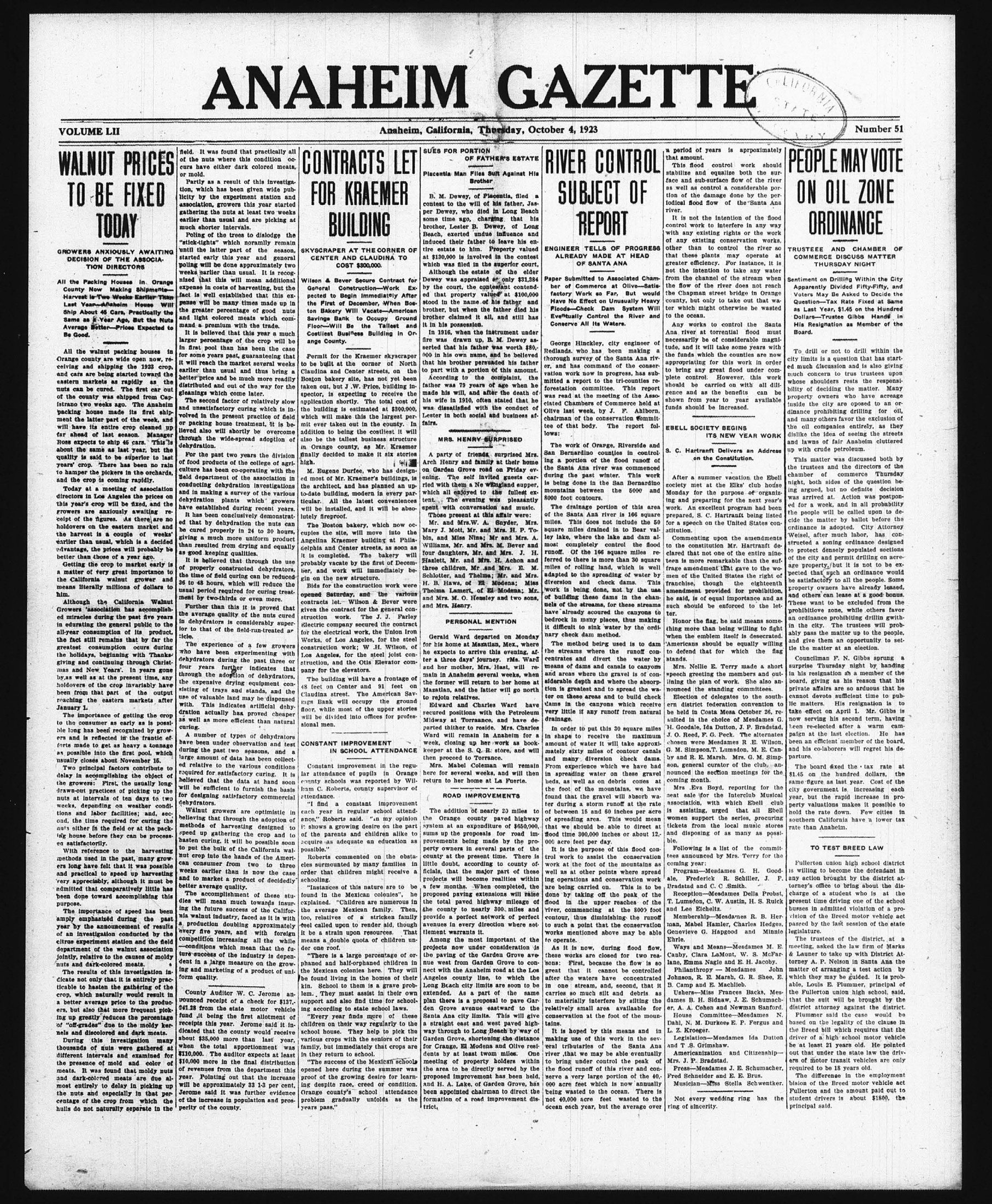
Searchable text
VOLUME LII
WALNUT PRICES TO BE FIXED TODAY
GROWERS ANXIOUSLY AWAITING DECISION OF THE ASSOCIATION DIRECTORS
All the Packing Houses in Orange County Now Making Shipments—Harvest is Two Weeks Earlier Than Last Year—Anaheim House Will Ship About 45 Cars, Practically the Same as a Year Ago, But the Nuts Average Better—Prices Expected to Be Good.
All the walnut packing houses in Orange county are wide open now, receiving and shipping the 1923 crop, and cars are being started toward the eastern markets as rapidly as the nuts can be cured. The first car out of the county was shipped from Capistrano two weeks ago. The Anaheim packing house made its first shipment the latter part of the week, and will have its entire crop cleaned up far ahead of last season. Manager Ross expects to ship 45 cars. This is about the same of the field. It was found that practically all of the nuts where this condition occurs have either dark colored meats, or mold.
Partly as a result of this investigation, which has been given wide publicity by the experiment station and association, growers this year started gathering the nuts at least two weeks earlier than usual and are picking at much shorter intervals.
Poling of the trees to dislodge the "stick-tights" which noramly remain until the latter part of the season, started early this year and general poling will be done approximately two weeks earlier than usual. It is recognized that this will mean additional expense in costs of harvesting, but the fact is well established that this expense will be many times made up in the greater percentage of good nuts and light colored meats which command a premium with the trade.
It is believed that this year a much larger percentage of the crop will be in first pool than has been the case for some years past, guaranteeing that it will reach the market several weeks earlier than usual and thus bring a better price and be much more readily distributed and out of the way for the gleanings which come later.
The second factor of relatively slow and unsatisfactory curing which is involved in the present practice of field or packing house treatment, it is believed also will shortly be overcome through the wide-spread adoption of dehydration.
CONTRACT FOR KRAFT BUILDING
SKYSCRAPER AT THE CENTER AND CLOSER COST $300,
Wilson & Bever Securities expected to Begin Immediately on the First of December on Bakery Will Vary Savings Bank to Offer Floor-Will Be the Costliest Business Range County.
Permit for the Kraeter to be built at the corner Claudina and Center s Boston bakery site, has taken out, but J.W.P. spector, is expecting application shortly. The building is estimated which will make this mit ever taken out in addition to being the also be the tallest busin in Orange county, as
Orange county are wide open now, receiving and shipping the 1923 crop, and cars are being started toward the eastern markets as rapidly as the nuts can be cured. The first car out of the county was shipped from Capistrano two weeks ago. The Anaheim packing house made its first shipment the latter part of the week, and will have its entire crop cleaned up far ahead of last season. Manager Ross expects to ship 46 cars. This is about the same as last year, but the quality is said to be superior to last years' crop. There has been no rain to hamper the pickers in the orchards, and the crop is coming rapidly.
Today at a meeting of association directors in Los Angeles the prices on this year's crop will be fixed, and the growers are anxiously awaiting receipt of the figures. As there are no holdovers on the eastern market and the harvest is a couple of weeks' earlier than usual, which is a decided advantage, the prices will probably be better than those of a year ago.
Getting the crop to market early is a matter of very great importance to the California walnut grower and means literally millions of dollars to him.
Although the California Walnut Growers 'association has accomplished miracles during the past five years in educating the general public to the all-year consumption of its product, the fact still remains that by far the greatest consumption occurs during the holidays, beginning with Thanksgiving and continuing through Christmas and New Years'. In years gone by, as well as at the present time, any holdovers of the crop invariably have been from that part of the output reaching the eastern markets after January 1.
The importance of getting the crop to the consumer as early as is possible long has been recognized by growers and is reflected in the frantic efforts made to get as heavy a tonnage as possible into the first pool, which usually closes about November 15.
Two principal factors contribute to delay in accomplishing the object of the growers: First, the usually long-drawn-out practices of picking up the nuts at intervals of ten days to two weeks, depending on weather conditions and labor facilities; and, second, the time required for curing the nuts either in the field or at the packing house before they can be processed satisfactorily.
With reference to the harvesting process for some years past, guaranteeing that it will reach the market several weeks earlier than usual and thus bring a better price and be much more readily distributed and out of the way for the gleanings which come later.
The second factor of relatively slow and unsatisfactory curing which is involved in the present practice of field or packing house treatment, it is believed also will shortly be overcome through the wide-spread adoption of dehydration.
For the past two years the division of food products of the college of agriculture has been co-operating with the field department of the association in conducting dehydration investigations and in making a survey of the various dehydration plants which growers have established during recent years.
It has been conclusively demonstrated that by dehydration the nuts can be cured properly in 24 to 30 hours, giving a much more uniform product than resulted from drying and equally as good keeping qualities.
It is believed that through the use of properly constructed dehydrators, the time of field curing can be reduced 36 to 48 hours, which will reduce the usual period required for curing treatment by two-thirds or even more.
Further than this it is proved that the average quality of the nuts cured in dehydrators is considerably superior to that of the field-run-treated article.
The experience of a few growers who have been experimenting with dehydrators during the past three or four years further indicates that through the adoption of dehydrators, the expensive drying equipment consisting of trays and stands, and the use of valuable land may be dispensed with. This indicates artificial dehydration actually has proved cheaper as well as more efficient than natural curing.
A number of types of dehydrators have been under observation and test during the past two seasons, and a large amount of data has been collected relative to the various conditions required for satisfactory curing. It is believed that the data at hand soon will be sufficient to furnish the basis for designing satisfactory commercial dehydrators.
Walnut growers are optimistic in believing that through the adoption of methods of harvesting designed to speed up gathering the crop and to hasten curing, it will be possible soon to put the bulk of the California walnut for some years past, guaranteeing that it will reach the market several weeks earlier than usual and thus bring a better price and be much more readily distributed and out of the way for the gleanings which come later.
The second factor of relatively slow and unsatisfactory curing which is involved in the present practice of field or packing house treatment, it is believed also will shortly be overcome through the wide-spread adoption of dehydration.
For the past two years the division of food products of the college of agriculture has been co-operating with the field department of the association in conducting dehydration investigations and in making a survey of the various dehydration plants which growers have established during recent years.
It has been conclusively demonstrated that by dehydration the nuts can be cured properly in 24 to 30 hours, giving a much more uniform product than resulted from drying and equally as good keeping qualities.
It is believed that through the use of properly constructed dehydrators, the time of field curing can be reduced 36 to 48 hours, which will reduce the usual period required for curing treatment by two-thirds or even more.
Further than this it is proved that the average quality of the nuts cured in dehydrators is considerably superior to that of the field-run-treated article.
The experience of a few growers who have been experimenting with dehydrators during the past three or four years further indicates that through the adoption of dehydrators, the expensive drying equipment consisting of trays and stands, and the use of valuable land may be dispensed with. This indicates artificial dehydration actually has proved cheaper as well as more efficient than natural curing.
A number of types of dehydrators have been under observation and test during the past two seasons, and a large amount of data has been collected relative to the various conditions required for satisfactory curing. It is believed that the data at hand soon will be sufficient to furnish the basis for designing satisfactory commercial dehydrators.
Walnut growers are optimistic in believing that through the adoption of methods of harvesting designed to speed up gathering the crop and to hasten curing, it will be possible soon to put the bulk of the California walnut for some years past, guaranteeing that it will reach the market several weeks earlier than usual and thus bring a better price and be much more readily distributed and out of the way for the gleanings which come later.
The second factor of relatively slow and unsatisfactory curing which is involved in the present practice of field or packing house treatment, it is believed also will shortly be overcome through the wide-spread adoption of dehydration.
For the past two years the division of food products of the college of agriculture has been co-operating with the field department of the association in conducting dehydration investigations and in making a survey of the various dehydration plants which growers have established during recent years.
It has been conclusively demonstrated that by dehydration the nuts can be cured properly in 24 to 30 hours, giving a much more uniform product than resulted from drying and equally as good keeping qualities.
It is believed that through the use of properly constructed dehydrators, the time of field curing can be reduced 36 to 48 hours, which will reduce the usual period required for curing treatment by two-thirds or even more.
Further than this it is proved that the average quality of the nuts cured in dehydrators is considerably superior to that of the field-run-treated article.
The experience of a few growers who have been experimenting with dehydrators during the past three or four years further indicates that through the adoption of dehydrators, the expensive drying equipment consisting of trays and stands, and the use of valuable land may be dispensed with. This indicates artificial dehydration actually has proved cheaper as well as more efficient than natural curing.
A number of types of dehydrators have been under observation and test during the past two seasons, and a large amount of data has been collected relative to the various conditions required for satisfactory curing. It is believed that the data at hand soon will be sufficient to furnish the basis for designing satisfactory commercial dehydrators.
Walnut growers are optimistic in believing that through the adoption of methods of harvesting designed to speed up gatheringthe crop and to hasten curing, it will be possible soon to putthe bulkoftheCaliforniawalntorsomeyearspastguaranteeingthatitwillreachthemarketseveralweeksearlierthanusualandthusbringabetterpriceandbeamostdeadlyapplicatorisexpectingfinaldecidedtomakehigh.
M.EugeneDurfee,widowedmostofMr.Kraemer,thearchitect,andhasto-datebuilding,modernticular.Allthelatestwillbeinstalled,andlutelyfireproof.
TheBostonbakery,cupiesthesite.willmAngelinaKraemerbuilddelphiaandCenterstretchitiscompleted.Theprobablyvacatebytheberland,andworkwillinginonthenewstructures.BidsfortheconstructedSaturday,andcontractslet.Wilsongiventhecontractforthestructionwork.Theelectriccompanysecurefortheelectricalwork.Works.ofLosAngelesconstructionwork;W.LosAngeles.fortheconstruction,andTheOtispanyforthe elevators.
Thebuildingwillhave48feetonCenterandClaudina street.TheingsBankwilloccupyfloor,whilemostofthewillbedividedintoffisionalmen.
CONSTANT IMPROVEMENTIN SCHOOL
Constant improvementlarattendanceofpuppercountyschoolswasreferredCamm.C.Roberts,countyattendance.
"Ifindacontinuouseachyearinregularance,"Robertssaid.itshowsagrowingdesireoftheparentsandchallengereaseteasadequateapossible."
Two principal factors contribute to delay in accomplishing the object of the growers: First, the usually long-drawn-out practices of picking up the nuts at intervals of ten days to two weeks, depending on weather conditions and labor facilities; and, second, the time required for curing the nuts either in the field or at the packing house before they can be processed satisfactorily.
With reference to the harvesting methods used in the past, many growers long have felt that it was possible and practical to speed up harvesting very appreciably, although it must be admitted that comparatively little has been done toward accomplishing this purpose.
The importance of speed has been amply emphasized during the past year by the announcement of results of an investigation conducted by the citrus experiment station and the field department of the walnut association jointly, relative to the causes of moldy nuts and dark-colored meats.
The results of this investigation indicate not only that it is entirely practicable to hasten the gathering of the crop, which naturally would result in a better average price to the producers, but also that more frequent picking up greatly reduces the percentage of "off-grades" due to the moldy kernels and discolored and dark meats.
During this investigation many thousands of nuts were gathered at different intervals and examined for the presence of mold and color of meats. It was found that moldy nuts and dark-colored meats are due almost entirely to delay in picking up the nuts and especially in that percentage of the crop from which the hulls do not naturally separate in the large amount of data has been collected relative to the various conditions required for satisfactory curing. It is believed that the data at hand soon will be sufficient to furnish the basis for designing satisfactory commercial dehydrators.
Walnut growers are optimistic in believing that through the adoption of methods of harvesting designed to speed up gathering the crop and to hasten curing, it will be possible soon to put the bulk of the California walnut crop into the hands of the American consumer from two to three weeks earlier than is now the case and to market a product of decidedly better average quality.
The accomplishment of these studies will mean much towards insuring the future success of the California walnut industry, faced as it is with a production doubling approximately every five years, and with foreign competition increasing all the while—conditions which mean that the future success of the industry is dependent in a large measure on the growing and marketing of a product of uniform quality.
County Auditor W. C. Jerome announced receipt of a check for $137,241.28 from the state motor vehicle fund, it being the first allotment of receipts this year. Jerome said it indicated that the county would receive about $35,000 more than last year, when the total apportionment was $110,000. The auditor expects at least $10,000 more in the final distribution of revenues from the department this year. Pointing out that the increase will be approximately 33 1/3 per cent, Jerome said it was further evidence of the increase in population and prosperity of the county.
Constant improvement in lar attendance and pupation county schools was received by C. Roberts, county attendance.
"I find a constant each year in regularance," Roberts said. It shows a growing desirability of the parents and children acquire as adequate and possible."
Roberts commented that classes surmounted by man order that children may schooling.
"Instances of this nature found in the Mexican explained." Children ate the average Mexican too, relatives of a feel called upon to remit it be a strain upon resumes means a double quota under one roof.
"There is a large percentage and half-orphaned the Mexican colonies he be found living in the skin. School to them islem. They must assist support and also find ing according to state laws."
Every year finds my children on their way to school house. They have various crops with their family, but immediately in they return to school.
"The success of the M opened here during the proof of the growing despite race, creed Orange county's scho problem gradually u years pass."
AHEIM GAZETT
Anaheim, California, Thursday, October 4, 1923
CONTRACTS LET FOR KRAEMER BUILDING
SKYSCRAPER AT THE CORNER OF CENTER AND CLAUDINA TO COST $300,000.
Wilson & Bever Secure Contract for General Construction—Work Expected to Begin Immediately After the First of December, When Boston Bakery Will Vacate—American Savings Bank to Occupy Ground Floor—Will Be the Tallest and Costliest Business Building in Orange County.
Permit for the Kraemer skyscraper to be built at the corner of North Claudina and Center streets, on the Boston bakery site, has not yet been taken out, but J.W. Price, building inspector, is expecting to receive the application shortly. The total cost of the building is estimated at $300,000, which will make this the largest permit ever taken out in the county. In addition to being the costliest it will also be the tallest business structure in Orange county, as Mr. Kraemer
SUES FOR PORTION OF FATHER'S ESTATE
Placentia Man Files Suit Against His Brother
B. M. Dewey, of Placentia, filed a contest to the will of his father, Jasper Dewey, who died in Long Beach some time ago, charging that his brother, Lester B. Dewey, of Long Beach, exerted undue influence and induced their father to leave his entire estate to him. Property valued at $130,000 is involved in the contest which was filed in the superior court.
Although the estate of the elder Dewey was appraised at only $31,384 by the court, the contestant contended that property valued at $100,000 stood in the name of his father and brother, but when the father died his brother claimed it all, and still has it in his possession.
In 1916, when the instrument under fire was drawn up, B. M. Dewey asserted that his father was worth $80,000 in his own name, and he believed that his brother persuaded his father to part with a portion of this amount.
According to the complaint, the father was 79 years of age when he made his will, and after the death of his wife in 1910, often stated that he was dissatisfied with the conduct of Lester in both social and business affairs.
MRS. HENRY SURPRISED
RIVER CONTROL SUBJECT OF REPORT
ENGINEER TELLS OF PROGRESS ALREADY MADE AT HEAD OF SANTA ANA
Paper Submitted to Associated Chamber of Commerce at Olive—Satisfactory Work so Far, But would Have No Effect on Unusually Heavy Floods—Check Dam System Will Eventually Control the River and Conserve All Its Waters.
George Hinckley, city engineer of Redlands, who has been making a thorough survey of the Santa Ana river, and has command of the conservation work now in progress, has submitted a report to the tri-counties forestation committee. This report was read at the meeting of the Associated Chambers of Commerce held at Olive last week, by J. F. Ahlborn, chairman of the conservation committee of that body. The report follows:
The work of Orange, Riverside and
Permit for the Kraemer skyscraper to be built at the corner of North Claudina and Center streets, on the Boston bakery site, has not yet been taken out, but J.W. Price, building inspector, is expecting to receive the application shortly. The total cost of the building is estimated at $300,000, which will make this the largest permit ever taken out in the county. In addition to being the costliest it will also be the tallest business structure in Orange county, as Mr. Kraemer finally decided to make it six stories high.
M. Eugene Durfee, who has designed most of Mr. Kraemer's buildings, is the architect, and has planned an up-to-date building, modern in every particular. All the latest conveniences will be installed, and it will be absolutely fireproof.
The Boston bakery, which now occupies the site, will move into the Angelina Kraemer building at Philadelphia and Center streets, as soon as it is completed. The bakery will probably vacate by the first of December, and work will immediately begin on the new structure.
Bids for the construction work were opened Saturday, and the various contracts let. Wilson & Bever were given the contract for the general construction work. The J.J. Farley electric company secured the contract for the electrical work, the Union Iron Works, of Los Angeles, for the steel construction work; W.H. Wilson, of Los Angeles, for the steel joist construction, and the Otis Elevator company for the elevators.
The building will have a frontage of 48 feet on Center and 91 feet on Claudina street. The American Savings Bank will occupy the ground floor, while most of the upper stories will be divided into offices for professional men.
CONSTANT IMPROVEMENT
IN SCHOOL ATTENDANCE
Constant improvement in the regular attendance of pupils in Orange county schools was reported by William C. Roberts, county supervisor of attendance.
"I find a constant improvement each year in regular school attendance," Roberts said. "In my opinion it shows a growing desire on the part of the parents and children alike to acquire as adequate an education as possible."
A party of friends surprised Mrs. Arch Henry and family at their home on Garden Grove road on Friday evening. The self invited guests carried with them a Ne w England supper, which all enjoyed to the fullest extent. The evening was pleasantly spent with conversation and music.
Those present at this affair were:
Mr. and Mrs.W.A. Snyder, Mrs. Mary J. Mott, and Mrs.H.P. Tobin, and Miss Nina; Mr and Mrs.A. Williams, Mr. and Mrs.M.Bever and four daughters, Mr. and Mrs.J.H.Haslett, Mr. and Mrs.H.Achon and three children, Mr. and Mrs.E.M.Schlotter, and Thelma; Mr. and Mrs.H.B.Haws, of El Modena; Miss Thelma Lamert, of El Modena; Mr. and Mrs.M.O.Hensley and two sons, and Mrs.Henry.
PERSONAL MENTION
Gerald Ward departed on Monday for his home at Mazatlan, Mex., where he expects to arrive this evening, after a three days' journey. rMs.Ward and her mother, Mrs.Hast, will remain in Anaheim several weeks, when the former will return to her home at Mazatlan, and the latter will go north to rejoin relatives.
Edward and Charles Ward have secured positions with the Petroleum Midway at Torrance, and have departed thither to reside. Mrs.Charles Ward will remain in Anaheim for a week, closing up her work as bookkeeper at the S.Q.R. store, and will then proceed to Torrance.
Mrs.Mabel Coleman will remain here for several weeks, and will then return to her home at La Fuerte.
ROAD IMPROVEMENTS
The addition of nearly 20 miles to the Orange county paved highway system at an expenditure of $650,000, sums up the proposals for road improvements being made by the property owners in several parts of the thorough survey of the Santa Ana river, and has command of the conservation work now in progress, has submitted a report to the tri-counties forestation committee. This report was read at the meeting of the Associated Chambers of Commerce held at Olive last week, by J.F.Ahlborn, chairman of the conservation committee of that body. The report follows:
The work of Orange, Riverside and San Bernardino counties in controlling a portion of the flood runoff of the Santa Ana river was commenced during the past winter. This work is being done in the San Bernardino mountains between the 5000 and 8000 foot contours.
The drainage portion of this area of the Santa Ana river is 166 square miles. This does not include the 50 square miles drained in to Bear valley lake, where the lake and dam almost completely control the flood runoff. Of the 166 square miles referred to there is more than 30 square miles of rolling land, which is well adapted to the spreading of water by diversion and check dams. This work is being done, not by the use of building these dams in the channels of the streams, for these streams have already scoured the canyons to bedrock in many places, thus making it difficult to sink water by the ordinary check dam method.
The method being used is to dam the streams where the runoff concentrates and divert the water by means of dams and canals to canyons and areas where the gravel is of considerable depth and where the absorption is greatest and to spread the water on these areas and to build check dams in the canyons which receive very little if any runoff from natural drainage.
In order to put this 30 square miles in shape to receive the maximum amount of water it will take approximately sixty miles of contour canals and many diversion check dams. From experience which we have had in spreading water on these gravel beds, as well as on debris cones at the foot of the mountains, we have found that the gravel will absorb water during a storm runoff at the rate of between 15 and 60 inches per acre of spreading area. This would mean that we should be able to direct at flood time 300,000 inches or about 12,000 acres feet per day.
It is the purpose of this flood con-
Constant improvement in the regular attendance of pupils in Orange county schools was reported by William C. Roberts, county supervisor of attendance.
"I find a constant improvement each year in regular school attendance," Roberts said. "In my opinion it shows a growing desire on the part of the parents and children alike to acquire as adequate an education as possible."
Roberts commented on the obstacles surmounted by many families in order that children might receive a schooling.
"Instances of this nature are to be found in the Mexican colonies," he explained. "Children are numerous in the average Mexican family. Then, too, relatives of a stricken family feel called upon to render aid, though it be a strain upon resources. That means a double quota of children under one roof.
"There is a large percentage of orphaned and half-orphaned children in the Mexican colonies here. They will be found living in the homes of their kin. School to them is a grave problem. They must assist in their own support and also find time for schooling according to state school laws.
"Every year finds more of these children on their way regularly to the school house. They help to pick the various crops with the seniors of their family, but immediately that crops are in they return to school.
"The success of the Mexican schools opened here during the summer was proof of the growing desire for learning despite race, creed or condition. Orange county's school attendance problem gradually unfolds as the years pass."
CONTROL OF IT
PROGRESS AT HEAD
A related Chamolive—SatisBut would usually Heavy System Will be River and Engineer of making a Santa Ana rivthe conserves, has subi-counties re-This report of the Associerce held at F. Ahlborn,
tion commit-report fol-liverside and
a period of years is aproximately that amount.
This flood control work should stabilize and equalize both the surface and sub-surface flow of the river as well as control a considerable portion of the damage done by the periodical flood flow of the Santa Ana river.
It is not the intention of the flood control work to interfere in any way with any existing rights or the work of any existing conservation works, other than to control the river so that these plants may operate at greater efficiency. For instance, it is not the intention to take any water from the channel of the stream when the flow of the river does not reach the Chapman street bridge in Orange county, but only to take out that water which might otherwise be wasted to the ocean.
Any works to control the Santa Ana river at torrential flood must necessarily be of considerable magnitude, and it will take some years with the funds which the counties are now appropriating for this work in order to bring any great flood under complete control. However, this work should be carried on with all diligence and as the benefits can be shown from year to year available funds should be increased.
EBELL SOCIETY BEGINS
ITS NEW YEAR WORK
PEOPLE MAY VOTE ON OIL ZONE ORDINANCE
TRUSTEEE AND CHAMBER OF COMMERCE DISCUSS MATTER THURSDAY NIGHT
Sentiment on Drilling Within the City Apparently Divided Fifty-Fifty, and Voters May Be Asked to Decide the Question—Tax Rate Fixed at Same as Last Year, $1.45 on the Hundred Dollars—Trustee Gibbs Hands in His Resignation as Member of the Board.
To drill or not to drill within the city limits is a question that has started much discussion and is also giving much concern to trust trustees upon whose shoulders rests the responsibility of deciding the matter. Many property owners who have acreage inside the city are opposed to an ordinance prohibiting drilling for oil, and many others favor the exclusion of the oil companies entirely, as they dislike the idea of seeing the streets and lawns of fair Anaheim cluttered up with crude petroleum.
EBELL SOCIETY BEGINS
ITS NEW YEAR WORK
S. C. Hartranft Delivers an Address on the Constitution.
After a summer vacation the Ebell society met at the Elks' club house Monday for the purpose of organizing and preparing for the next year's work. An excellent program had been prepared, S. C. Hartranft being listed for a speech on the United States constitution.
Commenting upon the amendments to the constitution Mr. Hartranft declared that not one of the entire nineteen is more remarkable than the suffrage amendment that gave to the women of the United States the right of franchise, though the eighteenth amendment provided for prohibition, he said, is of equal importance and as such should be enforced to the letter.
Honor the flag, he said means something more than being willing to fight when the emblem itself is desecrated. Americans should be equally willing to defend that for which the flag stands.
Mrs. Nellie E. Terry made a short speech greeting the members and outlining the plan of work. She also announced the standing committees.
Election of delegates to the southern district federation convention to be held in Costa Mesa October 26, resulted in the choice of Mesdames G. H. Goodale, Ida Dutton, J. P. Bradstad, J. O. Reed, F. G. Peck. The alternates chosen were Mesdames R. E. Wilson, G. M. Simpson, T. Lumsdon, M. E. Canby and R. E. Marsh. Mrs. G. M. Simpson, general curator of the club, announced the section meetings for the coming month.
Mrs. Eva Boyd, reporting for the neat sale for the Interclub Musical association, with which Ebell club is assisting, urged that all Ebell women support the series, procuring tickets from the local music stores and disposing of as many as possible.
Following is a list of the city limits is a question that has started much discussion and is also giving much concern to trustees upon whose shoulders rests the responsibility of deciding the matter. Many property owners who have acreage inside the city are opposed to an ordinance prohibiting drilling for oil, and many others favor the exclusion of the oil companies entirely, as they dislike the idea of seeing the streets and lawns of fair Anaheim cluttered up with crude petroleum.
This matter was discussed both by the trustees and the directors of the chamber of commerce Thursday night, both sides of the question being argued, but no definite decision was arrived at. Action was postponed for a week, and in all probability the people will be called upon to decide the matter by ballot before the ordinance is adopted. City Attorney Weisel, after much labor, has constructed a zoning ordinance designed to protect densely populated sections of the city and permit drilling on acreage property, but it is not to be expected that such an ordinance would be satisfactory to all the people. Some property owners have already leased, and others can lease at a good bonus. These want to be excluded from the prohibitive zone, while others favor an ordinance prohibiting drillin gwithin the city. The trustees will probably pass the matter up to the people, and give them an opportunity to settle the matter at an election.
Councilman F. N. Gibbs sprung a surprise Thursday night by handing in his resignation as a member of the board, giving as his reason that his private affairs are so arduous that he cannot devote sufficient time to public matters. His resignation is to take effect on April 1. Mr. Gibbs is now serving his second term, having been re-elected after a warm campaign at the last election. He has been an efficient member of the board, and his co-laborers will regret his departure.
The board fixed the tax rate at $1.45 on the hundred dollars, the same figure as last year. Cost of the city government is increasing each year, but the rapid increase in property valuations makes it possible to hold the rate down. Few cities in southern California have a lower tax rate than Anaheim.
TO TEST BREED LAW
we have had these gravel cones at mins, we have all absorb waft at the rate shes per acre would mean to direct at or about 12.
flood conservation mountains as where spreadervation work This is to be peak of the patches of the 800 foot long the runoff conservation may be able
flood flow, for two real flow is so controlled concentrated second, that it may silting the available for of the mountaineans and in rock in the seavale eventually the peak of river and cone of the 40. snow annually. There is wasted to the average over by R. E. Marsh. Mrs. G. M. Simpson, general curator of the club, announced the section meetings for the coming month.
Mrs. Eva Boyd, reporting for the neat sale for the Interclub Musical association, with which Ebell club is assisting, urged that all Ebell women support the series, procuring tickets from the local music stores and disposing of as many as possible.
Following is a list of the committees announced by Mrs. Terry for the coming year:
Program—Mesdames G. H. Goodale, Frederick R. Schiller, J. P. Bradstad and C. C. Smith.
Reception—Mesdames Della Probst, T. Lumsdon, C. W. Austin, H. S. Ruick and Lee Elcheltz.
Membership—Mesdames R. B. Herrman, Mabel Hamler, Charles Hedges, Genevieve G. Hapgood and Minnie Ehrle.
Ways and Means—Mesdames M. E. Canby, Clara LaMont, W. S. McFarlane, Emma Nagle and E. H. Jacoby.
Philanthropy — Mesdames John Johnson, R. E. Marsh, G. R. Shee, E. B. Camp and E. Machlieb.
Ushers—Miss Frances Backs, Mesdames B. H. Sidnaw, J. E. Schumacher, A. A. Cohen and Newman Sanford.
House Committee—Mesdames N. Dahl, N. M. Durkee, E. P. Fergus and L. Z. Kroeger.
Legislation—Mesdames Ida Dutton and T.S. Grimshaw.
Americanization and Citizenship—Mrs. J. P. Bradstad.
Press—Mesdames J. E. Schumacher, Fred Schneider and E. E. Brus.
Musician—Miss Stella Schwentker.
Not every wedding ring has the ring of sincerity.
The board fixed the tax rate at $1.45 on the hundred dollars, the same figure as last year. Cost of the city government is increasing each year, but the rapid increase in property valuations makes it possible to hold the rate down. Few cities in southern California have a lower tax rate than Anaheim.
TO TEST BREED LAW
Fullerton union high school district is willing to become the defendant in any action brought by the district attorney's office to bring about the discharge of a student who is at the present time driving one of the school buses in admitted violation of a provision of the Breed motor vehicle act passed by the last session of the state legislature.
The trustees of the district, at a meeting, asked the law firm of Marks & Launer to take up with District Attorney A. P. Nelson in Santa Ana the matter of arranging a test action by which they may be guided. It is probable, Louis E. Plummer, principal of the Fullerton union high school, said, that the suit will be brought by the district attorney against the district.
Plummer said the case would be based on the legality of the clause in the Breed bill which requires that the driver of a high school motor vehicle be at least 21 years old. He pointed out that under the state law the drivers of motor transit vehicles are only required to be 18 years old.
The difference in the employment bison of the Breed motor vehicle act Fullerton and the amount paid out to student drivers is about $1800, the principal said.