anaheim-gazette 1923-08-30
Scanned page
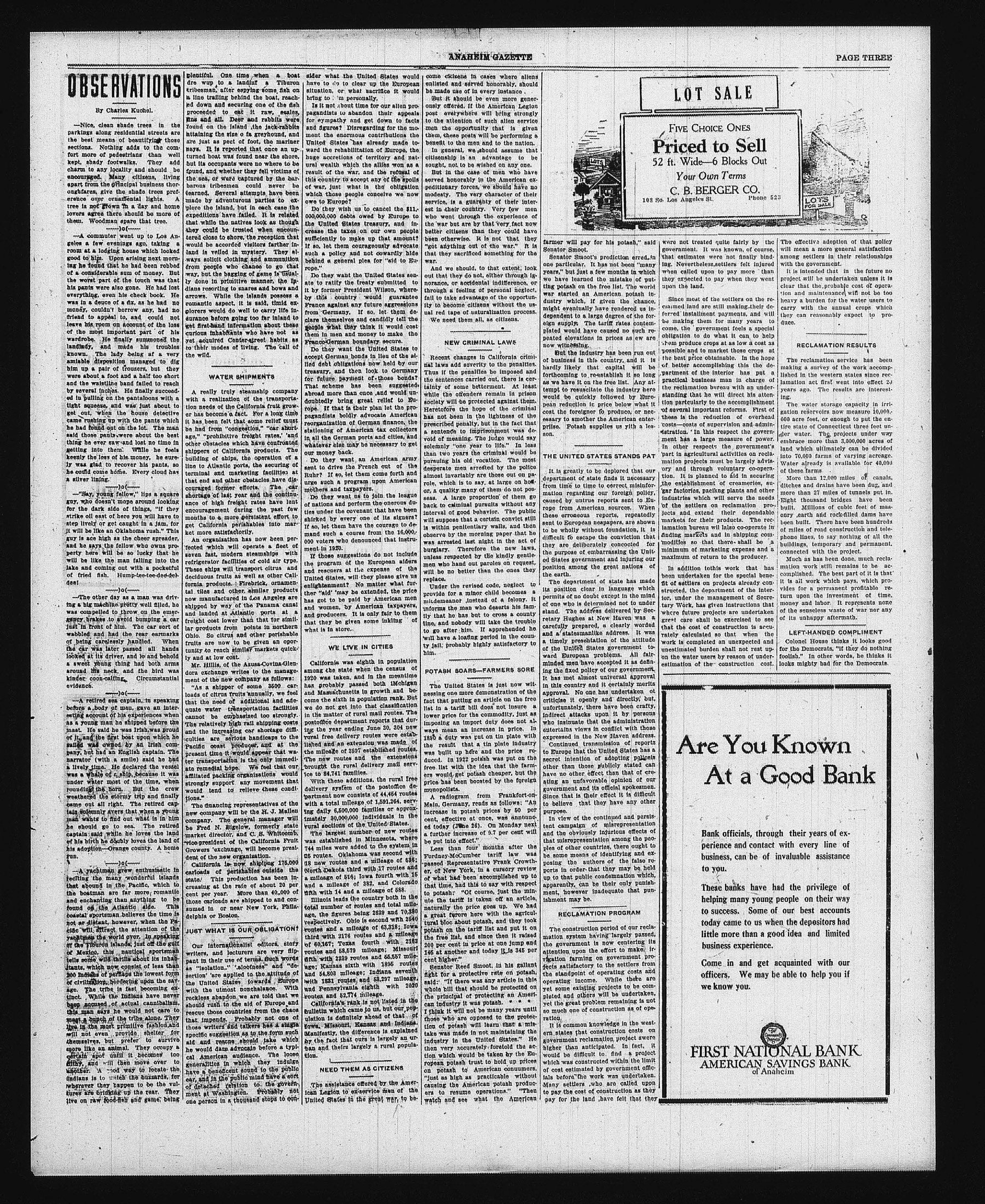
Searchable text
OBSERVATIONS
By Charles Kuchel.
Nice, clean shade trees in the parkings along residential streets are the best means of beautifying those sections. Nothing adds to the comfort more of pedestrians than well kept, shady footwalks. They add charm to any locality and should be encouraged. Many citizens, living apart from the principal business thoroughfares, give the shade trees preference over ornamental lights. A tree is not grown in a day and home lovers agree there should be more of them. Woodman spare that tree.
A commuter went up to Los Angeles a few evenings ago, taking a room at a lodging house which looked good to him. Upon arising next morning he found that he had been robbed of a considerable sum of money. But the worst part of the touch was that his pants were also gone. He had lost everything, even his check book. He was in a deuce of a fix, as he had no money, couldn't borrow any, had no friend to appeal to, and could not leave his room on account of the loss of the most important part of his wardrobe. He finally summoned the landlord, and made his troubles known. The lady being af a very amiable disposition managed to dig him up a pair of trousers, but they were about a foot and a half too short and the waistline band failed to reach by several inches. He finally succeeded in pulling on the pantaloons with a tight squeeze, and was just about to get out, when the house detective came rushing up with the pants which he had found on the lot. The man said those pants were about the best thing he ever saw and lost no time in getting into it.
plentiful. One time when a boat drew wup to a landinf a Tiburon tribesman, after aspiring some fish on a line trailing behind the boat, reached down and securing one of the fish proceeded to eat it raw, seales, fins and all. Deer and rabbits were found on the island, the jack-rabbits attaining the size o fa greyhound, and are just as pect of foot, the mariner says. It is reported that once an upturned boat was found near the shore, but its occupants were no where to be found, and whether they fell victims of the sea, or were captured by the barbary tribesmen could never be learned. Several attempts have been made by adventurous parties to explore the island, but in each case the expeditions have failed. It is related that while the natives look as though they could be trusted when encountered close to shore, the reception that would be accorded visitors farther inland is veiled in mystery. They always solicit clothing and ammunition from people who chance to go that way, but the bagging of game is usually done in primitive manner, the Indians resorting to snares and bows and arrows. While the islands possess a romantic aspect, it is said, timid explorers would do well to carry life insurance before going too far inland to get first-hand information about these curious inhabitants who have not as yet acquired Center-street habits as to their modes of living. The call of the wild.
WATER SHIPMENTS
A really truly steamship company with a realization of the transportation needs of the California fruit grower has become a fact. For a long time it has been felt that some relief must be had from "congestion," "car shortage," "prohibitive freight rates," and other obstacles which have confronted usider what the United States have to do to clear situation, or what we bring to him persons.
Is it not about times pagandists to abandon for sympathy and give figures? Disregardment the enormous United States has a ward the rehabilitation huge accretions of tural wealth which the result of the war, and this country to accept of war, just what is which those people owe to Europe?
Do they wish us to 000,000,000 debts owwe the United States try crease the taxes on sufficiently to make If so, let them courage such a policy and not behind a general pleo rope."
Do they want the Uate to ratify the treaty it by former President by this country w France against any fr from Germany. If clare themselves and people what they thie them in men and more Franco-German bound Do they want the accept German bonds lled debt obligations treasury, and then for future payment That scheme has abroad more than once doubtedly bring great rope. If that is their pagandists boldly add reorganization of Ger stationing of Amerfc in all the German port whatever else may be
The lady being at a very amiable disposition managed to dig him up a pair of frouser, but they were about a foot and a half too short and the waistline band failed to reach by several inches. He finally succeeded in pulling on the pantaloons with a tight squeeze, and was just about to get out, when the house detective came rushing up with the pants which he had found out on the lot. The man said those pants were about the best thing he ever saw and lost no time in getting into them. While he feels keenly the loss of his money, he surely was glad to recover his pants, so he could come home. Every cloud has a silver lining.
"Say, young fellow," lips a square guy, who doesn't mope around looking for the dark side of things, "if they strike old east of here you will have to step lively or get caught in a jam, for it will be like an Oklahoma rush." This guy is ace high as the cheer spreader, and he says the fellow who owns property here will be so lucky that he will be like the man falling into the lake and coming out with a pocketful of fried fish. Hump-tee-tee-dee-dee!
The other day as a man was driving a big machine pretty well filled, he was compelled to throw on the emergency brakes to avoid bumping a car just in front of him. The car sort of wobbled and had the rear earmarks of being carelessly handled. When the car was later passed all hands looked at its driver, and lo and behold a sweet young thing had both arms around his neck, and the bird was kinder coon-calfing. Circumstantial evidence.
A retired sea captain, in speaking before a body of men, gave an interesting account of his experiences when as a young man he shipped before the mast. He said he was Irish, was proud of it, and the first boat upon which he sailed was owned by an Irish company, but had an English captain. The narrator (with a smile) said he had a lively time. He declared the vessel was a whale of a ship, because it was under water most of the time, when rounding the horn. But the crew weathered the stormy trip and finally came out all right. The retired captain solemnly avers that when a young man wants to find out what is in him he should go to sea. The retired captain said while he loves the land of his birth he doubly loves the land of his adoption—Orange county. A home known.
A really truly steamship company with a realization of the transportation needs of the California fruit grower has become a fact. For a long time it has been felt that some relief must be had from "congestion," "car shortage," "prohibitive freight rates," and other obstacles which have confronted shippers of California products. The building of ships, the operation of a line to Atlantic ports, the securing of terminal and marketing facilities at that end and other obstacles have discouraged former efforts. The car shortage of last year and the continuance of high freight rates have lent encouragement during the past few months to a more persistent effort to get California perishables into market more satisfactorily.
An organization has now been perfected which will operate a fleet of seven fast, modern steamships with refrigerator facilities of cold air type. These ships will transport citrus and deciduous fruits as well as other California products. Firebrick, ornamental tiles and other, similar products now manufactured in Los Angeles are shipped by way of the Panama canal and landed at Atlantic ports at a freight cost lower than that for similar products from points in northern Ohio. So citrus and other perishable fruits are now to be given an opportunity to reach similar markets quickly and at low cost.
Mr. Hillis, of the Azusa-Covina-Glendora exchange writes to the management of the new company as follows:
"As a shipper of some 3500 carloads of citrus fruits annually, we feel that the need of additional and adequate water transportation facilities cannot be emphasized too strongly. The relatively high rail shipping costs and the increasing car shortage difficulties are serious handicaps to the Pacific coast producer, and at the present time it would appear that water transportation is the only immediate remedial hope. We feel that our affiliated packing organizations would strongly support any movement that would tend to relieve these conditions."
The financing representatives of the new company will be the H. J. Mallen company. The general manager will be Fred N. Bigelow, formerly state market director, and C. S. Whitcomb, vice-president of the California Fruit Growers' exchange, will become presi-
WATER SHIPMENTS
A really truly steamship company with a realization of the transportation needs of the California fruit grower has become a fact. For a long time it has been felt that some relief must be had from "congestion," "car shortage," "prohibitive freight rates," and other obstacles which have confronted shippers of California products. The building of ships, the operation of a line to Atlantic ports, the securing of terminal and marketing facilities at that end and other obstacles have discouraged former efforts. The car shortage of last year and the continuance of high freight rates have lent encouragement during the past few months to a more persistent effort to get California perishables into market more satisfactorily.
An organization has now been perfected which will operate a fleet of seven fast, modern steamships with refrigerator facilities of cold air type. These ships will transport citrus and deciduous fruits as well as other California products. Firebrick, ornamental tiles and other, similar products now manufactured in Los Angeles are shipped by way of the Panama canal and landed at Atlantic ports at a freight cost lower than that for similar products from points in northern Ohio. So citrus and other perishable fruits are now to be given an opportunity to reach similar markets quickly and at low cost.
Mr. Hillis, of the Azusa-Covina-Glendora exchange writes to the management of the new company as follows:
"As a shipper of some 3500 carloads of citrus fruits annually, we feel that the need of additional and adequate water transportation facilities cannot be emphasized too strongly. The relatively high rail shipping costs and the increasing car shortage difficulties are serious handicaps to the Pacific coast producer, and at the present time it would appear that water transportation is the only immediate remedial hope. We feel that our affiliated packing organizations would strongly support any movement that would tend to relieve these conditions."
The financing representatives of the new company will be the H. J. Mallen company. The general manager will be Fred N. Bigelow, formerly state market director, and C. S. Whitcomb, vice-president of the California Fruit Growers' exchange, will become presi-
WE LIVE IN
California was eight among the states when 1920 was taken, and it has probably passed and Massachusetts in come the sixth in popu- in the matter of rural postoffice department ing the year ending a rural free delivery li- lahed and an extensi- mileage of 2597 est. The new routes and brought the rural de- ice to 84,741 families.
With these addition delivery system of t apartment now consist with a total mileage o- ing daily 6,500,000 fa- imately 30,000,000 in rural sections of the.
The largest number was established in M 744 miles were added
A yachtman grew enthusiastic in reciting the many wonderful islands that abound in the Pacific, which to the boatman are far more romantic and enchanting than anything to be found on the Atlantic side. This coastal sportsman believes the time is not arid distant, however, when the Pacific will attract the attention of the yachtman the world over. In speaking of the Tiburon Islands, just off the Gulf of Mexico, this nautical sportsman tells some wild thrills about its inhabitants, which now consist of less than 200 Indians of perhaps the lowest form of civilization, bordering upon the savage. The tribe is fast becoming extinct. While the Indians have never been accused of actual cannibalism, this man says he would not care to mast a buoy of the tribe alone. They live in the most primitive fashion, and will not even provide shelter for themselves, but prefer to survive more like an animal. They occupy a certain spot until it becomes too dirty, and will then move over to another. A good way to locate the Indians is to watch the buzzards, for wherever they happen to be the vultures are bringing up the rear. They live on raw food fish and game, being
JUST WHAT IS OUR OBLIGATION?
Our internationalist editors, story writers, and lecturers are very flip-pant in their use of terms. Such words as "isolation," "alooiness" and "désertion" are applied to the attitude of the United States towards Europe with the utmost nonchalance. With reckless abandon we are told that we should rush to the aid of Europe and rescue those countries from the chaos that impends. Probably not one of those writers and talkers has a single specific suggestion as to the form such aid and rescue should take which he would dare advocate before a typical American audience. The loose generalities in which they indulge have a beneficent sound to the public ear, and in the public mind have a sort of detached relation to the government at Washington. Probably not one person in a thousand stops to confer transportation is the only immediate remedial hope. We feel that our affiliated packing organizations would strongly support any movement that would tend to relieve these conditions."
The financing representatives of the new company will be the H. J. Mallen company. The general manager will be Fred N. Bigelow, formerly state market director, and C. S. Whitcomb, vice-president of the California Fruit Growers' exchange, will become president of the new organization.
California is now shipping 175,000 carloads of perishables outside the state! This production has been increasing at the rate of about 20 percent per year. More than 40,000 of those carloads are shipped to and consumed in or near New York, Philadelphia or Boston.
JUST WHAT IS OUR OBLIGATION?
Our internationalist editors, story writers, and lecturers are very flip-pant in their use of terms. Such words as "isolation," "alooiness" and "désertion" are applied to the attitude of the United States towards Europe with the utmost nonchalance. With reckless abandon we are told that we should rush to the aid of Europe and rescue those countries from the chaos that impends. Probably not one of those writers and talkers has a single specific suggestion as to the form such aid and rescue should take which he would dare advocate before a typical American audience. The loose generalities in which they indulge have a beneficent sound to the public ear, and in the public mind have a sort of detached relation to the government at Washington. Probably not one person in a thousand stops to confer transportation is the only immediate remedial hope. We feel that our affiliated packing organizations would strongly support any movement that would tend to relieve these conditions."
The financing representatives of the new company will be the H. J. Mallen company. The general manager will be Fred N. Bigelow, formerly state market director, and C. S. Whitcomb, vice-president of the California Fruit Growers' exchange, will become president of the new organization.
California is now shipping 175,000 carloads of perishables outside the state! This production has been increasing at the rate of about 20 percent per year. More than 40,000 of those carloads are shipped to and consumed in or near New York, Philadelphia or Boston.
JUST WHAT IS OUR OBLIGATION?
Our internationalist editors, story writers, and lecturers are very flip-pant in their use of terms. Such words as "isolation," "alooiness" and "désertion" are applied to the attitude of the United States towards Europe with the utmost nonchalance. With reckless abandon we are told that we should rush to the aid of Europe and rescue those countries from the chaos that impends. Probably not one of those writers and talkers has a single specific suggestion as to the form such aid and rescue should take which he would dare advocate before a typical American audience. The loose generalities in which they indulge have a beneficent sound to the public耳,and in the public mind have a sort of detached relation to the government at Washington. Probably not one person in a thousand stops to confer transportation is the only immediate remedial hope. We feel that our affiliated packing organizations would strongly support any movement that would tend to relieve these conditions."
The financing representatives of the new company will be the H. J. Mallen company. The general manager will be Fred N. Bigelow, formerly state market director, and C. S. Whitcomb, vice-president of the California Fruit Growers' exchange, will become president of the new organization.
California is now shipping 175,000 carloads of perishables outside the state! This production has been increasing at the rate of about 20 percent per year. More than 40,000 of those carloads are shipped to and consumed in or near New York, Philadelphia or Boston.
JUST WHAT IS OUR OBLIGATION?
Our internationalist editors, story writers, and lecturers are very flip-pant in their use of terms. Such words as "isolation," "alooiness" and "désertion" are applied to the attitude of the United States towards Europe with the utmost nonchalance. With reckless abandon we are told that we should rush to the aid of Europe and rescue those countries from the chaos that impends. Probably not one of those writers and talkers has a single specific suggestion as to the form such aid and rescue should take which he would dare advocate before a typical American audience. The loose generalities in which they indulge have a beneficent sound to the public耳,and in the public mind have a sort of detached relation to the government at Washington. Probably not one person in a thousand stops to confer transportation is the only immediate remedial hope. We feel that our affiliated packing organizations would strongly support any movement that would tend to relieve these conditions."
The financing representatives of the new company will be the H. J. Mallen company. The general manager will be Fred N. Bigelow, formerly state market director, and C. S. Whitcomb, vice-president of the California Fruit Growers' exchange, will become president of the new organization.
California is now shipping 175,000 carloads of perishables outside the state! This production has been increasing at the rate of about 20 percent per year. More than 40,000 of those carloads are shipped to and consumed in or near New York, Philadelphia or Boston.
JUST WHAT IS OUR OBLIGATION?
Our internationalist editors, story writers, and lecturers are very flip-pant in their use of terms. Such words as "isolation," "alooiness" and "désertion" are applied to the attitude of the United States towards Europe with the utmost nonchalance. With reckless abandon we are told that we should rush to the aid of Europe and rescue those countries from the chaos that impends. Probably not one of those writers and talkers has a single specific suggestion as to the form such aid and rescue should take which he would dare advocate before a typical American audience. The loose generalities in which they indulge have a beneficent sound to the public耳,and in the public mind have a sort of detached relation to the government at Washington. Probably not one person in a thousand stops to confer transportation is the only immediate remedial hope. We feel that our affiliated packing organizations would strongly support any movement that would tend to relieve these conditions."
ANAHEIM GAZETTE
sider what the United States would have to do to clear up the European situation, or what sacrifice it would bring to him personally.
Is it not about time for our alien propagandists to abandon their appeals for sympathy and get down to facts and figures? Disregarding for the moment the enormous contributions the United States has already made toward the rehabilitation of Europe, the huge accretions of territory and natural wealth which the allies won as a result of the war, and the refusal of this country to accept any of the spoils of war, just what is the obligation which those people conceive we now owe to Europe?
Do they wish us to cancel the $11,000,000,000 debts owed by Europe to the United States treasury, and increase the taxes on our own people sufficiently to make up that amount? If so, let them courageously advocate such a policy and not cowardly hide behind a general plea for "aid to Europe."
Do they want the United States senate to ratify the treaty submitted to it by former President Wilson, whereby this country would guarantee France against any future aggressions from Germany. If so, let them declare themselves and candidly tell the people what they think it would cost them in men and money to make the Franco-German boundary secure.
Do they want the United States to accept German bonds in lieu of the allied debt obligations now held by our treasury, and then look to Germany for future payment of those bonds? That scheme has been suggested abroad more than once, and would undoubtedly bring great relief to Europe. If that is their plan let the propagandists boldly advocate American reorganization of German finance, the stationing of American tax collectors in all the German ports and cities, and whatever else may be necessary to get come citizens in cases where aliens enlisted and served honorably, should be made use of in every instance.
But it should be even more generously offered. If the American Legion post everywhere will bring strongly to the attention of such alien service men the opportunity that is given them, these posts will be performing a benefit to the men and to the nation.
In general, we should assume that citizenship is an advantage to be sought, not to be wished on any one.
But in the case of men who have served honorably in the American expeditionary forces, we should have no modesty. The very character of their service, is a guaranty of their interest in their country. Very few men who went through the experience of the war but are by that very fact now better citizens than they could have been otherwise. It is not that they "got anything out of the war." It is that they sacrificed something for the war.
And we should, to that extent, look out that they do not, either through ignorance, or accidental indifference, or through a feeling of personal neglect, fail to take advantage of the opportunity to become citizens without the usual red tape of naturalization process.
We need them all, as citizens.
NEW CRIMINAL LAWS
Recent changes in California criminal laws add severity to the penalties. Thus if the penalties be imposed and the sentences carried out, there is certain of some betterment. At least while the offenders remain in prison society will be protected against them. Heretofore the hope of the criminal has not been in the lightness of the prescribed penalty, but in the fact that a sentence to imprisonment was devoid of meaning. The judge would say solemnly "one year to life." In less farmer will pay for his potash," said Senator Smoot.
Senator Smoot's prediction erred in one particular. It has not been "many years," but just a few months in which we have learned the mistake of putting potash on the free list. The world war started an American potash industry which, if given the chance, might eventually have rendered us independent to a large degree of the foreign supply. The tariff rates contemplated would have caused no such repeated elevations in prices as ew are now witnessing.
But the industry has been run out of business in this country, and it is hardly likely that capital will be forthcoming to re-establish it so long as we have it on the free list. Any attempt to resuscitate the industry here would be quickly followed by European reduction in price below what it cost the foreigner to produce, or necessary to smother the American enterprise. Potash supplies us with a lesson.
accept German bonds in lieu of the silled debt obligations now held by our treasury, and then look to Germany for future payment of those bonds? That scheme has been suggested abroad more than once, and would undoubtedly bring great relief to Europe. If that is their plan let the propagandists boldly advocate American reorganization of German finance, the stationing of American tax collectors in all the German ports and cities, and whatever else may be necessary to get our money back.
Do they want an American army sent to drive the French out of the Ruhr? If so, let them come forth and urge such a program upon American mothers and taxpayers.
Do they want us to join the league of nations and perform the onerous duties under the covenant that have been shirked by every one of its signers? If so, let them have the courage to demand such a course from the 16,000,000 voters who denounced that instrument in 1920.
If these suggestions do not include the program of the European aiders and rescuers at the expense of the United States, will they please give us enlightenment? No matter what further "aid' may be extended, the price has got to be paid by American men and women, by American taxpayers, and producers. It is only fair to them that they be given some inkling of what is in store.
WE LIVE IN CITIES
California was eighth in population among the state when the census of 1920 was taken, and in the meantime has probably passed both iMchigan and Massachusetts in growth and become the sixth in population rank. But we do not get into that classification in the matter of rural mail routes. The postoffice department reports that during the year ending June 30, 304 new rural free delivery routes were established and an extension was made of the mileage of 2597 established routes. The new routes and the extensions brought the rural delivery mail service to 84,741 families.
With these additions, the rural free delivery system of the postoffice department now consists of 44,454 routes with a total mileage of 1,591,264, serving daily 6,500,000 families or approximately 30,000,000 individuals in the rural sections of the United States.
The largest number of new routes was established in Minnesota, where 744 miles were added to the system in recent changes in California criminal laws add severity to the penalties. Thus if the penalties be imposed and the sentences carried out, there is certainty of some betterment. At least while the offenders remain in prison society will be protected against them. Heretofore the hope of the criminal has not been in the lightness of the prescribed penalty, but in the fact that a sentence to imprisonment was devoid of meaning. The judge would say solemnly "one year to life." In less than two years the criminal would be pursuing his old vocation. The most desperate men arrested by the police almost invariably are those out on parole, which is to say, at large on hold, a quality many of them do not possess. A large proportion of them go back to criminal pursuits without any interval of good behavior. The public will suppose that a certain convict still is within penitentiary walls, and then observe by the morning paper that he was arrested last night in the act of burglary. Therefore the new laws, unless respected by the kindly gentlemen who hand out paroles on request, will be no better than the ones they replace.
Under the revised code, neglect to provide for a minor child becomes a misdemeanor instead of a felony. It informs the man who deserts his family that he has but to cross a county line, and nobody will take the trouble to go after him. If apprehended he will have a loafing period in the county jail; probably highly satisfactory to him.
POTASH SOARS—FARMERS SORE
The United States is just now witnessing one more demonstration of the fact that putting an article on the free list in a tariff bill does not insure a lower price for the commodity, just as imposing an import duty does not always mean an increase in price. In 1890 a duty was put on tin plate with the result that a tin plate industry was built up here and the price reduced. In 1922 potash was put on the free list with the idea that the farmers would get potash cheaper, but the price has been boosted by the foreign monopolists.
A radiogram from Frankfort-on-Main, Germany, reads as follows: "An increase in potash prices by 50 per cent, effective at once, was announced today (June 26). On Monday next a further increase of 9.7 per cent will be put into effect."
Less than four months after the
But the industry has been full of business in this country, and it is hardly likely that capital will be forthcoming to re-establish it so long as we have it on the free list. Any attempt to resuscitate the industry here would be quickly followed by European reduction in price below what it cost the foreigner to produce, or necessary to smother the American enterprise. Potash supplies us yith a lesson.
THE UNITED STATES STANDS PAT
It is greatly to be deplored that our department of state finds it necessary from time to time to correct misinformation regarding our foreign policy, caused by untrue reports sent to Europe from American sources. When these erroneous reports, repeatedly sent to European napesters, are shown to be wholly without foundation, it is difficult to escape the conviction that they are deliberately concocted for the purpose of embarrassing the United States government and injuring our position among the great nations of the earth.
The department of state has made its position clear in language which permits of no doubt except in the mind of one who is determined not to understand. The address delivered by Secretary Hughes at New Haven was a carefully prepared, a clearly worded and a statesmanlike address. It was a timely presentation of the attitude of the United States government toward European problems. All fairly-minded men have accepted it as defining the fixed policy of our government. It has met almost universal approval in this country and it certainly merits approval. No one has undertaken criticism it openly and directly; but unfortunately, there have been crafty, indirect attacks upon it by persons who insinuate that the administration entertains views in conflict with those expressed in the New Haven address.
Continued transmission of reports to Europe that the United States has a secret intention of adopting policies other than those publicly stated can have no other effect than that of creating an unfavorable opinion of our government and its official spokesmen. Since that is their effect it is difficult to believe that they have any other purpose.
In view of the continued and persistent campaign of misrepresentation and the obviously injurious effects of that misrepresentation among the peoples of other countries, there ought to
The new routes and the extensions brought the rural delivery mail service to 84,741 families.
With these additions, the rural free delivery system of the postoffice department now consists of 44,454 routes with a total mileage of 1,591,264, serving daily 6,500,000 families or approximately 30,000,000 individuals in the rural sections of the United States.
The largest number of new routes was established in Minnesota, where 744 miles were added to the system in 25 routes. Oklahoma was second with 18 new routes and a mileage of 538; North Dakota third with 17 routes and a mileage of 516; Iowa fourth with 15 and a mileage of 382, and Colorado fifth with 14 and a mileage of 588.
Illinois leads the country both in the total number of routes and total mileage, the figures being 2629 and 70,380 respectively. Ohio is second with 2540 routes and a mileage of 63,318; Iowa third with 2176 routes and a mileage of 60,167; Texas fourth with 2162 routes and 58,579 mileage; Missouri fifth with 2239 routes and 65,557 mileage; Kansas sixth with 1895 routes and 54,803 mileage; Indiana seventh with 1831 routes and 58,297 mileage; and Pennsylvania eighth with 2020 routes and 52,774 mileage.
California's rank is not listed in the bulletin which came to us, but our population is definitely ahead of that of Iowa, Missouri, Kansas and Indiana. Manifestly, the difference is explained by the fact that ours is largely an urban and theirs largely a rural population.
NEED THEM AS CITIZENS
The assistance offered by the American Legion to ex-service men of the United States in the great war, to beuced. In 1922 potash was put on the free list with the idea that the farmers would get potash cheaper, but the price has been boosted by the foreign monopolists.
A radiogram from Frankfort-on-Main, Germany, reads as follows: "An increase in potash prices by 50 per cent, effective at once, was announced today (June 26). On Monday next a further increase of 9.7 per cent will be put into effect."
Less than four months after the Fordney-McCumber tariff law was passed Representative Frank Crowther, of New York, in a cursory review of what had been accomplished up to that time, had this to say with respect to potash: "Of course, just the minute the tariff is taken off an article, naturally the price goes up. We had a great farre here with the agricultural bloom about potash, and they took potash on the tariff list and put it on the free list, and since then it raised 200 per cent in price at one jump and 146 at another and today it is 345 per cent higher."
Senator Reed Smoot, in his gallant fight for a protective rate on potash, said: "If there was any article in this whole bill that should be protected on the principal of protecting an American industry it was potash." I think it will not be many years until those who are opposed to the protection of potash will learn that a mistake was made in not maintaining the industry in the United States." He then very accurately foretold the action which would be taken by the European potash trust to hold up prices on potash to American consumers," just as high as practicable without causing the American potash producers to resume operations." "Then watch and see what the American secret intention of adopting policies other than those publicly stated can have no other effect than that of creating an unfavorable opinion of our government and its official spokesmen. Since that is their effect it is difficult to believe that they have any other purpose.
In view of the continued and persistent campaign of misrepresentation and the obviously injurious effects of that misrepresentation among the peoples of other countries, there ought to be some means of identifying and exposing the authors of the false reports in order that they may be held up to that public condemnation which, apparently, can be their only punishment, however inadequate that punishment may be.
RECLAMATION PROGRAM
The construction period of our reclamation system having largely passed, the government is now centering its attention upon the effort to make irrigation farming on government projects satisfactory to the settlers from the standpoint of operating costs and operating income. While there are yet some existing projects to be completed and others will be undertaken, yet the great problem remaining is not so much one of construction as of operation.
It is common knowledge in the western states that construction costs on government reclamation project swere higher than anticipated. In fact, it would be difficult to find a project which was constructed within the limit of cost estimated by government officials before the work was undertaken. Many settlers who are called upon to pay the cost of construction as they pay for the land have felt that they
LOT SALE
FIVE CHOICE ONES
Priced to Sell
52 ft. Wide—6 Blocks Out
Your Own Terms
C. B. BERGER CO.
108 So. Los Angeles St. Phone 523
were not treated quite fairly by the government. It was known, of course, that estimates were not finally binding. Nevertheless, settlers felt injured when called upon to pay more than they expected to pay when they went upon the land.
Since most of the settlers on the reclaimed land are still making their deferred installment payments, and will be making them for many years to come, the government feels a special obligation to do what it can to help them produce crops at as low a cost as possible and to market those crops at the best price obtainable. In the hope of better accomplishing this the department of the interior has put a practical business man in charge of the reclamation bureau with an understanding that he will direct his attention particularly to the accomplishment of several important reforms. First of these is the reduction of overhead costs—costs of supervision and administration. In this respect the government has a large measure of power. In other respects the government's
The effective adoption of that policy will mean a more general satisfaction among settlers in their relationships with the government.
It is intended that in the future no project will be undertaken unless it is clear that the probable cost of operation and maintenance will not be too heavy a burden for the water users to carry with the annual crops which they can reasonably expect to produce.
RECLAMATION RESULTS
The reclamation service has been making a survey of the work accomplished in the western states since reclamation act first went into effect 20 years ago. The results are interesting.
The water storage capacity in irrigation reservoirs now measure 10,000-10,000 acre feet, or enough to put the entire state of Connecticut three feet under water. The projects under way embrace more than 3,000,000 acres of land which ultimately can be divided
the best price obtainable. In the hope of better accomplishing this the department of the interior has put a practical business man in charge of the reclamation bureau with an understanding that he will direct his attention particularly to the accomplishment of several important reforms. First of these is the reduction of overhead costs—costs of supervision and administration. In this respect the government has a large measure of power. In other respects the government's part in agricultural activities on reclamation projects must be largely advisory and through voluntary co-operation. It is planned to aid in securing the establishment of creameries, sugar factories, pacikng plants and other industries which will serve the needs of the settlers on reclamation projects and extend their dependable markets for their products. The reclamation bureau will lalso co-operate in finding markets and in shipping commodities so that there shall be a minimum of marketing expense and a maximum of return to the producer.
In addition tothis work that has been undertaken for the special benefit of settlers on projects already constructed, the department of the interior, under the management of Secretary Work, has given instructions that where future projects are undertaken great care shall be exercised to see that the cost of construction is accurately calculated so that when the work is completed an unexpected and unestimated burden shall not rest upon the water users by reason of underestimation of the construction cost.
The reclamation service has been making a survey of the work accomplished in the western states since reclamation act first went into effect 20 years ago. The results are interesting.
The water storage capacity in irrigation reservoirs now measure 10,000,000 acre feet, or enough to put the entire state of Connecticut three feet under water. The projects under way embrace more than 3,000,000 acres of land which ultimately can be divided into 70,000 farms of varying acreage. Water already is available for 40,000 of these farms.
More than 12,000 miles of canals, ditches and drains have been dug, and more than 27 miles of tunnels put in. Eight thousand bridges have been built. Millions of cubic feet of masonry, earth and rock-filled dams have been built. There have been hundreds of miles of road construction and telephone lines, to say nothing of all the buildings, temporary and permanent, connected with the project.
Much as has been done, much reclamation work still remains to be accomplished. The best part of it is that it is all work which pays, which provides for a permanent profitable return upon the investment of time, money and labor. It represents none of the senseless waste of war nor any of its unhappy aftermath.
LEFT-HANDED COMPLIMENT
Colonel House thinks it looks good for the Democrats, "if they do nothing foolish." In other words, he thinks it looks mighty bad for the Democrats.
Are You Known At a Good Bank
Bank officials, through their years of experience and contact with every line of
At a Good Bank
Bank officials, through their years of experience and contact with every line of business, can be of invaluable assistance to you.
These banks have had the privilege of helping many young people on their way to success. Some of our best accounts today came to us when the depositors had little more than a good idea and limited business experience.
Come in and get acquainted with our officers. We may be able to help you if we know you.
FIRST NATIONAL BANK
AMERICAN SAVINGS BANK
of Anaheim