anaheim-gazette 1923-08-16
Scanned page
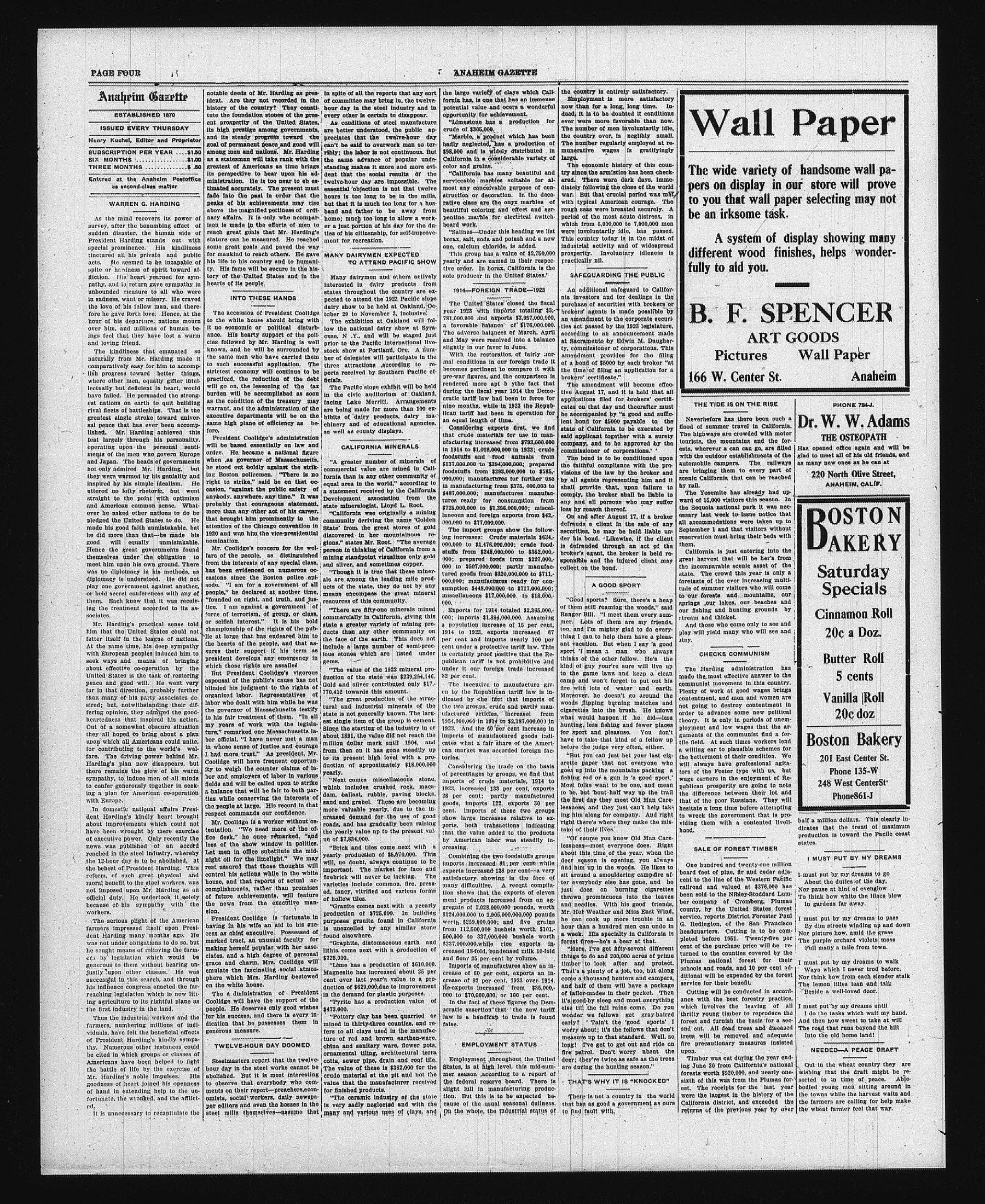
Searchable text
Anaheim Gazette
ESTABLISHED 1870
ISSUED EVERY THURSDAY
Henry Kuchel, Editor and Proprietor
SUBSCRIPTION PER YEAR ... $1.50
SIX MONTHS ... $1.00
THREE MONTHS ... $ .50
Entured at the Anaheim Postoffice as second-class matter
WARREN G. HARDING
As the mind recovers its power of survey, after the benumbing effect of sudden disaster, the human side of President Harding stands out with special prominence. His kindliness tinctured all his private and public acts. He seemed to be incapable of spite or hardness of spirit toward affliction. His heart yearned for sympathy, and in return gave sympathy in unbounded measure to all who were in sadness, want or misery. He craved the love of his fellow man, and therefore he gave forth love. Hence, at the hour of his departure, nations mourn over him, and millions of human beings feel that they have lost a warm and loving friend.
The kindliness that emanated so naturally from Mr. Harding made it comparatively easy for him to accomplish progress toward better things, where other men, equally gifter intellectually but deficient in heart, would have failed. He persuaded the strongest nations on earth to quit building rival fleets of battleships. That is the greatest single stroke toward universal peace that has ever been accomplished. Mr. Harding achieved this feat largely through his personality, operating upon the personal senti-
notable deeds of Mr. Harding as president. Are they not recorded in the history of the country? They constitute the foundation stones of the present prosperity of the United States, its high prestige among governments, and its steady progress toward the goal of permanent peace and good will among men and nations. Mr. Harding as a statesman will take rank with the greatest of Americans as time brings its perspective to bear upon his administration. He is too near to eb estimated accurately. The present must fade into the past in order that the peaks of his achievements may rise above the magnified pettiness of ordinary affairs. It is only when nocomparison is made in the efforts of men to reach great goals that Mr. Harding's stature can be measured. He reached some great goals, and paved the way for mankind to reach others. He gave his life to his country and to humanity. His fame will be secure in the history of the United States and in the hearts of its people.
INTO THESE HANDS
The accession of President Coolidge to the white house should bring with it no economic or political disturbance. His hearty support of the policies followed by Mr. Harding is well known, and he will be surrounded by the same men who have carried them to such successful application. The strictest economy will continue to be practiced, the reduction of the debt will go on, the lessoning of the tax burden will be accomplished as soon as the condition of the treasury may warrant, and the administration of the executive departments will be on the same high plane of efficiency as before.
President Coolidge's administration will be based essentially on law and in spite of all that of committee members hour day in the every other is.
As conditions are better under preclates that can't be said to ribly; the labor the same advantage standing makes dent that the twelve-hour day essential object hours is too low but that it is not band and fathom home; much to er a just portfolio ties of his citizenship for recreation.
MANY DAIRY TO AT
Many dairymen interested in states throughout pected to attend dairy show to October 28 to No.
The exhibitions low the nation cuse, N.Y., and prior to the Pacific stock show at one der of delegates three attractive ports received ficials.
The Pacific's in the civic area facing Lake Mead are being made hibits of dairies chinery and oil as well as coun-
naturally from Mr. Harding made it comparatively easy for him to accomplish progress toward better things, where other men, equally giftier intellectually but deficient in heart, would have failed. He persuaded the strongest nations on earth to quit building rival fleets of battleships. That is the greatest single stroke toward universal peace that has ever been accomplished. Mr. Harding achieved this feat largely through his personality, operating upon the personal sentiments of the men who govern Europe and Japan. The heads of governments not only admired Mr. Harding, but they were warmed by his geniality and inspired by his simple idealism. He uttered no lofty rhetoric, but went straight to the point with optimism and American common sense. Whatever he asked other nations to do he pledged the United States to do. He made his good faith unmistakable, but he did more than that—he made his good will equally unmistakable. Hence the great governments found themselves under the obligation to meet him upon his own ground. There was no diplomacy in his methods, as diplomacy is understood. He did not play one government against another, or hold secret conferences with any of them. Each knew that it was receiving the treatment accorded to its associates.
Mr. Harding's practical sense told him that the United States could not fetter itself in the league of nations. At the same time, his deep sympathy with European peoples induced him to seek ways and means of bringing about effective co-operation by the United States is the task of restoring peace and good will. He went very far in that direction, probably further than many of his party associates desired; but, notwithstanding their differing opinion, they admired the good-heartedness that inspired his action. Out of a somewhat obscure situation they all hoped to bring about a plan upon which all Americans could unite, for contributing to the world's welfare. The driving power behind Mr. Harding's plan now disappears, but there remains the glow of his warm sympathy, to induce men of all minds to confer generously together in seeking a plan for American co-operation with Europe.
In domestic national affairs President Harding's kindly heart brought about improvements which could not have been wrought by mere exercise of executive power. Only recently the news was published of an accord
the same men who have carried them to such successful application. The strictest economy will continue to be practiced, the reduction of the debt will go on, the lessening of the tax burden will be accomplished as soon as the condition of the treasury may warrant, and the administration of the executive departments will be on the same high plane of efficiency as before.
President Coolidge's administration will be based essentially on law and order. He became a national figure when as governor of Massachusetts, he stood out boldly against the striking Boston policemen. "There is no right to strike," said he on that occasion, "against the public safety of anybody, anywhere, any time." It was probably that courageous statement, more than any other act of his career, that brought him prominently to the attention of the Chicago convention in 1920 and won him the vice-presidential nomination.
Mr. Coolidge's concern for the welfare of the people, as distinguished from the interests of any special class, has been evidenced on numerous occasions since the Boston police episode. "I am for a government of all people," he declared at another time, "founded on right, and truth, and justice. I am against a government of force of terrorism, of group, or class, or selfish interest." It is his bold championship of the rights of the public at large that has endeared him to the hearts of the people, and that assures their support if his term as president develops any emergency in which those rights are assaulted.
But President Coolidge's vigorous espousal of the public's cause has not blinded his judgment to the rights of organized labor. Representatives of labor who dealt with him while he was the governor of Massachusetts testify to his fair treatment of them. "In all my years of work with the legislature," remarked one Massachusetts labor official, "I have never met a man in whose sense of justice and courage I had more trust." As president, Mr. Coolidge will have frequent opportunity to weigh the counter claims of labor and employers of labor in various fields and will be called upon to strike a balance that will be fair to both parties while conserving the interests of the people at large. His record in that respect commands our confidence.
Mr. Coolidge is a worker without ostentation. "We need more of the office desk," he once remarked, "and less of the show window in politics."
The Pacific's in the civic area are being made habits of dairy chinery and oil as well as court.
"A greater commercial valuation than in equal area in the statement recited Development state mineralogy.
"California we community derive State' from the discovered in regions," states M person in thinking mining standpoint and silver, and
"Though it is als are among units of the state means encompass resources of this
"There are five commercially in state a greater ducts than any face of the include a large loose stones which gems.
"The value oduction of the Gold and silver 770,412 towards
"The great physical and industrial state is not genetical single item Since the start about 1891, the million dollar from then on it to its present production of apr yearly.
"Next comes which includes dam, ballast, sand and gravel more valuable increased demand roads, and has the yearly value of $7,834,000."
"Brick and t
The driving power behind Mr. Harding's plan now disappears, but there remains the glow of his warm sympathy, to induce men of all minds to confer generously together in seeking a plan for American co-operation with Europe.
In domestic national affairs President Harding's kindly heart brought about improvements which could not have been wrought by mere exercise of executive power. Only recently the news was published of an accord reached in the steel industry, whereby the 12-hour day is to be abolished, at the behest of President Harding. This reform, of such great physical and moral benefit to the steel workers, was not imposed upon Mr. Harding as an official duty. He undertook it solely because of his sympathy with the workers.
The serious plight of the American farmers impressed itself upon President Harding many months ago. He was not under obligations to do so, but he sought means of relieving the farmers by legislation which would be generous to them without bearing unjustly upon other classes. He was successful in this search, and through his influence congress enacted the far-reaching legislation which is now lifting agriculture to its rightful plane as the first industry in the land.
Thus the industrial workers and the farmers, numbering millions of individuals, have felt the beneficial effects of President Harding's kindly sympathy. Numerous other instances could be cited in which groups or classes of Americans have been helped to fight the battle of life by the exercise of Mr. Harding's noble impulses. His goodness of heart joined his openness of hand in extending help to the unfortunate, the wronged, and the afflicted.
It is unnecessary to recapitulate the
TWELVE-HOUR DAY DOOMED
Steelmasters report that the twelve-hour day in the steel works cannot be abolished. But it is most interesting to observe that everybody who comments on their report—preachers,economists, social workers, daily newspaper editors and even the bosses in the steel mills themselves—assume that
ANAHEIM GAZETTE
in spite of all the reports that any sort of committee may bring in, the twelve-hour day in the steel industry and in every other is certain to disappear.
As conditions of steel manufacture are better understood, the public precepts that the twelve-hour day can't be said to overwork men so terribly; the labor is not continuous. But the same advance of popular understanding makes it more and more evident that the social results of the twelve-hour day are impossible. The essential objection is not that twelve hours is too long to be in the mills, but that it is much too long for a husband and father to be away from home; much too long to allow a worker a just portion of his day for the duties of his citizenship, for self-improvement for recreation.
MANY DAIRYMEN EXPECTED TO ATTEND PACIFIC SHOW
Many dairymen and others actively interested in dairy products from states throughout the country are expected to attend the 1923 Pacific slope dairy show to be held at Oakland, October 29 to November 3, inclusive.
The exhibition at Oakland will follow the national dairy show at Syracuse, N.Y., and will be staged just prior to the Pacific international livestock show at Portland, Ore. A number of delegates will participate in the three attractions according to reports received by Southern Pacific officials.
The Pacific slope exhibit will be held in the civic auditorium of Oakland, facing Lake Merritt. Arrangements are being made for more than 100 exhibits of dairy products, dairy machinery and of educational agencies, as well as county displays.
CALIFORNIA MINERALS
the large variety of clays which California has, is one that has an immense potential value and ocers a wonderful opportunity for achievement.
"Limestone has a production for crude of $305,000."
Marble, a product which has been badly neglected, has a production of $88,000 and is widely distributed in California in a considerable variety of color and grains.
"California has many beautiful and serviceable marbles suitable for almost any conceivable purpose of construction or decoration. In the decorative class are the onyx marbles of beautiful coloring and effect and serpentine marble for electrical switchboard work.
"Salines—Under this heading we list borax, salt, soda and potash and a new one, calcium chloride, is added.
This group has a value of $2,750,000 yearly and are named in their respective order. In borax, California is the sole producer in the United States."
1914—FOREIGN TRADE—1923
The United States' closed the fiscal year 1923 with imports totaling $3,781,000,000 and exports $3,957,000,000, a favorable balance of $176,000,000. The adverse balances of March, April and May were resolved into a balance slightly in our favor in June.
With the restoration of fairly normal conditions in our foreign trade it becomes pertinent to compare it with pre-war figures, and the comparison is rendered more apt by the fact that during the fiscal year 1914 the Democratic tariff law had been in force for nine months, while in 1923 the Republican tariff had been in operation for an equal length of time.
Considering exports first, we find that crude materials for use in manufacturing increased from $793,000,000 in 1914 to $1,018,000,000 in 1923; crude
the country is entirely satisfactory.
Employment is more satisfactory now than for a long, long time. Indeed, it is to be doubted if conditions ever were more favorable than now. The number of men involuntarily idle, the country over, is negligibly small. The number regularly employed at remunerative wages is gratifyingly large.
The economic history of this country since the arm'slice has been checked. There were dark days, immediately following the close of the world war. But that crucial period was mild with typical American courage. The rough seas were breasted securely. A period of the most acute distress, in which from 5,000,000 to 7,000,000 men were involuntarily idle, has passed. This country today is in the midst of industrial activity and of widespread prosperity. Involuntary idleness is practically nil.
SAFEGUARDING THE PUBLIC
An additional safeguard to California investors and for dealings in the purchase of securities with brokers or brokers' agents is made possible by an amendment to the corporate securities act passed by the 1923 legislature, according to an announcement made at Sacramento by Edwin M. Daugherty, commissioner of corporations. This amendment provides for the filing of a bond of $5000 by each broker "at the time of filing an application for a brokers' certificate."
The amendment will become effective August 17, and it is held that all applications filed for brokers' certificates on that day and thereafter must be accompanied by "a good and sufficient bond for $5000 payable to the state of California to be executed by said applicant together with a surety company, and to be approved by the
CALIFORNIA MINERALS
"A greater number of minerals of commercial value are mined in California than in any other community of equal area in the world," according to a statement received by the California Development association from the state mineralogist, Lloyd L. Root.
"California was originally a mining community deriving the name 'Golden State' from the great stores of gold discovered in her mountainous regions," states Mr. Root. "The average person in thinking of California from a mining standpoint visualizes only gold and silver, and sometimes copper."
"Though it is true that these minerals are among the leading mile products of the state, they do not by any means encompass the great mineral resources of this community."
"There are fifty-one minerals mined commercially in California, giving this state a greater variety of mining products than any other community on the face of the earth. This does not include a large number of semi-precious stones which are listed under gems."
"The value of the 1922 mineral production of the state was $239,294,146. Gold and silver contributed only $17,770,412 towards this amount."
"The great production of the structural and industrial minerals of the state is not generally known. The largest single item of the group is cement. Since the starting of the industry in or about 1891, the value did not reach the million dollar mark until 1904, and from then on it has gone steadily up to its present high level with a production of aproximately $18,000,000 yearly."
"Next comes miscellaneous stone, which includes crushed rock, macadam, ballast, rubble, paving blocks, sand and gravel. These are becoming more valuable yearly, due to the increased demand for the use of good roads, and has gradually been raising the yearly value up to the present value of $7,834,000."
"Brick and tiles come next with a berber of delegates will participate in the three attractions, according to reports received by Southern Pacific officials.
The Pacific slope exhibit will be held in the civic auditorium of Oakland, facing Lake Merritt. Arrangements are being made for more than 100 exhibits of dairy products, dairy machinery and of educational agencies, as well as county displays.
Considering exports first, we find that crude materials for use in manufacturing increased from $793,000,000 in 1914 to $1,018,000,000 in 1923; crude foodstuffs and food animals from $137,000,000 to $394,000,000; prepared foodstuffs from $293,000,000 to $585,000,000; manufactures for further use in manufacturing from $375,000,000 to $487,000,000; manufactures manufactures ready for consumption from $725,000,000 to $1,396,000,000; miscellaneous and foreign exports from $42,000,000 to $77,000,000.
The import groups show the following increases: Crude materials $634,000,000 to $1,476,000,000; crude foodstuffs from $248,000,000 to $352,000,000; prepared foods from $227,000,000 to $507,000,000; partly manufactured goods from $320,000,000 to $711,000,000; manufactures ready for consumption $448,000,000 to $717,000,000; miscellaneous $17,000,000 to $18,ooo,ooo.
Exports for 1914 totaled $2,365,ooo; imports $1.894,ooo,ooo. Assuming a population increase of 15 per cent, 1914 to 1923, exports increased 67 per cent and imports nearly 1oo per cent under a protective tariff law. This is certainly proof positive that the Republican tariff is not prohibitive and under it our foreign trade increased 82 per cent.
The incentive to manufacture given by the Republican tariff law is indicated by the fact that imports of the two groups, crude and partly manufactured articles, increase from $954,ooo,ooo in 1914 to $2,187,ooo,ooo in 1923. And the 6o per cent increase in imports of manufactured goods indicates what a fair share of the American market was accorded foreign factories.
Considering the trade on the basis of percentages by groups, we find that imports of crude materials, 1914 to 1923, increased 133 per cent; exports 28 per cent; partly manufactured goods; imports 122; exports 3o per cent. Imports of these two groups show large increases relative to exports both transactions indicating that the value added to the products by American labor was steadily increasing.
With the restoration of fairly normal conditions in our foreign trade it becomes pertinent to compare it with pre-war figures, and the comparison is rendered more apt b ythe fact that during the fiscal year 1914 the Democratic tariff law had been in force for nine months, while in 1923 the Republican tariff had been in operation for an equal length of time.
Considering exports first, we find that crude materials for use in manufacturing increased from $793,ooo,ooo in 1914 to $1.ooi8.ooo.ooo in 1923; crude foodstuffs and food animals from $137.ooo.ooo to $394.ooo.ooo; prepared foodstuffs from $293.ooo.ooo to $585.ooo.ooo; manufactures for further use in manufacturing from $375.ooo.ooo to $487.ooo.ooo; manufactures manufactures ready for consumption from $725.ooo.ooo to $1.396.ooo.ooo; miscellaneous and foreign exports from $42.ooo.ooo to $77.ooo.ooo.
The import groups show the following increases: Crude materials $634.ooo.ooo to $1.476.ooo.ooo; crude foodstuffs from $248.ooo.ooo to $352.ooo.ooo; prepared foods from $227.OOO.OOO to $5O7.OOO.OOO; partly manufactured goods from $32O.OOO.OOO to $71I.OOO.OOO; manufactures ready for consumption $448.OOO.OOO to $717.OOO.OOO; miscellaneous $17.OOO.OOO to $18.OOO.OOO.
Exports for 1914 totaled $2.365.ooo; imports $1.894.ooo.ooo. Assuming a population increase of 15 per cent, 1914 to 1923,exports increased 67 per cent and imports nearly 1oo per cent under a protective tariff law. This is certainly proof positive that the Republican tariff is not prohibitive and under it our foreign trade increased 82 per cent.
The incentive to manufacture given by the Republican tariff law is indicated by the fact that imports of the two groups,crude and partly manufactured articles,increase from $954.ooo.oool in 1914 to$2.187.oool.oool in 1923.And the 6o per cent increase in imports of manufactured goods indicates what a fair share of the American market was accorded foreign factories.
Considering the trade on the basis of percentages by groups,我们发现进口的柴油材料从1914到1923增加了约33%,出口的汽油减少了约33%。如果他们每半年来一次旅行,他们可能会花费更多的时间和精力。
The bond is to be condition upon the faithful compliance with the provisions of the law by the broker and by all agents representing him and it shall provide that,upon failure to comply,the broker shall be liable to any and all persons who may suffer loss by reason thereof.
On and after August 17,if a broker defrauds a client in the sale of any securities,he may be held liable under his bond.Likewise,if the client is defrauded through an act of the broker's agent,the broker is held responsible and the injured client may collect on the bond.
A GOOD SPORT
"Good sports? Sure,there's a heap of them still roaming the woods," said Ranger Bill." I meet them every summer.Lots of them are my friends,too,and I'm mighty glad to do everything I can to help them have a pleasant vacation。但 when I say 'a good sport I mean a man who always thinks of the other fellow。He's kind of guy you're sure will live up to the game laws and keep a clean camp and won't forget to put out his fire with lots of water and earth.Moreover,he doesn't go around the woods flipping burning matches and cigarettes into the brush.He knows what would happen if he did—less hunting,less fishing and fewer places for sport and pleasure。You don't have to take that kind of a fellow up before the judge very often, either.
"But you can just bet your last cigarette paper that not everyone who goes up into the mountains packing a fishing rod or a gun is 'a good sport.' Most folks want to be one,and mean to be,但 'bout half way up the trail first day they meet Old Man Carelessness,and they just can't help taking him along for company。And right there's where they make the mistake of their lives."
"Of course you know Old Man Carelessness—most everyone does。Right
without osse of the offeked, "and politics.
We may noughts will the white actual acco promises all feature live man fortunate in his successes of faculty for his assoc of personal bridge will al atmos-bestowed President port of the good wishes every in them
the twelve-cannot be interesting who com-hers,econy newspauses in the sum that
OOMED
the twelve-cannot be interesting who com-hers,econy newspauses in the sum that
POMED
the twelve-cannot be interesting who com-hers,econy newspauses in the sum that
EMPLOYMENT STATUS
Employment throughout the United States, is at high level, this mid-summer season, according to a report of the federal reserve board. There is slight lull in manufacturing production. But this is to be expected because of the usual seasonal dullness. On the whole, the industrial status of
But you can just bet your last cigarette paper that not everyone who goes up into the mountains packing a fishing rod or a gun is 'a good sport.' Most folks want to be one, and mean to be, but bout-half way up the trail the first day they meet Old Man Carelessness, and they just can't help taking him along for company. And right right there's where they make the mistake of their lives.
"Of course you know Old Man Carelessness—most everyone does. Right about this time of the year, when the deer season is opening, you always find him up in the woods. He likes to sit around a smouldering camp-fire after everybody else has gone, and he just does on burning cigarettes thrown promiscuous into the leaves and needles. With his good friends, Mr. Hot Weather and Miss East Wind, he can cook up more trouble in an hour than a hundred men can undo in a week. His specialty in California is forest fires—he's a bear at that.
"Here, I've got fifty-sevent different things to do and 200,000 acres of prime timber to look after and protect. That's a plenty of a job, too, but along come a thousand hunters and campers, and half of them will have a package of tallor-mades in their pocket. Then it's good by sleep and most everything else till the fall rains come. Do you wonder we fellows get gray-haired early? 'Tain't the 'good sports' I worry about; it's the fellows that don't measure up to that standard. Well, so long! I've get to get out and ride on fire patrol. Don't worry about the deer; they're twice as safe as the trees are during the hunting season."
THAT'S WHY IT IS "KNOCKED"
There is not a country in the world that has as good a government as ours to find fault with.
Wall Paper
The wide variety of handsome wall papers on display in our store will prove to you that wall paper selecting may not be an irksome task.
A system of display showing many different wood finishes, helps wonderfully to aid you.
B. F. SPENCER
ART GOODS
Pictures Wall Paper
166 W. Center St. Anaheim
THE TIDE IS ON THE RISE
Neverbefore has there been such a flood of summer travel in California. The highways are crowded with motor tourists, the mountains and the forests, wherever a can go, are filled
PHONE 784-J.
Dr. W. W. Adams
THE OSTEOPATH
THE TIDE IS ON THE RISE
Neverbefore has there been such a flood of summer travel in California. The highways are crowded with motor tourists, the mountains, and the forests, wherever a can can go, are filled with the outdoor establishments of the automobile campers. The railways are bringing them to every part of scenic California that can be reached by rail.
The Yosemite has already had upward of 15,000 visitors this season. In the Sequoia national park it was necessary last week to issue notice that all accommodations were taken up to September 1 and that visitors without reservation must bring their beds with them.
California is just entering into the great harvest that will be her’s from the incomparable scenic asset of the state. The crowd this year is only a foretaste of the ever increasing multitude of summer visitors who will come to our forests and mountains, our springs, our lakes, our beaches and our fishing and hunting grounds by stream and thicket.
And those who come only to see and play will yield many who will see and stay.
CHECKS COMMUNISM
The Harding administration has made the most effective answer to the communist movement in this country. Plenty of work at good wages brings contentment, and men and women are not going to destroy contentment in order to advance some new political theory. It is only in periods of unemployment and low wages that the arguments of the communist find a fertile field. At such times workers lend a willing ear to plausible schemes for the betterment of their condition. We will always have professional agitators of the Foster type with us, but wage earners in the enjoyment of Republican prosperity are going to note the difference between their lot and that of the poor Russians. They will hesitate a long time before attempting to wreck the government that is providing them with a contented livelihood.
SALE OF FOREST TIMBER
PHONE 784-J.
Dr. W. W. Adams
THE OSTEOPATH
Has opened office again and will be glad to meet all of his old friends, and as many new ones as he can at
220 North Olive Street,
ANAHEIM, CALIF.
BOSTON BAKERY
Saturday Specials
Cinnamon Roll
20c a Doz.
Butter Roll
5 cents
Vanilla Roll
20c doz
Boston Bakery
201 East Center St.
Phone 135-W
248 West CenterSt*
Phone861-J
SALE OF FOREST TIMBER
One hundred and twenty-one million board feet of pine, fir and cedar adjacent to the line of the Western Pacific railroad and valued at $376,000 has been sold to the Nibley-Stoddard Lumber company of Cromberg, Plumas county, by the United States forest service, reports District Forester Paul G. Redington, of the San Francisco headquarters. Cutting is to be completed before 1951. Twenty-five percent of the purchase price will be returned to the counties covered by the Plumas national forest for their schools and roads, and 10 per cent additional will be expended by the forest service for their benefit.
Cutting will be conducted in accordance with the best forestry practice, which involves the leaving of all thrifty young timber to reproduce the forest and furnish the basis for a second cut. All dead trees and diseased trees will be removed and adequate fire precautionary measures insisted upon.
Timber was cut during the year ending June 30 from California's national forests worth $920,000, and nearly one-sixth of this was from the Plumas forest. The receipts for the last year were the largest in the history of the California district, and exceeded the returns of the previous year by over
I MUST PUT BY MY DREAMS
I must put by my dreams to go
About the duties of the day.
Nor pause at hint of evenglow
To think how white the lilacs blow
In gardens far away.
I must put by my dreams to pass
By dim streets winding up and down
Nor picture how, amid the grass
The purple orchard violets mass
Full many a mile from town.
I must put by my dreams to walk
Ways which I never trod before.
Nor think how from each slender stalk
The lemon lilies lean and talk
Beside a well-loved door.
I must put by my dreams until
I do the tasks which wait my hand.
And then how sweet to take at will
The road that runs beyond the hill
Into the old home land!
NEEDED—A PEACE DRAFT
Out in the wheat country they are wishing that the draft might be resorted to in time of peace. Able-bodied young men sitting around in the towns while the harvest waits and the farmers are calling for help make the wheat farmer feel that way.