anaheim-gazette 1923-07-26
Scanned page
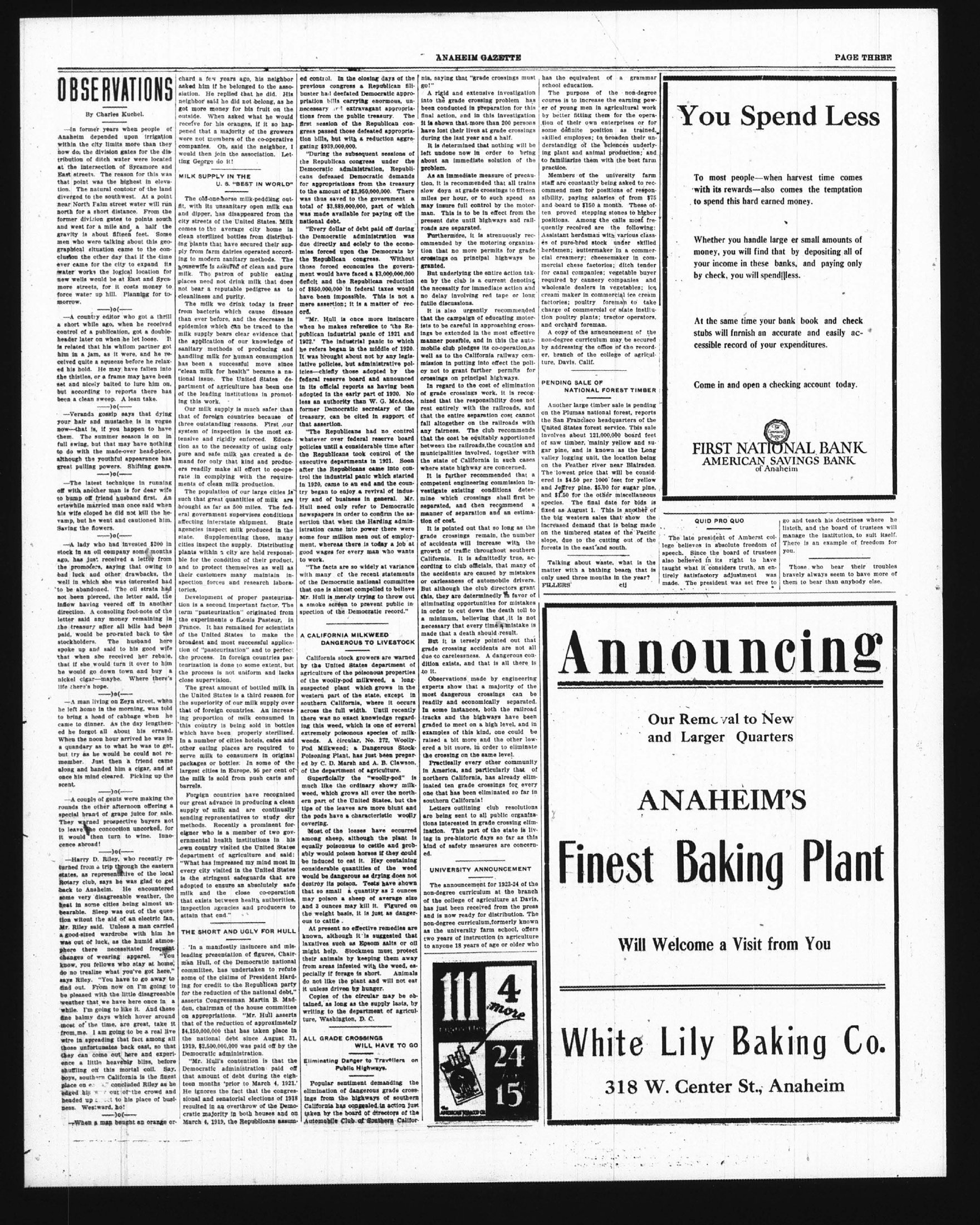
Searchable text
OBSERVATIONS
By Charles Kuchel.
In former years when people of Anaheim depended upon irrigation within the city limits more than they now do, the division gates for the distribution of ditch water were located at the intersection of Sycamore and East streets. The reason for this was that point was the highest in elevation. The natural contour of the land diverged to the southwest. At a point near North Palm street water will run north for a short distance. From the former division gates to points south and west for a mile and a half the gravity is about fifteen feet. Some men who were talking about this geographical situation came to the conclusion the other day that if the time ever came for the city to expand its water works the logical location for new wells would be at East and Sycamore streets, for it costs money to force water up hill. Planning for tomorrow.
A country editor who got a thrill a short while ago, when he received control of a publication, got a double-header later on when he let loose. It is related that his whithom partner got him in a jam, as it were, and he received quite a squeeze before he relaxed his hold. He may have fallen into the thistles, or a frame may have been set and nicely baited to lure him on, but according to reports there has been a clean sweep. A lean take.
Veranda gossip says that dying your hair and mustache is in vogue now—that is, if you happen to have them. The summer season is on in full swing, but that may have nothing to do with the made-over head-piece, chard a few years ago, his neighbor asked him if he belonged to the association. He replied that he did. His neighbor said he did not belong, as he got more money for his fruit on the outside. When asked what he would receive for his oranges, if it so happened that a majority of the growers were not members of the co-operative companies. Oh, said the neighbor, I would then join the association. Letting George do it!
MILK SUPPLY IN THE
U. S. "BEST IN WORLD"
The old-one-horse milk-peddling outfit, with its unsanitary open milk can and dipper, has disappeared from the city streets of the United States. Milk comes to the average city home in clean sterilized bottles from distributing plants that have secured their supply from farm dairies operated according to modern sanitary methods. The housewife is assured of clean and pure milk. The patron of public eating places need not drink milk that does not bear a reputable pedigree as to cleanliness and purity.
The milk we drink today is freer from bacteria which cause disease than ever before, and the decrease in epidemics which can be traced to the milk supply bears clear evidence that the application of our knowledge of sanitary methods of producing and handling milk for human consumption has been a successful move since "clean milk for health" became a national issue. The United States department of agriculture has been one of the leading institutions in promoting this work.
Our milk supply is much safer than that of foreign countries because of three outstanding reasons. First, our system of inspection is the most extensive and rigidly enforced. Education as to the necessity of using only pure and safe milk has created a deed control. In the close previous congress a buster had deafened depression bills carrying necessary extravagations from the public first session of thegress passed those defection bills, but with a gating $939,000,000.
"During the subsequent Republican congress Democratic administrations defeated Democracy due directly and solely miles forced upon the Republican congregation those forced economic ment would have faced deficit and the Republic of $850,000,000 in federal have been impossible mere assertion; it is a word.
"Mr. Hull is once when he makes reference publican industrial par 1922." The industrialist he refers began in the It was brought about relative policies, but adjoices—chiefly those a federal reserve board in its official reports adopted in the early period less an authority than former Democratic senate treasury, can be cited that assertion.
"The Republicans whatever over federal policies until a considerthe Republicans took..."
received quite a squeeze before he relaxed his hold. He may have fallen into the thistles, or a frame may have been set and nicely baited to lure him on, but according to reports there has been a clean sweep. A lean take.
Veranda gossip says that dying your hair and mustache is in vogue now—that is, if you happen to have them. The summer season is on in full swing, but that may have nothing to do with the made-over head-piece, although the youthful appearance has great pulling powers. Shifting gears.
The latest technique in running off with another man is for dear wife to bump off friend husband first. An ertswile married man once said when his wife eloped he did not kill the he-vamp, but he went and cautioned him. Saving the flowers.
A lady who had invested $200 in stock in an oil company some months ago, has just received a letter from the promoters, saying that owing to bad luck and other drawbacks, the well in which she was interested had to be abandoned. The oil strata had not been pierced, the letter said, the inflow having veered off in another direction. A consoling foot-note of the letter said any money remaining in the treasury after all bills had been paid, would be pro-rated back to the stockholders. The husband here spoke up and said to his good wife that when she received her rebate, that if she would turn it over to him he would go down town and buy a nickel cigar—maybe. Where there's life there's hope.
A man living on Zeyn street, when he left home in the morning, was told to bring a head of cabbage when he came to dinner. As the day lengthened he forgot all about his errand. When the noon hour arrived he was in a quandary as to what he was to get, but try as he would he could not remember. Just then a friend came along and handed him a cigar, and at once his mind cleared. Picking up the scent.
A couple of gents were making the rounds the other afternoon offering a special brand of grape juice for sale. They warned prospective buyers not to leave the concoction uncorked, for it would then turn to wine. Innocence abroad!
Harry D. Riley, who recently returned from a trip through the eastern
Our milk supply is much safer than that of foreign countries because of three outstanding reasons. First, our system of inspection is the most extensive and rigidly enforced. Education as to the necessity of using only pure and safe milk has created a demand for only that kind and producers readily make all effort to co-operate in complying with the requirements of clean milk production.
The population of our large cities is such that great quantities of milk are brought as far as 500 miles. The federal government supervises conditions affecting interstate shipment. State agencies inspect milk produced in the state. Supplementing these, many cities inspect the supply. Distributing plants within a city are held responsible for the condition of their product, and to protect themselves as well as their customers many maintain inspection forces and research laboratories.
Development of proper pasteurization is a second important factor. The term "pasteurization" originated from the experiments o f Louis Pasteur, in France. It has remained for scientists of the United States to make the broadest and most successful application of "pasteurization" and to perfect the process. In foreign countries pasteurization is done to some extent, but the process is not uniform and lacks close supervision.
The great amount of bottled milk in the United States is a third reason for the superiority of our milk supply over that of foreign countries. An increasing proportion of milk consumed in this country is being sold in bottles which have been properly sterilized. In a number of cities hotels, cafes and other eating places are required to serve milk to consumers in original packages or bottles: In some of the largest cities in Europe, 95 per cent of the milk is sold from push carts and barrels.
Forign countries have recognized our great advance in producing a clean supply of milk and are continually sending representatives to study our methods. Recently a prominent foreigner who is a member of two governmental health institutions in his own country visited the United States department of agriculture and said: "What has impressed my mind most in native policies, but adjoined policies—chiefly those at federal reserve board in its official reports adopted in the early years less an authority than former Democratic senator that assertion.
"The Republicans whatever over federal policies until a considerate Republican took executive departments after the Republicans trolled the industrial panel in 1920, came to an agreement began to enjoy a try and of business in Hull need only refer newspapers in order to sertion that when the institution came into power some four million men ment, whereas there is good wages for every man to work.
"The facts are so wide with many of the reasons of the Democratic nation that one is almost common Mr. Hull is merely trying to smoke screen to prosecution of the Democrat."
A CALIFORNIA MILK DANGEROUS YET
California stock grows by the United States agriculture of the polis; suspected plant which western part of the southern California, across the full width there was no exact king this weed, which extremely poisonous weeds. A circular, Pod Milkweed; a D Poisoning Plant, has been by C. D. Marsh and of the department of
Superficially they much like the ordinary weed, which grows alterm part of the United tips of the leaves are the pods have a charm covering.
Most of the losses among sheep, although equally poisonous to ably would poison hoof be induced to eat it.
A couple of gents were making the rounds the other afternoon offering a special brand of grape juice for sale. They warned prospective buyers not to leave the concoction uncorked, for it would then turn to wine. Innocence abroad!
Harry D. Riley, who recently returned from a trip through the eastern states, as representative of the local Rotary club, says he was glad to get back to Anaheim. He encountered some very disagreeable weather, the heat in some cities being almost unbearable. Sleep was out of the question without the aid of an electric fan, Mr. Riley said. Unless a man carried a good-sized wardrobe with him he was out of luck, as the humid atmosphere there necessitated frequent changes of wearing apparel. "You know, you fellows who stay at home, do no trealize what you've got here," says Riley. "You have to go away to find out. From now on I'm going to be pleased with the little disagreeable weather that we have here once in a while. I'm going to like it. And these fine balmy days which hover around most of the time, are great, take it from me. I am going to be a real live wire in spreading that fact among all those unfortunates back east, so that they can come out here and experience a little heavenly bliss, before shuffling off this mortal coil. Say, boys, southern California is the finest place on earth," concluded Riley as he edged his wrist out of the crowd and headed up next to his place of business. Westward, ho!
When a man bought an orange or...
ed control. In the closing days of the previous congress a Republican filibuster had deftated Democratic appropriation bills carrying enormous, unnecessary and extravagant appropriations from the public treasury. The first session of the Republican congress passed those defeated appropriation bills, but with a reduction aggregating $939,000,000.
"During the subsequent sessions of the Republican congress under the Democratic administration, Republicans defeased Democratic demands for appropriations from the treasury to the amount of $2,950,000,000. There was thus saved to the government a total of $3,889,000,000, part of which was made available for paying off the national debt.
"Every dollar of debt paid off during the Democratic administration was due directly and solely to the economies forced upon the Democrats by the Republican congress. Without those forced economies the government would have faced a $3,000,000,000 deficit and the Republican reduction of $850,000,000 in federal taxes would have been impossible. This is not a mere assertion; it is a matter of record.
"Mr. Hull is once more insincere when he makes reference to 'the Republican industrial panic of 1921 and 1922.' The industrial panic to which he refers began in the middle of 1920. It was brought about not by any legislative policies, but administrative policies—chiefly those adopted by the federal reserve board and announced in its official reports as having been adopted in the early part of 1920. No less an authority than W. G. McAdoo, former Democratic secretary of the treasury, can be cited in support of that assertion.
"The Republicans had no control whatever over federal reserve board policies until a considerable time after the Republicans took control of the nation, saying that "grade crossings must go!"
A rigid and extensive investigation into the grade crossing problem has been conducted in preparation for this final action, and in this investigation it is shown that more than 200 persons have lost their lives at grade crossings during the last year and a half.
It is determined that nothing will be left undone now in order to bring about an immediate solution of the problem.
As an immediate measure of precaution, it is recommended that all trains slow doyn at grade crossings to fifteen miles per hour, or to such speed as may insure full control by the motorman. This is to be in effect from the present date until highways and railroads are separated.
Furthermore, it is strenuously recommended by the motoring organization that no more permits for grade crossings on principal highways be granted.
But underlying the entire action taken by the club is a current denoting the necessity for immediate action and no delay involving red tape or long futile discussions.
It is also urgently recommended that the campaign of educating motorists to be careful in approaching crossings be extended in the most effective manner possible, and in this the automobile club pledges its co-operation as well as to the California railway commission in putting into effect the policy not to grant further permits for crossings on principal highways.
In regard to the cost of elimination of grade crossings work, it is recognized that the responsibility does not rest entirely with the railroads, and that the entire separation cost cannot fall altogether on the railroads with any fairness. The club recommends that the cost be equitably apportioned between the railroads,the counties and municipalities involved, together with has the equivalent of a grammar school education.
The purpose of the non-degree course is to increase the earning power of young men in agricultural work by better fitting them for the operation of their own enterprises or for some definite position as trained, skilled employees; to broaden their understanding of the sciences underlying plant and animal production; and to familiarize them with the best farm practice.
Members of the university farm staff are constantly being asked to recommend men for positions of responsibility, paying salaries of from $75 and board to $150 a month. These often proved stepping stones to higher positions. Among the calls most frequently received are the following: Assistant herdsman with various classes of pure-bred stock under skilled herdsmen; outtormaker in a commercial creamery; cheesemaker in commercial cheese factories; ditch tender for canal companies; vegetable buyer required by cannery companies and wholesale dealers in vegetables; ice cream maker in commercial ice cream factories; poultry foreman to take charge of commercial or state institution poultry plants; tractor operators, and orchard foreman.
A copy of the announcement of the non-degree curriculum may be secured by addressing the office of the recorder, branch of the college of agriculture, Davis, Calif.
PENDING SALE OF NATIONAL FOREST TIMBER
Another large timber sale is pending on the Plumas national forest, reports the San Francisco headquarters of the United States forest service. This sale involves about 121,000,000 board feet of saw timber, mainly yellow and sugar pine, and is known as the Long Valley logging unit, the location being
lative policies, but administrative policies—chiefly those adopted by the federal reserve board and announced in its official reports as having been adopted in the early part of 1920. No less an authority than W. G. McAdoo, former Democratic secretary of the treasury, can be cited in support of that assertion.
"The Republicans had no control whatever over federal reserve board policies until a considerable time after the Republicans took control of the executive departments in 1921. Soon after the Republicans came into control the industrial panic which started in 1920, came to an end and the country began to enjoy a revival of industry and of business in general. Mr. Hull need only refer to Democratic newspapers in order to confirm the assertion that when the Harding administration came into power there were some four million men out of employment, whereas there is today a job at good wages for every man who wants to work.
"The facts are so widely at variance with many of the recent statements of the Democratic national committee that one is almost compelled to believe Mr. Hull is merely trying to throw out a smoke screen to prevent public inspection of the Democratic record."
A CALIFORNIA MILKWEED DANGEROUS TO LIVESTOCK
California stock growers are warned by the United States department of agriculture of the poisonous properties of the woolly-pod milkweed, a long-suspected plant which grows in the western part of the state, except in southern California, where it occurs across the full width. Until recently there was no exact knowledge regarding this weed, which is one of several extremely poisonous species of milkweeds. A circular, No. 272, Woolly-Pod Milkweed; a Dangerous Stock-Poisoning Plant, has just been prepared by C. D. Marsh and A. B. Clawson, of the department of agriculture.
Superficially the "woolly-pod" is much like the ordinary showy milkweed, which grows all over the northern part of the United States, but the tips of the leaves are more blunt and the pods have a characteristic woolly covering.
Most of the losses have occurred among sheep, although the plant is equally poisonous to cattle and probably would poison horses if they could be induced to eat it. Hay containing mission in putting into effect the policy not to grant further permits for crossings on principal highways.
In regard to the cost of elimination of grade crossings work, it is recognized that the responsibility does not rest entirely with the railroads, and that the entire separation cost cannot fall altogether on the railroads with any fairness. The club recommends that the cost be equitably apportioned between the railroads,the counties and municipalities involved, together with the state of California in such cases where state highway are concerned.
It is further recommended that a competent engineering commission investigate existing conditions determine which crossings shall first be separated, and then recommend a manner of separation and an estimation of cost.
It is pointed out that so long as the grade crossings remain, the number of accidents will increase with the growth of traffic throughout southern California. It is admittedly true, according to club officials, that many of the accidents are caused by mistakes or carelessness of automobile drivers. But although the club directors grant this, they are determinedly in favor of eliminating opportunities for mistakes in order to cut down the death toll to a minimum, believing that it is not necessary that every time a mistake is made that a death should result.
But it is tersely pointed out that grade crossing accidents are not all due to carelessness. A dangerous condition exists, and that is all there is to it.
Observations made by engineering experts show that a majority of the most dangerous crossings can be readily and economically separated. In some instances, both the railroad tracks and the highways have been graded to meet on a high level, and in examples of this kind, one could be raised a bit more and the other lowered a bit more, in order to eliminate the crossing on the same level.
Practically every other community in America, and particularly that of northern California, has already eliminated ten grade crossings for every one that has been eliminated so far in southern California!
Letters outlining club resolutions are being sent to all public organizations interested in grade crossing elimination. This part of the state is living in pre-historic days so far as this kind of safety measures are concerned.
Superficially the "woolly-pod" is much like the ordinary showy milkweed, which grows all over the northern part of the United States, but the tips of the leaves are more blunt and the pods have a characteristic woolly covering.
Most of the losses have occurred among sheep, although the plant is equally poisonous to cattle and probably would poison horses if they could be induced to eat it. Hay containing considerable quantities of the weed would be dangerous as drying does not destroy its poison. Tests have shown that so small a quantity as 2 ounces may poison a sheep of average size and 3 ounces may kill it. Figured on the weight basis, it is just as dangerous to cattle.
At present no effective remedies are known, although it is suggested that laxatives such as Epsom salts or oil might help. Stockmen must protect their animals by keeping them away from areas infested with the weed, especially if forage is short. Animals do not like the plant and will not eat it unless driven by hunger.
Copies of the circular may be obtained, as long as the supply lasts, by writing to the department of agriculture, Washington, D.C.
ALL GRADE CROSSINGS WILL HAVE TO GO
Eliminating Danger to Travellers on Public Highways.
Popular sentiment demanding the elimination of dangerous grade crossings from the highways of southern California has congealed in action just taken by the board of directors of the Automobile Club of Southern California.
You Spend Less
To most people—when harvest time comes with its rewards—also comes the temptation to spend this hard earned money.
Whether you handle large or small amounts of money, you will find that by depositing all of your income in these banks, and paying only by check, you will spend less.
At the same time your bank book and check stubs willfnnish an accurate and easily accessible record of your expenditures.
Come in and open a checking account today.
FIRST NATIONAL BANK
Come in and open a checking account today.
FIRST NATIONAL BANK
AMERICAN SAVINGS BANK
of Anaheim
QUID PRO QUO
The late president of Amherst college believes in absolute freedom of speech. Since the board of trustees also believed in its right to have taught what it considers truth, an entirely satisfactory adjustment was made. The president was set free to go and teach his doctrines where he listeth, and the board of trustees will manage the institution, to suit itself. There is an example of freedom for you.
Those who bear their troubles bravely always seem to have more of them to bear than anybody else.
Our Removal to New
and Larger Quarters
ANAHEIM'S
ANAHEIM'S
Best Baking Plant
Will Welcome a Visit from You
te Lily Baking Co.
18 W. Center St., Anaheim