anaheim-gazette 1923-05-17
Scanned page
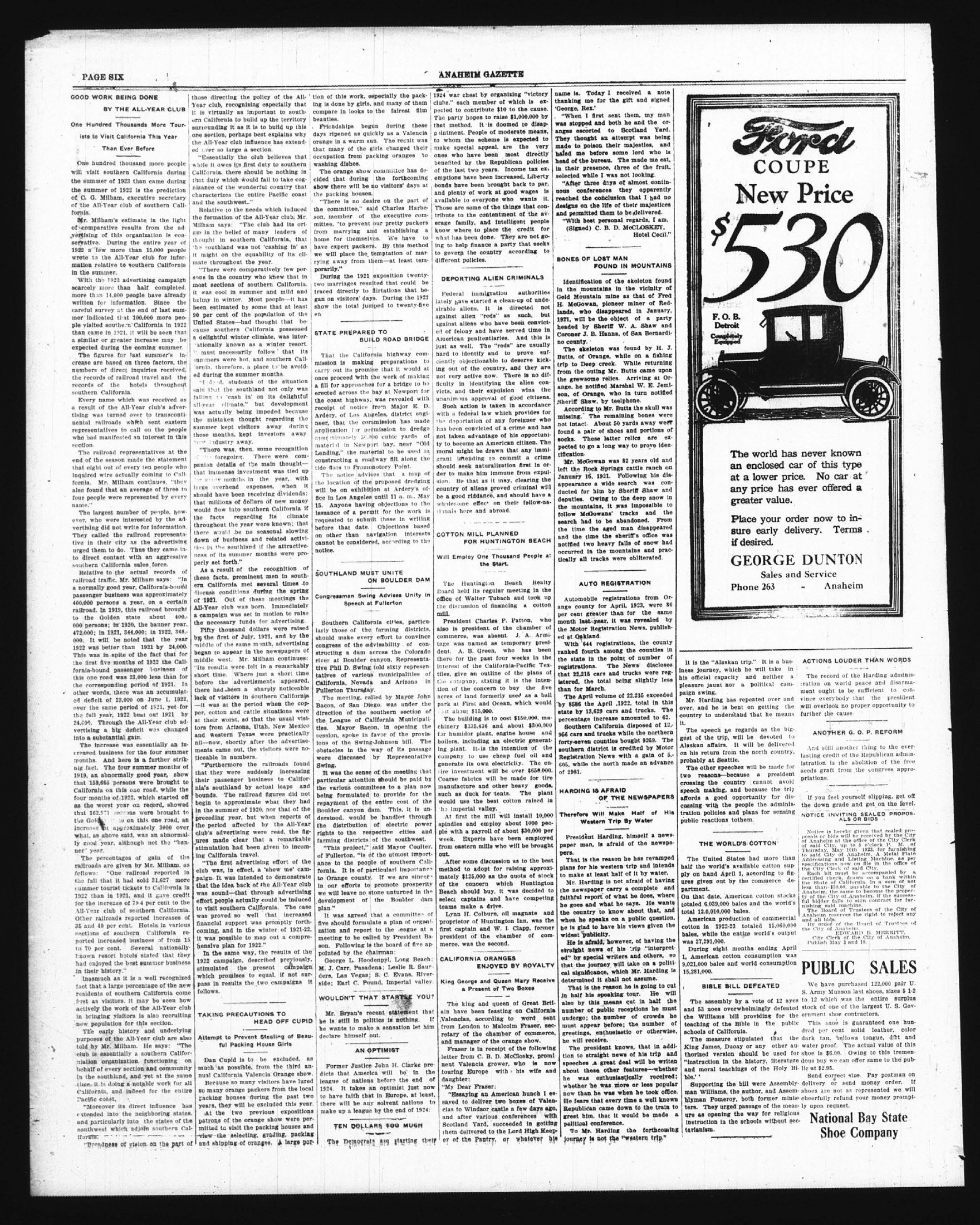
Searchable text
GOOD WORK BEING DONE
BY THE ALL-YEAR CLUB
One Hundred Thousands More Tourists to Visit California This Year
Than Ever Before
One hundred thousand more people will visit southern California during the summer of 1923 than came during the summer of 1922 is the prediction of C. G. Milham, executive secretary of the All-Year club of southern California.
Mr. Milham's estimate in the light of comparative results from the advertising of this organization is conservative. During the entire year of 1922 a few more than 15,000 people wrote to the All-Year club for information relative to southern California in the summer.
With the 1923 advertising campaign scarcely more than half completed, more than 14,000 people have already written for information. Since the careful survey at the end of last summer indicated that 100,000 more people visited southern California in 1922 than came in 1921, it will be seen that a similar or greater increase may be expected during the coming summer.
The figures for last summer's increase are based on three factors, the numbers of direct inquiries received, the records of railroad travel and the records of the hotels throughout southern California.
Every name which was received as a result of the All-Year club's advertising was turned over to transcontinental railroads which sent eastern representatives to call on the people who had manifested an interest in this section.
The railroad representatives at the those directing the policy of the All-Year club, recognizing especially that it is virtually as important to southern California to build up the territory surrounding it as it is to build up this one section, perhaps best explains why the All-Year club influence has extended over so large a section.
"Essentially the club believes that while it owes its first duty to southern California, there should be nothing in that duty which would fail to take cognizance of the wonderful country that characterizes the entire Pacific coast and the southwest."
Relative to the needs which induced the formation of the All-Year club, Mr. Milham says: "The club had its origin in the belief of many leaders of thought in southern California, that 'the southland was not 'cashing in' as it might on the equability of its climate throughout the year."
"There were comparatively few persons in the country who knew that in most sections of southern California, it was cool in summer and mild and balmy in winter. Most people—it has been estimated by some that at least 90 per cent of the population of the United States—had thought that because southern California possessed a delightful winter climate, was internationally known as a winter resort, it must necessarily follow' that its summers were hot, and southern California, therefore, a place to be avoided during the summer months.
"I looked students of the situation said that the southland not only was falling to 'cash in' on its delightful all-year climate," but development was actually being impeded because the mistaken thought regarding the summer kept visitors away during those months, kept investors away from industry away.
"There was, then, some recognition foregoing. There were tion of this work, ing is done by girl compare in looks beauties.
Friendships be days ripened as q orange in a warm that many of the occupation from washing dishes.
The orange showed that during show there will be the packing house.
"There is no d committee," son, member of mittee, "to prevent from marrying home for themse have expert pack we will place they rying away from porarily."
During the 1922 two marriages restraced directly to gan on visitors' show the total ju en.
STATE PREPARATION
That the Calif mission is make carry out its pro once proceed with a fill for approach erected across tha coast highway receipt of notice Ardery, of Los A neer, that the co application for p approximately 50 material in New Landing," the ma
crease are based on three factors, the numbers of direct inquiries received, the records of railroad travel and the records of the hotels throughout southern California.
Every name which was received as a result of the All-Year club's advertising was turned over to transcontinental railroads which sent eastern representatives to call on the people who had manifested an interest in this section.
The railroad representatives at the end of the season made the statement that eight out of every ten people who inquired wire actually coming to California. Mr. Milham continues, "they also found that an average of three to four people were represented by every name."
The largest number of people, however, who were interested by the advertising did not write for information. They called the railroad representative in their city as the advertising urged them to do. Thus they came into direct contact with an aggressive southern California sales force.
Relative to the actual records of railroad traffic, Mr. Milham says: "In a normally good year, California-bound passenger business was approximately 400,000 persons a year, on a certain railroad. In 1919, this railroad brought to the Golden state about 400,000 persons; In 1920, the banner year, 472,000; in 1921, 344,000; in 1922, 368,000. It will be noted that the year 1922 was better than 1921 by 24,000. This was in spite of the fact that for the first five months of 1922 the California-bound passenger business of this one road was 23,000 less than for the corresponding period of 1921. In other words, there was an accumulated deficit of 23,000 on June 1, 1922, over the same period of 1921, yet for the full year, 1922 beat out 1921 by 24,000. Through the All-Year club advertising a big deficit was changed into a substantial gain.
The increase was essentially an increased business for the four summer months. And here is a further striking fact. The four summer months of 1919, an abnormally good year, show that 159,665 persons were brought to California on this one road while the four months of 1922, which started off as the worst year on record, showed that 162,571 persons were brought to the Golden state on this one road, an increase or approximately 3000 over what, as above said, was an abnormally good year, although not the "banner" year.
The percentages of gain of the railroads are given by Mr. Milham as
"Ildad, students of the situation said that the southland not only was falling to 'cash in' on its delightful all-year climate," but development was actually being impeded because the mistaken thought regarding the summer kept visitors away during those months, kept investors away from industry away.
"There was then, some recognition foregoing. There were companion details of the main thought—that immense investment was tied up for many months in the year, with large overhead expenses, when it should have been receiving dividends; that millions of dollars of new money would flow into southern California if the facts regarding its climate throughout the year were known; that there would be no seasonal slowing down of business and related activities in the southland if the attractiveness of its summer months were properly set forth."
As a result of the recognition of these facts, prominent men in southern California met several times to discuss conditions during the spring of 1921. Out of these meetings the All-Year club was born. Immediately a campaign was set in motion to raise the necessary funds for advertising.
Fifty thousand dollars were raised by the first of July, 1921, and by the middle of the same month, advertising began to appear in the newspapers of middle west. Mr. Milham continues: "its results were felt in a remarkably short time. Where just a short time before the advertisements appeared, there had been a sharply noticeable lack of visitors in southern California—it was at the period when the copper, cotton and cattle situations were at their worst, so that the usual visitors from Arizona, Utah, New Mexico and western Texas were practically nil—now, shortly after the advertisements came out, the visitors were noticeable in numbers.
"Furthermore the railroads found that they were suddenly increasing their passenger business to California's southland by actual leaps and bounds. The railroad figures did not begin to approximate what they had in the summer of 1920, nor that of the preceding year, but when reports of the period affected by the All-Year club's advertising were read, the figures made clear that a remarkable stimulation had been given to incoming California travel.
"The first advertising effort of the mission is making carry out its promise once proceeded with a fill for approach erected across the coast highway receipt of notice Ardery, of Los Angeles 15. Anyone have issuance of a permit requested to submit before that date on other than cannot be consider notice."
The four summer months of 1919, an abnormally good year, show that 159,665 persons were brought to California on this one road, while the four months of 1922, which started off as the worst year on record, showed that 162,571 persons were brought to the Gold Coast on this one road, an increase of approximately 3000 over what, as above said, was an abnormally good year, although not the "banner" year.
The percentages of gain of the railroads are given by Mr. Milham, as follows: "One railroad reported in the fall that it had sold 31,627 more summer tourist tickets to California in 1922 than in 1921, and it gave credit for the increase of 79.4 per cent to the All-Year club of southern California. Other railroads reported increases of 35 and 40 per cent. Hotels in various sections of southern California reported increased business of from 15 to 70 per cent. Several nationally-known resort hotels stated that they had enjoyed the best summer business in their history."
Inasmuch as it is a well recognized fact that a large percentage of the new residents of southern California come first as visitors, it may be seen how actively the work of the All-Year club in bringing visitors is also recruiting new population for this section.
The early history and underlying purposes of the All-Year club are also told by Mr. Milham. He says: "The club is essentially a southern Californian organization functioning on behalf of every section and community in the southland, and yet at the same time, it is doing a notable work for all California, and indeed for the entire Pacific coast.
Moreover its direct influence has extended into the neighboring states, and particularly into the states of the southwest which adjoin southern California."
Brondness of vision on the part of
TAKING PRECAUTIONS TO HEAD OFF CUPID
Attempt to Prevent Stealing of Beautiful Packing House Girls
Dan Cupid is to be excluded, as much as possible, from the third annual California Valencia Orange show.
Because so many visitors have lured so many orange packers from the local packing houses during the past two years, they will be excluded this year.
At the two previous expositions patrons of the orange show were permitted to visit the packing houses and view the selecting, grading, packing and shipping of oranges. A large por-
ANAHEIM GAZETTE
tion of this work, especially the pack-ing is done by girls, and many of them compare in looks to the fairest film beauties.
Friendships begun during these days ripened as quickly as a Valencia orange in a warm sun. The result was that many of the girls changed their occupation from packing oranges to washing dishes.
The orange show committee has decided that during the forthcoming show there will be no visitors' days at the packing houses.
"There is no desire on the part of the committee," said Charles Harberson, member of the executive committee, "to prevent our pretty packers from marrying and establishing a home for themselves. We have to have expert packers. By this method we will place the temptation of marrying away from them—at least temporarily."
During the 1921 exposition twenty-two marriages resulted that could be traced directly to firtations that began on visitors' days. During the 1922 show the total jumped to twenty-five en.
STATE PREPARED TO BUILD ROAD BRIDGE
That the California highway commission is making preparations to carry out its promise that it would at once proceed with the work of making a fill for approaches for a bridge to be erected across the bay at Newport for the coast highway, was revealed with receipt of notice from Major E. D. Ardery, of Los Angeles, district engineer, that the commission has made application for permission to dredge approximately 50,000 cubic yards of material in Newport bay, near "Old Landing," the material to be used in 1924 war chest by organizing "victory clubs," each member of which is expected to contribute $10 to the cause. The party hopes to raise $1,000,000 by that method. It is doomed to disappointment. People of moderate means, to whom the scheme is expected to make special appeal, are the very ones who have been most directly benefited by the Republican policies of the last two years. Income tax exemptions have been increased, Liberty bonds have been brought back to par, and plenty of work at good wages is available to everyone who wants it. Those are some of the things that contribute to the contentment of the average family, and intelligent people know where to place the credit for what has been done. They are not going to help finance a party that seeks to govern the country according to different policies.
DEPORTING ALIEN CRIMINALS
Federal immigration authorities lately have started a clean-up of undesirable aliens. It is directed not against alien "reds" as such, but against allens who have been convicted of felony and have served time in American penitentiaries. And this is just as well. The "reds" are usually hard to identify and to prove sufficiently objectionable to deserve kicking out of the country, and they are not very active now. There is no difficulty in identifying the alien convicts, and their expulsion wins the unanimous approval of good citizens.
Such action is taken in accordance with a federal law which provides for the deportation of any foreigner who has been convicted of a crime and has not taken advantage of his opportunity to become an American citizen. The moral might be drawn that any immigrant is today I received a note thanking me for the gift and signed 'George, Rex.'
"When I first sent them, my man was stopped and both he and the oranges escorted to Scotland Yard. They thought an attempt was being made to poison their majesties, and hailed me before some lord who is head of the bureau. The made me eat, in their presence, three of the fruit, selected while I was not looking.
"After three days of almost continuous conferences they apparently reached the conclusion that I had no designs on the life of their majestics and permitted them to be delivered.
"With best personal regards, I am,
(Signed) C. B. D. McCLOSKEY,
Hotel Cecil."
BONES OF LOST MAN FOUND IN MOUNTAINS
Identification of the skeleton found in the mountains in the vicinity of Gold Mountain mine as that of Fred H. McGowan, pioneer miner of Redlands, who disappeared in January, 1921, will be the object of a party headed by Sheriff W. A. Shaw and Coroner J. B. Hanna, of San Bernardino county.
The skeleton was found by H. J. Butts, of Orange, while on a fishing trip to Deep creek. While returning from the outing Mr. Butts came upon the grewsome relics. Arriving at Orange, he notified Marshal W. E. Jemison, of Orange, who in turn notified Sheriff Shaw, by teelphone.
According to Mr. Butts the skull was missing. The remaining bones were not intact. About 50 yards away wee found a pair of shoes and portions of socks. These latter relics are expected to go a long way to prove identification.
mission is making preparations to carry out its promise that it would at once proceed with the work of making a fill for approaches for a bridge to be erected across the bay at Newport for the coast highway, was revealed with receipt of notice from Major E. D. Ardery, of Los Angeles, district engineer, that the commission has made application for permission to dredge approximately 50,000 cubic yards of material in Newport bay, near "Old Landing," the material to be used in constructing a roadway fill along the tide flats to Promonotory Point.
The notice advises that a map of the location of the proposed dredging will be on exhibition at Ardery's office in Los Angeles until 11 a.m., May 15. Anyone having objections to the issuance of a permit for the work is requested to submit these in writing before that date. Objections based on other than navigation interests cannot be considered, according to the notice.
SOUTHLAND MUST UNITE ON BOULDER DAM
Congressman Swing Advises Unity in Speech at Fullerton
Southern California cities, particularly those of the farming districts, should make every effort to convince congress of the advisability of constructing a dam across the Colorado river at Boulder canyon, Representative Phil D. Swing told sixty representatives of various municipalities of California, Nevada and Arizona in Fullerton Thursday.
The meeting, called by Mayor John Bacon, of San Diego, was under the direction of the southern section of the League of California Municipalities. Mayor Bacon, in opening the session, spoke in favor of the provisions of the Swing-Johnson bill. The obstacles in the way of its passage were discussed by Representative Swing.
It was the sense of the meeting that particular attention should be paid by the various committees to a plan now being formulated to provide for the repayment of the entire cost of the Boulder canyon dam. This, it is understood, would be handled through the distribution of electric power rights to the respective cities and farming districts of the southwest.
"This project," said Mayor Coulter, of Fullerton, "is of the utmost importance to the people of southern Cali-
COTTON MILL PLANNED FOR HUNTINGTON BEACH
Will Employ One Thousand People at the Start.
The Huntington Beach Realty Board held its regular meeting in the office of Walter Tubach and took up the discussion of financing a cotton mill.
President Charles P. Patton, who also is president of the chamber of commerce, was absent. J. A. Armitage was named as temporary president. A. B. Green, who has been there for the past four weeks in the interest of the California-Pacific Textiles, give an outline of the plans of the company, stating it is the intention of the concern to buy the five acres of land formerly used as a ball park at First and Ocean, which would cost about $15,000.
The building is to cost $150,000, machinery $335,436 and about $300,000 for humidor plant, engine house and boilers, including an electric generating plant. It is the intention of the company to use cheap fuel oil and generate its own electricity. The entire investment will be over $658,000. Coarse fabrics will be made for tire manufacture and other heavy goods, such as duck for tents. The plant would use the best cotton raised in the Imperial valley.
At first the mill will install 10,000 spindles and employ about 1000 people with a payroll of about $30,000 per week. Experts have been employed from eastern mills who will be brought out.
After some discussion as to the best trip to Deep creek. While returning from the outing Mr. Butts came upon the grewsome relics. Arriving at Orange, he notified Marshal W. E. Jemison, of Orange, who in turn notified Sheriff Shaw, by teelphone.
According to Mr. Butts the skull was missing. The remaining bones were not intact. About 50 yards away wee found a pair of shoes and portions of socks. These latter relics are expected to go a long way to prove identification.
Mr. McGowan was 82 years old and left the Rock Springs cattle ranch on January 16, 1921. Following his disappearance a wide search was conducted for him by Sheriff Shaw and deputies. Owing to the deep snow in the mountains, it was impossible to follow McGowans' tracks and the search had to be abandoned. From the time the aged man disappeared and the time the sheriff's office was notified two heavy falls of snow had occurred in the mountains and practically all tracks were obliterated.
AUTO REGISTRATION
Automobile registrations from Orange county for April, 1923, were 86 per cent greater than for the same month last year, it was revealed by Motor Registration News, published at Oakland.
With 644 registrations, the county ranked fourth among the counties in state in the point of number of registrations. The News discloses that 22,215 cars and trucks were registered, the total being slightly less than for March.
The April volume of 22,215 exceeded by 8586 the April, 1922, total in this state by 13,629 cars and trucks. The percentage increase amounted to 62.
Southern California disposed of 12,956 cars and trucks while the northern forty-seven counties bought 9259. The southern district is credited by Motor Registration News with a gain of 5,605 while the north made an advance of 2981.
HARDING IS AFRAID OF THE NEWSPAPERS
Therefore Will Make Half of His Western Trip By Water
President Harding himself a newspaper man, is afraid of the newspapers.
That is the reason he has revamped
It was the sense of the meeting that particular attention should be paid by the various committees to a plan now being formulated to provide for the repayment of the entire cost of the Boulder canyon dam. This, it is understood, would be handled through the distribution of electric power rights to the respective cities and farming districts of the southwest.
"This project," said Mayor Coulter, of Fullerton, "is of the utmost importance to the people of southern California. It is of particular importance to Orange county. If we are sincere in our efforts to promote prosperity we will leave no stone unturned in the development of the Boulder dam plan."
It was agreed that a committee of five should formulate a plan of organization and report to the league at a meeting to be called by President Bason. Following is the board of five appointed by the chairman:
George L. Hoodenpyl, Long Beach; M. J. Carr, Pasadena; Leslie R. Saunders, Las Vegas; S. C. Evans, Riverside; Earl C. Pound, Imperial valley.
WOULDN'T THAT STARTLE YOU?
Mr. Bryan's recent statement that he is still in politics is nothing. If he wants to make a sensation let him declare himself out.
AN OPTIMIST
Former Justice John H. Clarke predicts that America will be in the league of nations before the end of 1924. It takes an optimist just now to have faith that in Europe, at least, there will be any solvent nations to make up a league by the end of 1924:
TEN DOLLARS TOO MUGH
The Democrats are starting their fire investment will be over $658,000. Coarse fabrics will be made for tire manufacture and other heavy goods, such as duck for tents. The plant would use the best cotton raised in the Imperial valley.
At first the mill will install 10,000 spindles and employ about 1000 people with a payroll of about $30,000 per week. Experts have been employed from eastern mills who will be brought out.
After some discussion as to the best method to adopt for raising approximately $125,000 as the quota of stock of the concern which Huntington Beach should buy, it was decided to select captains and have competing teams make a drive.
Lynn H. Colburn, oil magnate and proprietor of Huntington Inn, was the first captain and W. I. Clapp, former president of the chamber of commerce, was the second.
CALIFORNIA ORANGES ENJOYED BY ROYALTY
King George and Queen Mary Receive a Present of Two Boxes
The king and queen of Great Britain have been feasting on California Valencias, according to word sent from London to Malcolm Fraser, secretary of the chamber of commerce, and manager of the orange show.
Fraser is in receipt of the following letter from C. B. D. McClosky, prominent Valencia grower, who is now touring Europe with his wife and daughter:
"My Dear Fraser:
"Essaying an American hunch I essayed to deliver two boxes of Valencias to Windsor castle a few days ago, and after various conferences with Scotland Yard, succeeded in getting them delivered to the Lord High Keeper of the Pantry, or whatever his
of 2981.
HARDING IS AFRAID OF THE NEWSPAPERS
Therefore Will Make Half of His Western Trip By Water
President Harding, himself a newspaper man, is afraid of the newspapers.
That is the reason he has revamped plans for his western trip and intends to make at least half of it by water.
Mr. Harding is not afraid of having the newspaper carry a complete and faithful report of what he does, where he goes and what he says. He wants the country to know about that, and when he speaks on a public question, he is glad to have his views given the widest publicity.
He is afraid, however, of having the straight news of his trip "interpreted" by special writers and others, so that the journey will take on a political significance, which Mr. Harding is determined it shall not assume.
That is the reason he is going to cut in half his speaking tour. He will also by this means cut in half the number of public receptions he must undergo; the number of crowds he must appear before; the number of greetings, enthusiasm or otherwise, he will receive.
The president knows, that in addition to straight news of his trip and speeches a great deal will be written about these other features—whether he was enthusiastically received; whether he was more or less popular now than he was when he took office. He fears that every time a well known Republican came down to the train to greet him, that it would be made a political conference.
To Mr. Harding the forthcoming journey is not the "western trip."
Ford
COUPE
New Price
$530
F. O. B.
Detroit
Completely
Equipped
The world has never known
The world has never known an enclosed car of this type at a lower price. No car at any price has ever offered a greater value.
Place your order now to insure early delivery. Terms if desired.
GEORGE DUNTON
Sales and Service
Phone 263 - Anaheim
It is the "Alaskan trip." It is a business journey, which he will take in his official capacity and neither a pleasure jaunt nor a political campaign swing.
Mr. Harding has repeated over and over, and he is bent on getting the country to understand that he means it.
The speech he regards as the biggest of the trip, will be devoted to Alaskan affairs. It will be delivered on his return from the north country, probably at Seattle.
The other speeches will be made for two reasons—because a president crossing the country cannot avoid speech making, and because the trip affords a good opportunity for discussing with the people the administration policies and plans for sensing public reactions to them.
ACTIONS LOUDER THAN WORDS
The record of the Harding administration on world peace and disarmament ought to be sufficient to convince everybody that the president will overlook no proper opportunity to further the cause.
ANOTHER G. O. P. REFORM
And still another thing to the everlasting credit of the Republican administration is the abolition of the free seeds graft from the congress appropriations.
If you feel yourself slipping, get off the down grade and get on the level.
NOTICE INVITING SEALED PROPOSALS OR BIDS
Notice is hereby given that sealed proposals or bids will be received by the City of Anaheim at the office of the City Clerk of said City, up to 8 o'clock P. M., of Thursday, May 10th, 1923, for furnishing to said City of Anaheim. A Metal Plate Addressing and Listing Machine, as per specifications now on file in the office of
THE WORLD'S COTTON
The United States had more than half the world's available cotton supply on hand April 1, according to figures given out by the commerce department.
On that date, American cotton stocks totaled 6,039,000 bales and the world's total 12,0,010,000 bales.
American production of commercial cotton in 1922-23 totaled 15,060,000 bales, while the entire world's output was 27,291,000.
During eight months ending April 1, American cotton consumption was 9,021,000 bales and world consumption 15,281,000.
BIBLE BILL DEFEATED
The assembly by a vote of 12 ayes and 53 noes overwhelmingly defeated the Williams bill providing for the teaching of the Bible in the public schools of California.
The measure stipulated that the King James, Duoay or any other authorized version should be used for "instruction in the history, literature and moral teachings of the Holy Bible."
Supporting the bill were Assemblyman Williams, the author, and Assemblyman Pomeroy, both former ministers. They urged passage of the measure as opening the way for religious instruction in the schools without sectarianism.
National Bay State Shoe Company