anaheim-gazette 1923-05-03
Scanned page
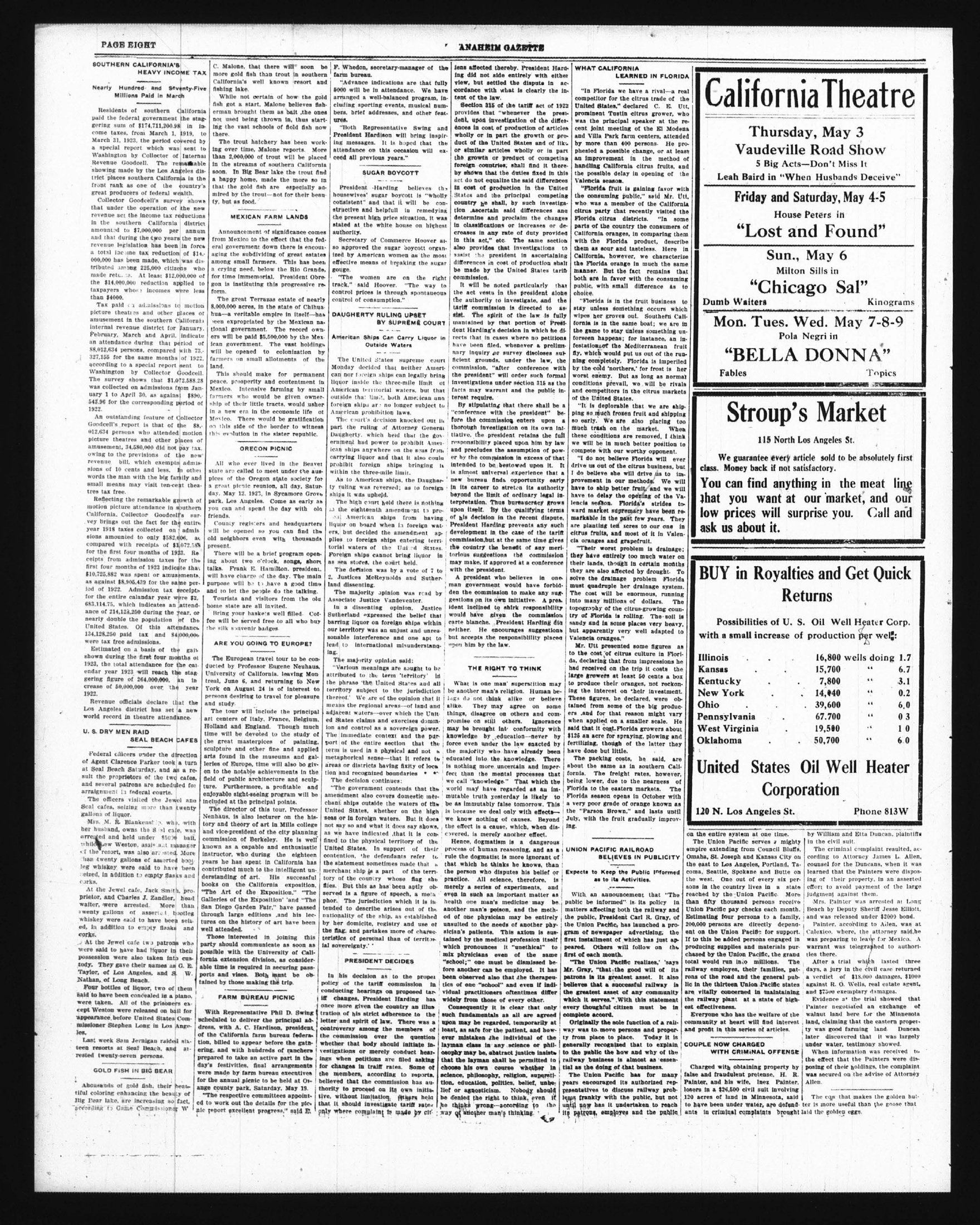
Searchable text
SOUTHERN CALIFORNIA'S HEAVY INCOME TAX
Nearly Hundred and Seventy-Five Millions Paid in March
Residents of southern California paid the federal government the staggering sum of $174,711,200.98 in income taxes, from March 1, 1919, to March 31, 1923, the period covered by a special report which was sent to Washington by Collector of Internal Revenue Goodcell. The remarkable showing made by the Los Angeles district places southern California in the front rank as one of the country's great producers of federal wealth.
Collector Goodcell's survey shows that under the operation of the new revenue act the income tax reductions in the southern California district amounted to $7,000,000 per annum and that during the two years the new revenue legislation has been in force a total income tax reduction of $14,000,000 has been made, which was distributed among 225,000 citizens who made returns. At least $12,000,000 of the $14,000,000 reduction applied to taxpayers whose incomes were less than $4000.
Tax paid on admissions to motion picture theatres and other places of amusement in the southern California internal revenue district for January. February, March and April, indicate an attendance during that period of 88,012,634 persons, compared with 73,327,155 for the same months of 1922, according to a special report sent to Washington by Collector Goodcell. The survey shows that $1,072,588.28 was collected on admissions from January 1 to April 30, as against $890,543.96 for the corresponding period of 1922.
An outstanding feature of Collector Goodcell's report is that of the 88,912,634 persons who attended motion picture theatres and other places of amusement, 34,580,000 did not pay tax, owing to the provisions of the new C. Malone, that there will soon be more gold fish than trout in southern California's well known resort and fishing lake.
While not certain of how the gold fish got a start, Malone believes fisherman brought them as bait, the ones not used being thrown in, thus starting the vast schools of flock fish now there.
The trout hatchery has been working over time. Malone reports. More than 2,000,000 of trout will be placed in the streams of southern California soon. In Big Bear lake the trout find a happy home, made the more so in that the gold fish are especially admired by the trout—not for their beauty, but as food.
MEXICAN FARM LANDS
Announcement of significance comes from Mexico to the effect that the federal government down there is encouraging the subdividing of great estates among small farmers. This has been a crying need, below the Rio Grande, for time immemorial. President Obregon is instituting this progressive reform.
The great Terrazas estate of nearly 8,000,000 acres, in the state of Chihuahua—a veritable empire in itself—has been expropriated by the Mexican national government. The record owners will be paid $5,500,000 by the Mexican government. The vast holdings will be opened to colonization by farmers on small allotments of the land.
This should make for permanent peace, prosperity and contentment in Mexico. Intensive farming by small farmers who would be given ownership of their little tracts, would usher in a new era in the economic life of Mexico. There would be gratification on this side of the border to witness this evolution in the sister republic.
ORECON PICNIC
F. Whedon farm burea
"Advance 5000 will be arranged at cluiling speers briefures."
"Both R President lying message attendance ceed all pro"
President housewives consistent structure at the present stated at the authority.
Secretary so approved by American effective me gouge.
"The wo track," said control price control of c
DAUGHERT
American S
The United Monday de can nor fore liquor inside American te outside that foreign ship American p
The court part the ru Daugherty.
ernment had ican ships a carrying li
An outstanding feature of Collector Goodcell's report is that of the 88,012,634 persons who attended motion picture theatres and other places of amusement, 34,580,000 did not pay tax, owing to the previsions of the new revenue bill, which exempts admissions of 10 cents and less. In other words the man with the big family and small means may visit ten-cent theatres tax free.
Reflecting the remarkable growth of motion picture attendance in southern California, Collector Goodcell's survey brings out the fact for the entire year 1918 taxes collected on admissions amounted to only $582,606, compared with receipts of $1,072,588 for the first four months of 1923. Receipts from admission taxes for the first four months of 1923 indicate that $10,725,882 was spent or amusements, as against $8,905,439 for the same period of 1922. Admission tax receipts for the entire calendar year were $2,683,114.75, which indicates an attendance of 214,123,250 during the year, or nearly double the population of the United States. Of this attendance 134,128,250 paid tax and 84,000,000 were tax free admissions.
Estimated on a basis of the gains shown during the first four months of 1923, the total attendance for the calendar year 1923 will reach the staggering figure of 264,000,000, an increase of 50,000,000 over the year 1922.
Revenue officials declare that the Los Angeles district has set a new world record in theatre attendance.
U. S. DRY MEN RAID
SEAL BEACH CAFES
Federal officers under the direction of Agent Clarence Parker took a turn at Seal Beach Saturday, and as a result the proprietors of the two cafes, and several patrons are scheduled for arraignment in federal courts.
The officers visited the Jewel and Seal cafes, seizing more than twenty gallons of liquor.
Mrs. M. R. Blankenship, who, with her husband, owns the Seal cafe, was arrested and held under $5000 bail, while New Weston, assistant manager of the resort, was also arrested. More than twenty gallons of asserted body fluid according to a special report sent to Washington by Collector Goodcell.
The survey shows that $1,072,588.28 was collected on admissions from January 1 to April 30, as against $890.543.96 for the corresponding period of 1922.
An outstanding feature of Collector Goodcell's report is that of the 88,012,634 persons who attended motion picture theatres and other places of amusement, 34,580,000 did not pay tax, owing to the previsions of the new revenue bill, which exempts admissions of 10 cents and less. In other words the man with the big family and small means may visit ten-cent剧院 tax free.
Reflecting the remarkable growth of motion picture attendance in southern California, Collector Goodcell's survey brings out the fact for the entire year 1918 taxes collected on admissions amounted to only $582,606, compared with receipts of $1,072,588 for the first four months of 1923. Receipts from admission taxes for the first four months of 1923 indicate that $10,725,882 was spent or amusements, as against $8,905.439 for the same period of 1922. Admission tax receipts for the entire calendar year were $2,683,114.75, which indicates an attendance of 214,123,250 during the year, or nearly double the population of the United States. Of this attendance 134,128,250 paid tax and 84,000,000 were tax free admissions.
Estimated on a basis of the gains shown during the first four months of 1923, the total attendance for the calendar year 1923 will reach the staggering figure of 264,000,000, an increase of 50,000,000 over the year 1922.
Revenue officials declare that the Los Angeles district has set a new world record in theatre attendance.
U. S. DRY MEN RAID
SEAL BEACH CAFES
Federal officers under the direction of Agent Clarence Parker took a turn at Seal Beach Saturday, and as a result the proprietors of the two cafes, and several patrons are scheduled for arraignment in federal courts.
The officers visited the Jewel and Seal cafes, seizing more than twenty gallons of liquor.
Mrs. M. R. Blankenship, who, with her husband, owns the Seal cafe, was arrested and held under $5000 bail, while New Weston, associate manager of the resort, was also arrested. More than twenty gallons of asserted body fluid according to a special report sent to Washington by Collector Goodcell.
The survey shows that $1,072,588.28 was collected on admissions from January 1 to April 30, as against $890.543.96 for the corresponding period of 1922.
An outstanding feature of Collector Goodcell's report is that of the 88,012,634 persons who attended motion picture theatres and other places of amusement, 34,580,000 did not pay tax, owing to the previsions of the new revenue bill, which exempts admissions of 10 cents and less. In other words the man with the big family and small means may visit ten-cent剧院 tax free.
Reflecting the remarkable growth of motion picture attendance in southern California, Collector Goodcell's survey brings out the fact for the entire year 1918 taxes collected on admissions amounted to only $582,606, compared with receipts of $1,072,588 for the first four months of 1923. Receipts from admission taxes for the first four months of 1923 indicate that $10,725,882 was spent or amusements, as against $8,905.439 for the same period of 1922. Admission tax receipts for the entire calendar year were $2,683,114.75,which indicates an attendance of 214,123,250 during the year,or nearly double the population of the United States. Of this attendance 134,128,250 paid tax and 84,000,000 were tax free admissions.
Estimated on a basis of the gains shown during the first four months of 1923,the total attendance forthe calendar year 1923will reachthe staggeringfigureof264,000,000anincreaseof50,000,00overtheyear1922.RevenueofficialsdeclarethattheLosAngelesdistricthassetanewworldrecordintheatreattendance.
U.S.DRYMENRAID
SEALBEACHCAFES
Federal officers under the direction of Agent Clarence Parker took a turn at Seal Beach Saturday,andasresulttheproprietorsofthetwocafes,andseveralpatronsarescheduledforarraignmentinfederalcourts.
The officers visitedtheJewelandSealcafese seizingmorethantwentygallonsofliquor.
Mrs.M.R.BlankenshipwhowithherhusbandownsheSealcafewasarrangedandheldunder$500bailwhileNewWestonassistantmanageroftheresortwasalsoarrested.MorethantwentygallonsofassertedbodyfluidaccordingtoaspecialreportsenttoWashingtonbyCollectorGoodcell.Thesurveyshowsthat$1,072,588.28wascollectedonadmissionsfromJanuary1toApril30.asagreatformationbysmallamounthentsoftheland.Intensivefarmingbysmallfarmerswhowouldbegivenownershipof theirlittletractswouldusherinaneweraidinthensideofthebordertowitnessthisevolutioninthesisrevolutioninthensideofthebordertowitnessthisevolutioninthensideofthebordertowitnessthisevolutioninthensideofthebordertowitnessthisevolutioninthensideofthebordertowitnessthisevolutioninthensideofthebordertowitnessthisevolutioninthensideofthebordertowitnessthisevolutioninthensideofthebordertowitnessthisevolutioninthensideofthebordertowitnessthisevolutioninthensideofthebordertowitnessthisevolutioninthensideofthebordertowitnessthisevolutioninthensideofthebordertowitnessthisevolutioninthensideofthebordertowitnessthisevolutioninthensideofthebordertowitnessthisevolutioninthensideofthebordertowitnessthisevolutioninthensideofthebordertowitnessthisevolutioninthensideofthebordertowitnessthisevolutioninthensideofthebordertowitnessthisevolutioninthensideofthebordertowitnessthisevolutioninthensideofthebordertowitnessthisevolutioninthensideofthebordertowitnessthisevolutioninthensideofthebordertowitnessthisevolutioninthensideofthebordertowitnessthisevolutioninthensideofthebordertowitnessthisevolutioninthensideofthebordertowitnessthisevolutioninthensideofthebordertowitnessthisevolutioninthensideofthebordertowitnessthisevolutioninthensideofthebordertowitnessthisevolutioninthensideofthebordertowitnessthisevolutioninthensideofthebordertowitnessthisevolutioninthensideofthebordertowitnessthisevolutioninthensideofthebordertowitnessthisevolutioninthensideofthebordertowitnessthisevolutioninthensideofthe borderto witnessthis evectioninthesieveryselectioninthesieveryselectioninthesieveryselectioninthesieveryselectioninthesieveryselectioninthesieveryselectioninthesieveryselectioninthesieveryselectioninthesieveryselectioninthesieveryselectioninthesieveryselectioninthesieveryselectioninthesieveryselectioninthesieveryselectioninthesieveryselectioninthesieveryselectioninthesieveryselectioninthesieveryselectioninthesieveryselectioninthesieveryselectioninthesieveryselectioninthesieveryselectioninthesieveryselectioninthesieveryselectioninthesieveryselectioninthesieveryselectioninthesieveryselectioninthesieveryselectioninthesieveryselectioninthesieveryselectioninthsieveryselectioninthsieveryselectioninthsieveryselectioninthsieveryselectioninthsieveryselectioninthsieveryselectioninthsieveryselectioninthsieveryselectioninthsieveryseclusioninthssieveryseclusioninthssieveryseclusioninthssieveryseclusioninthssieveryseclusioninthssieveryseclusioninthssieveryseclusioninthssieveryseclusioninthssieveryseclusioninthssieveryseclusioninthssieveryseclusioninthssieveryseclusioninthssieveryseclusioninthssieveryseclusion(inthssiesee)
at Seal Beach Saturday, and as a result the proprietors of the two cafes, and several patrons are scheduled for arraignment in federal courts.
The officers visited the Jewel and Seal cafes, seizing more than twenty gallons of liquor.
Mrs. M. R. Blankenship, who, with her husband, owns the Seal cafe, was arrested and held under $5000 bail, while New Weston, assistant manager of the resort, was also arrested. More than twenty gallons of asserted bootleg whiskey were said to have been seized, in addition to empty flasks and corks.
At the Jewel cafe, Jack Smith, proprietor, and Charles J. Zandler, head waiter, were arrested. More than twenty gallons of asserted bootleg whiskey were said to have been seized, in addition to empty flasks and corks.
At the Jewel cafe two patrons who were said to have had liquor in their possession were also taken into custody. They gave their names as G. E. Taylor, of Los Angeles, and S. W. Nathan, of Long Beach.
Four bottles of liquor, two of them said to have been concealed in a piano, were taken. All of the prisoners except Weston were released on bail for appearance before United States Commissioner Stephen Long in Los Angeles.
Last week Sam Jernigan raided sixteen resorts at Seal Beach, and arrested twenty-seven persons.
GOLD FISH IN BIG BEAR
Athousands of gold fish, their beautiful coloring enhancing the beauty of Big Pear lake, are increasing so fact, according to Game Commissioner W.
FARM BUREAU PICNIC
With Representative Phil D. Swing scheduled to deliver the principal address, with A. C. Hardison, president of the California farm bureau federation, billed to appear before the gathering, and with hundreds of ranchers prepared to take an active part in the day's festivities, final arrangements were made by farm bureau executives for the annual picnic to be held at Orange county park, Satnrday, May 19.
"The respective committees appointed to work out the details for the picnic report excellent progress," said E.
ANAHEIM GAZETTE
will soon be set in southern resort and know the gold believes fish oalthe ones, thus startold fish now has been workports. More will be placed in especially ador their beau-lands
Pollance comes that the federere is encouragestates this has been Rio Grande, resident Obre-Progressive re-state of nearly state of Chihuahua itself—has Mexican na-record own by the Mex-ast holdings organization by cents of the permanent indentment in being by small given owner would usher somatic life of gratification to witness republic.
F. Whedon, secretary-manager of the farm bureau.
"Advance indications are that fully 5000 will be in attendance. We have arranged a well-balanced program, including sporting events, musical numbers, brief addresses, and other features."
"Both Representative Swing and President Hardison will bring inspiring messages. It is hoped that the attendance on this occasion will exceed all previous years."
SUGAR BOYCOTT
President Harding believes thousewives' sugar boycott is "wholly consistent" and that it will be constructive and helpfull in remedying the present high price situation. It was stated at the white house on highest authority.
Secretary of Commerce Hoover also approved the sugar boycott organized by American women as the most effective means of breaking the sugar gouge.
"The women are on the right track," said Hoover. "The way to control prices is through spontaneous control of consumption."
DAUGHERTY RULING UPSET BY SUPRÉMÉ COURT
American Ships Can Carry Liquor in Outside Waters
The United States supreme court Monday decided that neither American nor foreign ships can legally bring liquor inside the three-mile limit of American territorial waters, but that outside that limit, both American and foreign ships are no longer subject to American prohibition laws.
The court's decision knocked out in part the ruling of Attorney General Daugherty, which held that the government had power to prohibit American ships anywhere on the seas from carrying liquor and that it also could lens affected thereby. President Harding did not side entirely with either view, but settled the dispute in accordance with what is clearly the intent of the law.
Section 315 of the tariff act of 1922 provides that "whenever the president, upon investigation of the differences in cost of production of articles wholly or in part the growth or product of the United States and of like or similar articles wholly or in part the growth or product of competing foreign countries; shall find it thereby shown that the duties fixed in this act do not equalize the said differences in cost of production in the United States and the principal competing country he shall, by such investigation ascertain said differences and determine and proclaim the changes in classifications or increases or decreases in any duty provided in this act," etc. The same section also provides that investigations to assist the president in ascertaining differences in cost of production shall be made by the United States tariff commission.
It will be noted particularly that the act vestu in the president alone the authority to investigate, and the tariff commission is directed to assist. The spirit of the law is fully maintained by that portion of President Harding's decision in which he directs that in cases where no petitions have been filed, whenever a preliminary inquiry or survey discloses sufficient grounds, under the law, the commission, "after conference with the president" will order such formal investigations under section 315 as the facts may warrant and the public interest require.
By stipulating that there shall be a "conference with the president" before the commission enters upon a thorough investigation on its own initiative, the president retains the full responsibility placed upon him by law and precludes the assumption of power by the commission in progress of that
WHAT CALIFORNIA LEARNED IN FLORIDA
"In Florida we have a rival—a real competitor for the citrus trade of the United States," declared C. E. Utt, prominent Tustin citrus grower, who was the principal speaker at the recent joint meeting of the El Modena and Villa Park farm centers, attended by more than 400 persons. He prophesied a possible change, or at least an improvement in the method of handling California citrus fruits, and the possible delay in opening of the Valencia season.
"Florida fruit is gaining favor with the consuming public," said Mr. Utt, who was a member of the California citrus party that recently visited the Florida citrus districts. "In some parts of the country the consumers of California oranges, in comparing them with the Florida product, describe them as sour and tasteless. Here in California, however, we characterize the Florida orange in much the same manner. But the fact remains that both are in favor with the consuming public, with small difference as to choice.
"Florida is in the fruit business to stay unless something occurs which wipes her groves out. Southern California is in the same boat; we are in the game to stay unless something unforeseen happens; for instance, an infestation of the Mediterranean fruit fly, which would put us out of the running completely. Florida is imperiled by the cold 'northers,' for frost is her worst enemy. But as long as normal conditions prevail, we will be rivals and competitors in the citrus markets of the United States.
"It is deplorable that we are shipping so much frozen fruit and shipping so early. We are also placing too much trash on the market. When these conditions are removed, I think we will be in much better position to compete with our worthy opponent."
The United States supreme court Monday decided that neither American nor foreign ships can legally bring liquor inside the three-mile limit of American territorial waters, but that outside that limit, both American and foreign ships are no longer subject to American prohibition laws.
The court's decision knocked out in part the ruling of Attorney General Daugherty, which held that the government had power to prohibit American ships anywhere on the seas from carrying liquor and that it also could prohibit foreign ships bringing it within the three-mile limit.
As to American ships, the Daugherty ruling was reversed; as to foreign ships it was upheld.
The high court held there is nothing in the eighteenth amendment to prevent American ships from having liquor on board when in foreign waters, but decided the amendment applies to foreign ships entering territorial waters of the United States. Foreign ships cannot bring liquor in as sea stores, the court held.
The decision was by a vote of 7 to 2. Justices McReynolds and Sutherland dissenting.
The majority opinion was read by Associate Justice Vandeventer.
In a dissenting opinion, Justice Sutherland expressed the belief that barring liquor on foreign ships within our territory was an unjust and unreasonable interference and one apt to lead to international misunderstanding.
The majority opinion said:
"Various meanings are sought to be attributed to the term 'territory' in the phrase 'the United States and all territory subject to the jurisdiction thereof.' We are of the opinion that it means the regional areas—of land and adjacent waters—over which the United States claims and exercises dominion and control as a sovereign power. The immediate context and the purpose of the entire section that the term is used in a physical and not a metaphorical sense—that it refers to areas or districts having fixity of location and recognized boundaries."
The decision continues:
"The government contends that the amendment also covers domestic merchant ships outside the waters of the United States, whether on the high seas or in foreign waters. But it does not say so and what it does say shows, as we have indicated, that it is confined to the physical territory of the United States. In support of their contention, the defendants refer to the statement sometimes made that
incident grounds, under the law, the commission, "after conference with the president" will order such formal investigations under section 315 as the facts may warrant and the public interest require.
By stipulating that there shall be a "conference with the president" before the commission enters upon a thorough investigation on its own initiative, the president retains the full responsibility placed upon him by law and precludes the assumption of power by the commission in excess of that intended to be bestowed upon it. It is almost universal experience that a new bureau finds opportunity early in its career to stretch its authority beyond the limit of ordinary legal interpretation. Thus bureaucracy grows upon itself. By the qualifying terms of his decision in the recent dispute, President Harding prevents any such development in the case of the tariff commission, but at the same time gives the country the benefit of any meritorious suggestions the commission may make, if approved at a conference with the president.
A president who believes in one man government would have forbidden the commission to make any suggestions on its own initiative. A president inclined to shirk responsibility would have given the commission carte blanche. President Harding did neither. He encourages suggestions but accepts the responsibility placed upon him by the law.
THE RIGHT TO THINK
What is one man' superstition may be another man's religion. Human beings do not think alike or believe alike. They may agree on some things, disagree on others and compromise on still others. Ignorance may be brought into conformity with knowledge by education—never by force even under the law enacted by the majority who have already been educated into the knowledge. There is nothing more uncertain and imperfect than the mental processes that we call "knowledge." That which the world may have regarded as an immutable truth yesterday is likely to be as immutably false tomorrow. This is because we deal only with effects—we know nothing of causes. Beyond the effect is a cause, which, when discovered, is merely another effect.
Hence, dogmatism is a dangerous process of human reasoning, and as a rule the dogmatist is more ignorant of that which he thinks he knows, than being completely. Florida is imperiled by the cold 'northers,' for frost is her worst enemy. But as long as normal conditions prevail, we will be rivals and competitors in the citrus markets of the United States.
"It is deplorable that we are shipping so much frozen fruit and shipping so early. We are also placing too much trash on the market. When these conditions are removed, I think we will be in much better position to compete with our worthy opponent.
"I do not believe Florida will ever drive us out of the citrus business, but I do believe she will drive us to improvement in our methods. We will have to ship better fruit, and we will have to delay the opening of the Valencia season. Florida's strides toward market supremacy have been remarkable in the past few years. They are planting ten acres to our one in citrus fruits, and most of it in Valencia oranges and grapefruit.
"Their worst problem is drainage; they have entirely too much water on their lands, though in certain months they are also affected by drought. To solve the drainage problem Florida must quadruple her drainage system. The cost will be enormous, running into many millions of dollars. The topography of the citrus-growing country of Florida is rolling. The soil is sandy and in some places very heavy, but apparently very well adapted to Valencia oranges."
Mr. Utt presented some figures as to the cost of citrus culture in Florida, declaring that from impressions he had received on the trip it costs the large growers at least 50 cents a box to produce their oranges, not reckoning the interest on their investment. These figures, he declared, were obtained from some of the big producers and for that reason might vary when applied on a smaller scale. He said that it cost Florida growers about $126 an acre for spraying, plowing and fertilizing, though of the latter they have done but little.
The packing costs, he said, are about the same as in southern California. The freight rates, however, being lower due to the nearness of Florida to the eastern markets. The Florida season opens in October with a very poor grade of orange known as the "Parson Brown," and lasts until July, with the fruit gradually improving.
The government contends that the amendment also covers domestic merchant ships outside the waters of the United States, whether on the high seas or in foreign waters. But it does not say so and what it does say shows, as we have indicated, that it is confined to the physical territory of the United States. In support of their contention, the defendants refer to the statement sometimes made that a merchant ship is a part of the territory of the country whose flag she flies. But this as has been aptly observed is a figure of speech, a meta phor. The jurisdiction which it is intended to describe arises out of the nationality of the ship, as established by her domicile, registry and use of the flag, and partakes more of characteristics of personal than of territorial sovereignty."
PRESIDENT DECIDES
In his decision as to the proper policy of the tariff commission in conducting hearings on proposed tariff changes, President Harding has once more given the country an illustration of his strict adherence to the letter and spirit of law. There was a controversy among the members of the commission over the question whether that body should initiate investigations or merely conduct hearings when petitions are filed asking for changes in tariff rates. Some of the members, according to reports, believed that the commission has authority to proceed on its own initiative, without limitation. Others held that it should investigate tariff rates only where complaint is made by citizens.
Effect than the mental processes that we call "knowledge." That which the world may have regarded as an immutable truth yesterday is likely to be as immutably false tomorrow. This is because we deal only with effects—we know nothing of causes. Beyond the effect is a cause, which, when discovered, is merely another effect.
Hence, dogmatism is a dangerous process of human reasoning, and as a rule the dogmatist is more ignorant of that which he thinks he knows, than the person who disputes his belief or practice. All science, therefore, is merely a series of experiments, and even in such an important matter as health one man's medicine may be another man's poison, and the method of one physician may be entirely unsuited to the needs of another physician's patients. This axiom is sustained by the medical profession itself which pronounces it "unethical" to mix physicians even of the same "school;" one must be dismissed before another can be employed. It has been observed also that the therapeutics of one "school" and even if individual practitioners oftentimes differ widely from those of every other.
Consequently it is clear that only such fundamentals as all are agreed upon may be regarded, temporarily at least, as safe for the patient, and however mistaken the individual of the layman class in any science or philosophy may be, abstract justice insists that the layman shall be permitted to choose his own course whether in science, philosophy, religion, supervision, education, politics, belief, unbelief or agnosticism. Nobody should be denied the right to think, even if he thinks wrong—according to the way of another man's thinking.
UNION PACIFIC RAILROAD BELIEVES IN PUBLICITY
Expects to Keep the Public Informed as to its Activities.
With an announcement that "The public be informed" is its policy in matters affecting both the railway and the public, President Carl R. Gray, of the Union Pacific, has launched a program of newspaper advertising, the first installment of which has just appeared. Others will follow on the first of each month.
"The Union Pacific realizes," says Mr. Gray, "that the good will of its patrons is its greatest asset. It also believes that a successful railway is the greatest asset of any community which it serves." With this statement every thoughtful citizen must be in complete accord.
Originally the sole function of a railway was to move persons and property from place to place. Today it is generally recognized that to explain to the public the how and why of the railway business is almost as essential as the doing of that business.
The Union Pacific has for many years encouraged its authorized representatives to discuss railway problems frankly with the public, but not until now has it undertaken to reach its patrons, employees and the public.
California Theatre
Thursday, May 3
Vaudeville Road Show
5 Big Acts—Don’t Miss It
Leah Baird in “When Husbands Deceive”
Friday and Saturday, May 4-5
House Peters in
“Lost and Found”
Sun., May 6
Milton Sills in
“Chicago Sal”
Dumb Waiters Kinograms
Mon. Tues. Wed. May 7-8-9
Pola Negri in
“BELLA DONNA”
Fables Topics
Stroup’s Market
115 North Los Angeles St.
Stroup’s Market
115 North Los Angeles St.
We guarantee every article sold to be absolutely first class. Money back if not satisfactory.
You can find anything in the meat line that you want at our market, and our low prices will surprise you. Call and ask us about it.
BUY in Royalties and Get Quick Returns
Possibilities of U. S. Oil Well Heater Corp. with a small increase of production per well:
Illinois 16,800 wells doing 1.7
Kansas 15,700 “ 6.7
Kentucky 7,800 “ 3.1
New York 14,040 “ 0.2
Ohio 39,600 “ 6.0
Pennsylvania 67,700 “ 0.3
West Virginia 19,500 “ 1.0
Oklahoma 50,700 “ 6.0
United States Oil Well Heater Corporation
120 N. Los Angeles St. Phone 813W
on the entire system at one time.
The Union Pacific serves a mighty empire extending from Council Bluffs, Omaha, St. Joseph and Kansas City on the east to Los Angeles, Portland, Taby William and Etta Duncan, plaintiff in the civil suit.
The criminal complaint resulted, according to Attorney James L. Allen, counsel for the Duncans, when it was
UNITED STATES Oil Well Heater Corporation
120 N. Los Angeles St. Phone 813W
on the entire system at one time.
The Union Pacific serves a mighty empire extending from Council Bluffs, Omaha, St. Joseph and Kansas City on the east to Los Angeles, Portland, Tacoma, Seattle, Spokane and Butte on the west. One out of every six persons in the country lives in a state reached by the Union Pacific. More than fifty thousand persons receive Union Pacific pay checks each month. Estimating four persons to a family, 200,000 persons are directly dependent on the Union Pacific for support. If to this be added persons engaged in producing supplies and materials purchased by the Union Pacific, the grand total would run into millions. The railway employs their families, patrons of the road and the general public in the thirteen Union Pacific states are vitally concerned in maintaining the railway plant at a state of highest effectiveness.
Everyone who has the welfare of the community at heart will find interest and profit in this series of articles.
COUPLE NOW CHARGED WITH CRIMINAL OFFENSE
Charged with obtaining property by false and fraudulent pretense, H. R. Painter, and his wife, Inez Painter, losers in a $26,500 civil suit involving 120 acres of land in Minnesota, said to have been under water, are defendants in criminal complaints brought by William and Etta Duncan, plaintiffs in the civil suit.
The criminal complaint resulted, according to Attorney James L. Allen, counsel for the Duncans, when it was learned that the Painters were disposing of their property, in an asserted effort to avoid payment of the large judgment against them.
Mrs. Painter was arrested at Long Beach by Deputy Sheriff Jesse Elliott, and was released under $2000 bond.
Painter, according to Ailen, was at Calexico, where, the attorney said, he was preparing to leave for Mexico. A warrant was telegraphed to authorities there.
After a trial which lasted three days, a jury in the civil case returned a verdict of $18,000 damages, $1000 against R. O. Wells, real estate agent, and $7500 exemplary damages.
Evidence at the trial showed that Painter negotiated an exchange of walnut land here for the Minnesota land, claiming that the eastern property was good farming land. Duncah later discovered that it was largely under water, testimony showed.
When information was received to the effect that the Painters were disposing of their holdings, the complaint was secured on the advise of Attorney Allen.
The cow that makes the golden butter is more useful than the goose that laid the golden eggs.