anaheim-gazette 1923-04-19
Scanned page
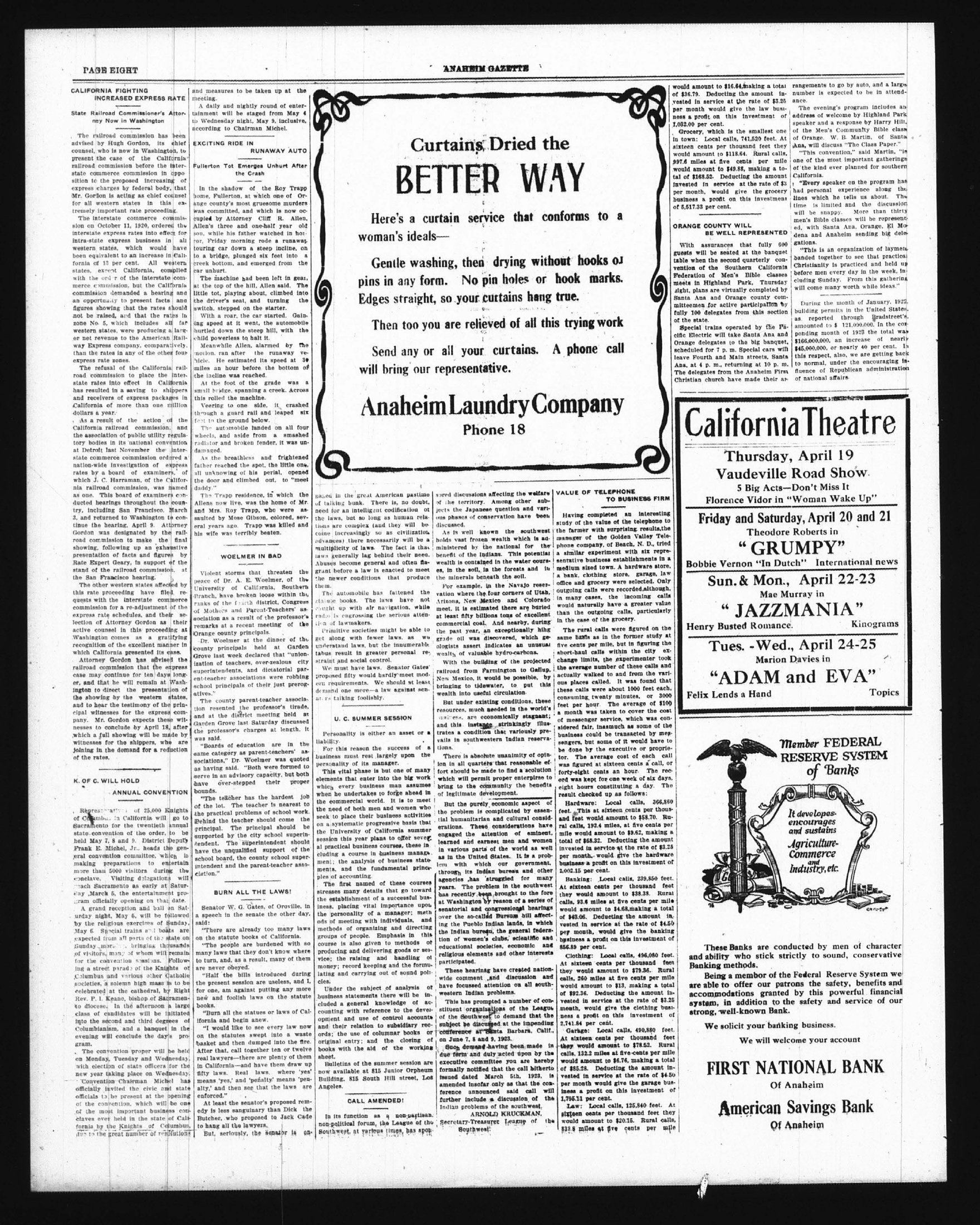
Searchable text
CALIFORNIA FIGHTING
INCREASED EXPRESS RATE
State Railroad Commissioner's Attorney Now in Washington
The railroad commission has been advised by Hugh Gordon, its chief counsel, who is now in Washington, to present the case of the California railroad commission before the interstate commerce commission in opposition to the proposed increasing of express charges by federal body, that Mr. Gordon is acting as chief counsel for all western states in this extremely important rate proceeding.
The interstate commerce commission on October 11, 1920, ordered the interstate express rates into effect for intra-state express business in all western states, which would have been equivalent to an increase in California of 13 per cent. All western states, except California, complied with the order of the interstate commerce commission, but the California commission demanded a hearing and an opportunity to present facts and figures showing that the rates should not be raised, and that the rates in zone No. 5, which includes all far western states, were producing a larger net revenue to the American Railway Express company, comparatively than the rates in any of the other four express rate zones.
The refusal of the California railroad commission to place the interstate rates into effect in California has resulted in a saving to shippers and receivers of express packages in California of more than one million dollars a year.
As a result of the action of the California railroad commission, and the association of public utility regulatory bodies in its national convention at Detroit last November the interstate commerce commission ordered and measures to be taken up at the meeting.
A daily and nightly round of entertainment will be staged from May 4 to Wednesday night, May 9, inclusive, according to Chairman Michel.
EXCITING RIDE IN
RUNAWAY AUTO
Fullerton Tot Emerges Unhurt After the Crash
In the shadow of the Roy Trapp home, Fullerton, at which one of Orange county's most gruesome murders was committed, and which is now occupied by Attorney Cliff R. Allen, Allen's three and one-half year old son, while his father watched in horror, Friday morning rode a runaway touring car down a steep incline, on to a bridge, plunged six feet into a creek bottom, and emerged from the car unhurt.
The machine had been left in gear at the top of the hill. Allen said. The little tot, playing about, climbed into the driver's seat, and turning the switch, stepped on the starter.
With a roar, the car started. Gaining speed at it went, the automobile hurtled down the steep hill, with the child powerless to halt it.
Meanwhile Allen, alarmed by the motion, ran after the runaway vehicle. He estimated its speed at 30 miles an hour before the bottom of the incline was reached.
At the foot of the grade was a small bridge, spanning a creek. Across this rolled the machine.
Veering to one side, it crashed through a guard rail and leaped six feet to the ground below.
The automobile landed on all four wheels, and aside from a smashed radiator and broken fender, it was undamaged.
The refusal of the California railroad commission to place the interstate rates into effect in California has resulted in a saving to shippers and receivers of express packages in California of more than one million dollars a year.
As a result of the action of the California railroad commission, and the association of public utility regulatory bodies in its national convention at Detroit last November the interstate commerce commission ordered a nation-wide investigation of express rates by a board of examiners, of which J. C. Harraman, of the California railroad commission, was named as one. This board of examiners conducted hearings throughout the country, including San Francisco, March 3, and returned to Washington to continue the hearing, April 9. Attorney Gordon was designated by the railroad commission to make the final showing, following up an exhaustive presentation of facts and figures by Rate Expert Geary, in support of the stand of the railroad commission, at the San Francisco hearing.
The other western states affected by this rate proceeding have filed requests with the interstate commerce commission for a re-adjustment of the express rate schedules, and their selection of Attorney Gordon as their active counsel in this proceeding at Washington comes as a gratifying recognition of the excellent manner in which California presented its case.
Attorney Gordon has advised the railroad commission that the express case may continue for ten days longer, and that he will remain at Washington to direct the presentation of the showing by the western states, and to hear the testimony of the principal witnesses for the express company. Mr. Gordon expects these witnesses to conclude by April 18, after which a full showing will be made by witnesses for the shippers, who are joining in the demand for a reduction of the rates.
K. OF C. WILL HOLD
ANNUAL CONVENTION
Representation of 25,000 Knights of Columbus in California will go to Sacramento for the twentieth annual state convention of the order, to be held May 7, 8 and 9. District Deputy Frank E. Michel, Jr., heads the general convention committee, which is making preparations to entertain
WOELMER IN BAD
Violent storms that threaten the peace of Dr. A. E. Woelmer, of the University of California, Southern Branch, have broken loose within the ranks of the fourth district, Congress of Mothers and Parent-Teachers' association as a result of the professor's remarks at a recent meeting of the Orange county principals.
Dr. Woelmer at the dinner of the county principals held at Garden Grove last week declared that "unionization of teachers, over-zealous city superintendents, and dictatorial parent-teacher associations were robbing school principals of their just prerogatives."
The county parent-teacher association resented the professor's tirade, and at the district meeting held at Garden Grove last Saturday discussed the professor's charges at length, it was said.
"Boards of education are in the same category as parent-teachers' associations," Dr. Woelmer was quoted as having said. "Both were formed to serve in an advisory capacity, but both have over-stepped their proper bounds.
"The teacher has the hardest job of the lot. The teacher is nearest to the practical problems of school work. Behind the teacher should come the principal. The principal should be supported by the city school superintendent. The superintendent should have the unqualified support of the school board, the county school superintendent and the parent-teacher assoc-
gaged in the great of talking bunk. need for an intellective laws, but so many are complex; come increasing advances) there multiplicity of laws generally law Abuses become grant before a law the newer condition them.
The automobile statute books. caught up with radio is engrossed in law makes.
Primitive society get along with understand laws tabus result in straint and social.
We must have proposed fifty worm requirements demand one more atrs talking foo
U. C. SUMMARY
Personality is liability.
For this reason business must re personality of it.
This vital phase elements that en which every bus when he undertakes the commercial need of both seek to place them on a systematic University session this year al practical buslcluding a course ment; the analy
K. OF C. WILL HOLD
ANNUAL CONVENTION
Representation of 25,000 Knights of Columbus in California will go to Sacramento for the twentieth annual state convention of the order, to be held May 7, 8 and 9. District Deputy Frank E. Michel, Jr., heads the general convention committee, which is making preparations to entertain more than 5000 visitors during the conelave. Visiting delegations will reach Sacramento as early at Saturday March 5, the entertainment program officially opening on that date.
A grand reception and ball on Saturday night, May 5, will be followed by the religious exercises of Sunday, May 6. Special trains and boats are expected from all parts of the state on Sunday morning, bringing thousands of visitors, many of whom will remain for the convention sessions. Following a street parade of the Knights of Columbus and various other Catholic societies, a solemn high mass is to be celebrated at the cathedral, by Right Rev. P. I. Keane, bishop of Sacramento diocese. In the afternoon a large class of candidates will be initiated into the second and third degrees of Columbianism, and a banquet in the evening will conclude the day's program.
The convention proper will be held on Monday, Tuesday and Wednesday, with election of state officers for the new year taking place on Wednesday.
Convention Chairman Michel has officially invited the civic and state officials to be present at the opening of the convention, which will be one of the most important business conclaves ever held in the state of California by the Knights of Columbus, due to the great number of resolutions
"The teacher has the hardest job of the lot. The teacher is nearest to the practical problems of school work. Behind the teacher should come the principal. The principal should be supported by the city school superintendent. The superintendent should have unqualified support of the school board, the county school superintendent and the parent-teacher association."
BURN ALL THE LAWS!
Senator W. G. Gates, of Oroville, in a speech in the senate the other day, said:
"There are already too many laws on the statute books of California.
"The people are burdened with so many laws that they don't know where to turn, and, as a result, many of them are never obeyed.
'Half the bills introduced during the present session are useless, and I, for one, am against putting any more new and foolish laws on the statute books.
'Burn all the statues or laws of California and begin anew.
"I would like to see every law now on the statutes swept into a waste basket and then dumped into the fire. After that, call together ten or twelve real lawyers—there are plenty of them in California—and have them draw up fifty laws. Real laws, where 'yes' means 'yes,' and 'penalty' means 'penalty,' and then see that the laws are enforced."
At least the senator's proposed remedy is less sanguinary than Dick Butcher, who proposed to Jack Cade to hang all the lawyers.
But, seriously, the senator is on-
Curtains Dried the
BETTER WAY
Here's a curtain service that conforms to a woman's ideals—
Gentle washing, then drying without hooks or pins in any form. No pin holes or hook marks. Edges straight, so your curtains hang true.
Then too you are relieved of all this trying work
Send any or all your curtains. A phone call will bring our representative.
Anaheim Laundry Company
Phone 18
will bring our representative.
Anaheim Laundry Company
Phone 18
gased in the great American pastime of talking bunk. There is, no doubt, need for an intelligent codification of the laws, but so long as human relations are complex (and they will become increasingly so as civilization advances) there necessarily will be a multiplicity of laws. The fact is that laws generally lag behind their need. Abuses become general and often flagrant before a law is enacted to meet the newer conditions that produce them.
The automobile has fattened the attitude books. The laws have not caught up with air navigation, while radio is engrossing the serious attention of lawmakers.
Primitive societies might be able to get along with fewer laws, as we understand laws, but the innumerable tabus result in greater personal restraint and social control.
We must have laws. Senator Gates' proposed fifty would hardly meet modern requirements. We should at least demand one more—a law against senators talking foolishly.
U. C. SUMMER SESSION
Personality is either an asset or a liability.
For this reason the success of a business must rest largely upon the personality of its manager.
This vital phase is but one of many elements that enter into the big work which every business man assumes when he undertakes to forge ahead in the commercial world. It is to meet the need of both men and women who seek to place their business activities on systematic progressive basis that the University of California summer session this year plans to offer several practical business courses, these including a course in business management; the analysis of business state-sured discussions affecting the welfare of the territory. Among other subjects the Japanese question and various phases of conservation have been discussed.
As is well known the southwest holds vast frozen wealth which is administered by the national for the benefit of the Indians. This potential wealth is contained in the water courses, in the soil, in the forests and in the minerals beneath the soil.
For example, in the Navajo reservation where the four corners of Utah, Arizona, New Mexico and Colorado meet, it is estimated there are buried at least fifty billion tons of excellent commercial coal. And nearby, during the past year, an exceptionally high grade oil was discovered, which geologists assert indicates an unusual wealth of valuable hydro-carbons.
With the building of the projected railroad from Farmington to Gallup, New Mexico, it would be possible, by bringing to tidewater, to put this wealth into useful circulation.
But under existing conditions, these resources, much needed in the world's business, are economically stagnant; and this instance strinkingly illustrates a condition that various prevails in southwestern Indian reservations.
There is absolute unanimity of opinion in all quarters that reasonable effort should be made to find a solution which will permit proper enterprise to bring to the community the benefits of legitimate development.
But the purely economic aspect of the problem is complicated by essential humanitarian and cultural considerations. These considerations have engaged the attention of eminent learned and earnest men and women in various parts of the world as well as in the United States. It is a problem with which our government,
VALUE OF TELEPHONE TO BUSINESS FIRM
Having completed an interesting study of the value of the telephone to the farmer with surprising results, the manager of the Golden Valley Telephone company, of Beach, N.D., tried a similar experiment with six representative business establishments in a medium sized town. A hardware store, a bank, clothing store, garage, law office and grocery were selected. Only outgoing calls were recorded, although, in many cases, the incoming calls would naturally have a greater value than the outgoing calls, particularly in the case of the grocery.
The rural calls were figured on the same basis as in the former study at five cents per mile, but in figuring the short-haul calls within the city exchange limits, the experiment took the average number of these calls and actually walked to and from various places called. It was found that these calls were about 1000 feet each, consuming twenty minutes, or 3000 feet per hour. The average of $100 a month was taken to cover the cost of messenger service, which was considered fair, inasmuch as some of the business could be transacted by messengers, but some of it would have to be done by the executive or proprietor. The average cost of each call was figured at sixteen cents a call, or forty-eight cents an hour. The record was kept for one week of six days, eight hours constituting a day. The result checked up as follows:
Hardware: Local calls, 366,860 feet. This at sixteen cents per thousand feet would amount to $58.70. Rural calls, 192.4 miles, at five cents per mile would amount to $9.62, making a total of $68.32. Deducting the amount invested in service at the rate of $3.25 per month, would give the hardware business a profit on this investment of
This vital phase is but one of many elements that enter into the big work which every business man assumes when he undertakes to forge ahead in the commercial world. It is to meet the need of both men and women who seek to place their business activities on a systematic progressive basis that the University of California summer session this year plans to offer several practical business courses, these including a course in business management; the analysis of business statements, and the fundamental principles of accounting.
The first named of these courses stresses many details that go toward the establishment of a successful business, placing vital importance upon the personality of a manager; methods of meeting with individuals, and methods of organizing and directing groups of people. Emphasis in this course is also given to methods of producing and delivering goods or service; the raising and handling of money; record keeping and the formulating and carrying out of sound policies.
Under the subject of analysis of business statements there will be included a general knowledge of accounting with reference to the development and use of control accounts and their relation to subsidiary records; the use of columnar books or original entry; and the closing of books with the aid of the working sheet.
Bulletins of the summer session are now available at 815 Junior Orpheum Building, 815 South Hill street, Los Angeles.
CALL AMENDED!
In its function as a non-partisan, non-political forum, the League of the Southwest, at various times, has sponsored
But the purely economic aspect of the problem is complicated by essential humanitarian and cultural considerations. These considerations have engaged the attention of eminent learned and earnest men and women in various parts of the world as well as in the United States. It is a problem with which our government, through its Indian bureau and other agencies, has struggled for many years. The problem in the southwest has recently been brought to the fore at Washington by reason of a series of senatorial and congressional hearings over the so-called Bursum bill affecting the Pueblo Indian lands, in which the Indian bureau, the general federation of women's clubs, scientific and educational societies, economic and religious elements and other interests participated.
These hearings have created nationwide comment and discussion and have focussed attention on all southwestern Indian problems.
This has prompted a number of constituent organizations of the League of the Southwest to demand that the subject be discussed at the impending conference at Santa Barbara, Calif., on June 7, 8 and 9, 1923.
Such demand having been made in due form and duly acted upon by the executive committee you are hereby formally notified that the call bitherto issued dated March 5th, 1923, is amended insofar only as that the conference announced said call will further include a discussion of the Indian problems of the southwest.
ARNOLD KRUCKMAN,
Secretary-Treasurer League of the Southwest:
Hardware: Local calls, 366,860 feet. This at sixteen cents per thousand feet would amount to $58.70. Rural calls, 192.4 miles, at five cents per mile would amount to $9.62, making a total of $68.32. Deducting the amount invested in service at the rate of $3.25 per month, would give the hardware business a profit on this investment of 2,002.15 per cent.
Banking: Local calls, 239,850 feet. At sixteen cents per thousand feet they would amount to $38.38. Rural calls, 93.6 miles at five cents per mile would amount to $4.68,making a total of $43.06. Deducting the amount invested in service at the rate of $4.50 per month, would give the banking business a profit on this investment of 856.89 per cent.
Clothing: Local calls, 496,080 feet. At sixteen cents per thousand feet they would amount to $79.36. Rural calls, 260 miles at five cents per mile would amount to $13, making a total of $92.36. Deducting the amount invested in service at the rate of $3.25 month, would give the clothing business a profit on this investment of 2,741.84 per cent.
Garage: Local calls, 490,880 feet. At sixteen cents per thousand feet they would amount to $78.52. Rural calls, 132.2 miles at five cents per mile would amount to $6.76, making a total of $85.28. Deducting the amount invested in service at the rate of $4.50 per month would give the garage business a profit on this investment of 1,795.11 per cent.
Law: Local calls, 125,840 feet. At sixteen cents per thousand feet they would amount to $20.15. Rural calls, 832.8 miles at five cents per mile
would amount to $16.64, making a total of $36.79. Deducting the amount invested in service at the rate of $3.25 per month would give the law business a profit on this investment of 1,032.00 per cent.
Grocery, which is the smallest one in town: Local calls, 741,520 feet. At sixteen cents per thousand feet they would amount to $118.64. Rural calls, 997.6 miles at five cents per mile would amount to $49.88, making a total of $168.52. Deducting the amount invested in service at the rate of $3 per month, would give the grocery business a profit on this investment of 5,517.33 per cent.
ORANGE COUNTY WILL BE WELL REPRESENTED
With assurances that fully 600 guests will be seated at the banquet table when the second quarterly convention of the Southern California Federation of Men's Bible classes meets in Highland Park, Thursday night, plans are virtually completed by Santa Ana and Orange county committee for active participation by fully 100 delegates from this section of the state.
Special trains operated by the Pacific Electric will take Santa Ana and Orange delegates to the big banquet, scheduled for 7 p.m. Special cars will leave Fourth and Main streets, Santa Ana, at 4 p.m., returning at 10 p.m. The delegates from the Anaheim First Christian church have made their arrangements to go by auto, and a large number is expected to be in attendance.
The evening's program includes an address of welcome by Highland Park speaker and a response by Harry Hill of the Men's Community Bible class of Orange. W. B. Martin, of Santa Ana, will discuss "The Class Paper."
"This convention," said Martin, "is one of the most important gatherings of the kind ever planned for southern California.
"Every speaker on the program has had personal experience along the lines which he tells us about. The time is limited and the discussion will be snappy. More than thirty men's Bible classes will be represented, with Santa Ana, Orange, El Medina and Anaheim sending big delegations.
"This is an organization of laymen banded together to see that practical Christianity is practiced and held up before men every day in the week, including Sunday. From this gathering will come many worth while ideas."
During the month of January, 1922, building permits in the United States, as reported through Bradstreet's, amounted to $121,000,000. In the compending month of 1923 the total was $166,000,000, an increase of nearly $45,000,000, or nearly 40 per cent. In this respect, also, we are getting back to normal, under the encouraging influence of Republican administration of national affairs.
California Theatre
Thursday April 19
California Theatre
Thursday, April 19
Vaudeville Road Show.
5 Big Acts—Don’t Miss It
Florence Vidor in “Woman Wake Up”
Friday and Saturday, April 20 and 21
Theodore Roberts in
“GRUMPY”
Bobbie Vernon “In Dutch” International news
Sun. & Mon., April 22-23
Mae Murray in
“JAZZMANIA”
Henry Busted Romance. Kinograms
Tues. - Wed., April 24-25
Marion Davies in
“ADAM and EVA”
Felix Lends a Hand Topics
Member FEDERAL RESERVE SYSTEM of Banks
It develops encourages and sustains Agriculture-Commerce and
of Banks
It develops encourages and sustains Agriculture-Commerce and Industry, etc.
These Banks are conducted by men of character and ability who stick strictly to sound, conservative Banking methods.
Being a membor of the Federal Reserve System we are able to offer our patrons the safety, benefits and accommodations granted by this powerful financial system, in addition to the safety and service of our strong, well-known Bank.
We solicit your banking business.
We will welcome your account
FIRST NATIONAL BANK
Of Anaheim
American Savings Bank
Of Anaheim