anaheim-gazette 1923-04-12
Scanned page
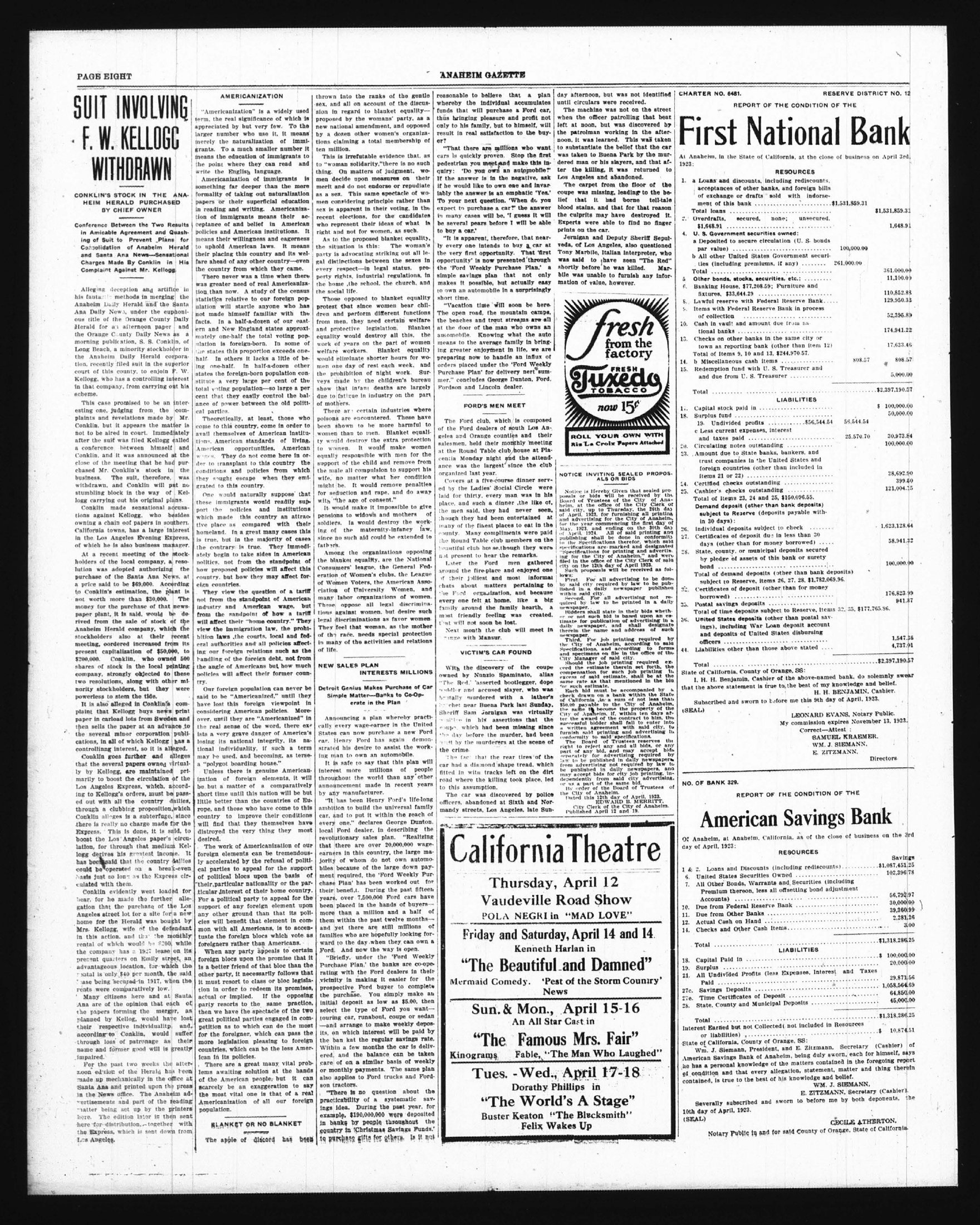
Searchable text
SUIT INVOLVING
F. W. KELLOGC
WITHDRAWN
CONKLIN'S STOCK IN THE ANAHEIM HERALD PURCHASED BY CHIEF OWNER
Conference Between the Two Results in Amicable Agreement and Quashing of Suit to Prevent Plans for Consolidation of Anaheim Herald and Santa Ana News—Sensational Charges Made By Conklin in His Complaint Against Mr. Kellogg.
Alleging deception and artifice in his fantastic methods in merging the Anaheim Daily Herald and the Santa Ana Daily News, under the euphonious title of the Orange County Daily Herald for an afternoon paper and the Orange County Daily News as a morning publication, S. S. Conklin, of Long Beach, a minority stockholder in the Anaheim Daily Herald corporation, recently filed suit in the superior court of this county, to enjoin F. W. Kellogg, who has a controlling interest in that company, from carrying out his scheme.
This case promised to be an interesting one, judging from the complaints and revelations made by Mr. Conklin, but it appears the matter is not to be aired in court. Immediately after the suit was filed Kellogg called a conference between himself and Conklin, and it was announced at the AMERICANIZATION
"Americanization" is a widely used term, the real significance of which is appreciated by but very few. To the larger number who use it, it means merely the naturalization of immigrants. To a much smaller number it means the education of immigrants to the point where they can read and write the English language.
Americanization of immigrants is something far deeper than the mere formality of taking out naturalization papers or their superficial education in reading and writing. Americanization of immigrants means their acceptance of and belief in American policies and American institutions. It means their willingness and eagerness to uphold American laws. It means their placing this country and its welfare ahead of any other country—even the country from which they came.
There never was a time when there was greater need of real Americanization than now. A study of the census statistics relative to our foreign population will startle anyone who has not made himself familiar with the facts. In a half-a-dozen of our eastern and New England states approximately one-half the total voting population is foreign-born. In some of these states this proportion exceeds one-half. In others it lacks a little of being one-half. In half-a-dozen other states the foreign-born population constitute a very large per cent of the total voting population—so large a percent that they easily control the balance of power between the old political parties.
Theoretically, at least, those who come to this country, come in order to avail themselves of American institutions, American standards of living, American opportunities, American wages. They do not come here in or thrown into the sex, and all on a vision in regard to proposed by the new national amends claiming a ten million.
This is irrefutable to "woman solidarity. On matters men decide upon merit and do not as a sex. This men considering sex is apparent in recent elections, who represent the right and not for.
As to the proper situation is party is advocating gal distinctions every respect—property rights, indicting the home,the scrape the social life.
Those opposed protest that since dren and perform from men, they and protective equality would work of years of welfare workers would eliminate men one day of the prohibition veys made by them show that infant due to fatigue in mothers.
There are certain poisons are encountered shown to women than to men would destroy to women. It equally responds
tion, recently filed suit in the superior court of this county, to enjoin F. W. Kellogg, who has a controlling interest in that company, from carrying out his scheme.
This case promised to be an interesting one, judging from the complaints and revelations made by Mr. Conklin, but it appears the matter is not to be aired in court. Immediately after the suit was filed Kellogg called a conference between himself and Conklin, and it was announced at the close of the meeting that he had purchased Mr. Conklin's stock in the business. The suit, therefore, was withdrawn, and Conklin will put no stumbling block in the way of Kellogg carrying out his original plans.
Conklin made sensational accusations against Kellogg, who besides owning a chain of papers in southern California towns, has a large interest in the Los Angeles Evening Express, of which he is also business manager.
At a recent meeting of the stockholders of the local company, a resolution was adopted authorizing the purchase of the Santa Ana News, at a price said to be $69,000. According to Conklin's estimation, the plant is not worth more than $30,000. The money for the purchase of that newspaper plant, it is said, would be derived from the sale of stock of the Anaheim Herald company, which the stockholders also at their recent meeting, ordered increased from its present capitalization of $50,000, to $200,000. Conklin, who owned 500 shares of stock in the local printing company, strongly objected to these two resolutions, along with other minority stockholders, but they were powerless to stem the tide.
It is also alleged in Conklin's complaint that Kellogg buys news print paper in carload lots from Sweden and then sells the paper at an advance to the several minor corporation publications, in all of which Kellogg has a controlling interest, so it is alleged.
Conklin goes further and alleges that the several papers owned virtually by Kellogg, are maintained primarily to boost the circulation of the Los Angeles Express, which, according to Kellogg's orders, must be passed out with all the country dailies, through a clubbing proposition, which Conklin alleges is a subterfuge, since there is really no charge made for the Express. This is done, it is said, to boost the Los Angeles paper's circulation, for through that medium Kellogg derives his greatest income. It has been said that the country dailies
Theoretically, at least, those who come to this country, come in order to avail themselves of American institutions. American standards of living. American opportunities. American wages. They do not come here in order to transplant to this country the conditions and policies from which they sought escape when they emigrated to this country.
One would naturally suppose that these immigrants would readily support the policies and institutions which made this country an attractive place as compared with their homeland. In a great many cases this is true, but in the majority of cases the contrary is true. They immediately begin to take sides in American politics, not from the standpoint of how proposed policies will affect this country, but how they may affect foreign countries.
They view the question of a tariff not from the standpoint of American industry and American wage, but from the sandpoint of how a tariff will affect their "home country." They view the immigration law, the prohibition laws, the courts, local and federal authorities and all policies affecting our foreign relations such as the handling of the foreign debt, not from the angle of Americans but how much policies will affect their former country.
Our foreign population can never be said to be "Americanized," until they have lost this foreign viewpoint in considering American policies. Moreover, until they are "Americanized" in the real sense of the word, there exists a very grave danger of America's losing its national integrity. Its national individuality, if such a term may be used, and becoming, as terse a "polygot boarding house."
Unless there is genuine Americanization of foreign elements, it will be but a matter of a comparatively short time until this nation will be but little better than the countries of Europe, and those who have come to this country to improve their conditions will find that they themselves have distroyed the very thing they most desired.
The work of Americanization of our foreign elements can be tremendously accelerated by the refusal of politi-
by Kellogg, are maintained primarily to boost the circulation of the Los Angeles Express, which, according to Kellogg's orders, must be passed out with all the country dailies, through a clubbing proposition, which Conklin alleges is a subterfuge, since there is really no charge made for the Express. This is done, it is said, to boost the Los Angeles paper's circulation, for through that medium Kellogg derives his greatest income. It has been said that the country dailies could be operated on a break-even basis just so long as the Express circulated with them.
Conklin evidently went loaded for bear, for he made the further allegation that the purchase of the Los Angeles street lot for a site for a new home for the Herald was bought by Mrs. Kellogg, wife of the defendant in this action, and that the monthly rental of which would be $200, while the company has a 1927 lease on its present quarters on Emily street, an advantageous location, for which the total is only $40 per month, the said case being secured in 1917, when the rents were comparatively low.
Many citizens here and at Santa Ana are of the opinion that each of the papers forming the merger, as planned by Kellog, would have lost their respective individuality, and, according to Conklin, would suffer through loss of patronage as their name and former good will is greatly impaired.
For the past two weeks the afternoon edition of the Herald has been made up mechanically in the office at Santa Ana and printed upon the press in the News office. The Anaheim advertisements and part of the reading matter being set up by the printers here. The edition later is then sent here for distribution, together with the Express, which is sent down from Los Angeles.
Unless there is genuine Americanization of foreign elements, it will be but a matter of a comparatively short time until this nation will be but little better than the countries of Europe, and those who have come to this country to improve their conditions will find that they themselves have distroyed the very thing they most desired.
The work of Americanization of our foreign elements can be tremendously accelerated by the refusal of political parties to appeal for the support of political blocs upon the basis of their particular nationality or the particular interest of their home country. For a political party to appeal for the support of any foreign element upon any other ground than that its policies will benefit that element in common with all Americans, is to accentuate the foreign blocs which vote as foreigners rather than Americans.
When any party appeals to certain foreign blocs upon the promise that it is a better friend of that bloc than the other party, it necessarily follows that it must resort to class or bloc legislation in order to redeem its promises, actual or implied. If the opposing party resorts to the same practice, then we have the spectacle of the two great political parties engaged in competition as to which can de the most for the foreigner, which can pass the more legislation pleasing to foreign countries, which can be the less American in its policies.
There are a great many vital problems awaiting solution at the hands of the American people; but it can scarcely be an exaggeration to say the most vital one is that of a real Americanization of all our foreign population.
BLANKET OR NO BLANKET
The apple of discord has been
ANAHEIM GAZETTE
only used which is To the means immilimber it wants to and grants is the mere utilization education american ones. It gerness means its wel- even came. In there american census sign pop who has with the our east-approx- ing pop home of eds one of be other con- dition of the are per the bal- l politi- ce who order to institu- living, american in or thrown into the ranks of the gentle sex, and all on account of the discussion in regard to blanket equality—proposed by the womans' party, as a new national amendment, and opposed by a dozen other women's organizations claiming a total membership of ten million.
This is irrefutable evidence that, as to "woman solidarity," there is no such thing. On matters of judgment, women decide upon measures on their merit and do not endorse or repudiate as a sex. This same spectacle of women considering principle rather than sex is apparent in their voting, in the recent elections, for the candidates who represent their ideas of what is right and not for women, as such.
As to the proposed blanket equality, the situation is this: The woman's party is advocating striking out all legal distinctions between the sexes in every respect—in legal status, property rights, industrial regulations, in the home, the school, the church, and the social life.
Those opposed to blanket equality protest that since women bear children and perform different functions from men, they need certain welfare and protective legislation. Blanket equality would destroy all this, the work of years on the part of women welfare workers. Blanket equality would eliminate shorter hours for women one day of rest each week, and the prohibition of night work. Surveys made by the children's bureau show that infant deaths are largely due to fatigue in industry on the part of mothers.
There are certain industries where poisons are encountered. These have been shown to be more harmful to women than to men. Blanket equality would destroy the extra protection to women. It would make women equally responsible with men for the reasonable to believe that a plan whereby the individual accumulates funds that will purchase a Ford car, thus bringing pleasure and profit not only to his family, but to himself, will result in real satisfaction to the buyer?
"That there are millions who want cars is quickly proven. Stop the first pedestrian you meet and make this inquiry: 'Do you own an automobile?' If the answer is in the negative, ask if he would like to own one and invariably the answer is an emphatic 'Yes.' To your next question, 'When do you expect to purchase a car?' the answer in many cases will be, 'I guess it will be several pears before I will be able to buy a car.'"
"It is apparent, therefore, that nearly every one intends to buy a car at the very first opportunity. That 'first opportunity' is now presented through the 'Ford Weekly Purchase Plan,' a simple savings plan that not only makes it possible, but actually easy to own an automobile in a surprisingly short time.
"Vacation time will soon be here. The open road, the mountain camps, the beaches and trout streams are all at the door of the man who owns an automobile. Knowing what the auto means to the average family in bringing greater enjoyment in life, we are preparing now to handle an influx of orders placed under the 'Ford Weekly Purchase Plan' for delivery nert summer." concludes George Dunton, Ford, Fordson and Lincoln dealer.
FORD'S MEN MEET
The Ford club, which is composed of the Ford dealers of south Los Angeles and Orange counties and their salesmen, held their monthly meeting at the Round Table club house at Plainview Monday night and the attend- day afternoon, but was not identified until circulars were received.
The machine was not on the street when the officer patrolling that beat left at noon, but was discovered by the patrolman working in the afternoon, it was learned. This was taken to substantiate the belief that the car was taken to Buena Park by the murdered man or his slayers, and that after the killing, it was returned to Los Angeles and abandoned.
The carpet from the floor of the coupe was missing, leading to the belief that it had borne tell-tale blood stains, and that for that reason the culprits may have destroyed it. Experts were able to find no finger prints on the car.
Jernigan and Deputy Sheriff Sepulveda, of Los Angeles, also questioned Tony Marbile, Italian interpreter, who was said to have seen "The Red" shortly before he was killed. Marbile was unable to furnish any information of value, however.
NEW SALES PLAN
INTERESTS MILLIONS
Detroit Genius Makes Purchase of Car Simple Matter—Banks to Co-Operate in the Plan
Announcing a plan whereby practically every wage earner in the United States can now purchase a new Ford car. Henry Ford has again demonstrated his desire to assist the working man to own an automobile.
It is safe to say that this plan will interest more millions of people throughout the world than any other announcement made in recent years by any manufacturer.
"It has been Henry Ford's life-long ambition to build the universal family car, and to put it within the reach of every one." declares George Dunton, local Ford dealer, in describing the revolutionary sales plan. "Realizing that there are over 20,000,000 wage earners in this country, the large majority of whom do not own automobiles placed under the 'Ford Weekly Purchase Plan' for delivery nert summer," concludes George Dunton, Ford, Fordson and Lincoln dealer.
FORD'S MEN MEET
The Ford club, which is composed of the Ford dealers of south Los Angeles and Orange counties and their salesmen, held their monthly meeting at the Round Table club house at Placeia Monday night and the attendance was the largest since the club organized last year.
Covers at a five-course dinner served by the Ladies' Social Circle were laid for thirty, every man was in his place, and such a dinner, like of, the men said, they had never seen, though they had been entertained at many of the finest places to eat in the county. Many compliments were paid to the Round Table club members on the beautiful club hot seethough they were not present to hear the remarks.
Later the Ford men gathered around the fire-place and enjoyed one of their jolliest and most informal chats about matters pertaining to the Ford organization, and because every one felt at home, like a big family around the family hearth, a most friendly feeling was created. That will not soon be lost.
Next month the club will meet in range with Mansur.
VICTIM'S CAR FOUND
With the discovery of the coupe owned by Nunzio Spaminato, alias "The Red," asserted bootlegger, dope dodder and accused slayer, who was brutally murdered with a lather's knot near Buena Park last Sunday. Sheriff Sam Jernigan was virtually involved in his assertions that the coupe, which had been missing since the day before the murder, had been shot by the murderers at the scene of the crime.
The fact that the rear tires of the car had a diamond shape tread, which fitted in with tracks left on the dirt road where the killing took place, led to this assumption.
The car was discovered by police officers, abandoned at Sixth and Normandy streets, Los Angeles, late Sun.
NOTICE INVITING SEALED PROPOSALS OR BIDS
Notice is Hereby Given that sealed proposals or bids will be received by the Board of Trustees of the City of Anaheim at the office of the City Clerk of said city, up to Thursday, the 26th day of April, 1923, for furnishing all printing and advertising for the City of Anaheim, for the year commencing the first day of May, 1923, and ending on the 30th day of April, 1924. All of said printing and publishing shall be done in conformity to the Specifications thereof, which said specifications are marked and designated "Specifications for printing and advertising for the City of Anaheim," and were filed in the office of the City Clerk of said city on the 12th day of April 1923.
Such proposals will be received as follows:
First. For all advertising to be done by said city required by law to be published in a daily newspaper published within said city.
Second. For all advertising not required by law to be published in a daily newspaper.
Third. Hildders shall state in their bids whether or not such bid is based upon an estimate for publication of advertising in a daily newspaper, and shall designate therein the name and address of such newspaper.
Fourth. For job printing required by the City of Anaheim, according to sale specifications, and according to forms and specimens on file in the office of the City Manager of said city.
Should the job printing required exceed the estimate therein set forth, the compensation for such job printing in excess of said estimate, shall be at the same rate as that mentioned in the bid or such estimate.
Each bid must be accompanied by a check drawn on a bank within the State of California, in a sum of not less than $50.00 payable to the City of Anaheim, the same become the property of the City of Anaheim. If, within ten days after the award of the contract to him, the successful bidder shall fail to enter into a written agreement with said city, to furnish said printing and advertising in conformity to said specifications.
The Board of Trustees reserves the right to reject any and all bids, or any part of any bid, and may accept bids separately for advertising required by law to be published in daily newspapers from advertising not required by law to be published in daily newspapers, and may accept bids for city job printing independently from said city advertising or as a part of the same bid.
By order of the Board of Trustees of the City of Anaheim.
Dated this 12th day of April, 1923.
EDWARD B. MERRITT.
City Clerk of the City of Anaheim.
Published April 12 and 19.
California Theatre
Thursday, April 12
Vaudeville Road Show
POLA NEGRI in "MAD LOVE"
Friday and Saturday, April 14 and 14
Kenneth Harlan in
"The Beautiful and Damned"
Mermaid Comedy. 'Pest of the Storm Country' News
Sun. & Mon., April 15-16
An All Star Cast in
"The Famous Mrs. Fair"
Kinograms Fable, "The Man Who Laughed"
Tues. - Wed., April 17-18
Dorathy Phillips in
"The World's A Stage"
Buster Keaton "The Blocksmith"
Felix Wakes Up
CHARTER NO. 6481. RESERVE DISTRICT NO. 12
REPORT OF THE CONDITION OF THE First National Bank
At Anaheim, in the State of California, at the close of business on April 3rd, 1923:
RESOURCES
1. a Loans and discounts, including rediscounts, acceptances of other banks, and foreign bills of exchange or drafts sold with indorsement of this bank ... $1,531,859.31
Total loans ... $1,531,859.31
2. Overdrafts, secured, none; unsecured, $1,648.91 ... 1,648.91
4. U. S. Government securities owned:
a Deposited to secure circulation (U. S. bonds par value) ... 100,000.00
b All other United States Government securities (including premiums, if any) ... 261,000.00
Total ... 361,000.00
5. Other bonds, stocks, securities, etc.: ... 11,100.00
6. Banking House, $77,208.59; Furniture and fixtures, $33,644.29 ... 110,852.88
8. Lawful reserve with Federal Reserve Bank ... 129,950.33
9. Items with Federal Reserve Bank in process of collection ... 52,396.89
10. Cash in vault and amount due from national banks ... 174,941.22
13. Checks on other banks in the same city or town as reporting bank (other than item 12) ... 17,633.46
Total of Items 9, 10 and 13, $244,970.57.
14. b Miscellaneous cash items ... 808.57 808.57
15. Redemption fund with U. S. Treasurer and due from U. S. Treasurer ... 5,000.00
Total ... $2,397,190.57
LIABILITIES
1. Capital stock paid in ... $ 100,000.00
2. Surplus fund ... 50,000.00
19. Undivided profits ... $56,544.54 56,544.54
c Less current expenses, interest and taxes paid ... 25,570.70 30,973.84
20. Circulating notes outstanding ... 100,000.00
23. Amount due to State banks, bankers, and
REPORT OF THE CONDITION OF THE
American Savings Bank
Of Anaheim, at Anaheim, California, as of the close of business on the 3rd day of April, 1923:
LIABILITIES
1. Capital stock paid in ... $ 100,000.00
2. Surplus fund ... 50,000.00
19. Undivided profits ... $56,544.54
c Less current expenses, interest and taxes paid ... 25,570.70
30,973.84
20. Circulating notes outstanding ... 100,000.00
23. Amount due to State banks, bankers, and trust companies in the United States and foreign countries (other than included in items 21 or 22) ... 28,692.90
24. Certified checks outstanding ... 399.60
25. Cashier's checks outstanding ... 121,004.15
Total of Items 23, 24 and 25, $150,096.55.
Demand deposit (other than bank deposits) subject to Reserve (deposits payable within 30 days):
26. Individual deposits subject to check ... 1,623,128.64
27. Certificates of deposit due in less than 30 days (other than for money borrowed) ... 58,941.32
28. State, county, or municipal deposits secured by pledge of assets of this bank or surety bond ... 100,000.00
Total of demand deposits (other than bank deposits) subject to Reserve, items 26, 27, 28, $1,782,069.96.
32. Certificates of deposit (other than for money borrowed) ... 176,823.99
35. Postal savings deposits ... 941.37
Total of time deposits subject to Reserve, Items 32, 35, $177,765.86.
36. United States deposits (other than postal savings), including War Loan deposit account and deposits of United States disbursing officers ... 1,547.35
44. Liabilities other than those above stated ... 4,737.91
Total ... $2,397,190.57
State of California, County of Orange, SS:
I. H. H. Benjamin, Cashier of the above-named bank, do solemnly swear that the above statement is true to the best of my knowledge and belief.
H. H. BENJAMIN, Cashier.
Subscribed and sworn to before me this 9th day of April, 1923.
(SEAL)
LEONARD EVANS, Notary Public.
My commission expires November 13, 1923.
Correct—Attest:
SAMUEL KRAEMER,
WM. J. SIEMANN,
E. ZITZMANN.
Directors
NO. OF BANK 329.
REPORT OF THE CONDITION OF THE
American Savings Bank
Of Anaheim, at Anaheim, California, as of the close of business on the 3rd day of April, 1923:
NO. OF BANK 329.
REPORT OF THE CONDITION OF THE
American Savings Bank
Of Anaheim, at Anaheim, California, as of the close of business on the 3rd day of April, 1923:
RESOURCES
Savings
1 & 2. Loans and Discounts (including rediscounts) ... $1,087,451.25
6. United States Securities Owned ... 102,396.78
7. All Other Bonds, Warrants and Securities (including Premium thereon, less all offsetting bond adjustment Accounts) ... 56,792.97
10. Due from Federal Reserve Bank ... 30,000.00
11. Due from Other Banks ... 39,360.99
12. Actual Cash on Hand ... 2,281.26
14. Checks and Other Cash Items... 3.00
Total ... $1,318,286.25
LIABILITIES
18. Capital Paid in ... $ 100,000.00
19. Surplus ... 20,000.00
21. All Undivided Profits (less Expenses, Interest and Taxes Paid) ... 29,871.56
27c. Savings Deposits ... 1,058,564.69
27e. Time Certificates of Deposit ... 64,850.00
28. State, County and Municipal Deposits ... 45,000.00
Total ... $1,318,286.25
Interest Earned but not Collected (not included in Resources or liabilities) ... $ 10,874.51
State of California, County of Orange, SS:
Wm. J. Siemann, President, and E. Zitzmann, Secretary (Cashier) of American Savings Bank of Anaheim, being duly sworn, each for himself, says he has a personal knowledge of the matters contained in the foregoing report of condition and that every allegation, statement, matter and thing therein contained, is true to the best of his knowledge and belief.
WM. J. SIEMANN,
E. ZITZMANN, Secretary (Cashier).
Severally subscribed and sworn to before me by both deponents, the 10th day of April, 1923.
(SEAL)
CECILE ATHERTON,
Notary Public in and for said County of Orange, State of California.