anaheim-gazette 1923-04-05
Scanned page
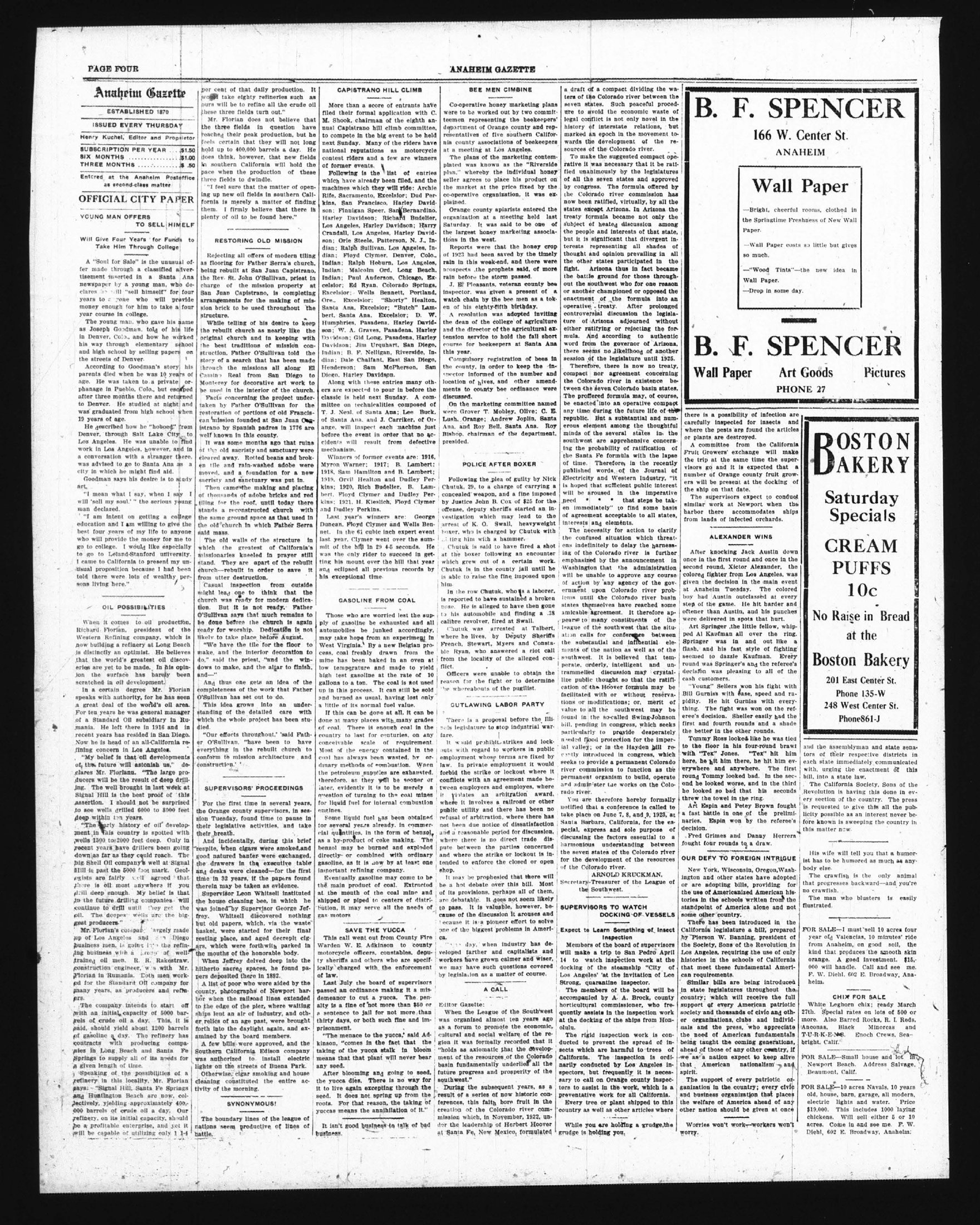
Searchable text
A "Soul for Sale" is the unusual offer made through a classified advertisement inserted in a Santa Ana newspaper by a young man, who declares he will "sell himself" for four years to anyone who will provide money enough for him to take a four year course in college.
The young man, who gave his name as Joseph Goodman, told of his life in Denver, Colo., and how he worked his way through elementary school and high school by selling papers on the streets of Denver.
According to Goodman's story, his parents died when he was 10 years of age. He was taken to a private orphanage in Pueblo, Colo., but escaped after three months there and returned to Denver. He studied at night and was graduated from high school when 19 years of age.
He described how he "hoboed" from Denver, through Salt Lake City, to Los Angeles. He was unable to find work in Los Angeles, however, and in a conversation with a stranger there, per cent of that daily production. It would take eighty refineries such as oils will be to refine all the crude oil these three fields turn out."
Mr. Florian does not believe that the three fields in question have reached their peak production, but he feels certain that they will not long hold up to 400,000 barrels a day. He does think, however, that new fields in southern California will hold the pace when the production of these three fields to dwindle.
"I feel sure that the matter of opening up new oil fields in southern California is merely a matter of finding them. I firmly believe that there is plenty of oil to be found here."
RESTORING OLD MISSION
Rejecting all offers of modern tiling as flooring for Father Serra's church, being rebuilt at San Juan Capistrano, the Rev. St. John O'Sullivan, priest in charge of the mission property at San Juan Capistrano, is completing arrangements for the making of mission brick to be used throughout the structure.
While telling of his desire to keep the rebuilt church as nearly like the original church and in keeping with the best traditions of mission construction, Father O'Sullivan told the story of a search that has been made through the missions all along El Camino Real from San Diego to Monterey for decorative art work to be used in the interior of the church.
Facts concerning the project undertaken by Father O'Sullivan for the restoration of portions of old Franciscan mission founded at San Juan Capistrano by Spanish padres in 1776 are well known in this county.
It was some months ago that ruins of the old sacristy and sanctuary were cleared away. Retted boats and bricks...
According to Goodman's story his parents died when he was 10 years of age. He was taken to a private orphanage in Pueblo, Colo., but escaped after three months there and returned to Denver. He studied at night and was graduated from high school when 19 years of age.
He described how he "hoboed" from Denver, through Salt Lake City to Los Angeles. He was unable to find work in Los Angeles, however, and in a conversation with a stranger there, was advised to go to Santa Ana as a city in which he might find aid.
Goodman says his desire is to study art.
"I mean what I say, when I say I will 'sell my soul.'" the serious young man declared.
"I am intent on getting a college education and I am willing to give the best four years of my life to anyone who will provide the money for me to go to college. I would like especially to go to Leland-Stanford university. I came to California to present my unusual proposition because I had been told there were lots of wealthy persons living here."
OIL POSSIBILITIES
When it comes to oil production, Richard Florian, president of the Western Refining company, which is now building a refinery at Long Beach is distinctly an optimist. He believes that the world's greatest oil discoveries are yet to be made. In his opinion the surface has barely been scratched in oil development.
In a certain degree Mr. Florian speaks with authority, for he has seen a great deal of the world's oil area. For ten years he was general manager of a Standard Oil subsidiary in Rumania. He left there in 1916 and in recent years has resided in San Diego. Now he is head of an all-California refining concern in Los Angeles.
"My belief is that oil developments of the future will astonish us," declares Mr. Florian. "The large producers will be the result of deep drilling. The well brought in last week at Signal Hill is the best proof of this assertion. I should not be surprised to see wells drilled 6000 to 8000 feet deep within ten years."
"The early history of oil development in this country is spotted with wells 1500 to 2000 feet deep. Only in recent years have drillers been going down as far as they could reach. The big Shell Oil company's well at Signal Hill."
SUPERVISORS' PROCEEDINGS
For the first time in several years, the Orange county supervisors, in session Tuesday, found time to pause in their legislative activities, and take their breath.
And incidentally, during this brief respite, when cigars were smoked, and good natured banter were exchanged, the drawers in the executive table story of a search that has been made through the missions all along El Camino Real from San Diego to Monterey for decorative art work to be used in the interior of the church.
Facts concerning the project undertaken by Father O'Sullivan for the restoration of portions of old Franciscan mission founded at San Juan Cistrano by Spanish padres in 1776 are well known in this county.
It was some months ago that ruins of the old sacristy and sanctuary were cleared away. Rotted beans and broken tile and rain-washed adobe were moved, and a foundation for a new sacristy and sanctuary was put in.
Then came the making and placing of thousands of adobe bricks and red tiling for the roof, until today there stands a reconstructed church with the same ground space as that used in the old church in which Father Serra said mass.
The old walls of the structure in which the greatest of California's missionaries kneeled in prayer still stand. They are apart of the rebuilt church—rebuilt in order to save it from utter destruction.
Casual inspection from outside might lead one to think that the church was ready for modern dedication. But it is not ready. Father O'Sullivan says that much remains to be done before the church is again ready for worship. Dedication is not likely to take place before August.
"We have the tile for the floor to make, and the interior decoration to do," said the priest, "and the windows to make, and the altar to finish, and—"
And thus one gets an idea of the completeness of the work that Father O'Sullivan has set out to do.
This idea grows into an understanding of the detailed care with which the whole project has been studied.
"Our efforts throughout," said Father O'Sullivan, "have been to have everything in the rebuilt church to conform to mission architecture and construction."
Mr. Florianu. "The large producers will be the result of deep drilling. The well brought in last week at Signal Hill is the best proof of this assertion. I should not be surprised to see wells drilled 6000 to 8000 feet deep within ten years.
"The early history of oil development in this country is spotted with wells 1500 to 2000 feet deep. Only in recent years have drillers been going down as far as they could reach. The big Shell Oil company's well at Signal Hill is past the 5000 foot mark. Geologists are fairly well agreed that there is oil most anywhere if you drill deep enough. My belief is that in the future drilling companies will continue to drill until they get the oil. The deepest wells are the biggest producers."
Mr. Florianu's company largely made up of Los Angeles and San Diego business men, is going into the refining business with a group of well-trained oil men. R. R. Rakestraw, construction engineer, was with Mr. Florianu in Rumania. Both men worked for the Standard Oil company for many years, as producers and refiners.
The company intends to start off with an initial capacity of 5000 barrels of crude oil a day. This, it is said, should yield about 1200 barrels of gasoline a day. The refinery has contracts with producing companies in Long Beach and Santa Fe Springs to supply all of its needs for a given length of time.
Speaking of the possibilities of a refinery in this locality, Mr. Florianu says: "Signal Hill, Santa Fe Springs and Huntington Beach are now collectively, yielding approximately 400,000 barrels of crude oil a day. Our refinery, on its initial capacity, should be a profitable enterprise, and yet it will be capable of utilizing only 11-4
SUPERVISORS' PROCEEDINGS
For the first time in several years, the Orange county supervisors, in session Tuesday, found time to pause in their legislative activities, and take their breath.
And incidentally, during this brief respite, when cigars were smoked, and good natured banter were exchanged, the drawers in the executive table and desks were cleaned—for the first time in 32 years, if the papers found therein may be taken as evidence.
Supervisor Leon Whitsell instituted the house cleaning bee, in which he was joined by Supervisor George Jeffrey. Whitsell discovered nothing but old papers, which, via the waste basket, were started for their final resting place, and aged decrepit cigars, which were forthwith parked in the mouths of the honorable body.
When Jeffrey delved deep into the hitherto sacred spaces, he found papers deposited there in 1892.
A list of poor who were aided by the county, photographs of Newport harbor when the railroad lines extended to the edge of the pier, where waiting ships lent an air of industry, and other relients of an age past, were brought forth into the daylight again, and examined by the board members.
A few bills were approved, and the Southern California Edison company was authorized to install electric lights on the streets of Buena Park.
Otherwise, cigar smoking and house cleaning constituted the entire activity of the morning.
SYNONYMOUS!
The boundary lines of the league of nations seem productive of lines of battle.
ANAHEIM GAZETTE
CAPISTRANO HILL CLIMB
More than a score of entrants have filed their formal application with C. M. Shook, chairman of the eighth annual Capistrano hill climb committee, to compete in the big event to be held next Sunday. Many of the riders have national reputations as motorcycle contest riders and a few are winners of former events.
Following is the list of entries which have already been filed, and the machines which they will ride: Archie Rife, Sacramento, Excelsior; Dud Perkins, San Francisco, Harley Davidson; Finnigan Speer, San Bernardino, Harley Davidson; Richard Budeller, Los Angeles, Harley Davidson; Harry Crandall, Los Angeles, Harley Davidson; Orle Steele, Patterson, N. J., Indian; Ralph Sullivan, Los Angeles, Indian; Floyd Clymer, Denver, Colo., Indian; Ralph Heburn, Los Angeles, Indian; Malcolm Ord, Long Beach, Indian; Paul Anderson, Chicago, Excelsior; Ed Ryan, Colorado Springs, Excelsior; Wells Bennett, Portland, Ore., Excelsior; "Shorty" Healton, Santa Ana, Excelsior; "Butch" Lambert, Santa Ana, Excelsior; D. W. Humphries, Pasadena, Harley Davidson; W. A. Graves, Pasadena, Harley Davidson; Gid Long, Pasadena, Harley Davidson; Jim Urquhart, San Diego, Indian; B. F. Nelligan, Riverside, Indian; Dale Chalfant, East San Diego, Henderson; Sam McPherson, San Diego, Harley Davidspn.
Along with these entries many others are expected to pour in before the classic is held next Sunday. A committee on technicalities composed of T. J. Neal of Santa Ana; Lee Buck, of Santa Ana; and J. Carriker, of Orange, will inspect each machine just before the event in order that no accidents will result from defective mechanism.
Winners of former events are: 1916
BEE MEN CIMBINE
Co-operative honey marketing plans were to be worked out by two committees representing the beekeepers' department of Orange county and representatives of five southern California county associations of beekeepers at a meeting at Los Angeles.
The plans of the marketing contemplated was known as the "Riverside plan," whereby the individual honey seller agrees to place his product on the market at the price fixed by the co-operative organization, it was explained.
Orange county apiarists entered the organization at a meeting held last Saturday. It was said to be one of the largest honey marketing associations in the west.
Reports were that the honey crop of 1923 had been saved by the timely rain in this week-end, and there were prospects the prophets said, of more rain before the storm passed.
J. E. Pleasants, veteran county bee inspector, was given a present of a watch chain by the bee men as a token of his eighty-fifth birthday.
A resolution was adopted inviting the dean of the college of agriculture and the director of the agricultural extension service to hold the fall short course for beekeepers at Santa Ana this year.
Compulsory registration of bees in the county, in order to keep the inspector informed of the number and location of hives, and other amendments to county bee ordinance were discussed.
On the marketing committee named were Grover T. Mobley, Olive; C. E. Lush, Orange; Andrew Joplin, Santa Ana, and Roy Bell, Santa Ana. Roy Bishop, chairman of the department, presided.
a draft of a compact dividing the waters of the Colorado river between the seven states. Such peaceful procedure to avoid the economic waste of legal conflict is not only novel in the history of interstate relations, but marked an epoch in the movement towards the development of the resources of the Colorado river.
To make the suggested compact operative it was necessary that it be ratified unanimously by the legislatures of all the seven states and approved by congress. The formula offered by the Colorado river commission has now been ratified virtually, by all the states except Arizona. In Arizona the treaty formula became not only the subject of heated discussion among the people and interests of that state, but it is significant that divergent interests representing all shades of thought and opinion prevailing in all other states participated in the fight. Arizona thus in fact became the battle ground for those throughout the southwest who for one reason or another championed or opposed the enactment of the formula into an operative treaty. After prolonged controversial discussion the legislature of Arizona adjourned without either ratifying or rejecting the formula. And according to authentic word from the governor of Arizona, there seems no likelihood of another session of the legislature until 1925.
Therefore, there is now no treaty, compact nor agreement concerning the Colorado river in existence between the seven Colorado basin states. The proffered formula may, of course, be enacted into an operative compact any time during the future life of the republic. But a substantial and numerous element among the thoughtful minds of the several states in the southwest are apprehensive concerning the probability of ratification of the Santa Fe formula with the lapse
Outside the dedicated Father remains toils again in not august. Floor to station toation to win no finish. Of the last Father under-ride with been studid Father have church to cure andINGS al years, in sespause in and take brief locked,and changed,table
GASOLINE FROM COAL
Those who are worried lest the supply of gasoline be exhausted and all automobiles be junked accordingly, may take hope from an experiment in West Virginia. By a new Belgian process, coal freshly drawn from the mine has been baked in an oven at low temperature and made to yield high test gasoline at the rate of 10 gallons to a ton. The coal is not used up in this process. It can still be sold and burned as usual, having lost only a little of its normal fuel value.
If this can be done at all, it can be done at many places with many grades of coal. There is enough coal in the country to last for centuries, on any conceivable scale of requirement. Most of the energy contained in the coal has always been wasted, by ordinary methods of combustion. When the petroleum supplies are exhausted, therefore, as they will be sooner or later, evidently it is to be merely a question of turning to the coal mines for liquid fuel for internal combustion engines.
Some liquid fuel has been obtained for several years already, in commercial quantities, in the form of benzol, as a by-product of coke making. The benzol may be burned and exploded directly or combined with ordinary gasoline, as it is now by at least one compulsory registration of bees in the county, in order to keep the inspector informed of the number and location of hives, and other amendments to county bee ordinance were discussed.
On the marketing committee named were Grover T. Mobley, Olive; C. E. Lush, Orange; Andrew Joplin, Santa Ana, and Roy Bell, Santa Ana. Roy Bishop, chairman of the department, presided.
POLICE AFTER BOXER
Following the plea of guilty by Nick Chutuk, 29, to a charge of carrying a concealed weapon, and a fine imposed by Justice John B. Cox of $25 for the offense, deputy sheriffs started an investigation which may lead to the arrest of K. O. Swall, heavyweight boxer, who is charged by Chutuk with killing him with a hammer.
Chutuk is said to have fired a shot at the boxer following an encounter which grew out of a certain work. Chutuk is in the county jail until he is able to raise the fine imposed upon him.
In the row Chutuk, who is a laborer, is reported to have sustained a broken nose. He is alleged to have then gone to his automobile and finding a .38 calibre revolver, fired at Swall.
Chutuk was arrested at Talbert, where he lives, by Deputy Sheriffs French, Stewart, Myers and Constable Ryan, who answered a riot call from the locality of the alleged conflict.
Officers were unable to obtain the reason for the fight or determine the whereabouts of the pugilist.
OUTLAWING LABOR PARTY
There is a proposal before the Illinois legislature to stop industrial warfare.
It would prohibit strikes and lockouts with regard to workers in public employment whose terms are fixed by law. In private employment it would forbid the strike or lockout where it conflicts with an agreement made between employers and employees, where it violates an arbitration award, where it involves a railroad or other public utility and there has been no refusal of arbitration, where there has not been due notice of dissatisfaction and a reasonable period for discussion, where there is no direct trade dispute between the parties concerned and where the strike or lockout is intended to enforce the closed or open
Therefore, there is now no treaty, compact nor agreement concerning the Colorado river in existence between the seven Colorado basin states. The proffered formula may, of course, be enacted into an operative compact any time during the future life of the republic. But a substantial and numerous element among the thoughtful minds of the several states in the southwest are apprehensive concerning the probability of ratification of the Santa Fe formula with the lapse of time. Therefore, in the recently published words of the Journal of Electricity and Western Industry, "it is hoped that sufficient public interest will be aroused in the imperative need * * that steps be taken immediately" to find some basis of agreement acceptable to all states, interests and elements.
The necessity for action to clarify the confused situation which threatens indefinitely to delay the harnessing of the Colorado river is further emphasized by the announcement in Washington that the administration will be unable to approve any course of action by any agency of the government upon Colorado river problems until the Colorado river basin states themselves have reached some amicable agreement. It therefore appears to many constituents of the league of the southwest that the situation calls for conference between the substantiial and influential elements of the nation as well as of the southwest. It is believed that temperate, orderly, intelligent and untrammelled discussion may crystallize public thought so that the ratification of the Hoover formula may be facilitated with or without reservations or modifications; or merit of value to all the southwest may be found in the so-called Swing-Johnson bill, pending in congress, which seeks particularly to provide desperately needed flood protection for the imperial valley; or in the Hayden bill recently introduced in congress, which seeks to provide a permanent Colorado river commission to function as the permanent organism to build, operate and administer tae works on the Colorado river.
You are therefore hereby formally notified that a conference is called to take place on June 7, 8, and 9, 1923, at Santa Barbara, California, for the especial, express and sole purpose of discussing the factors essential to a harmonious understanding between the seven states of the Colorado river for the development of the resources
the petroleum supplies are exhausted, therefore, as they will be sooner or later, evidently it is to be merely a question of turning to the coal mines for liquid fuel for internal combustion engines.
Some liquid fuel has been obtained for several years already. In commercial quantities, in the form of benzol, as a by-product of coke making. The benzol may be burned and exploded directly or combined with ordinary gasoline, as it is now by at least one important refining company.
Eventually gasoline may come to be the main product of coal. Extracted at the mouth of the coal mine and shipped or piped to centers of distribution, it may serve all the needs of gas motors.
SAVE THE YUCCA
This call went out from County Fire Warden W. E. Adkinson to county motorcycle officers, constables, deputy sheriffs and others who are specifically charged with the enforcement of law.
Last July the board of supervisors passed an ordinance making it a misdemeanor to cut a yucca. The penalty is a fine of not more than $50 or a sentence to jail for not more than thirty days, or both such fine and imprisonment.
"The menace to the yucca," said Adkinson, "comes in the fact that the taking of the yucca stalk in bloom means that that plant will never bear any seed.
After blooming and going to seed, the yucca dies. There is no way for it to live again excepting through the seed. It does not spring up from the roots. For that reason, the taking of yuccas means the annihilation of it."
It isn't good business to talk of bad business.
forbid the strike or lockout where it conflicts with an agreement made between employers and employees, where it violates an arbitration award, where it involves a railroad or other public utility and there has been no refusal of arbitration, where there has not been due notice of dissatisfaction and a reasonable period for discussion, where there is no direct trade dispute between the parties concerned and where the strike or lockout is intended to enforce the closed or open shop.
It may be prophesied that there will be a hot debate over this bill. Most of its provisions, perhaps all of them, are debatable. It does not seem likely to pass. It is valuable, however, because of the discussion it arouses and because it is a pioneer effort to solve one of the biggest problems in America.
DAY, when industry has developed farther and capitalists and workers have grown calmer and wiser, we may have such questions covered by legislation as a matter of course.
A CALL
Editor Gazette:
When the League of the Southwest was organized almost ten years ago as a forum to promote the economic, cultural and social welfare of the region it was formally recorded that it "holds as axiomatic that the development of the resources of the Colorado basin fundamentally underlies all the future progress and prosperity of the southwest."
During the subsequent years, as a result of a series of now historic conferences, this faith bore fruit in the creation of the Colorado river commission which, in November, 1922, under the leadership of Herbert Hoover at Santa Fe, New Mexico, formulated
river commission to function as the permanent organism to build, operate and administer tue works on the Colorado river.
You are therefore hereby formally notified that a conference is called to take place on June 7, 8, and 9, 1923, at Santa Barbara, California, for the especial, express and sole purpose of discussing the factors essential to a harmonious understanding between the seven states of the Colorado river for the development of the resources of the Colorado river.
ARNOLD KRUCKMAN,
Secretary-Treasurer of the League of the Southwest.
SUPERVISORS TO WATCH
DOCKING OF VESSELS
Expect to Learn Something of Insect Inspection
Members of the board of supervisors will make a trip to San Pedro April 14 to watch inspection work at the docking of the steamship "City of Los Angeles" at the invitation of Lee Strong, quarantine inspector.
The members of the board will be accompanied by A. A. Brock, county horticultural commissioner, who frequently assists in the inspection work at the docking of the ships from Honolulu.
The rigid inspection work is conducted to prevent the spread of insects which are harmful to trees of California. The inspection is ordinarily conducted by Los Angeles inspectors, but frequently it is necessary to call on Orange county inspectors to assist in the work, which is a preventative work for all California.
Every tree or plant shipped to this country as well as other articles where
While you are holding a grudge,the grudge is holding you.
B. F. SPENCER
166 W. Center St.
ANAHEIM
Wall Paper
—Bright, cheerful rooms, clothed in the Springtime Freshness of New Wall Paper.
—Wall Paper costs so little but gives so much.
—"Wood Tints"—the new idea in Wall Paper.
—Drop in some day.
B. F. SPENCER
Wall Paper Art Goods Pictures
PHONE 27
there is a possibility of infection are carefully inspected for insects and where the pests are found the articles or plants are destroyed.
A committee from the California Fruit Growers' exchange will make
Wall Paper Art Goods Pictures
PHONE 27
there is a possibility of infection are carefully inspected for insects and where the pests are found the articles or plants are destroyed.
A committee from the California Fruit Growers' exchange will make the trip at the same time the supervisors go and it is expected that a number of Orange county fruit growers will be present at the docking of the ship on that date.
The supervisors expect to conduct similar work at Newport when the harbor there accommodates ships from lands of infected orchards.
ALEXANDER WINS
After knocking Jack Austin down once in the first round and once in the second round, Xictor Alexander, the colored fighter from Los Angeles, was given the decision in the main event at Anaheim Tuesday. The colored boy had Austin outclassed at every step of the game. He hit harder and oftener than Austin, and his punches were delivered in spots that hurt.
Art Springer, the little fellow, whipped Al Kaufman all over the ring. Springer was in and out like a flash, and his fast style of fighting seemed to dazzle Kaufman. Every round was Springer's and the referee's decision was pleasing to all of the cash customers.
"Young" Sellers won his fight with Bill Gurniss with ease, speed and rapidity. He hit Gurniss with everything. The fight was won on the referee's decision. Shelter easily had the first and fourth rounds and a shade the better in the other rounds.
Tommy Ross looked like he was tied to the floor in his four-round brawl with "Tex" Jones. "Tex" hit him here, he hit him there, he hit him everywhere and anywhere. The first round Tommy looked bad. In the second he looked worse, and in the third he looked so bad that his seconds threw the towel in the ring.
Art Espin and Petey Brown fought a fast battle in one of the preliminaries. Espin won by the referee's decision.
Fred Grimes and Danny Herrera fought four rounds to a draw.
OUR DEFY TO FOREIGN INTRIGUE
and the assemblyman and state senators of their respective districts in each state immediately communicated with, urging the enactment of this bill, into a state law.
The California Society, Sons of the Revolution is having this done in every section of the country. The press is requested to give this all the publicity possible as an interest never before known is sweeping the country in this matter now.
His wife will tell you that a humorist has to be humored as much as any-
OUR DEFY TO FOREIGN INTRIGUE
New York, Wisconsin, Oregon, Washington and other states have adopted or are adopting bills, providing for the use of Americanized American histories in the schools written from the standpoint of America alone and not some other country.
There has been introduced in the California legislature a bill, prepared by Pierson W. Banning, president of the Society, Sons of the Revolution in Los Angeles, requiring the use of only histories in the schools of California that meet these fundamental American requirements.
Similar bills are being introduced in state legislatures throughout the country; which will receive the full support of every American patriotic society and thousands of civic and other organizations, clubs and individuals and the press, who appreciate the need of American fundamentals being taught the coming generations, ahead of those of any other country. If we as a nation expect to keep alive that American nationalism and spirit.
The support of every patriotic organization in the country; every civic and business organization that places the welfare of America ahead of any other nation should be given at once.
Worries won't work—workers won't worry.