anaheim-gazette 1923-02-15
Scanned page
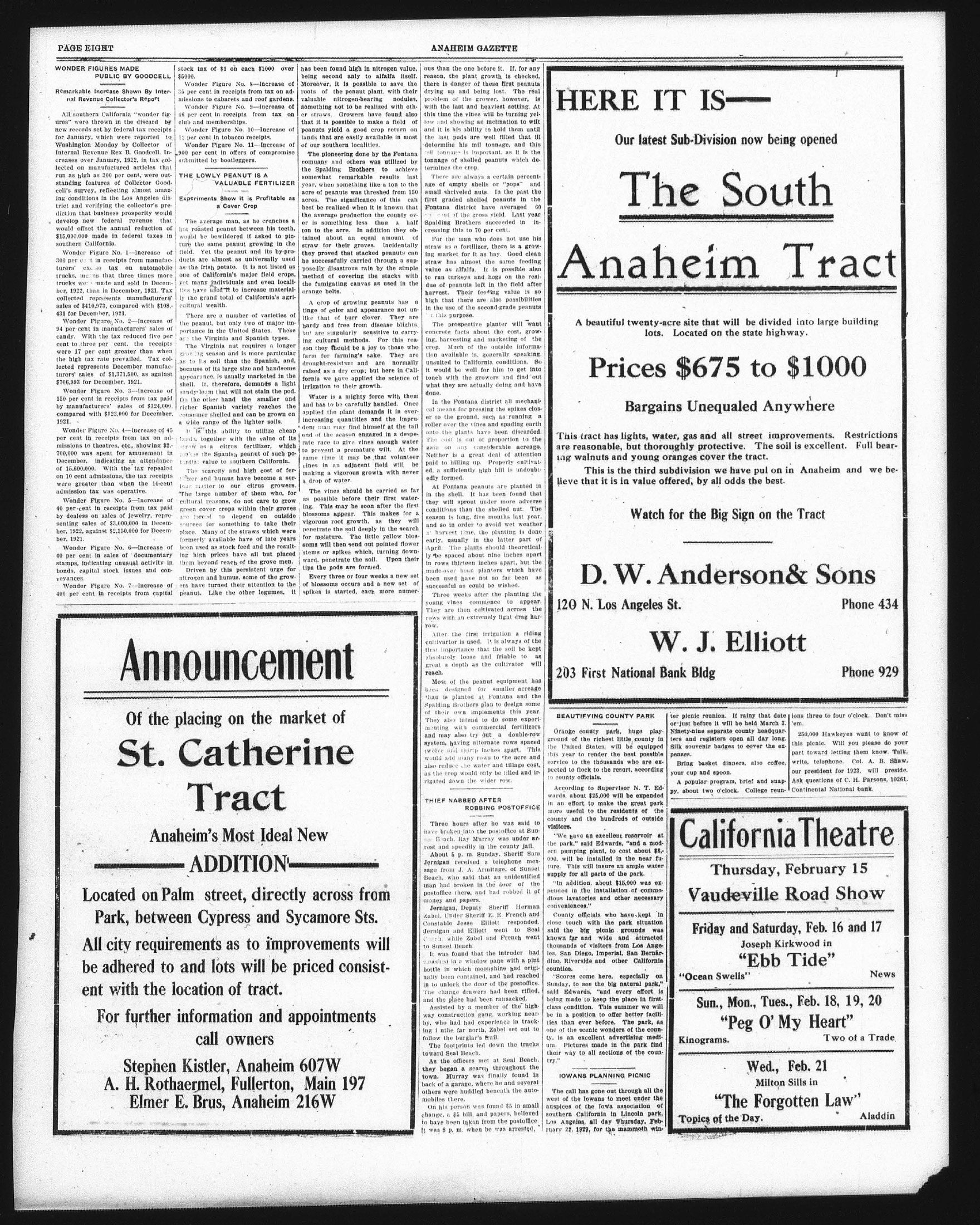
Searchable text
WONDER FIGURES MADE
PUBLIC BY GOODCELL
Remarkable Increase Shown By Internal Revenue Collector's Report
All southern California "wonder figures" were thrown in the discard by new records set by federal tax receipts for January, which were reported to Washington Monday by Collector of Internal Revenue Rex B. Goodcell. Increases over January, 1922, in tax collected on manufactured articles that run as high as 300 per cent; were outstanding features of Collector Goodcell's survey, reflecting almost amazing conditions in the Los Angeles district and verifying the collector's prediction that business prosperity would develop new federal revenue that would offset the annual reduction of $15,000,000 made in federal taxes in southern California.
Wonder Figure No. 1—Increase of 300 per cent in receipts from manufacturers' excise tax on automobile trucks, means that three times more trucks were made and sold in December, 1922, than in December, 1921. Tax collected represents manufacturers' sales of $410,973, compared with $108,431 for December, 1921.
Wonder Figure No. 2—Increase of 94 per cent in manufacturers' sales of candy. With the tax reduced five per cent to three per cent, the receipts were 17 per cent greater than when the high tax rate prevailed. Tax collected represents December manufacturers' sales of $1,371,500, as against $706,993 for December, 1921.
Wonder Figure No. 3—Increase of 150 per cent in receipts from tax paid by manufacturers' sales of $324,000, compared with $122,000 for December, 1921.
Wonder Figure No. 4—Increase of 45 per cent in receipts from tax on admissions to theatres, etc., showing $2,700,000 was spent for amusement in stock tax of $1 on each $1000 over $5000.
Wonder Figure No. 8—Increase of 35 per cent in receipts from tax on admissions to cabarets and roof gardens.
Wonder Figure No. 9—Increase of 46 per cent in receipts from tax on club and memberships.
Wonder Figure No. 10—Increase of 12 per cent in tobacco receipts.
Wonder Figure No. 11—Increase of 900 per cent in offers of compromise submitted by bootleggers.
THE LOWLY PEANUT IS A VALUABLE FERTILIZER
Experiments Show it is Profitable as a Cover Crop
The average man, as he crunches a hot roasted peanut between his teeth, would be bewildered if asked to picture the same peanut growing in the field. Yet the peanut and its by-products are almost as universally used as the Irish potato. It is not listed as one of California's major field crops, yet many individuals and even localities have used it to increase materially the grand total of California's agricultural wealth.
There are a number of varieties of the peanut, but only two of major importance in the United States. These are the Virginia and Spanish types.
The Virginia nut requires a longer growing season and is more particular as to its soil than the Spanish, and because of its large size and handsome appearance, is usually marketed in the shell. It, therefore, demands a light sandy-loam that will not stain the pod. On the other hand the smaller and richer Spanish variety reaches the consumer shelled and can be grown on a wide range of the lighter soils.
It is this ability to utilize cheap lands together with the value of its straw as a citrus fertilizer, which makes the Spanish peanut of such po-
has been found high firing being second only to Moreover, it is possible roots of the penaut valuable nitrogen-bearing something not to be rever straws. Growers say that it is possible to peanuts yield a good lands that are easily cultivated of our southern locality.
The pioneering donu comuany and others the Spalding Brothe somewhat remarkable year, when something acre of peanuts was tamed acres. The significant best be realized when the average production is something less ton to the acre. In contained about an eo straw for their grow they proved that stack be successfully carried posedly disastrous ra method of covering the fumigating canvas orange belts.
A crop of growing tinge of color and ap like that of burr chardy and free from but are singularly s ing cultural methods son they should be a farm for farming's drought-resistant and raised as a dry crop; fornia we have appli l irrigation to their g row.
Water is a mighty and has to be carefully applied the plant de increasing quantities dent man may find h end of the season enr rate race to give vin to prevent a premature time it may h
Wonder Figure No. 3—Increase of 150 per cent in receipts from tax paid by manufacturers' sales of $324,000 compared with $122,000 for December, 1921.
Wonder Figure No. 4—Increase of 45 per cent in receipts from tax on admissions to theatres, etc., showing $2,700,000 was spent for amusement in December, indicating an attendance of 15,600,000. With the tax repealed on 10 cent admissions, the tax receipts were greater than when the 10-cent admission tax was operative.
Wonder Figure No. 5—Increase of 40 per cent in receipts from tax paid by dealess on sales of jewelry, representing sales of $3,000,000 in December, 1922, against $2,150,000 for December, 1921.
Wonder Figure No. 6—Increase of 40 per cent in sales of documentary stamps, indicating unusual activity in bonds, capital stock issues and conveyances.
Wonder Figure No. 7—Increase of 400 per cent in receipts from capital land, together with the value of its straw as a citrus fertilizer, which makes the Spanish peanut of such potential value to southern California.
The scarcity and high cost of fertilizer and humus have become a serious matter to our citrus growers. The large number of them who, for cultural reasons, do not care to grow green cover crops within their groves are forced to depend on outside sources for something to take their place. Many of the straws which were formerly available have late years been used as stock feed and the resulting high prices have all but placed them beyond reach of the grove men.
Driven by this persistent urge for nitrogen and humus, some of the growers have turned their attention to the peanut. Like the other legumes, it has to its soil than the Spanish, and because of its large size and handsome appearance, is usually marketed in the shell. It, therefore, demands a light sandy-loam that will not stain the pod. On the other hand the smaller and richer Spanish variety reaches the consumer shelled and can be grown on a wide range of the lighter soils.
It is this ability to utilize cheap lands together with the value of its straw as a citrus fertilizer, which makes the Spanish peanut of such potential value to southern California.
The scarcity and high cost of fertilizer and humus have become a serious matter to our citrus growers. The large number of them who, for cultural reasons, do not care to grow green cover crops within their groves are forced to depend on outside sources for something to take their place. Many of the straws which were formerly available have late years been used as stock feed and the resulting high prices have all but placed them beyond reach of the grove men.
Driven by this persistent urge for nitrogen and humus, some of the growers have turned their attention to the peanut. Like the other legumes, it has to its soil than the Spanish, and because of its large size and handsome appearance, is usually marketed in the shell. It, therefore, demands a light sandy-loam that will not stain the pod. On the other hand the smaller and richer Spanish variety reaches the consumer shelled and can be grown on a wide range of the lighter soils.
It is this ability to utilize cheap lands together with the value of its straw as a citrus fertilizer, which makes the Spanish peanut of such potential value to southern California.
The scarcity and high cost of fertilizer and humus have become a serious matter to our citrus growers. The large number of them who, for cultural reasons, do not care to grow green cover crops within their groves are forced to depend on outside sources for something to take their place. Many of the straws which were formerly available have late years been used as stock feed and the resulting high prices have all but placed them beyond reach of the grove men.
Driven by this persistent urge for nitrogen and humus, some of the growers have turned their attention to the peanut. Like the other legumes, it has to its soil than the Spanish, and because of its large size and handsome appearance, is usually marketed in the shell. It, therefore, demands a light sandy-loam that will not stain the pod. On the other hand the smaller and richer Spanish variety reaches the consumer shelled and can be grown on a wide range of the lighter soils.
It is this ability to utilize cheap lands together with the value of its straw as a citrus fertilizer, which makes the Spanish peanut of such potential value to southern California.
The scarcity and high cost of fertilizer and humus have become a serious matter to our citrus growers. The large number of them who, for cultural reasons, do not care to grow green cover crops within their groves are forced to depend on outside sources for something to take their place. Many of the straws which were formerly available have late years been used as stock feed and the resulting high prices have all but placed them beyond reach of the grove men.
Driven by this persistent urge for nitrogen and humus, some of the growers have turned their attention to the peanut. Like the other legumes, it has to its soil than the Spanish, and because of its large size and handsome appearance, is usually marketed in the shell. It therefore, demands a light sandy-loam that will not stain the pod. On the other hand the smaller and richer Spanish variety reaches the consumer shelled and can be grown on a wide range of the lighter soils.
It is this ability to utilize cheap lands together with the value of its straw as a citrus fertilizer, which makes the Spanish peanut of such potential value to southern California.
The scarcity and high cost of fertilizer and humus have become a serious matter to our citrus growers. The large number of them who, for cultural reasons, do not care to grow green cover crops within their groves are forced to depend on outside sources for something to take their place. Many of the straws which were formerly available have late years been used as stock feed and the resulting high prices have all but placed them beyond reach of the grove men.
Driven by this persistent urge for nitrogen and humus, some of the growers have turned their attention to the peanut. Like the other legumes, it has to its soil than the Spanish, and because of its large size and handsome appearance, is usually marketed in the shell. It therefore, demands a light sandy-loam that will not stain the pod. On the other hand the smaller and richer Spanish variety reaches the consumer shelled and can be grown on a wide range of the lighter soils.
It is this ability to utilize cheap lands together with the value of its straw as a citrus fertilizer, which makes the Spanish peanut of such potential value to southern California.
The scarcity and high cost of fertilizer and humus have become a serious matter to our citrus growers. The large number of them who, for cultural reasons, do not care to grow green cover crops within their groves are forced to depend on outside sources for something to take their place. Many of the straws which were formerly available have late years been used as stock feed and the resulting high prices have all but placed them beyond reach of the grove men.
Driven by this persistent urge for nitrogen and humus, some of the growers have turned their attention to the peanut. Like the other legumes, it has to its soil than the Spanish, and because of its large size and handsome appearance, is usually marketed in the shell. It therefore, demands a light sandy-loam that will not stain the pod. On the other hand the smaller and richer Spanish variety reaches the consumer shelled and can be grown on a wide range of the lighter soils.
It is this ability to utilize cheap lands together with the value of its straw as a citrus fertilizer, which makes the Spanish peanut of such potential value to southern California.
The scarcity and high cost of fertilizer and humus have become a serious matter to our citrus growers. The large number of them who, for cultural reasons, do not care to grow green cover crops within their groves are forced to depend on outside sources for something to take their place. Many of the straws which were formerly available have late years been used as stock feed and the resulting high prices have all but placed them beyond reach of the grove men.
Driven by this persistent urge for nitrogen and humus, some of the growers have turned their attention to the peanut. Like the other legumes, it has to its soil than the Spanish, and because of its large size and handsome appearance, is usually marketed in the shell. It therefore, demands a light sandy-loam that will not stain the pod. On the other hand the smaller and richer Spanish variety reaches the consumer shelled and can be grown on a wide range of the lighter soils.
It is this ability to utilize cheap lands together with the value of its straw as a citrus fertilizer, which makes the Spanish peanut of such potential value to southern California.
The scarcity and high cost of fertilizer and humus have become a serious matter to our citrus growers. The large number of them who, for cultural reasons, do not care to grow green cover crops within their groves are forced to depend on outside sources for something to take their place. Many of the straws which were formerly available have late years been used as stock feed and the resulting high prices have all but placed them beyond reach of the grove men.
Driven by this persistent urge for nitrogen and humus, some of the growers have turned their attention to the peanut. Like the other legumes, it has to its soil than the Spanish, and because of its large size and handsome appearance, is usually marketed in the shell. It therefore, demands a light sandy-loam that will not stain the pod. On the other hand the smaller and richer Spanish variety reaches the consumer shelled and can be grown on a wide range of the lighter soils.
It is this ability to utilize cheap lands together with the value of its straw as a citrus fertilizer, which makes the Spanish peanut of such potential value to southern California.
The scarcity and high cost of fertilizer and humus have become a serious matter to our citrus growers. The large number of them who, for cultural reasons, do not care to grow green cover crops within their groves are forced to depend on outside sources for something to take their place. Many of the straws which were formerly available have late years been used as stock feed and the resulting high prices have all but placed them beyond reach of the grove men.
Driven by this persistent urge for nitrogen and humus, some of the growers have turned their attention to the peanut. Like the other legumes, it has to its soil than the Spanish, and because of its large size and handsome appearance, is usually marketed in the shell. It therefore, demands a light sandy-loam that will not stain the pod. On the other hand the smaller and richer Spanish variety reaches the consumer shelled and can be grown on a wide range of the lighter soils.
It is this ability to utilize cheap lands together with the value of its straw as a citrus fertilizer, which makes the Spanish peanut of such potential value to southern California.
The scarcity and high cost of fertilizer and humus have become a serious matter to our citrus growers. The large number of them who, for cultural reasons, do not care to grow green cover crops within their groves are forced to depend on outside sources for something to take their place. Many of the straws which were formerly available have late years been used as stock feed and the resulting high prices have all but placed them beyond reach ofthe grove men.
Driven by this persistent urge for nitrogen and humus, some of these growers have turned their attention tothe peanut.Like they other legumes,theas hastoits soilthantheSpanish,andbecauseofitslargesizeandhandsomeappearanceisusuallymarketedintheshell.ittherefore,demandsalightsandy-loamthatwillnotstainthepod.Ontheotherhandthesmallerandrichersthaneprematureismetwouldbeinanadjacentmakinga vigorousgrownthegrowsareusedbeforeting.Inthismaybesomeblossomsappear.Trevigorousrootgrowthpenetratethesoildecoverformoisture.Thebloomsswillthensendocustomestorspikeswhichward.penetratethetops提的podsareformedEverythreeorfourblossomsoccursa spikesisstarted,e
Announcement
OftheplacingonthemarketofSt.CatherineTract
Anaheim'sMostIdealNew ADDITION!
Tract
Anaheim’s Most Ideal New
ADDITION
Located on Palm street, directly across from Park, between Cypress and Sycamore St.
All city requirements as to improvements be adhered to and lots will be priced consistent with the location of tract.
For further information and appointment call owners
Stephen Kistler, Anaheim 607W
A. H. Rothaermel, Fullerton, Main 197
Elmer E. Brus, Anaheim 216W
has been found high in nitrogen value, being second only to alfalfa itself. Moreover, it is possible to save the roots of the penaut plant, with their valuable nitrogen-bearing nodules, something not to be realized with other straws. Growers have found also that it is possible to make a field of peanuts yield a good crop return on lands that are easily available in most of our southern localities.
The pioneering done by the Fontana comuany and others was utilized by the Spalding Brothers to achieve somewhat remarkable results last year, when something like a ton to the acre of peanuts was threshed from 150 acres. The significance of this can best be realized when it is known that the average production the county over is something less than a half ton to the acre. In addition they obtained about an equal amount of straw for their groves. Incidentally they proved that stacked peanuts can be successfully carried through a supposedly disastrous rain by the simple method of covering the stacks with the fumigating canvas as used in the orange belts.
A crop of growing peanuts has a tinge of color and appearance not unlike that of burr clover. They are hardy and free from disease blights, but are singularly sensitive to carrying cultural methods. For this reason they should be a joy to those who farm for farming's sake. They are drought-resistant and are normally raised as a dry crop; but here in California we have applied the science of irrigation to their growth.
Water is a mighty force with them and has to be carefully handled. Once applied the plant demands it in ever-increasing quantities and the imprudent man may find himself at the tail end of the season engaged in a desperate race to give vines enough water to prevent a premature wilt. At the same time it may be that volunteerous than the one before it. If, for any reason, the plant growth is checked, there is danger of these first peanuts drying up and being lost. The real problem of the grower, however, is with the last and heaviest setting. At this time the vines will be turning yellow and showing an inclination to wilt and it is his ability to hold them until the last pods are well filled that ill determine his miltonage, and this miltonage is important, as it is the tonnage of shelled peanuts which determines the crop.
There are always a certain percentage of amply shells or "pops" and small shriveled nuts. In the past the first graded shelled peanuts in the Fontana district have averaged 60 percent of the gross yield. Last year Spalding Brothers succeeded in increasing this to 70 per cent.
For the man who does not use his straw as a fertilizer, there is a growing market for it as hay. Good clean straw has almost the same feeding value as alfalfa. It is possible also to run turkeys and hogs on the residue of peanuts left in the field after harvest. Their feeding value is so high that there are also possibilities in the use of the second-grade peanuts in this purpose.
The prospective planter will want concrete facts about the cost, growing, harvesting and marketing of the crop. Much of the outside information available is, generally speaking, unaffected to California conditions. So it would be well for him to get into touch with the growers and find out what they are actually doing and have done.
In the Fontana district all mechanical means for pressing the spikes closer to the ground, such as running a roller over the vines and spading earth onto the plants have been discarded. The cost is out of proportion to the gain on any considerable acreage. Neither is a great deal of attention
HERE IT
Our latest SubThe
Anahe
A beautiful twenty-acre site
lots. Locat
Prices $
Bargains U
This tract has lights, water, gas
are reasonable, but thoroughly
walnuts and young orange
drought-resistant and are normally raised as a dry crop; but here in California we have applied the science of irrigation to their growth.
Water is a mighty force with them and has to be carefully handled. Once applied the plant demands it in ever-increasing quantities and the imprudent man may find himself at the tail end of the season engaged in a desperate race to give vines enough water to prevent a premature wilt. At the same time it may be that volunteer vines in an adjacent field will be making a vigorous growth with never a drop of water.
The vines should be carried as far as possible before their first watering. This may be soon after the first blossoms appear. This makes for a vigorous root growth, as they will penetrate the soil deeply in the search for moisture. The little yellow blossoms will then send out pointed flower stems or spikes which, turning downward, penetrate the soil. Upon their tips the pods are formed.
Every three or four weeks a new set of blossoms occurs and a new set of spikes is started, each more numer-
unaulted to California conditions. So it would be well for him to get into touch with the growers and find out what they are actually doing and have done.
In the Fontana district all mechanical means for pressing the spikes closer to the ground, such as running a roller over the vines and spading earth onto the plants have been discarded. The cost is out of proportion to the gain on any considerable acreage. Neither is a great deal of attention paid to hilling up. Properly cultivated, a sufficiently high hill is undoubtedly formed.
At Fontana peanuts are planted in in the shell. It has been found that they will sprout under more adverse conditions than the shelled nut. The season is long, five months last year, and so in order to avoid wet weather at harvest time, the planting is done early, usually in the latter part of April. The plants should theoretically be spaced about nine inches apart in rows thirteen inches apart, but the made-over bean planters which have been used have not so far been as successful as could be wished.
Three weeks after the planting the young vines commence to appear. They are then cultivated across the rows with an extremely light drag harrow.
After the first irrigation a riding cultivartor is used. It is always of the first importance that the soil be kept absolutely loose and friable to as great a depth as the cultivator will reach.
Most of the peanut equipment has been designed for smaller acreage than is planted at Fontana and the Spalding Brothers plan to design some of their own implements this year. They also intend to do some experimenting with commercial fertilizers and may also try out a double-row system, having alternate rows spaced twelve and thirty inches apart. This would add many rows to the acre and also reduce the water and tillage cost, as the crop would only be tilled and irrigated down the wider row.
THIEF NABBED AFTER
ROBBING POSTOFFICE
Three hours after he was said to have broken into the postoffice at Sunset Beach, Ray Murray was under arrest and speedily in the county jail.
About 5 p.m. Sunday, Sheriff Sam Jernigan received a telephone mes-
Prices $
Bargains U
This tract has lights, water, gas are reasonable, but thoroughly ing walnuts and young orange
This is the third subdivi lieve that it is in value offered,
Watch for t
D. W. An
120 N. Los Angeles St.
W.
203 First National Bank
BEAUTIFYING COUNTY PARK
Orange county park, huge playground of the richest little county in the United States, will be equipped this year to render the best possible service to the thousands who are expected to flock to the resort, according to county officials.
According to Supervisor N. T. Edwards, about $25,000 will be expended in an effort to make the great park more useful to the residents of the county and the hundreds of outside visitors.
"We have an excellent reservoir at the park," said Edwards, "and a modern pumping plant, to cost about $8,000, will be installed in the near fu-
THIEF NABBED AFTER
ROBBING POSTOFFICE
Three hours after he was said to have broken into the postoffice at Sunset Beach, Ray Murray was under arrest and speedily in the county jail.
About 5 p.m. Sunday, Sheriff Sam Jernigan received a telephone message from J. A. Armitage, of Sunset Beach, who said that an unidentified man had broken in the door of the postoffice there, and had robbed it of money and papers.
Jernigan, Deputy Sheriff Herman Zabel, Under Sheriff E. E. French and Constable Jesse Elliott responded. Jernigan and Elliott went to Seal Beach while Zabel and French went to Sunset Beach.
It was found that the intruder had swashed in a window pane with a pint bottle in which moonshine had originally been contained, and had reached in to unlock the door of the postoffice. The change drawers had been riffled, and the place had been ransacked.
Assisted by a member of the highway construction gang, working nearby, who had had experience in tracking i n the far north, Zabel set out to follow the burglar's trail.
The footprints led down the tracks toward Seal Beach.
As the officers met at Seal Beach, they began a search throughout the town. Murray was finally found in back of a garage, where he and several others were huddled beneath the automobiles there.
On his person was found $5 in small change, a $5 bill, and papers, believed to have been taken from the postoffice. It was 8 p.m. when he was arrested,
According to Supervisor N. T. Edwards, about $25,000 will be expended in an effort to make the great park more useful to the residents of the county and the hundreds of outside visitors.
"We have an excellent reservoir at the park," said Edwards, "and a modern pumping plant, to cost about $8,000, will be installed in the near future. This will insure an ample water supply for all parts of the park."
In addition, about $15,000 was expended in the installation of commodious lavatories and other necessary conveniences."
County officials who have kept in close touch with the park situation said the big picnic grounds was known far and wide and attracted thousands of visitors from Los Angeles, San Diego, Imperial, San Bernardino, Riverside and other California counties.
"Scores come here, especially on Sunday, to see the big natural park," said Edwards, "and every effort is being made to keep the place in first-class condition. This summer we will be in a position to offer better facilities than ever before. The park, as one of the scenic wonders of the country, is an excellent advertising medium. Pictures made in the park find their way to all sections of the country."
IOWANS PLANNING PICNIC
The call has gone out through all the west of the Iowaans to meet under the auspices of the Iowa association of southern California in Lincoln park, Los Angeles, all day Thursday, February 22, 1923, for the mammoth win-
RE IT IS—
Our latest Sub-Division now being opened
The South
naheim Tract
ful twenty-acre site that will be divided into large building
lots. Located on the state highway.
rices $675 to $1000
Bargains Unequaled Anywhere
lights, water, gas and all street improvements. Restrictions
e, but thoroughly protective. The soil is excellent. Full bear-
Bargains Unequaled Anywhere
lights, water, gas and all street improvements. Restrictions
e, but thoroughly protective. The soil is excellent. Full bearand young oranges cover the tract.
the third subdivision we have pul on in Anaheim and we bes in value offered, by all odds the best.
Watch for the Big Sign on the Tract
W. Anderson& Sons
Los Angeles St.
Phone 434
W. J. Elliott
National Bank Bldg
Phone 929
ter picnic reunion. If rainy that date
or just before it will be held March 3.
Ninety-nine separate county headquarters and registers open all day long.
Silk souvenir badges to cover the expenses.
Bring basket dinners, also coffee,
your cup and spoon.
A popular program, brief and snappy, about two o'clock. College reun-
ions three to four o'clock. Don't miss
'em.
250,000 Hawkeyes want to know of
this picnic. Will you please do your
part toward letting them know. Talk,
write, telephone. Col. A. B. Shaw,
our president for 1923, will preside.
Ask questions of C. H. Parsons, 10261,
Continental National bank.
California Theatre
California Theatre
Thursday, February 15
Vaudeville Road Show
Friday and Saturday, Feb. 16 and 17
Joseph Kirkwood in
“Ebb Tide”
“Ocean Swells” News
Sun., Mon., Tues., Feb. 18, 19, 20
“Peg O' My Heart”
Kinograms. Two of a Trade
Wed., Feb. 21
Milton Sills in
“The Forgotten Law”
Topics of the Day. Aladdin