anaheim-gazette 1923-02-08
Scanned page
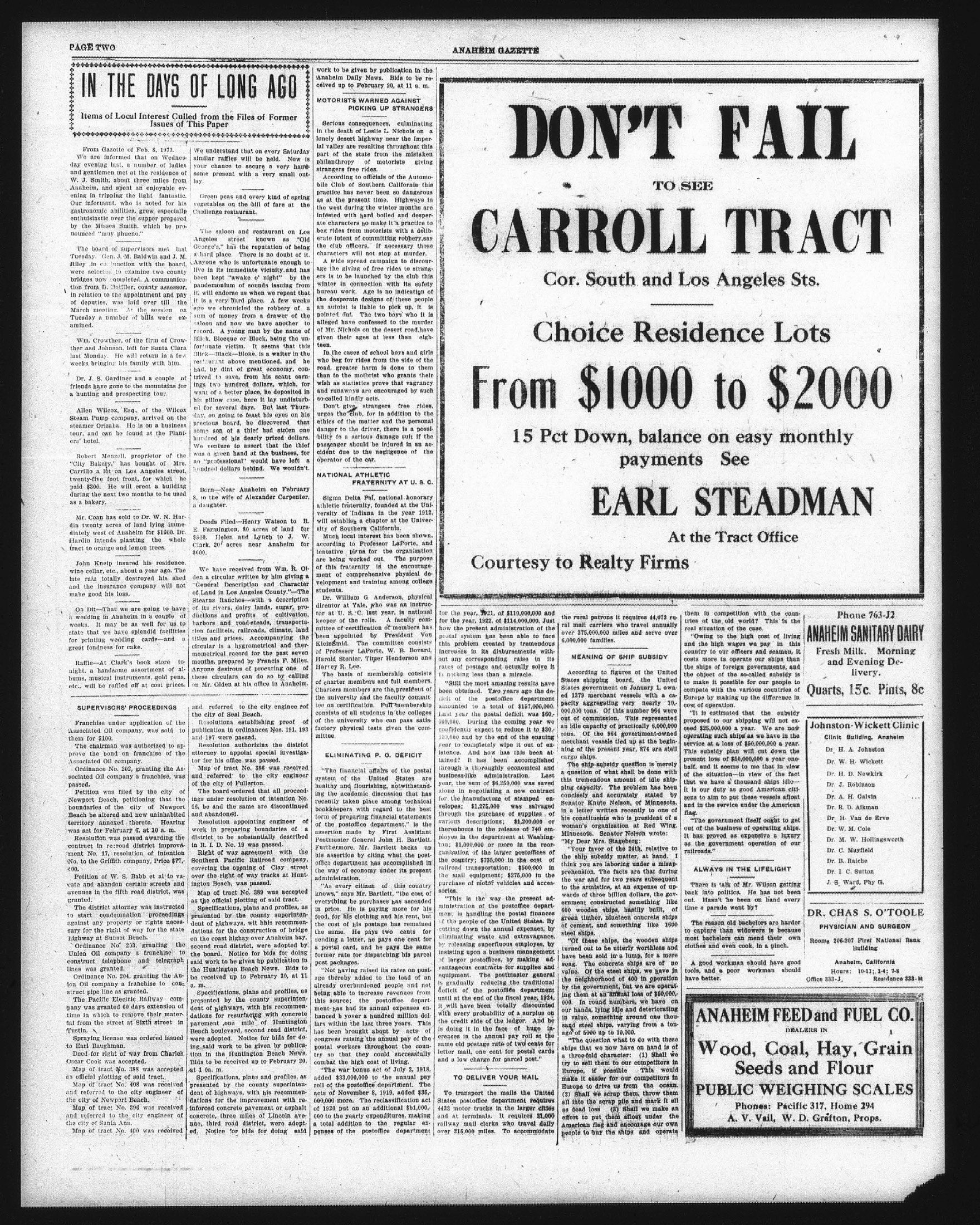
Searchable text
IN THE DAYS OF LONG AGO
Items of Local Interest Culled from the Files of Former Issues of This Paper
From Gazette of Feb. 8, 1973.
We are informed that on Wednesday evening last, a number of ladies and gentlemen met at the residence of W. J. Smith, about three miles from Anaheim, and spent an enjoyable evening in tripping the light fantastic. Our informant, who is noted for his gastronomic abilities, grew especially enthusiastic over the supper prepared by the Misses Smith, which he pronounced "muy phueno."
The board of supervisors met last Tuesday. Gen. J. M. Baldwin and J. M. Riley in conjunction with the board, were selected to examine two county bridges now completed. A communication from D. Botiller, county assessor, in relation to the appointment and pay of deputies, was laid over till the March meeting. At the session on Tuesday a number of bills were examined.
Wm. Crowther, of the firm of Crowther and Johnson, left for Santa Clara last Monday. He will return in a few weeks bringing his family wth him.
Dr. J. S. Gardiner and a couple of friends have gone to the mountains for a hunting and prospecting tour.
Allen Wilcox, Esq., of the Wilcox Steam Pump company, arrived on the steamer Orizaba. He is on a business tour, and can be found at the Planters' hotel.
Robert Menzell, proprietor of the We understand that on every Saturday similar raffles will be held. Now is your chance to secure a very handsome present with a very small outlay.
Green peas and every kind of spring vegetables on the bill of fare at the Challenge restaurant.
The saloon and restaurant on Los Angeles street known as "Old George's," has the reputation of being a hard place. There is no doubt of it. Anyone who is unfortunate enough to live in its immediate vicinity, and has been kept "awake o' night" by the pandemonium of sounds issuing from it, will endorse us when we repeat that it is a very hard place. A few weeks ago we chronicled the robbery of a sum of money from a drawer of the saloon and now we have another to record. A young man by the name of Blick, Bleeque or Block, being the unfortunate victim. It seems that this Blick—Black—Bloke, is a waiter in the restaurant above mentioned, and he had, by dint of great economy, contrived to save, from his scant earnings two hundred dollars, which, for want of a better place, he deposited in his pillow case, here it lay undisturbed for several days. But last Thursday, on going to feast his eyes on his precious hoard, he discovered that some son of a thief had stolen one hundred of his dearly prized dollars. We venture to assert that the thief was a green hand at the business, for work to be given Anaheim Daily received up to Feb.
MOTORISTS WILL PICKET
Serious concern in the death of D. lonely desert highland valley are rest part of the state philanthropy strangers free rite.
According to our bile Club of South practice has new as at the present the west during infested with hate characters he beg rides from re-enter intent of co-the club officers characters will.
A wide spread age the giving orders is to be launched winter in connex bureau work. A the desperate desire an autoist is listed pointed out. The alleged have come co-of Mr. Nichols or given their age teen.
In the cases of who beg for ride road, greater than to the motif wish as statistic and runaways are so-called kindly.
Don't give surges the club ethics of the mad danger to the driving ability to a serious passenger should cident due to th
Dr. J. S. Gardiner and a couple of friends have gone to the mountains for a hunting and prospecting tour.
Allen Wilcox, Esq., of the Wilcox Steam Pump company, arrived on the steamer Orizaba. He is on a business tour, and can be found at the Planters' hotel.
Robert Menzell, proprietor of the "City Bakery," has bought Mrs. Carrillo a lot on Los Angeles street, twenty-five foot front, for which he paid $300. He will erect a building during the next two months to be used as a bakery.
Mr. Coan has sold to Dr. W. N. Hardin twenty acres of land lying immediately west of Anaheim for $1600. Dr. Hardin intends planting the whole tract to orange and lemon trees.
John Kneip insured his residence, wine cellar, etc., about a year ago. The late rain totally destroyed his shed and the insurance company will not make good his loss.
On Dit—That we are going to have a wedding in Anaheim in a couple of weeks. It may be as well for us to state that we have splendid facilities for printing wedding cards—and a great fondness for cake.
Raffle—At Clark's book store tonight, a handsome assortment of albums, musical instruments, gold pens, etc., will be raffled off at cost prices.
SUPERVISORS' PROCEEDINGS
Franchise under application of the Associated Oil company, was sold to them for $100.
The chairman was authorized to approve the bond on franchise of the Associated Oil company.
Ordinance No. 202, granting the Associated Oil company a franchise, was passed.
Petition was filed by the city of Newport Beach, petitioning that the boundaries of the city of Newport Beach be altered and new uninhabited territory annexed thereto. Hearing was set for February 6, at 10 a.m.
Resolution was passed awarding the contract in re:road district improvement No. 17, resolution of intention No. to the Griffith company, Price $77,-
and referred to the city engineer of the city of Seal Beach.
Resolutions establishing proof of publication in ordinances Nos. 191, 193 and 197 were passed.
Resolution authorizing the district attorney to appoint special investigator for his office was passed.
Map of tract No. 386 was received and referred to the city engineer of the city of Fullerton.
The board ordered that all proceedings under resolution of intention No. 16, be and the same are discontinued and abandoned.
Resolution appointing engineer of work in preparing boundaries of a district to be substantially described in R. I. D. No. 19 was passed.
Right of way agreement with the Southern Pacific Railroad company,
who beg for ride road, greater than to the moth wish as statistic and runaways are so-called kindly.
Don't give surges the club, ethics of the man danger to the driability to a serious passenger should evident due to the operator of the e...
Ordinance No. 202, granting the Associated Oil company a franchise, was passed.
Petition was filed by the city of Newport Beach, petitioning that the boundaries of the city of Newport Beach be altered and new uninhabited territory annexed thereto. Hearing was set for February 6, at 10 a.m.
Resolution was passed awarding the contract in re:road district improvement No. 17, resolution of intention No. to the Griffith company, Price $77,-400.
Petition of W. S. Babb et al to vacate and abandon certain streets and avenues in the fifth road district, was granted.
The district attorney was instructed to start condemnation proceedings against any property or rights necessary for the right of way for the state highway at Sunset Beach.
Ordinance No. 203, granting the Union Oil company a franchise to construct telephone and telegraph lines was granted.
Ordinance No. 204, granting the Anion Oil company a franchise to construct pipe line as granted.
The Pacific Electric Railway company was granted 60 days extension of time in which to remove their material from the street at Sixth street in Tustin.
Spraying license was ordered issued to Earl Baughman.
Deed for right of way from Charles Oscar Cook was accepted.
Map of tract No. 388 was accepted as official plotting of said tract.
Map of tract No. 408 was received and referred to the city engineer of the city of Newport Beach.
Map of tract No. 396 was received and referred to the city engineer of the city of Santa Ana.
Map of tract No. 400 was received
Map of tract No. 388 was received and referred to the city engineer of the city of Fullerton.
The board ordered that all proceedings under resolution of intention No. 16, be and the same are discontinued and abandoned.
Resolution appointing engineer of work in preparing boundaries of a district to be substantially described in R. I. D. No. 19 was passed.
Right of way agreement with the Southern Pacific Railroad company, covering the opening of Clay street over the right of way tracks at Huntington Beach, was passed.
Map of tract No. 389 was accepted as the official plotting of said tract.
Specifications, plans and profiles, as presented by the county superintendent of highways, wit his recommendations for the construction of bridge on the coast highway over Anaheim bay, second road district, were adopted by the board. Notice for bids for doing said work to be given by publication in the Huntington Beach News. Bids to be received up to February 30, at 11 a.m.
Specifications, plans and profiles, as presented by the county superintendent of highways, with his recommendations for resurfacing with concrete pavement, one mile of Huntington Beach boulevard, second road district, were adopted. Notice for bids for doing said work to be given by publication in the Huntington Beach News. Bids to be received up to February 20, at 10 a.m.
Specifications, plans and profiles, as presented by the county superintendent of highways, with his recommendations for the improvement with reinforced concrete pavement or asphalt concrete, three miles of Lincoln avenue, third road district, were adopted. Notice for bids for doing said
work to be given by publication in the Anaheim Daily News. Bids to be received up to February 20, at 11 a.m.
MOTORISTS WARNED AGAINST PICKING UP STRANGERS
Serious consequences, culminating in the death of Leslie L. Nichols on a lonely desert highway near the Imperial valley are resulting throughout this part of the state from the mistaken philanthropy of motorists giving strangers free rides.
According to officials of the Automobile Club of Southern California this practice has never been so dangerous as at the present time. Highways in the west during the winter months are infested with hard boiled and desperate characters who make it a practice to beg rides from motorists with a deliberate intent of committing robbery, say the club officers. If necessary those characters will not stop at murder.
A wide spread campaign to discourage the giving of free rides to strangers is to be launched by the club this winter in connection with its safety bureau work. Age is no indication of the desperate designs of these people an autolist is liable to pick up, it is pointed out. The two boys who it is alleged have confessed to the murder of Mr. Nichols on the desert road, have given their ages at less than eighteen.
In the cases of school boys and girls who beg for rides from the side of the road, greater harm is done to them than to the motorbist who grants their wish as statistics prove that vagrancy and runaways are encouraged by such so-called kindly acts.
Don't give strangers free rides, urges the club, for in addition to the ethics of the matter and the personal danger to the driver, there is a possibility to a serious damage suit if the passenger should be injured in an accident due to the negligence of the
NATIONAL ATHLETIC FRATERNITY AT U. S. C.
Sigma Delta Psf, national honorary athletic fraternity, founded at the University of Indiana in the year 1912, will establish a chapter at the University of Southern California.
Much local interest has been shown, according to Professor LaPorte, and tentative plans for the organization are being worked out. The purpose of this fraternity is the encouragement of comprehensive physical development and training among college students.
Dr. William G Anderson, physical director at Yale, who was an instructor at U. S. C. last year, is national keeper of the rolls. A faculty committee of certification of members has been appointed by President Von KleinSmid. The committee consists of Professor LaPorte, W. B. Bovard, Harold Stonier, Tiner Henderson and Harvey R. Lee.
The basis of membership consists of charter members and full members. Charters members are the president of the university and the faculty committee on certification. Full membership consists of all students in the colleges of the university who can pass satisfactory physical tests given the committee.
ELIMINATING P. O. DEFICIT
"The financial affairs of the postal system of the United States are healthy and flourishing, notwithstanding the academic discussion that has recently taken place among technical bookkeepers with regard to the best form of preparing financial statements of the postoffice department," is the assertion made by First Assistant Postmaster General John H. Bartlett. Furthermore, Mr. Bartlett backs up his assertion by citing what the postoffice department has accomplished in for the year, 1921, of $110,000,000 and for the year, 1922, of $114,000,000. Just how the present administration of the postal system has been able to face this problem created by tremendous increases in its disbursements without any corresponding raise in its rates of postage and actually solve it is nothing less than a miracle.
"Still the most amazing results have been obtained. Two years ago the deficit of the postoffice department amounted to a total of $157,000,000. Last year the postal deficit was $60,000,000. During the coming year we confidently expect to reduce it to $30,000,000 and by the end of the ensuing year to completely wipe it out of existence. And how has this been attained? It has been accomplished through a thoroughly economical and business-like administration. Last year, the sum of $6,250,000 was saved alone in negotiating a new contract for the manufacture of stamped envelopes; $1,275,000 was salvaged through the purchase of supplies of various descriptions; $1,200,000 or thereabouts in the release of 740 employees in the department at Washington; $1,000,000 or more in the reorganization of the larger postoffices of the country; $735,000 in the cost of the rural patrons it requires 44,072 rural mail carriers who travel annually over 375,000,000 miles and serve over 6,000,000 families.
MEANING OF SHIP SUBSIDY
According to figures of the United States shipping board, the United States government on January 1, owned 1379 merchant vessels with a capacity aggregating very nearly 10,000,000 tons. Of this number 964 were out of commission. This represented an idle capacity of practically 6,000,000 tons. Of the 964 government-owned merchant vessels tied up at the beginning of the present year, 874 are still cargo ships.
The ship subsidy question is merely a question of what shall be done with this tremendous amount of idle shipping capacity. The problem has been concisely and accurately stated by Senator Knute Nelson, of Minnesota, in a letter written recently to one of his constituents who is president of a woman's organization at Red Wing, Minnesota. Senator Nelson wrote:
"My dear Mrs. Stageberg:
Your favor of the 24th, relative to the ship subsidy matter, at hand. I think you are laboring under a misap-
"The financial affairs of the postal system of the United States are healthy and flourishing, notwithstanding the academic discussion that has recently taken place among technical bookkeepers with regard to the best form of preparing financial statements of the postoffice department," is the assertion made by First Assistant Postmaster General John H. Bartlett. Furthermore, Mr. Bartlett backs up his assertion by citing what the post-office department has accomplished in the way of economy under its present administration.
"As every citizen of this country knows," says Mr. Bartlett, "the cost of everything he purchases has ascended in price. He is paying more for his food, for his clothing and his rent, but the cost of his postage has remained the same. He pays two cents for sending a letter, he pays one cent for a postal card, and he pays the same former rate for dispatching his parcel post packages."
"Not having raised its rates on postage thereby added to the load of an already overburdened people and not being able to increase revenues from this source; the postoffice department has had its annual expenses enhanced by yover a hundred million dollars within the last three years. This has been brought about by acts of congress raising the annual pay of the postal workers throughout the country so that they could successfully combat the high cost of living.
"The war bonus act of July 2, 1918, added $33,000,000 to the annual payroll of the postoffice department. The acts of November 8, 1919, added $35,-000,000 more. The reclassification act of 1920 put on an additional $b1,000,-000 to the yearly expenditures, making a total addition to the regular expenses of the postoffice department"
To deliver your mail
To transport the mails the United States postoffice department requires 4433 motor trucks in the larger cities and at terminals. It requires 21,000 railway mail clerks who travel daily over 215,000 miles. To accommodate a question of what shall be done with this tremendous amount of idle shipping capacity. The problem has been concisely and accurately stated by Senator Knute Nelson, of Minnesota, in a letter written recently to one of his constituents who is president of a woman's organization at Red Wing, Minnesota. Senator Nelson wrote:
"My Dear Mrs. Stageberg:
Your favor of the 24th, relative to the ship subsidy matter, at hand. I think you are laboring under a misapprehension. The facts are that during the war and for two years subsequent to the armistice, at an expense of upwards of three billion dollars, the government constructed something like 600 wooden ships, hastily built, of green timber, nineteen concrete ships of cement, and something like 1600 steel ships.
Of these ships, the wooden ships turned out to be utterly worthless and have been sold in a lump, for a mere song. The concrete ships are of no value. Of the steel ships, we have in the neighborhood of 400 in operation by the government, but we are operating them at an annual loss of $50,000,-000. In round numbers, we have on our hands, lying idle and deteriorating in value, something around one thousand steel ships, varying from a tonage of 5000 up to 10,000.
The question what to do with these ships that we now have on hand is of a three-fold character: (1) Shall we try to sell them to our competitors in Europe, if possible? This would make it easier for our competitors in Europe to drive us from the ocean. (2) Shall we scrap them, throw them all into the scrap pile and mark it all as dead loss. (3) Shall we make an effort to put them afloat under the American flag and encourage our own people to buy the ships and operate..."
DON'T FAIL
TO SEE
ROLL TRACT
South and Los Angeles Sts.
e Residence Lots
000 to $2000
n, balance on easy monthly
000 to $2000
n, balance on easy monthly
payments See
ARL STEADMAN
At the Tract Office
Firms
SHIP SUBSIDY
figures of the United
board, the United
on January 1, ownt vessels with a cag very nearly 10.
this number 964 were
This represented
practically 6,000,000
government-owned
tled up at the beginnt year, 874 are stell
question is merely
shall be done with
amount of idle shipthe problem has been
accurately stated by
elson, of Minnesota,
recently to one of
who is president of a
ation at Red Wing,
for Nelson wrote:
ageberg:
the 24th, relative to
matter, at hand. I
oering under a misap-
them in competition with the countries of the old world? This is the
real situation of the case.
"Owing to the high cost of living
and the high wages we pay in this
country to our officers and seamen, it
costs more ta operate our ships than
the ships of foreign governments, and
the object of the so-called subsidy is
to make it possible for our people to
compete with the various countries of
Europe by making up the difference in
cost of operation.
"It is estimated that the subsidy
proposed to our shipping will not excee
$25,000,000 a year. We are now
operating such ships as we have in the
service at a loss of $50,000,000 a year.
This subsidy plan will cut down the
present loss of $50,000,000 a year onehalf, and it seems to me that in view
of the situation—in view of the fact
that we have a thousand ships idle—it is our duty as good American citizens to aim to put these vessels afloat
and in the service under the American flag.
"The government itself ought to get out of the business of operating ships. It has proved as expensive a luxury as the government operation of our railroads."
of the situation—in view of the fact that we have a thousand ships idle—it is our duty as good American citizens to aim to put these vessels afloat and in the service under the American flag.
"The government itself ought to get out of the business of operating ships. It has proved as expensive a luxury as the government operation of our railroads."
ALWAYS IN THE LIFELIGHT
There is talk of Mr. Wilson getting back into politics. He has not been out. Hasn't he been on hand every time a parade went by?
The reason old bachelors are harder to capture than wildowers is because most bachelors can mend their own clothes and even cook, in a pinch.
A good workman should have good tools, and a poor workman should have better.
ANAHEIM FEEDand FUEL CO.
DEALERS IN
Wood, Coal, Hay, Grain Seeds and Flour
PUBLIC WEIGHING SCALES
Phones: Pacific 317, Home 294
A. V. Vail, W. D. Grafton, Props.