anaheim-gazette 1922-12-14
Scanned page
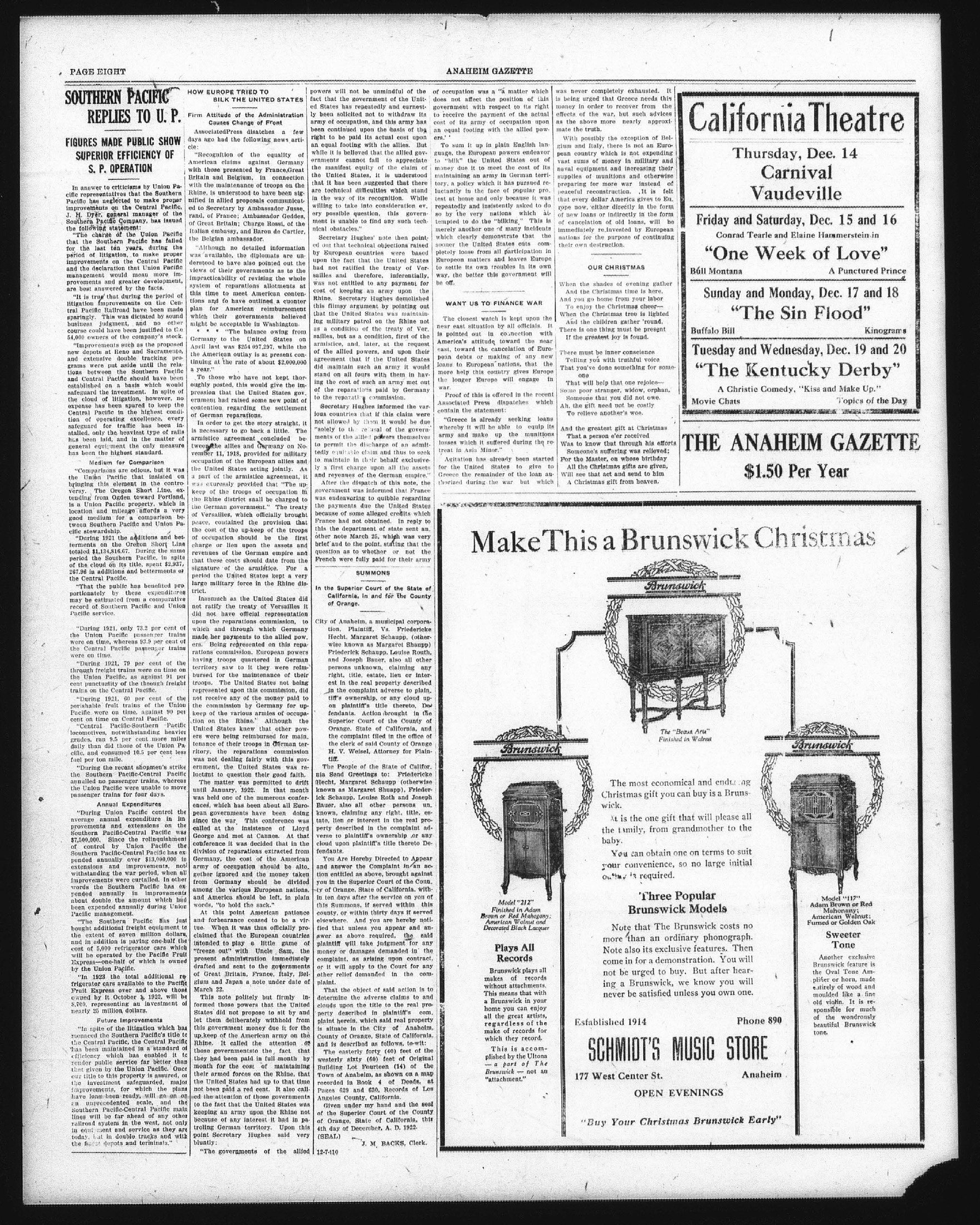
Searchable text
SOUTHERN PACIFIC REPLIES TO U.P.
FIGURES MADE PUBLIC SHOW SUPERIOR EFFICIENCY OF S. P. OPERATION
In answer to criticisms by Union Pacific representatives that the Southern Pacific has neglected to make proper improvements on the Central Pacific, J. H. Dyer, general manager of the Southern Pacific Company, has issued the following statement:
"The charge of the Union Pacific that the Southern Pacific has failed for the last ten years, during the period of litigation, to make proper improvements on the Central Pacific and the declaration that Union Pacific management would mean more improvements and greater development, are best answered by the facts.
"It is true that during the period of litigation improvements on the Central Pacific Railroad have been made sparingly. This was dictated by sound business judgment, and no other course could have been justified to the 54,000 owners of the company's stock.
"Improvements such as the proposed new depots at Reno and Sacramento, and extensive double tracking programs were put aside until the relations between the Southern Pacific and Central Pacific should have been established on a basis which would safeguard the investment. In spite of the cloud of litigation, however, no expense has been spared to keep the Central Pacific in the highest condition of operating excellence, every safeguard for traffic has been installed, only the heaviest type of rails has been laid, and in the matter of general equipment the only measure has been the highest standard."
HOW EUROPE TRIED TO BILK THE UNITED STATES
Firm Attitude of the Administration Causes Change of Front
Associated Press disatches a few days ago had the following news article:
"Recognition of the equality of American claims against Germany with those presented by France,Great Britain and Belgium, in connection with the maintenance of troops on the Rhine, is understood to have been signified in allied proposals communicated to Secretary by Ambassador Jusse, rand, of France; Ambassador Geddes, of Great Britain; Charge Rossi, of the Italian embassy, and Baron de Cartier, the Belgian ambassador.
Although no detailed information was available, the diplomats are understood to have also pointed out the views of their governments as to the impracticability of revising the whole system of reparations allotments at this time to meet American contentions and to have outlined a counter plan for American reimbursement which their governments believed might be acceptable in Washington.
* * * "The balance owing from Germany to the United States on April last was $254 097,297, while the American outlay is at present continuing at the rate of about $2,000,000 a year."
To those who have not kept thoroughly posted, this would give the impression that the United States government had raised some new point of contention regarding the settlement of German reparations.
In order to get the story straight, it is necessary to go back a little. The armistice agreement concluded between the allies and Germany on November 11, 1918, provided for military powers will not be fact that the governed States has repeatedly been solicited by army of occupation been continued upright to be paid by an equal footing while it is believed errments cannot the manifest equate the United States that it has been said are technical difficult in the way of its willing to take inery possible question is unable to technical obstacles."
Secretary Hughes out that technique by European coupon upon the fact that had not ratified saillies and there was not entitled cost of keeping Rhine. Secretary this films argument that the United States military patrol as a condition saillies, but as a co armistice, and, of the allied power agreement that did maintain such stand on all four ing the cost of suf of the reparatio to the reparati-
Secretary Hughes lous countries tha not allowed by t "solely to th re mentions of the allie to permit the di tedly equitable cl
and extensive double spacing.
Medium for Comparison
"Comparisons are odious, but it was the Union Pacific that insisted on bringing this element in the controversy. The Oregon Short Line, extending from Ogden toward Portland, is a Union Pacific property, which in location and mileage affords a very good medium for a comparison between Southern Pacific and Union Pacific stewardship.
"During 1921 the additions and betterments on the Oregon Short Line totaled $1,134,816.07. During the same period the Southern Pacific, in spite of the cloud on its title, spent $2,937,267.96 in additions and betterments of the Central Pacific.
"That the public has benefited proportionately by these expenditures may be estimated from a comparative record of Southern Pacific and Union Pacific service.
"During 1921, only 73.2 per cent of the Union Pacific passenger trains were on time, whereas 93.9 per cent of the Central Pacific passenger trains were on time.
"During 1921, 79 per cent of the through freight trains were on time on the Union Pacific, as against 91 per cent punctuality of the through freight trains on the Central Pacific.
"During 1921, 60 per cent of the perishable fruit trains of the Union Pacific were on time, against 90 per cent on time on Central Pacific.
"Central Pacific-Southern Pacific locomotives, notwithstanding heavier grades, ran 9.5 per cent more miles daily than did those of the Union Pacific, and consumed 10.5 per cent less fuel per ton mile.
"During the recent shopmen's strike the Southern Pacific-Central Pacific annuled no passenger trains, whereas the Union Pacific were unable to move passenger trains for four days."
Annual Expenditures
"During Union Pacific control the average annual expenditure in improvements and extensions on the Southern Pacific-Central Pacific was $7,500,000. Since the relinquishment of control by Union Pacific the Southern Pacific-Central Pacific has expended annually over $13,000,000 in expansions and improvements."
During Union Pacific control the average annual expenditure in improvements and extensions on the Southern Pacific-Central Pacific was $7,500,000. Since the relinquishment of control by Union Pacific the Southern Pacific-Central Pacific has expended annually over $13,000,000 in extensions and improvements, notwithstanding the war period, when all improvements were curtailed. In other words the Southern Pacific has expended annually in improvements about double the amount which had been expended annually during Union Pacific management.
"The Southern Pacific has just bought additional freight equipment to the extent of seven million dollars, and in addition is paying one-half the cost of 5,000 refrigerator cars which will be operated by the Pacific Fruit Express—one-half of which is owned by the Union Pacific.
"In 1923 the total additional refrigerator cars available to the Pacific Fruit Express over and above those owned by it October 1, 1922, will be 8,700, representing an investment of nearly 25 million dollars.
Future improvements
"In spite of the litigation which has monacled the Southern Pacific's title to the Central Pacific, the Central Pacific has been maintained in a standard of efficiency which has enabled it to render public service far better than that given by the Union Pacific. Once our title to this property is assured, or the investment safeguarded, major improvements, for which the plans have long been ready, will go on on an unprecedented scale, and the Southern Pacific-Central Pacific main lines will be far ahead of any other railroad system in the west, not only in equipment and service as they are today, but in double tracks and with the finest depots and terminals."
The matter was permitted to drift until January, 1922. In that month was held one of the numerous conferences, which has been about all European governments have been doing since the war. This conference was called at the insistence of Lloyd George and met at Cannes. At that conference it was decided that in the division of reparations extracted from Germany, the cost of the American army of occupation should be alto-gether ignored and the money taken from Germany should be divided among the various European nations, and America should be left, in plain words, "to hold the sack."
At this point American patience and forbearance ceased to be a virtue. When it was thus officially proclaimed that the European countries intended to play a little game of "freeze out" with Uncle Sam, the present administration immediately drafted and sent to the governments of Great Britain, France, Italy, Belgium and Japan a note under date of March 22.
This note politely but firmly informed those powers that the United States did not propose to sit by and let them deliberately withhold from this government money due it for the upkeep of the American army on the Rhine. It called the attention of those governments to the fact that they had been paid in full month by month for the cost of maintaining their armed forces on the Rhine, that the United States had up to that time not been paid a red cent. It also called the attention of those governments to the fact that the United States was keeping an army upon the Rhine not because of any interest it had in patrolling German territory. Upon this point Secretary Hughes said very bluntly:
"The governments of the allied
ANAHEIM GAZETTE
powers will not be unmindful of the fact that the government of the United States has repeatedly and earnestly been solicited not to withdraw its army of occupation, and this army has been continued upon the basis of the right to be paid its actual cost upon an equal footing with the allies. But while it is believed that the allied governments cannot fail to appreciate the manifest equity of the claim of the United States, it is understood that it has been suggested that there are technical difficulties which stand in the way of its recognition. While willing to take into consideration every possible question, this government is unable to find any such technical obstacles."
Secretary Hughes' note then pointed out that technical objections raised by European countries were based upon the fact that the United States had not ratified the treaty of Versailles and therefore, inferentially, was not entitled to any payment for cost of keeping an army upon the Rhine. Secretary Hughes demolished this flimsy argument by pointing out that the United States was maintaining military patrol on the Rhine not as a condition of the treaty of Versailles, but as a condition, first of the armistice, and later, at the request of the allied powers, and upon their agreement that if the United States did maintain such an army it would stand on all fours with them in having the cost of such an army met out of the reparations paid by Germany to the reparations commission.
Secretary Hughes informed the various countries that if this claim were not allowed by them it would be due "solely to the reusal of the governments of the allied powers themselves to permit the discharge of an admitted equitable claim and thus to seek of occupation was a "a matter which does not affect the position of this government with respect to its right to receive the payment of the actual cost of its army of occupation upon an equal footing with the allied powers."'
To sum it up in plain English language, the European powers endeavor to "bilk" the United States out of money due it to meet the cost of its maintaining an army in German territory, a policy which it has pursued reluctantly in the face of popular protest at home and only because it was repeatedly and insistently asked to do so by the very nations which attempted to do the "bilking." This is merely another one of many incidents which clearly demonstrate that the sooner the United States cuts completely loose from all participation in European matters and leaves Europe to settle its own troubles in its own way, the better this government will be off.
WANT US TO FINANCE WAR
The closest watch is kept upon the near east situation by all officials. It is pointed out in connection with America's attitude toward the near east, toward the cancelation of European debts or making of any new loans to European nations, that the more help this country gives Europe the longer Europe will engage in war.
Proof of this is offered in the recent Associated Press dispatches which contain the statement:
"Greece is already seeking loans whereby it will be able to equip its army and make up the munitions losses which it suffered during the retreat in Asia Minor."
was never completely exhausted. It is being urged that Greece needs this money in order to recover from the effects of the war, but such advices as the above more nearly approximate the truth.
With possibly the exception of Belgium and Italy, there is not an European country which is not expending vast sums of money in military and naval equipment and increasing their supplies of munitions and otherwise preparing for more war instead of peaceful reconstruction. It is felt that every dollar America gives to Europe now, either directly in the form of new loans or indirectly in the form of cancellation of old loans, will be immediately re-invested by European nations for the purpose of continuing their own destruction.
OUR CHRISTMAS
When the shades of evening gather And the Christmas time is here, And you go home from your labor To enjoy the Christmas cheer—When the Christmas tree is lighted And the children gather 'round There is one thing must be present If the greatest joy is found.
There must be inner conscience Telling you with truthful voice That you've done something for someone That will help that one rejoice—Some poor stranger, widow, orphan, Someone that you did not owe. Ah, the gift need not be costly To relieve another's woe.
And the greatest gift at Christmas That a person e'er received Was to know that through his efforts Someone's suffering was relieved;
Secretary Hughes informed the various countries that if this claim were not allowed by them it would be due "solely to the refusal of the governments of the allied powers themselves to permit the discharge of an admitted equitable claim and thus to seek to maintain in their behalf exclusively a first charge upon all the assets and reyenues of the German empire."
After the dispatch of this note, the government was informed that France was endeavoring to quibble regarding the payments due the United States because of some alleged credits which France had not obtained. In reply to this the department of state sent another note March 25, which was very brief and to the point, stating that the question as to whether or not the French were fully paid for their army.
SUMMONS
In the Superior Court of the State of California, in and for the County of Orange.
City of Anaheim, a municipal corporation, Plaintiff, Vs. Friederick Hecht, Margaret Schaupp, (otherwise known as Margaret Shuapp) Friederick Schaupp, Louise Routh, and Joseph Bauer, also all other persons unknown, claiming any right, title, estate, lien or interest in the real property described in the complaint adverse to plaintiff's ownership, or any cloud upon plaintiff's title thereto. Defendants. Action brought in the Superior Court of the County of Orange, State of California, and the complaint filed in the office of the clerk of said County of Orange H. V. Weisel, Attorney for Plaintiff.
The People of the State of California Send Greetings to: Friederick Hecht, Margaret Schaupp (otherwise known as Margaret Shuapp), Friederick Schaupp, Louise Roth and Joseph Bauer, also all other persons unknown, claiming any right, title, estate, lien or interest in the real property described in the complaint adverse to plaintiff's ownership or any cloud upon plaintiff's title thereto. Defendants.
You Are Hereby Directed to Appear and answer the Complaint in soo
Telling you with trivial voice That you've done something for someone That will help that one rejoice—Some poor stranger, widow, orphan Someone that you did not owe. Ah, the gift need not be costly To relieve another's woe.
And the greatest gift at Christmas That a person e'er received Was to know that through his efforts Someone's suffering was relieved; For the Master, on whose birthday All the Christmas gifts are given, Will see that act and send to him A Christmas gift from heaven.
nia Send Greetings to: Friedericke Hecht, Margaret Schaupp (otherwise known as Margaret Shuapp), Friedlerick Schaupp, Louise Roth and Joseph Bauer, also all other persons unknown, claiming any right, title, estate, lien or interest in the real property described in the complaint adverse to plaintiff's ownership or any cloud upon plaintiff's title thereto Defendants.
You Are Hereby Directed to Appear and answer the Complaint in an action entitled as above, brought against you in the Superior Court of the County of Orange, State of California, within ten days after the service on you of this Summons, if served within this county, or within thirty days if served elsewhere. And you are hereby notified that unless you appear and answer as above required, the said plaintiff will take judgment for any money or damages demanded in the complaint, as arising upon contract, or it will apply to the Court for any other relief demanded in the complaint.
That the object of said action is to determine the adverse claims to and clouds upon the title to the real property described in plaintiff's complaint herein, which said real property is situate in the City of Anaheim, County of Orange, State of California, and is described as follows, to-wit:
The easterly forty (40) feet of the westerly sixty (60) feet of Original Building Lot Fourteen (14) of the Town of Anaheim, as shown on a map recorded in Book 4 of Deeds, at Pages 629 and 630, Records of Los Angeles County, California.
Given under my hand and the seal of the Superior Court of the County of Orange, State of California, this 4th day of December, A. D. 1922.
(J. M. BACKS, Clerk)
Model "212"
Finished in Adam Brown or Red Mahogany; American Walnut and Decorated Black Lacquer
Plays All Records
Brunswick plays all makes of records without attachments. This means that with a Brunswick in your home you can enjoy all the great artists, regardless of the make of records for which they record.
This is accomplished by the Ultona — a part of The Brunswick — not an "attachment."
California Theatre
Thursday, Dec. 14
Carnival
Vaudeville
Friday and Saturday, Dec. 15 and 16
Conrad Tearle and Elaine Hammerstein in
"One Week of Love"
Búll Montana A Punctured Prince
Sunday and Monday, Dec. 17 and 18
"The Sin Flood"
Buffalo Bill Kinograms
Tuesday and Wednesday, Dec. 19 and 20
"The Kentucky Derby"
A Christie Comedy, "Kiss and Make Up."
Movie Chats Topics of the Day
THE ANAHEIM GAZETTE
"The Kentucky Derby"
A Christie Comedy, "Kiss and Make Up."
Movie Chats Topics of the Day
THE ANAHEIM GAZETTE
$1.50 Per Year
Brunswick Christmas
The "Beaux Arts"
Finished in Walnut
The most economical and enduring Christmas gift you can buy is a Brunswick.
It is the one gift that will please all family, from grandmother to the boy.
You can obtain one on terms to suit convenience, so no large initial
The most economical and enduring Christmas gift you can buy is a Brunswick.
It is the one gift that will please all family, from grandmother to the boy.
You can obtain one on terms to suit your convenience, so no large initial fee is required.
Three Popular Brunswick Models
Note that The Brunswick costs no more than an ordinary phonograph. It also its exclusive features. Then one in for a demonstration. You will be urged to buy. But after hearing a Brunswick, we know you will never be satisfied unless you own one.
ed 1914 Phone 890
MIDT'S MUSIC STORE
Center St. Anaheim
OPEN EVENINGS
Your Christmas Brunswick Early"
Model "117"
Adam Brown or Red Mahonany;
American Walnut;
Fumed or Golden Oak
Sweeter Tone
Another exclusive Brunswick feature is the Oval Tone Amplifier or horn, made entirely of wood and moulded like a fine old violin. It is responsible for much of the wondrously beautiful Brunswick tone.