anaheim-gazette 1922-04-13
Scanned page
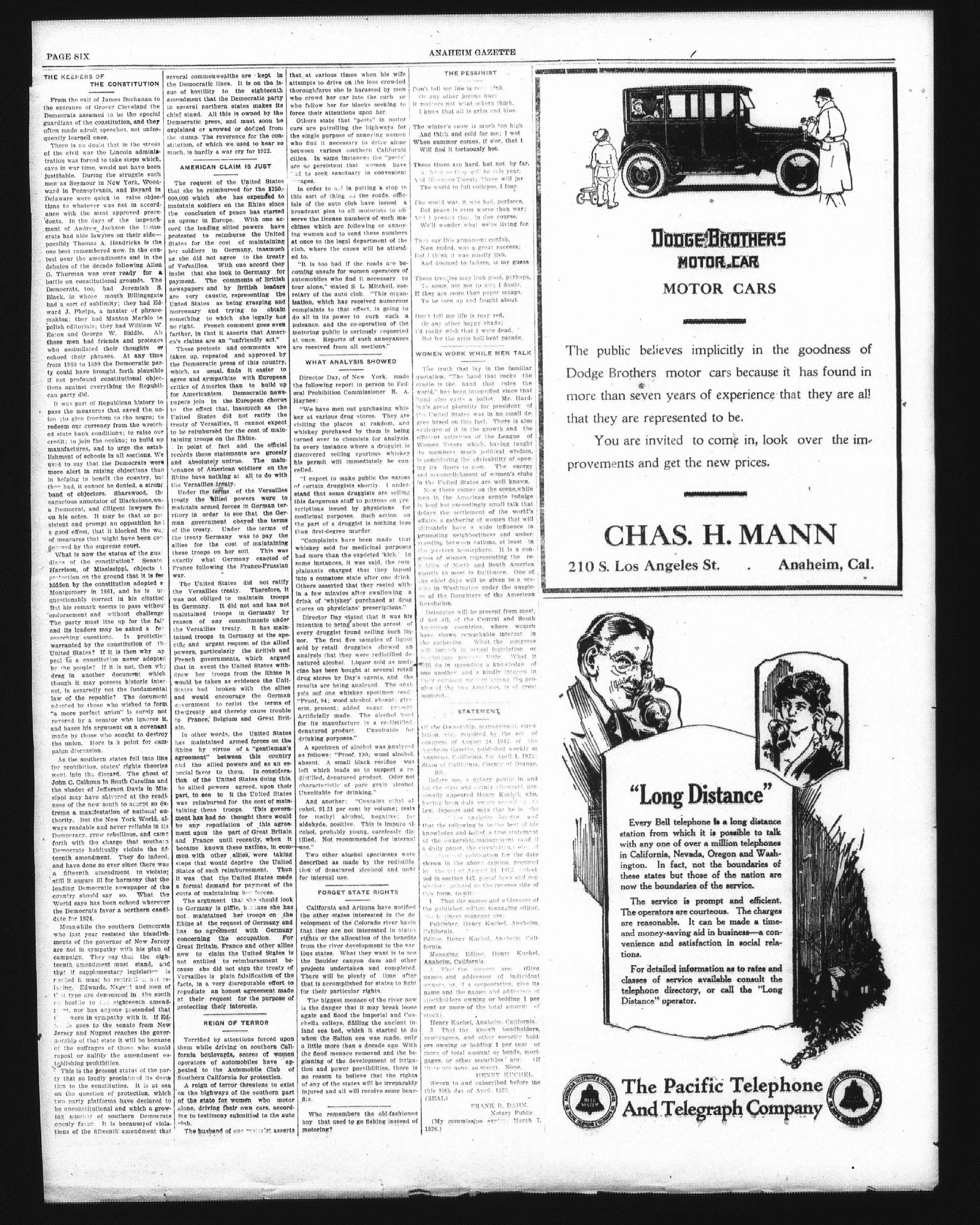
Searchable text
THE KEEPERS OF
THE CONSTITUTION
From the exit of James Buchanan to the entrance of Grover Cleveland the Democrats assumed to be the special guardians of the constitution, and they often made adroit speeches, not unfrequently learned ones.
There is no doubt that in the stress of the civil war the Lincoln administration was forced to take steps which save in war time, would not have been justifiable. During the struggle such men as Seymour in New York, Woodward in Pennsylvania, and Bayard in Delaware were quick to raise objections to whatever was not in accordance with the most approved precedents. In the days of the impeachment of Andrew Jackson the Democrats had able lawyers on their side—possibly Thomas A. Hendricks is the one best remembered now. In the contest over the amendments and in the debates of the decade following Allen G. Thurman was ever ready for a battle on constitutional grounds. The Democrats, too, had Jeremiah S. Black, in whose mouth Billingsgate had a sort of sublimity; they had Edward J. Phelps, a master of phrase-making; they had Manton Marble to polish editorials; they had William W. Eaton and George W. Biddle. All these men had friends and proteges who assimilated their thoughts or echoed their phrases. At any time from 1860 to 1890 the Democratic party could have brought forth plausible if not profound constitutional objections against everything the Republican party did.
It was part of Republican history to pass the measures that saved the union; to give freedom to the negro; to redeem our currency from the wretched state bank conditions; to raise our credit; to join the ecclesians; to build up manufactures, and to urge the establishment of schools in all sections. We several commonwealths are kept in the Democratic lines. It is on the issue of hostility to the eighteenth amendment that the Democratic party in several northern states makes its chief stand. All this is owned by the Democratic press, and must soon be explained or avowed or dodged from the stump. The reverence for the constitution, of which we used to hear so much, is hardly a war cry for 1922.
AMERICAN CLAIM IS JUST
The request of the United States that she be reimbursed for the $250,000,000 which she has expended to maintain soldiers on the Rhine since the conclusion of peace has started an uproar in Europe. With one accord the leading allied powers have protested to reimburse the United States for the cost of maintaining her soldiers in Germany, inasmuch as she did not agree to the treaty of Versailles. With one accord they insist that she look to Germany for payment. The comments of British newspapers and by British leaders are very caustic, representing the United States as being grasping and mercenary and trying to obtain something to which she legally has no right. French comment goes even farther, in that it asserts that America's claims are an "unfriendly act."
These protests and comments are taken up, repeated and approved by the Democratic press of this country, which, as usual, finds it easier to agree and sympathize with European critics of America than to build up Americanism. Democratic newspapers join in the European chorus to the effect that, inasmuch as the United States did not ratify the treaty of Versailles, it cannot expect to be reimbursed for the cost of maintaining troops on the Rhine.
In point of fact and the official records these statements are grossly that at various times we attempts to drive on the thoroughfares she is hard who crowd her car into who follow her for block force their attentions upon Others state that "pess cars are patrolling the single purpose of annuity who find it necessary to between various southern cities. In some instances are so persistent that they had to seek sanctuary in pages.
In order to aid in putting this sort of thing on their fails of the auto club he broadcast plea to all more serve the license number chines which are following women and to send them at once to the legal department club, where the cases were ed to.
"It is too bad if there coming unsafe for women automobiles who find it tour alone," stated S. L. retary of the auto club.ization, which has received complaints to that effect do all in its power to persuance, and the co-operative motoring public is serious at once. Reports of such are received from all se
WHAT ANALYSIS
Director Day, of New York, the following report in general Prohibition Commission Haynes:
"We have men out put key at various drug stores visiting the places at whiskey purchased by turned over to chemists. In every instance where discovered selling spruce."
from 1860 to 1890 the Democratic party could have brought forth plausible if not profound constitutional objections against everything the Republican party did.
It was part of Republican history to pass the measures that saved the union; to give freedom to the negro; to redeem our currency from the wretched state bank conditions; to raise our credit; to join the occans; to build up manufactures, and to urge the establishment of schools in all sections. We used to say that the Democrats were more alert in raising objections than in helping to benefit the country, but they had, it cannot be denied, a strong band of objectors. Sharswood, the sagacious annotator of Blackstone, was a Democrat, and diligent lawyers fed on his notes. It may be that so persistent and prompt an opposition had a good effect, that it blocked the way of measures that might have been condemned by the supreme court.
What is now the status of the guards of the constitution? Senate Harrison, of Mississippi, objects protection on the ground that it is fabled by the constitution adopted Montgomery in 1861, and he is unquestionably correct in his citation. But his remark seems to pass without endorsement and without challenge. The party must line up for the fall and its leaders may be asked a few searching questions. Is protection warranted by the constitution of the United States? If it is then why appeal to a constitution never adopted by the people? If it is not, then why drag in another document which though it may possess historic interest, is assuredly not the fundamental law of the republic? The document adopted by those who wished to form "a more perfect union" is surely not revered by a senator who ignores it, and bases his argument on a covenant made by those who sought to destroy the union. Here is a point for campaign discussion.
As the southern states fell into line for prohibition, states' rights theories went into the discard. The ghost of John C. Calhoun In South Carolina and the shades of Jefferson Davis in Mississippi may have shivered at the readiness of the new south to accept so extreme a manifestation of national authority. But the New York World, always readable and never reliable in its Democracy, grew rebellious, and came forth with the charge that southern Democrats habitually violate the fifteenth amendment. They do indeed, and have done so ever since there was the Democratic press of this country, which, as usual, finds it easier to agree and sympathize with European critics of America than to build up for Americanism. Democratic newspapers join in the European chorus to the effect that, inasmuch as the United States did not ratify the treaty of Versailles, it cannot expect to be reimbursed for the cost of maintaining troops on the Rhine.
In point of fact and the official records these statements are grossly and absolutely untrue. The maintenance of American soldiers on the Rhine have nothing at all to do with the Versailles treaty.
Under the terms of the Versailles treaty the allied powers were to maintain armed forces in German territory in order to see that the German government obeyed the terms of the treaty. Under the terms of the treaty Germany was to pay the allies for the cost of maintaining these troops on her soil. This was exactly what Germany exacted of France following the Franco-Prussian war.
The United States did not ratify the Versailles treaty. Therefore, it was not obliged to maintain troops in Germany. It did not and has not maintained troops in Germany by reason of any commitments under the Versailles treaty. It has maintained troops in Germany at the specific and urgent request of the allied powers, particularly the British and French governments, which argued that in event the United States withdrew her troops from the Rhine it would be taken as evidence the United States had broken with the allies and would encourage the German government to resist the terms of the treaty and thereby cause trouble to France, Belgium and Great Britain.
In other words, the United States has maintained armed forces on the Rhine by virtue of a "gentleman's agreement" between this country and the allied powers and as an especial favor to them. In consideration of the United States doing this, the allied powers agreed, upon their part, to see to it the United States was reimbursed for the cost of maintaining these troops. This government has had no thought there would be any repudiation of this agreement upon the part of Great Britain and France until recently, when it became known these nations, in common with other allies, were taking steps that would deprive the United
Director Day, of New York, stated in his following report in general Prohibition Commission Haynes:
"We have men out put key at various drug stores visiting the places at whiskey purchased by turned over to chemists. In every instance where discovered selling spruce his permit will immediately ceilled."
"I expect to make pulp of certain druggists should stand that some druggist this dangerous stuff to prescriptions issued by pure medicinal purposes. So the part of a druggist than first-degree murder.
"Complaints have been whiskey sold for medicine had more than the expected some instances, it was plainnies charged that into a comatose state others asserted that tha in a few minutes after drink of 'whiskey' purposes on physicians' pu"
Director Day stated his intention to bring about every druggist found suicid. The first five said by retail druggists analysis that they were natured alcohol. Liquice cine has been bought a drug stores by Day's results are being analys oof one whiskey "Proof, 94; wood alcoholerin present; added Artificially made. Thi for its manufacture is denatured product drinking purposes."
A specimen of alcohol as follows: "Proof, 190 absent. A small black left which leads us t distilled, denatured pro characteristic of pure Unsuitable for drinking.
And another: "Coohol, 91.21 per cent b for methyl alcohol aldehyde positive. T coohol probably young tilled. Not recommen use."
Two other alcohol described as made b
went into the discard. The ghost of John C. Calhoun in South Carolina and the shades of Jefferson Davis in Mississippi may have shivered at the readiness of the new south to accept so extreme a manifestation of national authority. But the New York World, always readable and never reliable in its Democracy, grew rebellious, and came forth with the charge that southern Democrats habitually violate the fifteenth amendment. They do indeed, and have done so ever since there was a fifteenth amendment to violate; still it augurs ill for harmony that the leading Democratic newspaper of the country should say so. What the World says has been echoed wherever the Democrats favor a northern candidate for 1924.
Meanwhile the southern Democrats who last year resisted the blandishments of the governor of New Jersey are not in sympathy with his plan of campaign. They say that the eighteenth amendment must stand, and that if supplementary legislation is needed it must be restrictive, not relaxing. Edwards, Nugent and men of that type are denounced in the south on hostile to the eighteenth amendment, nor has anyone pretended that they were in sympathy with it. If Edwards goes to the senate from New Jersey and Nugent reaches the governorship of that state it will be because of the suffrages of those who would repeal or nullify the amendment establishing prohibition.
This is the present status of the party that so loudly proclaimed its devotion to the constitution. It is at sea on the question of protection, which two party platforms have declared to be unconstitutional and which a growing number of southern Democrats openly favor. It is because of violations of the fifteenth amendment that special favor to them. In consideration of the United States doing this, the allied powers agreed, upon their part, to see to it the United States was reimbursed for the cost of maintaining these troops. This government has had no thought there would be any repudiation of this agreement upon the part of Great Britain and France until recently, when it became known these nations, in common with other allies, were taking steps that would deprive the United States of such reimbursement. Then it was that the United States made a formal demand for payment of the costs of maintaining her forces.
The argument that she should look to Germany is piffle, because she has not maintained her troops on the Rhine at the request of Germany and has no agreement with Germany concerning the occupation. For Great Britain, France and other allies now to claim the United States is not entitled to reimbursement because she did not sign the treaty of Versailles is plain falsification of the facts, in a very disreputable effort to repudiate an honest agreement made at their request for the purpose of protecting their interests.
REIGN OF TERROR
Terrified by attentions forced upon them while driving on southern California boulevards, scores of women operators of automobiles have appealed to the Automobile Club of Southern California for protection.
A reign of terror threatens to exist on the highways of the southern part of the state for women who motor alone, driving their own cars, according to testimony submitted to the auto club.
The husband of one motorist asserts
that at various times when his wife attempts to drive on the less crowded thoroughfares she is harassed by men who crowd her car into the curb or who follow her for blocks seeking to force their attentions upon her.
Others state that "pests" in motor cars are patrolling the highways for the single purpose of annoying women who find it necessary to drive alone between various southern California cities. In some instances the "pests" are so persistent that women have had to seek sanctuary in convenient images.
In order to aid in putting a stop to this sort of thing on the roads, officials of the auto club have issued a broadcast plea to all motorists to observe the license numbers of such machines which are following or annoying women and to send these numbers at once to the legal department of the club, where the cases will be attended to.
"It is too bad if the roads are becoming unsafe for women operators of automobiles who find it necessary to tour alone," stated S. L. Mitchell, secretary of the auto club. "This organization, which has received numerous complaints to that effect, is going to do all in its power to curb such a pulsance, and the co-operation of the motoring public is seriously requested at once. Reports of such annoyances are received from all sections."
WHAT ANALYSIS SHOWED
Director Day, of New York, made the following report in person to Federal Prohibition Commissioner R. A. Haynes:
"We have men out purchasing whiskey at various drug stores. They are visiting the places at random, and whiskey purchased by them is being turned over to chemists for analysis. In every instance where a druggist is discovered selling spurious whiskey
THE PESSIMIST
Don't tell me life is rosy pink.
Or any other joyous hue;
It matters not what others think.
I know that all is grim and blue.
The winter's snow is much too high
And thick and cold for me; I wot
When summer comes, if e'er, that I
Will find it tortuously hot.
These times are hard, but not, by far,
At hand as they will be this year,
And Nineteen Twenty Three will jar
The world to full collapse, I fear.
The world war, it was bad, perforce,
But peace is even worse than war;
And I predict that, in due course,
We'll wonder what we're living for.
They say this armament confab,
Now ended, was a great success;
But I think it was mostly gab,
And doomed to failure, is my guess.
These treasures may look good, perhaps,
To some, but not to me; I doubt.
If they are more than paper scraps,
To be torn up and fought about.
Don't tell me life is rosy red,
Or any other happy shade;
I'd really wish that I were dead.
But for the grim hell-bent parade.
WOMEN WORK WHILE MEN TALK
The truth that lay in the familiar quotation, "The hand that rocks the cradle is the hand that rules the world," has been intensified since that hand also casts a ballot. Mr. Harding's great plurality for president of the United States was in no small degree based on this fact. There is also evidence of it in the growth and the efficient activities of the League of Women Voters which, having taught its members much political wisdom,
Director Day, of New York, made the following report in person to Federal Prohibition Commissioner R. A. Haynes:
"We have men out purchasing whiskey at various drug stores. They are visiting the places at random, and whiskey purchased by them is being turned over to chemists for analysis. In every instance where a druggist is discovered selling spurious whiskey his permit will immediately be cancelled.
"I expect to make public the names of certain druggists shortly. I understand that some druggists are selling this dangerous stuff to patrons on prescriptions issued by physicians for medicinal purposes. Such action on the part of a druggist is nothing less than first-degree murder.
"Complaints have been made that whiskey sold for medicinal purposes had more than the expected 'kick.' In some instances, it was said, the complainants charged that they lapsed into a comatose state after one drink. Others asserted that they reeled within a few minutes after swallowing a drink of 'whiskey' purchased at drug stores on physicians' prescriptions."
Director Day stated that it was his intention to bring about the arrest of every druggist found selling such liquor. The first five samples of liquor sold by retail druggists showed an analysis that they were redistilled denatured alcohol. Liquor sold as medicine has been bought at several retail drug stores by Day's agents, and the results are being analyzed. The analysis of one whiskey specimen read: "Proof, 94; wood alcohol, absent; glycerin, present; added sugar, present Artificially made. The alcohol used for its manufacture is a redistilled denatured product. Unsuitable for drinking purposes."
A specimen of alcohol was analyzed as follows: "Proof, 190; wood alcohol, absent. A small black residue was left which leads us to suspect a redistilled, denatured product. Odor not characteristic of pure grain alcohol. Unsuitable for drinking."
And another: "Contains ethyl alcohol, 91.21 per cent by volume; tests for methyl alcohol, negative; for aldehyde, positive. This is impure alcohol, probably young, carelessly distilled. Not recommended for internal use."
Two other alcohol specimens were described as made by the redistillera
The truth that lay in the familiar quotation, "The hand that rocks the cradle is the hand that rules the world," has been intensified since that hand also casts a ballot. Mr. Harding's great plurality for president of the United States was in no small degree based on this fact. There is also evidence of it in the growth and the efficient activities of the League of Women Voters which, having taught its members much political wisdom, is considering the advisability of opening its doors to men. The energy and accomplishment of women's clubs in the United States are well known.
Now there comes on the scene, while men in the American senate indulge in loud but exceedingly small talk that delays the settlement of the world's affairs, a gathering of women that will ultimately have a wide influence in promoting neighborliness and understanding between nations, at least in the western hemisphere. It is a congress of women representing the republics of North and South America shortly to meet in Baltimore. One of the chief days will be given to a session in Washington under the auspices of the Daughters of the American Revolution.
Delegates will be present from most, if not all, of the Central and South American countries, where women have shown remarkable interest in the gathering. What the congress will furnish in actual legislation or resolutions matters little. What it will do in spreading a knowledge of one another and a kindly interest in their common welfare among the peoples of the two Americas, is of great moment.
STATEMENT
Of the Ownership, management, circulation, etc., required by the act of Congress of August 24, 1912, of the Anaheim Gazette, published weekly at Anaheim, California, for April 1, 1922: State of California, County of Orange, S.S.
Before me, a notary public in and for the state and county offices said personally appeared Henry Kuchol, who having been daily sworn according to law, deposes and says that he is the Anaheim Gazette and that the following is to the best of his knowledge and belief, a true statement of the ownership/management (and if a daily paper, the circulation), etc., of foreseen publication for the date shown in the above caption, required.
FORGET STATE RIGHTS
California and Arizona have notified the other states interested in the development of the Colorado river basin that they are not interested in state rights or the allocation of the benefits from the river development to various states. What they want is to see the Boulder canyon dam and other projects undertaken and completed. There will be plenty of time after that is accomplished for states to fight for their particular rights.
The biggest menace of the river now is the danger that it may break loose again and flood the Imperial and Coachella valleys, filling the ancient inland sea bed, which it started to do when the Salton sea was made, only a little more than a decade ago. With the flood menace removed and the beginning of the development of irrigation and power possibilities, there is no reason to believe that the rights of any of the states will be irreparably injured and all will receive some benefits.
Who remembers the old-fashioned boy that used to go fishing instead of motoring?
Before me, a notary public in and for the state and county offices said personally appeared Henry Kuchel, who having been daily sworn according to law, deposes and says that he is the Anaheim Gazette and that the following is to the best of his knowledge and belief, a true statement of the ownership/management (and if a daily paper, the circulation) etc. of this publication for the date shown in the above caption, required by the act of August 24, 1912, embodied in section 443, postal laws and regulations printed on the reverse side of this form, to wit:
1. That the names and addresses of the publisher, editor, managing editor, business manager are:
Publisher, Henry Kuchel, Anaheim, California.
Editor, Henry Kuchel, Anaheim, California.
Managing Editor, Henry Kuchel, Anaheim, California.
2. That the owners are: (Give names and addresses of individual owners, or if a corporation, give its name and the names and addresses of stockholders owning or holding 1 per cent or more of the total amount of stock).
Henry Kuchel, Anaheim, California.
3. That the known bondholders, mortgagees, and other security holders owning or holding 1 per cent or more of total amount or bonds, mortgages, or other securities are: (If there are none, so state). None.
HENRY KUCHEL
Sworn to and subscribed before me this 10th day of April, 1922.
SEAL
FRANK R. DAHN.
Notary Public.
(My commission expires March 7, 1926.)
DODGE BROTHERS
MOTOR CAR
MOTOR CARS
public believes implicitly in the goodness of Brothers motor cars because it has found in seven years of experience that they are all
are represented to be.
u are invited to come in, look over the im-
Brothers motor cars because it has found in
an seven years of experience that they are all
are represented to be.
u are invited to come in, look over the iments and get the new prices.
CHAS. H. MANN
Los Angeles St. . Anaheim, Cal.
"Long Distance"
Every Bell telephone is a long distance
station from which it is possible to talk
with any one of over a million telephones
in California, Nevada, Oregon and Wash-
"Long Distance"
Every Bell telephone is a long distance station from which it is possible to talk with any one of over a million telephones in California, Nevada, Oregon and Washington. In fact, not the boundaries of these states but those of the nation are now the boundaries of the service.
The service is prompt and efficient. The operators are courteous. The charges are reasonable. It can be made a time-and money-saving aid in business—a convenience and satisfaction in social relations.
For detailed information as to rates and classes of service available consult the telephone directory, or call the "Long Distance" operator.
The Pacific Telephone And Telegraph Company