anaheim-gazette 1922-03-02
Scanned page
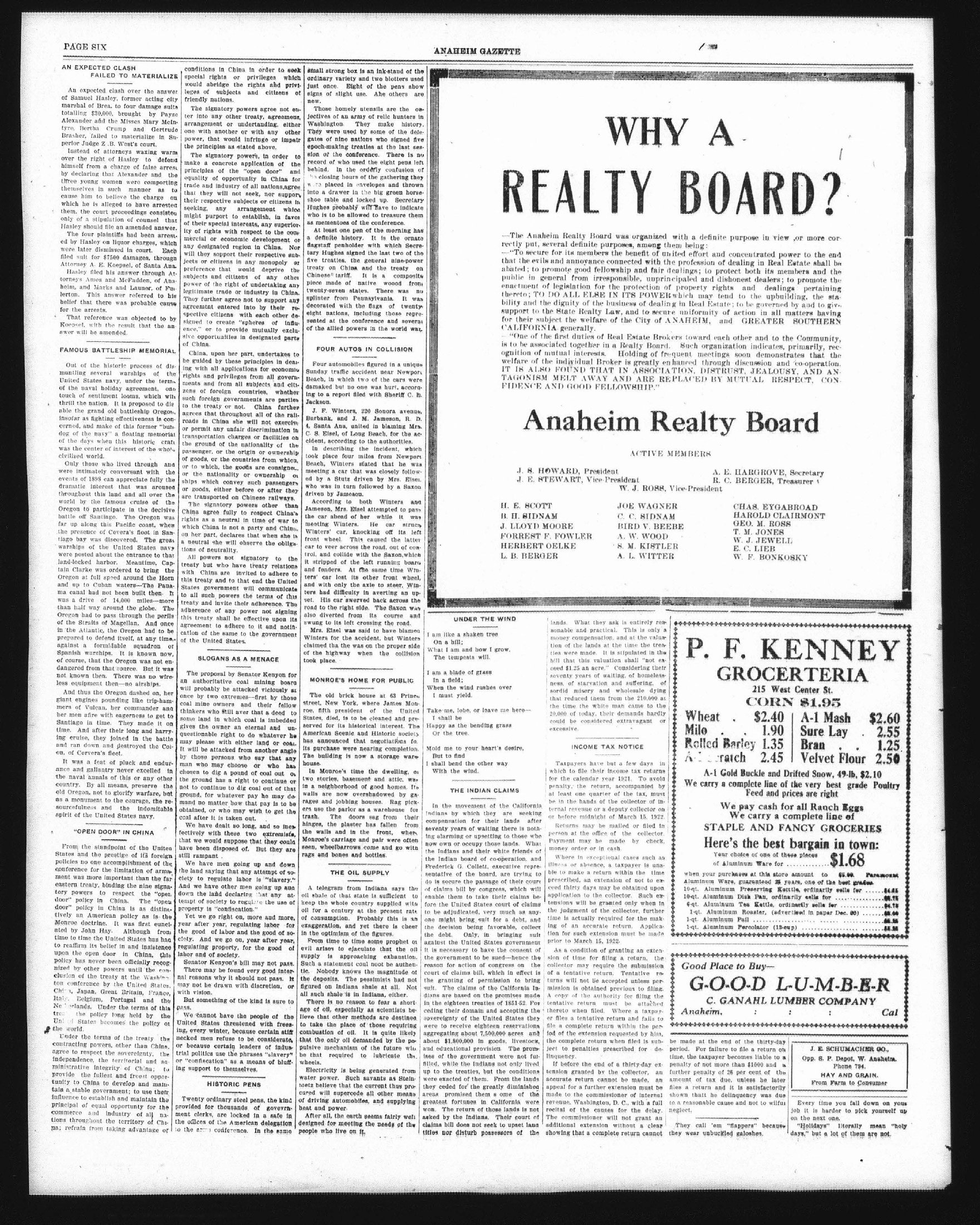
Searchable text
AN EXPECTED CLASH
FAILED TO MATERIALIZE
An expected clash over the answer of Samuel Hasley, former acting city marshal of Brea, to four damage suits totalling $20,000, brought by Payse Alexander and the Misses Mary McIntyre, Bertha Crump and Gertrude Brasher, failed to materialize in Superior Judge Z.B. West's court.
Instead of attorneys waxing warm over the right of Hasley to defend himself from a charge of false arrest by declaring that Alexander and the three young women were complying themselves in such manner as to cause him to believe the charge on which he is alleged to have arrested them, the court proceedings consisted only of a stipulation of counsel that Hasley should file an amended answer.
The four plaintiffs had been arrested by Hasley on liquor charges, which were later dismissed in court. Each filed suit for $7500 damages, through Attorney A.E.Koepsel, of Santa Ana.
Hasley filed his answer through Attorneys Ames and McFadden, of Anheim, and Marks and Launer, of Furlerton. This answer referred to his belief that there was probable cause for the arrests.
That reference was objected to by Koepsel, with the result that the answer will be amended.
FAMOUS BATTLESHIP MEMORIAL
Out of the historic process of dismantling several warships of the United States navy, under the terms of the naval holiday agreement, one touch of sentiment looms, which will thrill the nation. It is proposed to disable the grand old battleship Oregon, insofar as fighting effectiveness is concerned, and make of this former "bundog of the navy" a floating memorial of the days when this historic craft was the center of interest of the whole civilized world.
conditions in China in order to seek special rights or privileges which would abridge the rights and privileges of subjects and citizens of friendly nations.
The signatory powers agree not enter into any other treaty, agreement, arrangement or undertanding, either one with another or with any other power, that would infringe or impair the principles as stated above.
The signatory powers, in order to make a concrete application of the principles of the "open door" and equality of opportunity in China for trade and industry of all nations, agree that they will not seek, nor support their respective subjects or citizens in seeking, any arrangement which might purport to establish, in favor of their special interests, any superiority of rights with respect to the commercial or economic development or any designated region in China. Nor will they support their respective subjects or citizens in any monopoly or preference that would deprive the subjects and citizens of any other power of the right of undertaking any legitimate trade or industry in China. They further agree not to support any agreement entered into by their respective citizens with each other designed to create "spheres of influence," or to provide mutually exclusive opportunities in designated parts of China.
China, upon her part, undertakes to be guided by these principles in dealing with all applications for economic rights and privileges from all governments and from all subjects and citizens of foreign countries, whether such foreign governments are parties to the treaty or not. China further agrees that throughout all of the railroads in China she will not exercise or permit any unfair discrimination in transportation charges or facilities on the ground of the nationality of the passenger, or the origin or ownership small strong box is ordinary variety and just once. Eight signs of slight use new.
Those homely objectives of an army Washington. The They were used by gates of nine nations epoch-making treatment record of who used behind. In the order closing hours were placed in envoy into a drawer in the shoe table and lock Hughes probably who is to be allowed as mementoes of th.
At least one pen a definite history flagstaff penholder tary Hughes signed five treaties, the treaty on China and Chinese tariff. It piece made of naut twenty-seven states splinter from Penn decorated with eight nations, included at the conference of the allied powers.
FOUR AUTOS
Four automobiles Sunday traffic accident Beach, in which two damaked but no one ing to a report filed Jackson.
J.F.Winters, 22 Burbank, and J.M. 4 Santa Ana, united C.S. Elsel, of Long cident, according to In describing thook place four mi
Out of the historic process of dismantling several warships of the United States navy, under the terms of the naval holiday agreement, one touch of sentiment looms, which will thrill the nation. It is proposed to disable the grand old battleship Oregon, insofar as fighting effectiveness is concerned, and make of this former "bundog of the navy" a floating memorial of the days when this historic craft was the center of interest of the who's civilized world.
Only those who lived through and were intimately conversant with the events of 1898 can appreciate fully the dramatic interest that was aroused throughout this land and all over the world by the famous cruise of the Oregon to participate in the decisive battle off Santiago. The Oregon was far up along this Pacific coast, when the presence of Coervera's float in Santiago bay was discovered. The great warships of the United States navy were posted about the entrance to that land-locked harbor. Meantime, Captain Clarke was ordered to bring the Oregon at full speed around the Horn and up to Cuban waters—The Panama canal had not been built then. It was a drive of 14,000 miles—more than half way around the globe. The Oregon had to pass through the perils of the Straits of Magellan. And once in the Atlantic, the Oregon had to be prepared to defend itself, at any time, against a formidable squadron or Spanish warships. It is known now, of course, that the Oregon was not endangered from that source. But it was not known then. There was no wireless equipment then—no airships.
And thus the Oregon dashed on, her giant engines pounding like trip-hammers of Vulcan, her commander and her men afire with eagerness to get to Santiago in time. They made it on time. And after their long and harrying cruise, they joined in the battle and ran down and destroyed the Colon, of Cervera's fleet.
It was a feat of pluck and endurance and gallantry never excelled in the naval annals of this or any other country. By all means, preserve the old Oregon, not to glorify warfare, but as a monument to the courage, the resourcefulness and the indomitable spirit of the United States navy.
"OPEN DOOR" IN CHINA
From the standpoint of the United States and the prestige of its foreign policies no one accomplishment of the be guided by these principles in dealing with all applications for economic rights and privileges from all governments and from all subjects and citizens of foreign countries, whether such foreign governments are parties to the treaty or not. China further agrees that throughout all of the railroads in China she will not exercise or permit any unfair discrimination in transportation charges or facilities on the ground of the nationality of the passenger, or the origin or ownership of goods, or the countries from which, or to which, the goods are consigned, or the nationality or ownership on ships which convey such passengers or goods, either before or after they are transported on Chinese railways.
The signatory powers other than China agree fully to respect China's rights as a neutral in time of war to which China is not a party and China on her part, declares that when she is a neutral she will observe the obligations of neutrality.
All powers not signatory to the treaty but who have treaty relations with China are invited to adhere to this treaty and to that end the United States government will communicate to all such powers the terms of this treaty and invite their adherence. The adherence of any power not signing this treaty shall be effective upon its agreement to adhere to it and notification of the same to the government of the United States.
SLOGANS AS A MENACE
The proposal by Senator Kenyon for an authoritative coal mining board will probably be attacked viciously at once by two extremes—first by those coal mine owners and their fellow thinkers who still aver that a deed to some land in which coal is imbedded gives the owner an eternal and unquestionable right to do whatever he may please with either land or coal. It will be attacked from another angle by those persons who say that any man who may choose or who has chosen to dig a pound of coal out on the ground has a right to continue or not to continue to dig coal out of that ground, for whatever pay he may demand no matter how that pay is to be obtained, or who may wish to get the coal after it is taken out.
We have dealt so long, and so ineffectively with these two extremists, that we would suppose that they could have been disposed of. But they are still rampant.
Four automobiles Sunday traffic accident Beach, in which two damaked but no one ing to a report filed Jackson.
J. F. Winters, 223 Burbank, and J. M. 4, Santa Ana, united C. S. Elsel, of Long Island, according to In describing that took place four miles Beach, Winters stated meeting a car thatwed by a Stutz driver who was in turn follived driven by Jameson.
According to boston Jameson, Mrs. Elsel stated the car ahead of her meeting Winters.
Winters' car, knock front wheel. This car to veer across the trot, and collide with it stripped of the lock and fenders. At these' cars lost its oak and with only the alders had difficulty in set. His car swerved road to the right side also diverted from his swung to its left crook.
Mrs. Elsel was said Winters for the acci claimed tha she was off of the highway whook place.
MONROE'S HOME
The old brick house street, New York, wore fifth president States, died, is to be served for its history American Scenic and has announced that its purchase were new The building is now house.
In Monroe's time two stories, basement in a neighborhood of walls are now over rages and jobbing harsers use the parlor as trash. The doors hinges, the plaster tiled the walls and in tha Monroe's carriage and seen, wheelbarrows crags and bones and
"OPEN DOOR" IN CHINA
From the standpoint of the United States and the prestige of its foreign policies no one accomplishment of the conference for the limitation of armament was more important than the far eastern treaty, binding the nine signatory powers to respect the "open door" policy in China. The "open door" policy in China is as distinctively an American policy as is the Monroe doctrine. It was first enclosed by John Hay. Although from time to time the United States has had to reaffirm its belief in and insistence upon the open door in China, this policy has never been officially recognized by other powers until the conclusion of the treaty at the Washington conference by the United States, China, Japan, Great Britain, France, Italy, Belgium, Portugal and the Netherlands. Under the terms of this treaty the policy long held by the United States becomes the policy of the world.
Under the terms of the treaty the contracting powers, other than China, agree to respect the sovereignty, the independence, the territorial and administrative integrity of China; to provide the fullest and freest opportunity to China to develop and maintain a stable government; to use their influence to establish and maintain the principal of equal opportunity for the commerce and industry of all nations throughout the territory of China; refrain from taking advantage of chosen to dig a pound of coal out on the ground has a right to continue or not to continue to dig coal out of that ground, for whatever pay he may demand no matter how that pay is to be obtained, or who may wish to get the coal after it is taken out.
We have dealt so long, and so ineffectively with these two extremists, that we would suppose that they could have been disposed of. But they are still rampant.
We have men going up and down the land saying that any attempt of society to regulate labor is "slavery." And we have other men going up and down the land declaring that any attempt of society to regulate the use of property is "confiscation."
Yet we go right on, more and more, year after year, regulating labor for the good of labor and the good of society. And we go on, year after year, regulating property, for the good of labor and of society.
Senator Kenyon's bill may not pass.
There may be found very good internal reasons why it should not pass. It may not be drawn with discretion, or with vision.
But something of the kind is sure to pass.
We cannot have the people of the United States threatened with freezing, every winter, because certain stiff necked men refuse to be considerate, or because certain leaders of industrial politics use the phrases "slavery" or "confiscation" as a means of bluffing support to themselves.
HISTORIC PENS
Twenty ordinary steel pens, the kind provided for thousands of government clerks, are locked in a safe in the offices of the American delegation to the arms conference. In the same
WHY REALTY BROKERS ARE USED FOR THE PROTECTION OF LAND AND WATER
The Anaheim Realty Board was organized with a direct purpose of protecting real estate properties in the city. They were used by some of the delegates of nine nations who signed five epoch-making treaties at the last session of the conference. There is no record of who used the eight pens left behind. In the orderly confusion of the closing hours of the gathering they were placed in envelopes and thrown into a drawer in the big green horse-shoe table and locked up. Secretary Hughes probably will have to indicate who is to be allowed to treasure them as mementoes of the conference.
At least one pen of the morning has a definite history. It is the ornate flagstaff penholder with which Secretary Hughes signed the last two of the five treaties, the general nine-power treaty on China and the treaty on Chinese tariff. It is a composite piece made of native wood from twenty-seven states. There was no splinter from Pennsylvania. It was decorated with the flags of twenty-eight nations, including those represented at the conference and several of the allied powers in the world war.
FOUR AUTOS IN COLLISION
Four automobiles figured in a unique Sunday traffic accident near Newport Beach, in which two of the cars were damaked but no one was hurt, according to a report filed with Sheriff C. E. Jackson.
J. F. Winters, 220 Sonora avenue, Burbank, and J. M. Jameson, R. D. 4, Santa Ana, united in blaming Mrs. C. S. Elsel, of Long Beach, for the accident, according to the authorities.
In describing the incident, which took place four miles from Newport
Four automobiles figured in a unique Sunday traffic accident near Newport Beach, in which two of the cars were damaked but no one was hurt, according to a report filed with Sheriff C. B. Jackson.
J. F. Winters, 220 Sonora avenue, Burbank, and J. M. Jameson, R. D. 4, Santa Ana, united in blaming Mrs. C. S. Elsel, of Long Beach, for the accident, according to the authorities.
In describing the incident, which took place four miles from Newport Beach, Winters stated that he was meeting a car that was closely followed by a Stutz driven by Mrs. Elsen, who was in turn followed by a Saxon driven by Jameson.
According to both Winters and Jameson, Mrs. Eisel attempted to pass the car ahead of her while it was meeting Winters. He car struck Winters' car, knocking off its left front wheel. This caused the latter car to veer across the road, out of control, and collide with the Saxon, which it stripped of the left running board and fenders. At the same time Winters' car lost its other front wheel, and with only the axle to steer, Winters had difficulty in averting an upset. His car swerved back across the road to the right side. The Saxon was also diverted from its course and swung to its left crossing the road.
Mrs. Eisel was said to have blamed Winters for the accident, but Winters claimed that the was on the proper side of the highway when the collision took place.
MONROE'S HOME FOR PUBLIC
The old brick house at 63 Prince street, New York, where James Monroe, fifth president of the United States, died, is to be cleaned and preserved for its historical interest. The American Scenic and Historic society has announced that negotiations for its purchase were nearing completion. The building is now a storage warehouse.
In Monroe's time the dwelling, or two stories, basement and attic, war in a neighborhood of good homes. Its walls are now overshadowed by garages and jobbing houses. Rag pickers use the parlor as a warehouse for trash. The doors sag from their hinges, the plaster has fallen from the walls and in the front, where Monroe's carriage and pair were often seen, wheelbarrows come and go with rags and bones and bottles.
UNDER THE WIND
I am like a shaken tree
On a hill;
What I am and how I grow,
The tempests will.
I am a blade of grass
In a field;
When the wind rushes over
I must yield.
Take me, lobe, or leave me here—
I shall be
Happy as the bending grass
Or the tree.
Mold me to your heart's desire,
But to find
I shall bend the other way
With the wind.
THE INDIAN CLAIMS
In the movement of the California Indians by which they are seeking compensation for their lands after seventy years of waiting there is nothing alarming or upsetting to those who now own or occupy those lands. What the Indians and their white friends of the Indian board of co-operation, and Frederick G. Collett, executive range,
What they ask is entirely reasonable and practical. This is only a money compensation, and at the valuation of the lands at the time the treaties were made. It is stipulated in the bill that this valuation shall "not exceed $1.25 an acre." Considering their seventy years of waiting, of homelessness, of starvation and suffering, of sordid misery and wholesale dying that reduced them from the 210,000 at the time the white man came to the 20,000 of today, their demands hardly could be considered extravagant or excessive.
INCOME TAX NOTICE
Taxpayers have but a few days in which to file their income tax returns for the calendar year 1921. To avoid penalty, the return, accompanied by at least one quarter of the tax, must be in the hands of the collector of internal revenue or a deputy collector on or before midnight of March 15, 1922.
Returns may be mailed or filed in person at the office of the collector. Payment may be made by check, money order or in cash.
Where in exceptional cases such as illness or absence, a taxpayer is unaffected.
In Monroe's time the dwelling, on two stories, basement and attic, war in a neighborhood of good homes. Its walls are now overshadowed by garages and jobbing houses. Rag pickers use the parlor as a warehouse for trash. The doors sag from their hinges, the plaster has fallen from the walls and in the front, where Monroe's carriage and pair were often seen, wheelbarrows come and go with rags and bones and bottles.
THE OIL SUPPLY
A telegram from Indiana says the oil shale of that state is sufficient to keep the whole country supplied with oil for a century at the present rate of consumption. Probably this is an exaggeration, and yet there is cheer in the optimism of the figures.
From time to time some prophet of evil arises to ejaculate that the oil supply is approaching exhaustion. Such a statement coul not be authentic. Nobody knows the magnitude of the deposits. The pessimists had not figured on Indiana shale at all. Not all such shale is in Indiana, either.
There is no reason to fear a shortage of oil, especially as scientists believe that other methods are destined to take the place of those requiring combustion of oil. It is quite likely that the only oil demanded by the populous mechanism of the future will be that required to lubricate wheels.
Electricity is being generated from water power. Such savants as Steinmetz believe that the current thus procured will supercede all other means of driving automobiles, and supplying heat and power.
After all, the earth seems fairly well designed for meeting the needs of the people who live on it.
THE INDIAN CLAIMS
In the movement of the California Indians by which they are seeking compensation for their lands after seventy years of waiting there is nothing alarming or upsetting to those who now own or occupy those lands. What the Indians and their white friends of the Indian board of co-operation, and Frederick G. Collett, executive representative of the board, are trying to do is secure the passage of their court of claims bill by congress, which will enable them to take their claims before the United States court of claims to be adjudicated, very much as anyone might bring suit for a debt, and the decision being favorable, collect the debt. Only, in bringing suit against the United States government it is necessary to have the consent of the government to be sued—hence the reason for action of congress on the court of claims bill, which in effect is the granting of permission to bring suit. The claims of the California Indians are based on the promises made in the eighteen treaties of 1851-52. For ceding their domain and accepting the sovereignty of the United States they were to receive eighteen reservations aggregating about 7,500,000 acres and about $1,800,000 in goods, livestock, and educational provision. The promises of the government were not fulfilled, while the Indians not only lived up to the treaties, but the conditions were exacted of them. From the lands they ceded for the greatly diminished areas promised them some of the greatest fortunes in California were won. The return of those lands is not asked by the Indians. Their court of claims bill does not seek to upset land titles nor disturb possessors of the
As a condition of granting an extension of time for filing a return, the collector may require the submission of a tentative return. Tentative returns will not be accepted unless permission is obtained previous to filing. A copy of the authority for filing the tentative return must be attached thereto when filed. Where a taxpayer files a tentative return and fails to file a complete return within the period of the extension requested by him, the complete return when filed is subject to penalties prescribed for delinquency.
If before the end of a thirty-day extension granted by the collector, an accurate return cannot be made, an appeal for a further extension must be made to the commissioner of internal revenue. Washington, D.C., with a full recital of the causes for the delay. The commissioner will not grant an additional extension without a clear showing that a complete return cannot
WHY A
TY BOARD?
was organized with a definite purpose in view or more corposes, among them being:
the benefit of united effort and concentrated power to the end
connected with the profession of dealing in Real Estate shall be
responsible, unprincipaled and dishonest dealers; to promote the
protection of property rights and dealings pertaining
IN ITS POWER which may tend to the upbuilding, the stabusiness of dealing in Real Estate; to be governed by and to give
aw, and to secure uniformity of action in all matters having
of the City of ANAHEIM, and GREATER SOUTHERN
Real Estate Brokers toward each other and to the Community,
a Realty Board. Such organization indicates, primarily, recholding of frequent meetings soon demonstrates that the
order is greatly enhanced through discussion and co-operation.
IN ASSOCIATION, DISTRUST, JEALOUSY, AND ANAND ARE REPLACED BY MUTUAL RESPECT, CONLOWSHIP.”
m Realty Board
ACTIVE MEMBERS
m Realty Board
ACTIVE MEMBERS
A. E. HARGROVE, Secretary
R. C. BERGER, Treasurer
W. J. ROSS, Vice-President
JOE WAGNER
C. C. SIDNAM
BIRD V. BEEBE
A. W. WOOD
S. M. KISTLER
A. L. WITTER
CHAS. EYGABROAD
HAROLD CLAIRMONT
GEO. M. ROSS
T. M. JONES
W. J. JEWELL
E. C. LIEB
W. F. BONKOSKY
P. F. KENNEY
GROCERTERIA
215 West Center St.
CORN $1.95
Wheat . $2.40
Milo . 1.90
Rolled Barley 1.35
A-1 Cratch 2.45
A-1 Mash $2.60
Sure Lay . 2.55
Bran . 1.25
Velvet Flour 2.50
A-1 Gold Buckle and Drifted Snow, 49-lb, $2.10
We carry a complete line of the very best grade Poultry
Feed and prices are right
We pay cash for all Ranch Eggs
We carry a complete line of
STAPLE AND FANCY GROCERIES
Here's the best bargain in town:
Your choice or one of these pieces of Aluminum Ware for ... $1.68
A-1 Gold Buckle and Drifted Snow, 49-lb, $2.10
We carry a complete line of the very best grade Poultry
Feed and prices are right
We pay cash for all Ranch Eggs
We carry a complete line of
STAPLE AND FANCY GROCERIES
Here's the best bargain in town:
Your choice or one of these pieces
of Aluminum Ware for ... $1.68
when your purchases at this store amount to $5.00. Paramount
Aluminum Ware, guaranteed 25 years, one of the best grades.
10-qt. Aluminum Preserving Kettle, ordinarily sells for ... $4.85
10-qt. Aluminum Dish Pan, ordinarily sells for ... $8.75
4-qt. Aluminum Tea Kettle, ordinarily sells for ... $4.75
1-qt. Aluminum Roaster, (advertised in paper Dec. 80) ... $8.00
1-qt. Aluminum Pail ... $8.25
1-qt. Aluminum Percolator (12-cup) ... $8.95
Good Place to Buy—
G-O-O-D L-U-M-B-E-R
C. GANAHL LUMBER COMPANY
Anaheim, Cal
be made at the end of the thirty-day
period. For failure to file a return on
time, the taxpayer becomes liable to a
penalty of not more than $1000 and a
further penalty of 25 per cent of the
amount of tax due, unless he later
files a return and it is satisfactorily
shown that he delinquency was due
to a reasonable cause and not to wilful
neglect.
They call 'em "flappers" because they wear unbuckled galoshes.
J. E. SCHUMACHER CO.,
Opp. S. P. Depot, W. Anaheim.
Phone 794.
HAY AND GRAIN.
From Farm to Consumer
Every time you fall down on your job it is harder to pick yourself up on the next one.
"Holidays" literally mean "holy days," but a lot of them are not.