anaheim-gazette 1922-02-02
Scanned page
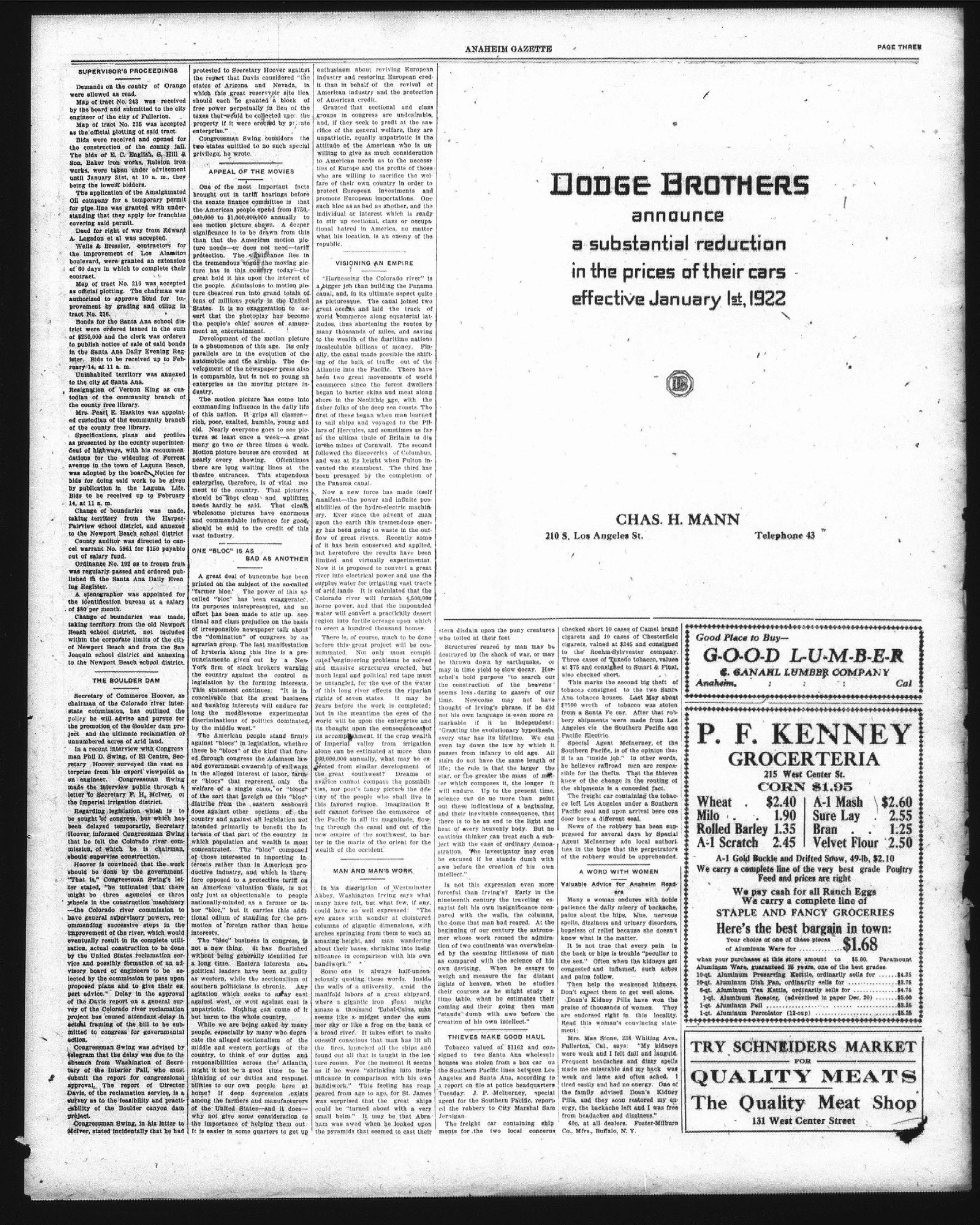
Searchable text
SUPERVISOR'S PROCEEDINGS
Demands on the county of Orange were allowed as read.
Map of tract No. 243 was received by the board and submitted to the city engineer of the city of Fullerton.
Map of tract No. 235 was accepted as the official plotting of said tract.
Bids were received and opened for the construction of the county jail. The bids of E. C. English, S. Hill & Son, Baker iron works, Ralston iron works, were taken under advisement until January 31st, at 10 a.m., they being the lowest bidders.
The application of the Amalgamated Oil company for a temporary permit for pipe line was granted with understanding that they apply for franchise covering said permit.
Deed for right of way from Edward A. Logsdon et al was accepted.
Wells & Bressler, contractors for the improvement of Los Alamitos boulevard, were granted an extension of 60 days in which to complete their contract.
Map of tract No. 216 was accepted as official plotting. The chairman was authorized to approve bond for improvement by grading and oiling in tract No. 216.
Bonds for the Santa Ana school district were ordered issued in the sum of $250,000 and the clerk was ordered to publish notice of sale of said bonds in the Santa Ana Daily Evening Register. Bids to be received up to February 14, at 11 a.m.
Uninhabited territory was annexed to the city of Santa Ana.
Resignation of Vernon King as custodian of the community branch of the county free library.
Mrs. Pearl E. Haskins was appointed custodian of the community branch of the county free library.
Specifications, plans and profiles as presented by the county superintendent of highways, with his recommendations for the widening of Fortress
protested to Secretary Hoover against the report that Davis considered "the states of Arizona and Nevada, in which this great reservoir site lies should each be granted a block of free power perpetually in lieu of the taxes that would be collected upon: the property if it were erected by private enterprise."
Congressman Swing considers the two states entitled to no such special privilege, he wrote.
APPEAL OF THE MOVIES
One of the most important facts brought out in tariff hearings before the senate finance committee is that the American people spend from $750,000,000 to $1,000,000,000 annually to see motion picture shows. A deeper significance is to be drawn from this than that the American motion picture needs—or does not need—tariff protection. The significance lies in the tremendous vogue the moving picture has in this country today—the great hold it has upon the interest of the people. Admissions to motion picture theatres run into grand totals of tens of millions yearly in the United States. It is no exaggeration to assert that the photoplay has become the people's chief source of amusement an entertainment.
Development of the motion picture is a phenomenon of this age. Its only parallels are in the evolution of the automobile and the airship. The development of the newspaper press also is comparable, but is not so young an enterprise as the moving picture industry.
The motion picture has come into commanding influence in the daily life of this nation. It grips all classes—rich, poor, exalted, humble, young and old. Nearly everyone goes to see pictures at least once a week—a great many go two or three times a week. Motion picture houses are crowded at enthusiasm about industry and reservation than in behalf American industry of American creature.
Granted that groups in congress and, if they seek riftice of the general unpatriotic, equal attitude of the willing to give up to American needs of Europe and who are willing fare of their own protect European promote European such bloc as as best individual or intuit to stir up sectional hatred in what his location republic.
VISIONING
"Harnessing this bigger job than canal, and, in its as picturesque great oceans and world commerce itudes, thus show many thousands to the wealth offcalculable billi-ally, the canal ming of the bulk Atlantic into the been two great commerce since began to barter shore in the New fisher folks of the first of these begin to sail ships and lars of Hercules, as the ultima tha in the mines of O followed the discu-
Uninhabited territory was annexed to the city of Santa Ana.
Resignation of Vernon King as custodian of the community branch of the county free library.
Mrs. Pearl E. Haskins was appointed custodian of the community branch of the county free library.
Specifications, plans and profiles as presented by the county superintendent of highways, with his recommendations for the widening of Forrest avenue in the town of Laguna Beach. Was adopted by the board. Notice for bids for doing said work to be given by publication in the Laguna Life. Bids to be received up to February 14, at 11 a.m.
Change of boundaries was made, taking territory from the Harper-Fairview school district, and annexed to the Newport Beach school district.
County auditor was directed to cancel warrant No. 5961 for $150 payable out of salary fund.
Ordinance No. 192 as to frozen fruit was regularly passed and ordered published in the Santa Ana Daily Evening Register.
A stenographer was appointed for the identification bureau at a salary of $80 per month.
Change of boundaries was made, taking territory from the old Newport Beach school district, not included within the corporate limits of the city of Newport Beach and from the San Joaquin school district and annexing to the Newport Beach school district.
THE BOULDER DAM
Secretary of Commerce Hoover, as chairman of the Colorado river interstate commission, has outlined the policy he will advise and pursue for the promotion of the Boulder dam project and the ultimate reclamation of unnumbered acres of arid land.
In a recent interview with Congressman Phil D. Swing, of El Centro, Secretary Hoover surveyed the vast enterprise from his expert viewpoint as an engineer. Congressman Swing made the interview public through a letter to Secretary F. H. McIver, of the Imperial irrigation district.
Regarding legislation which is to be sought of congress, but which has been delayed temporarily, Secretary Hoover informed Congressman Swing that he felt the Colorado river commission, of which he is chairman, should supervise construction.
Hoover is convinced that the work automobile and the airship. The development of the newspaper press also is comparable, but is not so young an enterprise as the moving picture industry.
The motion picture has come into commanding influence in the daily life of this nation. It grips all classes—rich, poor, exalted, humble, young and old. Nearly everyone goes to see pictures at least once a week—a great many go two or three times a week. Motion picture houses are crowded at nearly every showing. Ofentimes there are long waiting lines at the theatre entrances. This stupendous enterprise, therefore, is of vital moment to the country. That pictures should be kept clean and uplifting needs hardly be said. That clean, wholesome pictures have enormous and commendable influence for good; should be said to the credit of this vast industry.
ONE "BLOC" IS AS BAD AS ANOTHER
A great deal of buncombe has been printed on the subject of the so-called "farmer bloc." The power of this so-called "bloc" has been exaggerated its purposes misrepresented, and an effort has been made to stir up sectional and class prejudice on the basis of irresponsible newspaper talk about the "domination" of congress by an agrarian group. The last manifestation of hysteria along this line is a pronunciation given out by a New York firm of stock brokers warning the country against the control on legislation by the farming interests. This statement continues: "It is inconceivable that the great business and banking interests will endure for long the meddlesome experimental discriminations of politics dominated by the middle west."
The American people stand firmly against "blocs" in legislation, whether these be "blocs" of the kind that foredough congress the Adamson law and government ownership of railways in the alleged interest of labor, farmer "blocs" that represent only the welfare of a single class, or "blocs" of the sort that invigilate as this "bloc" diatribe from the eastern seaboard does against other sections of the country and against all legislation not intended primarily to benefit the interests of that part of the country in which population and wealth is most concentrated. The "bloc" composed of those interested in importing interests rather than in American pro-
Now it is proposed river into electric surplus water formed of arid lands. Its Colorado river will horse power, and water will convert region into fertile to erect a hundred.
There is, of course before this great summated. Not cated engineering, and massive strung much legal and priced untangled, for of this long river rights of seven years before they but in the meant world will be up its thought upon its accomplishment of imperial valle alone can be est $60,000,000 annually subjected from simi great south avarice cannot cities, nor poet's tiny of the people this favored regia self cannot forests the Pacific in all ing through the new empire of ter in the marts wealth of the occ
terprise from his expert viewpoint as an engineer. Congressman Swing made the interview public through a letter to Secretary F. H. McIver, of the Imperial irrigation district.
Regarding legislation which is to be sought of congress, but which has been delayed temporarily, Secretary Hoover, informed Congressman Swing that he felt the Colorado river commission, of which he is chairman, should supervise construction.
Hoover is convinced that the work should be done by the government "That is," Congressman Swing's letter stated, "he intimated that there might be three agencies or three wheels in the construction machinery—the Colorado river commission to have general supervisory powers, recommending successive steps in the improvement of the river, which would eventually result in its complete utilization, actual construction to be done by the United States reclamation service and possibly formation of an advisory board of engineers to be selected by the commission to pass upon proposed plans and to give their expert advice." Delay in the approval of the Davis report on a general survey of the Colorado river reclamation project has caused attendant delay in actual framing of the bill to be submitted to congress for governmental action.
Congressman Swing was advised by telegram that the delay was due to the absence from Washington of Secretary of the Interior Fall, who must submit the report for congressional approval. The report of Director Davis, of the reclamation service, is a survey as to the feasibility and practicability of the Boulder canyon dam project.
Congressman Swing, in his letter to McIver, stated incidentally that he had in the alleged interest of labor, farmer "blocs" that represent only the welfare of a single class, or "blocs" of the sort that invigilate as this "bloc" dislattice from the eastern seaboard does against other sections of the country and against all legislation not intended primarily to benefit the interests of that part of the country in which population and wealth is most concentrated. The "bloc" composed of those interested in importing interests rather than in American productive industry, and which is therefore opposed to a protective tariff on an American valuation basis, is not only just as objectionable to people nationally-minded as a farmer or labor "bloc," but it carries this additional odium of standing for the promotion of foreign rather than home interests.
The "bloc" business in congress, is not a new thing. It has flourished without being generally identified for a long time. Eastern interests and political leaders have been as guilty as western, while the sectionalism of southern politicians is chronic. Any agitation which seeks to array east against west, or west against east is unpatriotic. Nothing can come of it but harm to the whole country.
While we are being asked by many people, especially by many who deprecate the alleged sectionalism of the middle and western portions of the country, to think of our duties and responsibilities across the Atlantic, might it not be a good time to be thinking of our duties and responsibilities to our own people here at home? If deep depression exists among the farmers and manufacturers of the United States—and it does—why not give some consideration to the importance of helping them out? It is easier in some quarters to get up in the alleged interest of labor, farmer "blocs" that represent only the welfare of a single class, or "blocs" of the sort that invigilate as this "bloc" dislattice from the eastern seaboard does against other sections of the country and against all legislation not intended primarily to benefit the interests of that part of the country in which population and wealth is most concentrated. The "bloc" composed of those interested in importing interests rather than in American productive industry, and which is therefore opposed to a protective tariff on an American valuation basis, is not only just as objectionable to people nationally-minded as a farmer or labor "bloc," but it carries this additional odium of standing for the promotion of foreign rather than home interests.
The "bloc" business in congress, is not a new thing. It has flourished without being generally identified for a long time. Eastern interests and political leaders have been as guilty as western, while the sectionalism of southern politicians is chronic. Any agitation which seeks to array east against west, or west against east is unpatriotic. Nothing can come of it but harm to the whole country.
While we are being asked by many people, especially by many who deprecate the alleged sectionalism of the middle and western portions of the country, to think of our duties and responsibilities across the Atlantic, might it not be a good time to be thinking of our duties and responsibilities to our own people here at home? If deep depression exists among the farmers and manufacturers of the United States—and it does—why not give some consideration to the importance of helping them out? It is easier in some quarters to get up in the alleged interest of labor, farmer "blocs" that represent only the welfare of a single class, or "blocs" of the sort that invigilate as this "bloc" dislattice from the eastern seaboard does against other sections of the country and against all legislation not intended primarily to benefit the interests of that part of the country in which population and wealth is most concentrated. The "bloc" composed of those interested in importing interests rather than in American productive industry, and which is therefore opposed to a protective tariff on an American valuation basis, is not only just as objectionable to people nationally-minded as a farmer or labor "bloc," but it carries this additional odium of standing for the promotion of foreign rather than home interests.
The "bloc" business in congress, is not a new thing. It has flourished without being generally identified for a long time. Eastern interests and political leaders have been as guilty as western, while the sectionalism of southern politicians is chronic. Any agitation which seeks to array east against west, or west against east is unpatriotic. Nothing can come of it but harm to the whole country.
While we are being asked by many people, especially by many who deprecate the alleged sectionalism of the middle and western portions of the country, to think of our duties and responsibilities across the Atlantic, might it not be a good time to be thinking of our duties and responsibilities to our own people here at home? If deep depression exists among the farmers and manufacturers of the United States—and it does—why not give some consideration to the importance of helping them out? It is easier in some quarters to get up in the alleged interest of labor, farmer "blocs" that represent only the welfare of a single class, or "blocs" of the sort that invigilate as this "bloc" dislattice from the eastern seaboard does against other sections of the country and against all legislation not intended primarily to benefit the interests of that part of the country in which population and wealth is most concentrated. The "bloc" composed of those interested in importing interests rather than in American productive industry, and which is therefore opposed to a protective tariff on an American valuation basis, is not only just as objectionable to people nationally-minded as a farmer or labor "bloc," but it carries this additional odium of standing for the promotion of foreign rather than home interests.
In his discipline Abbey, Washington many have felt, could have so well eye gazes with columns of gigantic arches springing amazing height, about their bases nificance in comp handiwork."
Some one is seriously quoting: "the walls of a u manifold labors where a gigantic amaze a thousand seems like a mi mer sky or like a broad river. It oneself conscious tha fires, launch found out all tha ture rooms. For as if he were 'mificence in com handiwork.' Tha peared from age was surprised tha could be 'turned small helm.' It ham was awed wi th the pyramids tha..."
ANAHEIM GAZETTE
against "the
da, in
state lies,
ock of
of the
apo: the
private
verses the
special
facts before
that
am $750,
fully to
deeper from this
on pictariff
lies in
ing picay—the
rest of
lon pictotals of
United
to asbecome
amusepicture
its only
of the
the decess also
duing an
ature in
one into
family life
passes—
ing and
three picgreat
week.
ed at
enthusiasm about reviving European industry and restoring European credit than in behalf of the revival of American industry and the protection of American credit.
Granted that sectional and class groups in congress are undesirable, and, if they seek to profit at the sacrifice of the general welfare, they are unpatriotic, equally unpatriotic is the attitude of the American who is unwilling to give as much consideration to American needs as to the necessities of Europe and the profits of those who are willing to sacrifice the welfare of their own country in order to protect European investments and promote European importations. One such bloc as as bad as another, and the individual or interest which is ready to stir up sectional, class or occupational hatred in America, no matter what his location, is an enemy of the republic.
VISIONING AN EMPIRE
"Harnessing the Colorado river" is a bigger job than building the Panama canal, and, in its ultimate aspect quite as picturesque. The canal joined two great oceans and laid the track of world commerce along equatorial latitudes, thus shortening the routes by many thousands of miles, and saving to the wealth of the maritime nations incalculable billions of money. Finally, the canal made possible the shifting of the bulk of traffic out of the Atlantic into the Pacific. There have been two great movements of world commerce since the forest dwellers began to barter skins and meat along shore in the Neolithic age, with the fisher folks of the deep sea coasts. The first of these began when man learned to sail ships and voyaged to the Pillars of Hercules, and sometimes as far as the ultima thule of Britain to dig in the mines of Cornwall. The second followed the discoveries of Columbus.
CHAS. H. M.
210 S. Los Angeles St.
ing of the bulk of traffic out of the Atlantic into the Pacific. There have been two great movements of world commerce since the forest dwellers began to barter skins and meat along shore in the Neolithic age, with the fisher folks of the deep sea coasts. The first of these began when man learned to sail ships and voyaged to the Pillars of Hercules, and sometimes as far as the ultima thule of Britain to dig in the mines of Cornwall. The second followed the discoveries of Columbus, and was at its height when Fulton invented the steamboat. The third has been presaged by the completion of the Panama canal.
Now a new force has made itself manifest—the power and infinite possibilities of the hydro-electric machinery. Ever since the advent of man upon the earth this tremendous energy has been going to waste in the outflow of great rivers. Recently some of it has been conserved and applied, but heretofore the results have been limited and virtually experimental. Now it is proposed to convert a great river into electrical power and use the surplus water for irrigating vast tracts of arid lands. It is calculated that the Colorado river will furnish 4,500,000 horse power, and that the impounded water will convert a practically desert region into fertile acreage upon which to erect a hundred thousand homes.
There is, of course, much to be done before this great project will be committed. Not only must complicated engineering problems be solved and massive structures erected, but much legal and political red tape must be untangled, for the use of the water of this long river effects the riparian rights of seven states. It may be years before the work is completed; but in the meantime the eyes of the world will be upon the enterprise and its thought upon the consequences of its accomplishment. If the crop wealth of Imperial valley from irrigation alone can be estimated at more than $60,000,000 annually, what may be expected from similar development of the great southwest? Dreams of avarice cannot compass the possibilities, nor poet's fancy picture the destiny of the people who shall live in this favored region. Imagination itself cannot foresee the commerce of the Pacific in all its magnitude, flowing through the canal and out of the new empire of the southwest, to barter in the marts of the orient for the wealth of the occident.
stern disdain upon the puny creatures who toiled at their feet.
Structures reared by man may be destroyed by (the shock of war, or may be thrown down by earthquake, or may in time yield to slow decay. Herschel's bold purpose "to search out the construction of the heavens" seems less-daring to gazers of our time. Newcome may not have thought of Irving's phrase, if he did not his own language is even more remarkable if it be independent: "Granting the evolutionary hypothesis, every star has its lifetime. We can even lay down the law by which it passes from infancy to old age. All stars do not have the same length of life; the rule is that the larger the star, or the greater the mass of matter which composes it, the longer it will endure. Up to the present time, science can do no more than point out these indications of a beginning, and their inevitable consequence, that there is to be an end to the light and heat of every heavenly body. But no cautious thinker can treat such a subject with ease of ordinary demonstration. The investigator may even be excused if he stands dumb with checked short 10 cases of Camel brand cigarets and 10 cases of Chesterfield cigarets, valued at $345 and consigned to the Roehm-Sylvvester company. Three cases of Tuxedo tobacco, values at $75 and consigned to Smart & Final, also checked short.
This marks the second theft of tobacco consigned to the two Santa Ana tobacco houses. Last May about $950 worth of tobacco was stolen from a Santa Fe car. After that robbery shipments were made from Los Angeles via the Southern Pacific and Pacific Electric.
Special Agent McInnerney, of the Southern Pacific, is of the opinion that it is an "inside job." In other words, he believes railroad men are responsible for the thefts. That the thieves knew of the change in the routing of the shipments is a conceded fact.
The freight car containing tobacco left Los Angeles under a Southern Pacific seal and upon arrival here one door bore a different seal.
News of the robbery has been suppressed for several days by Special Agent McInnerney adn local authorities in the hope that the perpetrators of the robbery would be apprehended.
MAN AND MAN'S WORK
In his description of Westminster Abbey, Washington Irving says what many have felt, but what few, if any, could have so well expressed: "The eye gazes with wonder at cloistered columns of glgantic dimensions, with arches springing from them to such an amazing height, and man wandering about their bases, shrinking into insignificance in comparison with his own handiwork."
Some one is always half-unconsciously quoting these words. Inside the walls of a university, amid the manifold labors of a great shipyard, where a gigantic iron plant might amaze a thousand Tubal-Cains, man seems like a midget under the summer sky or like a frog on the bank of a broad river. It takes effort to make oneself conscious that man has lit all the fires, launched all the ships and found out all that is taught in the lecture rooms. For the moment it seems as if he were "shrinking into insignificance in comparison with his own handiwork." This feeling has reappeared from age to age, for St. James was surprised that the great ships could be "turned about with a very small helm." It may be that Abraham was awed when he looked upon the pyramids that seemed to cast their star, or the greater the mass of matter which composes it, the longer it will endure. Up to the present time, science can do no more than point out these indications of a beginning, and their inevitable consequence, that there is to be an end to the light and heat of every heavenly body. But no cautious thinker can treat such a subject with the ease of ordinary demonstration. The investigator may even be excused if he stands dumb with awe before the creation of his own intellect."
Is not this expression even more forceful than Irving's? Early in the nineteenth century the traveling essayist felt his own insignificance compared with the walls, the columns, the dome that man had reared. At the beginning of our century the astronomer whose work roused the admiration of two continents was overwhelmed by the seeming littleness of man as compared with the science of his own devising. When he essays to weigh and measure the far distant lights of heaven, when he studies their courses as he might study a time table, when he estimates their coming and their going then man "stands dumb with awe before the creation of his own intellect."
THIEVES MAKE GOOD HAUL
Tobacco valued at $1162 and consigned to two Santa Ana wholesale houses was stolen from a box car on the Southern Pacific lines between Los Angeles and Santa Ana, according to a report on file at police headquarters Tuesday. J. P. McInerney, special agent for the Southern Pacific, reported the robbery to City Marshal Sam Jernigan.
The freight car containing shipments for the two local concernsible for the thefts. That the thieves knew of the change in the routing of the shipments is a conceded fact.
The freight car containing the tobacco left Los Angeles under a Southern Pacific seal and upon arrival here one door bore a different seal.
News of the robbery has been suppressed for several days by Special Agent McInerney adn local authorities in the hope that the perpetrators of the robbery would be apprehended.
A WORD WITH WOMEN
Valuable Advice for Anaheim Readers
Many a woman endures with noble patience the daily misery of backache, pains about the hips, blue, nervous spells, dizziness and urinary disorders, hopeless of relief because she doesn't know what is the matter.
It is not true that every pain in the back or hips is trouble "peculiar to the sex." Often when the kidneys get congested and inflamed, such aches and pains follow.
Then help the weakened kidneys. Don't expect them to get well alone. Doan's Kidney Pills have won the praise of thousands of women. They are endorsed right in this locality. Read this woman's convincing statement:
Mrs. Mae Stone, 238 Whiting Ave., Fullerton, Cal., says: "My kidneys were weak and I felt dull and languid. Frequent headaches and dizzy spells made me miserable and my back was weak and lame and often ached. I tired easily and had no energy. One of the family advised Doan's Kidney Pills, and they soon restored my energy, the backache left and I was free from headaches and dizziness."
60c, at all dealers. Foster-Milburn Co., Mfrs., Buffalo, N. Y.
AGE BROTHERS
announce
contantial reduction
the prices of their cars
active January 1st, 1922
CHAS. H. MANN
eles St. Telephone 43
Good Place to Buy—
G-O-O-D L-U-M-B-E-R
C. GANAHL LUMBER COMPANY
Anaheim. Cal
P. F. KENNEY
GROCERTERIA
215 West Center St.
CORN $1.95
Wheat . $2.40 A-1 Mash $2.60
Milo . 1.90 Sure Lay 2.55
Rolled Barley 1.35 Bran . 1.25
A-1 Scratch 2.45 Velvet Flour 2.50
A-1 Gold Buckle and Drifted Snow, 49-lb, $2.10
215 West Center St.
CORN $1.95
Wheat $2.40 | A-1 Mash $2.60
Milo 1.90 | Sure Lay 2.55
Rolled Barley 1.35 | Bran 1.25
A-1 Scratch 2.45 | Velvet Flour 2.50
A-1 Gold Buckle and Drifted Snow, 49-lb, $2.10
We carry a complete line of the very best grade Poultry
Feed and prices are right
We pay cash for all Ranch Eggs
We carry a complete line of
STAPLE AND FANCY GROCERIES
Here’s the best bargain in town:
Your choice of one of these pieces
of Aluminum Ware for ... $1.68
when your purchases at this store amount to $5.00. Paramount
Aluminum Ware, guaranteed 25 years, one of the best grades.
10-qt. Aluminum Preserving Kettle, ordinarily sells for ... $4.35
10-qt. Aluminum Dish Pan, ordinarily sells for ... $3.75
6-qt. Aluminum Tea Kettle, ordinarily sells for ... $4.75
1-qt. Aluminum Roaster, (advertised in paper Dec. 20) ... $5.00
1-qt. Aluminum Pail ... $3.25
1-qt. Aluminum Percolator (12-cup) ... $5.25
TRY SCHNEIDERS MARKET
FOR
QUALITY MEATS
The Quality Meat Shop
131 West Center Street